In a community college auto welding program, you learn how to work safely around heat, sparks, fumes, electricity, and sharp metal while building the hands-on skills used in repair and fabrication shops. Most programs start with safety, PPE, machine setup, basic metallurgy, cutting, and simple joints before moving into MIG, TIG, stick, and flux core welding. You may practice on coupons first, then move into real-world projects such as brackets, exhaust sections, panels, and structural mockups.
Quick Answer
A community college auto welding program usually covers shop safety, PPE, cutting, metal preparation, blueprint reading, measuring, MIG, TIG, stick, and flux core welding. You should expect more lab time than lecture time, steady practice on joints and weld positions, and training that can lead to entry-level repair, fabrication, manufacturing, or welding helper jobs.
Key Takeaways
- Most programs begin with safety, PPE, shop rules, cutting, metal prep, and equipment setup before advanced welding work.
- MIG is especially common in automotive repair, but TIG, stick, and flux core help you handle more materials and job settings.
- Expect repeated practice on lap joints, butt joints, T-joints, fillet welds, tack welds, and weld inspection.
- Costs vary by college, but you may pay for tuition, lab fees, PPE, consumables, textbooks, and a small tool kit.
- A strong program should connect training to certifications, employer weld tests, internships, apprenticeships, or local shop partnerships.
At a Glance
| Time Required | Varies by school: short workforce certificates may take a few months, while associate degree paths often take about two years. |
| Difficulty | Beginner-friendly, but physically demanding. You need patience, steady hand control, and a strong safety mindset. |
| Tools Needed | Welding helmet, safety glasses, gloves, jacket, boots, measuring tools, clamps, wire brush, chipping hammer, and school-provided welding machines. |
| Cost | Varies by college and residency status. Check tuition, lab fees, books, PPE, consumables, certification testing fees, and tool rental or purchase requirements. |
What a Community College Auto Welding Program Covers
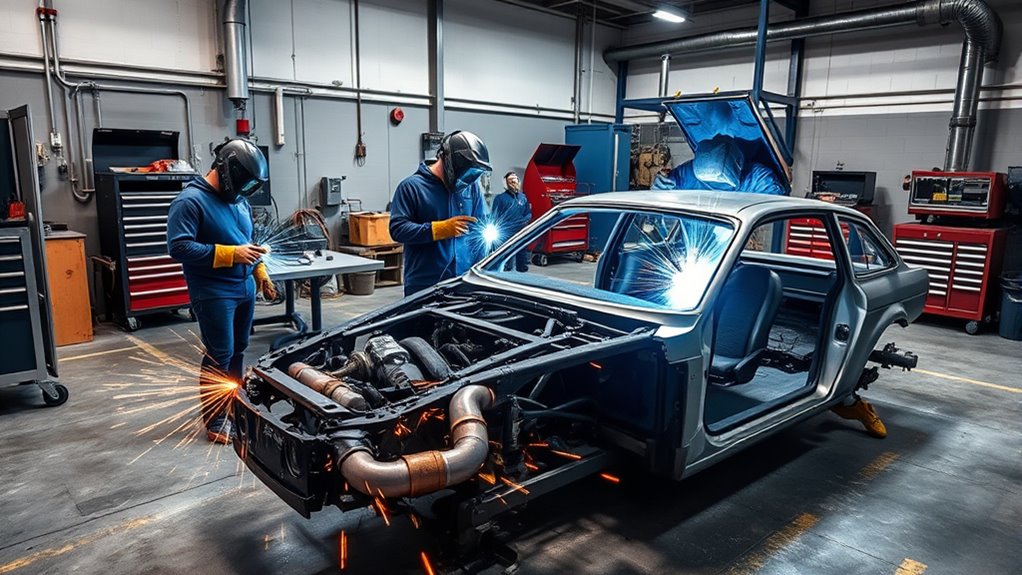
A community college auto welding program usually combines classroom instruction with repeated shop practice. In class, you learn welding terms, safety rules, weld symbols, basic metallurgy, blueprint reading, and how heat changes metal. In the lab, you set up machines, prepare joints, strike arcs, adjust settings, and inspect your results.
The first goal is not speed. It is control. You learn how to clean metal, fit two pieces together, tack them in place, set amperage or wire speed, control travel angle, and avoid defects such as porosity, undercut, burn-through, lack of fusion, and excessive spatter.
Most programs introduce several welding processes. You may start with oxy-fuel cutting and basic arc welding, then move into MIG welding, TIG welding, stick welding, and flux core welding. The exact order depends on the college, but the pattern is usually the same: learn safety first, build hand control next, then apply those skills to more realistic projects.
You may also study how welding fits into automotive service, collision repair, fabrication, and manufacturing. That matters because automotive welding is not only about making a bead. It also involves thin metal control, fit-up, corrosion protection, panel alignment, structural limits, and following the correct repair procedure for the vehicle.
A good welding program teaches you to set up the job, control heat, inspect the weld, and explain why the weld is acceptable, not just run a bead that looks clean.
Admissions and Prerequisites
Most entry-level community college welding programs do not expect you to arrive with welding experience. You usually need to meet the college’s normal admission requirements, which may include a high school diploma, GED, placement testing, orientation, or advisor approval.
Some programs also require basic math or reading readiness because welding uses measurements, fractions, decimals, angles, and blueprint notes. Courses in shop math, mechanical drawing, electricity, and blueprint reading can help, but many beginner programs teach those skills as part of the sequence.
You should also be ready for the physical side of the trade. Welding labs may involve standing for long periods, wearing protective gear, grinding metal, lifting parts, working near heat, and keeping steady body position while you weld. If you have breathing, vision, hearing, or mobility concerns, talk with the college before enrolling so you understand lab requirements and available accommodations.
What You’ll Learn in the Shop
In the shop, you learn the habits that working welders use every day: inspect the area, choose PPE, prepare the metal, set up the machine, weld a test piece, check the result, and adjust before doing the final weld. These steps are especially important in automotive work because thin panels, brackets, and exhaust tubing can warp or burn through quickly.
Common shop skills include:
- Cleaning rust, paint, oil, coatings, and mill scale before welding.
- Using clamps, magnets, squares, and fixtures to hold parts in alignment.
- Reading simple blueprints, weld symbols, and repair notes.
- Measuring parts with tape measures, rulers, squares, calipers, and gauges.
- Making tack welds to control fit-up before the final weld.
- Running lap joints, butt joints, T-joints, corner joints, and fillet welds.
- Inspecting welds for cracks, porosity, undercut, overlap, and poor penetration.
- Grinding, brushing, chipping slag, and preparing welded parts for finishing.
The job tasks match what employers expect. The O*NET profile for welders, cutters, solderers, and brazers lists safety habits, measuring, blueprint use, equipment setup, welding in different positions, surface preparation, alignment, and equipment operation as common welding tasks.
Shop Safety Basics
Shop safety starts before you strike an arc. You learn how to inspect your station, check cables and leads, confirm ventilation, remove fire hazards, and make sure the right extinguisher or fire-control equipment is available. You also learn how to protect your eyes, skin, lungs, hearing, and hands.
Basic welding PPE often includes a properly rated welding helmet, safety glasses, welding gloves, flame-resistant jacket or sleeves, long pants, leather boots, and hearing protection when grinding or cutting. Some tasks may also require a respirator or local exhaust ventilation, depending on the material, coating, and shop policy.
Warning: Welding can expose you to intense light, hot metal, fumes, gases, sparks, and fire hazards. Follow your instructor’s safety rules, use the required PPE, and do not weld on coated, unknown, pressurized, or fuel-contaminated parts unless the work has been properly identified, cleaned, ventilated, and approved.
Safety is not just a school rule. OSHA’s welding, cutting, and brazing guidance points to specific standards for welding work, and OSHA’s general welding requirements include fire prevention steps such as moving fire hazards, guarding combustibles, and keeping suitable extinguishing equipment ready for use.
Hands-On Welding Techniques
Once you understand shop safety, you move into hands-on welding. Instructors often begin with simple practice coupons because they let you repeat the same skill until your bead shape, travel speed, work angle, and heat control improve.
You may practice flat welds first, then horizontal, vertical, and overhead positions as your control improves. You will learn how puddle size, travel speed, stickout, electrode angle, wire feed speed, voltage, amperage, and gas flow affect the final weld.
In automotive labs, you may also practice plug welds, stitch welds, tack weld spacing, patch panels, brackets, and exhaust joints. When working on thin sheet metal, the main challenge is controlling heat. Too much heat can warp the panel or burn through it. Too little heat can leave a weak weld with poor fusion.
Tools and Equipment
The shop floor introduces you to the tools you will use in training and in entry-level work. You may use MIG welders, TIG welders, stick welders, flux core machines, oxy-fuel equipment, plasma cutters, grinders, clamps, welding tables, vises, squares, magnets, and measuring tools.
You also learn tool care. Clean contact tips, correct shielding gas flow, tight work clamps, sound cables, dry electrodes, and properly stored filler metals all affect weld quality. A strong program teaches you to diagnose problems instead of blaming the machine every time a weld looks wrong.
Pro Tip: Keep a small notebook during lab. Write down material thickness, process, filler metal, voltage, wire speed, amperage, gas, position, and what changed after each adjustment. Those notes help you learn faster than guessing from memory.
Which Welding Processes You’ll Learn First
The exact class order depends on the school, but many programs start with cutting, safety, and basic arc welding before moving into more specialized processes. You may see the processes listed by their formal names: SMAW for stick welding, GMAW for MIG welding, GTAW for TIG welding, and FCAW for flux core welding.
Safety and Basic Setup
Before welding, you learn how to set up the work area and prepare the metal. That includes choosing PPE, checking the machine, connecting the work clamp, selecting the correct filler metal, setting gas flow if needed, cleaning the joint, and confirming the part is safe to weld.
| Step | Focus | Outcome |
|---|---|---|
| PPE check | Helmet, gloves, clothing, eye protection | Reduced exposure |
| Tool setup | Leads, torches, clamps, gas, filler metal | Stable operation |
| Metal prep | Clean surfaces, bevels, gaps, fit-up | Stronger joints |
| Test weld | Practice coupon and inspection | Better final settings |
You may also study basic metallurgy so you understand how heat affects steel, stainless steel, aluminum, and coated metals. Even at the beginner level, this matters because different metals respond differently to heat and contamination.
Stick Before Specialties
Some programs introduce stick welding early because it builds strong fundamentals. Stick welding teaches arc length, puddle control, slag removal, electrode angle, and travel speed. It also gives direct feedback because poor movement, wrong amperage, or bad arc length shows up quickly in the bead.
Skills you build with stick welding include:
- Striking and maintaining an arc.
- Reading puddle shape and heat input.
- Controlling electrode angle and travel speed.
- Cleaning slag and inspecting the weld surface.
- Understanding how electrode type affects the weld.
Even if you plan to work mostly on cars, stick welding helps you understand weld behavior. That foundation makes it easier to learn MIG, TIG, and flux core later.
MIG and Flux Core
MIG and flux core often appear early because they are common in repair, fabrication, and production work. MIG welding is widely used because it can be fast, clean, and easier to learn than some other processes. In automotive work, MIG is common for mild steel sheet metal, brackets, and general repair practice.
Flux core welding uses a tubular wire with flux inside. Some flux core wires are self-shielded, which means they do not need external shielding gas. That can make them useful outdoors or in drafty conditions where wind may disturb shielding gas. Other flux core wires do use shielding gas and are common in heavier fabrication.
You may also learn flux core MIG welding settings so you understand how voltage, wire speed, polarity, and material thickness affect the weld.
TIG Welding and Thin Metal Control
TIG welding usually requires more coordination because you control the torch, filler rod, and heat input separately. It is slower than MIG, but it gives excellent control on thin material, stainless steel, and aluminum when the setup is correct.
In an auto-focused program, TIG may be used for aluminum parts, stainless exhaust sections, custom brackets, and precision work. It is not always the first process you learn, but it is valuable if you want to move into custom fabrication, motorsports, restoration, or higher-skill repair work.
Community College Auto Welding Class Sequence
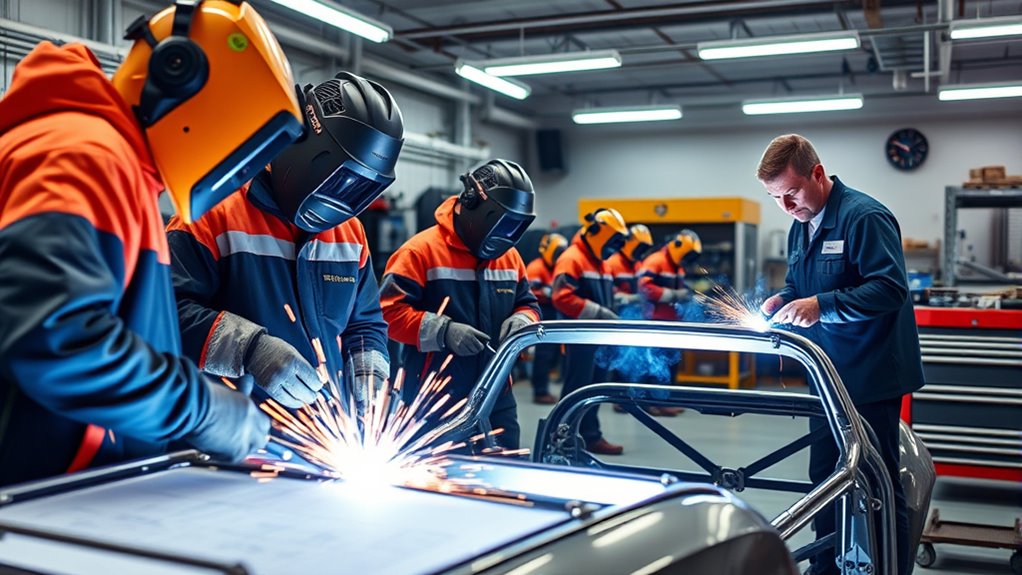
A typical sequence moves from basic safety and process control to more advanced fabrication and repair work. A short certificate may focus mainly on shop skills and employability. An associate degree may add general education, math, communications, blueprint reading, fabrication, inspection, and related automotive or manufacturing courses.
A common path looks like this:
- Early courses: safety, PPE, shop rules, cutting, metal prep, basic welding terms, and simple joints.
- First lab sequence: stick welding, MIG welding, flux core, joint fit-up, and weld inspection.
- Intermediate courses: TIG welding, blueprint reading, fabrication layout, metallurgy, and more weld positions.
- Auto-focused work: sheet metal repair, brackets, exhaust sections, panel fit-up, and heat control.
- Final courses or capstone: larger projects, certification preparation, production-style work, or employer-style weld tests.
Prerequisites may control when you can take advanced courses. That is a good thing. Welding skill builds in layers, and advanced labs are safer and more useful when you already know setup, PPE, joint preparation, and basic inspection.
Note: Do not judge a program only by the number of processes listed in the catalog. A program with more supervised shop hours, better equipment, and stronger instructor feedback may prepare you better than a longer list of rushed topics.
Automotive Welding Projects That Build Real Experience
Real experience comes from projects that force you to plan, fit, weld, and inspect the work. Early projects may use flat coupons. Later projects may use heavier plate, tubing, brackets, mock frames, exhaust pieces, or sheet metal patches.
| Project | Skill Focus | Outcome |
|---|---|---|
| Frame or bracket mockup | Alignment, fit-up, tack welds | Better structural accuracy |
| Panel patch | Heat control and stitch welding | Cleaner fit with less warping |
| Exhaust section | Tubing prep and joint consistency | Functional, leak-resistant practice |
| Fabricated bracket | Layout, cutting, drilling, welding | Practical fabrication confidence |
Automotive welding also teaches limits. On modern vehicles, you cannot assume every part should be welded just because it is metal. High-strength steels, aluminum structures, crumple zones, sensors, corrosion protection, and manufacturer repair procedures all affect what repair method is allowed.
For that reason, a good program should teach the difference between practice welding in a lab and approved vehicle repair in the field. When a real customer vehicle is involved, repair decisions should follow the correct OEM service information, shop policy, and instructor approval.
If you want to build more background before class, review how to weld sheet metal on a car so you understand why thin automotive metal requires short welds, clean prep, and careful cooling.
Auto Welding Tools and Program Costs
Costs vary widely by state, college, residency status, course load, and whether you choose a certificate or associate degree. Do not rely only on the tuition number. Ask for the full estimated cost before you enroll.
Common expenses include:
- Tuition and registration fees.
- Lab fees or shop fees.
- Welding helmet, gloves, jacket, boots, and safety glasses.
- Books, digital materials, or online course access.
- Consumables such as electrodes, wire, filler rod, coupons, and grinding discs.
- Measuring tools, clamps, chipping hammer, wire brush, or basic hand tools.
- Certification testing fees, if testing is offered separately.
Some colleges provide welding machines, booths, gas, tables, and major equipment. Some rent tool kits. Others require you to buy your own PPE before the first lab. Ask for the official tool list, not a guess from another student, because requirements can change each semester.
Products Worth Considering

Long lasting quality

Crafted with precision, our steel plates are laser-cut, offering unparalleled edge smoothness and dimensional accuracy compared to stamped and sheared parts.

●High carbon steel chipping hammer,heat treated,10-1/2-Inch overall length.1-1/16" width chisel to remove welding slag faster,●Leather welding gloves are heat and flame resistant,have a comfortable cotton lining,fully welted seams,and lock-stitch construction
Certifications and Credentials You May Prepare For
A college certificate and a welding certification are not always the same thing. A college certificate shows that you completed a school program. A welding certification usually means you passed a performance test under a specific code, process, material, position, and procedure.
The AWS Certified Welder Program is performance-based. AWS states that there are no prerequisite courses or certifications for the Certified Welder test, and candidates test at AWS Accredited Testing Facilities. That means a community college program can prepare you, but you still need to pass the actual test required for the credential or employer.
Employers may also give their own weld tests. A shop test might ask you to weld a fillet, butt joint, pipe, tubing, sheet metal, or a position that matches the job. For auto body and collision repair, shops may also care about OEM procedures, squeeze-type resistance spot welding, MIG brazing, aluminum repair, and industry-specific training.
Before choosing a program, ask these questions:
- Does the program prepare students for AWS testing or local employer weld tests?
- Is there an AWS Accredited Testing Facility nearby?
- Are certification fees included or separate?
- Which processes and positions can students practice before testing?
- Do local employers recognize the program?
How to Compare Welding Programs
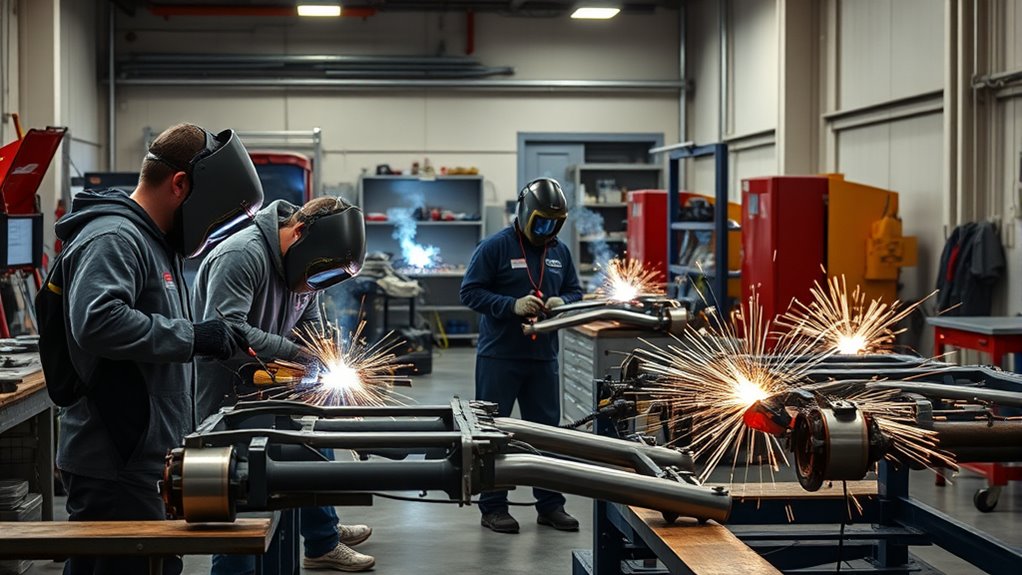
When you compare welding programs, start with the basics: accreditation, cost, schedule, lab access, instructor experience, safety standards, and job placement support. A program should fit your budget and schedule, but it should also give you enough booth time to build real skill.
Use this checklist before enrolling:
- Accreditation: Confirm the college is properly accredited and eligible for the aid or transfer path you need.
- Shop hours: Ask how many lab hours you get each week and how much time is supervised.
- Process coverage: Look for MIG, TIG, stick, flux core, cutting, blueprint reading, and inspection.
- Automotive relevance: Ask whether projects include sheet metal, exhaust, brackets, and repair-style fit-up.
- Equipment quality: Tour the lab if possible and look at booths, ventilation, machines, tables, and safety controls.
- Instructor background: Ask about field experience, certifications, and employer connections.
- Credentials: Find out whether the program prepares you for AWS testing, employer weld tests, or other industry credentials.
- Career support: Ask about internships, apprenticeships, employer visits, and job placement help.
Also ask about schedule flexibility. Many community colleges offer day, evening, or part-time options because welding students often balance school with work and family responsibilities.
Products Worth Considering

🔧 Upgraded Soldering Kit - The 90W 110V soldering iron uses a high-power advanced ceramic heating core, which heats up quickly within 20 seconds, allowing you to work faster. And our digital soldering iron has a non-slip silicone sheath, which is soft and comfortable to handle, allowing you to avoid scalding during operation

Unleashing Your Creativity: crafted meticulously from sturdy, solid low carbon steel, the kit allows you to assemble and weld into an aesthetic deer head fulfilling your passion for welding; Experience magical artistry with your style creation, truly making this kit an emblem of your welding skills

Fun and Functional Cat Design: turn practice into art! This welding practice kit lets you craft a charming 3D cat sculpture; Once completed, it serves as an ideal desk decor piece or handmade gift, ideal for Father's Day, birthdays, and holiday gifting for welding enthusiasts and cat lovers alike
Jobs and Next Steps After Graduation
After graduation, your first role may be a welding helper, fabrication assistant, production welder, automotive repair assistant, exhaust technician, maintenance helper, or entry-level shop welder. Many employers still train new hires on their equipment and procedures, so your goal is to leave school with safe habits, clean basic welds, and the ability to keep learning.
The U.S. Bureau of Labor Statistics lists welders, cutters, solderers, and brazers as workers who join, repair, or cut metal parts and products. BLS also notes that employers often prefer or require technical training, which may be available through community colleges, vocational-technical schools, and similar programs.
BLS reported a $51,000 median annual wage for welders, cutters, solderers, and brazers in May 2024, with about 45,600 projected openings per year from 2024 to 2034.
Those numbers do not guarantee your pay. Entry-level wages depend on location, industry, shift, skill level, certifications, overtime, and whether the job is automotive, manufacturing, construction, structural, pipeline, shipyard, or repair work. Higher pay usually comes with stronger skills, harder conditions, travel, overtime, specialized materials, inspection duties, or advanced certifications.
To keep moving after graduation, build a simple portfolio. Include photos of projects, process notes, bend-test results if available, certifications, instructor references, and a list of machines and materials you have used. That gives employers more than a résumé. It shows how you work.
Is an Auto Welding Program Right for You?
An auto welding program may be a good fit if you like hands-on work, problem-solving, tools, vehicles, and visible progress. It also fits people who prefer a skill-based path over a desk-only career. You do not need to be perfect at first. You need patience, safe habits, and a willingness to practice the same movement until it improves.
It may not be the right fit if you dislike heat, noise, protective gear, fumes, standing, grinding, or repetitive practice. Welding can be rewarding, but it is still shop work. The best way to decide is to tour the lab, talk with an instructor, ask about beginner expectations, and watch a class if the college allows it.
Frequently Asked Questions
Can you make $100,000 as a welder?
Yes, some welders can reach $100,000, but it is not typical entry-level pay. Higher earnings usually require specialized work, strong certifications, overtime, travel, union work, pipeline jobs, inspection roles, hazardous conditions, or years of experience. For context, BLS reported a $51,000 median annual wage for welders, cutters, solderers, and brazers in May 2024.
Is welding easy in college?
No, welding is not easy for most beginners. The classroom material is manageable, but the shop work takes practice. You have to coordinate your hands, eyes, posture, travel speed, heat, and angle while following safety rules. Most students improve through repetition and instructor feedback.
What is the golden rule in welding?
The golden rule is to prepare the joint correctly before you weld. Clean metal, correct fit-up, the right settings, proper PPE, and a stable work position do more for weld quality than trying to fix mistakes after the bead is already finished.
Is automotive welding a good job?
Automotive welding can be a good job if you like hands-on repair, fabrication, and vehicle work. It can lead to roles in exhaust repair, restoration, fabrication, collision repair support, manufacturing, and general welding. The strongest opportunities usually go to people who keep improving their process skills and learn modern repair procedures.
Do you need your own welder for college welding classes?
Usually, no. Most colleges provide welding machines, booths, tables, gas, and major shop equipment. You may still need to buy PPE, basic hand tools, textbooks, and consumables. Always ask for the current course tool list before buying anything.
How long does a community college welding program take?
It depends on the credential. Short workforce certificates may take a few months or one semester. More complete certificate programs may take one year. Associate degree programs often take about two years because they include more welding labs, related technical courses, and general education classes.
Conclusion
A community college auto welding program gives you a structured way to learn safety, machine setup, metal preparation, weld control, inspection, and real shop habits. You will likely start with basic cuts and simple joints, then build toward MIG, TIG, stick, flux core, sheet metal, brackets, exhaust work, and fabrication projects. The best programs do more than teach you how to make a bead. They teach you how to prepare the job, choose the process, control heat, inspect your work, and keep improving after graduation.
Sources
- OSHA Welding, Cutting, and Brazing — supports welding safety, hazard, and standards coverage.
- OSHA 1910.252 General Welding Requirements — supports fire prevention and shop safety guidance.
- U.S. Bureau of Labor Statistics: Welders, Cutters, Solderers, and Brazers — supports wage, outlook, training, and job-duty information.
- O*NET: Welders, Cutters, Solderers, and Brazers — supports common welding tasks, work context, and skill expectations.
- American Welding Society Certified Welder Program — supports certification and testing guidance.