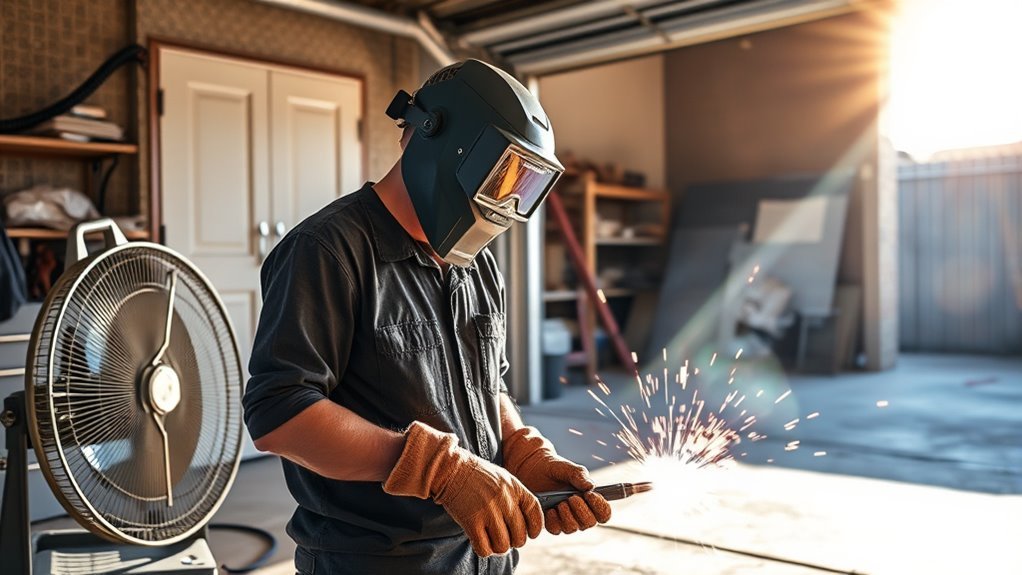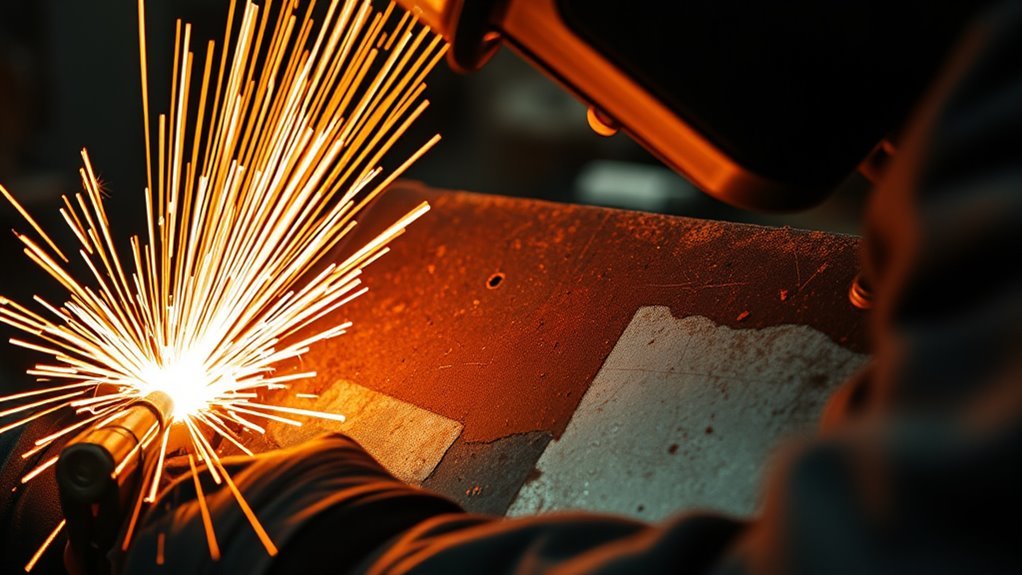
Flux core welding can work in auto body repair, but it is a limited-use process rather than the default choice. It is most useful for non-structural repairs on thicker mild steel, especially outdoors, when finish quality is secondary. Thin outer panels, structural collision repairs, galvanized steels, and modern high-strength materials need more caution and often require an OEM-approved GMAW, resistance spot welding, brazing, or adhesive procedure.
Quick Answer
Use self-shielded flux core for non-structural auto body repairs on steel thick enough for the wire and machine chart, especially outdoors. For thin, visible sheet metal, MIG with small solid wire and 75/25 argon-CO2 usually gives better heat control and less cleanup. Always follow the vehicle maker’s repair procedure for structural or late-model repairs.
Key Takeaways
- Treat flux core as a specialty option for thicker, non-structural mild-steel repairs—not a universal auto body process.
- Use the vehicle-specific OEM repair manual before welding structural panels, high-strength steel, or late-model collision parts.
- For most thin visible panels, .023- or .024-inch solid MIG wire with 75/25 argon-CO2 offers better control and less spatter.
- Control heat with tight fit-up, brief tacks, skip welding, cooling pauses, and a copper or aluminum backing bar when permitted.
- Remove coatings and fire hazards, protect electronics, ventilate fumes, clean slag, inspect the weld, and restore corrosion protection.
At a Glance
| Time Required | About 30–60 minutes for setup and scrap testing; the repair itself may take several hours. |
| Difficulty | Intermediate to advanced on thin sheet metal. |
| Tools Needed | Compatible wire-feed welder, approved wire, PPE, fire extinguisher, clamps, cleaning tools, scrap steel, slag brush, and corrosion-protection materials. |
| Cost | Varies by machine and repair; wire, patch steel, abrasives, PPE, and corrosion coatings are the main added costs. |
What’s in This Article
- Check OEM Repair Procedures First
- Can You Use Flux Core for Patch Panels?
- When Flux Core Makes Sense on Bodywork
- Why Flux Core Struggles With Thin Sheet Metal
- Set Up Flux Core for Thin Sheet Metal
- How to Avoid Burn-Through With Flux Core
- MIG vs. Flux Core for Patch Panels
- Clean Up and Protect the Repair
- Frequently Asked Questions
- Conclusion
Check OEM Repair Procedures Before Welding a Vehicle
Before choosing flux core, identify the vehicle, model year, panel material, panel function, and required attachment method. Modern vehicles may use mild steel, high-strength steel, ultra-high-strength steel, aluminum, tailored blanks, adhesives, rivets, resistance spot welds, GMA welds, or MIG brazing in different locations.
For collision repair, the vehicle maker’s body repair manual takes priority over general welding advice. A process that is acceptable for a non-structural restoration patch may be prohibited on a rocker reinforcement, pillar, rail, crush zone, suspension mount, seat-belt anchorage, or other safety-critical part. I-CAR repeatedly advises technicians to use vehicle-specific repair information for attachment methods and to use MIG brazing only where the OEM specifies it.
Warning: Do not use flux core on structural, restraint-related, high-voltage, or crash-management components unless the exact vehicle repair procedure permits that process. When the procedure is unavailable or unclear, stop and obtain the OEM information or use a qualified collision-repair technician.
Protect Vehicle Electronics and High-Voltage Systems
Follow the OEM power-down procedure before welding. Depending on the vehicle, that may include disconnecting and isolating both 12-volt battery cables, disabling the supplemental restraint system, disconnecting the high-voltage service disconnect, waiting the specified discharge time, and removing nearby electronic modules. Keep the work clamp close to the weld on the same panel so welding current has a short return path. I-CAR also advises routing welding cables away from modules, wiring, and sensors.
Hybrid, plug-in hybrid, fuel-cell, and battery-electric vehicles require model-specific high-voltage precautions. Never assume that disconnecting the 12-volt battery makes the high-voltage system safe.
Remove Fire and Fume Hazards
Inspect both sides of the panel. Remove or shield carpet, trim, sound deadener, seam sealer, undercoating, wiring, hoses, fuel lines, brake lines, vapor lines, and other materials that heat or sparks could damage. Keep a suitable fire extinguisher ready, and check hidden cavities and the opposite side of the panel during and after welding.
Clean paint, rust, oil, adhesive, and coatings from the weld zone. Many auto body steels are zinc-coated. Heating zinc can create zinc oxide fumes, which can cause metal fume fever. Use effective local exhaust or mechanical ventilation, keep your head out of the plume, and follow workplace respiratory-protection requirements when ventilation alone is not enough.
Can You Use Flux Core for Patch Panels?
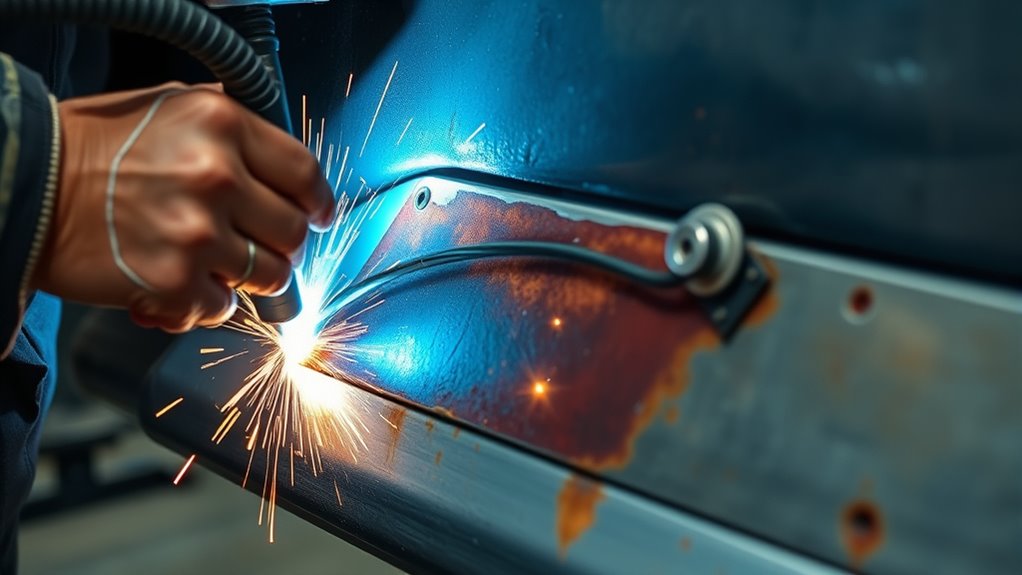
Yes, you can use flux core welding for some patch panels, but the decision depends on the panel’s function, steel type, actual thickness, wire classification, welder output, and manufacturer chart. It is most defensible on non-structural mild-steel patches where appearance is secondary and the wire maker lists the thickness as suitable.
Do not rely on a blanket “18- to 20-gauge” rule. Some small self-shielded wires and machines list 18- or 20-gauge minimums, while other manufacturer guidance treats self-shielded flux core as a better fit for 16-gauge steel and thicker. The wire label and machine chart control the setup.
You can make a sounder repair by using short tack welds and spacing them around the joint. This skip-welding method spreads heat, limits panel distortion, and reduces the chance of burn-through.
Choose wire size with care. Many compact flux core welders use .030- or .035-inch wire. Those diameters can work on thicker repair areas, but they may deliver too much heat and filler metal for delicate outer skins.
Keep the fit-up tight because wide gaps require more filler metal and arc time. Flux core also creates slag and spatter, so remove slag before placing the next tack or covering the weld with another pass.
If you want reliable results, practice on scrap with the same material, coating condition, joint style, and thickness before touching the vehicle. That test helps you adjust voltage, wire speed, travel speed, stickout, gun angle, and cooling time.
Pro Tip: Use a trimmed piece from the repair area for test welds when it is safe to do so. Old automotive steel may be thinner from corrosion or previous grinding, so new sheet of the nominal gauge may not behave the same way.
With disciplined technique, correct consumables, and a non-structural application, flux core wire can handle selected patch-panel work. For thin visible panels, MIG usually gives you a wider safety margin.
Quick Process Decision
| Repair Type | Better Starting Choice | Reason |
|---|---|---|
| Thin visible outer panel | Small-wire MIG/GMAW | Lower heat input, less slag, less spatter, and easier finishing. |
| Thicker non-structural mild-steel patch outdoors | Self-shielded flux core may be practical | No external shielding gas and better wind tolerance. |
| Structural or crash-related panel | OEM-specified method only | Attachment method, heat limits, and weld locations affect crash performance. |
| Aluminum panel | OEM-approved aluminum process | Steel self-shielded flux core wire is not an aluminum body-repair substitute. |
When Flux Core Makes Sense on Bodywork
Flux core welding makes the most sense on bodywork when you need portability, wind tolerance, and penetration more than a show-quality finish.
You can use self-shielded flux core outdoors because the wire generates shielding as the flux burns. That makes it less vulnerable than gas-shielded MIG when wind would disturb external shielding gas. It does not make the process windproof, however; severe wind can still affect the arc and deposit.
Flux core can tolerate minor surface contamination better than solid wire because many wires contain deoxidizers, but that is not permission to weld over rust, oil, paint, seam sealer, or undercoating. Remove contamination and coatings to clean, sound metal before welding. For more background, see this guide to self-shielded flux core.
Good candidates include non-structural brackets, older restoration patches, equipment-style repairs, and thicker floor or trunk patches when the OEM procedure, material, and wire chart allow the process. Compared with small-wire MIG, flux core usually creates more smoke, slag, and cleanup on sheet metal.
Keep your work well ventilated and expect to brush or chip slag after each tack. For budget restorations, flux core can be a practical, cost-effective route when you already own a compatible machine and the repair does not require a refined outer-panel finish.
When the goal is a durable non-structural repair rather than cosmetic perfection, flux core offers useful access, speed, and portability. The process still has to match the panel and the repair manual.
For auto body work, convenience never overrides panel thickness, material type, weld quality, or the vehicle maker’s attachment method.
Why Flux Core Struggles With Thin Sheet Metal
On thin auto body sheet metal, flux core’s heat and deposition rate can push the panel past its limit and cause burn-through. Thin panels have little mass to absorb heat, so a small change in gap, stickout, wire speed, or trigger time can open a hole.
Flux core can also leave pinholes, porosity, trapped slag, or surface defects when you rush the work or skip cleaning. Slag adds another step because you must remove it before adding the next tack. These proper cleaning techniques help reduce defects.
| Issue | Effect | Likely Result |
|---|---|---|
| Excess heat | Rapid melting and a growing puddle | Burn-through or warping |
| Wide panel gap | More filler and arc time needed | Holes and distortion |
| Pinholes or porosity | Incomplete or contaminated deposit | Leak path or weak repair |
| Slag | Cleaning required between tacks | Slower work or slag inclusions |
| Aggressive grinding | Metal becomes thinner | Greater burn-through risk |
Your technique matters. Use small tack or stitch welds rather than a continuous bead to limit distortion and keep the sheet stable.
Do not grind the metal too thin during preparation or finishing. Excess thinning removes your safety margin and can weaken the repair even when the weld itself looks smooth.
Set Up Flux Core for Thin Sheet Metal
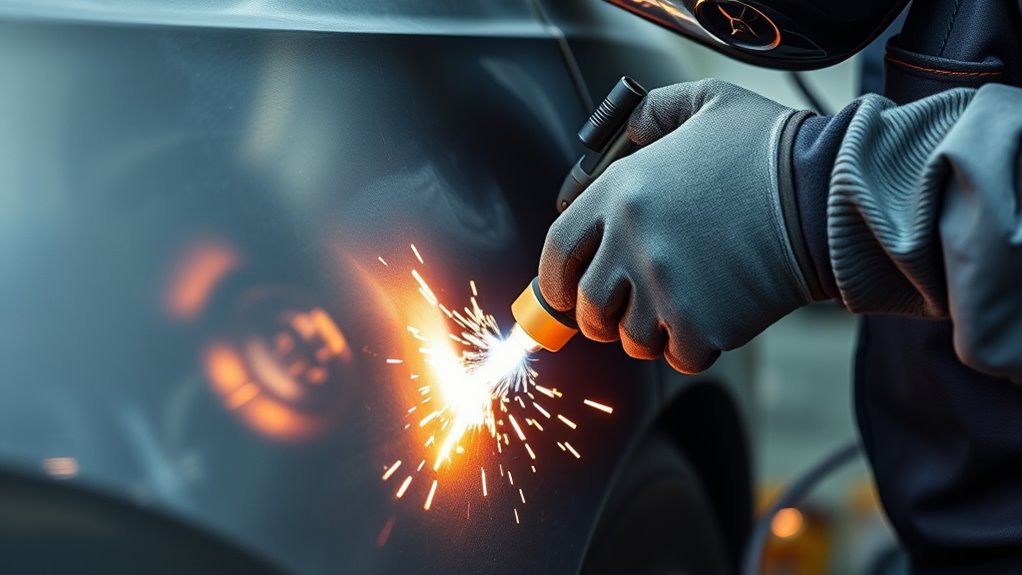
Set your machine to the lowest clean setting that produces a stable arc and sound fusion. Start with the welder’s door chart and the wire manufacturer’s data, then test on scrap before welding the panel. Do not copy settings from a different welder, wire type, joint, or material thickness.
If you can switch processes, use .023- or .024-inch solid wire with 75/25 argon-CO2 for most light-gauge mild-steel body panels. That setup is GMAW/MIG, not true gasless flux core, and it usually gives better control on thin visible steel.
For flux core, use the smallest compatible self-shielded wire that your welder and the wire data support for the actual material thickness. Tack the panels in place, let each tack cool, and keep the surface clean for better fusion. This guide to welding thin metal with flux core explains the basic technique.
Note: C25 or 75/25 gas with solid wire is a MIG/GMAW setup. Self-shielded flux core does not need external gas. Gas-shielded flux-cored wire is a separate process and is generally intended for thicker fabrication, not delicate auto body skins.
Products Worth Considering

E71T-GS FLUX CORE WIRE: This self-shielding, AWS E71T-GS flux-cored wire excels due to its advanced core design, delivering exceptional arc stabilization and high feedability for effortless welding. The core also incorporates powerful deoxidizing agents, ensuring clean, reliable welds even when welding through light rust or mill scale.

Versatile welding capability on a variety of base materials
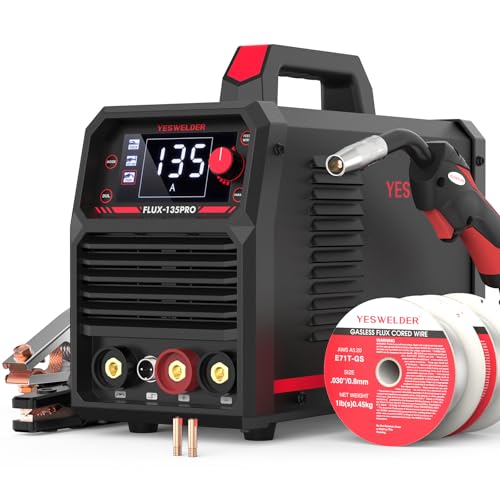
READY OUT OF THE BOX: Start welding immediately! It masterfully handles Gasless Flux Core MIG, Stick, and Lift TIG (Extra Lift TIG torch required). This budget-friendly 3-in-1 machine includes extra E71T-GS .030''&.035'' flux core wires, known for its smooth arc and high feedability. Say goodbye to heavy shielding gas cylinders—perfect for outdoor, windy, or all-position welding.
Wire and Polarity Setup
For thin auto sheet metal, MIG with .023- or .024-inch ER70S-6 solid wire and 75/25 argon-CO2 is a common starting point when the OEM procedure allows GMAW. The smaller wire needs less heat to melt and gives more control over the weld deposit.
If you use a flux core welder, check the wire label and machine manual before starting. Many self-shielded wires run on direct current electrode negative (DCEN), while solid-wire MIG generally uses direct current electrode positive (DCEP). Some flux-cored wires are exceptions, so the consumable manufacturer’s polarity requirement controls.
Clean the weld area to sound metal because rust, paint, oil, adhesive, zinc residue, and seam sealer can damage weld quality and create hazardous fumes. Keep the electrical stickout within the wire maker’s range; self-shielded flux core often uses a longer stickout than solid-wire MIG.
Match voltage and wire speed to the panel thickness, wire, joint, and position using the machine chart. Make test welds on scrap of the same gauge, then bend, cut, or otherwise inspect the test coupon when the repair procedure calls for destructive testing.
A controlled wire feed, correct polarity, stable work clamp, and approved setup help you weld thin steel with less distortion and fewer defects.
Prepare the Panel and Vehicle
- Confirm that the panel is repairable and identify its material and structural role.
- Read the vehicle-specific repair procedure, including weld type, number, size, location, and corrosion-protection steps.
- Disable the 12-volt, restraint, and high-voltage systems exactly as the OEM directs.
- Remove nearby trim, wiring, hoses, fuel-system parts, sound deadener, seam sealer, and flammable coatings.
- Trim the patch for a close, even fit and clamp it without forcing the panel out of shape.
- Place the work clamp on clean metal near the weld and on the same panel when practical.
- Set up ventilation, PPE, a fire extinguisher, and a fire watch for hidden cavities.
Tack Weld Thin Panels
Start with small tack welds to lock the panels in place. Keep your gun angle steady and the gap as tight and even as the repair procedure requires.
In flux-cored arc welding (FCAW), thin-panel tack welding demands control and patience. Use brief trigger pulls, then pause so heat can leave the panel.
- Clean both edges before striking an arc.
- Place the first tacks far apart to hold alignment.
- Move to a cool area for each new tack instead of welding adjacent spots in sequence.
- Remove slag and inspect each tack before covering it.
- Watch for distortion, a widening gap, or a glowing panel and stop early.
- Practice the exact sequence on scrap before the final repair.
This skip-welding pattern helps keep the panel flatter while you build strength and accuracy.
How to Avoid Burn-Through With Flux Core
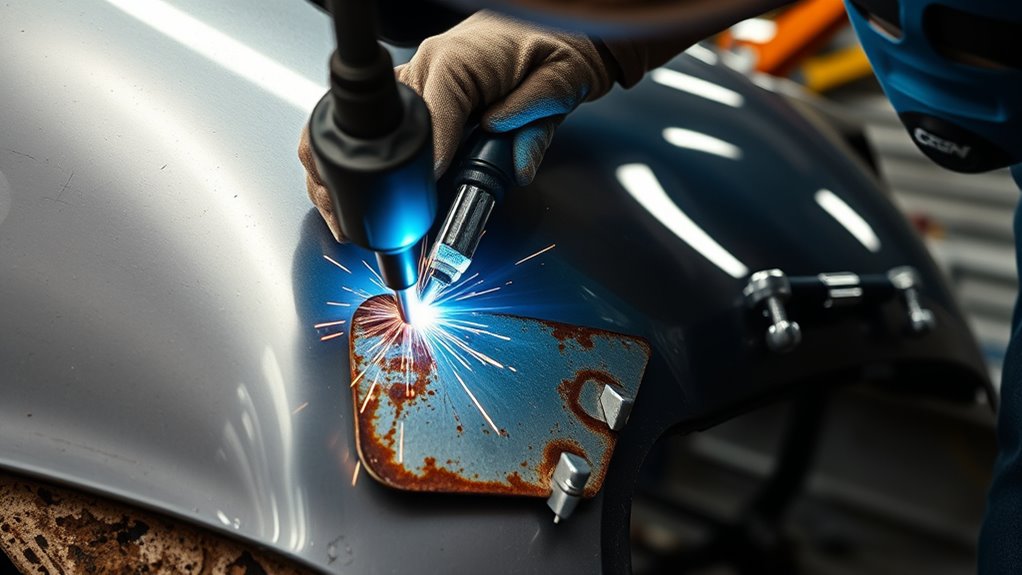
Burn-through is a constant risk when you use flux core on light-gauge auto sheet metal. You can reduce that risk with correct settings, tight fit-up, short arc time, and disciplined cooling.
In flux-cored arc welding, use spot or stitch welds instead of long beads on thin auto sheet metal. Keep each weld short, then move to another area while the panel cools.
Hold the gun angle and stickout specified for the wire. Set wire speed and voltage to match the material because excess voltage, excessive wire feed, or too much dwell time can open the panel quickly.
Back the joint with a clean copper or aluminum chill bar when you have access and the repair procedure allows it. The backing supports the molten edge and draws heat away from the joint.
Warning: Remove paint, undercoating, seam sealer, interior trim, and fuel or vapor hazards from both sides of the work area. Keep extinguishing equipment ready and inspect enclosed cavities after welding because sparks can smolder out of sight.
If you lose control, stop and reset. Do not chase a hole with continuous arc time because that often makes the opening larger. Let the area cool, trim or reshape the damaged edge if needed, add a fitted patch, and restart with shorter tacks.
Before touching the car, practice on scrap pieces of the same thickness. That lets you dial in timing, heat, gun angle, and motion with less risk.
Using the right flux core welding technique can help you manage weld quality and reduce defects. Precision comes from repeatable setup, and restraint keeps the metal intact.
Burn-Through Troubleshooting
| Symptom | Likely Cause | Correction |
|---|---|---|
| Hole forms as soon as the arc starts | Metal is too thin, settings are too hot, or the gap is too wide | Stop, verify thickness and settings, tighten fit-up, add backing, or switch to small-wire MIG. |
| Panel pulls or ripples | Heat is concentrated in one area | Use shorter tacks, skip farther around the joint, and allow more cooling time. |
| Tack sits high with poor tie-in | Low voltage, excessive stickout, poor clamp connection, or contamination | Clean the joint and clamp point, correct stickout, and fine-tune from the chart on scrap. |
| Pinholes appear after grinding | Porosity, slag inclusion, missed gaps, or over-grinding | Stop, clean and inspect, repair only sound metal, and avoid covering defects with filler. |
MIG vs. Flux Core for Patch Panels
When you are patching auto body panels, MIG/GMAW with small solid wire and 75/25 argon-CO2 is usually the cleaner choice for light-gauge mild steel. It produces no slag, generally reduces spatter, and gives you better control over heat and finishing.
For most thin visible body panels, small-diameter solid wire and 75/25 shielding gas provide a more forgiving starting point than self-shielded flux core.
Use flux-cored arc welding when you need portability, no external shielding gas, or outdoor capability and when the panel is non-structural, thick enough, and approved for the process.
For patch panels, choose based on metal, thickness, finish, location, and repair requirements:
- MIG gives cleaner welds on visible repairs and requires less slag cleanup.
- Self-shielded flux core is better suited to thicker steel than delicate outer skins.
- Flux core creates slag, smoke, and spatter, so plan for more cleaning and inspection.
- Short FCAW tacks can control heat, but they do not make an unsuitable wire or panel safe.
- MIG supports smoother, smaller deposits with less finishing on thin panels.
- Neither process may be used as a substitute for an OEM-required spot weld, MIG-braze joint, rivet-bonded joint, or adhesive procedure.
| Factor | Small-Wire MIG | Self-Shielded Flux Core |
|---|---|---|
| Thin sheet control | Usually better | More difficult and wire-dependent |
| Outdoor wind | Shielding gas may need a windbreak | Better wind tolerance |
| Cleanup | No slag; usually less spatter | Slag and more surface cleanup |
| Equipment | Gas cylinder, regulator, and correct polarity | No gas cylinder; correct wire and polarity still required |
| Best fit | Thin visible mild-steel patches when approved | Thicker non-structural steel repairs where finish matters less |
If you want less grinding and cleaner visible work, MIG is usually the better control tool. If you need field-ready versatility and acceptable finish on an approved non-structural repair, flux core can be practical.
Consider the wire diameter and machine settings when choosing your process because they affect heat input, deposition, and penetration.
Match the process to the panel, verify it against the repair information, and then weld with intent.
Products Worth Considering

Package Includes: 10ft mig gun + 1pcs nozzle +1pcs diffuser + 6 tips (.023", .030", .035" - two of each size). This mig gun uses the same consumables as the Tweco Mini/#1. 21-50 nozzle, 35-50 diffuser, 11-series contact tip.

4 IN 1 MULTIFUNCTIONAL: Enjoy the convenience of a 4-in-1 welding machine that masterfully handles Gasless Flux Core MIG/Gas MIG/Stick/Lift TIG (additional lift TIG torch required). This unit suits a wide range of welding applications and meets your various welding needs.

【LOW SPATTER & EASY CLEANUP】Minimal Spatter, Flawless Beads: Experience exceptionally low spatter and minimal post-weld cleanup. This ER70S-6 solid wire allows you to achieve smooth, visually appealing beads with ease, saving both time and grinding effort on your metal fabrication.
Clean Up, Inspect, and Protect the Repair
After the weld cools, remove all slag and inspect the joint under good lighting. Look for cracks, pinholes, missed edges, undercut, excessive buildup, and areas that did not fuse. Do not hide a questionable weld under body filler, seam sealer, or paint.
Grind only as much as the finish requires. Use light pressure and keep the abrasive moving so you do not thin the panel or overheat the joint. On a structural repair, follow the OEM’s instructions for whether and how welds may be dressed.
Restore every corrosion-protection layer removed during the repair. Depending on the vehicle procedure and joint, that may include epoxy primer, seam sealer, cavity wax, undercoating, paint, and backside protection. Keep drain holes open and duplicate the original sealing path.
Note: Weld-through primer is not universally approved for every weld or vehicle. Use only the coating and joint preparation specified by the OEM and product manufacturer.
Frequently Asked Questions
Is Flux Core Good for Auto Body?
Flux core can work for selected non-structural repairs on thicker mild steel, hidden patches, brackets, or outdoor work. It is usually not the best choice for thin visible panels, structural collision parts, aluminum, or areas where the OEM requires another attachment method.
When Should You Use Flux Core Welding on a Car?
Use it when you need a portable, self-shielded process for an approved non-structural steel repair that is thick enough for the wire and machine. Appearance and cleanup should be secondary. Always check the vehicle-specific repair manual first.
What Are Common Flux Core Welding Mistakes?
Common mistakes include welding the wrong panel, skipping OEM procedures, poor cleaning, wrong polarity, settings that are too hot, long beads, wide gaps, excessive stickout, weak work-clamp contact, skipped slag removal, and aggressive grinding. Test on matching scrap before welding the vehicle.
What Kind of Welding Is Best for Auto Body Work?
For traditional thin mild-steel patches, small-wire MIG/GMAW is often the easiest process to control. Modern collision repair may instead require squeeze-type resistance spot welding, MIG brazing, adhesives, rivets, or another OEM-specified method. The repair manual decides.
Can Flux Core Weld 22-Gauge Sheet Metal?
Some machines and small wires may list very thin steel capability, but 22-gauge auto sheet is difficult to weld with self-shielded flux core and has a high burn-through risk. For visible body panels, small-wire MIG is usually the safer starting choice. Use flux core only when the wire data, machine chart, and repair procedure support it.
Should You Grind Flux Core Welds on Body Panels?
You can dress a non-structural flux core weld after removing slag and confirming that the weld is sound. Grind lightly and only as needed because aggressive grinding can thin the panel, expose pinholes, or weaken the joint. Follow OEM limits on structural weld dressing.
Can You Use Flux Core on Structural Auto Body Panels?
Do not assume you can. Structural rails, pillars, rockers, reinforcements, suspension mounts, and restraint anchorages must be repaired with the exact process, weld locations, and joint design specified by the vehicle maker. Flux core is acceptable only when that procedure expressly permits it.
Can You Weld Galvanized Auto Body Steel?
Yes, but you must follow the repair procedure, remove coatings only as directed in the weld zone, control zinc-containing fumes with effective ventilation, and restore corrosion protection afterward. Never weld through unknown coatings, seam sealer, or paint.
Conclusion
Use flux core welding in auto body work when the repair is non-structural, the steel is thick enough for the approved wire and machine, outdoor portability matters, and finish quality is secondary. It may suit selected brackets, older restoration patches, thicker floor or trunk areas, and field repairs better than delicate outer skins.
For clean, controlled bodywork on thin mild steel, you will usually get better results with small-wire MIG. For structural, high-strength, aluminum, hybrid, or late-model collision repairs, the vehicle-specific procedure—not convenience—must choose the process. Test on matching scrap, control heat, protect the vehicle, inspect the weld, and restore corrosion protection before returning the panel to service.
Sources
- Miller Electric: Successfully Welding Sheet Metal with MIG and TIG — small-wire guidance, shielding gas, skip welding, and chill bars.
- Miller Electric: Solid Wire Versus Flux-Cored Wire — process selection, outdoor use, thickness, cleaning, and finish differences.
- I-CAR: Protecting Electronic Parts During Welding — battery isolation, high-voltage disconnects, work-clamp placement, and module protection.
- I-CAR: OEM MIG Brazing Requirements and Recommendations — why vehicle-specific repair information controls attachment methods.
- OSHA 29 CFR 1910.252 — welding ventilation, fumes, and general hot-work requirements.
- OSHA 29 CFR 1926.352 — fire prevention, hidden hazards, extinguishing equipment, and fire watch.