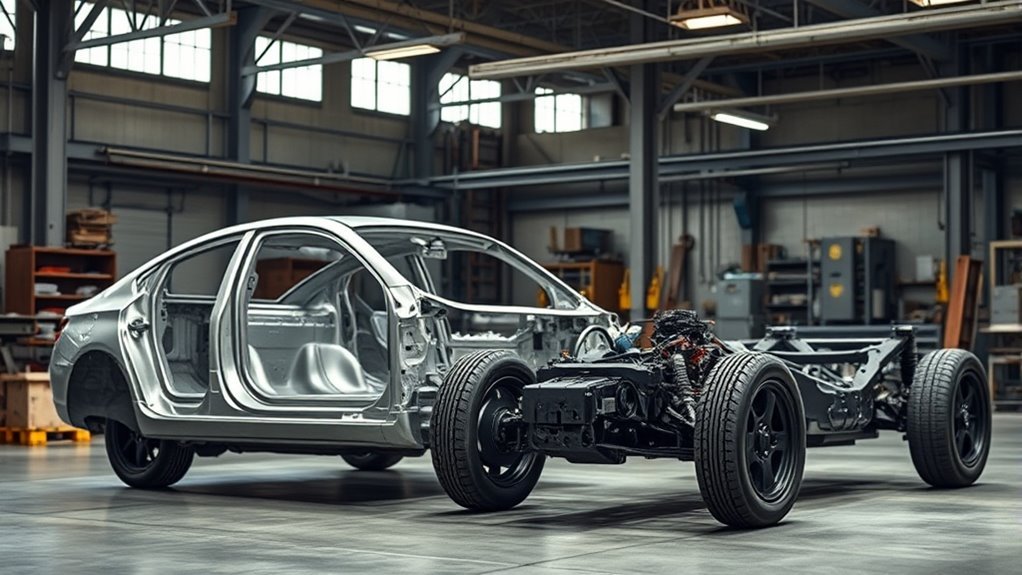
Unibody cars replaced body-on-frame construction in most passenger-vehicle classes because an integrated body structure gives engineers a practical balance of weight, cabin space, road manners, crash-energy management, efficiency, and high-volume production. Body-on-frame design still matters for heavy towing, high payloads, commercial upfits, and severe off-road work, but most everyday drivers do not need those specialized advantages.
Quick Answer
Unibody cars replaced most body-on-frame cars because the body and chassis work as one load-carrying structure. This can reduce weight, free up cabin space, improve road handling, and help engineers manage crash forces. Body-on-frame remains valuable for heavy towing, payload, work-body installation, and demanding off-road use.
Key Takeaways
- Unibody construction joins the floor, rails, pillars, roof, and crossmembers into one main load-carrying structure.
- The architecture can reduce mass and floor height, which helps packaging, efficiency, braking, and road handling.
- Neither unibody nor body-on-frame is automatically safer; compare the exact model’s crash ratings, weight, restraints, and safety technology.
- Body-on-frame vehicles dominate the highest towing, payload, commercial-upfit, and severe off-road categories.
- A tow rating applies only to the specified model, trim, drivetrain, equipment, payload, hitch, and operating conditions.
- Structural repairs on either design must follow model-specific manufacturer procedures, especially around high-strength steel and EV batteries.
What Makes Unibody Cars the Default Choice
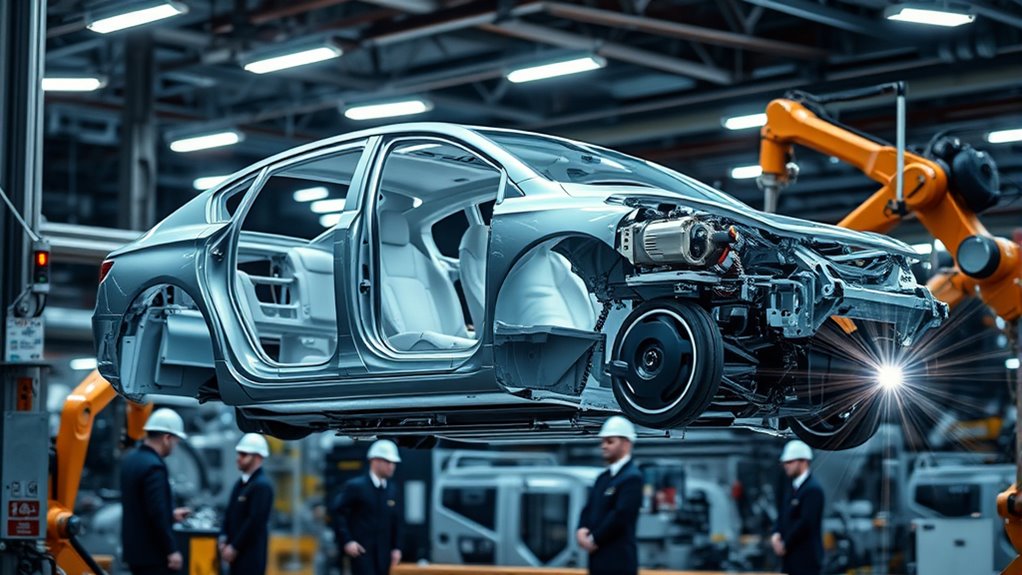
Unibody construction became the default for most passenger vehicles because it turns the body, floor, roof, pillars, rockers, and structural rails into one integrated shell. Instead of placing a separate passenger body on top of a complete ladder frame, the joined structure carries driving, braking, cornering, cargo, and crash loads.
Ford’s definition of unitized body construction describes the front, rear, and side rails as being joined with the floorpan, crossmembers, and torque boxes to form one unit. “Unitized body,” “unit-body,” and “unibody” are generally used for the same broad type of passenger-vehicle construction.
A unibody vehicle can still have bolt-on subframes or cradles. These smaller structures may support the engine, transmission, steering, or suspension, but they do not turn the vehicle into a traditional body-on-frame design. The main body shell remains the primary load-carrying structure.
This approach gives automakers several advantages at once. It can reduce mass, lower the floor, improve cabin packaging, increase body stiffness, and make the vehicle easier to tune for everyday comfort and road response. You often feel the result as a vehicle that is quieter, more controlled, and easier to maneuver than a similarly sized truck-based model.
It also fits how most people use their vehicles. Commuters, sedans, hatchbacks, minivans, and crossovers rarely need the separate frame capacity of a work truck. They need usable interior room, stable road behavior, effective crash protection, and reasonable energy costs.
Note: “Unibody” does not mean weak or frameless. Modern unitized vehicles use shaped rails, pillars, rockers, crossmembers, high-strength materials, adhesives, welds, and local reinforcements to manage different loads.
Manufacturing and Cabin Packaging
A unibody platform usually requires substantial design work, stamping dies, welding equipment, fixtures, and factory tooling. Once that investment is in place, however, it suits high-volume production because the body structure can move through a repeatable automated assembly process.
Removing a full ladder frame can also give designers more freedom around the floor. A lower floor may provide easier entry, a lower seating position, more cargo room, or more passenger space without making the outside of the vehicle much larger.
Body-on-frame production remains useful when one chassis must support several bodies or commercial configurations. A manufacturer can place pickup beds, utility bodies, passenger bodies, or specialty equipment on related frame designs without creating an entirely new unitized shell for every use.
Unibody vs Body-on-Frame: Quick Comparison
| Category | Unibody | Body-on-Frame |
| Best fit | Cars, crossovers, minivans, many SUVs, and daily family vehicles | Pickups, heavy-duty SUVs, commercial vehicles, work bodies, and demanding off-road builds |
| Structure | Body shell and structural rails form the main load-carrying unit; bolt-on subframes may still be used | Passenger or cargo body is mounted to a separate structural frame |
| Weight | Often lighter than a comparable vehicle using a separate full frame | Often heavier because the frame and mounted body are separate structures |
| Packaging | Can provide a lower floor and more cabin space for the exterior size | Frame height can raise the floor, but the layout supports varied bodies and upfits |
| Handling | Often lower and more car-like, depending on suspension, tires, dimensions, and tuning | Can feel taller or more truck-like, though independent suspension and modern controls can improve road behavior |
| Towing and payload | Ranges from light towing to substantial ratings on reinforced models | Common in the highest payload, hitch-load, and trailer-weight classes |
| Repair approach | Structural work requires precise measurement, approved joining methods, corrosion protection, and OEM procedures | Some beds, cabs, and bodies are modular, but structural frame repairs still require OEM limits and procedures |
What Construction Type Does Not Guarantee
Frame type does not determine every part of a vehicle’s performance. It does not guarantee safety, reliability, ride quality, towing capacity, off-road ability, repair cost, or service life by itself.
A vehicle is a complete system. Its results depend on material grades, joint design, dimensions, curb weight, suspension, tires, brakes, powertrain, cooling, electronic controls, maintenance, and the way it is used.
That is why comparisons should be made between actual models that serve a similar purpose. A low unibody sedan and a lifted body-on-frame SUV differ in far more than the way their structures are assembled.
How Unibody Design Supports Modern Safety Engineering
A modern unibody vehicle can be engineered so its front and rear structures deform along planned paths while the passenger compartment resists collapse. These deformable areas are often called crumple zones. Their purpose is not to keep every exterior panel undamaged. Their purpose is to manage crash forces and preserve usable space around the occupants.
The integrated shell also lets engineers coordinate roof rails, rocker panels, the floorpan, pillars, crossmembers, seat mounts, airbags, and seat-belt systems as one crash-management package. Safety therefore depends on much more than whether a vehicle has a separate frame.
The National Highway Traffic Safety Administration evaluates frontal, side, and rollover performance. NHTSA says frontal and Overall Vehicle Scores should be compared only among vehicles in the same class and within 250 pounds of one another. This prevents misleading comparisons between vehicles with very different mass and body types.
The Insurance Institute for Highway Safety evaluates crashworthiness and crash avoidance through several tests. IIHS updates its test programs and considers changes to a vehicle’s structure, airbags, seat belts, weight, and platform when deciding whether an earlier rating still applies.
Warning: Do not assume a vehicle is safer only because it is unibody, body-on-frame, larger, or newer. Compare the exact model year’s NHTSA and IIHS results, recall status, safety equipment, tire condition, and vehicle history.
Why Unibody Cars Often Feel Better on the Road
Unibody architecture often helps engineers produce a lighter, lower passenger vehicle with a stiff foundation for the suspension. Those characteristics can improve steering response, ride control, braking behavior, and cornering compared with a taller truck-based vehicle designed around different priorities.
You may feel the difference as less shake over rough pavement, more direct steering, and more predictable movement in curves. It is often most noticeable in sedans, hatchbacks, minivans, and crossovers that spend nearly all their time on paved roads.
The structure alone does not create good handling. Tires, suspension geometry, dampers, springs, track width, wheelbase, mass distribution, steering calibration, and electronic stability control determine how the completed vehicle responds.
Lower Center of Gravity
A unibody platform can allow a lower floor and seating position because a complete ladder frame does not have to run beneath the passenger compartment. Lower placement of major components can reduce the center of gravity, limit body roll, and help the vehicle feel planted.
This is not automatic. A tall unibody SUV may have more body movement than a low body-on-frame specialty vehicle. Battery placement, suspension tuning, tires, ride height, and vehicle width also matter.
Controlled Structural Stiffness
Because the body and primary structure are integrated, a unibody shell can spread loads through several connected paths. The roof rails, pillars, rockers, floor, and crossmembers all help resist bending and twisting.
This stiffness gives the suspension a consistent foundation and helps it maintain its intended geometry as the vehicle turns, brakes, and crosses uneven pavement. It can also help control squeaks, rattles, and vibration when the complete body is engineered and assembled well.
Body-on-frame vehicles can also use stiff boxed rails, strong crossmembers, isolated body mounts, and independent suspension. The difference is not that one layout can be stiff and the other cannot; the two layouts manage loads and design priorities differently.
Better Cornering Control
Cornering behavior comes from the full system: total mass, center of gravity, body stiffness, suspension geometry, tires, steering, brakes, and electronic stability control. Unibody construction often helps by giving these systems a lighter and more compact platform.
When structural movement is well controlled, steering and suspension inputs can produce a more direct response. That can improve confidence not only during sporty driving but also during emergency lane changes and wet-road maneuvers.
Fuel Economy Gains From Unibody Construction
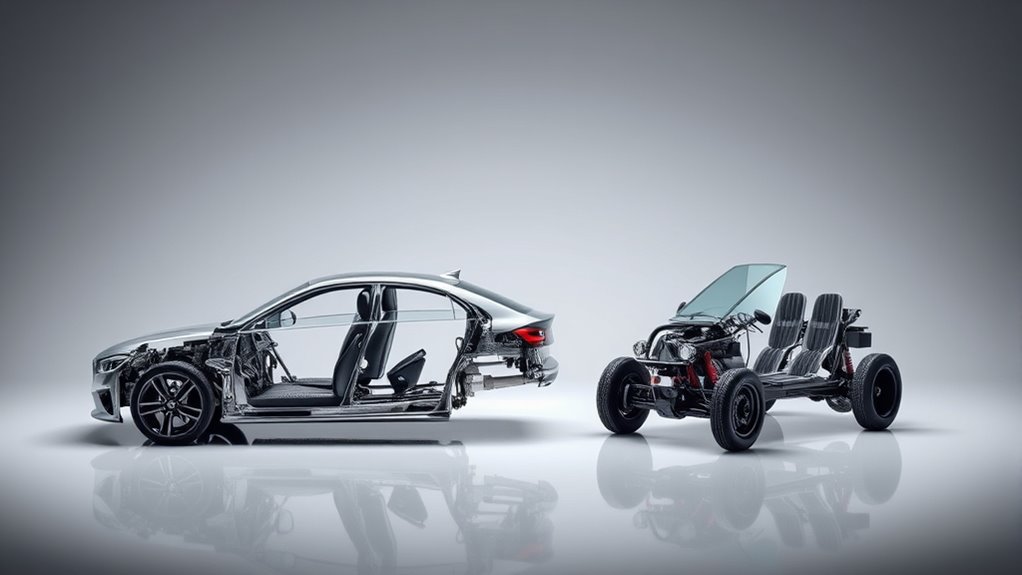
Weight reduction is one reason unibody construction suits passenger cars. A lighter vehicle generally needs less energy to accelerate and climb. Weight savings can also allow engineers to reduce the size or mass of related components while maintaining the required performance.
The U.S. Department of Energy says a 10% reduction in vehicle weight can result in a 6%–8% improvement in fuel economy. That figure describes the benefit of reducing weight; it does not mean every unibody vehicle is 6%–8% more efficient than every body-on-frame vehicle.
The U.S. Department of Energy estimates that a 10% reduction in vehicle weight can improve fuel economy by about 6%–8%.
Fuel use still depends on curb weight, engine or motor efficiency, hybrid-system design, gearing, aerodynamics, tires, accessory loads, weather, speed, and driving style. A large unibody SUV may therefore use more fuel than a smaller body-on-frame vehicle under some conditions.
For electric vehicles, lower mass can help improve range or allow a smaller battery to provide the same target range. The body structure is one part of that effort, alongside aerodynamics, motor efficiency, thermal management, and battery chemistry.
Unibody vs Body-on-Frame Towing Limits
Body-on-frame construction is common among vehicles with the highest trailer and payload ratings. A separate frame gives engineers a strong base for heavy-duty suspension, axles, hitch attachments, driveline parts, cooling hardware, commercial bodies, and repeated high-load use.
That pattern does not make every body-on-frame vehicle a better tow vehicle than every unibody model. A towing limit applies to the complete vehicle and its tested configuration. Engine or motor output, transmission, cooling, brakes, wheelbase, tires, hitch design, payload, axle ratings, and stability programming can all affect the published number.
The current SAE J2807_202411 recommended practice, reaffirmed in November 2024, establishes performance criteria and calculation methods for tow-vehicle gross combination and trailer-weight ratings. Buyers should still use the vehicle manufacturer’s model-specific manual and labels as the final authority.
Products Worth Considering

[3-in-1 Hitch Design]-The atv trailer hitch Combines a 2" standard hitch receiver, a 2" weld-on trailer ball rated at 3,500 lbs, and a winch strap loop rated at 6,700 lbs—all in one compact unit. Perfect for towing trailers, campers, motorcycles, ATVs, and utility equipment.

The 5T aluminium hitch receiver is made of aluminum alloy 6061.
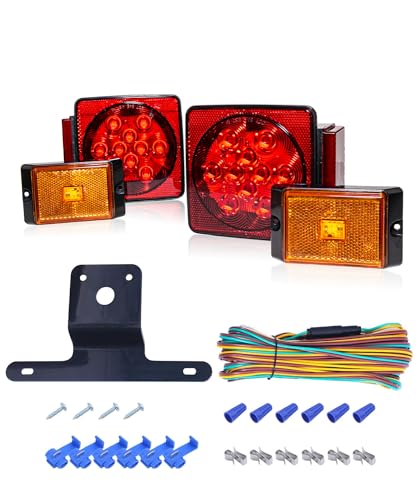
Complete Light Kit: This comprehensive kit includes two 12V LED stop, tail, and turn signal lights, two amber clearance lights, a license plate bracket, and a wiring harness. Its universal fit ensures compatibility with various trailers.
Current Unibody Towing Examples
Many compact unibody crossovers are rated for small utility trailers or other light loads. For the 2026 model year, the Honda CR-V specifications list a 1,000- or 1,500-pound towing capacity depending on the trim and powertrain.
Larger reinforced unibody vehicles can tow more. The 2026 Honda Passport uses unit-body construction and is listed with a 5,000-pound towing capacity. The unibody 2026 Honda Ridgeline pickup is also listed at 5,000 pounds.
Body-on-frame pickups and truck-based SUVs frequently exceed those figures because they are designed for higher combined loads and repeated work. Contractors, RV owners, equipment haulers, and people who tow near a vehicle’s limits often benefit from the extra capacity and equipment available in truck platforms.
Tow Rating Is Not the Only Limit
Trailer tongue load presses down on the tow vehicle and counts against its payload capacity. Passengers, luggage, tools, accessories, hitch hardware, and cargo also consume payload. A vehicle can therefore remain below its advertised trailer limit while exceeding its payload, axle, tire, or hitch limit.
Check all of the following before choosing or loading a tow vehicle:
- The exact model year, trim, engine or motor, drivetrain, and factory tow equipment
- The owner’s manual and towing guide
- The door-jamb payload label
- Gross vehicle weight rating and axle weight ratings
- Gross combined weight rating
- Maximum permitted tongue load
- Receiver, ball mount, tow-ball, and hitch-component ratings
- Trailer-brake and brake-controller requirements
- Tire load capacity and cold inflation pressure
- Passengers, cargo, accessories, and weight added after purchase
Warning: Never rely on the advertised maximum tow rating alone. Use the lowest applicable limit among the vehicle, payload label, axles, tires, hitch components, and trailer equipment.
When Body-on-Frame Still Makes Sense
Body-on-frame construction makes sense when high load capacity, commercial flexibility, and severe-duty use matter more than low weight, a low floor, and car-like road behavior. This is why it remains common in full-size pickups, heavy-duty trucks, commercial chassis, and some rugged SUVs.
Towing and Hauling
Body-on-frame construction is often the better fit when you regularly tow heavy trailers, carry tools, load a pickup bed, or work close to the vehicle’s rated limits. The separate frame gives engineers a robust base for suspension mounts, axles, driveline parts, hitches, and different body configurations.
| Advantage | Impact |
| Separate frame | Provides a dedicated structural base for high payloads, hitch loads, and work equipment |
| High-capacity configurations | Offers more choices for heavy trailers, boats, campers, and machinery |
| Heavy-duty components | Supports repeated work when the suspension, brakes, cooling, axles, and tires are designed for it |
| Modular body and bed | Makes commercial bodies, fleet upfits, and some body replacements easier to package |
If you haul only a small trailer a few times a year, a properly equipped unibody crossover may be enough. If you regularly tow near the limits, carry heavy cargo, or operate in severe heat and grades, a body-on-frame truck with suitable capacity may provide more useful margin.
Off-Road Durability
Body-on-frame platforms are common in serious off-road vehicles because they can provide room for durable axles, long-travel suspension, skid plates, low-range gearing, commercial recovery equipment, and modifications. The separate frame can also support different body styles while carrying trail loads through dedicated rails and crossmembers.
- Suitable ground clearance helps the vehicle pass over rocks and deep ruts.
- Manufacturer-rated recovery points provide secure attachment locations.
- Heavy-duty axles, suspension, tires, and underbody protection can withstand repeated rough use.
- Some truck platforms offer wider support for approved lifts and larger tires.
Unibody off-road vehicles can still be highly capable when designed for that purpose. Structure type alone does not determine traction, approach angle, suspension travel, water-fording depth, or durability.
Warning: Use only recovery points rated by the vehicle or equipment manufacturer. Never recover a stuck vehicle from a tow ball, shipping tie-down, suspension arm, bumper trim, or unrated hook. Improper recovery hardware can detach with lethal force.
Lift kits, oversized tires, wheel-offset changes, and added armor can affect steering, braking, stability control, gearing, payload, wheel bearings, crash behavior, and warranty coverage. Follow manufacturer limits and use qualified installers.
Repair Modularity and Serviceability
Modularity is another reason body-on-frame construction survives. A pickup bed, work body, cab component, bumper, or bolt-on panel may sometimes be repaired or replaced without replacing the separate frame.
This does not make all body-on-frame collision repairs simple. Bent frame rails, crossmembers, suspension mounts, and hitch areas still require accurate measurement and vehicle-specific repair limits. Some manufacturers permit limited straightening or sectioning, while others require complete component replacement.
| Component | Possible Action | Important Limit |
| Bolt-on body panel | Repair or replace | Both unibody and body-on-frame vehicles may use replaceable exterior panels |
| Frame rail | Measure, straighten, section, or replace only as permitted | OEM material, heat, joining, and location restrictions apply |
| Cargo bed or work body | Repair, replace, or change the upfit | Mounting, wiring, weight distribution, and payload limits must remain correct |
| Suspension or hitch mount | Inspect, measure, and repair by procedure | Hidden deformation or cracking can affect alignment and load capacity |
Unibody repair is not impossible, but it is exacting because structural panels may perform several jobs at once. After a crash, the vehicle may need computerized measurement, model-specific sectioning, approved welding or adhesive methods, restored seam sealing and corrosion protection, wheel alignment, and calibration of driver-assistance sensors.
Manufacturer repair information is essential. Honda’s collision-repair information, for example, separates guidance for steel repairability, welding and sectioning, adhesives, corrosion protection, high-voltage inspection, and aiming driver-support systems.
A poor structural repair on either architecture can affect alignment, tire wear, water sealing, corrosion resistance, noise, crash performance, towing alignment, and resale value.
Checking a Used Vehicle After Structural Repair
Before buying a vehicle with reported structural damage, obtain the repair invoice and ask which OEM procedures were followed. A qualified collision-repair or body-measurement specialist should inspect the structure, welds, adhesives, corrosion protection, suspension mounts, tire wear, panel fit, water leaks, warning lights, and sensor calibration records.
A clean-looking exterior does not prove that the underlying structure is correctly aligned or protected. Either architecture can be declared a total loss when safe repair costs exceed the vehicle’s economic value.
Why Automakers Moved Away From Body-on-Frame Cars
Automakers moved away from body-on-frame passenger cars over many decades rather than because of one rule or one model. Separate frames became less useful as paved-road travel increased, high-volume body manufacturing improved, fuel-efficiency pressure grew, and buyers expected quieter, roomier, more car-like vehicles.
Early vehicles often borrowed construction methods from wagons and trucks, making a separate chassis practical. Later, improved stamping, welding, adhesives, material modeling, computer-aided design, and crash simulation made integrated structures easier to manufacture and optimize.
A lower-mass structure also helped manufacturers add stronger occupant compartments, airbags, electronics, sound insulation, emissions equipment, and comfort features without allowing vehicle weight to rise as quickly.
Cost played a role, but not in the simple sense that every unibody vehicle is cheaper to build. Developing and tooling a new unitized platform can be expensive. The benefit appears when the manufacturer produces enough vehicles to spread that investment across a large number of cars and related models.
How Electric Vehicles Continue the Unibody Trend
Electric vehicles have made structural integration and packaging even more important. Many passenger EVs place a wide traction-battery pack beneath the floor. Depending on the design, the battery enclosure may work with the body structure to increase stiffness and manage crash loads.
This does not mean every EV uses the same architecture. Some electric pickups and commercial vehicles use frame-based or specialized layouts because they must support high payloads, towing loads, or varied work bodies. Passenger EVs commonly favor integrated platforms because a low battery location can support a low center of gravity and efficient cabin packaging.
Battery weight also changes the design challenge. Engineers may use advanced steel, aluminum, castings, structural adhesives, and carefully planned load paths to protect the passenger compartment and battery while controlling total mass.
Warning: Never cut, weld, drill, heat, pull, or straighten an EV or hybrid structure near the traction battery or high-voltage components without model-specific procedures and proper training. NHTSA warns that damaged high-voltage batteries may create shock hazards, toxic or flammable gases, and immediate or delayed fire.
After an EV or hybrid suffers structural, underbody, flood, or battery-enclosure damage, keep people away from exposed high-voltage parts and contact emergency services when there is smoke, heat, fire, hissing, leaking, or a strong unusual odor. Have the vehicle evaluated by a qualified facility using the manufacturer’s battery-inspection and isolation procedures.
Which Layout Should You Choose?
Choose a unibody vehicle when your driving is mainly commuting, family travel, road trips, school runs, paved-road winter use, and light or occasional towing. You will often get easier entry, more interior room for the exterior size, lower curb weight, and more car-like road behavior.
Choose body-on-frame when the vehicle is also a heavy-duty tool. Common examples include large trailers, job-site payloads, regular bed loads, commercial bodies, snowplow work, difficult trails, repeated recovery use, and long-term fleet service.
Products Worth Considering

WEIGHT DISTRIBUTION: Hardened steel chains connect the hitch arms to your trailer frame for improved load distribution. The result is improved steering, braking control, and helping to reduce stressful towing situations.

LEVEL TOWING — Distributes trailer tongue weight across the tow vehicle and trailer to help level the load, improve control and smooth the ride; includes sway control kit #17200 to help reduce trailer sway.

Allows for easy leveraging of weight distribution hookup brackets
Buying Checklist
Before choosing either design, answer these questions with real numbers rather than general impressions:
- What is the heaviest trailer you will tow when fully loaded?
- How much payload will passengers, cargo, accessories, hitch hardware, and tongue load require?
- Will heavy towing or hauling happen rarely, monthly, or every workday?
- Will the vehicle operate on pavement, maintained dirt roads, or difficult trails?
- Do you need a pickup bed, commercial body, snowplow, or other upfit?
- How important are fuel or electricity costs, parking ease, entry height, and cabin space?
- Can the vehicle fit in your garage and remain within tire, axle, and payload limits after accessories are installed?
- Are qualified structural and high-voltage repair facilities available in your area?
Pro Tip: Shop by use case, ratings, and configuration rather than architecture alone. A well-engineered unibody SUV may be the better family vehicle, while a properly equipped frame-based truck may be the safer and more durable choice for repeated heavy work.
Frequently Asked Questions
Why is body-on-frame better than unibody?
Body-on-frame is often better for the highest towing and payload classes, repeated hauling, commercial upfits, and demanding off-road modifications. It is not automatically better for daily driving because the separate frame can add weight, raise the floor, and make the vehicle feel more truck-like.
Which is safer, body-on-frame or unibody?
Neither layout is always safer. Safety depends on the exact model, curb weight, structure, restraints, airbags, stability control, crash-avoidance systems, and crash-test performance. Compare NHTSA frontal and Overall Vehicle Scores within the same class and within 250 pounds, and review the applicable IIHS results.
What are the disadvantages of unibody construction?
Many unibody vehicles have lower maximum towing, payload, and commercial-upfit capacity than heavy frame-based trucks. Structural repairs can also be complex because one panel may contribute to stiffness, suspension alignment, corrosion protection, and crash-energy management.
Why don’t they make most cars body-on-frame anymore?
Most passenger cars do not need truck-level payload or towing capacity. Unibody construction can reduce weight, lower the floor, improve cabin packaging, support controlled crash structures, and provide the road behavior expected from modern cars.
Can a unibody SUV tow a trailer?
Yes. The rating depends on the exact model year, trim, drivetrain, cooling system, hitch, payload, tires, and trailer equipment. For 2026, Honda lists the CR-V at 1,000 or 1,500 pounds depending on configuration, while the unit-body Passport is listed at 5,000 pounds.
Are all SUVs unibody?
No. Most crossovers and many modern SUVs use unibody construction, while several truck-based SUVs use body-on-frame platforms. Check the manufacturer’s specifications instead of judging by the vehicle’s shape or marketing category.
Can a damaged unibody vehicle be repaired safely?
Yes, when the damage is within the manufacturer’s repair limits and a qualified facility follows the model-specific measuring, sectioning, joining, corrosion-protection, alignment, scanning, and calibration procedures. Some damage requires complete structural-part replacement or may be uneconomical to repair.
Conclusion
Unibody cars replaced body-on-frame construction in most passenger classes because the integrated structure matches the way most people drive. It can provide a lighter, lower, and more space-efficient platform that engineers can tune for comfort, handling, efficiency, and modern crash protection.
Body-on-frame construction is not outdated. It is specialized for high payloads, heavy trailers, commercial bodies, severe-duty use, and certain off-road needs. Its benefits come from the design of the complete truck or SUV, not from the presence of a separate frame alone.
For most daily drivers, a well-designed unibody vehicle offers the better overall balance. For repeated heavy work, a properly rated body-on-frame vehicle may provide the capacity, durability, and configuration flexibility the job requires.
Sources
- U.S. Department of Energy: Lightweight Materials for Cars and Trucks — supports the relationship between vehicle-weight reduction, efficiency, and electric-vehicle range.
- NHTSA 5-Star Safety Ratings — supports crash-test categories and the same-class, 250-pound frontal-rating comparison rule.
- IIHS: About Our Tests — supports current crashworthiness, crash-avoidance, and rating-update context.
- 2026 Honda CR-V Specifications — supports the 1,000- and 1,500-pound compact unibody crossover towing examples.
- Honda Rugged SUVs and Trucks — supports the Ridgeline’s unibody construction and current Honda 5,000-pound towing examples.
- NHTSA: Electric and Hybrid Vehicle Safety — supports high-voltage battery, damaged-EV, shock, gas, and delayed-fire precautions.