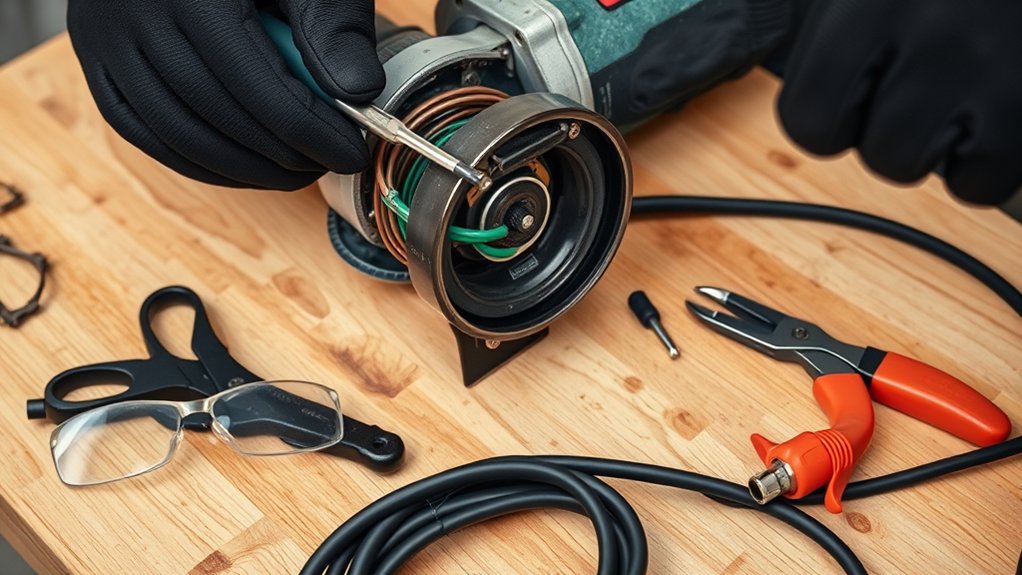
Replacing an angle grinder power cord can make a damaged tool safer to use, but it is not just a cosmetic repair. You are working on a corded tool that connects to mains voltage, so the cord, plug, strain relief, wire routing, switch connections, and grounding system must all match the original design. If you are not comfortable identifying these parts, stop and use an authorized repair shop.
Quick Answer
To replace an angle grinder cord safely, unplug the grinder, match the replacement cord to the original gauge, voltage rating, plug type, insulation, and strain relief, then reconnect each wire exactly as designed. Inspect for exposed copper, pinched wires, and weak clamps before doing a controlled no-load test.
Key Takeaways
- Unplug the grinder and keep it unplugged until the housing is fully closed and all checks are complete.
- Use an OEM or manufacturer-approved cord that matches the original cord rating, wire count, plug type, jacket, and strain relief.
- Never tape over damaged insulation, remove a ground pin, bypass the switch, or force a cord that does not fit the clamp.
- After replacement, check wire routing, strain relief, continuity, grounding if present, and tool operation before grinding.
At a Glance
| Time Required | 20 to 45 minutes for a simple cord swap, longer if the strain relief, switch, or terminals are damaged |
| Difficulty | Moderate, because the repair affects electrical safety |
| Tools Needed | Screwdrivers, wire strippers, wire cutters, multimeter, insulated gloves, safety glasses, replacement cord, and matching strain relief if needed |
| Cost | Usually $10 to $40 for a cord or cord set, more if a switch or housing part is damaged |
Warning: Do not open or repair a plugged-in grinder. If this is a workplace tool, electrical testing and return-to-service checks may need to be done by a qualified person under your employer’s safety program. A damaged corded grinder should stay out of service until it has been repaired and tested.
Why Angle Grinder Cord Replacement Safety Matters
A damaged angle grinder cord can expose you to shock, burns, short circuits, and fire. OSHA says portable cord-and-plug equipment should be visually inspected for damage before use, and damaged equipment that could expose a worker to injury must be removed from service until repairs and tests make it safe. You can review the rule in OSHA 1910.334.
The risk is higher with grinders because the cord is often dragged across sharp metal, hot workpieces, sparks, oily floors, and abrasive dust. A small crack in the jacket can become a cut conductor. A loose cord clamp can pull on the switch terminals. A wrong replacement cord can overheat if it is too light for the tool’s current draw.
The safest repair keeps the grinder as close as possible to the manufacturer’s original design. That means the same wire count, proper gauge, correct plug type, correct jacket rating, secure terminals, and a working strain relief that grips the cord jacket.
When Should You Replace an Angle Grinder Cord?
Replace the cord or remove the grinder from service if you see any of these problems:
- Cracked, cut, melted, brittle, or missing outer jacket
- Frayed insulation or any exposed copper
- A plug that is loose, burned, cracked, bent, or missing a ground pin
- A cord that gets hot during normal use
- Intermittent power when you flex the cord near the plug or tool housing
- Damage where the cord enters the grinder body
- Arcing, buzzing, burning smell, or tripped breakers during use
Do not patch a grinder cord with tape and keep working. The U.S. Consumer Product Safety Commission warns against inadequate repairs such as taping damaged insulation on extension cords, and the same safety logic applies to tool cords that see vibration, heat, and pulling force.
Choose the Correct Replacement Cord
Start with the model number and parts diagram for your grinder. An OEM cord or manufacturer-approved replacement is the safest choice because it is sized for the motor load, housing opening, strain relief, and switch terminals.
Match these details before you install anything:
- Wire gauge: Use the original AWG size or the exact manufacturer-approved cord. Do not downsize the wire.
- Voltage and amp rating: The cord and plug must handle the grinder’s nameplate rating.
- Wire count: A grounded three-prong grinder needs a grounding conductor. A double-insulated two-prong grinder should keep the original two-conductor design.
- Jacket type: Use a flexible, abrasion-resistant cord suitable for portable power tools.
- Plug type: Never cut off a ground pin or force a plug into the wrong receptacle.
- Strain relief: The clamp, bushing, or molded relief must fit the new cord and grip the outer jacket securely.
Note: Wire colors can vary by country and tool design. In many 120-volt U.S. tools, black is hot, white is neutral, and green is ground. In many IEC-style cords, brown is live, blue is neutral, and green-yellow is protective earth. Do not rely on color alone if the tool has been repaired before.
Products Worth Considering

Widely used: for Makita various models and other power tool power cord repair,rubber strain relief as well (please check the connector)

Widely used in drills, sanders, chop saws, grinders, vacuum cleaners, miter saws, electrical appliances, motors and power tools Rebuild Skills Replacement Power Tool Cord

【SUITABLE FOR A WIDE RANGE OF POWER TOOLS】Replacement power cords for drill bits, miter saws, chopper saws, table saws, sanders, grinders, grinders, vacuum cleaners, shop floor vacuum cleaners, kitchen appliances, lights, compressors, motors, and power tools.
Must-Have Tools and Personal Protective Equipment for Cord Replacement
Gather everything before you open the grinder. A rushed cord swap is when wires get pinched, screws go missing, and strain reliefs are forgotten.
- Correct replacement cord or OEM cord set
- Matching strain relief, cord clamp, or grommet if the old one is cracked or loose
- Phillips, Torx, or flat screwdrivers that match the housing screws
- Wire cutters and wire strippers
- Multimeter for continuity and short checks
- Needle-nose pliers for terminals
- Insulated gloves and safety glasses
- Small tray for screws
- Phone camera for reference photos before disconnecting wires
Keep the wheel, guard, and side handle in safe condition. OSHA requires abrasive wheels on portable grinders to be used on machines with safety guards, and guard position matters during operation. You can check the relevant grinder guard rule in OSHA 1910.243.
Products Worth Considering

【Value Sets】The grinder nut set includes 1 angle grinder wrench and 6 angle grinder nuts (3 inner flange nuts, 3 outer flange nuts). Please check size and compatibility before ordering. Please contact us with any questions or concerns. We prioritize your satisfaction .

Angle Grinder Wrench & Nut Kit, 7-Piece Set: Includes 1 grinder wrench and 6 flange lock nuts (3 inner, 3 outer) for quick wheel changes and arbor nut replacement on 4-1/2", 5", and 7" grinders.
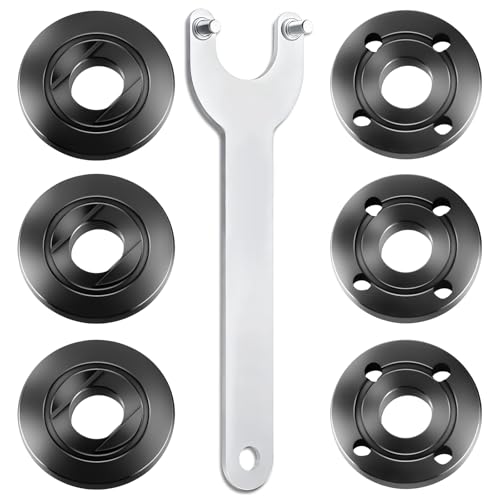
WHAT YOU GET: Includes 1 extended angle grinder wrench and 6 thickened-design flange nuts (3 inner nuts + 3 outer nuts), always have spare nuts to avoid downtime.
How to Replace Your Angle Grinder Cord Safely
- Unplug the grinder. Confirm the plug is out of the outlet before you touch screws, wires, or terminals.
- Remove the wheel or accessory if needed. This gives you a safer tool to handle while the housing is open. Keep the guard and hardware together.
- Open the handle or rear housing. Use the correct screwdriver so you do not strip the screws or crack the plastic housing.
- Take clear photos. Photograph the switch terminals, cord routing, ground connection if present, strain relief, and wire positions before disconnecting anything.
- Inspect the inside of the tool. Look for burned terminals, melted insulation, cracked housings, loose switch parts, carbon dust buildup, or damaged brush leads. If you see heat damage, stop and use a repair shop.
- Release the strain relief. Loosen the cord clamp, bushing, or molded retainer. The strain relief should grip the outer jacket, not the individual conductors.
- Disconnect the old cord. Remove the conductors from the switch, terminal block, or ground point exactly as designed. Do not cut internal leads shorter unless the manufacturer’s service instructions say to.
- Prepare the new cord. Strip only enough outer jacket and insulation to match the original setup, often about 3/8 to 1/2 inch at the terminal. Avoid nicking the copper strands.
- Connect each conductor. Put each wire back on the same type of terminal or connection point shown in your photos and parts diagram. A grounded tool must keep the ground conductor on the proper grounding terminal.
- Route the wires safely. Keep wires away from the motor fan, armature, brush holders, switch movement, screw bosses, and housing seams.
- Secure the strain relief. Tug gently on the cord outside the housing. The clamp should hold the jacket firmly without sliding or crushing it.
- Close the housing. Make sure no wires are pinched. Tighten screws evenly and reinstall any guard, handle, or accessory parts according to the manual.
Pro Tip: If the new cord is thicker than the original and the housing will not close cleanly, do not force it. Use the correct cord set or replacement strain relief instead of pinching the jacket inside the case.
Avoid These Mistakes: Checking Your Angle Grinder Cord
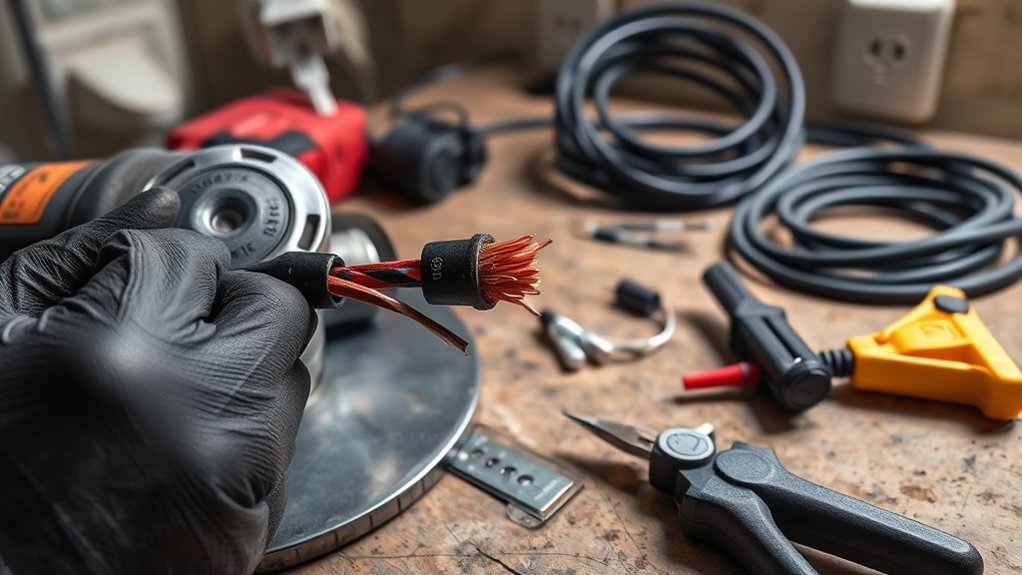
Most cord-replacement mistakes happen because the repair looks simple from the outside. Before you use the grinder, check for these common problems:
- Taping over damage: Tape is not a proper repair for cracked or cut insulation on a tool cord.
- Wrong cord gauge: A lighter cord can heat up under motor load.
- No strain relief: If the cord pulls directly on the switch terminals, the repair is unsafe.
- Pinched wires: A housing screw or plastic rib can cut insulation after the grinder vibrates.
- Defeated ground: Never remove a ground pin or leave a ground conductor disconnected on a grounded tool.
- Loose plug fit: A plug that wiggles or heats up can signal a worn plug or receptacle.
- Long, light-duty extension cord: Too much length or too small a gauge can cause voltage drop and heat.
The Electrical Safety Foundation International advises matching the extension cord rating to the tool load, avoiding damaged cords, and not using extension cords as permanent wiring.
What Should You Check After Replacing Your Angle Grinder Cord?
Do these checks before grinding anything:
- Visual check: Confirm the housing is fully closed, screws are seated, and no copper or inner insulation is exposed outside the tool.
- Tug test: Pull gently on the cord near the entry point. The jacket should not move inside the housing.
- Switch check: Make sure the switch is off before plugging in the grinder.
- Continuity check: Use a multimeter to confirm each conductor has continuity from plug to terminal.
- Ground check if present: On a three-prong grounded tool, confirm the grounding conductor is continuous and connected to the proper point.
- Short check: Confirm there is no continuity between hot and neutral when the switch is off, and no unintended continuity from live conductors to exposed metal parts.
- No-load test: Plug the grinder into a properly rated outlet, hold it firmly, stand clear of the wheel path, and run it briefly without contacting the workpiece.
- Heat and smell check: Unplug it and feel near the plug and cord entry. Stop using it if you notice heat, arcing, buzzing, smoke, or a burning odor.
For construction workplaces, OSHA requires ground-fault protection through GFCIs or an assured equipment grounding conductor program for certain 120-volt, single-phase, 15- and 20-amp receptacles. OSHA also requires visual inspection and grounding tests in that program before equipment returns to service after repairs. See OSHA 1926.404 for the full workplace rule.
Extension Cord and Outlet Safety for Angle Grinders
A new grinder cord will not help if the outlet or extension cord is unsafe. Use the shortest properly rated extension cord that fits the job, keep it out of the grinding path, and do not run it through water, under rugs, through doorways, or under heavy objects.
The CPSC warns that extension cords can overheat when overloaded or damaged, and that damaged extension cords should be replaced. The same inspection habit is useful for grinder cords: check the plug, jacket, and full cord length before each job.
- Use outdoor-rated cords outdoors.
- Match the extension cord amperage and gauge to the grinder’s nameplate load.
- Do not daisy-chain extension cords.
- Do not use a cord that feels hot during use.
- Keep the cord behind you and away from sparks, cut lines, and sharp scrap.
- Use GFCI-protected power where required or where damp conditions increase shock risk.
When to Stop and Use a Repair Shop
A cord replacement is not worth the risk if the damage goes beyond the cord. Stop and take the grinder to a repair shop if you find:
- A cracked housing near the cord entry
- Burned switch terminals or melted plastic
- Loose brush holders or damaged brush leads
- A missing, broken, or unavailable strain relief
- Unknown wire routing from a past repair
- A grinder that trips a breaker or GFCI after the new cord is installed
- Any wiring you cannot identify with confidence
NIOSH warns that uncontrolled electrical, mechanical, and other hazardous energy during repair work can cause serious injury or death, which is why service work needs careful energy control and safe procedures. You can read the NIOSH alert on preventing injuries from hazardous energy.
Frequently Asked Questions
What are the safety precautions when using an angle grinder?
Wear safety glasses or a face shield, hearing protection, gloves suited to the task, and nonflammable clothing. Use the side handle and guard, match the wheel to the grinder speed, clamp the work, stand out of the wheel path, and keep the cord behind the tool.
What are 10 safety precautions before using a grinding machine?
Before using a grinder, inspect the cord, plug, guard, handle, wheel, flanges, switch, extension cord, work area, and PPE. Do not use the grinder if the cord is damaged, the guard is missing, the wheel is cracked, or the plug gets hot.
How do you use an angle grinder step by step?
Install the correct wheel, set the guard between you and the wheel, attach the side handle, inspect the cord, plug into a rated outlet, let the wheel reach full speed, contact the work lightly, keep two hands on the tool, and let the wheel stop before setting it down.
What are the OSHA requirements for angle grinders?
For workplaces, OSHA requires employers to keep tools in safe condition, inspect portable cord-and-plug equipment, remove damaged equipment from service, and use proper guards on portable abrasive wheels. Construction sites may also require GFCI protection or an assured equipment grounding conductor program.
Can I tape a damaged angle grinder cord?
No. Tape is not a safe permanent repair for a damaged power-tool cord. Replace the cord with the correct cord set or remove the grinder from service until it can be repaired properly.
Can I use a two-prong cord on a three-prong grinder?
No. If the grinder was built with a three-prong grounded cord, the replacement must keep the equipment grounding conductor and proper plug. Only use a two-prong cord on a tool that was originally designed as a two-prong double-insulated tool.
What gauge cord should I use for an angle grinder?
Use the OEM replacement cord or match the original cord gauge and rating. Do not install a smaller wire gauge than the original. If you are unsure, check the parts diagram or contact the manufacturer before using the grinder.
Conclusion
Replacing an angle grinder cord safely means more than swapping old wire for new wire. Match the original cord, keep the grounding design intact, secure the strain relief, route the wires away from moving parts, and test the grinder before putting it back to work. If the repair raises any doubt, the safest move is to use a qualified repair shop and keep the damaged grinder out of service.
Sources
- OSHA 1910.334, Use of Equipment — supports portable cord-and-plug inspection, damaged equipment removal, grounding, and qualified testing guidance
- OSHA 1910.243, Guarding of Portable Powered Tools — supports portable grinder guard requirements
- OSHA 1926.404, Wiring Design and Protection — supports construction-site GFCI and grounding conductor program guidance
- U.S. Consumer Product Safety Commission, Household Extension Cords Can Cause Fires — supports damaged cord, overloading, temporary use, and no-tape repair guidance
- Electrical Safety Foundation International, Extension Cord Safety Tips — supports extension cord rating, temporary use, and damaged cord precautions
- NIOSH, Preventing Worker Deaths from Uncontrolled Release of Hazardous Energy — supports hazardous energy caution during repair work