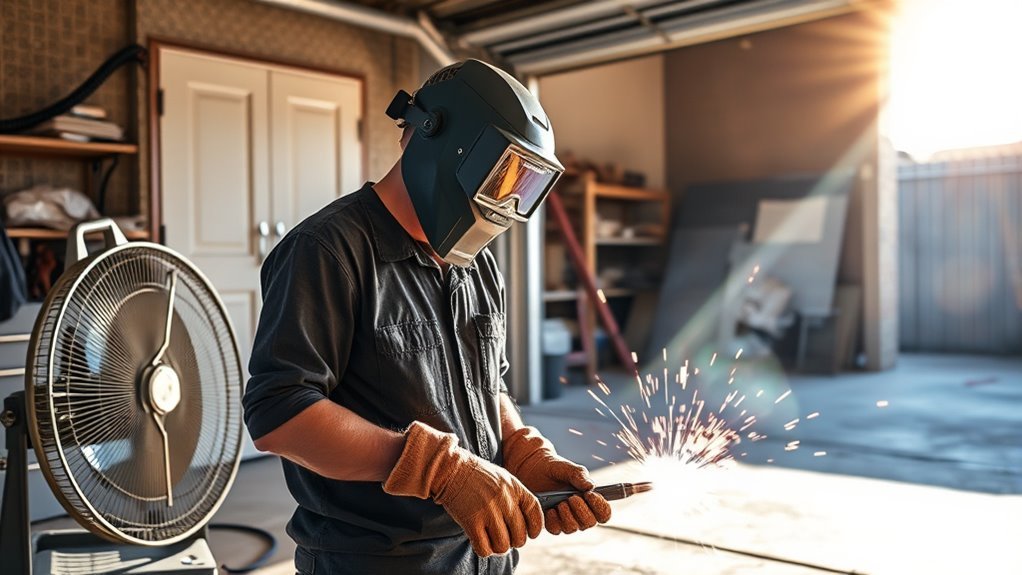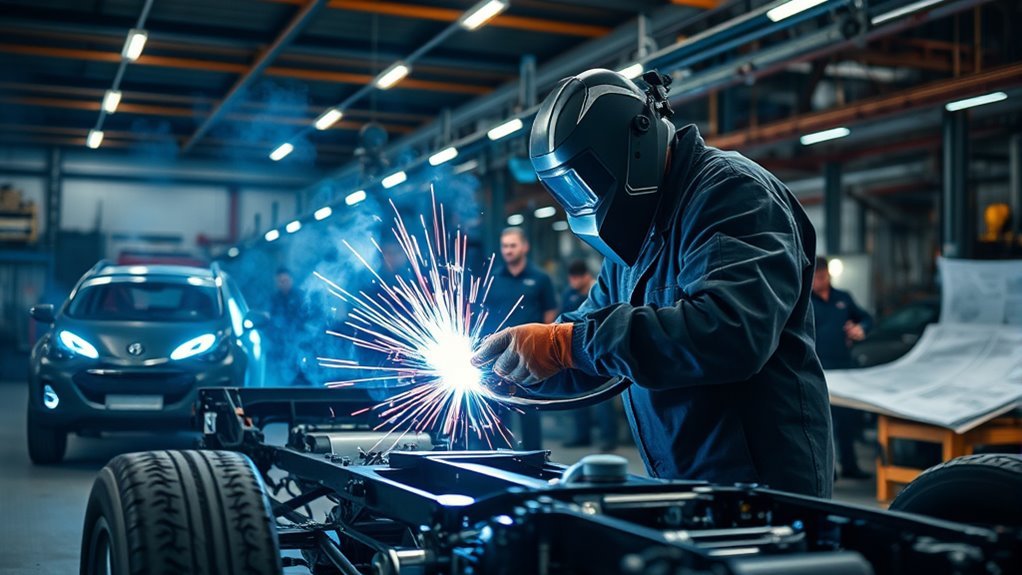
Automotive welding can lead to a hands-on career in collision repair, restoration, manufacturing, fleet maintenance, and custom fabrication. You’ll use processes such as MIG, TIG, resistance spot welding, and flux core to repair or build vehicle structures, body panels, brackets, exhaust parts, and specialty components. To succeed, you need safe work habits, heat control, material knowledge, and the ability to follow OEM repair procedures.
Quick Answer
Automotive welding is a practical career path if you like vehicle repair, metalwork, and shop-based problem solving. Most welders start with a high school diploma or GED, technical training, and hands-on practice. Certifications from AWS or I-CAR can improve credibility, especially for collision repair, structural work, aluminum welding, and robotic welding roles.
Key Takeaways
- Automotive welders repair, join, and fabricate vehicle metal parts, from thin body panels to structural components.
- MIG welding is common in repair and fabrication, while TIG is useful for cleaner, precise work on aluminum and thin materials.
- Safety matters because welding can expose you to fumes, UV radiation, burns, eye injury, electrical shock, and fire risks.
- AWS and I-CAR credentials can help prove skill, but employers may also require shop-specific or OEM-specific training.
- The U.S. median annual wage for welders, cutters, solderers, and brazers was $51,000 in May 2024, with pay varying by skill, location, industry, and overtime.
What Automotive Welders Do
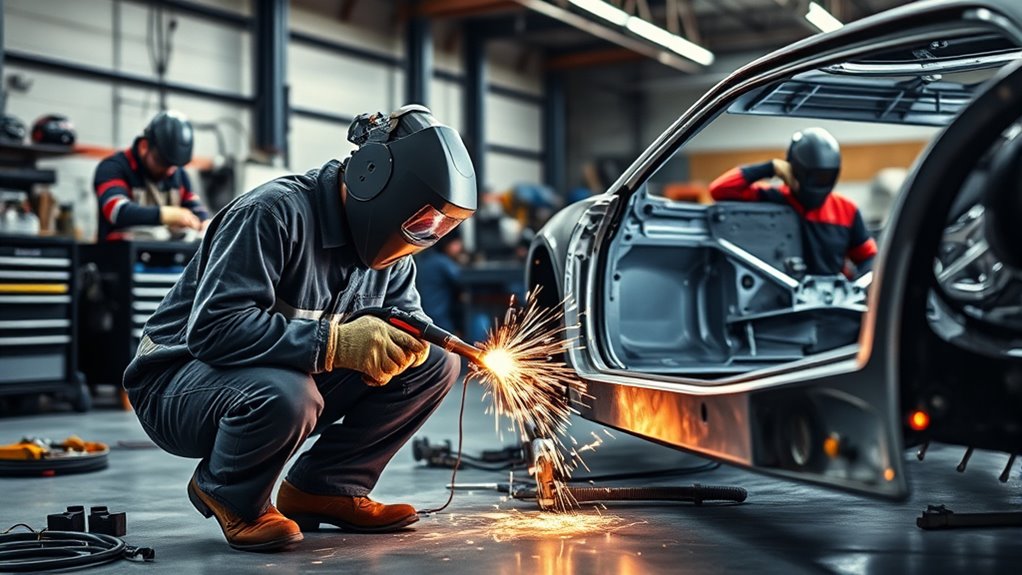
Automotive welders join, repair, and reshape metal components used in cars, trucks, specialty vehicles, trailers, and fleet equipment. In a repair shop, you may restore collision damage, attach replacement panels, repair brackets, or help return structural parts to approved repair specifications. In a fabrication shop, you may build custom mounts, exhaust parts, roll cages, patch panels, or performance components.
Automotive welding is not just about making metal stick. The real skill is choosing the right process, controlling heat, protecting the vehicle, and producing a repair that is strong, clean, and safe.
You use welding to restore safety, alignment, fit, and durability across vehicle systems. Daily tasks can include reading repair information, checking material type, cleaning metal, setting up equipment, clamping parts, running test welds, inspecting beads, and correcting fitment problems before final assembly.
Precision matters because vehicle metals vary. Mild steel, high-strength steel, galvanized steel, stainless steel, and aluminum all respond differently to heat. Your welding technique must match the metal, joint design, thickness, and repair procedure so you can avoid distortion, burn-through, cracking, porosity, and weak seams.
Surface preparation is also part of the job. For example, understanding the importance of removing zinc coating before welding is crucial for cleaner welds and safer fume control when working near galvanized metal.
Automotive Welding Processes You Should Know
Most automotive welding careers start with a few core processes. You do not need to master every process on day one, but you should understand where each one fits.
| Process | Common Automotive Use | Why It Matters |
|---|---|---|
| MIG / GMAW | Body panels, brackets, fabrication, steel repairs | Fast, common, and easier to learn than TIG for many shop tasks |
| TIG / GTAW | Aluminum, stainless, thin material, visible custom work | Offers strong control and clean weld appearance |
| Resistance spot welding | Factory-style panel joining and collision repair | Often required for modern structural panel repairs |
| Flux core / FCAW | Thicker steel, outdoor repair, equipment work | Useful where wind or heavier material makes solid-wire MIG harder |
| Robotic or automated welding | Manufacturing, high-volume parts, production cells | Helps you move into advanced manufacturing and automation roles |
Understanding welding parameters will help you choose better settings for wire speed, voltage, amperage, travel speed, shielding gas, and material thickness.
Products Worth Considering

[Pure Copper Material] The 4ga battery cable is made of high-precision pure copper material (red cable positive, black cable negative) with extremely high conductivity and low loss, which can easily achieve parallel/series connection of dual batteries in trucks, RVs, and ships, ensuring stable and reliable power transmission.


Package Contents: You will receive 5 pieces of plastic reinforcing stainless steel wire mesh screen
Skills and Training for Automotive Welding
You’ll need hands-on training in MIG, TIG, resistance spot welding, and basic arc welding, plus a strong grasp of safety, fit-up, metallurgy, measuring, and blueprint reading. The U.S. Bureau of Labor Statistics says welders, cutters, solderers, and brazers typically need a high school diploma or equivalent, along with technical and on-the-job training.
Training can come from a trade school, community college, high school technical program, apprenticeship, military program, employer training, or a combination of these paths. For collision repair, I-CAR welding training is especially relevant because vehicle repairs often involve OEM and insurer network requirements.
Products Worth Considering

Crafted with precision, our steel plates are laser-cut, offering unparalleled edge smoothness and dimensional accuracy compared to stamped and sheared parts.

Fun and Functional Dachshund Design: turn practice into art! This welding practice kit lets you craft a charming 3D dachshund (sausage dog) sculpture; Once completed, it serves as an ideal desk decor piece or handmade gift, ideal for Father's Day, birthdays, and holiday gifting for welding enthusiasts and dog lovers alike

🎲Superior Processing: Our steel plates are all laser-cut, providing edge and overall flatness that is unmatched by other stamped and sheared components.
Core Welding Techniques
Core automotive welding skills center on clean preparation, stable body position, correct machine setup, and heat control. MIG welding is often the first process new automotive welders learn because it is common in steel repair and fabrication. TIG welding takes more coordination but can produce precise welds on aluminum, stainless steel, and thin materials.
- Control heat input to reduce panel warping and burn-through.
- Read material type before you strike an arc.
- Select the correct filler, shielding gas, and settings for steel or aluminum.
- Practice plug welds, lap joints, butt joints, and fillet welds on scrap before vehicle work.
- Inspect bead shape, penetration, porosity, undercut, and fit-up after every practice weld.
With focused practice, you can choose the right process, avoid weak repairs, and build durable seams that restore form and function.
Safety and Materials
When you weld vehicles, safety and material knowledge go hand in hand. You need to protect the electrical system, control fire risk, and manage fumes while working around paint, seam sealer, insulation, fuel residue, adhesives, batteries, airbags, sensors, and vehicle wiring.
Warning: Welding can expose you to metal fumes, ultraviolet radiation, burns, eye damage, electrical shock, fire, and other hazards. Follow OSHA rules, wear proper PPE, ventilate the work area, remove flammable materials, protect vehicle electronics, and follow the vehicle maker’s repair procedure before welding on any structural part.
The Occupational Safety and Health Administration lists welding hazards such as metal fumes, UV radiation, burns, eye damage, electrical shock, cuts, and crushed toes or fingers. In automotive work, you should also isolate or protect the battery and nearby electronics, keep a fire extinguisher nearby, remove coatings where required, and avoid welding near fuel, vapor, or hidden trim materials.
Your training should also teach how different materials behave. Advanced high-strength steels may lose strength or crack if repaired the wrong way. Aluminum dissipates heat quickly and needs clean preparation. Galvanized steel can release hazardous zinc fumes if coatings are heated without proper controls.
Certifications and Career Advancement
Certifications can help your automotive welding career, but they are not all the same. A certification usually proves you can meet a specific test, procedure, process, material, position, or inspection standard. It does not automatically qualify you for every welding task.
- AWS Certified Welder: The AWS Certified Welder Program is performance-based and does not require prerequisite courses or certifications before testing.
- AWS Certified Welding Inspector: The AWS CWI credential is more advanced and focuses on welding inspection, quality, processes, and standards.
- AWS Certified Robotic Arc Welding: The AWS CRAW program can help welders move toward robotic welding operator or technician roles.
- I-CAR welding certification: I-CAR welding training and certification is especially useful in collision repair, including steel GMA welding, steel sectioning, and aluminum GMA welding.
- Employer or OEM-specific qualification: Many shops require you to prove skill on their equipment, materials, and repair procedures before structural work.
When you stack training carefully, you build stronger options. You can move from entry-level panel preparation into structural repair, aluminum work, custom fabrication, inspection, shop leadership, or robotic welding support.
Common Automotive Welding Jobs
Common automotive welding jobs span several shop and production roles. Some jobs are focused on repair, while others lean toward fabrication or manufacturing. You may start by preparing metal, cleaning panels, setting up fixtures, and running simple welds under supervision. As your skills grow, you can take on structural repairs, custom builds, or advanced materials.
| Job | Core Task | Best Fit |
|---|---|---|
| Body Repair Technician | Repair collision damage and replace welded panels | Safety, fit, factory-style repairs |
| Structural Repair Technician | Restore frame, rail, pillar, and structural parts | OEM procedures and measurement accuracy |
| Custom Fabrication Welder | Build brackets, mounts, cages, panels, and specialty parts | Performance, style, problem solving |
| Restoration Welder | Preserve or rebuild vintage vehicle metalwork | Accuracy, patience, authenticity |
| Exhaust or Performance Welder | Weld tubing, hangers, stainless parts, and custom systems | TIG practice and clean fit-up |
| Production Welder | Join repeat parts in a manufacturing setting | Speed, consistency, process control |
| Robotic Welding Operator | Load parts, monitor weld cells, and support automated production | Automation and manufacturing |
Each role shapes your earning potential through speed, accuracy, material knowledge, and the ability to pass weld tests. Understanding MIG welding advantages can also help you improve efficiency and weld quality on many automotive and fabrication tasks.
Useful Automotive Welding Certifications
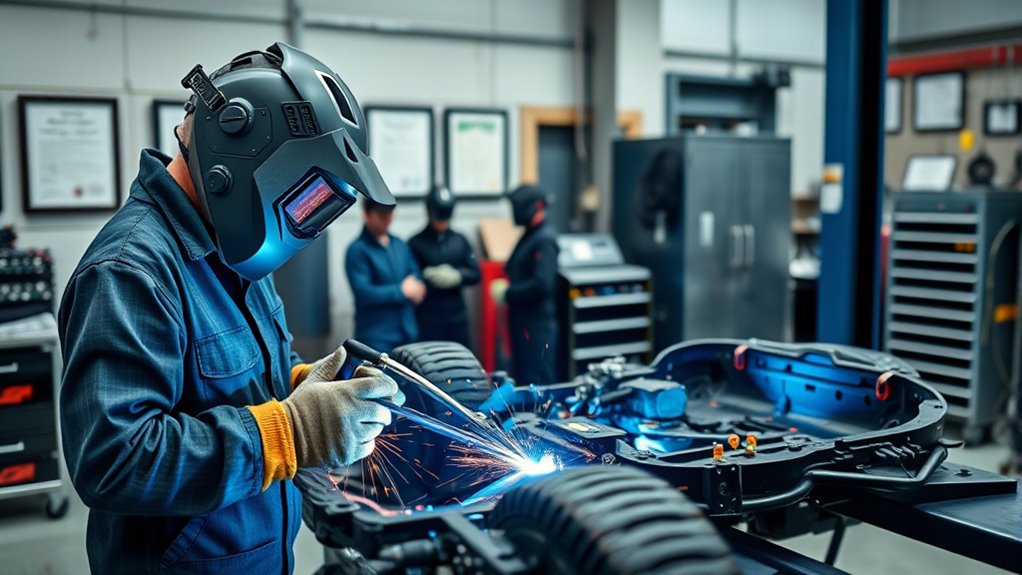
If you want to build credibility in automotive welding, choose certifications that match the job you want. A collision repair shop may care more about I-CAR steel and aluminum welding certification. A fabrication employer may value AWS performance qualifications. A manufacturing plant may value robotic welding experience or production welding tests.
Start with the most practical credential for your target role:
- For entry-level proof of welding skill: AWS Certified Welder can validate your ability to produce acceptable welds under a specific procedure.
- For collision repair: I-CAR welding certification is highly relevant because it focuses on steel and aluminum repair skills used in body shops.
- For inspection or quality control: AWS CWI is a stronger long-term goal after you gain real welding experience.
- For manufacturing advancement: AWS CRAW or robotic welding training can help you move toward automation roles.
- For structural work: learn the code, material, and position requirements your employer or project uses.
Additionally, understanding weld strength calculations is useful when you need to understand load, joint design, and why some repairs require exact procedures.
Many employers prefer or require certification because it reduces risk and gives them a clearer way to judge your skills. Still, certification is not a shortcut around practice. You must keep training, document your work, and stay current as vehicle materials and repair methods change.
Where Automotive Welders Work
You’ll find automotive welders in auto repair shops, collision centers, fabrication shops, restoration garages, manufacturing plants, motorsports shops, fleet maintenance facilities, dealerships, and specialty equipment companies. Some welders stay close to passenger vehicles, while others use automotive skills in heavy equipment, trailers, marine repair, or defense-related vehicle work.
Auto Repair Shops
Auto repair and collision shops are major workplaces for automotive welders. In these settings, you may replace panels, repair mounting points, weld brackets, section steel parts, or restore damaged structures to approved repair procedures.
Many shops use MIG, squeeze-type resistance spot welding, and aluminum welding systems. Your job is not only to make a neat bead. You must inspect damage, identify materials, confirm repair methods, control heat, protect nearby parts, and verify alignment before the vehicle returns to the road.
- Inspect damage before welding.
- Match the process to the material.
- Follow OEM repair information.
- Control heat input carefully.
- Test and inspect repairs for integrity.
Manufacturing and Fabrication
In manufacturing and fabrication, you may work on assembly lines, fixtures, subframes, brackets, trailers, aftermarket parts, or custom components. These jobs reward repeatability. You need to hold tolerances, keep welds consistent, and follow written procedures.
| Setting | Work Focus | Outcome |
|---|---|---|
| Manufacturing | Repeat welds on vehicle parts or assemblies | Consistent production quality |
| Fabrication | Custom parts, brackets, cages, mounts, and panels | Unique modifications and repair solutions |
| Repair | Panel replacement and structural restoration | Safer, cleaner vehicle repairs |
Your welding career can stay flexible if you keep improving. A welder who understands both hand welding and automated welding systems can be valuable in modern vehicle manufacturing.
Marine and Heavy Equipment
Marine and heavy equipment work can take your welding career beyond passenger vehicles. Shipyards, equipment plants, repair docks, trailer shops, and fleet operations rely on durable welds to keep large structures safe and functional.
In these settings, you may join thicker steel, aluminum, or other alloys while following stricter inspection and documentation requirements. You may fabricate or repair excavators, bulldozers, trailers, service bodies, utility vehicles, or specialty fleet equipment. Understanding flux core welding can help when working on thicker steel or outdoor jobs where shielding gas is harder to control.
- Read blueprints and repair procedures carefully.
- Check material thickness and alloy type.
- Control preheat and heat input when required.
- Inspect welds before the part returns to service.
- Document work when the employer or project requires it.
Automotive Welding Salary and Outlook
Automotive welding pay depends on your skill level, region, industry, certifications, overtime, and whether you work in repair, fabrication, manufacturing, or a specialty role. The BLS groups welders, cutters, solderers, and brazers together. For that broader occupation, the median annual wage was $51,000 in May 2024, or $24.52 per hour.
The same BLS data shows the lowest 10 percent earned less than $38,130, while the highest 10 percent earned more than $75,850. Those figures do not guarantee what every automotive welder will earn, but they give a useful national benchmark.
The job outlook is steady rather than explosive. BLS projects 2% employment growth from 2024 to 2034 for welders, cutters, solderers, and brazers. Even with limited growth, it projects about 45,600 openings per year on average, mostly because workers transfer to other jobs or leave the labor force.
You can improve your earning potential by building skills in structural collision repair, aluminum welding, stainless fabrication, robotic welding, inspection, blueprint reading, and high-quality TIG work. Pay can also rise with overtime, shift work, production incentives, shop leadership, mobile welding, or specialized fleet and heavy equipment work.
If marine, offshore, or specialty welding interests you, learning about commercial diving training can show how pay, risk, certification, and working conditions change outside standard automotive repair.
How to Start an Automotive Welding Career
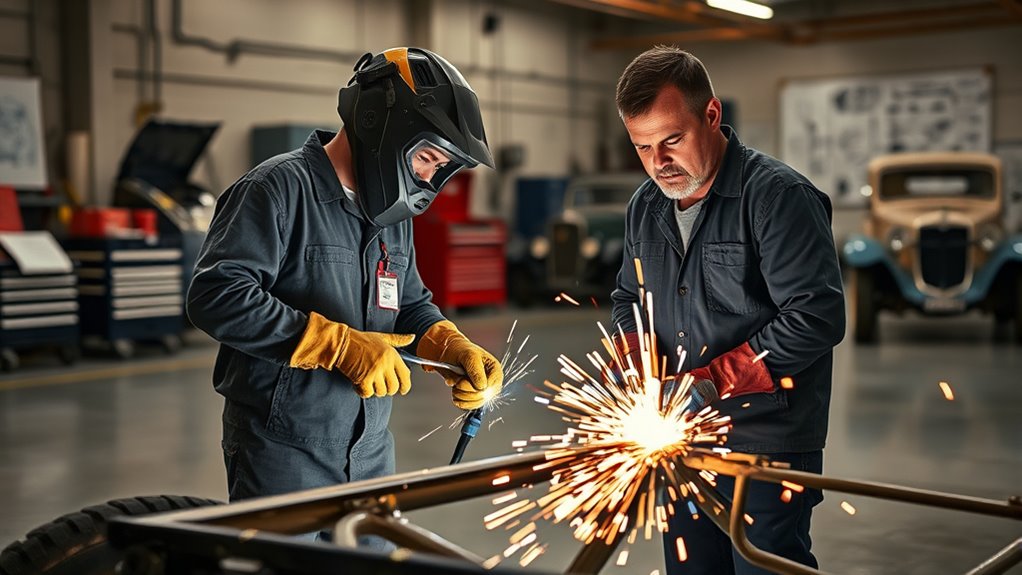
To start an automotive welding career, build a foundation with a high school diploma or GED, then move into a focused welding program, collision repair program, apprenticeship, or entry-level shop role. You should practice MIG, TIG, resistance spot welding basics, metal prep, joint fit-up, measuring, and safe equipment setup.
From there, sharpen your specialized skills by studying metallurgy, blueprint reading, vehicle repair information, aluminum handling, and heat control. Pursue certifications through AWS or I-CAR when they match your target job. A welding certificate can also improve your job prospects by showing employers that you have completed structured training.
Pro Tip: Keep a small photo portfolio of practice welds, test coupons, fabrication projects, and finished repairs. Employers can learn a lot from clear photos that show fit-up, bead consistency, grinding discipline, and finished quality.
- Take shop math, blueprint reading, and basic electrical courses if available.
- Practice on scrap metal before welding real vehicle parts.
- Ask local collision shops which certifications they value most.
- Seek apprenticeships or entry-level roles in body repair, fabrication, manufacturing, or fleet maintenance.
- Learn advanced high-strength steel and aluminum repair limits.
- Maintain safe, disciplined work habits every day.
- Keep upgrading your skills as vehicle materials and repair tools evolve.
With each project, you’ll build better judgment. That judgment is what separates a beginner who can run a bead from a professional who can make safe, repeatable, and repair-ready welds.
Frequently Asked Questions
Is automotive welding a good job?
Yes, automotive welding can be a good job if you enjoy hands-on repair, fabrication, and problem solving. It offers paths into collision repair, restoration, manufacturing, custom work, fleet maintenance, and specialty equipment. The best opportunities usually go to welders who keep improving their safety habits, material knowledge, and certifications.
Can you make $100,000 as a welder?
Some welders can reach $100,000 or more, but it is not typical for every automotive welding role. Higher pay usually requires overtime, travel, specialized certifications, inspection skills, heavy industrial work, union work, mobile welding, advanced TIG, robotic welding, or high-demand locations. For the broader welder occupation, BLS reported a May 2024 median annual wage of $51,000.
Will AI or robots replace welding?
AI and robots will change some welding jobs, especially in high-volume manufacturing, but they will not remove the need for skilled welders. Repair shops, custom fabrication, restoration, inspection, setup, troubleshooting, and one-off repairs still need human judgment. Welders who learn automation can move into robotic welding operator or technician roles.
Why do some welders seem to age fast?
Welding can be physically demanding. Long hours, heat, awkward positions, fumes, UV exposure, noise, vibration, and stress can wear on the body if safety controls are weak. Good PPE, ventilation, work rotation, hydration, hearing protection, skin protection, and regular breaks can help protect long-term health.
Do you need certification to weld cars?
You do not always need a national certification for every basic shop task, but many employers require proof of skill before structural repairs. Collision repair shops may require I-CAR welding certification, OEM network training, or internal weld tests. AWS certification can also help prove welding ability for fabrication, manufacturing, and career advancement.
Conclusion
Automotive welding is a strong path if you want practical work that blends vehicle repair, metal fabrication, safety, and technical judgment. You can start with training, build shop experience, earn useful certifications, and target repair shops, manufacturing plants, fleet operations, or custom fabrication roles that match your goals.
The best welders keep learning. They follow safety procedures, respect OEM repair information, control heat, inspect their work, and stay current with steel, aluminum, and automation trends. With steady practice and the right credentials, you can turn strong welds into a durable automotive career.
Sources
- U.S. Bureau of Labor Statistics, Welders, Cutters, Solderers, and Brazers — wage data, education, training, job outlook, and projected openings.
- OSHA Welding, Cutting, and Brazing Hazards and Solutions — welding hazards, PPE, fumes, UV radiation, burns, electrical shock, and safety controls.
- American Welding Society Certified Welder Program — AWS Certified Welder eligibility, performance testing, and certification maintenance.
- American Welding Society Certified Welding Inspector Program — CWI credential purpose, inspection focus, and career advancement context.
- American Welding Society Certified Robotic Arc Welding Program — robotic welding certification and automation career path.
- I-CAR Welding Training and Certification — collision repair welding, steel GMA welding, steel sectioning, aluminum GMA welding, and OEM network relevance.