When you finish welding school, the certificate in your hand can feel both exciting and confusing. You have practiced joint preparation, arc control, fit-up, and safe shop habits—but you may still wonder which jobs you can apply for and what employers will expect next.
A welding certificate can help you qualify for entry-level fabrication, manufacturing, construction, repair, and apprenticeship opportunities. It can also be the first step toward pipe welding, inspection, aerospace work, boilermaking, automation, or a small welding business.
The key is knowing what the certificate proves, what it does not prove, and which additional tests or credentials each career path requires. That distinction keeps your job search realistic and helps you build skills that employers can use right away.
Quick Answer
With a welding certificate, you can pursue entry-level welding, fabrication, sheet-metal, repair, and apprenticeship roles. You may also build toward pipefitting, structural work, inspection, aerospace, boilermaking, automation, or self-employment. Most employers will still require a hands-on weld test, and code work may need a separate process-specific qualification.
Image credit: neit.edu
Key Takeaways
- A school completion certificate is not the same as an AWS Certified Welder credential or an employer qualification test.
- Common starting points include production welding, fabrication, repair, sheet metal, cutting, fit-up, and registered apprenticeships.
- Pay depends on location, industry, union status, shift, travel, overtime, and proven skill—not the certificate alone.
- Structural, pressure, pipe, aerospace, inspection, and underwater work usually require added training or project-specific qualification.
- Blueprint reading, measuring, fit-up, safety, documentation, and a clean weld test often matter as much as the school credential.
What a Welding Certificate Proves—and What It Does Not
The phrase welding certificate can describe more than one thing. A school may issue a certificate after you complete a training program. The AWS SENSE program, for example, gives schools a framework for teaching and assessing entry-level welding skills.
An AWS Certified Welder credential is different. It is earned through a performance test tied to a specific welding procedure, process, material, thickness range, and position. A person who passes one test is not automatically qualified for every process or job.
| Credential or Record | What It Shows | What May Still Be Required |
|---|---|---|
| School completion certificate | You completed a course or program | Employer weld test, experience, safety training, or code qualification |
| AWS Certified Welder credential | You passed a defined performance test | Continuity records and additional tests for other processes, positions, or procedures |
| Employer or project qualification | You can weld to that employer’s procedure or project code | Retesting when the procedure, essential variables, employer, or project changes |
Note: OSHA 10 is a voluntary outreach course, not a welding license or a substitute for the task-specific training an employer must provide. It can still strengthen a job application when local employers or projects request it.
Review the AWS Certified Welder Program
Entry-Level Jobs You Can Pursue With a Welding Certificate
Most new welders begin in production, fabrication, repair, construction support, or an apprenticeship. The best first role is not always the one with the highest advertised hourly rate. A shop that teaches print reading, fit-up, inspection, and several processes may give you a stronger long-term foundation.
| Path | Common Work | What Employers Often Check | May 2025 National Median* |
|---|---|---|---|
| Production or fabrication welder | Frames, brackets, trailers, machinery, and assemblies | MIG or flux-core test, print reading, fit-up, pace, and visual quality | $53,750 for welders, cutters, solderers, and brazers |
| Sheet-metal worker | Ductwork, architectural metal, seams, layout, and installation | Layout, measuring, thin-metal control, and sometimes apprenticeship entry | $61,800 |
| Cutting or fit-up technician | Sawing, plasma or oxy-fuel cutting, beveling, tacking, and assembly | Measurement, drawings, safe equipment use, and part accuracy | Varies by occupational classification |
| Maintenance or repair welder | Equipment, farm machinery, plant repairs, and worn components | Troubleshooting, material identification, safe disassembly, and process range | Varies by industry and job title |
| Apprentice | Paid field and classroom training in a trade such as ironwork, pipefitting, or boilermaking | Program eligibility, aptitude, physical requirements, interview, and drug-testing rules where applicable | Starts below journey-level pay and rises by program steps |
*These are broad national occupational medians from the BLS May 2025 Occupational Employment and Wage Statistics, not promised starting salaries. Local pay can be much higher or lower.
The Bureau of Labor Statistics projects about 45,600 openings per year for welders, cutters, solderers, and brazers from 2024 to 2034, mostly because workers leave the occupation or retire.
How to Turn Your Certificate Into Your First Welding Job
A certificate gets attention, but a clean test and dependable work habits get offers. Use this practical sequence:
- Read local job posts before choosing a specialty. Note the processes, positions, materials, shifts, travel, and certifications that appear most often.
- Build a one-page welding resume. List the processes, positions, materials, equipment, safety training, blueprint skills, and tests you have actually completed.
- Create a small portfolio. Use clear photos of representative coupons or projects. Add the process, material, position, and inspection result without exposing a former employer’s confidential work.
- Practice the likely test. Ask the recruiter what process and position are used. Do not assume your school settings will match the employer’s machine, joint, wire, gas, or procedure.
- Apply to apprenticeships as well as shops. The federal Apprenticeship.gov directory can help you find registered programs.
- Show up ready for basic shop math. Be prepared to read a tape, use a square, identify weld symbols, calculate simple dimensions, and explain how you prevent common defects.
- Follow up professionally. A short message thanking the tester and confirming your interest can separate you from equally skilled applicants.
Pro Tip: Keep a weld journal with the approved procedure, machine, consumable, position, inspection result, and lessons from each practice session. Do not record a number by itself; record the full setup so it has meaning.
Pipefitting, Structural Welding, and Fabrication Paths
A basic certificate can help you enter these fields, but it rarely qualifies you for code work by itself. Pipefitters and steamfitters often learn through apprenticeships that combine paid jobsite work with classroom instruction. The national median for plumbers, pipefitters, and steamfitters was $63,800 in May 2025, but apprentice rates, union scales, overtime, per diem, and regional demand can change take-home pay.
Structural welding may be performed under a code such as AWS D1.1, but D1.1 is a structural welding code—not a universal certificate every welder automatically receives. A contractor may qualify you to a specific welding procedure and range of variables before you touch production work.
Fabrication is broader. It may involve layout, cutting, forming, tacking, MIG, TIG, stick, flux-core, grinding, inspection, and assembly. Employers value welders who can make the whole part fit, not just run an attractive bead.
Warning: Never copy a bevel angle, preheat temperature, filler metal, polarity, amperage, voltage, or travel-speed rule from a general article into safety-critical work. Follow the approved welding procedure specification, project code, consumable data sheet, machine chart, and supervisor’s instructions.
Specialized Careers That Require More Training
Your certificate can be the first rung on the ladder, but specialized roles have added gates. Here is the realistic path:
| Career | What the Work Involves | What You Need Beyond a Basic Certificate |
|---|---|---|
| Boilermaker | Pressure vessels, boilers, tanks, heavy plate, rigging, maintenance, and shutdown work | Usually an apprenticeship, site safety training, rigging skills, and procedure-specific welding qualifications |
| Welding inspector | Visual inspection, code review, procedure verification, documentation, and coordination of nondestructive testing | Qualifying education and work experience, vision requirements, and the AWS CWI examinations or another employer-recognized inspection credential |
| Aerospace welder | Precision work on thin sections, stainless steel, aluminum, nickel alloys, titanium, and tightly controlled assemblies | Strong TIG skills, traceable documentation, employer or customer qualification, and strict quality-system compliance |
| Underwater welder | Commercial diving, inspection, cutting, rigging, and wet or dry hyperbaric work | Commercial-diver training, medical fitness, dive-safety credentials, employer qualification, and surface welding skill |
| Robotic welding technician | Cell setup, fixtures, programming, troubleshooting, consumable control, and quality checks | Automation, electrical, controls, programming, and preventive-maintenance skills |
The May 2025 national median for boilermakers was $76,410. There is no single reliable national median for “underwater welder” or “aerospace welder” because those labels can fall under different occupations, industries, travel arrangements, and pay systems. Treat six-figure claims as possibilities for limited assignments—not a normal starting salary.
Starting Your Own Welding Business
A welding certificate can support your credibility, but it does not automatically authorize every type of paid work. A small mobile or shop-based business may handle gates, brackets, noncritical fabrication, equipment repair, or farm work, while structural, vehicle, pressure, lifting, and public-project work can bring extra code, licensing, engineering, insurance, or inspection requirements.
- Choose a narrow service area. Start with work you can perform and inspect consistently.
- Check state and local rules. Confirm business registration, sales tax, contractor licensing, zoning, fire-code, and mobile-work requirements.
- Buy the right insurance. Discuss general liability, commercial auto, tools, completed operations, and workers’ compensation with a qualified agent.
- Write clear estimates. Define materials, finish, exclusions, schedule, payment terms, and who approves design changes.
- Control safety and quality. Use written procedures where needed, keep cylinders and hot work under control, and document inspections.
- Price the whole job. Include travel, setup, consumables, gas, grinding, cleanup, administration, rework risk, taxes, and profit—not only arc time.
Do not accept a safety-critical repair just because the customer says, “It only needs a quick bead.” When the design, material, loading, or failure history is unclear, stop and involve the manufacturer, engineer, or qualified specialist.
Products Worth Considering

SIZE DIMENSIONS - Special for 1/0 & 2/0 setups,compatible with trailer rigs and mobile welding trucks,This cover is designed to fit most 2 reels within this size range.For secure fit,please verify your reel's measurements before choosing.

1️⃣ Fits Dual Welding Lead Reels: Designed for double stacked welding cable reels, this heavy duty welding reel cover is ideal for 1/0 & 2/0 setups, compatible with trailer rigs and mobile welding trucks.

【DOT Certified & High-Visibility Safety】Engineered to meet strict DOT FMVSS 108 standards, this LED trailer light kit ensures your vehicle is road-legal and safe. Featuring premium high-output diodes, these lights provide crisp, glare-free illumination for stop, turn, tail, and side marker functions. With up to 5X the brightness of standard halogen bulbs, you’ll stay visible to other drivers even in heavy rain, thick fog, or midnight driving conditions.
Welding Processes and Tools to Build After Certification
The best next process depends on the employers and projects around you. Learn the process deeply enough to understand its limits instead of collecting shallow exposure to every machine.
| Process or Skill | Common Uses | What to Practice Next |
|---|---|---|
| MIG/GMAW | Production, light fabrication, automotive-related assemblies, and general shop work | Machine setup, contact-tip distance, joint fit-up, transfer modes, distortion control, and visual inspection |
| TIG/GTAW | Stainless steel, aluminum, tubing, sanitary work, aerospace, and precision fabrication | Torch angle, shielding, filler control, purge quality, heat input, cleanliness, and material-specific setup |
| Stick/SMAW | Construction, field repair, pipe, maintenance, and outdoor work | Arc length, electrode storage, restart quality, position work, slag control, and procedure compliance |
| Flux-core/FCAW | Structural fabrication, heavy production, shipbuilding, and field work | Wire classification, required shielding gas, polarity, gun angle, interpass cleaning, and fume control |
| Cutting, layout, and fit-up | Nearly every fabrication and repair job | Print reading, weld symbols, tolerances, squaring, sequencing, distortion control, and accurate tack-up |
Remember that not every flux-core wire is “gasless.” Some classifications require external shielding gas, while self-shielded products may use different polarity. Likewise, a low-hydrogen electrode such as E7018 does not remove the need for proper storage, joint preparation, and an approved procedure.
Warning: Welding can expose you to fumes, gases, ultraviolet and infrared radiation, electric shock, fire, explosions, noise, and hot metal. Review the OSHA welding, cutting, and brazing guidance, use the required PPE and ventilation, and follow your employer’s hazard controls.
Products Worth Considering

Crafted with precision, our steel plates are laser-cut, offering unparalleled edge smoothness and dimensional accuracy compared to stamped and sheared parts.
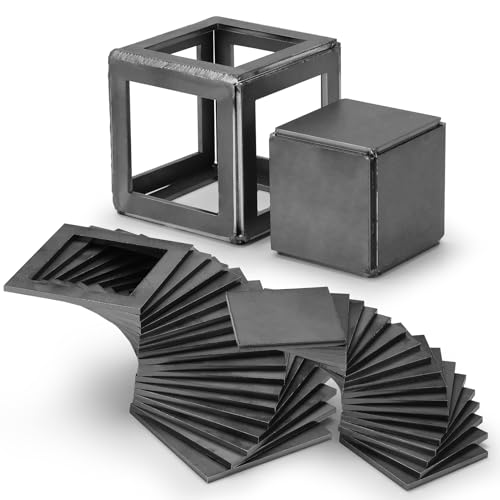
Quantity and size: Welding practice kit, with 18 of 3.6 inch, 18 of 2.6 inch, set of 36

COMPLETE PRACTICE SET: Includes 6 welding practice coupons, each 2" x 4" and 3 mm thick; compact mild steel plates form a convenient welding starter kit
How to Advance From Entry-Level Welder to Higher-Skill Work
There is no single national “master welder” license. Employers use that phrase differently, so focus on measurable skills and recognized qualifications.
- Broaden your positions and materials: Add skills only after you can repeat quality results in your current process.
- Learn prints and welding symbols: The person who can fit and sequence the assembly is more useful than the person who only runs beads.
- Understand inspection: Practice visual inspection, gauges, discontinuity terms, acceptance criteria, and clear documentation.
- Protect qualification continuity: Keep accurate records and submit any required maintenance on time.
- Add complementary skills: Rigging, machining, CAD, CNC cutting, robotics, supervision, estimating, and quality systems can widen your options.
- Choose the next credential for a real job: Do not pay for a certification until you know which employers, codes, or contracts recognize it.
A sensible path might be school certificate → entry-level shop or apprenticeship → employer qualification → broader position or process qualification → lead, specialist, inspector, supervisor, automation technician, or business owner. Your path can branch, but each step should build on work you can prove.
Conclusion
A welding certificate can open the door to production welding, fabrication, repair, sheet metal, apprenticeships, and several skilled-trade careers. It can also support a later move into pipe work, structural welding, boilermaking, inspection, aerospace, underwater work, automation, or self-employment.
What it cannot do is replace experience, a hands-on weld test, or the project-specific qualification required for code work. Build a clean portfolio, learn to read prints, practice the tests local employers use, protect your safety, and keep accurate qualification records. The certificate is your starting point; dependable, documented skill is what turns it into a career.
Frequently Asked Questions
Is a welding certificate enough to get a job without experience?
It can be enough to qualify for an interview, entry-level shop role, helper position, or apprenticeship. Many employers will still give you a practical weld test and check measuring, fit-up, blueprint, safety, and attendance skills. A strong school portfolio and honest list of completed processes can help offset limited work history.
How much does a welder with a certificate make in the United States?
The May 2025 national median for welders, cutters, solderers, and brazers was $53,750. That is not an entry-level guarantee. Location, industry, shift, overtime, travel, union agreement, process, and proven qualification can move actual pay far above or below the national median.
Can I start my own welding business with only a certificate?
You can start a business if you also meet local registration, tax, zoning, insurance, fire-safety, and contractor rules. The certificate does not qualify you for every repair or code project. Begin with work inside your proven skill range, use written estimates, and decline jobs whose design, material, load, or legal requirements are unclear.
What is the best welding process to learn first after certification?
Choose the process requested by employers in your area. MIG is common in production and general fabrication, stick is valuable for construction and field work, TIG supports precision and specialty materials, and flux-core is widely used in structural and heavy fabrication. Depth in one useful process is usually better than shallow practice in four.
Do I need to renew my welding certificate?
It depends on the credential. A school completion certificate may not expire. AWS Certified Welder status requires maintenance of continuity at six-month intervals. AWS CWI credentials follow their own renewal and recertification cycle. Employers and project codes may also require new tests when your procedure or work scope changes.
What is the difference between a welding certificate and a welding certification?
A certificate often shows that you completed training. A certification or performance qualification shows that you passed a defined test under stated variables. Employers may use the words loosely, so ask for the exact standard, process, position, material, thickness range, expiration or continuity rule, and issuing organization.
Does a welding certificate qualify me for structural, pipe, aerospace, or underwater work?
Not by itself. Those fields commonly require procedure-specific weld tests, employer approval, code knowledge, safety training, experience, and sometimes an apprenticeship, inspection credential, commercial-diver training, medical clearance, or customer-specific quality qualification.
Sources
- U.S. Bureau of Labor Statistics: Welders, Cutters, Solderers, and Brazers — occupational outlook, entry requirements, and projected openings.
- U.S. Bureau of Labor Statistics: May 2025 OEWS Tables — current national occupational wage estimates.
- American Welding Society: Certified Welder Program — performance testing and certification maintenance.
- American Welding Society: Certified Welding Inspector — inspector eligibility and examination pathway.
- Occupational Safety and Health Administration: Welding, Cutting, and Brazing — welding hazards, standards, and safety resources.
- Apprenticeship.gov — official registered-apprenticeship search and guidance.