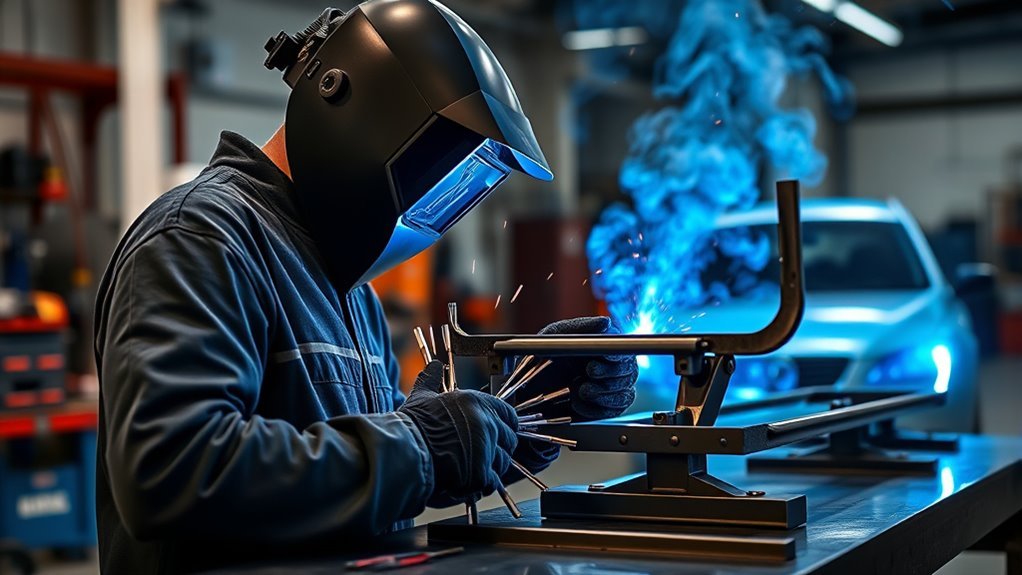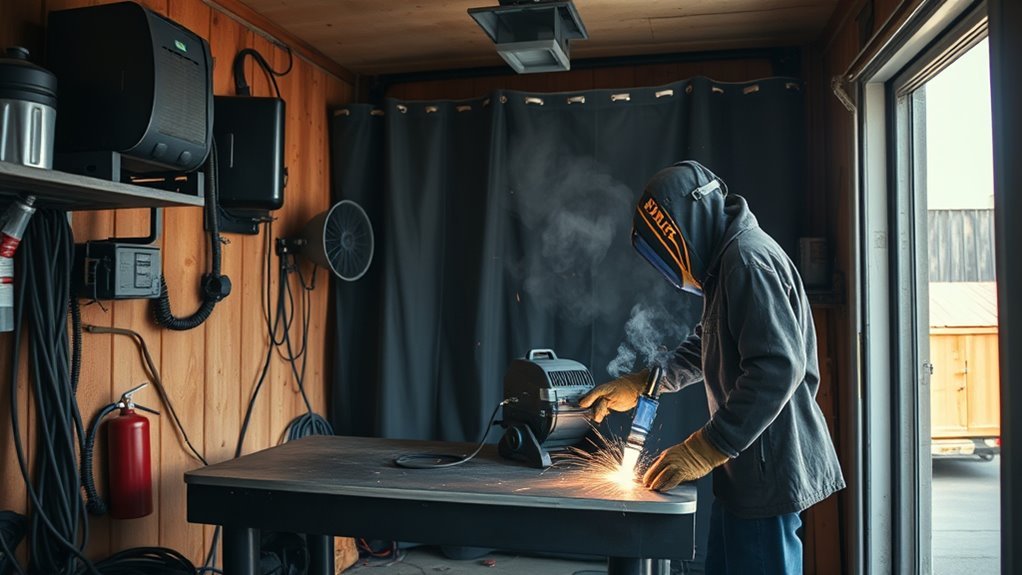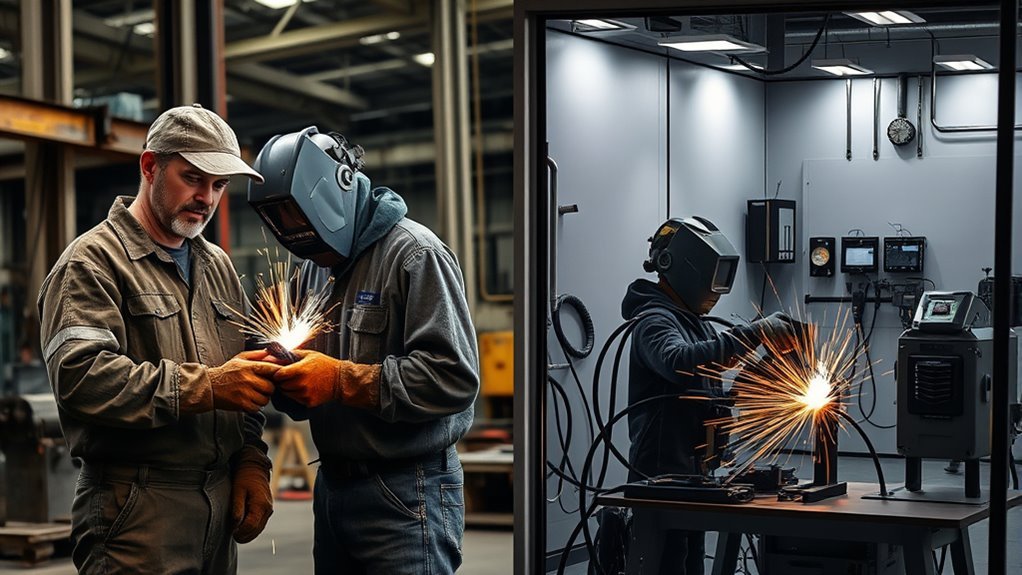
If you are choosing between welding trade school and a welding apprenticeship, the better path depends on how fast you want to start working, how much you can pay upfront, and how you learn best. Trade school usually gives you a faster, more structured classroom and lab path. An apprenticeship usually gives you paid, supervised work experience over a longer timeline.
Quick Answer
Choose welding trade school if you want structured training, flexible class options, and a faster route into entry-level welding. Choose an apprenticeship if you want to earn wages while learning, build real job-site experience, and can commit to a longer, employer-led path.
Key Takeaways
- Trade school is usually faster, more structured, and easier to fit around work or family if evening or weekend classes are available.
- A registered apprenticeship is a paid job with supervised on-the-job learning, classroom instruction, wage increases, and an industry credential.
- Time-based registered apprenticeships use at least 2,000 hours of on-the-job learning, but competency-based and hybrid models can differ.
- Trade school may require tuition upfront, while apprenticeships usually reduce school debt because you earn while you learn.
- The best choice depends on your budget, schedule, learning style, local employers, and the welding process you want to use on the job.
Welding Trade School vs. Apprenticeship: Key Differences

When you compare welding trade school and a welding apprenticeship, the biggest differences are time, cost, schedule control, work experience, and credential type.
| Factor | Welding Trade School | Welding Apprenticeship |
|---|---|---|
| Main style | Classroom plus welding lab training | Paid work plus related instruction |
| Typical timeline | Often months to 2 years, depending on certificate, diploma, or associate degree | Often several years, depending on sponsor and program model |
| Cost | Usually tuition, fees, supplies, PPE, and testing costs | Usually paid employment with progressive wage increases |
| Schedule | May offer day, night, weekend, or part-time options | Usually follows employer or sponsor work hours |
| Best fit | You want structure, faster training, and broad lab practice | You want job-site experience and paid skill growth |
A trade school program can give you planned lessons in blueprint reading, shop math, welding safety, and welding processes such as SMAW, GMAW, FCAW, and GTAW. Employers often prefer or require technical training, and the U.S. Bureau of Labor Statistics notes that welding training is available through vocational-technical institutes, community colleges, private welding schools, and the U.S. Armed Forces.
An apprenticeship is different because it is also a job. A Registered Apprenticeship Program combines paid work experience, mentoring, classroom instruction, progressive wage increases, and a portable industry credential.
How Long Each Welding Path Takes
Timing is one of the biggest factors when you are choosing between welding trade school and an apprenticeship.
Trade school programs usually move faster. Some certificate or diploma programs can be completed in months, while associate degree programs may take about 2 years. The exact timeline depends on the school, class schedule, lab hours, and whether you attend full time or part time.
Apprenticeships usually take longer because they are built around supervised job experience. Under 29 CFR 29.5, a time-based registered apprenticeship includes at least 2,000 hours of on-the-job learning. Federal standards also recommend at least 144 hours of related instruction for each year of apprenticeship. Some programs use competency-based or hybrid models, so the exact timeline can vary.
Trade school is usually the faster path. Apprenticeship is usually the deeper paid-work path.
If your goal is to qualify for entry-level work sooner, trade school may fit you better. If your goal is to grow inside a company or union training system while earning wages, an apprenticeship may be worth the longer route.
How Flexible Each Program Is
If you choose an apprenticeship, your schedule will usually follow the employer, contractor, union, or program sponsor. That can mean full-time work hours, early starts, overtime, travel to job sites, and required related instruction.
Trade schools often give you more control. Many schools offer day, evening, weekend, or part-time options, which can help if you are working, raising a family, or changing careers while still paying bills.
Note: Flexibility depends on the exact program. Before you enroll, ask for the full weekly schedule, lab-hour requirements, attendance policy, make-up policy, and whether certification testing is included.
Apprenticeship Scheduling Limits
Welding apprenticeships often require a serious time commitment because you are both an employee and a trainee. You may need to be available for job-site hours, safety meetings, classroom sessions, and performance reviews.
This structure can be a strong fit if you want real-world experience and steady mentoring. It can be harder if you need full control over your weekly schedule.
Trade School Class Options
Trade school class options are usually built around a set curriculum. You may move through safety, weld symbols, cutting, fit-up, metallurgy basics, welding positions, and inspection skills in a planned order.
This structure is useful if you want guided practice before applying for welding jobs. It also helps you compare programs more easily because you can ask each school the same questions about lab time, processes taught, instructor background, testing fees, and job placement support.
What Welding Training Costs and Pays
Cost is one of the clearest differences between trade school and apprenticeship.
Trade school usually requires tuition and may also require fees for tools, PPE, books, filler metal, lab supplies, and certification tests. Public community colleges may cost less than private career schools, but prices vary widely by state, school, and credential type. Always ask for the total program cost, not just tuition.
Apprenticeships usually reduce upfront school cost because you are paid while you learn. Registered apprenticeship standards include a progressively increasing wage schedule, and the entry wage must meet applicable minimum wage rules or any higher wage required by law or agreement.
Pro Tip: Compare total net cost, not sticker price. For trade school, include tuition, fees, PPE, tools, books, consumables, commuting, and test fees. For apprenticeship, compare starting wage, wage steps, benefits, required dues, travel, and unpaid classroom time.
Products Worth Considering

Long lasting quality

Crafted with precision, our steel plates are laser-cut, offering unparalleled edge smoothness and dimensional accuracy compared to stamped and sheared parts.

Packaging Includes: in our welding kit, you will get a welding hat, chipping hammer, a pair of flame-resistant welding sleeves, heat-resistant gloves, a rust-removal steel wire brush, two thickness gauges, a marker pen, and a storage bag large enough to hold all these tools; This comprehensive set includes everything you need for welding, such as protection, marking, rust removal, and measurement tools; It is designed to easily remove and clean corrosion and slag from most welds
What Credentials You Earn

The credential you earn depends on the path and the program.
| Path | Possible Credential | Career Value |
|---|---|---|
| Trade school | Certificate, diploma, or associate degree | Shows completed formal training |
| Trade school plus testing | Process-specific welder qualification or certification | Helps prove skill for specific processes, positions, metals, and codes |
| Registered apprenticeship | Portable nationally recognized apprenticeship credential | Shows completed employer-vetted training and work experience |
Trade school credentials can help you apply for entry-level welding jobs, especially when the program includes strong booth time and prepares you for employer or third-party testing. Apprenticeship credentials can be powerful because they combine work history, mentorship, wage progression, and documented completion.
Also remember that welding certification is not one single universal card. A welder may be qualified for a specific process, material, thickness, position, or code. Before choosing a program, ask which tests it prepares you for and whether testing fees are included.
How Mentors and Instructors Support You
The support style is different in each path.
In trade school, instructors usually teach from a planned curriculum. That can make lessons easier to follow because you know what you will practice next and how each skill connects to the next one.
In an apprenticeship, mentors and journey-level workers teach you in the field. You learn how welders actually work around fit-up problems, deadlines, weather, confined spaces, inspection requirements, and team communication.
Registered apprenticeship standards require related instruction and qualified training personnel. The best apprenticeship sponsors also give clear feedback, track your progress, and let you build skills safely instead of just using you as low-cost labor.
Safety and PPE Should Affect Your Choice
Welding training is not only about making a clean bead. You also need to learn how to work safely around arc light, heat, fumes, gases, electricity, grinders, compressed cylinders, and heavy material.
Warning: Do not choose a welding program that treats safety as a side topic. A good program should cover PPE, ventilation, fire prevention, electrical safety, cylinder handling, eye protection, hearing protection, and shop rules before you begin serious lab work.
The Occupational Safety and Health Administration provides welding, cutting, and brazing safety resources, and BLS notes that welders can be exposed to fumes, hot materials, and intense arc light. Whether you choose trade school or apprenticeship, safety training should be built into the path from day one.
Products Worth Considering

𝐏𝐫𝐨𝐟𝐞𝐬𝐬𝐢𝐨𝐧𝐚𝐥-𝐆𝐫𝐚𝐝𝐞 𝐋𝐞𝐧𝐬 𝐂𝐨𝐚𝐭𝐢𝐧𝐠: Compared to standard safety glasses, our premium coating delivers superior performance: impact-resistant, scratch-resistant, and acid/alkali-resistant on the outside, with an advanced anti-fog treatment on the inside to maintain clear vision in changing temperature and humidity conditions. Durable and easy to clean – simply rinse with water and wipe dry.

Outstanding corporate and product innovator

Strong & Durable Design: Thanks to their tough polycarbonate wraparound construction, these anti-fog safety goggles offer superior protection from both direct and peripheral threats.
What to Check Before You Choose a Program
Before you choose welding trade school or an apprenticeship, compare the details that will affect your training quality.
- Lab time: Ask how many hours you will spend welding, not just sitting in class.
- Processes taught: Look for the welding processes used by employers in your area.
- Instructor or mentor quality: Ask about industry experience, teaching experience, and safety expectations.
- Testing: Ask whether welder qualification tests are included or separate.
- Job placement: Ask which employers hire graduates or apprentices from the program.
- Schedule: Make sure you can attend consistently without risking your current job or family responsibilities.
- Total cost: Compare tuition, fees, tools, PPE, travel, dues, and lost work time.
- Local demand: Look at job postings near you and note which processes, certifications, and experience levels employers request.
Job Outlook and Pay Context
Training choice should connect to real job demand. BLS reported that welders, cutters, solderers, and brazers had a 2024 median pay of $51,000 per year, or $24.52 per hour. BLS also projected 2% employment growth from 2024 to 2034, with about 45,600 openings per year on average.
That does not mean every welding job pays the same. Your pay can change based on location, industry, overtime, travel, union status, certifications, code work, inspection skills, and experience. Structural welding, pipe welding, shipyard work, fabrication, manufacturing, repair, and maintenance can all have different pay paths.
Which Welding Path Fits Your Goals?
Choose welding trade school if you want a faster, more structured path and can handle the cost. This path can work well if you are new to welding, want guided lab practice, need schedule flexibility, or plan to apply for entry-level jobs after training.
Choose a welding apprenticeship if you want paid work experience and can commit to a longer training path. This route can work well if you learn best by doing, want steady mentorship, and are ready to follow an employer or sponsor schedule.
| Choose This Path | If You Want | Main Tradeoff |
|---|---|---|
| Trade school | Faster entry-level preparation | Higher upfront cost |
| Apprenticeship | Paid learning and job-site experience | Longer timeline and less schedule control |
| Trade school | Broad practice across welding processes | Less real job-site time during training |
| Apprenticeship | Employer-led skill growth | Application, interview, and selection process |
If you are still unsure, start with local employers. Look at welding job postings near you, visit nearby schools, and search for registered apprenticeship sponsors. The best path is the one that connects your training to real work in your area.
Frequently Asked Questions
Should I go to welding school or get an apprenticeship?
Choose welding school if you want structured lessons, faster training, and more schedule options. Choose an apprenticeship if you want paid work experience, mentoring, and a longer employer-led path. Your best choice depends on money, time, local openings, and how you learn.
Is it better to go to trade school or get an apprenticeship?
Neither path is automatically better. Trade school can be better if you need a faster, more predictable training plan. An apprenticeship can be better if you want to earn wages while learning and build real job experience from the start.
Do welding apprenticeships pay you?
Yes. Registered apprenticeships are paid jobs. Apprentices earn wages from the beginning, and their wages increase as skills and productivity improve. The exact starting pay depends on the sponsor, location, occupation, agreement, and employer.
How long does welding trade school take?
Many welding trade school programs take several months to 2 years. Short certificate programs may focus on entry-level skills, while longer diploma or associate degree programs may include more processes, math, blueprint reading, metallurgy, and general education courses.
What career paths follow a welding apprenticeship?
A welding apprenticeship can lead to roles such as welder, fabricator, pipe welder, structural welder, ironworker, boilermaker, maintenance welder, or welding technician. With more training, some welders move into inspection, supervision, teaching, robotic welding, or welding engineering support.
What is the best path to a welding career?
The best path is the one that gets you safe, practical training and connects you to real employers. If you need structure and speed, start with trade school. If you want paid experience and can commit to a longer route, apply for apprenticeships.
Conclusion
Welding trade school and apprenticeship can both lead to strong welding careers, but they serve different needs. Trade school gives you a faster, more structured training path with controlled lab practice. Apprenticeship gives you paid work experience, mentorship, wage growth, and a documented completion credential. Compare cost, time, schedule, safety, lab hours, local jobs, and credential value before you choose. The right path is the one you can complete and turn into real welding work.
Sources
- U.S. Bureau of Labor Statistics: Welders, Cutters, Solderers, and Brazers — welding training paths, job duties, safety hazards, pay, and job outlook.
- Apprenticeship.gov: Registered Apprenticeship Program — paid work experience, mentorship, classroom instruction, wage progression, and credentials.
- Apprenticeship.gov: Career Seekers — apprentice benefits, paid learning, education, and portable credentials.
- eCFR: 29 CFR 29.5 Standards of Apprenticeship — on-the-job learning, related instruction, wage progression, and registered apprenticeship standards.
- OSHA: Welding, Cutting, and Brazing — welding safety hazards, standards, and safety resources.