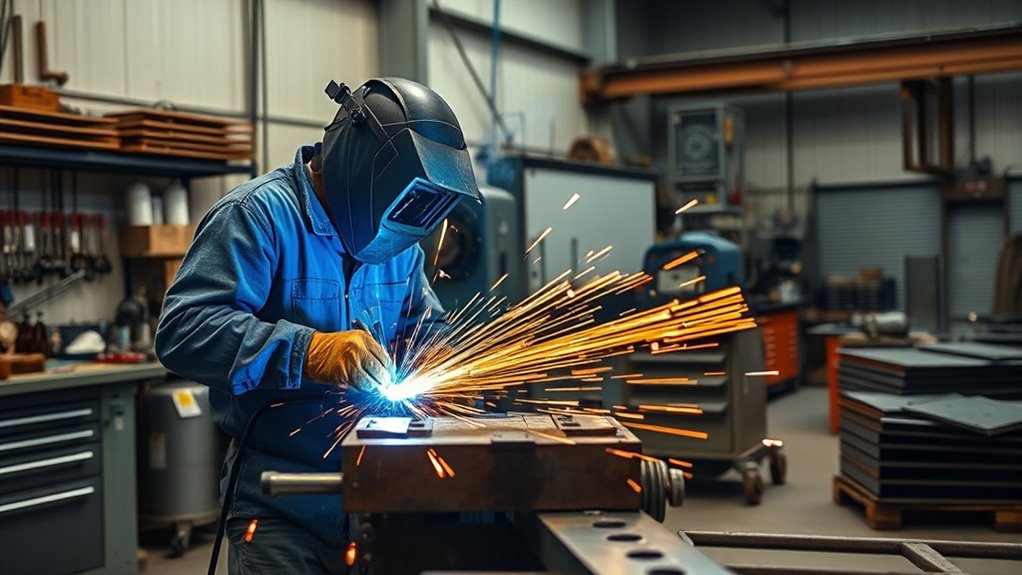
A CWI certification shows that you have met the American Welding Society requirements to work as an AWS Certified Welding Inspector. It proves you can review welding documents, inspect welds, apply code requirements, document findings, and support weld quality in industries such as construction, manufacturing, aerospace, shipbuilding, pipelines, and pressure equipment.
Quick Answer
CWI certification is the AWS Certified Welding Inspector credential. To earn it, you must meet education and welding-experience requirements, pass a vision test, submit required documents, and pass three exam parts: Fundamentals, Practical, and Code Book.
Key Takeaways
- CWI certification is issued by AWS and verifies welding inspection knowledge, code use, and practical inspection skill.
- You must document qualifying education and welding-related work experience before you can test.
- The CWI exam has three parts: Part A Fundamentals, Part B Practical, and Part C Code Book.
- AWS requires a minimum score of 72% on each exam part to earn the credential.
- The credential is valid for nine years, with renewal applications at years three and six and recertification at year nine.
At a Glance
| Time Required | Each exam part is time-limited. Study time varies by experience, but most candidates should plan several weeks or months of focused preparation. |
| Difficulty | Advanced. You need welding knowledge, inspection judgment, code navigation skill, and time management. |
| Tools Needed | AWS application, employment documentation, visual acuity form, approved code book, Part B Book of Specifications, weld gauges, and practice exams. |
| Cost | AWS fees change, but initial CWI exam pricing is commonly in the $1,000+ range before optional training, travel, books, or retesting. Always confirm the current AWS price list. |
What Is CWI Certification?

CWI certification, or Certified Welding Inspector certification, is a professional credential from the American Welding Society. It verifies that you understand welding processes, inspection methods, welding symbols, destructive and nondestructive testing basics, procedure documents, safety, reporting, and code requirements.
As a CWI, you do not simply look at a finished weld and decide whether it “looks good.” You compare the work to approved drawings, welding procedure specifications, contract documents, and governing codes. You also document your findings so the project has traceable quality-control evidence.
The AWS B5.1:2025 qualification standard describes welding inspector qualification requirements and the knowledge areas inspectors are expected to understand, including welding processes, procedures, NDE, destructive testing, symbols, reports, metallurgy, math, safety, quality assurance, and responsibilities.
Warning: CWI certification does not replace employer procedures, project specifications, code requirements, hot-work permits, PPE, or legal safety rules. Welding and cutting work still must follow applicable safety requirements, including fire-prevention and authorization rules.
Who Qualifies for CWI Certification?
To qualify for CWI certification, you must pass a vision test and document a qualifying mix of education and welding-related work experience. AWS allows education to substitute for part of the work-experience requirement, but you still need direct welding-based experience.
The basic CWI eligibility paths are:
| Education level | Typical minimum welding-based work experience |
| Bachelor’s degree or higher in welding engineering or welding technology | 1 year |
| Associate degree or higher in welding, engineering technology, engineering, or physical science | 2 years |
| Relevant technical courses toward a bachelor-level welding program | 3 years |
| Trade or vocational welding courses | 4 years |
| High school diploma or approved equivalency | 5 years |
| 8th-grade schooling | 9 years |
| Less than 8th-grade schooling | 12 years |
You should also be ready to submit employment verification, a current photo, and the required visual acuity form. AWS visual acuity requirements focus on near vision, color perception, and contrast differentiation, because inspectors must be able to evaluate fine weld details and surface conditions.
What Do CWIs Inspect?
Certified Welding Inspectors inspect welds and the conditions around them to verify compliance with applicable codes, drawings, specifications, and approved procedures. Their work usually falls into three phases: before welding, during welding, and after welding.
Before welding starts, a CWI may review material certifications, welding procedure specifications, procedure qualification records, welder qualifications, fabrication drawings, joint design, filler metals, and base material condition. For example, surface preparation matters when working near coatings or galvanized steel, so understanding how to handle zinc coatings can support safer and cleaner weld preparation.
During welding, the inspector may monitor joint fit-up, preheat, interpass temperature, filler-metal handling, electrode selection, travel speed, amperage, voltage, shielding, and other welding parameters. Process knowledge matters here, whether the work involves SMAW, GMAW, GTAW, FCAW, or another process. Reviewing common types of welding and practical flux core welding techniques can help you understand what the welder is trying to control.
After welding, a CWI checks weld size, profile, contour, undercut, overlap, cracks, porosity, arc strikes, incomplete fusion indicators, and other discontinuities. They may use visual inspection, weld gauges, and nondestructive testing methods when the code or project requires them.
A good CWI does not inspect by opinion. The decision should trace back to the drawing, procedure, code, specification, or acceptance criteria.
CWIs also prepare reports. These records help project teams correct defects, verify acceptance, prevent repeat problems, and maintain a documented quality-control trail.
Products Worth Considering

【7 pieces Weld Fillet Gauges】: 7 pieces weld fillet gauges are held by bolt and nut that can be disassembled, each weld gauge can be used to check the size of fillet legs and fillet throats

7piece Fillet Weld Set Gage Rl Gauge

MG-11 GAUGE SET: Metal Weld Fillet Gages Set (7PCS), It has wide measurement range, meets various kinds of needs. Checking fillet leg size and fillet throat size. Increments standard and metric equivalents etched into the surface for clarity and easier reading.
How the CWI Exam Works

The CWI exam has three parts. You must pass each part with a minimum score of 72% to earn the credential.
| Exam part | What it tests | Format |
| Part A: Fundamentals | Welding processes, destructive testing, fabrication math, safety, metallurgy, NDE, welding symbols, WPS/PQR, and welding fundamentals. | 150 questions through computer-based testing. |
| Part B: Practical | Hands-on inspection judgment using AWS-provided equipment and inspection activities. | 46 questions tied to practical inspection tasks. |
| Part C: Code Book | Locating, reading, and applying code requirements to inspection decisions. | Open-book exam with 50 to 65 questions based on the selected approved code book. |
Exam Order and Scheduling
AWS requires candidates to take Part B Practical before Parts A and C. Parts A and C are administered through computer-based testing at Prometric, while Part B is administered separately at AWS educational seminar locations and other scheduled exam locations.
After Part B, schedule Parts A and C within the deadline shown in your AWS eligibility notice and current AWS scheduling instructions. Do not rely on old forum posts or outdated prep-course pages for scheduling windows.
Scoring and Passing Rules
You need at least 72% on Part A, Part B, and Part C. A strong overall average does not cancel a failed section. If one part is weak, build a separate study plan for that part instead of trying to “make up” points elsewhere.
Part A rewards broad welding knowledge. Part B rewards hands-on inspection accuracy. Part C rewards fast code navigation. Treat them as three different tests, not one long welding quiz.
How to Get CWI Certified Step by Step
Use this path to move from interest to application to exam day:
- Check your eligibility. Compare your education and welding-based work experience against AWS requirements.
- Collect documents. Prepare employment verification, education records if needed, a current photo, and AWS application information.
- Complete the vision test. Use the required AWS visual acuity form and follow the timing rules shown in current AWS instructions.
- Choose your code book for Part C. Select an approved code book that fits your work, background, and study plan.
- Study by exam part. Separate fundamentals, practical inspection, and code navigation in your schedule.
- Submit your application and fees. Confirm deadlines, fees, and exam locations before paying.
- Take Part B first, then Parts A and C. After you complete all three parts and meet the 72% threshold on each, AWS issues the CWI credential if all requirements are satisfied.
Pro Tip: Build your study plan around weak areas. A welder with strong shop experience may still need extra work on code navigation, symbols, metallurgy, reporting, and inspection acceptance criteria.
How to Prepare for the CWI Exam
Good CWI preparation is structured. You need welding fundamentals, hands-on inspection practice, and codebook speed. Do not study only the topics you already know from the shop.
Build Fundamentals for Part A
Part A covers broad welding knowledge. Review welding processes, safety, metallurgy, NDE, destructive testing, welding symbols, procedure documents, reports, and basic fabrication math. Understanding the five parameters of welding can also help you connect procedure settings to real weld quality.
If your background is narrow, study outside your normal process. For example, a structural stick welder may need more practice with stainless work, GMAW variables, or material-specific concerns. A guide on MIG welding 304 stainless steel can help you think through process variables, shielding, and base-metal behavior from an inspector’s point of view.
Practice Hands-On Inspection for Part B
Part B is where many candidates feel pressure because it tests practical judgment, not just memory. Practice using fillet weld gauges, bridge cams, hi-lo gauges, magnifiers, measuring tools, and the Part B Book of Specifications.
You should be comfortable checking weld size, reinforcement, undercut, porosity, overlap, cracks, and fit-up against written acceptance criteria. Practical knowledge of proper fillet weld sizing can make this section easier to understand.
Build Codebook Speed for Part C
Part C is open-book, but open-book does not mean easy. You must find the correct clause, table, figure, or note under time pressure. Use the same code book you plan to test with, and practice locating answers without reading long sections from the beginning.
Marking rules vary by exam instructions, so follow AWS guidance for what you may bring and how your code book may be prepared. Your goal is not to memorize the whole code. Your goal is to know where the answer lives and how to apply it correctly.
Use Practice Seminars and Mock Exams
Practice seminars, prep courses, and timed mock exams can help you measure readiness. AWS offers in-person, online instructor-led, and self-paced training options, and many candidates also use independent study groups or employer-sponsored prep.
Mock exams are most useful when you review every missed question. Track whether the error came from knowledge, codebook navigation, careless reading, poor time management, or confusion about inspection acceptance criteria.
Avoid Common CWI Study Mistakes
- Studying only welding theory: You also need reporting, symbols, code use, NDE basics, and inspection judgment.
- Ignoring Part B tools: You must be comfortable measuring and interpreting physical inspection examples.
- Assuming open-book means simple: Part C tests speed and accuracy under pressure.
- Waiting too long on documents: Employment verification, vision forms, and application deadlines can delay you.
- Skipping safety context: Inspection work happens around real hazards, so review jobsite safety, plasma cutter safety rules, and proper protective clothing.
Where CWIs Work and Add Value
Certified Welding Inspectors work anywhere weld quality, safety, and documentation matter. Common settings include structural steel, bridges, pipelines, pressure vessels, refineries, shipbuilding, aerospace, heavy equipment, manufacturing, power generation, and repair facilities.
As a CWI, you add value by catching problems before they become expensive failures. You verify that procedures are followed, materials match the job requirements, welders are qualified, inspections are documented, and finished welds meet acceptance criteria.
CWI inspection supports quality by turning weld acceptance into a documented decision based on standards, not guesswork.
This matters in high-consequence work. A missed defect in a handrail may cause rework. A missed defect in a bridge member, pressure boundary, lifting device, or pipeline can create far greater risk.
How CWI Renewal and Recertification Work

The CWI credential is valid for nine years, but you do not wait nine years to act. AWS requires renewal applications at the third and sixth years after initial activation. At the ninth year, you must complete recertification.
| Credential point | What you do |
| Year 3 | Submit renewal application, confirm continued practice, and pay required fees. |
| Year 6 | Submit another renewal application and confirm continued eligibility. |
| Year 9 | Complete recertification through an approved route, such as examination, qualifying Professional Development Hours, endorsement route, or other current AWS-approved option. |
Track Professional Development Hours early. Waiting until the last few months can force you into rushed training or missed deadlines. You should also keep records of inspection work, continuing education, employer verification, and any endorsements you earn.
Note: Renewal and recertification rules can change. Always check the current AWS renewal, recertification, and price-list pages before submitting forms or fees.
CWI Endorsements to Add
CWI endorsements let you show additional knowledge in a specific code, material, process, or inspection area. AWS offers endorsements for areas such as structural steel, structural aluminum, bridge welding, railroad welding, aerospace, pipeline work, magnetic particle testing, penetrant testing, ASME pressure piping and vessel work, ISO standards, welding coordination, and other specialized subjects.
Common endorsement options include:
- AWS D1.1 Structural Steel: useful for building, bridge-related, and structural fabrication work.
- AWS D1.2 Structural Aluminum: useful for aluminum structures and fabrication.
- AWS D17.1 Aerospace: useful for aerospace welding inspection environments.
- API 1104 Pipeline: useful for pipeline welding inspection.
- MT and PT endorsements: useful when your work includes magnetic particle or penetrant testing responsibilities.
Do not choose an endorsement only because it looks impressive. Choose one that matches your industry, employer needs, code exposure, and career path. Also confirm current exam fees before applying, because endorsement pricing varies by exam and member status.
How CWI Certification Improves Weld Quality
CWI certification improves weld quality by giving projects a trained person who can verify procedures, fit-up, welder qualifications, materials, welding variables, inspection results, and records. The value is not just finding bad welds. The bigger value is preventing avoidable defects and documenting acceptance decisions.
A CWI can help a team:
- Confirm that the correct welding procedure is being used.
- Verify base materials, filler metals, and documentation.
- Check joint preparation and fit-up before welding begins.
- Monitor welding variables during production.
- Measure weld size, contour, and visible discontinuities after welding.
- Coordinate NDE requirements when the code or contract requires them.
- Reduce rework by catching problems early.
- Support continuous improvement through reports and corrective action.
Inspection also connects to production control. For example, understanding machine limitations such as duty cycle can help you recognize when equipment setup, heat input, or production pace may affect weld consistency.
CWI vs Welder Certification, CAWI, and SCWI
A CWI certification is not the same as a welder performance qualification. A welder certification or qualification shows that a welder can make an acceptable weld under a specific procedure, process, position, material, and code. A CWI certification shows that the inspector can evaluate welding work and documentation against requirements.
AWS also has related inspector levels:
- CAWI: Certified Associate Welding Inspector. This is an entry-level inspection credential with more limited responsibility.
- CWI: Certified Welding Inspector. This is the main inspector credential discussed in this article.
- SCWI: Senior Certified Welding Inspector. This is an advanced credential for experienced inspectors who move into higher-level supervision, quality systems, and technical responsibility.
The right path depends on your experience. If you are early in your inspection career, CAWI may be a stepping stone. If you have years of inspection leadership, SCWI may become the long-term goal.
Products Worth Considering


Frequently Asked Questions
What can I do with a CWI certification?
You can work in welding inspection, quality control, quality assurance, fabrication oversight, construction inspection, pipeline inspection, manufacturing, shipbuilding, aerospace, and related fields. Many CWIs also move into lead inspector, quality manager, or welding coordinator roles.
What is the hardest part of the CWI exam?
Many candidates find Part C difficult because it requires fast, accurate codebook navigation under time pressure. Others struggle with Part B because it tests hands-on inspection judgment. The hardest part depends on whether your weaker area is theory, practical inspection, or code use.
How much does CWI certification cost?
The cost depends on AWS member status, exam package, training, books, travel, code books, and retesting. Current AWS initial exam fees are commonly over $1,000 before optional training and travel. Always check the current AWS price list before budgeting.
How hard is it to get a CWI certification?
It is challenging because you must meet experience requirements and pass three different exam parts. Shop experience helps, but it is not enough by itself. You also need codebook skill, inspection terminology, welding symbols, NDE basics, reporting knowledge, and practical measurement ability.
Does CWI certification expire?
Yes. The CWI credential is valid for nine years. You submit renewal applications at years three and six, then complete recertification at year nine through an AWS-approved route.
Is CWI certification the same as being a certified welder?
No. A certified welder proves they can make an acceptable weld under a specific procedure or code test. A CWI proves they can inspect welding work, review documentation, apply acceptance criteria, and report results.
Conclusion
CWI certification is a serious credential for people who want to verify weld quality, code compliance, and inspection documentation. To earn it, you need qualifying experience, a vision test, complete application documents, and passing scores on all three AWS exam parts. Once certified, you help projects move from opinion-based weld acceptance to documented, standards-based decisions.
The best path is simple but demanding: confirm eligibility, study each exam part separately, practice codebook navigation, build hands-on inspection skill, and track renewal requirements early. A strong CWI does more than find flaws. You help teams build weldments with accuracy, accountability, and trust.
Sources
- American Welding Society — Certified Welding Inspector Program — CWI eligibility, exam parts, scoring, renewal, recertification, and pricing references.
- AWS B5.1:2025 — Specification for the Qualification of Welding Inspectors — welding inspector qualification requirements, duties, visual acuity, and body of knowledge.
- AWS QC1:2016-AMD1 — Specification for AWS Certification of Welding Inspectors — AWS certification program rules for welding inspectors.
- AWS Open-Book Exam Reference Guide — official reference guidance for code-book based AWS exams.
- AWS Program Price List — current AWS certification, renewal, recertification, and endorsement fee references.
- OSHA 1910.252 — Welding, Cutting, and Brazing General Requirements — safety, fire-prevention, authorization, and PPE requirements related to welding and cutting work.