Automotive welding starts with two skills: controlling heat and knowing when not to weld. A MIG welder is a practical first machine for mild-steel brackets, patches, and practice coupons, but modern vehicles also contain high-strength steel, electronics, airbags, fuel systems, and high-voltage components. Learn on clean scrap first, then follow the vehicle maker’s repair procedure before touching an actual car.
Quick Answer
Start automotive welding with a gas-shielded MIG welder, solid mild-steel wire, and clean scrap that matches the thickness of the metal you plan to repair. Learn machine setup, fit-up, tack placement, and heat control before welding a vehicle. Leave structural, fuel-system, airbag, and EV high-voltage repairs to trained technicians.
Key Takeaways
- MIG is beginner-friendly for common mild-steel practice and nonstructural automotive work.
- Match the wire, shielding gas, polarity, and starting settings to the machine chart and the actual metal thickness.
- Remove paint, rust, oil, undercoating, and seam sealer from both sides of the weld area.
- Use spaced tack welds and allow cooling time to limit burn-through and panel warping.
- Check OEM repair information before welding any vehicle, especially one with high-strength steel, airbags, or a hybrid or EV powertrain.
At a Glance
| Time Required | Several practice sessions; plan about 1–2 hours for each focused session |
| Difficulty | Beginner on scrap; advanced for structural or late-model vehicle repairs |
| Tools Needed | MIG welder, solid wire, shielding gas, PPE, clamps, grinder, hand tools, scrap metal, and fume control |
| Cost | Varies widely; the welder, gas cylinder, PPE, and ventilation are the main startup expenses |
What’s in This Article
- Start Automotive Welding With MIG
- Essential Auto Welding Gear for Beginners
- Set Up Your Auto Welding Space Safely
- Know What Not to Weld as a Beginner
- Prep Automotive Metal Before Welding
- Practice Automotive Welding on Scrap
- Set Your MIG Welder for Automotive Steel
- How to Make Clean Auto Welds
- Control Heat to Prevent Warping
- Finish Welds With an Angle Grinder
- Common Auto Welding Mistakes to Avoid
- What to Learn After Your First Weld
- Sources
Start Automotive Welding With MIG
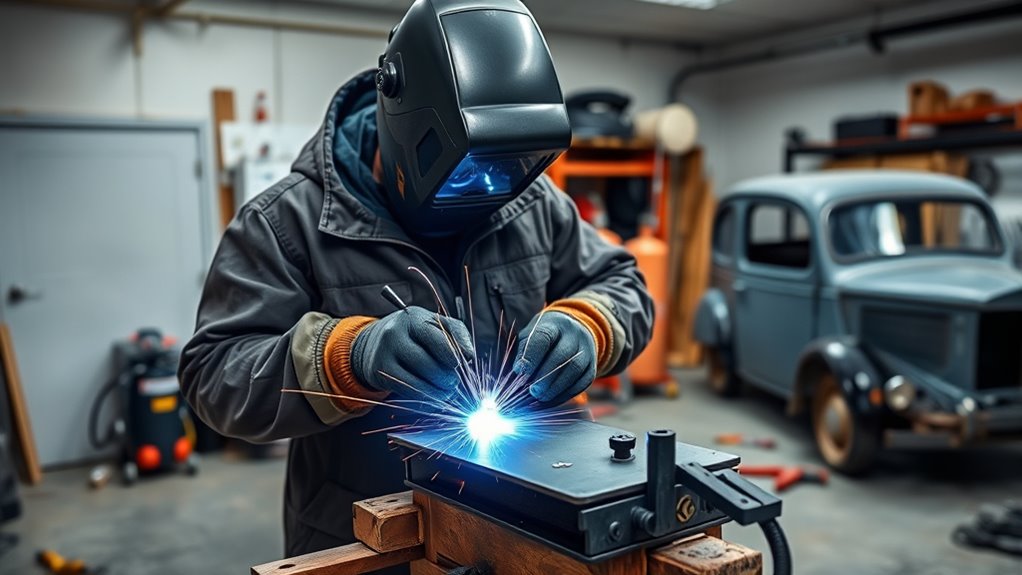
MIG welding, technically gas metal arc welding or GMAW, feeds a continuous wire electrode through the gun. Shielding gas protects the molten puddle while you control gun position, travel speed, and heat input.
That setup is practical for beginners because the machine handles the wire feed. You can focus on watching the puddle and keeping the gun steady. MIG also works well on the mild-steel sheet and brackets found in many older vehicles and fabrication projects.
For common mild steel, a 75% argon and 25% carbon dioxide mix—often called C25—produces a stable arc with relatively low spatter. It is a common starting gas, not a universal answer for every metal or transfer mode. Always follow the chart inside your welder and the wire manufacturer’s instructions.
For stainless steel parts, match the filler wire and shielding gas to the exact alloy. For example, ER308L filler wire is commonly compatible with 304 stainless steel, but dissimilar-metal joints and safety-critical parts may require a different procedure.
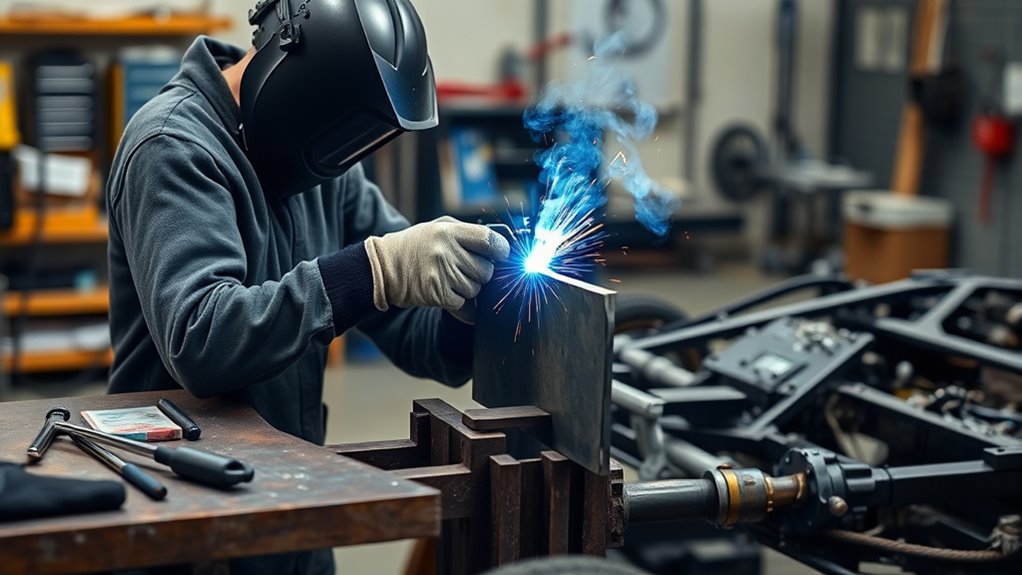
Do not begin on a vehicle. Practice first on clean scrap so you can learn heat control, gun angle, bead placement, and machine response without damaging a panel or safety system.
Note: MIG is a useful first process, but it does not make every automotive repair suitable for a beginner. Vehicle structure, material grade, joint design, and OEM repair instructions determine whether GMA welding is allowed.
Products Worth Considering
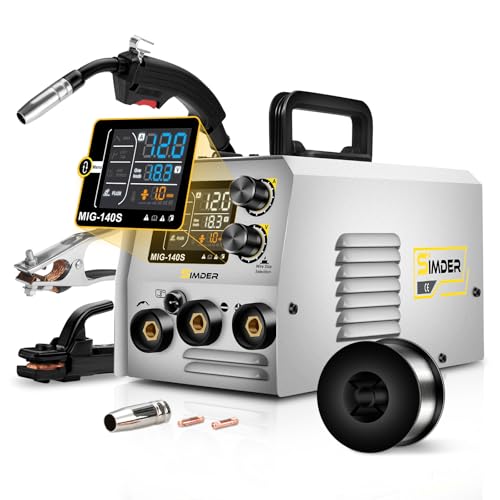
THREE-PROCESS WELDING STATION BUILT FOR FIRST-TIME USERS - Flux Core MIG, Lift TIG and Stick in one machine, so you can find the process that fits your projects without buying three separate welders. Runs on a standard 110V household outlet or 220V for heavier work - no electrician, no special wiring. Welds carbon steel, low-alloy steel, stainless steel, titanium, copper and cast iron
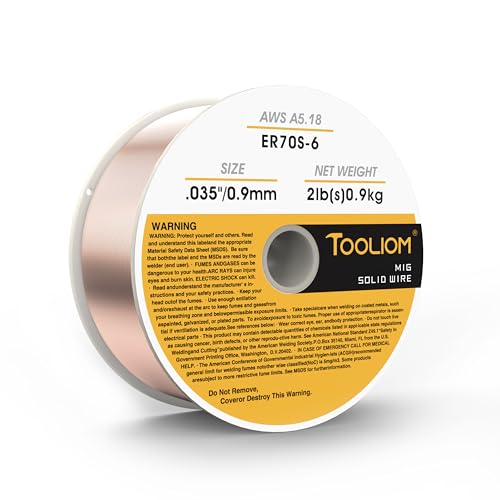
High-quality:Tooliom's .035" ER70S-6 MIG Welding Wire (2lb spool) meets all industry standards for consistent strength and performance. Enjoy smooth feeding, stable arcs, optimal penetration, and high deposition rates—everything you need for exceptional welds

Package Includes: 10ft mig gun + 1pcs nozzle +1pcs diffuser + 6 tips (.023", .030", .035" - two of each size). This mig gun uses the same consumables as the Tweco Mini/#1. 21-50 nozzle, 35-50 diffuser, 11-series contact tip.
Essential Auto Welding Gear for Beginners
Choose equipment that fits the thinnest and thickest metal you expect to practice on. A machine with a smooth low-end arc is more useful for body-panel practice than a welder selected only for maximum output. Multiprocess features can be helpful later, but they are not a substitute for stable wire feeding and good low-amperage control.
- MIG welder: Match the input power to your shop circuit and confirm the machine can run solid wire with shielding gas.
- Solid wire: ER70S-6 is a common mild-steel choice. Small-diameter wire such as .023 or .024 inch is often easier to control on light-gauge sheet; use the sizes approved for your machine.
- Shielding gas and regulator: C25 is a common mild-steel option. Secure the cylinder upright and protect the valve from impact.
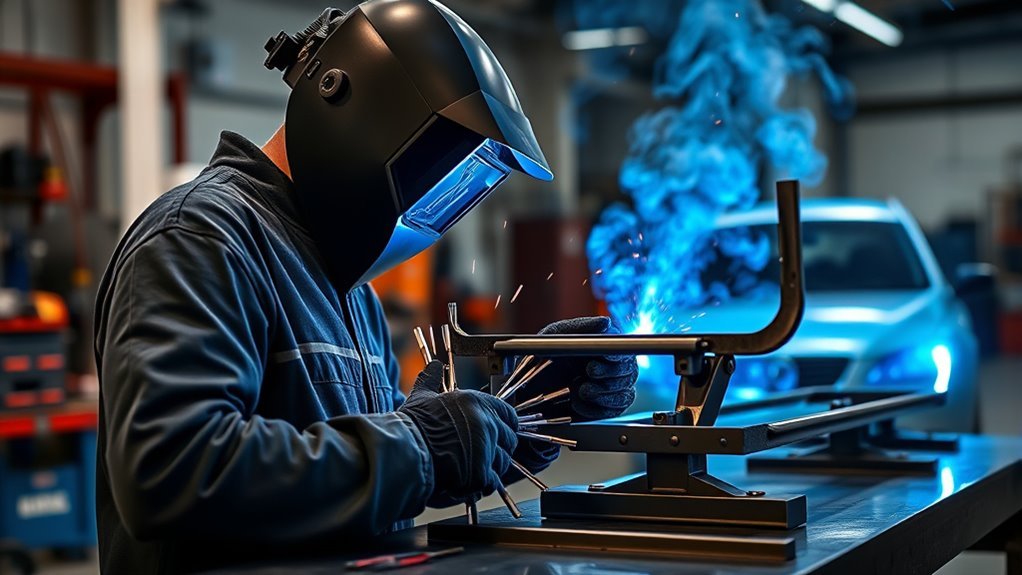
- Helmet and eye protection: Use a welding helmet with the proper shade for the welding current. Wear safety glasses under the helmet and a face shield when grinding.
- Protective clothing: Wear dry welding gloves, hearing protection, leather footwear, and flame-resistant clothing that covers exposed skin. Avoid cuffs and open pockets that can catch sparks.
- Fume control: Use local exhaust ventilation close enough to capture fumes without pulling shielding gas away from the arc.
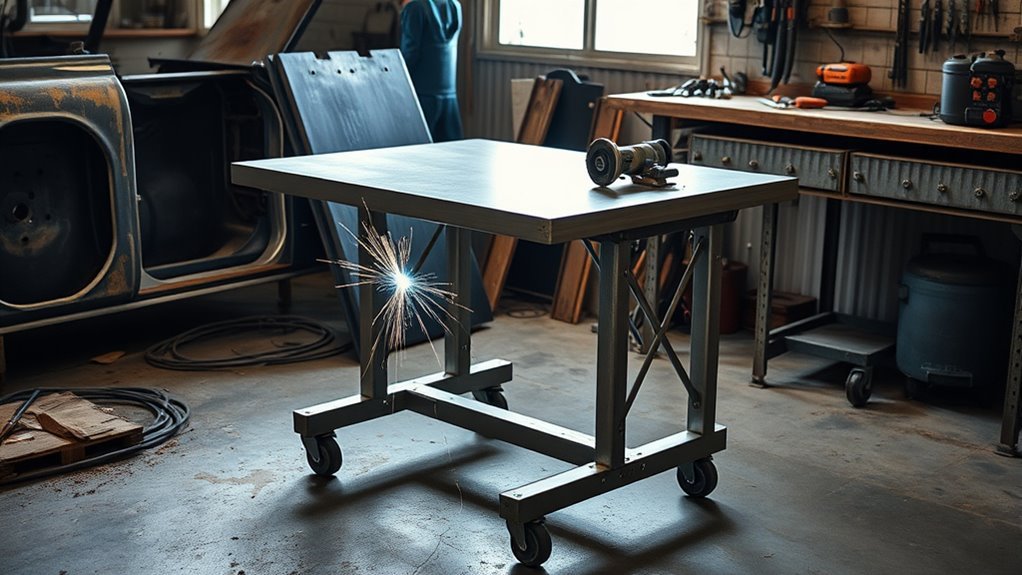
- Prep and fit-up tools: Keep clamps, locking pliers, a wire brush reserved for the metal type, deburring tools, and an angle grinder with the correct guard and wheel.
- Practice supplies: Collect clean coupons in several thicknesses, including pieces that match the panel gauge you hope to weld.
A welder with multiprocess capabilities can expand your options after you master basic MIG setup. Start with one process and learn what a sound weld looks like before adding more controls.
The best first upgrade is not more amperage. It is better fume control, better fit-up, and more practice on metal that matches the job.
Products Worth Considering
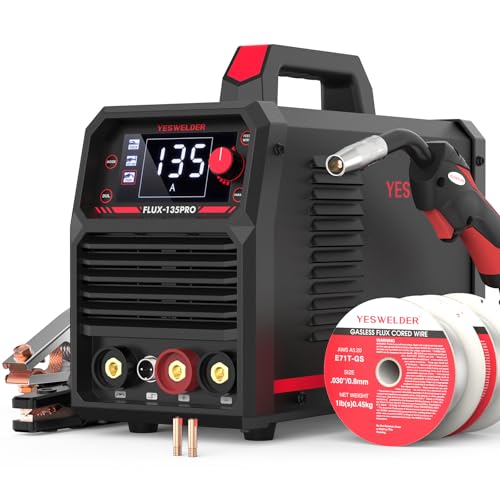
READY OUT OF THE BOX: Start welding immediately! It masterfully handles Gasless Flux Core MIG, Stick, and Lift TIG (Extra Lift TIG torch required). This budget-friendly 3-in-1 machine includes extra E71T-GS .030''&.035'' flux core wires, known for its smooth arc and high feedability. Say goodbye to heavy shielding gas cylinders—perfect for outdoor, windy, or all-position welding.


PREMIUM MATERIALS. Durability with high grade of US split leather available on the market. Got the CE EN388 and EN407 Certificates. Full cow split leather back till the cuff. Unlike other stiff welding gloves, these gloves are softer. Heat and flame resistant for all types of welding.
Set Up Your Auto Welding Space Safely
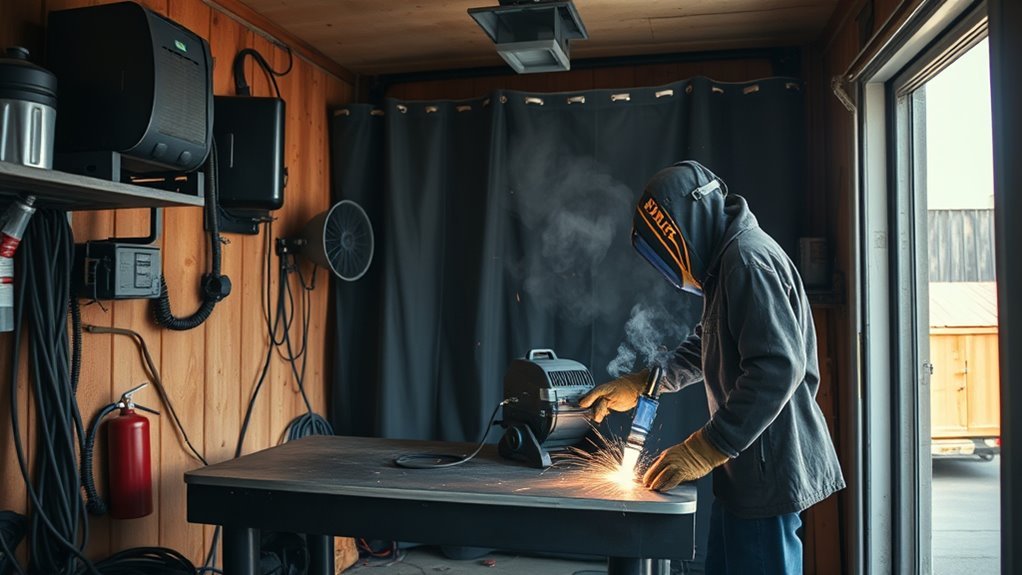
Welding produces ultraviolet radiation, hot metal, sparks, gases, and metal fumes. Work in a dry, uncluttered area with local exhaust ventilation. Position the intake near the plume, but not so close that it disrupts the shielding gas.
Remove gasoline, oil, paper, cardboard, solvent containers, oily rags, aerosol cans, and other combustibles from the hot-work area. OSHA requires movable combustibles to be moved at least 35 feet from welding when practical, or protected when they cannot be moved. Keep suitable fire-extinguishing equipment ready for immediate use.
Warning: Never weld on or near a fuel tank, fuel line, sealed container, pressure vessel, or part that has held a flammable substance unless it has been handled under an approved professional hot-work procedure. An “empty” tank can still contain explosive vapor.
Use welding curtains or screens to protect other people from arc radiation. Route cables and hoses away from walkways, sharp edges, hot metal, and vehicle lift points. Inspect the gun, work lead, electrode holder, power cord, gas hose, regulator, and grinder before each session.
Secure shielding-gas cylinders upright to a cart or fixed support. Keep the protective cap on when the cylinder is not connected. Never lift a cylinder by its valve or expose it to welding current.
Do not weld near chlorinated brake cleaner or other chlorinated solvent vapors. Cleaners and degreasers must be removed, and any approved flammable solvent must fully evaporate before an arc is struck. Review regular inspection habits before using a grinder for preparation or cleanup.
Know What Not to Weld as a Beginner
Before welding a vehicle, identify the material, the function of the part, and the systems behind it. Stop when any of those details are unknown.
- Structural and crash-energy parts: Do not guess on pillars, rails, rockers, crush zones, reinforcements, or suspension mounting areas. Heat can weaken high-strength and ultra-high-strength steel, and an OEM may allow welding only at specific locations with specific equipment.
- Steering, suspension, wheels, and restraint anchors: These are safety-critical components. Use the vehicle maker’s procedure and a qualified repairer.
- Fuel and vapor systems: Do not weld near tanks, filler necks, lines, charcoal canisters, or fuel-soaked material.
- Airbags and pretensioners: Welding heat and current can damage supplemental restraint system components. Follow the OEM power-down, wait-time, removal, and reconnection procedure.
- Hybrids and electric vehicles: High voltage may remain present even when the vehicle is switched off. NHTSA recommends EV-specific high-voltage training for service work. Do not improvise a disconnect procedure.
- Coated or unknown metal: Galvanized coatings, lead-containing paint, cadmium plating, stainless steel, and other alloys can create more hazardous fumes than clean mild steel.
- Sealed or previously filled containers: Do not weld them. Residue and vapor can ignite or explode.
Warning: Disconnecting the 12-volt battery is not a complete safety procedure for every vehicle. Some modules need a controlled shutdown, and an EV or hybrid can still have energized high-voltage components. Use the exact model-year repair information.
Prep Automotive Metal Before Welding
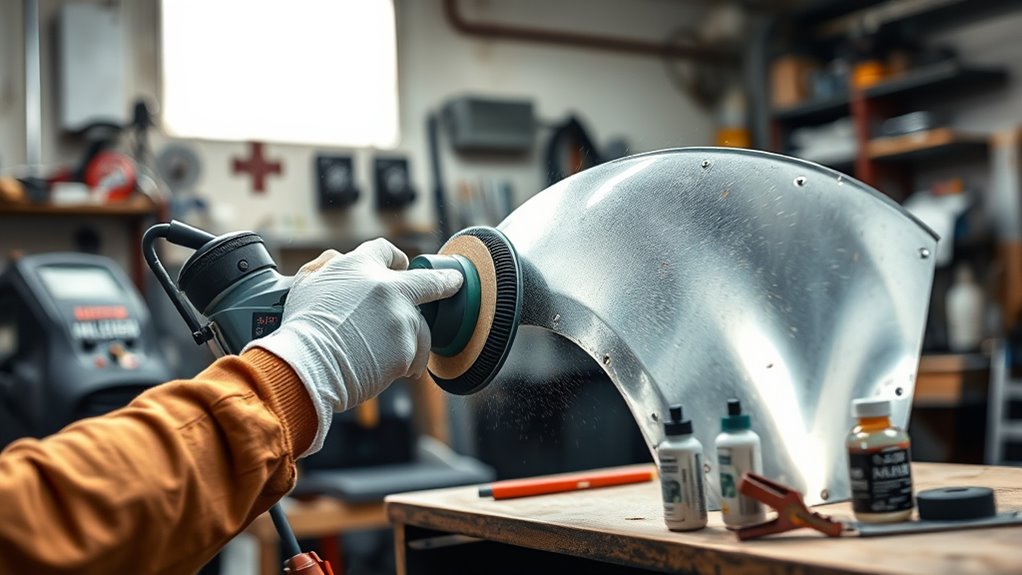
Good preparation starts before the grinder touches the panel. Confirm the repair method, inspect both sides of the work area, and move or shield wiring, hoses, glass, upholstery, sound deadener, seam sealer, and trim that could melt or catch fire.
- Identify the metal and thickness. Mild steel, high-strength steel, stainless steel, and aluminum need different wires, gases, and procedures.
- Follow the vehicle power-down procedure. Use model-specific service information for battery, airbag, module, and high-voltage precautions.
- Expose clean metal on both sides. Remove paint, rust, undercoating, seam sealer, adhesive, oil, and scale far enough from the joint to prevent contamination and hidden fire.
- Degrease safely. Use a product approved for the material and process. If acetone is used, keep it away from ignition sources and wait until it has fully evaporated before welding.
- Trim and deburr the joint. Tight, even fit-up reduces the heat needed to bridge gaps.
- Clamp the work securely. Use enough clamps to hold alignment without forcing a distorted panel into place.
- Attach the work clamp correctly. Place it on clean metal as close to the weld area as practical, while following OEM instructions so current does not travel through bearings, modules, or sensitive components.
- Run a final fire check. Look behind and below the joint for insulation, cavity wax, wiring, fuel vapor, and trapped debris.
Preheating is not triggered by a simple “over 1/8 inch” rule. Material grade, thickness, restraint, ambient temperature, filler metal, and the approved welding procedure determine whether preheat is needed. Thin body sheet normally needs less heat, not preheat.
Before welding, confirm that the wire-feeding mechanism runs smoothly and that the correct drive-roll groove, contact tip, liner, and spool tension are in use.
Practice Automotive Welding on Scrap
Begin with flat beads on clean mild-steel coupons, then move to lap joints, butt joints, and plug-weld practice. Thicker 1/8-inch plate is forgiving for learning arc starts and travel, but it does not teach the heat control needed for a thin body panel. Before touching a car, practice on scrap that matches the vehicle metal in alloy, coating, and thickness.
| Practice Coupon | What It Teaches | Move On When |
|---|---|---|
| 1/8-inch mild steel | Starts, gun angle, travel, and bead consistency | Beads are even and show fusion without undercut |
| Matched-gauge sheet | Burn-through control and short tack timing | You can join coupons without large holes or severe distortion |
| Lap-joint coupons | Edge placement and fusion into both layers | A destructive test tears base metal rather than peeling along the weld |
| Plug-weld coupons | Hole size, puddle placement, and penetration into the lower panel | The plug is fully fused and passes the approved test for the procedure |
Log voltage, wire-feed speed, wire diameter, gas, metal thickness, joint type, gun angle, and the result. Change one setting at a time. This makes troubleshooting faster and helps you return to a proven starting point.
Cut, bend, hammer, or peel test practice coupons where appropriate. Surface appearance alone cannot prove penetration or fusion. Maintain a steady travel speed, but slow down or speed up only after reading what the puddle and test coupon show.
Pro Tip: Make two identical coupons for every setup. Keep one as a visual reference and destroy the other to check fusion. A repeatable result matters more than one attractive bead.
Set Your MIG Welder for Automotive Steel
Use the welder’s door chart or manual as the starting point. The correct voltage and wire-feed speed depend on wire diameter, shielding gas, joint design, position, and actual metal thickness.
- Polarity: Solid MIG wire for steel normally uses direct-current electrode positive. Confirm the lead connections inside the machine.
- Wire: Small wire, often .023 or .024 inch, gives better control on light-gauge sheet. A machine may also support .030-inch wire for thicker work.
- Gas: C25 is a common mild-steel choice. Set flow according to the machine and regulator instructions, then adjust only for drafts, nozzle size, and the work environment.
- Contact-tip-to-work distance: Keep it short and consistent. Excessive stickout makes the arc less stable and changes heat input.
- Gun angle: Use a slight push angle on thin sheet unless the procedure calls for another technique.
- Test first: Run a bead on matched scrap and inspect both sides before welding the part.
A harsh, irregular arc can come from poor work-clamp contact, incorrect polarity, contaminated metal, a worn contact tip, too much spool tension, or a gas problem. Do not compensate for a mechanical fault by randomly changing voltage and wire speed.
How to Make Clean Auto Welds
Start with clean metal and tight fit-up. Remove rust, paint, oil, adhesive, seam sealer, and mill scale where present. Clean the back side too, because hidden coatings can burn and contaminate the joint.
- Make a test weld. Confirm the machine settings on matched scrap.
- Tack the joint in alignment. Place small tacks at spaced locations instead of starting at one end.
- Watch the leading edge of the puddle. Aim the wire so both sides of the joint melt together.
- Keep the gun steady. Maintain a consistent distance, angle, and travel path.
- Pause between short welds. Move to a distant area while the previous tack cools.
- Inspect both sides. Look for fusion, burn-through, pinholes, cracks, incomplete fill, and heat damage.
A clean-looking bead can still be weak. Undercut, lack of fusion, porosity, and excessive grinding can reduce joint strength even when the surface appears smooth.
Control Heat to Prevent Warping
Thin sheet warps because welding heats and expands a small area, then the metal shrinks as it cools. The goal is to distribute heat instead of concentrating it along one continuous seam.
- Use a series of small, spaced tacks rather than a long bead.
- Move around the panel so consecutive welds are far apart.
- Allow the metal to cool naturally between passes.
- Keep gaps small so the arc is not used to bridge missing metal.
- Clamp a clean copper or aluminum backing bar behind the joint when access and the procedure allow it.
- Stop and correct fit-up if the panel begins to pull out of shape.
- Do not quench a hot structural repair with water unless an approved procedure specifically calls for it.
For a cosmetic sheet-metal seam, add a new tack at the edge of a cooled tack and continue in a skip pattern. Do not assume the same sequence is approved for a structural panel; use the OEM weld type, location, spacing, and test requirements.
Finish Welds With an Angle Grinder
Grinding is for controlled finishing, not hiding a poor weld. Let the joint cool, then inspect it before removing material.
- Unplug the grinder or remove its battery before changing accessories.
- Install the correct guard, side handle, and wheel for the task.
- Wear safety glasses, a face shield, hearing protection, gloves, and suitable clothing.
- Use a flap disc or other approved finishing abrasive with light pressure.
- Keep the tool moving so grinding heat does not distort the panel.
- Stop when the weld is level enough for the repair. Do not thin the surrounding base metal.
- Inspect for pinholes, cracks, undercut, and incomplete fusion. Repair defects before coating.
- Restore corrosion protection, seam sealer, primer, cavity wax, and coatings as required by the vehicle maker.
Warning: Never operate an angle grinder without its guard or with an accessory that is damaged, oversized, or rated below the grinder’s maximum speed.
Common Auto Welding Mistakes to Avoid
| Mistake | What Happens | Better Approach |
|---|---|---|
| Practicing only on thick plate | Settings and timing do not transfer to body sheet | Move to matched-gauge coupons before vehicle work |
| Welding over paint or undercoating | Porosity, toxic fumes, contamination, and hidden fire | Clean both sides to sound metal and use fume extraction |
| Running a continuous bead on thin sheet | Burn-through and severe distortion | Use spaced tacks and a skip sequence |
| Using one setting for every joint | Inconsistent fusion and bead shape | Start from the chart and test on matched scrap |
| Judging strength by appearance | A smooth bead may hide lack of fusion | Destructively test practice coupons |
| Grinding until the repair disappears | The weld and base metal become too thin | Use light pressure and inspect often |
| Ignoring OEM procedures | Heat or weld placement can reduce crash performance | Verify the material and approved repair method by model year |
What to Learn After Your First Weld
Once you can repeat sound beads and joints on scrap, build skill in a controlled order:
- Practice lap, butt, corner, and plug welds in flat and vertical positions.
- Learn how wire speed, voltage, travel speed, stickout, and gun angle change the puddle.
- Cut and etch practice welds or use approved destructive tests to evaluate fusion.
- Study corrosion protection, weld-through primer use, seam sealing, cavity wax, and coating restoration.
- Learn to read vehicle-specific body repair manuals and material maps.
- Take hands-on training before attempting structural, aluminum, high-strength-steel, airbag-area, or high-voltage repairs.
Your first goal is not speed. It is a repeatable process: identify the material, prepare it correctly, set the machine from verified information, make a controlled weld, test the result, and restore the vehicle safely.
Sources
- OSHA 29 CFR 1910.252 — General Requirements for Welding, Cutting, and Brazing — hot-work fire prevention, eye protection, ventilation, and safe work practices
- OSHA 29 CFR 1910.133 — Eye and Face Protection — minimum filter-shade guidance for GMAW
- NIOSH — Welding Fumes and Manganese — welding-fume composition and health concerns
- Miller Electric — Successfully Welding Sheet Metal With MIG and TIG — wire size, C25 gas, fit-up, backing bars, and heat-control methods
- NHTSA — Electric and Hybrid Vehicle Safety — need for qualified EV-specific high-voltage service training
- Tesla Collision Repair Manual — Body Structure Materials and Allowed Operations — example of OEM limits on sectioning and GMA welding of high-strength steel