Disclosure: As an Amazon Associate, we earn from qualifying purchases. If you click a link on this page and make a purchase, we may receive a small commission at no extra cost to you.
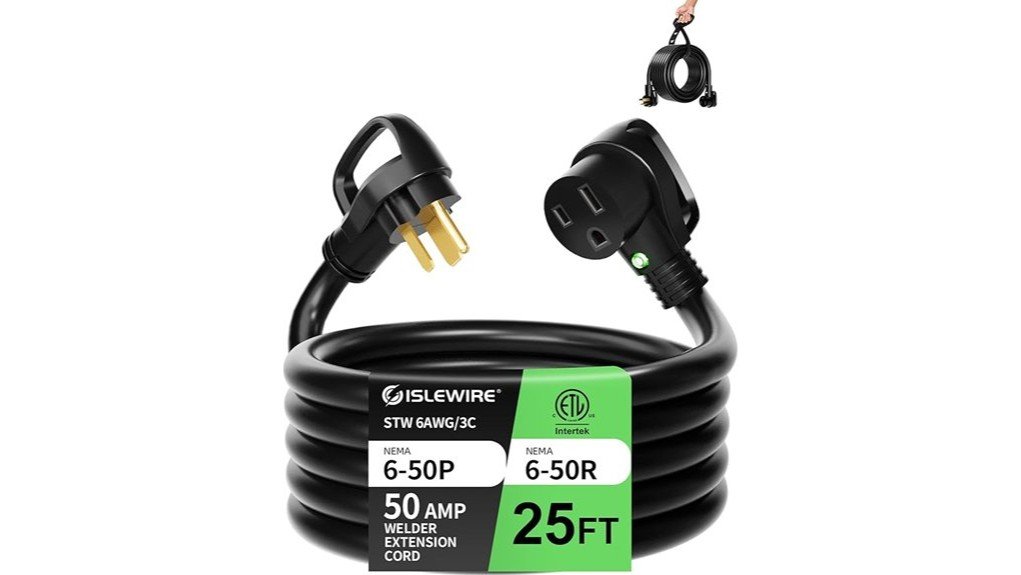
Running a welder from the wrong extension cord can cause voltage drop, weak arc starts, overheating, or unsafe connections. The 6 AWG 250V welder extension cord is built for high-current welding setups with a 50 Amp rating, copper conductors, and an STW-rated weather-resistant jacket. This review helps you decide if its heavy-duty build fits your MIG or TIG setup, or if its size and stiffness make it more cord than you need.
Quick Verdict
Rating: 8/10, Recommended with caveats
Best For: MIG/TIG welders, mobile welding rigs, fabrication shops, and outdoor work areas that need 50A 250V support
Bottom Line: The 6 AWG copper build, 50A rating, and STW jacket make this cord a strong pick for demanding welding work. The tradeoff is handling, because a heavy-gauge cord can feel stiff, bulky, and unnecessary for low-power hobby tools.
Key Specifications at a Glance
| Specification | Detail |
|---|---|
| Product Type | Heavy-duty welder extension cord |
| Wire Gauge | 6 AWG |
| Voltage Rating | 250V |
| Current Capacity | 50 Amps |
| Max Power Output | Up to 12,500 watts when used with properly rated equipment and circuits |
| Conductor Material | 100% pure copper |
| Jacket Type | STW-rated weather-resistant jacket |
| Temperature Range | -40°F to 140°F |
| Safety Features | LED power indicator and molded ergonomic plug |
| Best Use | MIG/TIG welding, mobile welding, fabrication shops, and outdoor job sites |
| Storage Note | Store loosely coiled, dry, and away from sharp edges or repeated strain points |
What Is the 6 AWG 250V Welder Extension Cord?
This is a heavy-duty power cord made for welding machines that need stable, high-current delivery. The 6 AWG copper wiring gives the cord a larger conductor size than common household extension cords, which helps reduce resistance and voltage drop during demanding work.
The 50A and 250V ratings make it suitable for compatible MIG and TIG welders, as long as your welder, plug, receptacle, and circuit are all rated correctly. The STW-rated jacket adds weather resistance for shop floors, garages, and outdoor job sites, but it still needs careful routing and storage.
It is not meant to replace proper wiring or a permanent outlet. It works best as a temporary power extension for welding tasks where you need more reach without stepping down to a lighter-duty cord.
Who Should Buy It?
Best For
- Welders using compatible 50A, 250V MIG or TIG machines
- Mobile welding rigs that need durable power reach between locations
- Fabrication shops and garages where voltage stability matters under load
Skip If
- Your welder does not use a 50A, 250V power setup
- You need a light, flexible cord for basic household tools
- You want a permanent wiring solution instead of a temporary extension cord
Before You Buy: Confirm your welder’s voltage, amperage, plug type, receptacle, and circuit rating before ordering. A 50A cord only helps when the rest of your setup is also properly rated.
Build Quality and Materials
The key strength is the 6 AWG copper conductor design. Copper handles electrical current efficiently, and the larger gauge helps limit heat buildup and voltage loss when your welder draws heavy current.
The STW-rated outer jacket is built for tougher environments than a light indoor cord. It gives the cord better resistance against moisture, oil exposure, abrasion, and job-site handling, which matters when the cable gets dragged across concrete, gravel, or a shop floor.
The tradeoff is flexibility. Heavy-gauge cords are naturally thicker and harder to coil than light-duty cords, so storage and handling take more effort.
Compatibility and Electrical Safety
This cord makes sense only with equipment that matches its 50A and 250V rating. Before use, check your welder manual, circuit breaker, receptacle, and plug pattern so you do not force a mismatch or overload a weaker part of the setup.
The LED power indicator helps you confirm that power is present at the connection point. That is useful during setup, but it does not replace safe electrical checks, proper grounding, or inspection for damaged insulation and plug wear.
The molded ergonomic plug helps with grip and strain control during plugging and unplugging. Avoid pulling the cord from the cable body, because repeated strain near the plug can damage the connection over time.
Pro Tip: Fully uncoil the cord before welding. A tightly coiled high-load cord can trap heat, especially during longer weld sessions.
Setup Tips Before First Use
Start by inspecting the entire cord, including the jacket, plug ends, and molded strain areas. Do not use it if you see cuts, exposed conductors, heat damage, loose parts, or a burning smell from previous use.
Route the cord where it will not sit under metal, sharp edges, tires, doors, or heavy shop equipment. Keep it out of standing water, and do not cover it with mats or rugs that can trap heat.
After use, let the cord cool if it feels warm, then coil it loosely for storage. A loose coil reduces stress on the jacket and makes the cord easier to lay flat the next time you weld.
How It Performs in Real Use
For Workshop Welding
In a fixed garage or fabrication shop, the 6 AWG copper build helps keep power delivery steadier than thinner cords. That can support a more consistent arc when your compatible welder pulls higher current.
For Outdoor Job Sites
The STW-rated jacket is useful when the cord may face dust, moisture, oil, and rough surfaces. You should still avoid standing water and store the cord indoors or in a dry protected area after use.
For Mobile Welding Rigs
Mobile welders benefit from the 50A capacity and rugged jacket because setup conditions can change from job to job. The downside is weight and stiffness, so plan for extra storage space in the truck or trailer.
For Heavy-Duty Equipment
The cord can support high-wattage tools up to 12,500 watts only when the equipment and circuit are properly rated. For tools that draw less power, the cord may still work if compatible, but it can feel bulky and unnecessary.
Pros and Cons
Pros
- 50A, 250V rating fits compatible high-current welding setups
- 6 AWG copper conductors help reduce resistance and voltage drop
- STW-rated jacket improves durability for shop and outdoor use
- LED indicator helps confirm power at the connection point
- -40°F to 140°F temperature range supports varied work environments
Cons
- Thick 6 AWG cable can be heavy, stiff, and harder to coil
- Not useful unless your welder, outlet, plug, and breaker match the rating
- Overkill for light-duty tools, small hobby machines, or short indoor runs
Need a Heavy-Duty Welding Cord?
Check the current product details and confirm compatibility before you buy.
Is It Worth the Price?
This cord sits in the heavy-duty category, so its value depends on how often you weld and how demanding your setup is. It is worth considering if you need 6 AWG copper conductors, a 50A rating, and a rugged jacket for repeated shop or field use.
Professional welders, mobile fabricators, and serious DIY users will get the most value from the higher capacity and stronger construction. Casual users may find that the extra bulk is not worth it if they only run smaller tools or occasional low-amperage projects.
The best value comes from buying the cord for the right reason: safe, compatible reach for a high-current welding setup. It is not a shortcut around an undersized circuit or mismatched outlet.
How It Compares to Alternatives
Compared with standard 10 or 12 AWG extension cords, this 6 AWG welder cord offers stronger current handling and better support for high-load welding applications. Those lighter cords are easier to move, but they are not a safe substitute when your welder calls for heavier capacity.
Compared with mid-range welding cords, this one stands out through its 50A rating, copper conductors, LED power indicator, molded plug, and STW-rated jacket. It makes the most sense if durability and power stability matter more than compact storage.
Frequently Asked Questions
Can this 6 AWG cord be used with any welder?
No. It is intended for welders that match a 50A, 250V setup. Check your welder manual, plug type, outlet, and breaker before connecting it.
Is the cord safe for outdoor use?
The STW-rated jacket is built for weather-resistant use, so it is better suited to outdoor work than a basic indoor cord. Still, keep the connections away from standing water and store the cord dry when not in use.
Does 6 AWG wiring reduce voltage drop?
Yes, the larger 6 AWG copper conductors are designed to carry high current with less resistance than thinner extension cords. That can help your compatible welder maintain more stable arc performance.
Can it handle tools other than welders?
It can support compatible high-power tools within its 50A, 250V, and 12,500-watt limits. The tool, plug, outlet, and circuit must all be properly rated.
Why is this cord heavier than a household extension cord?
The 6 AWG conductors and heavy-duty jacket add size and weight. That extra build helps with high-current use, but it also makes the cord stiffer and harder to store.
Should you leave the cord coiled while welding?
No. Fully uncoil the cord before use so heat can dissipate more easily. This is especially important when running a welder under heavier load.
Who should skip this welder extension cord?
Skip it if your equipment does not require a 50A, 250V cord or if you only need a light cord for small household tools. It is also not the right solution for permanent wiring.
How should you store it after use?
Let the cord cool if it feels warm, then coil it loosely and store it in a dry place. Avoid sharp bends near the plug ends because those areas take the most strain.
The Bottom Line
The 6 AWG 250V welder extension cord is a strong choice for welders who need a 50A, copper-conductor cord for compatible MIG or TIG machines. It is best for demanding shop, mobile, and outdoor welding setups where stable power delivery matters.
Skip it if you need a light household cord, a permanent wiring fix, or a cord for equipment that does not match its rating. Its main strength is high-current durability, while its main limitation is bulk and stiffness.