Wire gauge in welding usually refers to the size of the copper welding cable that carries current between your welder, electrode holder or gun, and work clamp. It is not the same thing as MIG wire diameter, which is normally sold by inches or millimeters. In the AWG system, lower numbers mean thicker conductors, lower resistance, and better current delivery over longer leads.
Quick Answer
Welding cable gauge tells you the conductor size of your welding leads. A lower AWG number means a thicker cable that can carry more current with less heat and voltage drop. Choose cable size by amperage, total lead length, duty cycle, and the cable maker’s rating.
Key Takeaways
- Lower AWG numbers are thicker. A 2 AWG welding cable is larger than 6 AWG, and 1/0 is larger than 1 AWG.
- Total cable length matters. Count both the electrode lead and work lead when sizing welding cable.
- Duty cycle affects heat. Long, high-amperage welds need more cable capacity than short tack welds.
- MIG wire diameter is different. A .030 MIG wire is a filler wire size, not a welding cable gauge.
- Safety comes first. Replace damaged cable, avoid tight coils, and use connectors rated for the same current as the cable.
At a Glance
| Time Required | 5–10 minutes to check amperage, lead length, and cable markings |
| Difficulty | Easy for basic shop setups; ask a qualified electrician for machine supply wiring |
| Tools Needed | Welder manual, tape measure, cable size chart, and cable jacket markings |
| Cost | Free to inspect; replacement cost depends on cable gauge, length, copper price, and connector type |
What Is Wire Gauge in Welding?
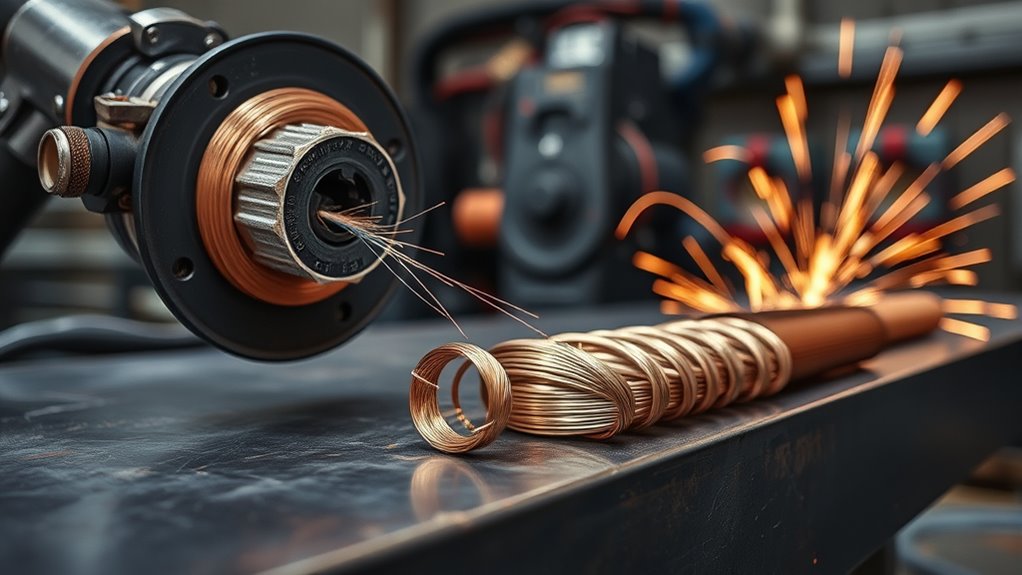
In welding, wire gauge most often means the AWG size of your welding cable or leads. These cables carry welding current from the machine to the electrode holder, MIG gun, TIG torch connection, or work clamp. The cable must be large enough to carry the machine’s output without excess heat or voltage loss.
ASTM B258 covers the standard nominal diameters and cross-sectional areas for AWG sizes used as electrical conductors. The key rule is simple: a lower AWG number means a larger conductor. For example, 2 AWG is larger than 6 AWG, and 1/0 AWG is larger than 1 AWG.
That size matters because welding cables carry high current at relatively low voltage. If the cable is too small for the amperage and length, it can heat up, waste power, and make the arc feel weak or inconsistent.
Note: Welding cable gauge is different from filler wire diameter. A spool of .030 MIG wire describes the electrode wire fed into the weld. A 2 AWG or 1/0 cable describes the power lead that carries current.
How Wire Gauge Numbers Affect Welds
Gauge numbers affect welds by changing resistance, heat buildup, and voltage drop. A thicker cable has less resistance, so more of the machine’s output reaches the arc instead of being lost as heat in the leads.
When the cable is sized correctly, you get more stable starts, steadier arc behavior, and less cable heating. When the cable is undersized, you may notice harder arc starts, a soft arc, inconsistent puddle control, and hot leads after a short amount of welding.
Lower AWG means thicker cable, lower resistance, and better current flow over the same lead length.
Longer cable runs need special attention. A 25 ft electrode lead and 25 ft work lead create a 50 ft welding circuit. A 50 ft electrode lead and 50 ft work lead create a 100 ft circuit. That total length is what matters when you size welding cable.
What AWG Means for Welding Cable
AWG stands for American Wire Gauge. It is a conductor sizing system used in North America. For welding cable, the AWG number tells you the conductor size, while the finished outside diameter also depends on strand count, insulation thickness, and jacket material.
AWG Size Basics
As AWG numbers go down, conductor size goes up. After 1 AWG, larger sizes use “aught” numbers: 1/0, 2/0, 3/0, and 4/0. A 4/0 cable is much larger than 4 AWG, so do not treat those labels as the same size.
| Cable Label | How to Read It | General Meaning |
|---|---|---|
| 6 AWG | Six gauge | Small welding lead for lighter output and shorter runs |
| 2 AWG | Two gauge | Medium to heavy lead for many shop welders |
| 1/0 AWG | One-aught | Heavy cable for higher current or longer leads |
| 4/0 AWG | Four-aught | Very heavy cable for high-output industrial work |
Choosing Welding Cable Gauge
Choose welding cable gauge by matching four things: maximum amperage, total circuit length, duty cycle, and the cable manufacturer’s rating. Do not size the cable only for the amperage you use most often. Size it for the highest current you reasonably expect to run.
Also check the rest of the current path. The electrode holder, work clamp, lugs, dinse connector, and cable couplers should be rated for the same current range as the cable. A large cable with a weak clamp or loose lug can still overheat.
Pro Tip: If two cable sizes both look acceptable, choose the larger one when the leads are long, the shop is hot, or you run high duty cycle welds. The extra copper gives you more safety margin and less voltage drop.
Which Wire Gauges Work Best for Common Welding Jobs?
The best welding cable gauge depends on how much amperage you run and how far the current must travel. The chart below is a practical starting point for copper welding cable in common shop setups. Always confirm the final size with your welder manual, cable jacket markings, and the cable manufacturer’s chart.
| Welder Output | Up to 50 ft Total Circuit | Up to 100 ft Total Circuit | Up to 150 ft Total Circuit |
|---|---|---|---|
| Up to 100 amps | 6 AWG | 4 AWG | 2 AWG |
| 125–150 amps | 4 AWG | 2 AWG | 1/0 AWG |
| 175–200 amps | 2 AWG | 1/0 AWG | 2/0 AWG |
| 225–250 amps | 1 AWG or 1/0 AWG | 2/0 AWG | 3/0 AWG |
| 275–300 amps | 1/0 AWG | 3/0 AWG | 4/0 AWG |
| 350–400 amps | 2/0 to 3/0 AWG | 4/0 AWG | Use shorter leads, parallel leads, or manufacturer engineering guidance |
Products Worth Considering

【Pure Copper Wire Material】:This fully annealed pure copper cable (OFC) is made of 1703 strands of 0.2mm AS copper wire and solvent resistant EPDM rubber insulation sheath (specific voltage, outer diameter, and stranded wire data can be found in the cable table for details)

【Pure Copper Wire Material】:This fully annealed pure copper cable (OFC) is made of 1703 strands of 0.2mm AS copper wire and solvent resistant EPDM rubber insulation sheath (specific voltage, outer diameter, and stranded wire data can be found in the cable table for details)

Included Items: 1/0 AWG 5ft red & 5ft black pure welding copper cable (select cable gauge, insulation color and length using the selection tabs), 5pcs 5/16" copper cable lugs + 5pcs 3/8" copper cable lugs + 5pcs black& 5pcs red heat shrink tubing.
Light-Duty Welding Gauges
For light-duty welding, short leads, and lower amperage work, 6 AWG or 4 AWG cable may be enough. These sizes are easier to handle, cost less, and reduce fatigue when you move around a bench or small garage bay.
Use a larger cable if you run long beads, weld near the top of the machine’s output, or use longer leads. A cable that feels warm after a few minutes is a sign to stop and check the size, connections, and duty cycle.
Heavy-Duty Welding Gauges
Heavy-duty welding needs thicker cable because higher current creates more heat in the conductor. For many larger shop machines, 1/0, 2/0, 3/0, or 4/0 cable may be appropriate, especially when the total lead length grows.
The tradeoff is handling. Larger cable is heavier and less flexible. Route heavy leads so they do not pull on the holder, torch, machine terminals, or work clamp. Support the cable when working overhead or on large structures.
How to Choose the Right Wire Gauge
Use this process to choose the right welding cable gauge before you buy or replace leads.
- Find your maximum output amperage. Check the welder’s rated output, not only the setting you use most often.
- Measure total welding circuit length. Add the electrode lead or gun lead plus the work lead.
- Check duty cycle. Long welds at high output need more cable capacity than short tack welds.
- Pick a starting gauge from a chart. Use the chart above or your machine maker’s guidance.
- Verify the cable marking. Look for AWG size, copper conductor, insulation type, and temperature rating.
- Match the connectors. Use lugs, holders, clamps, and plugs rated for the current.
- Inspect during use. Stop if the cable, connectors, or clamp become hot, loose, or damaged.
Warning: Do not keep welding cable tightly coiled while welding. Spread the cable out so heat can escape, and replace any cable with damaged insulation or exposed bare conductor.
Products Worth Considering
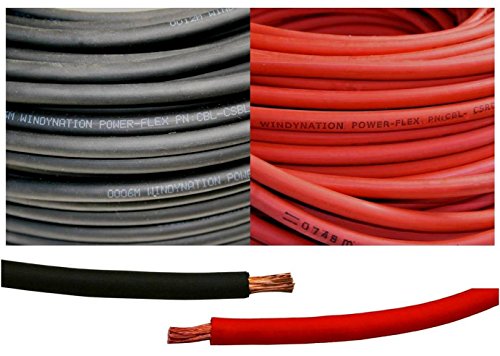
Use selection tabs above to select (1) cable gauge size and (2) cable length and insulation color. Available in 8 Gauge through 4/0 Gauge. Please refer to the photo gallery for a technical specification chart (amperage, voltage, stranding, insulation and copper thickness, etc.)

【Heavy Duty Safe Battery Cables】This 4AWG battery cable is made of 673 strands of 0.2mm AS copper wire. 5/16'' ring terminal at each end(already crimped). The cable is an ultra flexible pure copper cable manufactured with a tough, solvent resistant. Please refer to the photo gallery for a cable specification chart ( stranding,voltage,insulation and copper thickness, etc.)
What Affects Welding Wire Performance?
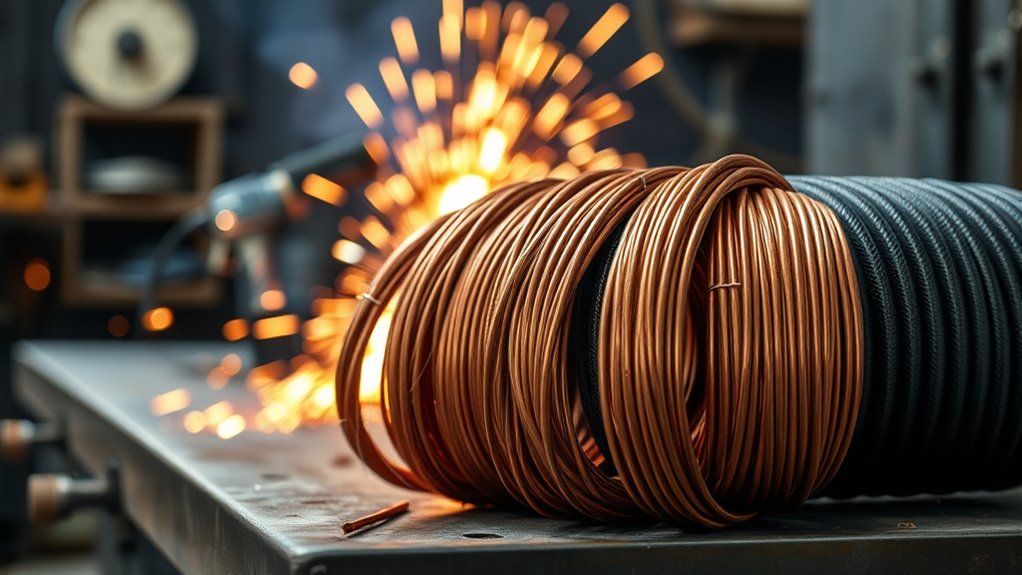
Welding cable performance depends on more than the AWG number. Material, stranding, insulation, cable length, connector quality, and working conditions all affect how well the cable carries current.
| Factor | What It Changes | What to Do |
|---|---|---|
| Gauge | Resistance, heat, and voltage drop | Use a lower AWG number for higher current or longer leads |
| Copper conductor | Conductivity and durability | Use flexible copper welding cable for welding leads |
| Stranding | Flexibility and handling | Choose fine-stranded cable for leads that move often |
| Lead length | Voltage drop | Shorten the leads or increase cable size |
| Connections | Heat at lugs, plugs, and clamps | Keep connections tight, clean, and properly rated |
Aluminum conductors are not a direct one-for-one substitute for copper welding cable. Aluminum has lower conductivity, needs different terminations, and is not usually the flexible welding lead choice for portable shop work. For welding leads, flexible copper welding cable is the normal option.
How Wire Gauge Affects Weld Safety and Output
Wire gauge affects weld safety because undersized cable turns more electrical energy into heat. That heat can damage insulation, weaken connectors, and increase the chance of shock or fire hazards. OSHA’s arc welding rule also warns that coiled cable should be spread out before use to avoid serious overheating and insulation damage, and that damaged insulation or exposed bare conductors must be replaced.
Wire gauge also affects output. If your leads are too small or too long, the machine may show one setting while the arc receives less usable voltage. You may compensate by turning the machine up, but that does not fix the hot cable problem. The better fix is a shorter lead, larger cable, better connections, or a combination of all three.
Signs Your Welding Cable Is Too Small
- The cable gets hot during normal welding.
- The arc starts poorly or feels weak at the workpiece.
- You need higher machine settings than usual for the same weld.
- The work clamp, lug, or connector becomes hot.
- The insulation smells hot, stiffens, cracks, or shows damage.
Welding Cable Safety Checklist
- Spread cable out before welding instead of leaving it tightly coiled.
- Do not wrap the electrode cable around your body.
- Keep splices away from the electrode holder area.
- Replace cable with damaged insulation or exposed copper.
- Keep lugs, plugs, holders, and clamps tight and clean.
- Do not use chains, hoists, cranes, or wire rope as the welding current path.
- Follow your welder manufacturer’s operating instructions.
Frequently Asked Questions
What gauge is .030 welding wire?
A .030 welding wire is normally called .030 inch MIG wire, not an AWG cable size. If you convert only by bare diameter, .030 inch is roughly around 21 AWG, but welders and wire manufacturers identify MIG wire by inch or millimeter diameter.
What gauge is #4 welding wire?
#4 usually means 4 AWG when you are talking about electrical conductor size. A 4 AWG solid conductor has a bare conductor diameter of about 0.204 inch, but finished welding cable will be larger because it is stranded and insulated.
Which is bigger, 14 gauge or 17 gauge wire?
14 gauge is bigger than 17 gauge wire. In the AWG system, the lower number means the thicker conductor. That is why 14 AWG can carry more current than 17 AWG under the same conditions.
Is welding cable the same as building wire?
No. Welding cable is usually fine-stranded and flexible so it can move around the shop. Building wire is designed for fixed electrical installations. Use welding cable for welding leads, and follow electrical code and a qualified electrician’s guidance for machine supply wiring.
Can welding cable be too large?
A larger cable is not usually unsafe by itself, but it can be expensive, heavy, and hard to handle. It may also strain small connectors if the setup is not supported well. The best choice is the smallest cable that safely covers your amperage, length, duty cycle, and connector rating.
Do longer welding leads need thicker cable?
Yes. Longer leads add resistance and voltage drop, so they often need thicker cable. Count the full circuit length, including both the electrode lead and work lead, before choosing a gauge.
Conclusion
Wire gauge has a direct effect on welding safety, arc stability, and cable life. Use AWG to understand conductor size, but choose welding cable by the full job: amperage, total lead length, duty cycle, cable material, insulation rating, and connector capacity. When in doubt, check the welder manual and cable manufacturer’s chart, then choose enough copper to keep the leads cool and the arc steady.
Sources
- ASTM B258-18(2026) — standard nominal diameters and cross-sectional areas for AWG electrical conductors
- OSHA 29 CFR 1910.254 — arc welding equipment, cable, grounding, operation, and maintenance safety requirements
- NFPA 70, National Electrical Code — electrical-code reference for safe electrical installations and conductor guidance