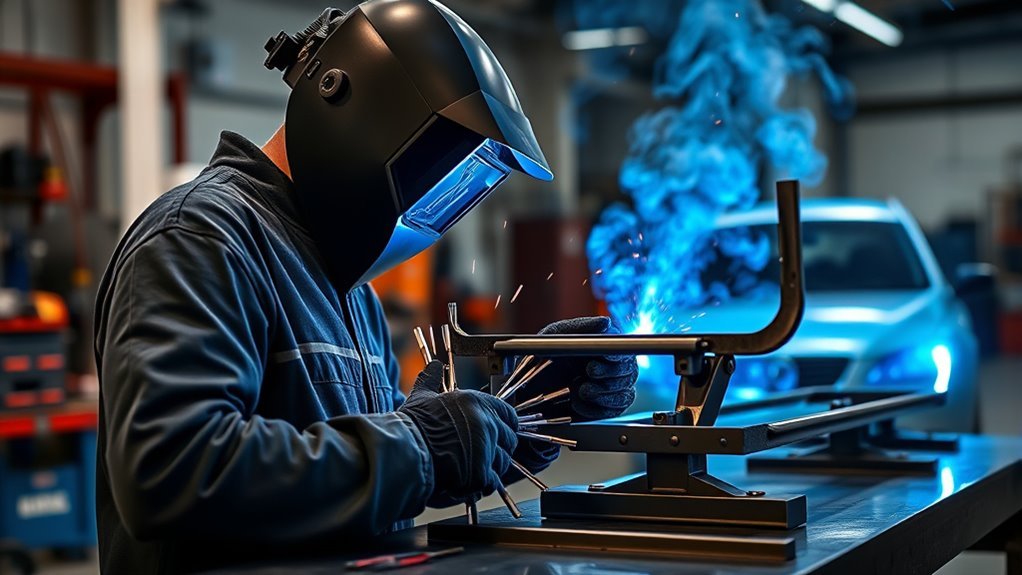
Controlling heat input on thin auto body panels comes down to using the lowest stable settings, short weld bursts, clean fit-up, and plenty of cooling time between tacks. Thin sheet metal moves quickly when it gets hot, so your goal is not to run one long bead. Your goal is to place small, controlled welds that fuse the joint without warping the panel or burning a hole through it.
Quick Answer
To control heat input on thin auto body panels, use 0.023- or 0.025-inch MIG wire, C25 shielding gas for mild steel, tight fit-up, short tack or stitch welds, and cooling breaks between welds. Start low, test on scrap of the same thickness, and move around the panel instead of welding one long bead.
Key Takeaways
- Use the welder chart as a starting point, then fine-tune on scrap from the same panel thickness.
- Tack, skip, and stitch weld instead of running a continuous bead on thin sheet metal.
- Keep the joint clean, tightly fitted, and clamped so you do not need extra heat to bridge gaps.
- Use copper or brass backing when possible to support the puddle and reduce burn-through.
- Protect yourself from fumes, UV light, fire risk, and coated-metal hazards before welding.
At a Glance
| Time Required | 30 minutes to several hours, depending on panel size, fit-up, and finishing work |
| Difficulty | Moderate to advanced, especially on outer body panels |
| Tools Needed | MIG or TIG welder, 0.023- or 0.025-inch wire for MIG, shielding gas, clamps, copper or brass backing, grinder, sanding discs, PPE, and fire extinguisher |
| Cost | Low if you already own welding gear; higher if you need shielding gas, clamps, backing bars, or safety equipment |
Warning: Welding can expose you to metal fumes, ultraviolet radiation, sparks, burns, electric shock, and fire risk. Work in a ventilated area, wear a proper welding helmet and PPE, keep a fire extinguisher nearby, and remove paint, seam sealer, undercoating, galvanized coating, and fuel-contaminated residue before welding. For structural panels or modern high-strength steel, follow the vehicle maker’s repair procedure.
Understanding the Impact of Heat on Thin Panels
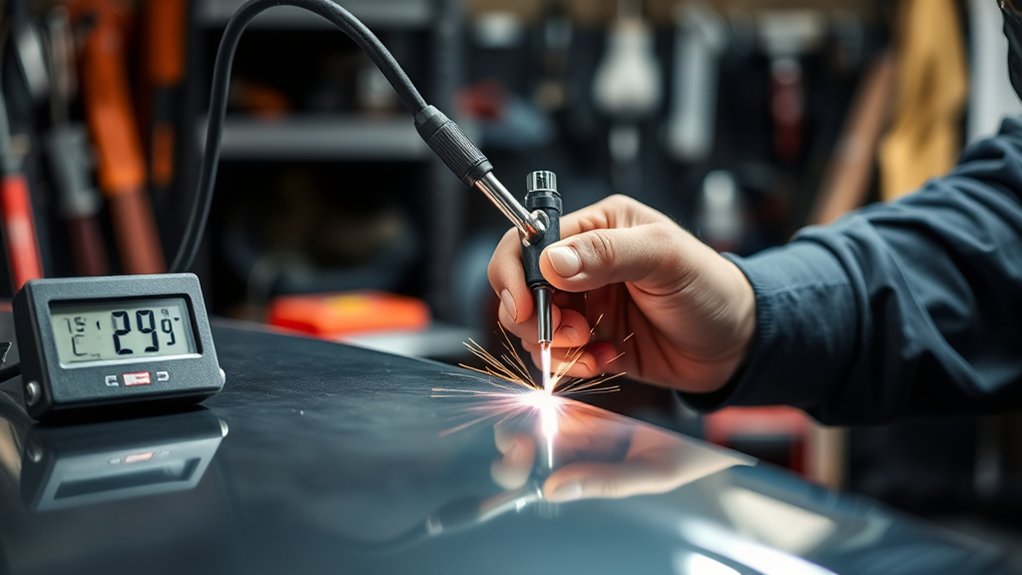
Thin auto body panels are usually much less forgiving than frame brackets or thick plate. When heat stays in one small area for too long, the metal expands, shrinks as it cools, and pulls the panel out of shape. That is why long weld beads can leave a door skin, quarter panel, or patch panel wavy even when the weld itself looks acceptable.
High heat input can also cause burn-through, edge melt-back, pinholes, excessive shrinkage, and weak fusion. Low heat can create cold tacks that sit on top of the metal without tying both sides together. The right balance is a small, controlled puddle that wets into both panel edges without sagging or dropping out.
Before welding, clean the joint to bright metal on both sides when you can reach them. Remove paint, primer, rust, body filler, seam sealer, adhesives, and undercoating from the weld zone. Clean metal lets you use lower heat and helps reduce porosity, spatter, and weak welds.
Note: Do not guess on structural areas such as pillars, rocker reinforcements, rails, or airbag-related sections. Many late-model vehicles use high-strength or ultra-high-strength steels that require specific OEM repair methods.
Choosing the Right Welder Settings for Thin Materials
Welder settings for thin sheet metal are starting points, not fixed rules. A 50-60 amp range may work on some very thin mild-steel panels, but the correct setting depends on panel gauge, wire size, wire feed speed, voltage, shielding gas, stickout, joint gap, and your welding technique. Always test on scrap metal that matches the panel before welding on the vehicle.
For MIG welding mild-steel auto body panels, 0.023- or 0.025-inch solid wire is usually easier to control than larger wire because it needs less heat to run smoothly. A 75/25 argon and carbon dioxide mix, often called C25, is a common choice for short-circuit MIG welding on mild steel because it gives a stable arc with less spatter than straight CO2.
| Panel Thickness | MIG Wire | Technique |
| 22-24 gauge | 0.023 or 0.025 inch | Quick tacks, skip welding, copper backing if possible |
| 18-20 gauge | 0.023 or 0.025 inch | Tack every 1-2 inches, then fill in slowly |
| 16 gauge or thicker | 0.025 or 0.030 inch | Short stitches, still avoid long beads on visible panels |
Set gas flow high enough to shield the weld, but not so high that turbulence pulls air into the puddle. Many small MIG setups work well around 20 cubic feet per hour indoors, but drafts, nozzle size, and weld position can change the need. If you see porosity, brown soot, or an unstable arc, check gas coverage, nozzle cleanliness, and workpiece cleanliness before increasing heat.
Techniques for Heat Control During Welding
The best way to manage heat is to break the weld into small pieces. Tack welding, stitch welding, and skip welding all help, but they are not exactly the same. Tack welds lock the panel in position. Stitch welds are short weld bursts. Skip welding means moving to another area before the last weld overheats the panel.
Techniques for Minimizing Heat
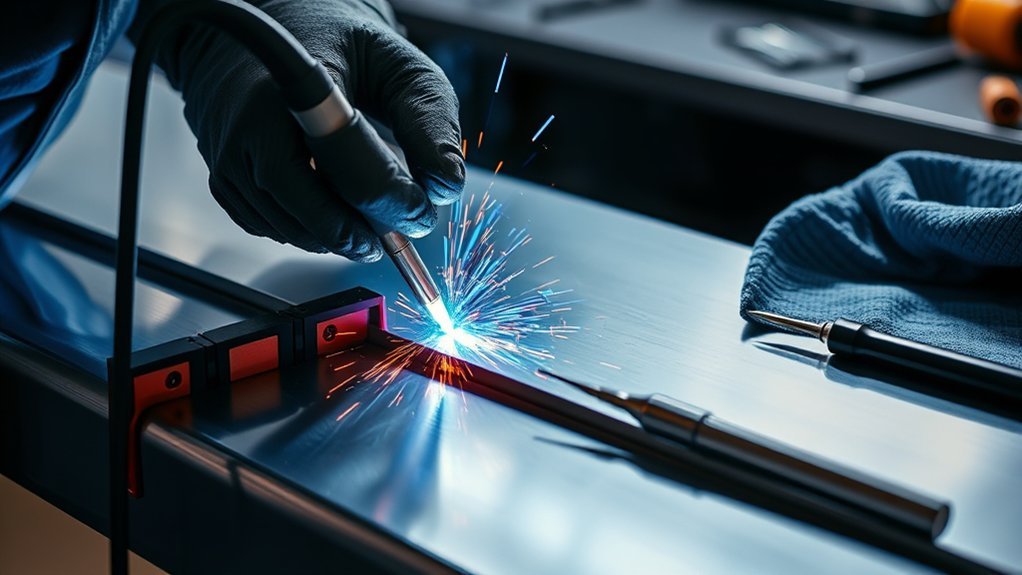
Start with a few small tacks to hold the panel. Place them about 1 to 2 inches apart, or closer if the seam wants to move. Then add more tacks between the first ones, moving around the panel so heat does not build in one area. Let each tack cool before placing the next tack nearby.
Keep your stickout short and consistent, usually around 3/8 inch for MIG sheet metal work. Hold the gun steady, use quick trigger pulls, and aim at both panel edges. If the tack balls up on top, you may need slightly more heat or cleaner metal. If the edge melts away, you need less heat, a tighter gap, faster trigger timing, or backing support.
Pro Tip: Use a copper or brass backing bar behind butt welds when access allows. Weld metal will not readily fuse to copper, and the backing helps support the puddle while pulling heat away from the panel.
Effective Cooling Methods
Cooling breaks are more important than forced cooling. After a few tacks, stop and let the panel cool until you can touch the area near the weld with a gloved hand without feeling heavy heat. You can use compressed air across the panel, a copper backing spoon, or a heat sink near the weld to slow heat buildup.
Use wet cloths carefully. They can help protect nearby paint or trim from heat, but do not soak the weld joint or quench each hot tack aggressively. Water near the weld zone can create contamination, steam, and uneven cooling. Controlled spacing and patience are safer than trying to cool a panel after overheating it.
Essential Techniques for Welding Thin Auto Body Panels
Good heat control starts before the arc. Trim the patch carefully, keep the gap small and even, and clamp the panel so both sides sit flush. A wide gap forces you to add filler metal and heat, which raises the chance of burn-through and distortion.
- Prepare the metal: Grind or sand both sides of the weld area to clean, bright metal.
- Fit the patch: Keep the joint tight. A tiny, even gap is easier to weld than a wide, uneven one.
- Clamp the panel: Use panel clamps, magnets, clecos, or locking pliers to hold the surface flush.
- Test on scrap: Use the same thickness and joint style before welding the actual panel.
- Place anchor tacks: Start at opposite ends, then add tacks across the seam to hold shape.
- Skip around: Add short tacks in different areas instead of working in a straight line.
- Fill slowly: Keep adding cooled tacks until the seam is closed.
- Inspect both sides: Check for pinholes, lack of fusion, and distortion before grinding.
For visible outer panels, do not try to make the seam look finished with one pass. A row of cooled, overlapping tacks is usually safer than a continuous bead. Once the seam is complete, the strength comes from proper fusion across the full joint, not from piling extra weld on top.
MIG vs TIG vs Flux-Core for Auto Body Panels
MIG is the most common choice for auto body patch panels because it is fast, accessible, and works well with short tacks. TIG gives excellent heat control in skilled hands, but it is slower and requires very clean fit-up. Flux-core can work for some repairs, but it usually creates more spatter, more cleanup, and more heat than gas-shielded MIG, so it is harder to use on thin cosmetic panels.
| Process | Best Use | Heat-Control Notes |
| MIG with gas | Most patch panels and mild-steel body repairs | Use small wire, short tacks, and C25 gas indoors |
| TIG | Precise seams, custom work, and clean metal | Excellent control, but slow travel can still overheat panels |
| Flux-core | Outdoor or non-cosmetic work when gas is not available | More spatter and cleanup; harder to control on thin panels |
Products Worth Considering
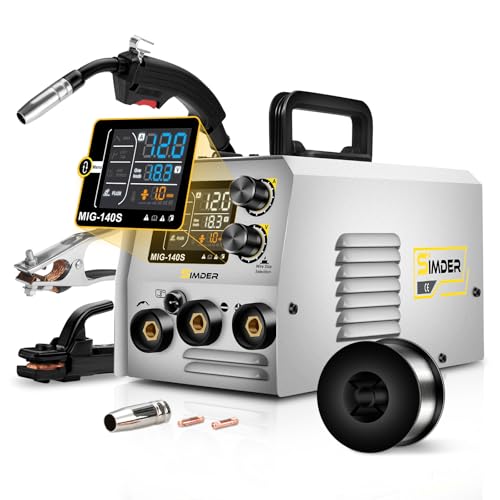
THREE-PROCESS WELDING STATION BUILT FOR FIRST-TIME USERS - Flux Core MIG, Lift TIG and Stick in one machine, so you can find the process that fits your projects without buying three separate welders. Runs on a standard 110V household outlet or 220V for heavier work - no electrician, no special wiring. Welds carbon steel, low-alloy steel, stainless steel, titanium, copper and cast iron

【LOW SPATTER & EASY CLEANUP】Minimal Spatter, Flawless Beads: Experience exceptionally low spatter and minimal post-weld cleanup. This ER70S-6 solid wire allows you to achieve smooth, visually appealing beads with ease, saving both time and grinding effort on your metal fabrication.

Wires diameter :0.6-1.0mm(0.023‘’-0.04‘’)
How to Spot and Avoid Blow-Through

Blow-through happens when the panel edge melts away or the puddle drops out before the tack can freeze. You may see the edge open up, a hole form, or molten metal fall through the joint. It usually comes from too much heat, too wide a gap, dirty metal, slow movement, poor backing, or trying to bridge missing metal with weld.
To avoid blow-through, tighten the fit-up first. Then reduce voltage or wire speed slightly if the puddle is too hot, shorten the trigger pull, and let the panel cool longer between tacks. If the panel is very thin, use copper backing and build the seam with quick, separated tacks.
How to Repair a Small Burn-Through Hole
- Stop welding and let the area cool.
- Clean the edges of the hole with a small burr, file, or abrasive disc.
- Place copper backing behind the hole if you can reach it.
- Add tiny tacks around the edge of the hole, not directly in the center.
- Let each tack cool, then slowly close the opening.
- Grind lightly and check for pinholes before finishing.
If the hole keeps growing, do not keep adding heat. Cut the damaged area back to solid metal and fit a small patch. A controlled patch is stronger and cleaner than a large overheated blob of weld.
Inspecting and Finishing Welds
After welding, inspect the seam before grinding it flat. Look for pinholes, dark soot, porosity, cold tacks, undercut, and panel movement. A good tack should be fused into both edges, not sitting like a BB on top of the seam.
Visual Inspection Techniques
Check the front and back of the weld when access allows. The back side should show signs of fusion without heavy burn-through. If you only inspect the front, you may miss a cold lap or an edge that never fully tied in. Use a bright light behind the panel to find pinholes before applying primer or filler.
Also check the panel shape. Run your hand over the surface and use a straightedge where needed. If the panel has moved, correct the metal before burying the problem under filler. Small lows can often be corrected with careful hammer and dolly work after the weld is dressed.
Final Surface Preparation
Grind welds slowly and lightly. A 2- or 3-inch abrasive disc can dress the weld, but too much pressure will thin the surrounding sheet metal and add more heat. Keep the grinder moving, pause often, and stop as soon as the weld is close to flush.
After grinding, use a guide coat to reveal highs and lows. Finish with sanding blocks instead of leaning hard on a grinder. Before primer, clean the seam and protect the back side with the correct corrosion protection for the repair area.
Note: Do not grind the weld until it disappears into the surrounding panel if that means thinning the base metal. A slightly visible weld that is properly finished is better than a weak, overheated seam.
Recommended Tools for Thin Metal Welding
For thin auto body panels, a gas-shielded MIG welder with stable low-end control is usually the easiest setup. Use 0.023- or 0.025-inch ER70S-6 wire for most mild-steel patch work, a clean contact tip that matches the wire, and C25 shielding gas when welding indoors.
Helpful tools include panel clamps, locking pliers, copper backing bars, a copper spoon, magnets used away from the weld puddle, a body hammer and dolly, a bright work light, and a small pneumatic or electric grinder. Keep extra contact tips nearby because poor wire feeding can make you increase heat when the real issue is a worn tip, dirty liner, or bad ground clamp.
If you use TIG, keep the tungsten clean, use a small filler rod, and control amperage with a pedal or fingertip control when possible. TIG can make neat welds on thin steel, but it still overheats panels if you travel too slowly or add too much filler.
Products Worth Considering

Value Pack: The package includes 24 packs of butt welding clamps, enough quantity to meet your daily needs and replacements. Each butt welding clamps is individually wrapped in a small bag, convenient to carry and use.

16-Pack Welding Clamps Set: Includes 16 butt welding clamps designed for precise edge-to-edge welding, ideal for body repair, floor patching, door skins, and sheet metal alignment.

Adaptability: Our butt welding clamps are suitable for both straight panels or curved panels. Maintains 0.40" gap between panels for edge-to-edge welding.They will work well in these 2 kinds of p
Troubleshooting Heat-Related Welding Problems
| Problem | Likely Cause | Fix |
| Burn-through | Too much heat, wide gap, slow trigger timing | Lower settings slightly, tighten fit-up, use copper backing, shorten tacks |
| Warping | Too many welds in one area | Skip around, let tacks cool, reduce grinding heat |
| Cold tacks | Too little heat or dirty metal | Clean better, improve ground, increase heat slightly on a test coupon |
| Porosity | Poor gas coverage, paint, rust, oil, or drafts | Clean to bright metal, check gas flow, clean nozzle, block drafts |
| Excessive spatter | Settings mismatch, dirty metal, wrong stickout | Tune wire speed and voltage, shorten stickout, clean the joint |
Frequently Asked Questions
How do you reduce heat when welding thin metal?
Use small wire, low stable settings, short tacks, and cooling breaks. Fit the joint tightly, clamp it well, and skip around the seam instead of welding in a straight line. Copper or brass backing also helps support the puddle and absorb heat.
How can welders reduce long-term health risks?
Use ventilation, keep your head out of the fume plume, wear proper PPE, remove hazardous coatings before welding, and use respiratory protection when required. Welding fumes can contain metals and gases that should not be inhaled.
What mindset helps when welding thin auto body panels?
Work patiently and treat each tack as part of the final panel shape. Clean prep, honest test welds, safe work habits, and controlled heat matter more than speed. Rushing usually leads to warping, holes, and extra bodywork.
Is the Rule of 33 useful for TIG welding thin panels?
Do not rely on a fixed travel-speed rule for auto body panels. TIG heat control depends on amperage, filler size, joint fit-up, pedal control, and panel thickness. Use test coupons and watch the puddle. If the puddle widens or the edge sags, reduce heat or move faster.
Should you cool a weld with water?
Avoid soaking or quenching the weld bead. Water can contaminate the weld zone and cool the metal unevenly. It is better to use short welds, wait between tacks, and use copper or brass backing to control heat.
Conclusion
Controlling heat input on thin auto body panels is about patience and consistency. Use small wire, clean metal, tight gaps, short tacks, and cooling breaks. Test your settings before welding the vehicle, move around the seam, and stop before the panel gets too hot. With the right setup and a careful tack-by-tack method, you can reduce warping, prevent blow-through, and create a clean repair that needs less filler and finishing work.
Sources
- OSHA Welding, Cutting, and Brazing Hazards and Solutions — backs up welding hazards, PPE, fumes, UV, burns, shock, and safety precautions.
- CDC/NIOSH Welding Fumes and Manganese — backs up welding fume and manganese exposure risk.
- Gas Metal Arc Welding reference — supports GMAW shielding gas, short-circuit transfer, pulse transfer, and shielding-gas principles.
- Gas Tungsten Arc Welding reference — supports TIG heat input, shielding, tungsten contamination, and equipment basics.