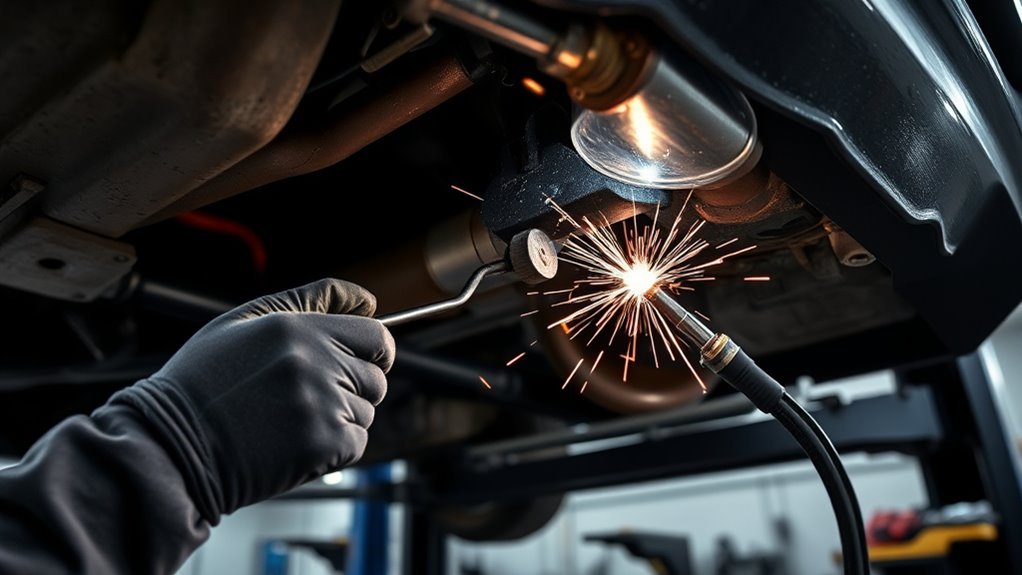
A broken exhaust weld can often be repaired if the surrounding pipe is still solid, the crack is accessible, and you can weld safely without heating fuel lines, brake lines, wiring, plastic shields, or the fuel tank. Start by inspecting the crack, cleaning the metal to bare steel, supporting the exhaust so it sits naturally, then tack-weld and finish the joint in short passes to control heat.
Quick Answer
To repair a broken exhaust weld, clean the crack to bare metal, drill stop holes at the crack tips if the crack is spreading, clamp the pipe in its natural position, tack-weld it in short bursts, then weld small sections while letting the pipe cool. Grind only as needed, inspect the weld, and test for leaks before driving.
Key Takeaways
- Repair only solid metal. If the pipe is thin, scaly, crushed, or cracked around a hanger, replacing that section is usually safer.
- Use MIG for most mild-steel exhaust repairs and TIG when you need cleaner control on stainless steel or thin tubing.
- Clean away rust, paint, oil, zinc coating, and soot before welding so the joint does not trap contamination or porosity.
- Use short tacks and short stitch welds. Thin exhaust tubing overheats fast and can warp or burn through.
- Always test for leaks before driving because exhaust leaks can allow carbon monoxide to enter the vehicle cabin.
At a Glance
| Time Required | 1 to 3 hours, depending on access, rust, removal time, and leak testing |
| Difficulty | Moderate to advanced; thin exhaust tubing is easy to burn through |
| Tools Needed | MIG or TIG welder, grinder or flap disc, wire brush, clamps, jack stands or lift, marker, drill, PPE, fire extinguisher, and leak-test method |
| Cost | Low if you already own welding gear; higher if the pipe must be removed, patched, or replaced by a shop |
Warning: Welding exhaust parts is hot work. Wear a welding helmet, gloves, jacket, eye protection, and hearing protection. Keep a fire extinguisher ready, remove nearby combustibles, disconnect the battery when appropriate, and do not weld near fuel vapors, fuel lines, brake lines, wiring, plastic shields, or the fuel tank. Work in a well-ventilated area and use fume extraction when possible. OSHA notes that welding fumes can contain harmful metal fumes and gases, and ventilation may be required to control exposure. OSHA welding fume guidance
Assess the Broken Exhaust Weld
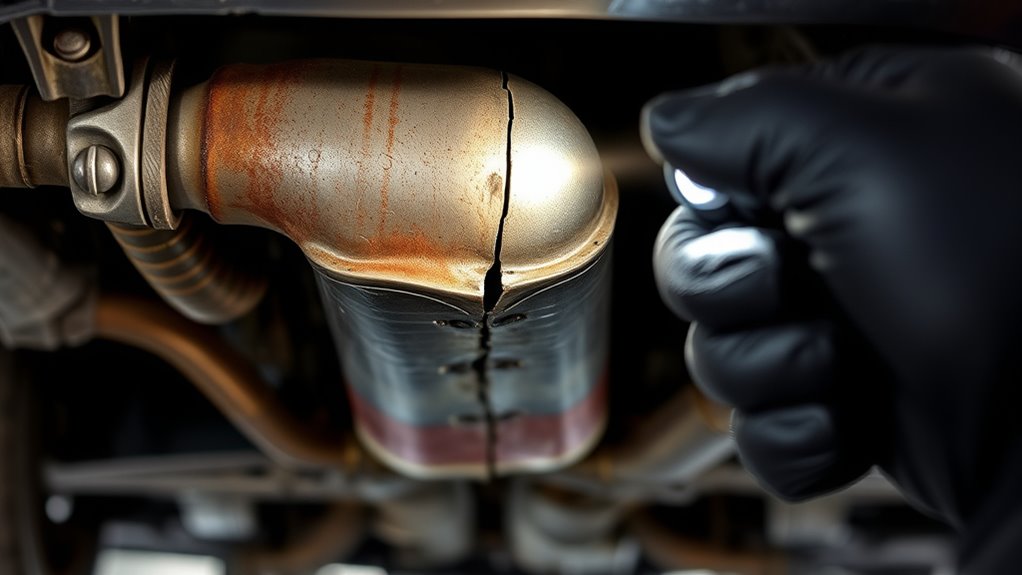
Start by inspecting the broken exhaust weld closely for cracks, gaps, separated joints, soot marks, rust scale, and movement around the hanger or flange. A black soot trail usually points to an exhaust leak, while a bright crack line shows where the joint is still opening under vibration.
Let the exhaust cool completely before touching it. Then support the vehicle safely on a lift or rated jack stands. Do not rely on a jack alone. Shake the exhaust gently by hand and watch the cracked area. If the pipe moves because a hanger is broken, fix the hanger too, or the new weld may crack again.
Identify whether the part is mild steel, aluminized steel, or stainless steel. Mild steel often rusts heavily. Aluminized steel has a dull silver coating. Stainless usually resists red rust better, though it may show heat tint or surface discoloration. If you need to trim stainless tubing before the repair, review safe plasma cutting techniques and remove any sharp or contaminated edges before welding.
Measure the damaged section and decide whether a localized weld will hold. A short crack on solid pipe is a good repair candidate. A long split, paper-thin metal, crushed tubing, or rust holes around the joint usually calls for a replacement sleeve, patch, or new exhaust section.
Note: If exhaust smell enters the cabin, stop driving until the leak is fixed. The CDC warns that even a small exhaust leak can let carbon monoxide build up inside a car or truck. CDC carbon monoxide guidance
Decide Whether to Repair or Replace the Section
A weld repair is worth doing when the crack is limited, the metal is thick enough to grind without collapsing, and the pipe can be clamped back into its original shape. You need clean edges, a tight fit, and enough space to place a safe bead around the joint.
Replace the section or hire a professional if you find any of these problems:
- The pipe wall is thin, flaky, or full of pinholes.
- The crack runs into a catalytic converter, flex pipe, oxygen sensor bung, muffler seam, or flange face.
- The exhaust sits close to fuel lines, brake lines, wiring, rubber bushings, or the fuel tank.
- The vehicle needs structural welding near the frame, suspension, or safety-related brackets.
- The exhaust cannot be supported safely while you work under the vehicle.
If the damage sits near sensitive parts, remove the exhaust section and weld it on a bench. Bench welding gives you better access, safer body position, and less fire risk under the car.
Get Tools, Safety Gear, and Patch Metal
You’ll need a MIG or TIG welder, an angle grinder or flap disc, wire brush, clamps, a drill, and a full set of safety gear. Use a welding helmet, gloves, jacket, safety glasses, and closed-toe leather footwear. Keep a fire extinguisher within reach and check the work area for combustibles before striking an arc.
Use patch metal from the same type and similar thickness as the original exhaust part. Matching the metal helps the weld cool evenly and reduces cracking. Clean the joint surfaces and secure the exhaust so it hangs in its natural position, not pulled tight by a jack, pry bar, or misaligned hanger. A repair that is welded under stress can crack again after a few heat cycles.
Proper prepared metal is the difference between a repair that holds and a bead that sits on top of contamination.
Gather Tools and Gear
Before you start, lay out everything you need so you do not leave hot metal unattended:
- MIG welder with solid wire and shielding gas, or TIG welder with the right filler rod
- Angle grinder with flap disc, grinding wheel, and wire wheel
- Drill and small bit for crack stop holes
- Locking pliers, exhaust clamps, magnets, or V-blocks for alignment
- Patch sleeve or same-thickness sheet if the pipe has a missing section
- Welding helmet, gloves, jacket, safety glasses, and hearing protection
- Fire extinguisher, water spray bottle, and a safe fire watch area
Choose the Right Filler and Patch Metal
For most mild-steel exhaust repairs, MIG with small-diameter ER70S wire works well because it is fast and easy to control on tubing. For stainless exhaust, TIG with a stainless filler rod gives cleaner control, especially on thin pipe. If you use MIG on stainless, use stainless wire and the correct shielding gas for the wire you choose.
For aluminized exhaust pipe, grind the coating away from the weld zone first. Do not breathe the fumes from heated coatings. OSHA recommends cleaning welding surfaces of coatings that can create toxic exposure, including paint and solvent residue. OSHA fume control guidance
Cut and Fit Patch Metal
With your safety gear on, cut away ragged, cracked, or missing metal with a grinder or cutting tool. Trim a patch from matching material that is the same thickness as the original pipe. The patch should cover the damaged area with enough overlap to weld onto solid metal, not rust scale.
Clean both the patch and the pipe until bare metal shows. Remove rust, paint, oil, road grime, and coating from at least 1/2 inch around the weld zone. If the part is galvanized or zinc-coated, remove the coating completely from the heated area and use strong ventilation. Any remaining zinc residues can contaminate the weld and create hazardous fumes.
Clamp the patch in place before you weld. The edges should touch evenly with no high spots and minimal gaps. If the patch rocks or springs away, reshape it before welding rather than forcing it with clamps.
Clean the Crack and Stop It Spreading
Clean the crack thoroughly with a wire brush, grinder, or flap disc. Remove rust, dirt, paint, soot, oil, and loose metal until you can see the full crack line. Poor cleaning is one of the most common reasons an exhaust weld repair leaks.
If the crack is spreading, drill a small stop hole at each visible crack tip. This reduces the chance of the crack continuing past the weld. Keep the hole small and place it at the actual end of the crack, not beside it.
Hold the pipe steady and check that the joint edges stay aligned while you work. A stable repair zone should show:
- Bright bare metal along the full fracture
- Small stop holes at the crack tips when needed
- No loose rust, coating, oil, or soot in the weld zone
- Clamped edges that sit flush without force
- Enough room for the torch angle and welding helmet
If you see thin gaps, do not rely on adhesive as a permanent fix. Metal epoxy, wrap, or band clamps may help as a temporary low-load repair, but they are not the same as welding and should not be trusted near high heat, structural brackets, or parts that support exhaust weight. Clean surfaces also reduce porosity issues when you weld thin automotive metal.
Grind the Old Weld and Check the Fit
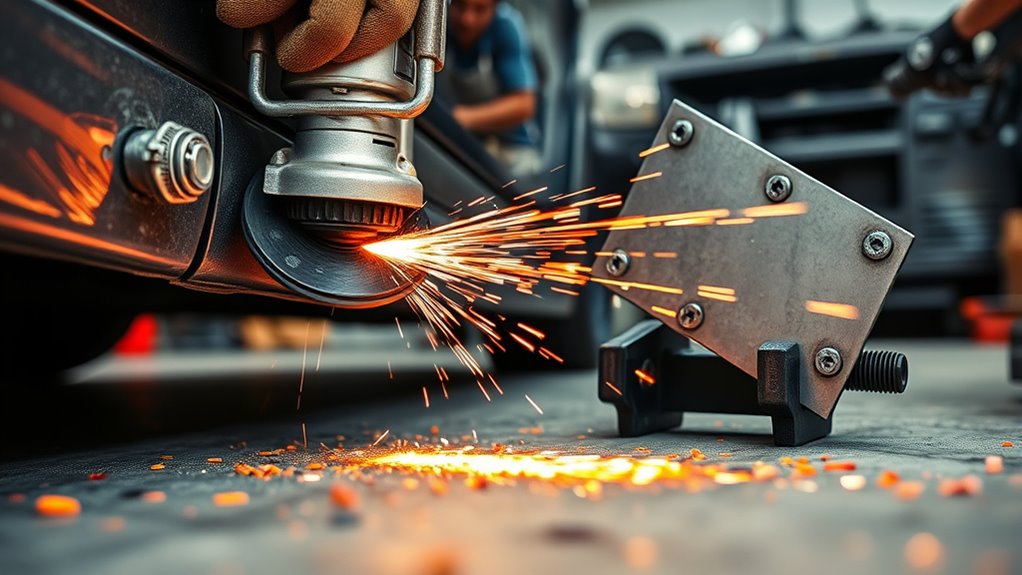
Grind away the failed weld until you reach clean, shiny metal. Do not remove more material than necessary. Exhaust tubing is thin, and aggressive grinding can leave the pipe too weak to weld.
Test-fit the pieces and clamp them in place before welding. Check for gaps, twist, or offset. A gap wider than about 1/16 inch on thin exhaust pipe can make burn-through more likely, so close the fit before adding heat.
Products Worth Considering

⭐ 【3.0 Inch Exhaust Clamp】 The packaging contains 2x exhaust clamps. This exhaust repair clamp has an inner diameter of 3.0inch/76.2mm and a bandwidth of...
Grind Away Old Weld
Use a grinder or flap disc to remove the cracked bead, slag, and contamination. Keep the tool flat and controlled. Stop often and inspect the metal so you do not thin the pipe wall.
- Bright sparks tracing the seam
- Bare steel showing around the joint
- A smooth edge with no cracked bead left behind
- Rust dust brushed away from the repair zone
- A joint shape that allows the weld to penetrate
If the edges are thick enough, dress them lightly with a small bevel. Do not bevel thin exhaust tubing too much, or the edge may disappear when the weld puddle forms.
Test Fit the Pieces
Smooth the broken weld area with a grinder or file until the edges are even. Then push the pipe or patch into place by hand and confirm the parts meet naturally. If the repair needs heavy force to line up, the exhaust may be bent, hanging wrong, or missing a support.
| Check | Tool | Good Result |
|---|---|---|
| Edge | Grinder or file | Smooth, clean, and not thinned out |
| Surface | Wire brush | Bare metal with no soot or coating |
| Fit | Hands and straight edge | Snug, straight, and low-stress |
| Hold | Clamp or locking pliers | Stable without pulling the exhaust out of position |
Check Alignment and Gaps
Use a straight edge or ruler to check the seam. The pipe should sit in the same position it held before the crack opened. Look around the full joint for daylight, high spots, or a pulled hanger.
- Straight edge against the pipe
- Ruler showing a narrow, even gap
- Clamps holding both sides flush
- Exhaust hangers carrying the pipe weight
- Bright clean metal ready for welding
Tack-Weld the Exhaust Repair
Set the exhaust in alignment and tack-weld it with short bursts. Tack welding locks the repair in position without overheating the thin pipe. Clean the joint again before you tack because contamination can cause blowholes and weak spots. Proper arc formation also matters; an unstable arc can leave cold starts and poor fusion.
| Step | Action |
|---|---|
| Prep | Clean both edges to bare metal |
| Safety | Wear helmet, gloves, jacket, and eye protection |
| Weld | Place small tacks at opposite sides of the crack |
| Control | Let the pipe cool between tacks |
Start with two tacks opposite each other, then add two more to lock the pipe from four directions. Recheck the fit after each tack. If the pipe pulls out of alignment, cut the bad tack and reset the joint before continuing.
Pro Tip: On thin exhaust tubing, weld in short stitches rather than one long bead. Move around the joint and let each area cool. This reduces warping and burn-through.
Finish the Weld in Short Passes
Once the tacks hold the pipe in the correct position, fill the gaps between the tacks with short welds. A common method is to weld 1/4 to 1/2 inch at a time, then move to the opposite side of the pipe. Let the metal cool between passes.
Keep your heat low enough to avoid burn-through but high enough for fusion. A tall bead sitting on top of the pipe without wetting into the edges is a cold weld. A hole or sagging edge means too much heat, too slow a travel speed, or too wide a gap.
Watch for these signs of a good exhaust weld:
- The bead ties into both sides of the crack or patch
- No visible pinholes, crater cracks, or undercut
- No black soot or oil boiling out of the joint
- The pipe remains round and aligned
- The hanger or flange sits without stress after cooling
Do not weld over a dirty or cracked old bead just to save time. Grind out the failed area first so the new weld bonds to clean metal.
Grind the Repair and Inspect the Weld
After the weld cools, inspect it before grinding. Look for pinholes, missed edges, undercut, and tiny cracks at the ends of the repair. If you see a defect, clean that spot and repair it before smoothing the bead.
Grind only enough to remove sharp edges or high spots. You do not need a perfectly flat bead on an exhaust pipe unless clearance demands it. Over-grinding can weaken the weld and expose pinholes.
If you do smooth the repair, use a flap disc and light pressure. Keep the grinder moving so you do not heat one area too much. When finished, wipe the area clean and inspect it again under good light.
Test the Repair Before Driving
Before you drive, inspect the repaired weld visually for cracks, pinholes, incomplete fusion, or missed spots. Tap lightly around the weld with a small hammer or similar tool. A dull, loose, or rattling sound can point to a weak joint or nearby broken hanger.
Start the engine only after tools, rags, and combustibles are clear. Listen for ticking, puffing, rattles, or uneven pulses near the repair. Do not put your bare hand on or near hot exhaust parts. If you need to feel for leaks, keep your hand away from the pipe and use caution while the system is still cool.
You can test for leaks several ways:
- Listen closely around the repair during a cold start.
- Use a smoke machine to trace leaks around the weld.
- Temporarily cover the tailpipe for a few seconds while a helper listens for escaping air, but do not overpressurize the system.
- Look for fresh soot after a short idle period.
- Use a carbon monoxide detector near the cabin if you suspect fumes are entering the vehicle.
Then drive at low speed on a smooth road and listen for new rattles, vibration, or exhaust noise. If anything smells, sounds, or feels wrong, park the vehicle and inspect the weld again before trusting the repair.
Wearing proper safety gear during the full repair process helps prevent eye injuries, burns, and fume exposure.
Common Mistakes That Make Exhaust Welds Fail Again
A broken exhaust weld usually fails again for one of five reasons: dirty metal, too much heat, poor fit-up, unsupported exhaust weight, or welding over metal that is already too thin.
- Welding over soot or rust: Contamination causes porosity and weak fusion.
- Skipping hanger repair: A broken hanger lets the pipe vibrate until the new weld cracks.
- Overheating thin tubing: Long beads can warp the pipe or burn holes in it.
- Grinding too much: Removing too much bead can expose pinholes and weaken the repair.
- Ignoring CO risk: A tiny exhaust leak can still be dangerous if fumes enter the cabin.
Frequently Asked Questions
Can welds be repaired?
Yes, many welds can be repaired by grinding out the failed area, cleaning the surrounding metal, correcting the fit, and re-welding with the right process and filler. For an exhaust weld, the repair is only worthwhile if the surrounding pipe is still thick enough to hold a bead.
How much does weld work on a car cost?
Cost depends on access, rust, local labor rates, and whether the exhaust can be repaired in place or must be removed. A small, accessible exhaust weld is usually much cheaper than replacing a long pipe section. Structural welding, frame welding, and catalytic converter area repairs cost more and should be quoted by a qualified shop.
How do you fix a broken weld without welding?
For a temporary exhaust repair, you can use an exhaust band clamp, repair sleeve, high-temperature exhaust paste, or metal epoxy rated for the temperature. These fixes are not equal to welding, and they should not be used for structural parts, heavy brackets, or areas that carry exhaust weight.
Can you weld over an existing weld?
You can weld near an existing weld, but you should not simply cover a cracked, dirty, or porous bead. Grind out the failed metal first, clean the joint, inspect for cracks, then weld onto solid material. Welding over a bad bead often traps contamination and leaves the original crack underneath.
Is MIG or TIG better for exhaust weld repair?
MIG is usually faster and easier for mild-steel exhaust repairs. TIG gives better control and a cleaner bead on thin stainless exhaust, but it takes more skill and cleaner fit-up. Either process can work if the metal is clean, the filler matches the pipe, and heat is controlled.
Can I drive with a broken exhaust weld?
Do not keep driving if the leak is loud, fumes enter the cabin, the exhaust hangs low, or the pipe is close to fuel, brake, or wiring components. Exhaust leaks can let carbon monoxide enter the vehicle, and a loose exhaust can break farther while driving.
Conclusion
A solid exhaust weld starts before you strike an arc. Inspect the crack, decide whether the pipe is worth saving, clean the metal to bare steel, support the exhaust in its natural position, and weld in short passes so the tubing does not overheat. After the bead cools, inspect it, grind only what you need, and test carefully for leaks. If the metal is too thin, the crack is near sensitive parts, or fumes enter the cabin, replace the section or take the vehicle to a qualified shop.
Sources
- OSHA Welding, Cutting, and Brazing Overview — backs up welding hazards and OSHA topic coverage.
- OSHA 29 CFR 1910.252 General Requirements — backs up fire prevention, fire watch, and eye protection requirements.
- OSHA Controlling Hazardous Fume and Gases During Welding — backs up fume, coating, ventilation, and respiratory-protection guidance.
- NIOSH Welding Fumes and Manganese — backs up welding fume exposure concerns and confined-space risk.
- CDC Carbon Monoxide Poisoning Basics — backs up the exhaust-leak and vehicle CO warning.