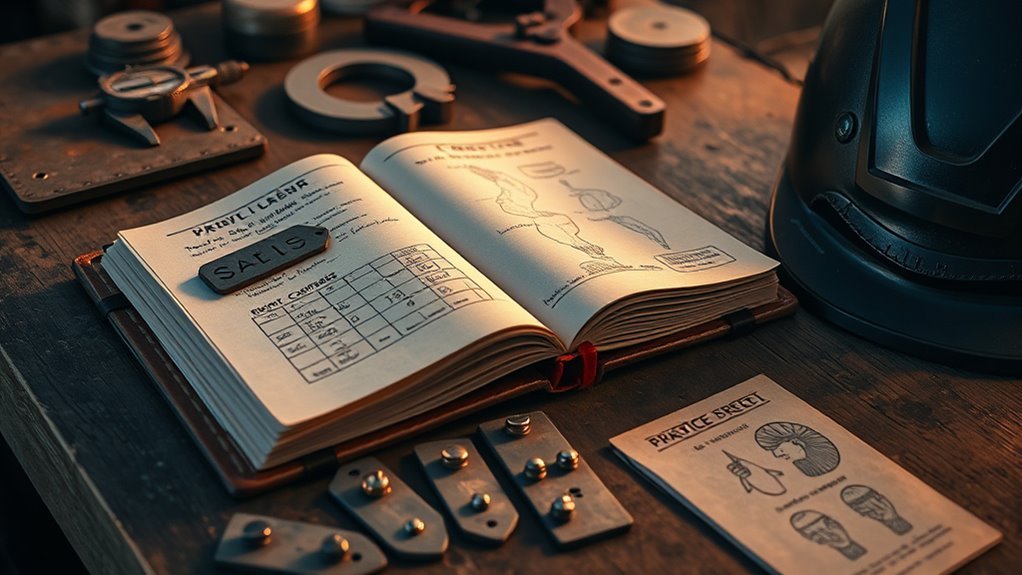
Keep a welding journal by recording each weld in the same format every time. Write down the project, process, base metal, filler metal, joint type, position, machine settings, safety checks, defects, fixes, inspection results, and photos. A steady log helps you compare practice sessions, troubleshoot problems, and see which settings give you the cleanest, most repeatable welds.
Quick Answer
To keep a welding journal, use one template for every session. Record the date, project, process, base and filler metal, joint type, position, amperage, voltage, gas flow, travel speed, safety checks, defects, inspection results, and photos. Review it weekly to spot repeat problems and improve your settings.
Key Takeaways
- Use the same journal format each time so you can compare settings, materials, defects, and results fairly.
- Log both the numbers and the conditions, including amperage, voltage, gas flow, travel speed, fit-up, position, and joint prep.
- Add clear photos before and after cleanup so your notes have visual proof.
- Review entries on a schedule instead of guessing which technique or setting changed the result.
- A journal supports good recordkeeping, but it does not replace required WPS, PQR, WQTR, inspection, or employer forms.
At a Glance
| Time Required | 3 to 10 minutes per session, plus extra time for photos or inspection notes |
| Difficulty | Easy for beginners, more detailed for code work or shop quality records |
| Tools Needed | Notebook, spreadsheet, phone camera, weld gauge, tape measure, marker, and applicable WPS or shop procedure |
| Cost | Free to about $20, depending on whether you use paper, a binder, cloud storage, or a paid app |
Warning: A welding journal is not a substitute for safe work. Before you weld, follow your shop rules and applicable standards for PPE, ventilation, fire prevention, electrical safety, and eye protection. OSHA lists welding hazards such as fumes, UV radiation, burns, eye damage, electrical shock, cuts, and crushed toes or fingers, so include safety checks in your log when they affect the job.
What to Record in Your Welding Journal?

To keep your welding journal useful, record the same core details for every weld. Start with the date, project name, welding process, base metal, filler metal, joint type, weld position, and the reason for the weld. These details give you traceability and repeatability when you need to compare one session with another.
Then record your machine settings. For MIG, TIG, stick, and flux-core welding, useful settings can include amperage, voltage, wire feed speed, gas type, gas flow, tungsten size, electrode size, polarity, travel speed, and number of passes. If you change a setting, write down what changed and why.
Use a simple field for defects and fixes. Note problems such as spatter and porosity, undercut, lack of fusion, burn-through, arc instability, poor fit-up, or contamination. Beside each issue, write the corrective action you tried, such as cleaning the joint, changing travel angle, reducing heat, increasing gas coverage, or adjusting stick-out.
Also include inspection results. For practice welds, this may be a visual check, bead profile note, bend test note, cut-and-etch result, or photo review. For shop or code work, follow your employer’s required records, WPS, inspection plan, and quality system instead of relying on a personal journal alone.
| Journal Field | What to Write | Why It Helps |
| Date and project | Date, job name, part number, drawing number, or practice goal | Keeps each weld easy to find later |
| Process | GMAW, GTAW, SMAW, FCAW, or another process | Lets you compare like with like |
| Materials | Base metal, thickness, filler metal, electrode, wire, or rod | Shows which settings worked on each material |
| Settings | Amperage, voltage, wire speed, gas flow, polarity, travel speed | Makes good welds easier to repeat |
| Result | Bead shape, penetration, defects, inspection result, repair notes | Turns the entry into a learning tool |
Set Up a Welding Journal Template
Set up your welding journal template before your next session. A good template keeps you from missing small details while the job is fresh in your mind. You can use a paper notebook, a printed sheet, a spreadsheet, or a phone app, as long as the layout is easy to repeat.
Products Worth Considering

Metal Stencil for bullet journaling, productivity planner, daily planning, weekly and monthly spreads, calligraphy lettering guide, drafting lettering, drawing, taking notes in albums notebooks diaries

【Practical Set Combination】 This set includes 2 metal bookmark stencils and a 4.52 x 7.8-inch gray felt storage pouch. The large planner stencil is ideal for creating comprehensive layouts (such as monthly planners and habit trackers), while the smaller record stencil is convenient for daily carry—easily clipped into a notebook or book for instant access whenever needed. The storage pouch effectively protects the calendar stencils from dust and loss, making them easy to store and transport.

Material: These templates are made of reselient plastic so it may be bend in transit, you just need to straighten it
Essential Journal Fields
Start with the basics: date, project, process, joint type, weld position, base metal, filler metal, material thickness, and preparation method. Then add machine settings, including amperage, voltage, wire feed speed, gas type, gas flow, polarity, electrode size, tungsten size, or stick electrode classification when those fields apply.
If you weld under a shop procedure, add fields for the WPS number, drawing number, inspector name, welder ID, and required inspection method. A personal journal can help you prepare, but it does not replace official WPS, PQR, WQTR, NDT reports, or employer quality forms required by ASME BPVC Section IX, contract documents, or your workplace quality system.
- For practice: track one skill goal, one setting change, and one lesson learned.
- For repair work: track the defect, cause, repair method, and final result.
- For shop work: follow the required forms first, then use your journal for extra notes.
Simple Layout Structure
A clean welding journal template should organize each session in the same order. Put date and project information first, then process, materials, joint details, equipment settings, safety checks, results, and photos. Keep a short reflection box at the end for successes, faults, and lessons learned.
For beginners, avoid a template that is too long. Start with eight fields: date, process, material, filler, joint, settings, result, and next adjustment. Once that becomes easy, add more detail such as travel speed, torch angle, gas flow, preheat, interpass temperature, or inspection results.
Pro Tip: Change only one major variable at a time during practice. If you change amperage, travel speed, torch angle, and gas flow in the same session, your journal will not show which change improved or hurt the weld.
Track Progress Consistently
To track your welding progress consistently, write entries as soon as the weld cools and inspection is complete. Waiting until the end of the day makes details harder to remember. A phone photo, short voice note, or quick spreadsheet entry can help you capture facts before cleanup hides evidence.
Review entries weekly if you are practicing often. Compare completion time, defect type, bead profile, travel speed, and repair frequency. If you are learning from an instructor or mentor, add their feedback to the same entry so your next session has a clear target.
Use the Same Format for Every Session
You should keep consistent entry fields in every session so your welding journal stays easy to compare. A fixed order also saves time because you do not have to decide what to write after each weld.
Use the same session order each time: goal, project, process, material, joint, position, settings, safety check, result, photo, and next adjustment. Also note whether your workspace followed relevant safety rules, including PPE, ventilation, electrical lead condition, and fire prevention. For more shop-safety context, review essential safety rules before cutting or welding.
Consistent Entry Fields
Consistent entry fields keep your welding journal uniform. This makes it easier to spot performance trends across several sessions. For example, you may find that porosity appears when gas flow is too low, undercut appears when travel speed is too fast, or overhead welds take longer than flat welds.
Use one template with fields for date, project details, material, joint type, weld position, technique, amperage, voltage, wire speed, gas flow, and inspection result. Default text fields or drop-down menus can reduce typing if you use a spreadsheet.
Standard Session Order
After you lock in your entry fields, keep the order of each session the same. Start with the date and session number. Then log the weld details, materials, joint preparation, and specifications. Next, record settings and technique. Finish with defects, fixes, inspection notes, photos, and the next action.
This order keeps troubleshooting simple. When a problem repeats, you can scan the same field across several entries instead of rereading every paragraph.
Repeatable Tracking Template
A repeatable tracking template keeps every welding journal entry uniform. Put your goal first and make it measurable. A weak goal is “practice MIG.” A better goal is “reduce undercut on 3/16-inch mild steel fillet welds by lowering voltage and slowing travel speed.”
Then record date, duration, base metal, filler metal, amperage, voltage, travel speed, gas flow, torch angle, stick-out, and the exact technique you practiced. Add challenges, mistakes, and your next adjustment in a short reflection.
Track Settings, Materials, and Results

Start each project entry by recording the welding settings, base metals, and filler materials. These details help you compare results across jobs and identify the best parameters for each material, thickness, and technique.
Log amperage, voltage, travel speed, wire feed speed, gas flow, and polarity for every pass when those details apply. Note the material specifications for each base metal and filler, including alloy, thickness, and any standard identifier shown on the drawing, mill cert, filler package, or shop paperwork.
When you make weld adjustments, document exactly what you changed, why you changed it, and how the arc responded. Record inspection results after completion, whether you used visual checks, a weld gauge, bend test, macro-etch, or NDT through your shop process.
If you repair or reweld a joint, write down the defect, the correction method, and the reason for rework. This record helps reduce repeat mistakes and supports better conversations with instructors, inspectors, supervisors, or mentors. If the weld size matters, check the drawing, WPS, or design requirement instead of guessing. You can also review maximum fillet weld size guidance for more context.
Note: For workplace welding, your journal should support the required records, not replace them. Always follow the WPS, drawing, inspection plan, employer forms, and applicable code requirements.
Products Worth Considering

Organize Review and Track Your Reading Progress: Whether you're a dedicated reader or enjoy books occasionally, remembering every detail can be challenging. This meticulously designed guided reading journal serves as your companion, allowing you to organize reviews, meticulously track your reading progress, and compile comprehensive notes. Use it to structure your thoughts, ideas, and opinions, providing inspiration for your own writing endeavors.
Made in USA - Proudly produced in Ohio by a Veteran-owned business

ORGANIZE AND TRACK YOUR READING - This reading journal allows you to easily track and review every book you read, including the title, author, genre, your thoughts ideas, and opinions.
Build a Simple Weld Matrix
A weld matrix is a structured table that links each weld to its process, material, joint, position, WPS, welder, inspection result, and repair status. It is more formal than a personal note and more useful when you need to track many welds on the same project.
For a small shop or practice project, your weld matrix can be simple. Use columns for weld number, location, process, material, filler, position, settings, inspection result, defect, repair, and final status. For code or contract work, use the format required by the project quality plan.
| Weld No. | Process | Material | Result |
| W-001 | GMAW | 1/8-inch mild steel | Accepted after visual check |
| W-002 | FCAW | 3/16-inch mild steel | Undercut noted, settings adjusted |
Review Your Welding Journal for Patterns
Review your welding journal regularly to spot patterns in performance. Repeated issues with certain techniques, materials, positions, or joint types can point to specific skill gaps.
Use simple pattern recognition. Look for repeat defects, slower completion times, failed visual checks, excessive cleanup, or frequent rewelds. Then compare the related settings and conditions. This method helps you move from guesswork to evidence so you can direct your practice where it matters most.
Use your welding journal to answer one question after every session: what changed, and did the weld get better or worse?
- Porosity keeps appearing: compare gas flow, wind, nozzle condition, stick-out, and base-metal cleanliness.
- Undercut repeats: compare voltage, travel speed, angle, and pause time at the toes.
- Overhead welds take too long: compare position, puddle control, amperage, and bead size.
- Repairs increase on one material: compare filler choice, joint prep, heat input, and cleaning steps.
When you compare entries over time, you can see whether technique changes, tool adjustments, or procedure updates improve quality. Tracking your progress can also highlight the high skill requirements involved in welding and show you where focused practice will help most.
Add Photos to Track Your Progress
Once you have written notes, add photos to give those notes visual proof. Shoot each weld before and after cleanup so you can compare fit-up, bead shape, toe line, spatter, undercut, penetration clues, and finish quality over time.
Use high-resolution images. Lock focus, control lighting, and avoid glare so the bead is clear. Photograph the setup, materials, joint prep, machine display, gas regulator, filler package, and final weld when those details help explain the result.
Keep editing minimal. Crop, straighten, and correct exposure, but do not alter evidence. Then organize images by date, process, material, and joint type so you can find them fast. A simple file name such as 2026-07-07_GMAW_3-16-mild-steel_T-fillet_W001_before.jpg is easier to search than a default phone-camera name.
This structure gives you a precise record for skill review, audits, or quality discussions. By pairing written notes with images, you build a verifiable path to better welds.
Example Welding Journal Entry
Use this example as a starting point. Adjust the fields for your process, shop rules, and project requirements.
| Date | July 7, 2026 |
| Goal | Improve toe tie-in on horizontal fillet welds |
| Process and Material | GMAW on 3/16-inch mild steel T-joint with ER70S-6 wire |
| Settings | Voltage 18.5, wire speed 245 ipm, 75/25 shielding gas, 25 CFH, short-circuit transfer |
| Result | Bead profile improved after slowing travel speed; slight spatter remained near start |
| Next Adjustment | Clean nozzle, keep stick-out shorter, and pause slightly longer at both toes |
How Long to Keep a Welding Journal?
For personal practice, keep your welding journal as long as it helps you learn. Many welders keep at least one full year of entries so they can compare projects, materials, and skill changes across time.
For school, certification, employer, or code-related work, follow the required retention period from your instructor, employer, contract, or quality program. Do not delete records that may support training, qualification continuity, inspection history, or repair history unless your workplace policy allows it.
Back up digital logs. If you use cloud storage, protect the files with strong passwords and clear folder names. If you use paper, keep photos in matching dated folders and number each journal entry so the notes and images stay connected.
Frequently Asked Questions
What is F1, F2, F3, F4 in welding?
Be careful with the wording. Weld positions are commonly written as 1F, 2F, 3F, and 4F for fillet welds, which refer to flat, horizontal, vertical, and overhead positions. In a different context, an F-number can refer to filler metal grouping under qualification rules. Do not treat “F1” and “1F” as the same thing.
How do you record your welding?
Record your welding by logging the date, project, process, joint type, position, base metal, filler metal, amperage, voltage, wire speed, gas flow, travel speed, safety checks, defects, repairs, photos, and final result. Keep the same order every time so the entries are easy to compare.
What is a weld matrix?
A weld matrix is a structured table that links weld numbers to process, material, filler, position, WPS, welder, inspection result, defect status, and repair status. It helps track many welds on one job and can support project quality control when used with required shop records.
How can you increase welding productivity with a journal?
Use the journal to find where time is lost. Track setup time, weld time, cleanup time, defects, repairs, and repeated setting changes. Productivity improves when you reduce rework, prepare joints consistently, maintain equipment, and repeat settings that already produced clean welds.
Should beginners keep a paper or digital welding journal?
Beginners can use either. Paper is fast in the shop and easy to mark up. Digital logs are easier to search, back up, and connect with photos. The best choice is the one you will actually use after every session.
Does a welding journal replace a WPS or inspection report?
No. A welding journal can support learning and traceability, but it does not replace a Welding Procedure Specification, Procedure Qualification Record, Welder Qualification Test Record, inspection report, NDT report, or employer-required quality form.
Conclusion
Your welding journal turns practice into usable data. When you record the same details every time, you can see which settings, materials, joint positions, and habits produce the best results. Add photos, review entries on a schedule, and write down the next adjustment before you forget it. Over time, your journal becomes more than a notebook. It becomes a clear record of how your welding skill is improving.
Sources
- OSHA Welding, Cutting, and Brazing: Hazards and Solutions — backs up welding hazard and PPE safety notes.
- OSHA 1910 Subpart Q: Welding, Cutting and Brazing — backs up references to general welding, oxygen-fuel, arc welding, and resistance welding safety rules.
- 29 CFR 1910.133 Eye and Face Protection — backs up eye and face protection and filter lens guidance.
- ASME BPVC Section IX: Welding, Brazing, and Fusing Qualifications — backs up qualification-record caution and standards context.
- ISO 3834-1: Quality Requirements for Fusion Welding of Metallic Materials — backs up quality-system and traceability context.