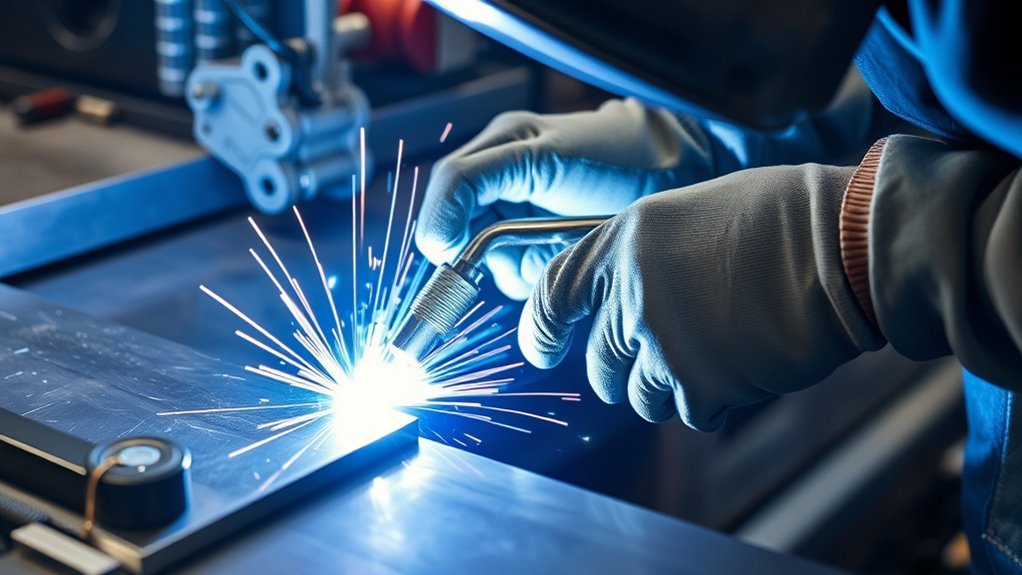
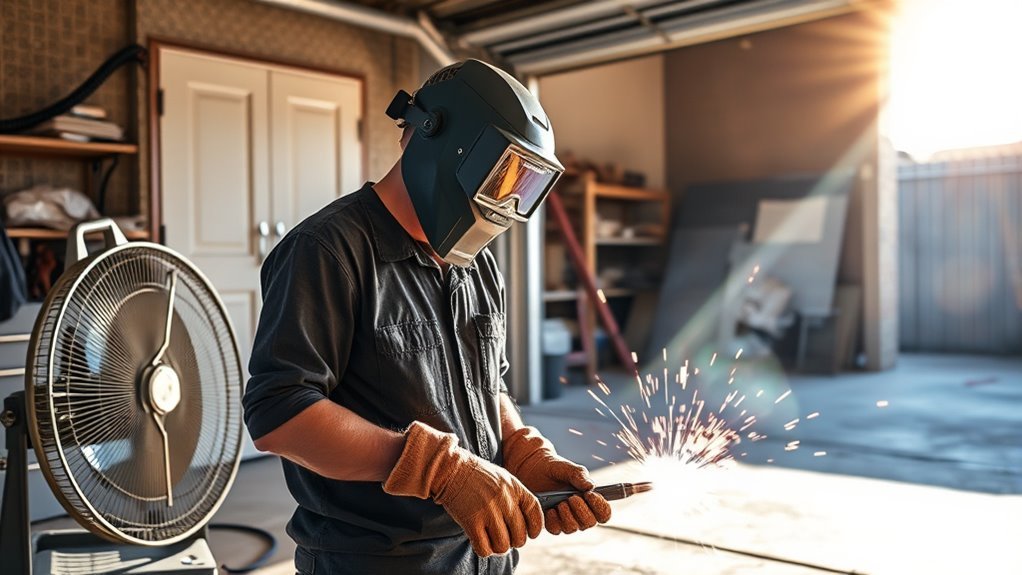
For a practical welding table for auto body work, start with a flat, stable metal work surface, enough room to reach the work safely, reliable clamping points, and ventilation that controls welding fumes near their source. A 36-inch table height can be a useful starting point for standing work, but the correct height depends on your body height, the thickness of the parts on the table, and whether you weld standing or seated. Tabletop thickness also depends on the span, frame bracing, load, and flatness you need rather than one universal minimum. For thin auto body panels, good fit-up, secure but controlled clamping, and heat management are just as important as the table itself.
Last updated: August 8, 2026. Safety and setup guidance was refreshed using current OSHA and welding-manufacturer resources.
Quick Welding Table Setup for Auto Body Work
| Setup Point | Practical Approach |
|---|---|
| Location | Use a stable area with safe access, effective fume control, and separation from paint, solvents, fuel, and other combustible hazards. |
| Height | Use about 36 inches only as a starting point; adjust for your height, posture, workpiece height, and welding process. |
| Top | Use a flat steel surface sized and braced for the intended parts and loads. Heavier plate can resist denting and deflection, but thickness must be considered with the support structure. |
| Workholding | Provide accessible edges, fixture holes, slots, or another clamping system that can hold thin panels without forcing out their intended shape. |
| Work clamp | Connect the welding work clamp to clean bare metal on the workpiece, or to an approved conductive table setup, as close to the weld as practical. |
| Mobility | If casters are used, size them for the fully loaded table and lock the table against movement before welding. |
How to Choose the Best Location for Your Welding Table
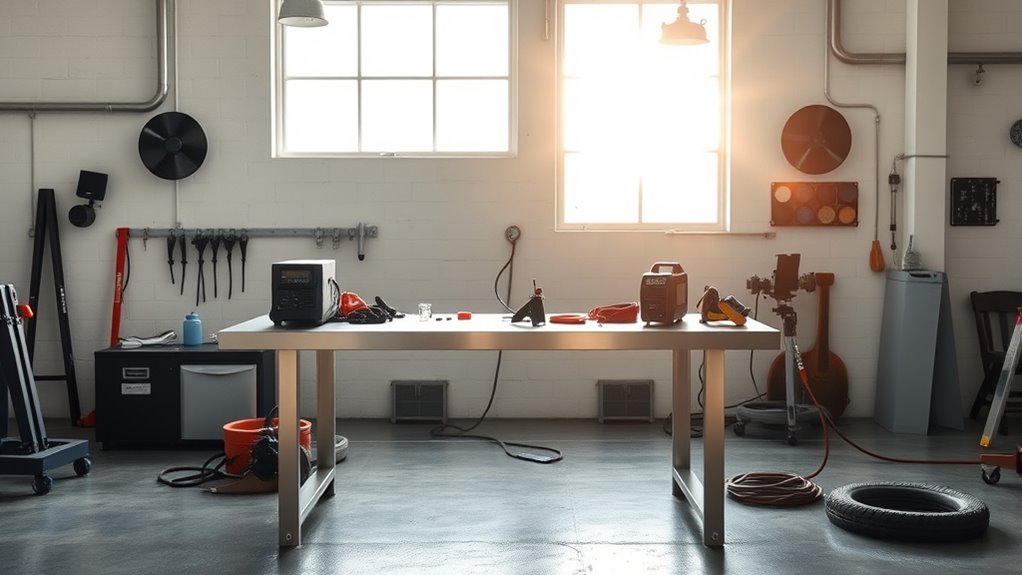
Choose a location that gives you a stable work surface, safe access, effective fume control, and separation from fire hazards. An open window can contribute to general ventilation, but it should not be treated as a complete welding-fume control system. OSHA explains that local exhaust ventilation is designed to capture contaminants at or near their source before they spread through the work area. When practical, position a suitable fume extractor so fumes are drawn away without pulling the plume through your breathing zone. See OSHA’s ventilation guidance.
The floor beneath the welding table should be stable and level. If the floor is uneven, adjustable feet can help keep the work surface from rocking. A mobile table should be locked or otherwise prevented from moving before you begin welding, grinding, or fitting a panel.
Keep electrical cables arranged so they do not create trip hazards or contact hot metal. If the welder needs a dedicated electrical circuit, follow the welding-machine manufacturer’s installation instructions rather than relying on an undersized extension cord or a generic electrical rule.
Set up the table so you can reach the joint, clamp the panel, position the work lead, and move around the work without stepping over cables or working in the welding-fume plume.
Do not place the welding station beside a spray booth, solvent-cleaning area, fuel work, or another location where flammable vapors can be present. Welding, cutting, and grinding are hot-work operations that can ignite combustible materials. OSHA advises removing or protecting combustible materials and controlling fire hazards before hot work begins. See OSHA’s hot-work safety guidance.
For vehicle work, also plan the table location so the work lead does not need to run through or across the vehicle unnecessarily. The site’s guide to protecting car electronics when welding explains why the welding-current path deserves special attention.
Choose the Right Materials for Your Welding Table
A welding table needs a flat, conductive, noncombustible work surface and a frame that remains rigid under its intended load. Steel is commonly used because it tolerates normal welding heat and provides a conductive surface for workholding.
There is no single tabletop thickness that is correct for every auto-body table. A thicker plate generally provides more mass and resistance to local denting, while a well-braced frame reduces unsupported span and deflection. A smaller table with close-spaced bracing can therefore have different requirements from a large fabrication table.
Use the following design logic instead of treating one plate thickness as a universal rule:
| Design Item | What to Consider |
|---|---|
| Steel tabletop | Flatness, span between supports, intended load, heat exposure, and resistance to denting |
| Frame tubing/channel | Table dimensions, support spacing, load, and resistance to racking |
| Cross braces | Reduce frame movement and unsupported tabletop span |
| Feet or casters | Total loaded weight, floor condition, stability, and positive locking |
| Clamping system | Accessible edges, fixture holes, slots, stops, or another system suited to your panels and jigs |
Do not assume a DIY welding table can support a vehicle simply because it uses heavy steel. Use it for body panels, brackets, jigs, patch pieces, and other fabrication parts within the table’s known capacity. Supporting a complete vehicle or other exceptionally heavy load requires equipment designed and rated for that purpose.
An accessible table edge is useful for ordinary C-clamps and locking clamps. Fixture holes or T-slots can add positioning options, but neither system is mandatory. Choose the workholding layout around the parts you actually expect to repair. Proper wire selection and welding-machine setup should be treated separately from the structural design of the table.
Products Worth Considering

ROBUST WORKBENCH: Unleash your productivity with this workbench, known as the Klutch Steel Welding Table, which boasts a 4mm thick steel top and a 2mm thick frame. Workbenches like this one can support up to 600 lbs, making it an ideal choice for heavy-duty welding tasks.

Powerful load-bearing capacity: Welding table is made of a sturdy carbon steel frame, which boasts a 4mm thick steel top and a 2mm thick frame. Workbenches like this one can support up to 2000 lbs, making it an ideal choice for heavy-duty welding tasks.

Standard 16mm holes are evenly spaced 2in. apart for exceptional flexibility in fixture setup
Find the Right Height and Size for Your Table
The best welding-table dimensions depend on your posture and the parts you work on. A surface around 36 inches high is common and can be a useful starting point for standing work, but it is not an ergonomic standard that fits every welder.
Before fixing the legs permanently, stand in your normal welding position with a representative workpiece on the table. Check whether you can see the joint and control the torch without raising your shoulders or bending your back excessively. Remember that a jig, fixture, or body panel can raise the actual working height several inches above the tabletop.
For length and width, size the table around the largest removed body panels and subassemblies you expect to fixture. A 4-by-6-foot table can provide generous space in a larger shop, but a smaller table may be easier to walk around and clamp in a home garage. Leave enough access to reach the joint from the required side rather than making the table larger simply because space is available.
Recommended Table Heights
Instead of treating one height as ideal, use this approach:
- Start near normal bench height: Around 36 inches can be a useful first reference for standing fabrication.
- Add the workpiece height: A fixture, panel, rocker section, or other component raises the joint above the tabletop.
- Check your posture: You should be able to support and guide the torch without sustained shoulder elevation or excessive bending.
- Consider adjustability: Adjustable legs or an appropriate height-adjustable table can be valuable if several people or very different jobs use the same station.
An adjustable height design can make the workstation more versatile when your tasks vary.
Optimal Table Dimensions
For auto body work, the useful table size is the one that lets you support a panel without losing access to its edges or underside. Larger is not automatically better. A very wide table can make it difficult to reach a joint or position a clamp from the opposite edge.
Measure the panels, jigs, and subassemblies you commonly handle and add working room for clamps. If the table must move, also account for door openings, parked vehicles, cabinets, and the turning radius of the table.
Adjustable leveling feet are useful on uneven floors. If you use casters instead, verify that the caster set and frame are rated for the complete loaded table and that the table cannot roll while welding or grinding.
Assemble Your Welding Table Step-by-Step
Before cutting steel, decide the table’s finished dimensions, support spacing, workholding system, maximum intended load, and whether it will use fixed feet or casters. These choices determine the frame design more reliably than copying one tubing or plate size from another shop.
Then assemble the table in this order:
- Build and square the frame: Cut the structural members to the planned dimensions, square the frame carefully, tack it, recheck the diagonals and flatness, and then complete the welds using a sequence that limits distortion.
- Add cross bracing: Support the top adequately and brace the legs or lower frame so the table resists racking when a part is clamped near an edge.
- Fit the tabletop: Support the plate evenly and verify flatness before permanently attaching it. Avoid introducing unnecessary heat that can pull the surface out of plane.
- Add feet or rated casters: Leveling feet work well for a stationary table. If mobility is needed, choose casters for the actual loaded weight and use a positive method to prevent movement while working.
- Add workholding features: A clamping lip, accessible edges, fixture holes, removable stops, or T-slots can all work. Choose the system that matches your clamps and projects.
- Add storage carefully: A lower shelf can hold nonflammable tools and fixtures, but do not create a collection point for oily rags, aerosols, cardboard, solvents, or other combustible materials beneath a hot-work surface.
A portable design such as the VEVOR welding table demonstrates how compact work surfaces and integrated clamping features can be useful when shop space is limited.
Must-Have Features for Your Welding Table Setup
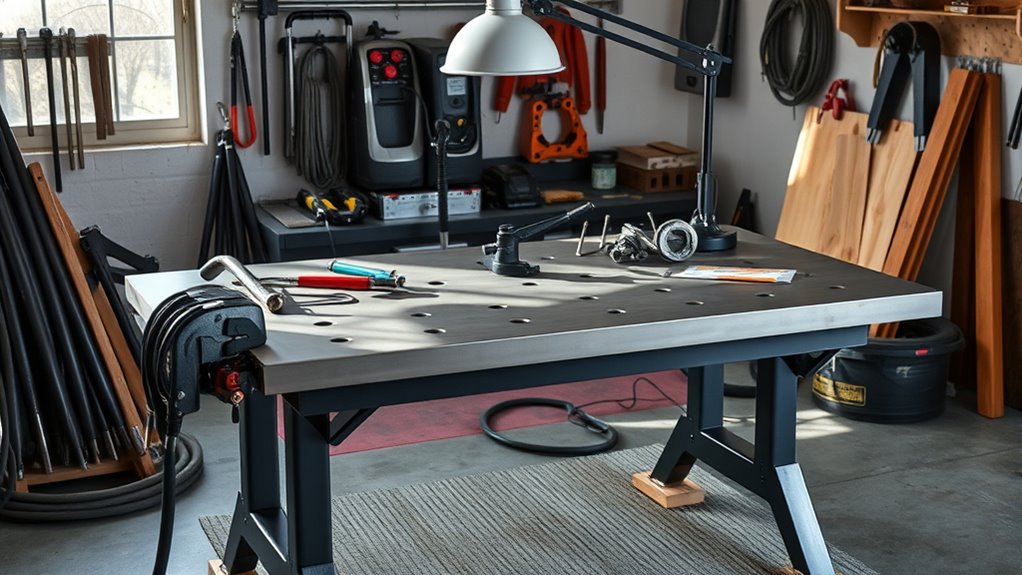
For auto body work, prioritize a flat surface, stable support, useful clamping access, a controlled welding-current path, and safe cable management. Features such as shelves or elaborate fixture systems are secondary if the basic table rocks or makes it difficult to hold a panel in its intended shape.
Essential Table Dimensions
Choose dimensions by answering three questions:
- What is the largest removed panel or assembly you will place on the table? The surface should support it without excessive overhang at the areas you need to fixture.
- Can you reach the weld? You should not have to stretch across a table so wide that torch control suffers.
- Can you clamp it? Leave enough edge access or provide fixture points so clamps can reach the repair area without distorting the panel.
If several people use the table, or your jobs range from small patch panels to tall fixtures, an adjustable system may be more useful than optimizing one fixed measurement. A table with multiple height adjustments illustrates one way portable designs accommodate different working positions.
Optimal Material Thickness
Do not select tabletop thickness in isolation. Plate thickness, unsupported span, underside bracing, table size, and expected load work together.
A heavier plate can resist denting and provide more mass, but it also increases the demands on the frame, legs, casters, and floor. A lighter top with well-planned support may be more practical for a mobile auto-body station. If precision flatness under a known load is critical, design the table for that requirement rather than assuming that a particular plate thickness automatically guarantees it.
Also think about workholding before fabricating the top. A plain plate with accessible edges works with conventional clamps; fixture holes accommodate compatible tooling; and T-slots allow continuous positioning with the matching hardware. The best system is the one that holds your panels repeatably without forcing unwanted curvature into thin sheet metal.
How to Fixture Auto Body Panels Without Causing Extra Distortion
Thin sheet metal can distort from both clamping force and welding heat. A heavy, perfectly flat welding table does not mean every body panel should be forced flat against it. Doors, quarter panels, wheelhouse pieces, and many fabricated patches may have intentional curvature.
Support the part at points that preserve its intended shape, then use enough clamping pressure to hold the joint in alignment without flattening or twisting the panel. Check the fit before adding more clamps.
Heat control matters once welding starts. Miller’s guidance for thin sheet metal recommends tight fit-up, distributing heat with intermittent or skip-weld sequences, and using copper or aluminum backing bars where appropriate to help absorb heat. See Miller’s sheet-metal welding guidance.
For an auto-body table, that translates into a simple workflow:
- Fit and align the panel before committing to the weld.
- Clamp only where needed to preserve the intended contour.
- Use spaced tacks or the weld sequence appropriate to the repair instead of concentrating unnecessary heat in one location.
- Recheck alignment as the joint progresses because welding shrinkage can move thin material.
- Use a suitable backing or chill bar when the joint and repair procedure allow it.
How to Connect the Work Clamp and Protect the Vehicle
The welding work clamp completes the welding-output circuit; it should not be confused with the equipment-grounding conductor for the welding machine. For reliable welding, connect the work clamp to clean, bare conductive metal and keep the connection close to the weld when practical.
Miller welding instructions specify connecting the work clamp to clean bare metal on the workpiece. Vehicle-specific Miller instructions also call for keeping the work clamp close to the weld to avoid long electrical paths. If you are welding a part that has been removed from the vehicle, clamping directly to that part is usually the simplest current path.
If you are welding on the vehicle itself, follow the vehicle manufacturer’s repair and electronics-isolation procedure before welding. Modern vehicles can contain sensitive control modules, restraint systems, high-voltage components, sensors, and networked electronics, so a generic battery-disconnection rule should not replace the OEM procedure. For more detail, see how to protect car electronics when welding.
Do not rely on rusty, painted, loose, or contaminated contact between the panel and table to complete the circuit. A poor connection can create an unstable arc or an unintended current path.
Follow These Safety Best Practices for Welding
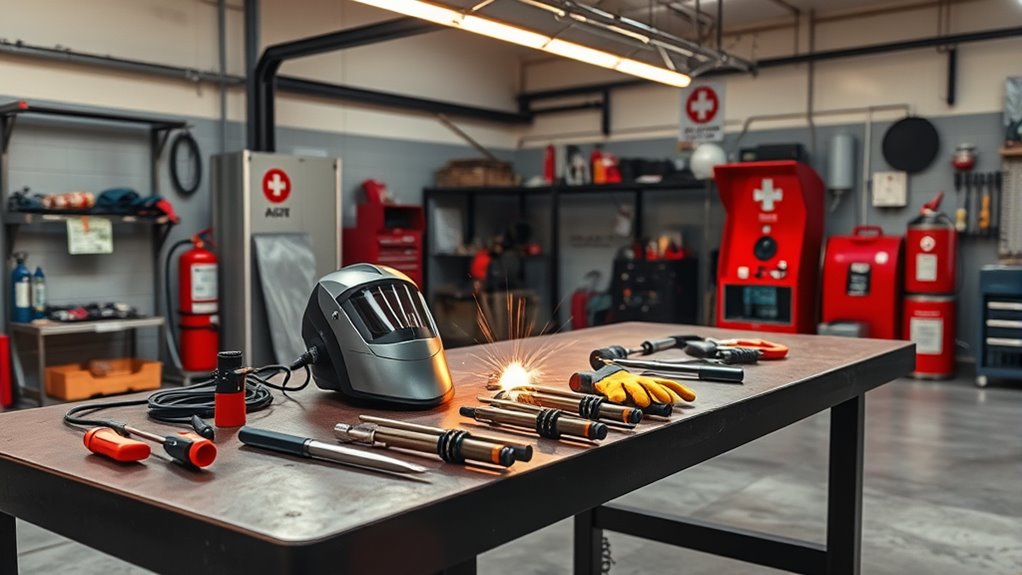
Welding exposes you to hazards that can include arc radiation, hot metal, sparks, fumes, electrical hazards, fire, noise, and flying particles from grinding. OSHA identifies PPE, ventilation, safe work practices, and fire prevention as important controls. See OSHA’s welding hazards and solutions.
- Wear the correct PPE: Use appropriate eye and face protection, welding gloves, protective clothing, and any additional PPE required by the process and hazard assessment. The correct filter shade depends on the welding or cutting operation rather than one universal helmet setting.
- Control combustibles: Remove flammable and combustible materials from the hot-work area or protect them using an appropriate hot-work procedure. Pay particular attention to paint products, solvents, aerosols, oily materials, fuel, upholstery, sound deadening, and hidden combustible material around vehicle repairs.
- Control welding fumes: Position effective ventilation so fumes are captured or carried away from your breathing zone. Local exhaust near the source is generally more effective than simply relying on room air movement.
- Inspect the back side of the repair: Before welding a vehicle panel, check the opposite side for wiring, hoses, insulation, trim, sealers, coatings, fuel-related components, or other materials that heat or sparks could damage or ignite.
- Secure the work: Confirm that the panel, fixture, and table cannot shift unexpectedly while welding or grinding.
- Maintain fire protection: Keep the appropriate fire-control equipment accessible and follow applicable hot-work requirements for the environment in which you are working.
OSHA notes that hot-work hazards can include toxic gases and metal fumes, and that local or mechanical ventilation may be required depending on the material and working conditions. Welding coatings or metals containing substances such as lead, cadmium, chromium, or zinc can require additional controls. Do not assume ordinary garage ventilation is adequate for every coated automotive part.
Organize and Maintain Your Welding Table Setup
A well-organized welding table setup makes it easier to position panels correctly and reduces the chance that a cable, clamp, or combustible item ends up where it should not be.
Keep frequently used clamps, squares, stops, and backing bars where they are easy to reach. Store combustible products, aerosols, oily rags, cardboard, and solvent containers away from the hot-work area rather than underneath the table.
A clean welding table is not just easier to work on—it makes loose hardware, poor clamp contact, combustible debris, and damaged cables easier to spot before welding begins.
Use C-clamps, locking clamps, fixture clamps, stops, or magnetic positioning tools as appropriate for the workpiece. Thin automotive panels require controlled clamping pressure; overtightening a clamp can pull a panel out of its intended contour before heat distortion even begins.
Keep welding and power cables clear of sharp edges, hot metal, and traffic paths. Inspect the table before use for loose fasteners, damaged casters, unstable feet, accumulated spatter, and anything that could interfere with a clean work-clamp connection.
Remove loose debris and welding spatter as needed after work, and verify the table’s usable clamping surfaces before the next job. If rust develops, clean the affected area using a method appropriate to the surface and maintain clean conductive contact where the work lead or workpiece relies on the table.
Also keep appropriate protective clothing available for the welding process and surrounding work.
Frequently Asked Questions
What Type of Welding Machine Is Best for Auto Body Work?
For many mild-steel auto body repairs, gas-shielded MIG welding is a practical choice because it offers good control on thin sheet metal and is relatively easy to learn. TIG can provide very precise heat and puddle control but is slower and requires more skill. The correct process still depends on the metal, joint, repair location, and vehicle manufacturer’s repair procedure. Miller’s sheet-metal guidance notes that MIG, TIG, and pulsed processes can be used to control heat on thin material.
How Do I Prevent Rust on My Welding Table?
Keep the table dry, remove corrosive residue, and address surface rust before it becomes heavy scale. A light protective product may be appropriate during storage, but clean any product from areas that must provide reliable electrical contact or that could contaminate a weld before welding begins.
Can I Use a Wooden Table for Welding?
An exposed wooden bench should not be your primary hot-work surface because sparks, molten metal, and grinding debris can ignite or damage combustible material. Use a stable, noncombustible metal welding surface designed for the work, and control nearby combustibles according to appropriate hot-work precautions.
What Tools Should I Have on Hand for Welding?
Useful table-side equipment includes appropriate welding PPE, clamps, squares, stops, a wire brush or other approved cleaning tools, tools for panel fit-up, and suitable fire-control equipment. For sheet-metal work, a copper or aluminum backing bar can also help control heat when the joint and repair procedure allow its use.
How Often Should I Clean My Welding Table?
Inspect the table before each welding session and remove spatter, loose metal, combustible debris, or contamination whenever it interferes with workholding, flatness, safety, or electrical contact. A quick cleanup after a job makes the next inspection easier, but maintenance should be based on the table’s actual condition rather than a fixed cleaning interval alone.
Conclusion
A good welding table for auto body work is not defined by one height, one plate thickness, or one table size. It should provide a stable metal surface, practical access to the joint, secure workholding, a reliable welding-current path, and enough flexibility to support thin panels without forcing them out of shape.
For auto body repairs, pay particular attention to fit-up, heat distortion, work-clamp placement, vehicle electronics, welding fumes, and hidden combustible materials. Set those fundamentals correctly first; shelves, T-slots, casters, and other convenience features can then be added around the work you actually perform.