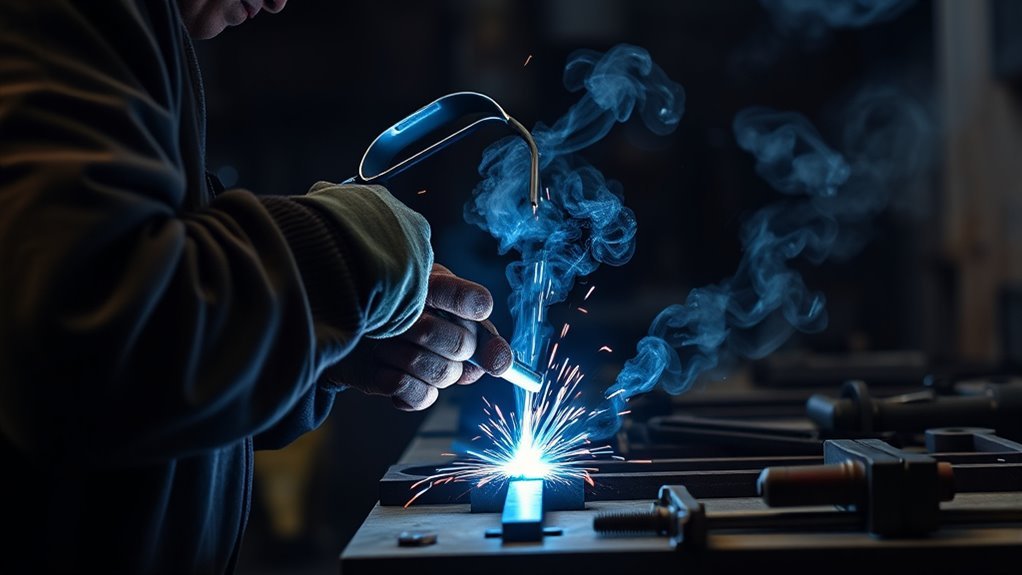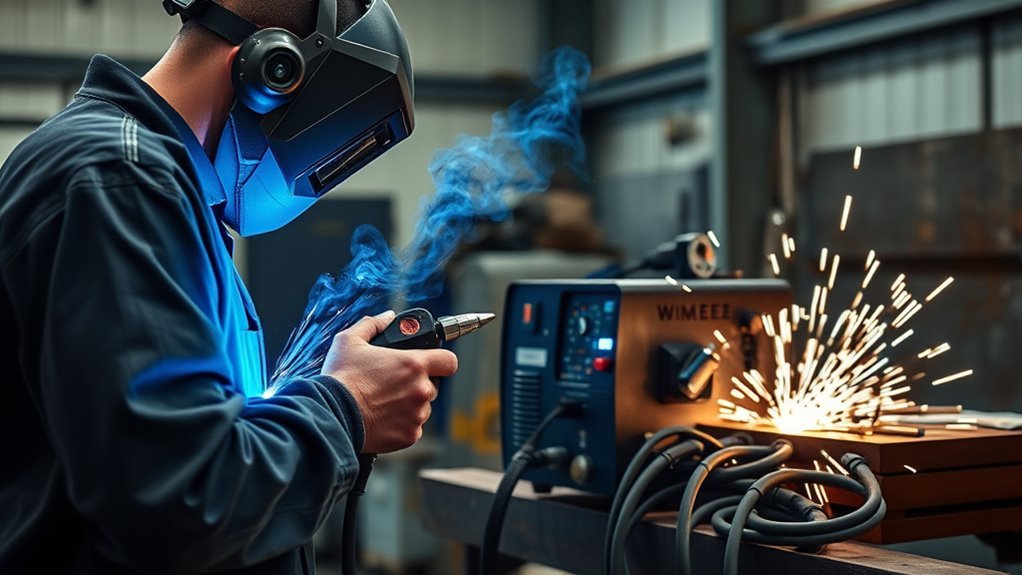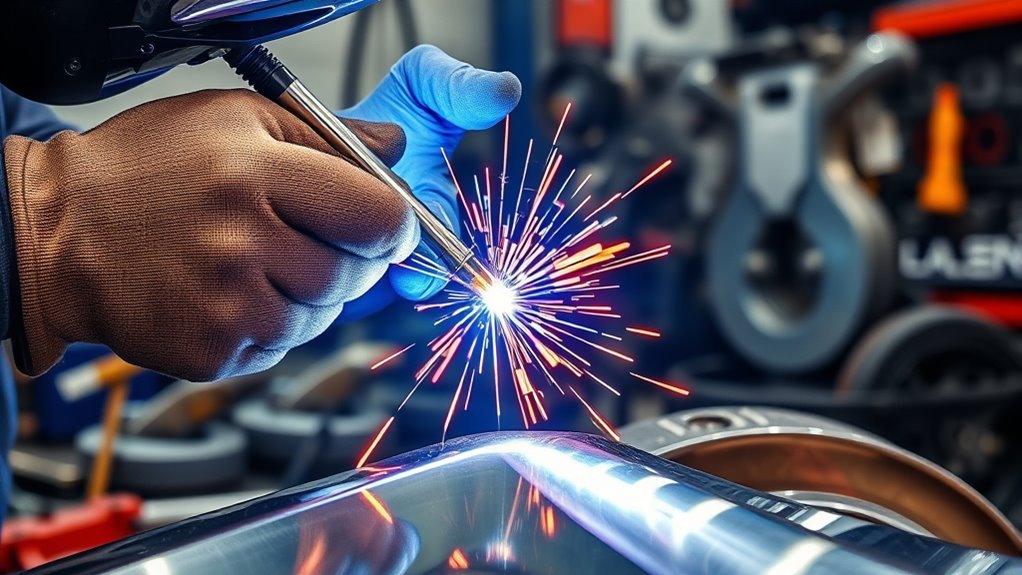
To weld a T-joint for auto body fabrication, clean the metal first, clamp the parts square, add small tack welds, then run a controlled fillet weld along the inside corner. For most garage auto body work, MIG welding is the easiest process to control. TIG works well when you need extra precision, especially on thin sheet metal or aluminum. Keep your heat low, move steadily, and practice on scrap metal of the same thickness before welding on the vehicle.
Quick Answer
To weld a T-joint, clean both pieces to bare metal, clamp the vertical piece at 90 degrees, place small tack welds, then weld a fillet bead into the inside corner. Start with a 45-degree work angle, use a 5 to 15-degree travel angle, and control heat with short welds on thin auto body metal.
Key Takeaways
- A T-joint usually uses a fillet weld, which should tie into both pieces and form a smooth triangular bead.
- Clean metal, tight fit-up, and solid tack welds matter more than trying to “fix” the joint with extra weld metal.
- For MIG welding, start with the gun aimed about 45 degrees into the joint and tilt it 5 to 15 degrees in the travel direction.
- Thin auto body panels warp fast, so use short stitch welds, skip around the joint, and let the metal cool between passes.
- Do not weld near fuel, upholstery, wiring, coated metal, or sealed containers unless the area is safely prepared.
At a Glance
| Time Required | 20 to 45 minutes for practice coupons; longer for real vehicle fit-up and prep |
| Difficulty | Beginner to intermediate, depending on metal thickness and welding position |
| Tools Needed | MIG or TIG welder, clamps, welding helmet, gloves, jacket, grinder or wire brush, measuring square, filler wire or rod, scrap test metal, fire extinguisher |
| Cost | Low if you already own welding gear; expect added cost for wire, gas, abrasives, clamps, and PPE |
Warning: Welding creates arc radiation, fumes, sparks, hot metal, and fire risk. Wear a welding helmet, gloves, eye protection, and flame-resistant clothing. Keep a fire extinguisher nearby, clear combustibles from the work area, and use ventilation. Do not weld on fuel tanks, sealed containers, painted or galvanized metal, or near vehicle wiring, upholstery, brake lines, or fuel lines until the area is safely prepared.
Understanding T-Joint Welding Basics
A T-joint is made when one piece of metal meets another at a right angle, forming a “T” shape. In auto body fabrication, you may see this joint on brackets, patch supports, rocker reinforcements, floor supports, tabs, and small structural add-ons.
Most T-joints use a fillet weld. A fillet weld fills the inside corner where the two pieces meet. When it is done well, the bead looks smooth and triangular, with both edges of the bead blending into the base metal.
A strong T-joint is not just a bead sitting on top. It needs clean metal, tight fit-up, enough penetration, and smooth tie-in on both sides of the joint.
The vertical piece often heats faster than the flat base piece because its edge has less mass. That is why you need to aim the arc into the corner while watching both sides of the puddle. If you focus too much heat on the vertical edge, it can melt back. If you focus too much heat on the base, the weld may not fuse into the upright piece.
Before you run the main weld, use tack welds. These are small welds that hold the joint in place. They keep the parts from shifting as heat pulls on the metal. If you are new to this joint, practice on scrap pieces before welding the real part.
Essential Tools and Materials for T-Joint Welding
You do not need a large shop to weld a T-joint, but you do need clean metal, safe gear, and enough control over the workpiece. Use this list as your starting setup.
| Tool or Material | Purpose | Notes |
|---|---|---|
| MIG or TIG welder | Fuses the joint | MIG is common for auto body work; TIG gives more control on thin or aluminum parts. |
| Welding helmet | Protects your eyes and face | Use the proper shade for your process and amperage. |
| Gloves and flame-resistant clothing | Protects skin from sparks and hot metal | Avoid synthetic fabric because it can melt into skin. |
| Clamps and magnetic square | Holds the joint at 90 degrees | Remove magnets before welding if they interfere with the arc. |
| Grinder, flap disc, or wire brush | Cleans rust, paint, mill scale, and coatings | Clean both sides of the joint and the work clamp area. |
| Filler wire or rod | Adds weld metal | For mild steel MIG work, ER70S-6 is common, but always match the filler to the base metal. |
| Scrap test pieces | Lets you tune settings before the real weld | Use the same thickness and material as the job. |
| Fire extinguisher | Fire safety | Keep it close and inspect the area after welding. |
You should also clean your metal workpieces thoroughly with a wire brush, flap disc, or grinder. This is especially important if you are using flux-core welding, because flux-core can tolerate some surface contamination but still works better on clean metal.
Note: If the metal is galvanized, plated, painted, undercoated, or covered in seam sealer, clean it safely before welding. Zinc and coating fumes are dangerous. Review safe coating removal before welding galvanized steel, and use ventilation and proper respiratory protection when needed.
Products Worth Considering

Value Pack: The package includes 24 packs of butt welding clamps, enough quantity to meet your daily needs and replacements. Each butt welding clamps is individually wrapped in a small bag, convenient to carry and use.

PACKAGE INCLUDES - You will receive 24 pack silver butt welding clamps, each measuring 2.3 × 1 inch, lightweight and compact, a necessary tool for sheet metal, body repair and other industries.

16-Pack Welding Clamps Set: Includes 16 butt welding clamps designed for precise edge-to-edge welding, ideal for body repair, floor patching, door skins, and sheet metal alignment.
Preparing a T-Joint for Welding
Good prep prevents most T-joint problems. Do not rush this part. A clean, tight joint is easier to weld and much stronger than a dirty joint with a big gap.
- Clean the metal to bare steel: Remove rust, paint, oil, seam sealer, undercoating, and zinc coating from the weld zone. Clean at least 1 inch around the joint when possible. If you are working with galvanized material, review how to remove zinc coating from galvanized steel before welding.
- Clean the work clamp area: A poor ground connection can cause an unstable arc, spatter, and inconsistent penetration.
- Fit the parts tightly: Place the vertical piece on the base piece at 90 degrees. Use a square to check the angle.
- Clamp the joint: Use C-clamps, locking pliers, or panel clamps so the parts cannot shift.
- Add tack welds: Place small tack welds at both ends first, then add more tacks along the joint if it is long.
- Check alignment again: Heat can pull parts out of square. Fix the alignment before the main weld, not after.
- Test your settings on scrap: Weld a practice T-joint using the same thickness and process before touching the real part.
Misalignment can make the main weld harder to control and can weaken the final joint. If the upright piece is leaning, the weld bead may be bigger on one side and cold on the other.
Choosing the Right Process for an Auto Body T-Joint
The best welding process depends on the metal, thickness, location, and finish you need. In auto body fabrication, you usually want the lowest heat that still gives good fusion.
| Process | Best For | Watch Out For |
|---|---|---|
| MIG | Most mild-steel auto body brackets, floor supports, rocker reinforcements, and practice T-joints | Too much wire feed or voltage can burn through thin panels. |
| TIG | Thin sheet metal, aluminum, stainless, and work that needs cleaner control | Slower than MIG and less forgiving of dirty metal. |
| Flux-core | Outdoor practice, heavier brackets, and jobs where shielding gas is not practical | Runs hotter and creates more spatter and fumes. Use the right polarity and review a flux-core MIG welding settings chart before testing. |
| Stick welding | Thicker mild-steel brackets and non-body-panel fabrication | Usually too hot for thin auto body sheet metal. Cast iron repairs need a different method and filler choice than sheet-steel T-joints, so review cast iron welding rods separately. |
For most beginners, MIG is the simplest starting point. Use the machine chart, match the wire to the base metal, and run test welds until the bead ties into both sides without burning through.
Products Worth Considering
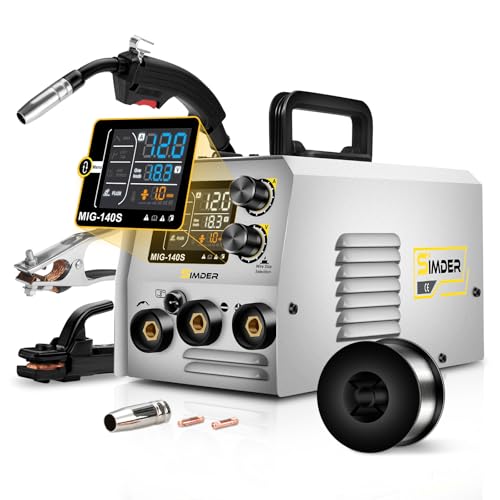
THREE-PROCESS WELDING STATION BUILT FOR FIRST-TIME USERS - Flux Core MIG, Lift TIG and Stick in one machine, so you can find the process that fits your projects without buying three separate welders. Runs on a standard 110V household outlet or 220V for heavier work - no electrician, no special wiring. Welds carbon steel, low-alloy steel, stainless steel, titanium, copper and cast iron

Wires diameter :0.6-1.0mm(0.023‘’-0.04‘’)

【LOW SPATTER & EASY CLEANUP】Minimal Spatter, Flawless Beads: Experience exceptionally low spatter and minimal post-weld cleanup. This ER70S-6 solid wire allows you to achieve smooth, visually appealing beads with ease, saving both time and grinding effort on your metal fabrication.
Setting Up Your Welder for a T-Joint
Settings depend on metal thickness, wire size, shielding gas, joint position, and your machine. Do not copy one setting blindly. Use your welder’s chart as a starting point, then fine-tune on scrap.
- Wire size: For thin automotive steel, small wire is easier to control. Miller lists .023 to .024 inch wire as a common choice for body panels and material up to 1/16 inch, .030 inch for 20 gauge to 1/8 inch, and .035 inch for 16 gauge to 1/4 inch.
- Shielding gas: A 75% argon and 25% CO2 blend is a common MIG choice for mild steel because it gives a smoother bead and less spatter than straight CO2.
- Stickout: For MIG, start around 1/4 to 3/8 inch of wire from the contact tip to the work.
- Voltage and wire feed: If the bead piles up and does not tie in, you may be too cold or moving too fast. If the panel burns through or warps badly, you may be too hot or moving too slowly.
- Test coupon: Make a sample T-joint before the real weld. Cut or bend the sample to see whether the weld is fusing or just sitting on top.
Pro Tip: Keep a small notebook with your wire size, gas, voltage, wire feed speed, metal thickness, and result. Your best settings become easier to repeat the next time you weld a similar T-joint.
Mastering the Welding Technique for a Strong Joint
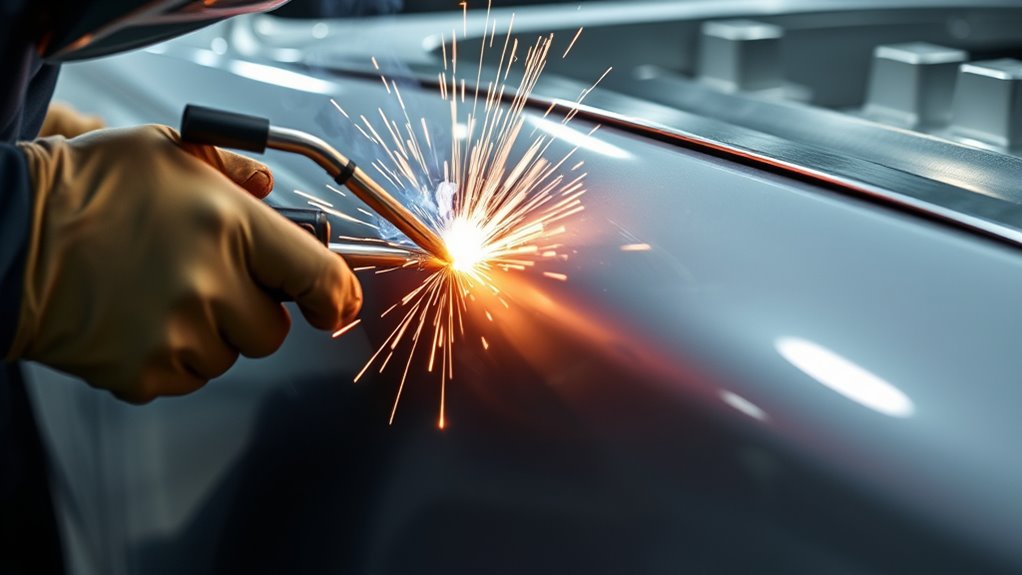
Now that the joint is clean, clamped, and tacked, focus on gun angle, puddle control, and travel speed. For a flat-position MIG T-joint, start with the gun pointed about 45 degrees into the corner. This puts the wire at roughly equal distance from both pieces.
Next, add a small travel angle. Under normal MIG conditions, a 5 to 15-degree travel angle is a good starting range. Keep your motion steady and watch the front edge of the puddle. The weld should wet into both sides of the joint.
- Start at one tack weld: Begin on a tack so the main bead covers it.
- Aim into the root: The root is the inside corner where both pieces meet.
- Watch both toes: The toes are the edges where the bead meets the base metal. They should blend in smoothly.
- Move steadily: Too fast can cause poor penetration. Too slow adds heat and can cause burn-through.
- End cleanly: Pause briefly at the end to fill the crater before releasing the trigger.
If you are using stick welding with a 7018 rod, the same joint prep still matters. Use dry rods, follow the electrode manufacturer’s amperage chart for the rod diameter, hold a short arc, and run a steady stringer bead. For thin auto body metal, 7018 is usually not the first choice because it can add too much heat.
For more basic control practice, review arc length, travel speed, and work angle before welding on a vehicle part.
Controlling Heat on Auto Body Panels
Auto body panels are thin, so they warp and burn through quickly. A strong weld is not always a long, continuous bead. On sheet metal, short welds often work better.
- Use tack welds first: Place them evenly so the joint stays square.
- Stitch weld: Weld short sections instead of one long bead.
- Skip around: Move to another part of the joint after each short weld so one area does not overheat.
- Let the metal cool: Give thin panels time to cool naturally between welds.
- Avoid over-grinding: Grinding too much can thin the metal and weaken the joint.
For body panels, a series of controlled stitch welds can be better than one hot pass. For thicker brackets or frame-related work, follow the repair procedure and weld size requirements for that part.
Common Mistakes to Avoid When Welding T-Joints
Most failed T-joint welds come from poor prep, bad fit-up, too much heat, or poor gun angle. Fix these before blaming the machine.
Inadequate Surface Preparation
- Failing to clean: Rust, paint, oil, undercoating, and mill scale can cause porosity and poor fusion.
- Ignoring the work clamp: A dirty clamp area can make the arc unstable.
- Welding over coatings: Coatings can create toxic fumes and contaminate the weld.
Improper Tack Weld Placement
Use small, evenly spaced tack welds to keep the workpieces stable. Large tacks can add too much heat, and missing tacks can let the upright piece move during the main weld.
Avoid placing tack welds too close to an unsupported edge on thin sheet metal. Heat can pull the edge out of shape. Make sure your main weld covers the tack welds completely so you do not leave weak spots.
Using Too Much Heat
Too much heat can warp panels, melt the edge of the vertical piece, or burn through the base metal. Reduce heat by lowering settings, using smaller wire, moving in short stitches, or letting the panel cool between welds.
Poor Fit-Up and Gaps
Gaps make the weld harder to control. They force you to add more filler metal, which adds more heat. If the joint has a gap, fix the fit-up before welding. Do not try to bridge a bad joint with a huge bead.
Troubleshooting T-Joint Weld Defects
Use the bead as feedback. A good bead is consistent, tied into both pieces, and free of holes, cracks, and heavy undercut.
| Problem | Likely Cause | Fix |
|---|---|---|
| Porosity or pinholes | Dirty metal, poor gas coverage, wind, long stickout, or coating contamination | Clean the joint, check gas flow, block wind, shorten stickout, and remove coatings. |
| Undercut | Too much voltage, too much travel angle, or moving too fast | Reduce heat, slow slightly, and pause enough for the toes to fill. |
| Cold lap or poor fusion | Too cold, too fast, poor angle, or dirty metal | Increase heat carefully, aim into the root, clean better, and slow down. |
| Burn-through | Too much heat for thin metal | Lower settings, use shorter stitches, move faster, and let the panel cool. |
| Warping | Too much continuous heat | Skip around the joint, use more tacks, and weld shorter sections. |
| Bead only melts one side | Wrong work angle or uneven travel | Return to a 45-degree starting angle and watch both sides of the puddle. |
How to Check if Your Weld Is Strong
You can learn a lot from simple shop checks, but remember that visual checks and bend tests on scrap are not a substitute for certified inspection on critical vehicle structures.
- Visual inspection: Look for a consistent bead, smooth tie-in, and no cracks, holes, heavy undercut, or missed edges.
- Bead shape: A T-joint fillet weld should look smooth and triangular, not like a tall rope sitting on the surface.
- Backside and distortion check: Look for burn-through, warping, or metal pulled out of square.
- Practice bend test: Weld a scrap T-joint, clamp it in a vise, and bend it. Ideally, the base metal near the weld should fail before the weld bead peels away.
- Cut and inspect: Cut through a practice weld and look for fusion into both pieces.
If your weld cracks, peels away, or breaks along the toe, review your heat, cleaning, and gun angle. If you need a different joint style for the part, compare the T-joint with a butt joint in welding projects before making the repair.
When Not to Weld on a Vehicle
Some jobs should not be treated like simple garage practice. Stop and check the repair procedure when the weld is near safety systems, fuel systems, high-strength steel, aluminum structures, or crash-energy parts.
- Do not weld on fuel tanks or sealed containers: Heat can ignite vapors or pressure.
- Do not weld near fuel lines, brake lines, wiring, or upholstery: Move or shield these parts first.
- Do not guess on structural repairs: Use OEM repair information for frame rails, pillars, rocker structures, and suspension mounts.
- Do not weld coated metal without safe prep: Remove paint, undercoating, zinc, and seam sealer from the weld area.
- Do not rely on a small flux-core-only machine for every repair: A compact machine may be useful for practice or light work, but check whether it can handle the material thickness and duty cycle. If you are comparing entry-level machines, review a flux-core mini welder review with those limits in mind.
T-Joint Welding: Career Opportunities and Training
If you want to turn T-joint welding and auto body fabrication into paid work, build skill in more than one process. Employers often look for clean fit-up, blueprint reading, safety habits, and the ability to weld in different positions.
Welding apprenticeships and technical programs can teach MIG, TIG, stick, flux-core, layout, inspection basics, and safe shop practice. Community colleges, trade schools, employer programs, and apprenticeship programs are common paths.
The U.S. Bureau of Labor Statistics lists 457,300 welding, cutting, soldering, and brazing jobs in 2024. It also lists a May 2024 median annual wage of $51,000 and projects 2% employment growth from 2024 to 2034, with about 45,600 openings per year on average. Wages vary by location, industry, certifications, and experience.
For auto body fabrication, MIG is a core skill. TIG can help with aluminum, stainless, and precision work. Stick and flux-core can help on heavier fabrication jobs, but thin sheet metal needs careful heat control.
Frequently Asked Questions
What type of weld can be used on a T-joint?
A T-joint usually uses a fillet weld. The fillet weld fills the inside corner where the upright piece meets the base piece. A groove weld may be used on some thicker or engineered joints, but most auto body brackets and reinforcements use fillet welds.
What is the process of T-joint welding?
Clean both pieces, clamp the upright piece at 90 degrees, add small tack welds, check alignment, then weld a controlled fillet bead into the corner. For MIG, start with a 45-degree work angle and a 5 to 15-degree travel angle, then adjust based on bead shape and penetration.
How do you weld a T-joint with 7018?
Clean the joint, clamp it square, use dry 7018 rods, follow the electrode maker’s amperage range for your rod diameter, and hold a short arc. Run a steady stringer bead into the root of the joint. For thin auto body panels, 7018 is usually too hot, so MIG or TIG is often a better choice.
What does a tee weld look like?
A good tee weld usually looks like a smooth triangular bead along the inside corner of the T-joint. The bead should be consistent, tied into both pieces, and free of cracks, holes, heavy undercut, or sharp edges.
Is MIG or TIG better for auto body T-joints?
MIG is usually easier and faster for mild-steel auto body T-joints. TIG gives more heat control and a cleaner weld, but it is slower and needs cleaner fit-up. For thin sheet metal, either process can work if the settings and heat input are controlled.
How do you stop a T-joint from warping?
Use tight fit-up, small tack welds, short stitch welds, and cooling pauses. Skip around the joint instead of welding one long bead. On thin auto body panels, too much continuous heat is the main cause of warping.
Conclusion
T-joint welding gets easier when you treat it as a setup problem first and a welding problem second. Clean the metal, clamp the parts square, tack the joint, test your settings on scrap, and keep the heat under control. For most auto body fabrication, a clean MIG fillet weld with the right angle and short heat-controlled passes will give you the best starting point. Practice on scrap before welding on a vehicle, and follow proper repair procedures whenever the part affects safety or structure.
Sources
- MillerWelds: MIG Basics for Automotive Welding Repair — automotive MIG process guidance, wire sizes, shielding gas, stickout, and T-joint angles.
- MillerWelds: MIG Welding Tips and Techniques for Beginners — cleaning, work angle, travel speed, bead appearance, and beginner technique.
- MillerWelds: MIG Welding, Setting the Correct Parameters — voltage, wire feed speed, weld defects, porosity, travel speed, and bead evaluation.
- OSHA 29 CFR 1910.252: Welding, Cutting, and Brazing General Requirements — PPE, eye protection, fire prevention, ventilation, and welding safety requirements.
- U.S. Bureau of Labor Statistics: Welders, Cutters, Solderers, and Brazers — current wage, employment, and job outlook data.