Choosing the wrong vertical welding direction can leave a bead with poor fusion, excessive buildup, undercut, burn-through, or trapped slag. Uphill welding and downhill welding both have valid uses, but the correct choice depends on the welding process, material thickness, joint design, consumable, and approved procedure—not direction alone.
Quick Answer
Use vertical-up welding for most thicker, load-bearing, or multi-pass joints because the slower progression usually improves sidewall fusion and puddle control. Use vertical-down mainly for thin sheet or for a qualified pipe procedure with the correct consumable. The WPS, consumable data sheet, joint design, and required weld quality always override a general rule.
Key Takeaways
- Vertical-up commonly gives better toe fusion and penetration on thicker MIG and stick-welded joints.
- Vertical-down MIG uses faster travel and lower heat input, making it useful for thin sheet where burn-through is a concern.
- Downhill is not limited to thin metal: qualified pipeline procedures may use fast-freeze E6010-type electrodes on thick pipe.
- Do not assume an electrode is approved for both directions. Many common E7018 products exclude vertical-down welding.
- The drawing, welding procedure specification, consumable instructions, and qualification requirements control safety-critical work.
At a Glance
| Time Required | Allow 30–60 minutes to set up and compare both directions on practice coupons; production weld time depends on the joint and procedure. |
| Difficulty | Intermediate. Vertical-up normally requires more puddle control, while vertical-down demands careful speed and arc placement. |
| Tools Needed | Suitable welder, approved electrode or wire, clean practice metal, work clamp, wire brush or grinder, chipping tools when needed, welding helmet, gloves, flame-resistant clothing, ventilation, and fire extinguisher. |
| Cost | No fixed cost. If you own the equipment, expect only the cost of scrap, electrodes or wire, shielding gas, grinding supplies, and PPE wear. |
Uphill vs. Downhill Welding: A Comparative Overview
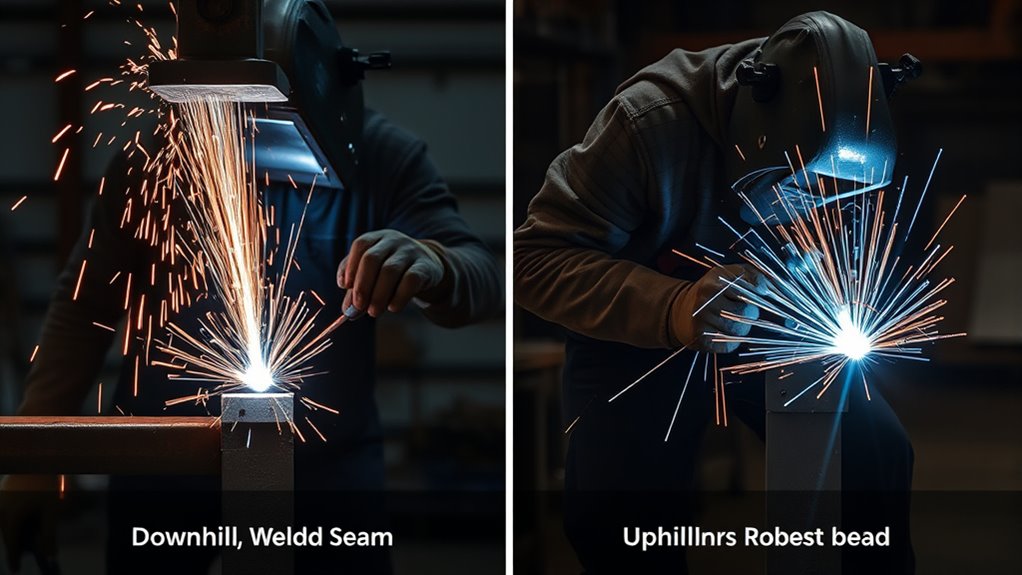
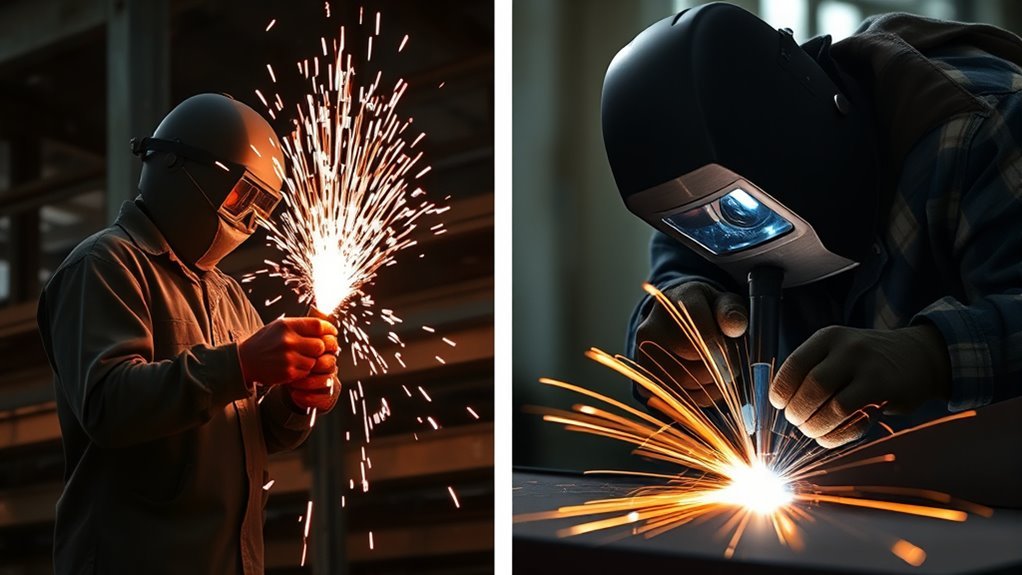
Vertical-up welding moves from the bottom of a joint toward the top. Vertical-down welding starts at the top and progresses toward the bottom. The American welding-position terms commonly used for these joints are 3F for a vertical fillet weld and 3G for a vertical groove weld. Miller Electric notes that vertical-up is typically more common on thicker materials because gravity makes a large molten puddle difficult to support.
Uphill progression normally uses a smaller, slower-moving puddle. The welder pauses long enough at each toe to obtain fusion, then crosses the center before excess metal or slag builds up. This approach often suits thick plate, multi-pass welds, brackets, frames, and other joints where sidewall fusion matters.
Downhill progression uses gravity and a faster travel speed. In conventional MIG welding, the faster movement puts less heat into thin material and can reduce melt-through and distortion. The arc must remain at the leading edge of the puddle so molten metal does not run ahead and cover unfused base metal.
The basic difference is described in Miller Electric’s guide to welding positions. However, material thickness is only one part of the decision. You must also consider the process, transfer mode, electrode or wire classification, joint preparation, polarity, required weld size, and welding procedure specification.
Note: Uphill and downhill describe the direction of progression along a vertical joint. Push, drag, forehand, and backhand describe the angle of the electrode or gun relative to the direction of travel. They are related technique choices, but they are not the same thing.
Key Differences in Weld Quality and Technique
| Aspect | Vertical-Up | Vertical-Down |
|---|---|---|
| Typical travel speed | Slower, with controlled pauses or stringer passes | Faster, with the arc kept ahead of the puddle |
| Common MIG result | Better penetration and sidewall fusion on thicker material | Lower penetration and heat input on thin material because of faster travel |
| Puddle control | Support a small puddle against gravity and watch both toes | Prevent molten metal from running ahead of the arc |
| Typical use | Thicker plate, multi-pass welds, heavy brackets, and many structural joints | Thin sheet, light repairs, and qualified pipeline procedures |
| Main defect risk | Sagging, undercut, excessive buildup, or slag entrapment | Lack of fusion, overlap, a concave bead, or moving outside the procedure |
| Consumable rule | Use an electrode or wire approved for vertical-up | Use vertical-down only when the product data and procedure permit it |
Vertical-up commonly gives the welder more time to establish fusion at the root and toes. Vertical-down can produce a smooth-looking bead quickly, but appearance alone does not prove that the weld fused to the base metal.
For conventional MIG welding on mild steel, Miller recommends considering a reduction in voltage and amperage when moving from flat to vertical work. Its guidance also places the wire at the leading edge of the puddle and identifies vertical-down as useful for thin metal where melt-through is a concern. See Miller’s mild-steel MIG technique guide.
For vertical MIG welding, Miller recommends starting about 10–15% below comparable flat-position voltage and amperage settings, then fine-tuning the puddle within the machine and wire manufacturer’s approved range.
Choose the Direction by Welding Process
The same uphill-versus-downhill rule does not transfer perfectly from one arc-welding process to another. Use the process-specific guidance below as a starting point, then follow the WPS and consumable instructions.
| Process | When Vertical-Up Is Common | When Vertical-Down May Be Used |
|---|---|---|
| SMAW / stick | Low-hydrogen fill and cap welds, thick plate, multi-pass joints, and many structural applications | Qualified pipe procedures using suitable fast-freeze or purpose-designed electrodes |
| GMAW / MIG | Thicker material, larger fillets, multi-pass work, or joints needing better toe fusion | Thin sheet and light sections where faster travel helps prevent burn-through |
| FCAW / flux core | Many all-position structural wire procedures, especially when weld size and fusion are critical | Only when the exact wire classification, manufacturer data, and WPS permit downhill progression |
| GTAW / TIG | Often chosen when deliberate root and sidewall control are needed | Possible in suitable joints, but filler control, purge requirements, and the procedure determine acceptability |
Warning: Never switch a structural, pressure, pipeline, vehicle, lifting, or other safety-critical weld from vertical-up to vertical-down merely to save time. Progression direction, polarity, filler metal, joint preparation, heat input, and pass sequence may be essential variables in the approved procedure.
Products Worth Considering
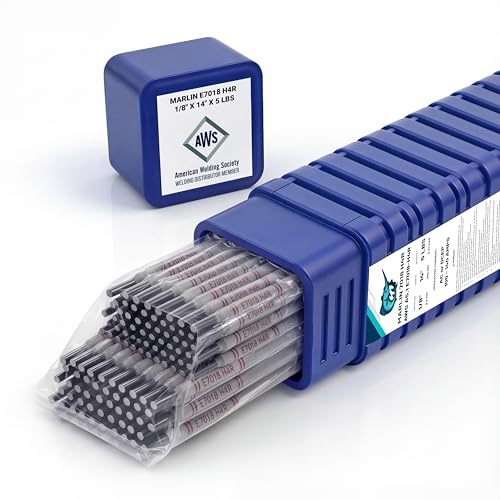
【 AWS-COMPLIANT E7018 LOW-HYDROGEN ELECTRODES 】: Metal Marlin H4R provides premium quality, low-hydrogen, arc welding carbon steel stick electrodes that ensure strong, reliable welds for all projects, ensuring strong and reliable welds with low hydrogen content, conforming to AWS A5.1 E7018 and ASME SFA-5.1 E7018 requirements.

ERGONOMIC SINGLE-FINGER OPERATION — The HM-600A welding stinger features an upgraded grip design that reduces hand strain during prolonged stick welding sessions, requiring only a single finger press to install welding rods versus traditional stingers that demand significant palm force, cutting strength requirements by 300% while maintaining consistent comfort throughout long jobs

Uphill Welding: Techniques and Benefits
Uphill welding, also called vertical-up welding, helps you control fusion on thicker material by keeping the arc near the leading edge of a relatively small puddle. It also gives you time to tie the weld into both sides of the joint.
The E7018 electrode often works well for vertical-up stick welding when its classification, diameter, storage condition, polarity, base metal, and procedure match the job. However, do not assume it can also run downhill. For example, Lincoln Electric lists Excalibur E7018-1 MR for all positions except vertical-down.
E6010 and E6011 electrodes may also be used in vertical work when the exact product and procedure allow them. Their arc behavior is different from a low-hydrogen E7018, so do not use the same manipulation or polarity automatically.
How to Weld Vertical-Up
- Confirm the procedure. Check the drawing, WPS, electrode or wire data sheet, permitted progression, polarity, joint details, preheat, and pass sequence.
- Prepare the joint. Remove rust, scale, oil, moisture, paint, and other contamination. Grind a clean location for the work clamp.
- Set a controllable heat level. Start within the manufacturer’s range. Vertical work often needs a smaller, cooler puddle than comparable flat welding.
- Begin at the bottom. Establish the root or fillet shelf without creating an oversized starting lump.
- Keep a short, stable arc. A long arc increases spatter, undercut, porosity risk, and puddle instability.
- Watch both toes. Pause briefly at each side for fusion, then cross the middle promptly before the puddle sags.
- Use a narrow weave or stringers. Do not make a wide weave merely to fill space. Multiple stringer passes are often easier to control.
- Fill the crater. Finish without leaving a deep crater, slag pocket, or abrupt stop at the end of the bead.
Stringer beads produce a narrow, controlled deposit. A small zigzag, triangle, or side-to-side weave can help fill a wider joint, but excessive weaving increases heat and makes it harder to confirm fusion. Miller’s stick-welding technique guide recommends limiting side-to-side manipulation and pausing at the joint sides for vertical-up tie-in.
Pro Tip: If the uphill puddle starts to sag, shorten the arc, keep the arc at the leading edge, reduce heat slightly within the approved range, cross the center faster, and avoid depositing an oversized puddle. Do not automatically slow down; excessive dwell time can add heat and create cold lap or heavy buildup.
Downhill Welding: Key Insights
Downhill welding gives you a fast way to weld suitable vertical joints. Gravity helps the puddle travel down the joint, so maintaining arc position is more important than simply following the flowing metal.
For conventional short-circuit MIG on thin steel, vertical-down can reduce burn-through and distortion because the faster travel speed lowers heat input. Keep the wire at the leading edge of the puddle. If the puddle runs ahead of the arc, it can wash over cold base metal and create overlap or lack of fusion.
Downhill welding also has an important industrial exception. It is widely used in qualified pipeline procedures with fast-freeze cellulosic electrodes. Lincoln Electric’s pipeline welding guide describes vertical-down procedures using electrodes such as E6010, E7010, E8010, and E9010. Those procedures use controlled joint preparation, current, polarity, electrode diameter, pass sequence, and travel technique. They do not make casual downhill welding acceptable on any thick joint.
How to Weld Vertical-Down
- Verify that downhill progression is permitted. Check the exact wire or electrode data sheet and the WPS before setting up.
- Prepare and fit the joint. Thin sheet still needs clean metal, stable fit-up, and a controlled gap.
- Set the machine for the process and material. Do not copy an uphill setting or select polarity from a generic rule.
- Start at the top. Establish a small puddle without letting it roll below the arc.
- Keep the arc on the leading edge. Move fast enough to avoid excessive buildup but not so fast that the bead becomes narrow, concave, or intermittent.
- Use minimal manipulation. A slight weave may flatten a MIG bead, but wide weaving can let the puddle outrun the arc.
- Inspect the toes. A smooth surface is not enough; look for overlap, incomplete tie-in, undercut, and an undersized bead.
Note: Pipe welding is not a general exception that lets you run any electrode downhill. Pipeline procedures may specify a particular electrode family, diameter, polarity, land, root opening, current range, interpass condition, and welder qualification.
Before You Strike an Arc
- Identify the joint: fillet or groove, single-pass or multi-pass, open root or closed root.
- Determine the service: cosmetic, light-duty, structural, pressure-retaining, fatigue-loaded, or safety-critical.
- Check thickness and fit-up: include the thinner member, root gap, bevel, land, and access.
- Confirm the process: SMAW, GMAW, FCAW, or GTAW guidance is not interchangeable.
- Read the consumable data: verify approved positions, polarity, shielding gas, diameter, and current or wire-feed range.
- Review the WPS: confirm progression, preheat, interpass temperature, pass sequence, weave limits, and inspection requirements.
- Prepare matching practice metal: use the same thickness, joint orientation, process, and consumable whenever possible.
- Plan safe access: arrange leads, ventilation, screens, footing, and fall protection before welding begins.
Common Vertical-Welding Problems and Fixes
Gravity affects the puddle, bead shape, slag movement, and heat distribution. Diagnose the visible symptom before changing several settings at once.
| Problem | Likely Causes | Correction |
|---|---|---|
| Uphill puddle sags | Too much heat, long arc, oversized weave, slow travel, or excess deposit | Shorten the arc, reduce heat within the allowed range, narrow the weave, and keep a smaller leading puddle |
| Undercut at the toes | Excess heat, long arc, poor angle, or crossing the toes too quickly | Reduce heat or arc length and pause briefly enough for the toe to fill |
| Slag inclusions | Slag running ahead, poor cleaning, narrow groove angle, or welding over unremoved slag | Keep slag behind the arc, clean every pass, correct joint access, and maintain sidewall fusion |
| Downhill overlap or cold lap | Puddle running ahead of the arc, poor gun angle, low heat, or excessive deposit | Move the arc back to the leading edge, correct the angle, and use approved settings and speed |
| Burn-through | Too much heat, slow travel, large root gap, or poor fit-up on thin metal | Reduce heat, increase travel speed carefully, improve fit-up, or use a backing method approved for the job |
| Ropy or narrow uphill bead | Moving straight up without washing into the toes or traveling too fast | Use controlled side-to-side movement and confirm fusion at both edges |
| Excessively convex bead | Travel too slow, heat too low, poor angle, or too much filler deposition | Increase travel speed slightly, correct the angle, and adjust settings within the approved range |
Keep heat input steady, but do not adjust only one control by habit. With stick welding, current, electrode angle, arc length, and travel speed work together. With MIG and flux core, voltage, wire feed speed, travel speed, contact-tip distance, transfer mode, and gun angle all affect the puddle.
Use the correct stick-welding amperage range as a starting point, then follow the exact electrode manufacturer’s data. For wire welding, machine charts and process-specific guidance are more reliable than a single universal setting. Your wire speed and voltage must also match the wire diameter, gas, transfer mode, metal thickness, and joint.
Mastering Vertical Welding: Essential Tips
Good vertical welding begins with a stable body position and a clear view of the leading edge and both weld toes. Brace your hand or forearm when possible without touching electrically live or hot parts.
- Practice on scrap that matches the production joint instead of using unrelated flat plate.
- Change one variable at a time so you can identify what improved or harmed the bead.
- Keep stringers or weaves within the limits of the procedure.
- Clean slag completely between passes.
- Watch the puddle edges instead of staring only at the arc.
- Check the finished weld against the required fillet size, groove fill, contour, and acceptance criteria.
- For designed joints, confirm the required and maximum fillet weld size instead of overwelding.
How to Inspect a Practice Weld
Begin with a visual check under good light. Look for a consistent bead width, complete tie-in at both toes, proper fill at the start and stop, and no visible cracks, porosity, overlap, slag, or undercut. Confirm that the bead is not undersized or excessively convex.
A surface that looks smooth can still hide incomplete fusion. On noncritical practice coupons, cutting, grinding, bending, or breaking a sample can help reveal penetration and internal discontinuities. These informal checks do not replace code-required inspection, procedure qualification, nondestructive examination, or a certified weld test.
Safety and Equipment Considerations
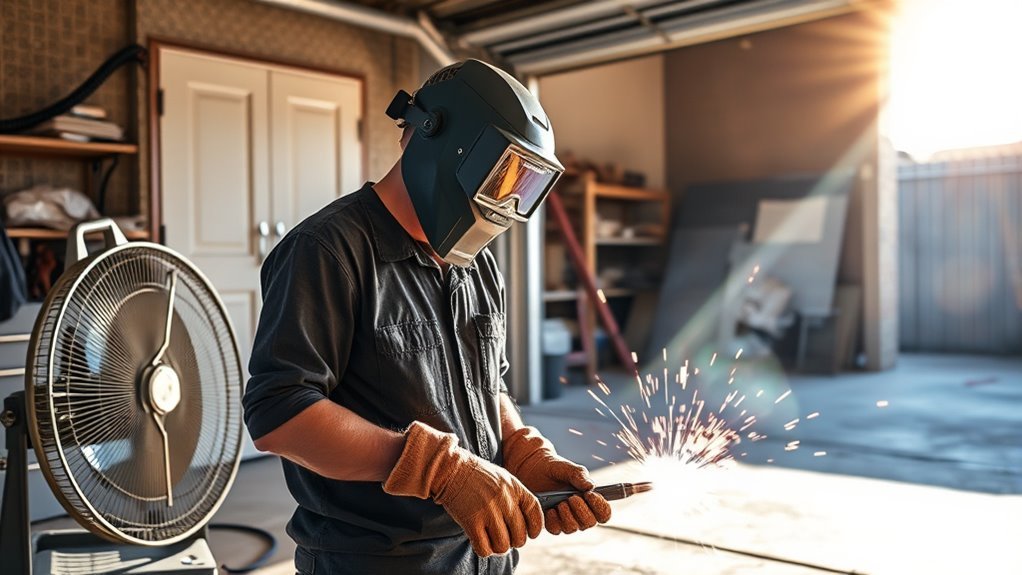
Wear a welding helmet with a suitable filter shade, safety glasses, dry welding gloves, hearing protection when needed, leather footwear, and flame-resistant clothing that covers exposed skin. Vertical welding can drop sparks and slag directly onto the welder, so avoid cuffs, open pockets, synthetic clothing, and gaps around the neck or boots.
Use enough general ventilation or local exhaust to keep fumes away from your breathing zone. Do not place your head in the plume. Welding on galvanized, plated, painted, stainless, lead-bearing, cadmium-bearing, or otherwise coated metal can require additional controls. OSHA’s general welding requirements address PPE, ventilation, coated metals, confined spaces, and hazardous cleaning vapors.
Warning: Never weld a drum, tank, pipe, hollow structure, or container that contains—or previously contained—a flammable, toxic, or pressurized substance unless it has been handled under an approved cleaning, isolation, testing, ventilation, and hot-work procedure. Do not enter a confined space without the required permit, ventilation, atmospheric testing, attendant, rescue plan, and respiratory protection.
Remove or protect nearby combustible material. Keep suitable fire-extinguishing equipment ready, check the opposite side of walls or floors for hidden ignition hazards, and use a fire watch when ordinary precautions are not enough. OSHA’s construction hot-work rules require control of sparks, slag, heat, and nearby fire hazards.
Inspect the electrode holder or gun, cable insulation, work clamp, gas hoses, connections, and machine before use. Keep gloves and the work area dry. Use stable footing, secure scaffolding, and required fall protection when welding above floor level. Route leads so they do not create a trip hazard or pull you off balance.
Set polarity according to the electrode or wire data sheet and the WPS. Do not select DCEP, DCEN, or AC solely from a general statement about penetration. The correct choice may change with the consumable and qualified procedure.
Products Worth Considering

【Professional Welding Glasses】Protect the eyes from sparks, and harmful radiation under normal welding conditions, It also features anti-ultraviolet, infrared radiation, anti-glare, which can resist 99% of the harmful light to the eyes.

【 Clear True Color Field of View 】 The lenses of this welding helmet use the latest true color technology to provide a highly clear picture in a 3.66 "x 1.69" field of view. Extreme elevation improves the visual experience of welders and relieves eye pressure. The welded helmet lens is 1/2/1/2 optical clarity.

Premium Goatskin Leather: Crafted from high-quality goatskin leather, these gloves offer a superior combination of flexibility and durability. The soft leather provides excellent dexterity while ensuring long-lasting wear.
When Should You Choose Uphill or Downhill Welding?
Choose vertical-up when the approved procedure calls for it or when you are making a thicker, multi-pass, or heavily loaded joint that needs deliberate root and sidewall fusion. It is a common choice for heavy brackets, plate, frames, structural fillets, and low-hydrogen stick welds.
Choose vertical-down for thin sheet or light-gauge MIG work when reducing heat input and burn-through is the main concern. It may also be correct for pipe when a qualified procedure specifies the joint, consumable, polarity, current, pass sequence, and downhill progression.
When no formal WPS exists for a noncritical practice or repair job, use the following order:
- Check whether the consumable is approved for the direction.
- Consider the thinnest member and risk of burn-through.
- Consider the required weld size and service load.
- Test the setup on matching scrap.
- Inspect the result and correct any lack of fusion, undercut, overlap, porosity, slag, or poor bead shape before welding the final joint.
Frequently Asked Questions
What is the difference between uphill and downhill welding?
Uphill welding progresses from the bottom of a vertical joint to the top. Downhill welding progresses from the top toward the bottom. Uphill commonly gives better puddle and sidewall control on thicker work, while downhill commonly provides faster, lower-heat travel on thin MIG-welded metal. Process-specific pipe procedures are an important exception.
Is E7018 better uphill or downhill?
Many common E7018 electrodes are intended for vertical-up rather than vertical-down welding. For example, Lincoln Electric lists Excalibur E7018-1 MR for all positions except vertical-down. Always check the exact product data sheet and WPS because electrode brand, classification, diameter, and application matter.
Can you make $100,000 a year welding?
Yes, but it is not typical base pay for the occupation as a whole. The U.S. Bureau of Labor Statistics reported a $51,000 median annual wage in May 2024, with the highest-paid 10% earning more than $75,850. Six-figure earnings may involve extensive overtime, travel, specialized certifications, remote work, supervision, hazardous conditions, or a related trade role. See the BLS welding occupation profile.
Is uphill or downhill welding harder?
Uphill often feels harder because the welder must support and shape the puddle against gravity. Downhill can feel easier because it moves faster, but maintaining the arc at the leading edge and preventing hidden lack of fusion also requires skill.
Can you downhill weld thick steel?
Do not downhill weld a thick or critical joint unless the consumable and approved procedure permit it. Ordinary downhill MIG advice is mainly aimed at thin metal, but qualified pipeline procedures can weld thick pipe downhill with purpose-selected electrodes and tightly controlled parameters.
Is vertical-up always stronger than vertical-down?
No. Vertical-up often promotes better fusion on thicker conventional MIG and stick-welded joints, but direction alone does not determine strength. A sound vertical-down weld made under a qualified procedure can meet demanding requirements. Joint design, filler metal, heat input, fusion, weld size, discontinuities, and inspection all matter.
Is uphill welding the same as pushing the electrode?
No. Uphill describes movement from the bottom to the top of a vertical joint. Push and drag describe the electrode or gun angle relative to travel. A vertical-up stick technique often uses a slight push angle, but progression and travel angle remain separate variables.
Conclusion
Your best welding direction depends on more than metal thickness. Uphill welding commonly gives better puddle support and sidewall fusion on thicker, multi-pass, or heavily loaded joints. Downhill welding commonly gives faster, lower-heat travel on thin MIG-welded metal, while qualified pipeline work shows that downhill can also be used on thick material under a specialized procedure.
Before starting, verify the WPS, consumable position limits, polarity, machine settings, joint preparation, and required weld size. Practice on matching scrap, keep the arc at the leading edge of the puddle, and inspect both toes instead of judging the weld only by its surface appearance.
When the joint is structural, pressure-retaining, vehicle-related, or otherwise safety-critical, do not choose a direction by convenience. Use the approved welding procedure and the qualified progression that the job requires.
Sources
- Miller Electric — Basic Welding Positions — vertical-up, vertical-down, 3F/3G positions, and vertical puddle control.
- Miller Electric — MIG Welding for Mild Steel — vertical MIG settings, thin-metal downhill use, travel angle, and leading-edge arc placement.
- Miller Electric — Stick Welding Technique — arc length, angle, weave width, travel speed, cleaning, and vertical-up manipulation.
- Lincoln Electric — Excalibur E7018-1 MR — example E7018 welding-position restrictions.
- Lincoln Electric — Welding Pressure Pipelines & Piping Systems — qualified vertical-down pipe procedures and consumable selection.
- OSHA 29 CFR 1910.252 — welding PPE, ventilation, confined-space, coating, and fume requirements.