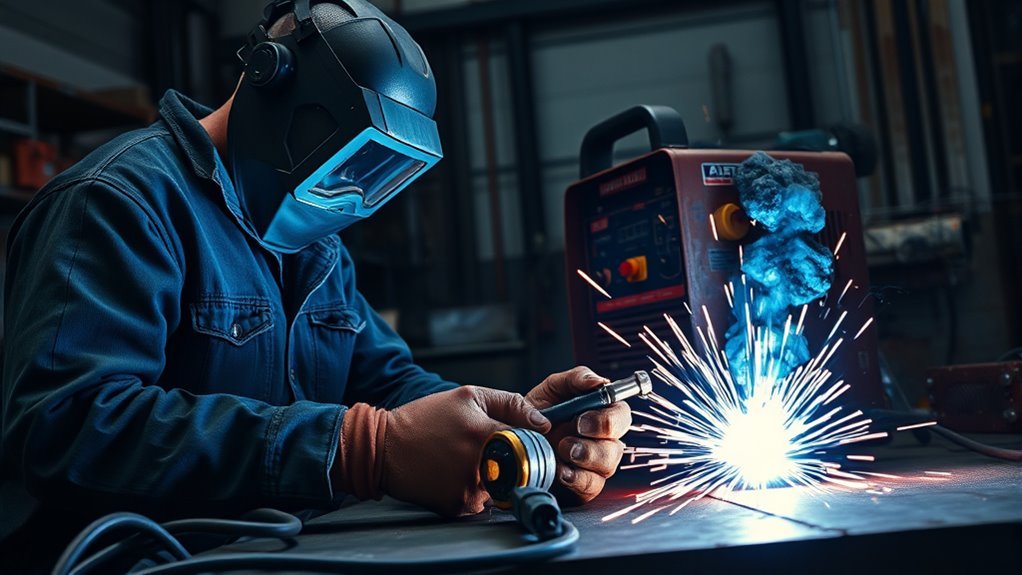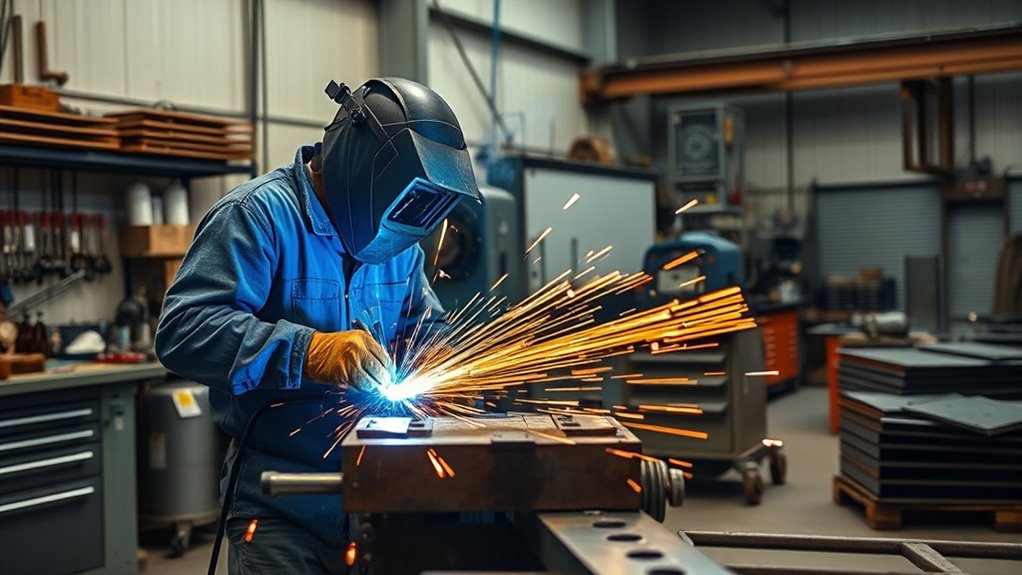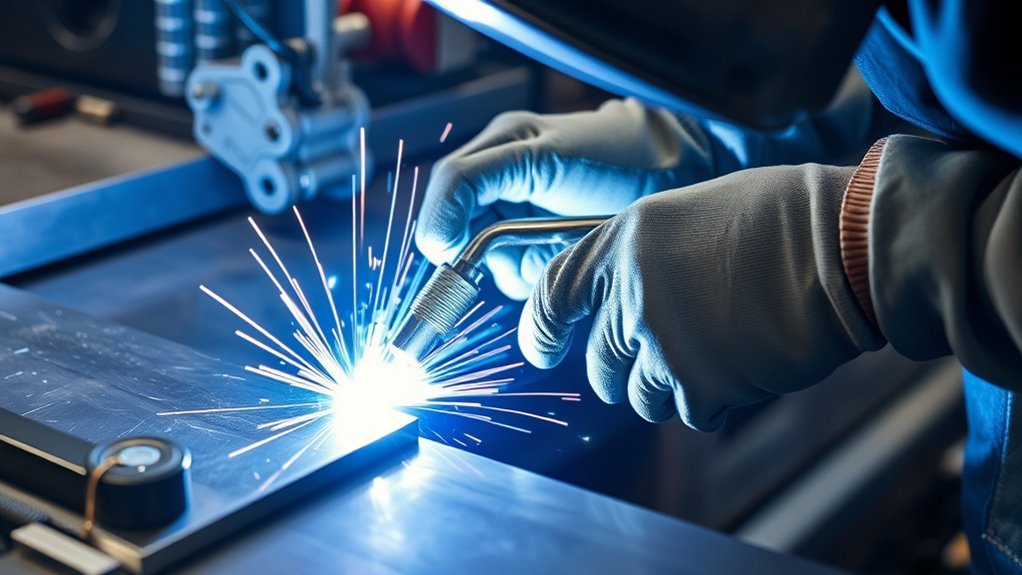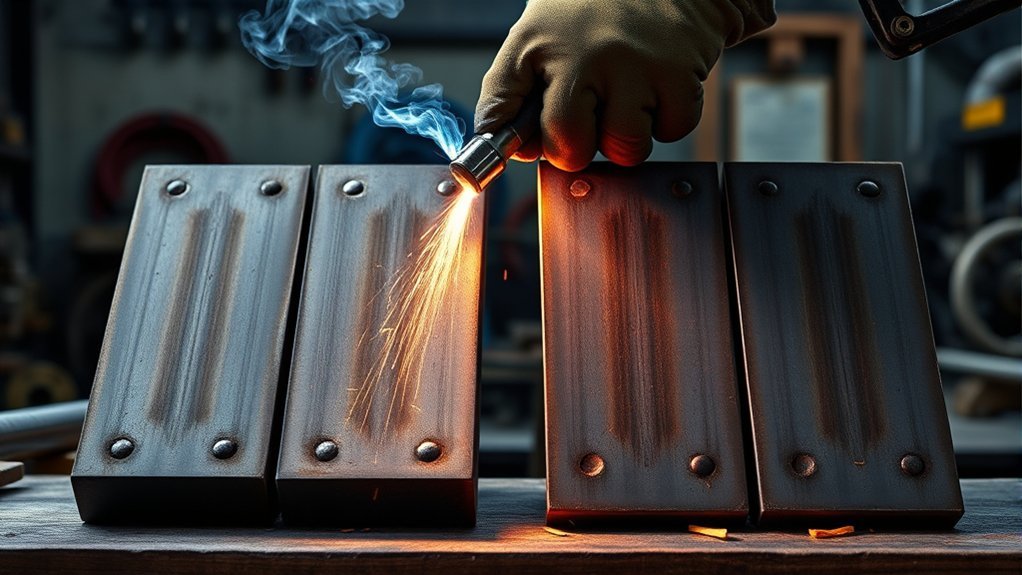
Your welding position changes how the molten weld puddle behaves. In flat welding, gravity helps the puddle stay centered, so bead shape and penetration are easier to control. In horizontal, vertical, and overhead welding, gravity can pull molten metal sideways, downward, or out of the joint, which raises the risk of undercut, sagging, lack of fusion, spatter, and burn-through.
Quick Answer
Welding position affects weld quality by changing how gravity, heat, arc force, and filler metal act on the puddle. Flat welds are usually easiest to control, horizontal welds need careful angle control, vertical welds need disciplined travel speed, and overhead welds demand the tightest heat control and safety awareness.
Key Takeaways
- Flat welding usually gives the easiest puddle control and the most consistent bead appearance.
- Horizontal welding can sag because gravity pulls molten metal toward the lower edge of the joint.
- Vertical-up welding can improve fusion on some thicker joints, but it is not automatically the strongest position.
- Overhead welding needs lower heat input, a short arc, careful body position, and strong PPE because molten metal can fall.
- The strongest weld comes from the right joint prep, settings, filler, procedure, and inspection, not from position alone.
How Welding Position Affects Weld Quality
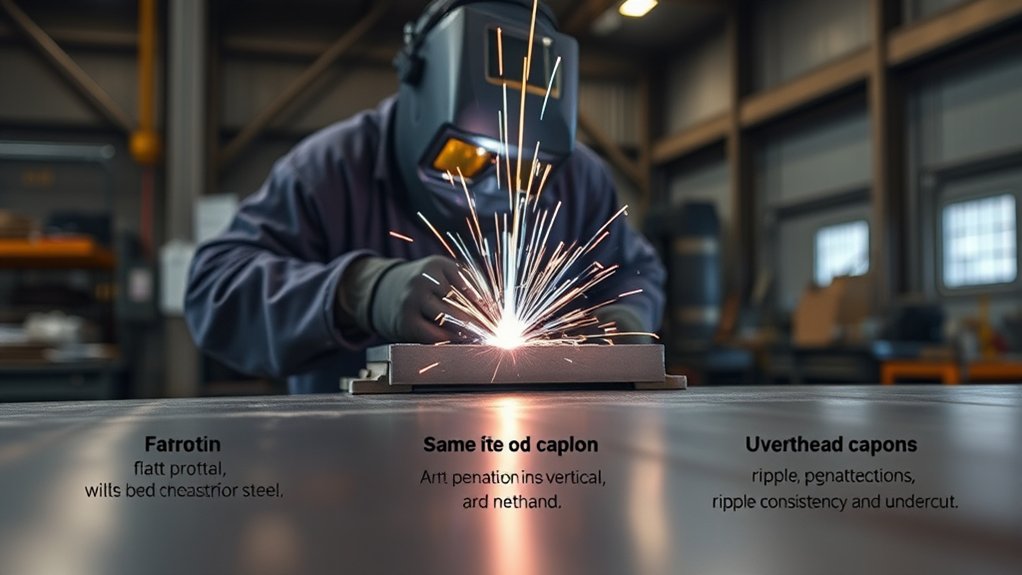
Welding position affects weld quality because it changes how the molten metal flows before it freezes. The same joint can behave very differently when you weld it flat, sideways, uphill, downhill, or overhead.
In the flat position, the weld puddle rests in the joint. That makes it easier to hold a steady arc length, keep a smooth bead profile, and maintain even heat input. In vertical welding and overhead welding, the puddle wants to run, sag, or drip. You have to control heat, travel speed, arc length, and filler placement much more carefully.
Position also affects defect risk. Too much heat in a vertical or overhead weld can cause sagging, undercut, or burn-through. Too little heat can cause lack of fusion. A long arc can increase spatter and make the puddle harder to steer. That is why good position welding is not just about holding the torch in a different place. You are adjusting the whole technique to keep the puddle supported until it solidifies.
Joint design still matters too. For example, maximum fillet weld size affects how much weld metal the joint can accept before extra heat and distortion become a problem.
What Welding Position Numbers Mean
Welding position numbers describe the orientation of the weld. The number tells you the position, and the letter tells you the weld type. G means groove weld, and F means fillet weld.
| Position | Meaning | Why It Matters |
|---|---|---|
| 1G / 1F | Flat groove or flat fillet | Easiest puddle control and smoothest bead appearance. |
| 2G / 2F | Horizontal groove or horizontal fillet | Molten metal can sag toward the lower toe of the weld. |
| 3G / 3F | Vertical groove or vertical fillet | Requires tight travel speed, arc length, and puddle support. |
| 4G / 4F | Overhead groove or overhead fillet | Hardest puddle control and highest burn risk from falling metal. |
| 5G / 6G | Fixed pipe positions | Tests control across multiple positions without rotating the pipe. |
Note: Position numbers help describe the weld, but they do not replace a welding procedure. For code work, follow the approved WPS, material requirements, filler classification, and inspection standard for the job.
Flat vs. Horizontal Welding: Key Differences
Although flat and horizontal welding both use controlled heat input, they feel very different in practice. In flat welding positions, such as 1G and 1F, gravity helps keep the weld puddle seated in the joint. This makes the puddle easier to watch, the bead easier to shape, and the heat easier to control.
On a 90-degree fillet weld, your work angle is often near 45 degrees, but it still depends on joint fit-up, process, filler size, and weld symbol requirements. Keep your travel speed steady and avoid making the bead larger than the joint needs. A bead that is too large can trap slag, add distortion, and waste filler metal.
Horizontal welding, such as 2G and 2F, adds a side-load problem. Gravity pulls the molten metal toward the lower edge of the weld. If your angle is too flat or your travel speed is too slow, the lower toe can overlap while the upper toe undercuts. You may need a slightly faster travel speed, a tighter arc, and a small pause at the upper toe to keep both sides tied in.
Material condition also affects quality. Coatings, paint, rust, oil, and galvanizing can change arc behavior and fume risk. When welding coated material, review safe prep and ventilation first, especially with zinc fume hazards.
| Position | Puddle Behavior | Common Risk | Best Control Move |
|---|---|---|---|
| Flat | Puddle settles into the joint | Too much deposition or distortion | Use steady travel and avoid oversized beads |
| Horizontal | Puddle pulls toward the lower toe | Overlap below, undercut above | Favor the upper toe and keep a tight arc |
| Vertical Up | Puddle builds upward in small shelves | Sagging, undercut, slow travel | Use small pauses at the sides and control bead size |
| Vertical Down | Puddle runs with gravity | Shallow fusion on thicker joints | Use only when the process, material, and procedure allow it |
| Overhead | Puddle can drip out of the joint | Burns, spatter, lack of fusion | Lower heat, shorten arc, and use smaller passes |
Vertical Welding: Control the Puddle
In vertical welding, gravity pulls the molten puddle downward, so you have to control travel speed, amperage, and arc length to keep the bead stable. The goal is to make a puddle small enough to hold its shape, but hot enough to fuse into both sides of the joint.
Vertical up is often used on thicker material because the weld can build upward in small shelves. This can help penetration and sidewall fusion when your settings and technique are right. It is slower than flat welding, but it gives you more time to tie the weld into both sides of the joint.
Vertical down can be useful on thinner material and some production work because it moves faster and puts in less heat. The tradeoff is that it can produce shallow fusion if used on material or joints that need deeper penetration. Do not assume vertical down is acceptable unless your process, filler, and procedure allow it.
- Use a short arc to keep the puddle tight.
- Keep the bead small instead of trying to fill too much at once.
- Pause briefly at each side of a weave, not in the middle.
- Watch the leading edge of the puddle so you can correct sagging early.
- Reduce heat if the puddle starts washing out or undercutting the toes.
Undercut is one of the most common vertical-position defects. If the toes of the weld are melting away and not filling back in, review your heat, travel angle, and pause timing. This guide on how to prevent undercut in welding explains the defect in more detail.
Pro Tip: For vertical-up practice, run smaller stringers before wide weaves. If you cannot hold a small puddle cleanly, a wider weave will usually magnify the problem.
Overhead Welding: Heat and Safety
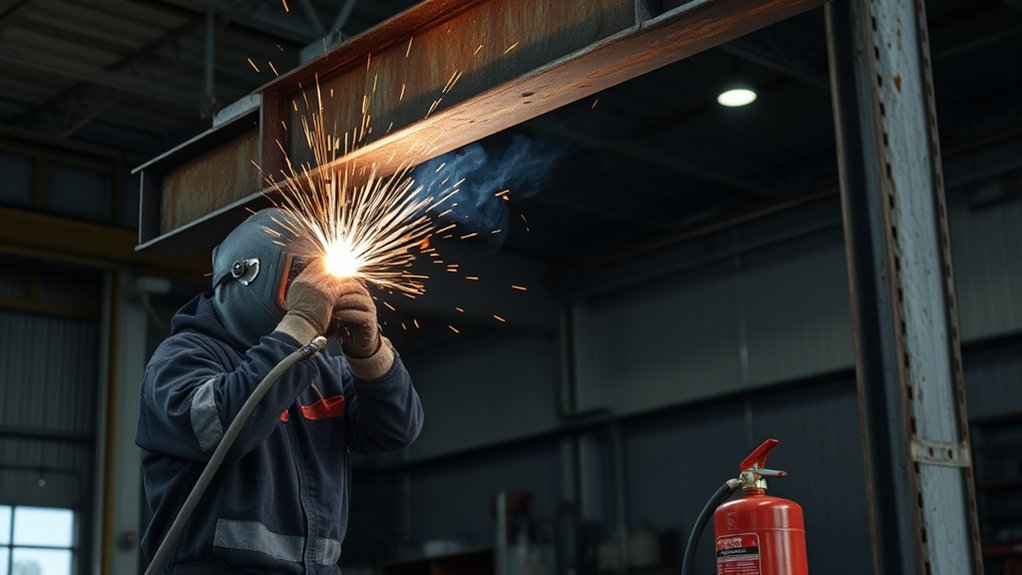
Overhead welding demands tight heat control because gravity works directly against the weld puddle. If the puddle gets too large or too hot, molten metal can drip out of the joint. That can ruin the bead, increase spatter, and create a serious burn hazard.
Use smaller passes, a short arc, and controlled travel speed. Lower amperage may help, but do not reduce heat so much that the weld loses fusion. Keep your body positioned so you are not directly under falling slag or spatter. Support your arms when possible, keep your stance balanced, and make deliberate movements rather than reaching awkwardly.
Warning: Overhead welding increases burn and fire risk. Wear flame-resistant clothing, gloves, eye and face protection, and keep combustibles away from the work area. OSHA requires fire-prevention precautions for welding and cutting, including moving fire hazards or guarding them when they cannot be moved.
Ventilation matters in every position, but it becomes even more important when your head and helmet are close to the arc. The NIOSH welding fumes and manganese guidance notes that welding fumes contain metals and that confined-space welding can increase exposure. OSHA also maintains a welding, cutting, and brazing safety topic page covering hazards and standards.
If you are welding in a confined space, on coated metal, or near combustible materials, stop and review the job setup first. Proper ventilation, respiratory protection when required, fire watch, and hot-work controls are not optional details. They are part of making the weld safely. For related shop safety habits, see this PPE and setup checklist.
Which Welding Position Gives the Strongest Weld?
No welding position is automatically the strongest. The strongest weld is the one that meets the required procedure, size, penetration, fusion, and inspection criteria for that joint. Position affects how hard it is to achieve those results, but it does not guarantee strength by itself.
The flat position usually gives the easiest control and the cleanest bead because gravity helps the puddle stay in place. That makes flat welding a strong choice when the work can be positioned safely. In many shops, parts are rotated or fixtured into the flat position for this reason.
Vertical-up welding can produce strong results on some thicker groove welds and fillet welds because it allows controlled buildup and sidewall tie-in. But if the bead is too large, too cold, or poorly timed, it can still fail from slag inclusions, lack of fusion, or undercut.
Overhead welding can also meet high-strength requirements when done by a qualified welder using the right procedure. The challenge is that the margin for error is smaller. Heat input, arc length, electrode angle, and bead size all need discipline.
Advanced pipe positions, such as 5G and 6G, are best understood as skill and qualification positions. They prove that a welder can control the puddle as the joint moves through flat, vertical, horizontal, and overhead zones. They do not make the weld stronger on their own. Correct settings still matter, so check the process range, filler, and correct amperage before you weld.
Position changes the difficulty of making a sound weld. Procedure, preparation, heat control, and inspection determine whether that weld is actually sound.
How Different Processes Handle Position Welding
Welding position also depends on the process. A setting that works in flat MIG welding may be too hot for overhead welding. A rod that runs smoothly in the flat position may not freeze fast enough for vertical or overhead work.
- MIG/GMAW: Short-circuit transfer is often easier for thin material and out-of-position work because it uses a smaller puddle. Spray transfer usually creates a larger, hotter puddle and is often limited to flat or horizontal work unless the equipment and procedure support pulsed spray.
- Stick/SMAW: Electrode choice matters. Some rods are all-position, while others are better for flat or horizontal fillets. Read the electrode classification and follow the procedure.
- Flux-cored/FCAW: Flux-cored wire can work well out of position when the wire type and parameters are designed for it. Slag control becomes important in vertical and overhead passes.
- TIG/GTAW: TIG gives excellent control, but it demands steady body position and precise filler timing. Overhead TIG is especially unforgiving because both torch and filler rod control must stay stable.
Products Worth Considering
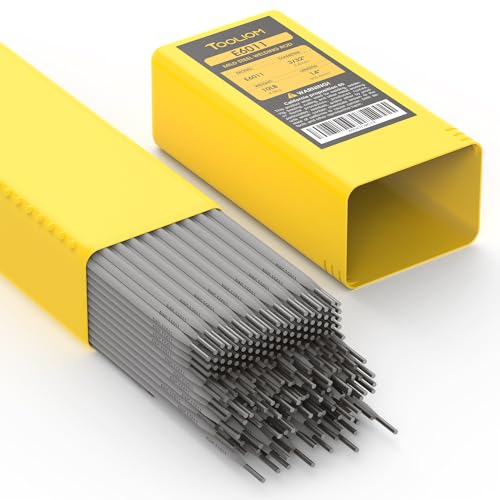
PRODUCT: E6011 is an all-position, multi-channel mild steel electrode designed primarily for use with AC power sources, with beautiful molding and high welding efficiency.

MODEL: E6011 is a mild-steel, all position electrode designed primarily for use on AC power sources. It produces a strong arc force for deep penetration and a fine spray transfer that enhances operator appeal.

Settings and Technique That Change by Position
When the position gets harder, your technique usually needs to get tighter. Do not simply copy flat-position settings into vertical or overhead work.
- Arc length: Keep it shorter in vertical and overhead positions to reduce spatter and keep the puddle focused.
- Travel speed: Move fast enough to avoid sagging, but slow enough to maintain fusion at the root and toes.
- Amperage and voltage: Reduce heat when the puddle becomes too fluid, but avoid going so low that fusion suffers.
- Work angle: Aim the arc where fusion is needed most. In horizontal fillets, this often means watching the upper toe carefully.
- Travel angle: Keep the arc force pushing the puddle where you want it, not washing it out of the joint.
- Bead size: Use smaller passes in vertical and overhead work. Oversized beads are harder to support against gravity.
Note: If you are welding to code, do not adjust settings outside the approved range. Use the qualified WPS and ask the responsible welding supervisor or inspector before changing essential variables.
Products Worth Considering

6 Jackson Safety Hard Hat Welding Helmet Interchange Systems / Case

CLEAR VIEWING AREA - Features a 3.86 x 1.62 in viewing area for a clear view of your work. The fixed shade lens requires no manual shade adjustment, making this welding helmet simple and convenient to use

➤Material: 7oz FR balaclava is made of 100% cotton. Soft, breathable, lightweight and moisture-wicking, ensuring all day comfort and durability. FR face mask will remain arc and flame retardant regardless of the washes and wear cycles
Troubleshooting Position-Related Weld Defects
Most position-related defects come from a puddle that is too hot, too large, too cold, or poorly supported. Use the bead shape as feedback.
| Problem | Likely Cause | Fix |
|---|---|---|
| Sagging bead | Too much heat, slow travel, large puddle | Use smaller passes, shorten arc, and increase control at the toes. |
| Undercut | Too much heat, long arc, poor pause timing | Lower heat slightly, tighten arc, and pause long enough to fill the edge. |
| Lack of fusion | Travel too fast, heat too low, poor angle | Aim into the joint, clean the base metal, and use enough heat for tie-in. |
| Burn-through | Too much heat for thin material | Reduce heat, move faster, and use shorter weld segments when needed. |
| Porosity | Contamination, poor shielding, long arc | Clean the joint, protect shielding gas, and keep the correct arc length. |
| Heavy spatter | Settings too high, arc too long, poor polarity or wire setup | Check polarity, tune settings, clean the nozzle, and stabilize travel speed. |
Frequently Asked Questions
Why is the position of welding important?
Welding position is important because it changes puddle control, heat control, filler placement, and defect risk. The harder the position, the more carefully you must manage arc length, travel speed, angle, and bead size.
Why can welding be hard on long-term health?
Welding does not automatically shorten a person’s life, but unmanaged hazards can raise health risks. Fumes, heat, UV radiation, noise, awkward posture, burns, and confined-space work all need proper controls, including ventilation, PPE, training, and safe work practices.
What do 1F, 2F, 3F, and 4F mean in welding?
1F, 2F, 3F, and 4F are fillet weld positions. 1F is flat, 2F is horizontal, 3F is vertical, and 4F is overhead. The matching groove weld positions are 1G, 2G, 3G, and 4G.
What is the golden rule in welding?
The golden rule is to keep the puddle under control. That means clean base metal, correct settings, a steady travel speed, proper angle, short enough arc length, and enough heat to fuse the joint without overwelding it.
Is overhead welding always weaker?
No. Overhead welding can meet demanding strength requirements when the welder, procedure, filler, settings, and inspection are correct. It is harder because gravity works against the puddle, so the chance of defects is higher if technique slips.
Should you weld vertical up or vertical down?
Use vertical up when you need better control and fusion on thicker joints. Use vertical down only when the material, process, filler, and procedure allow it, often on thinner material or specific production welds.
Conclusion
Welding position affects weld quality because it changes how gravity acts on the puddle. Flat welding gives you the easiest control. Horizontal welding asks you to manage side sag. Vertical welding demands careful heat, travel speed, and puddle support. Overhead welding requires the tightest heat control and the strongest safety habits.
The main lesson is simple: do not judge weld strength by position alone. A strong weld comes from clean prep, correct settings, proper filler, controlled technique, safe work practices, and inspection. Master the position, but always let the procedure and the puddle guide the result.
Sources
- OSHA: Welding, Cutting, and Brazing — supports welding hazard and standards context.
- OSHA 29 CFR 1910.252 General Requirements — supports fire prevention, combustible control, and fire-watch guidance.
- NIOSH: Welding Fumes and Manganese — supports welding fume, manganese, and confined-space exposure guidance.
- ISO 6947 Welding Positions — supports standardized welding-position terminology and classification.