As an Amazon Associate, Garage Welding may earn from qualifying purchases. This does not change the price you pay.
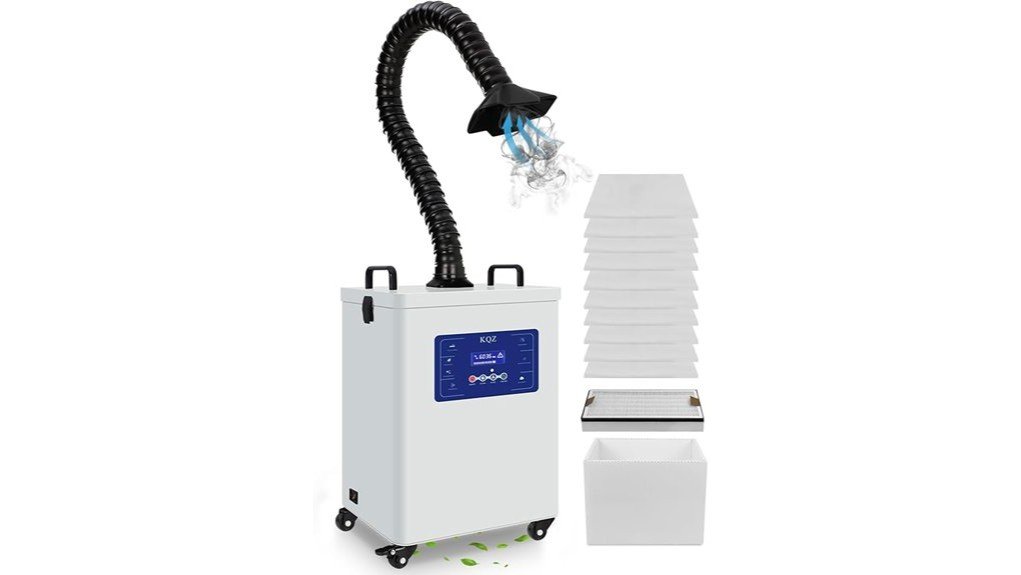
The KQZ 150W solder fume extractor is a benchtop fan-and-filter unit that pulls flux smoke away from your face while you solder, and the listing also mentions laser cutting and 3D printing. This KQZ 150W solder fume extractor review is based on the Amazon listing, not hands-on testing. It is worth considering for a home electronics bench; it is not a replacement for ventilation or a respirator on welding or heavy metal fume work.
Quick specs at a glance
| Item | Per the listing |
|---|---|
| Type | Benchtop fume extractor with filters |
| Power | 150W, brushless motor |
| Fan speed | Listed at 6036 RPM, adjustable |
| Filtration | Listed 99.97% efficiency to 0.03 micron particles; activated carbon layer |
| Noise | Listed at about 55 dB |
| Features | Anti-clogging alarm, timer, speed control, 10 pre-filters |
Treat the filtration numbers as the seller’s claims. Look at the listing for how the figure is defined before relying on it.
Check current price on Amazon →
What it is and who it suits
Soldering produces rosin and flux smoke that irritates eyes, nose and lungs. A fume extractor draws air through a pre-filter, a particulate filter and activated carbon, then returns it to the room. It captures smoke close to the source, where a general room fan does not.
It suits hobby electronics benches, repair desks, and small 3D printer or laser corners where you work seated and the source stays within a short distance of the intake. It is not a substitute for welding fume extraction, which deals with metal fumes and much more airflow.
How to check it fits your setup
- Distance to the work: extractors work best with the intake close to the joint. Place it within a short distance of the tip and use the lowest speed that clears the smoke.
- Filter replacement: the listing includes 10 pre-filters. Check how often the carbon and main filters need replacing, and whether replacements are sold.
- Noise: 55 dB is a seller figure. Test at your speed setting to see if it suits your bench.
- Footprint and power: check size and cable length against your bench.
- What it captures: activated carbon helps with odors, but no consumer filter removes every gas. Keep the room ventilated.
Pros and limitations
| Pros | Limitations |
|---|---|
| Captures smoke at the bench, reducing irritation | Not a respirator or welding-grade extractor |
| Speed control and timer | Filtration claims are the seller’s, not verified |
| Anti-clogging alarm and spare pre-filters | Filters are a recurring cost |
| Useful for 3D printing and laser work too | Needs to sit close to the work to be effective |
Check current price on Amazon →
Using a fume extractor properly
- Position the intake between you and the work, as close as you can without blocking your view.
- Run it before you start soldering and for a short time afterward to clear the room.
- Replace or clean pre-filters when airflow drops or the alarm sounds.
- Combine it with an open window or room ventilation, especially in a small space.
- Use lead-free solder and wash your hands afterwards; the extractor does not remove lead or solder dust from surfaces.
- Do not use it to extract welding fumes, grinding sparks or flammable vapors.
Related bench gear: a heat-safe soldering mat and a tidy solder wire holder stand make the bench safer.
Alternatives and related guides
- Preciva 852D++ if you do hot air rework, where fumes are heavier.
- PowerPath PP-1390 leaded solder kit, where fume and hand hygiene matter more.
- Half facepiece respirator if you also need PPE for other work.
Frequently Asked Questions
Does a solder fume extractor remove all fumes?
No. It captures much of the smoke near the intake, and carbon filters help with odors, but no consumer unit removes every gas or particle. Keep the room ventilated, keep the intake close to the work and replace filters on schedule.
How close should the extractor be to my soldering iron?
Place the intake as close as you can without blocking the work, typically within a short distance of the tip. Capture efficiency drops quickly with distance, so reposition it when you move to a different part of the board.
How often should I replace the filters?
It depends on use. Pre-filters should be changed when airflow drops or the alarm sounds, while carbon and main filters have a longer but limited life. Check the listing and manual for the seller’s guidance on replacement intervals.
Can it be used for welding fumes?
No. Welding produces metal fumes and heat that need dedicated local extraction, ventilation and a suitable respirator. A bench solder extractor is intended for flux smoke at hobby scale, not for MIG, TIG or stick welding.
Conclusion
The KQZ 150W extractor looks like a solid way to take flux smoke away from your face at a hobby bench, as long as you keep it close to the work and maintain the filters. It complements ventilation and does not replace PPE for welding.
Check current price on Amazon →