Up to 40% of plasma operating cost ties back to gas choice and flow rate, yet you control much of it. You’ll balance cut speed, amperage, and gas purity against flow—typically 3–7 scfm for compressed air at low amps—while oxygen or nitrogen can improve edge quality and consumable life. Ambient conditions, filtration, and regulator accuracy matter. Set the wrong flow and you waste gas or degrade cut quality. Here’s how to optimize both.
Factors That Affect Plasma Gas Consumption

Even before you select consumables, plasma gas consumption hinges on controllable process parameters and site conditions. You should baseline gas usage by correlating cutting speed and amperage settings to the cut profile. Higher travel speeds and elevated current increase mass flow to stabilize the arc column, so plan for proportional rises in consumption.
Match the type of gas to the application; compressed air generally yields lower gas usage than oxygen or argon‑hydrogen mixes, but verify per cut quality requirements.
Choose gases by application—air often uses less than oxygen or argon‑hydrogen, but confirm against cut quality needs.
Account for material thickness and alloy; thicker, denser sections need higher energy density, driving flow and current upward to maintain kerf quality and pierce reliability.
Operating conditions matter: ambient temperature and humidity shift arc stability and cooling rates. Colder or humid environments can increase consumption to sustain energy transfer.
Implement regular maintenance on compressors, dryers, and filtration to prevent contaminants from destabilizing flow, forcing overcompensation, and inflating plasma gas consumption beyond specification.
Compressed Air: Usage Rates and Cost Impacts

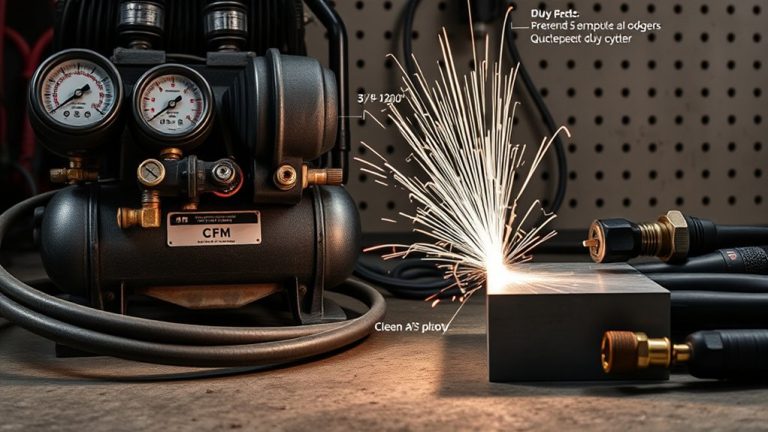
Although compressed air is the most common plasma gas, you should quantify its usage rate and cost by tying flow demand to amperage, duty cycle, and cut thickness. For rough sizing, many air plasma torches draw 3–7 scfm at 30–60 A and 7–12 scfm at 80–120 A; continuous cutting at 60% duty cycle drives higher average flow and operational cost.
Match your air compressor to peak scfm plus 20–30% margin and maintain ≥90–120 psi at the torch to protect performance on materials up to 1 inch thickness.
Account for lifecycle costs: while you don’t buy gas, you’ll pay for electricity and maintenance on the compressor, refrigerated dryer, and filters.
Dry, clean compressed air—per ISO 8573-1 Class 2–4 for particles, oil, and moisture—prevents orifice wear, contamination, nitriding, and oxidation that degrade edge quality and weldability.
Track kWh per scfm-hour and filter change intervals to benchmark true operational cost.
Oxygen and Nitrogen: Consumption vs. Cut Quality

While oxygen and nitrogen are both common plasma gases, you’ll choose between them based on material, desired edge quality, and consumable life, then size supply to the torch’s flow and pressure spec. For mild steel, oxygen maximizes cut quality and speed by refining molten spray and improving kerf ejection; however, it’s unsuitable for stainless steel or aluminum due to accelerated wear on consumables. Use nitrogen for stainless steel and aluminum to extend consumable life—often beyond 1,000 starts—while maintaining excellent cut quality. Pair nitrogen with air as a secondary gas to stabilize the arc and improve surfaces on sections up to 3 inches. For mixed material loads, nitrogen with carbon dioxide is a versatile choice that balances speed, cut quality, and gas consumption.
| Parameter | Recommendation |
|---|---|
| Material: mild steel | oxygen primary |
| Material: stainless steel | nitrogen primary |
| Material: aluminum | nitrogen primary |
| Secondary gas | air (with nitrogen) |
| Performance target | quality, life, throughput |
Argon-Hydrogen and Specialty Mixes: When Higher Flow Pays Off

For jobs that push beyond oxygen or nitrogen capabilities, argon‑hydrogen mixes—most commonly 65/35—offer higher volumetric flow, hotter arcs, and cleaner kerfs on thick stainless and aluminum.
You’ll leverage higher flow rates to raise energy density at the nozzle, delivering cleaner cuts on thick stainless steel and high‑conductivity aluminum with fewer inclusions. Argon-hydrogen increases arc stability, lowers contamination risk, and supports tighter kerf geometry, yielding polished surfaces on high‑alloy materials.
Expect elevated gas consumption with these specialty gas mixes; the benefit is process capability, not economy.
On sections where oxygen or nitrogen stall, the hotter arc maintains cut speed and reduces dross, translating to improved output quality and rework reduction. Cost per hour rises, but cost per compliant part often falls.
When oxygen or nitrogen stall, hotter arcs sustain speed, cut dross, and reduce rework, lowering cost per compliant part.
Calibrate gas management for these blends: match flow to amperage, plate thickness, and torch design to maintain the boundary layer and prevent turbulence.
Validate parameters through cut-voucher data and maintain consistent supply purity.
How to Reduce Gas Use: Setup, Filtration, and Best Practices

Even before you tweak cut parameters, lock in a clean, stable gas supply: pair a dedicated compressor with a refrigerated dryer to deliver ISO 8573-1 Class 2–4 quality air, then stage particulate/coalescing filters (e.g., 5 µm prefilter, 0.01 µm final) to keep moisture and oil below OEM limits.
Standardize your setup to minimize gas consumption: verify regulator accuracy, leak-test lines, and log inlet/outlet pressures to confirm ideal gas delivery.
Replace filtration elements on hours/ΔP, not guesswork, so gas flow stays within spec. Use OEM pressure and flow tables; over-pressurizing a plasma cutter increases usage without improving cut quality.
Calibrate torch height control, then match cutting speed to amperage and material; too slow wastes gas and overheats edges, too fast increases dross and rework.
Follow best practices with regular maintenance: inspect hoses, seals, and consumables; worn nozzles and electrodes drive excess flow.
Trend data (pressure, dew point, filter ΔP) to catch deviations early.
Frequently Asked Questions
Is a 6 Gallon Air Compressor Enough for a Plasma Cutter?
No. You’ll undercut plasma cutter efficiency. Verify compressor capacity (≥4–5 CFM @ 90 psi), air pressure requirements, cutting thickness limits, and duty cycle considerations. Prioritize power supply compatibility, compressor maintenance tips, noise level concerns, portability advantages, and cost effectiveness analysis.
How Much Air Does It Take to Run a Plasma Cutter?
Like a thirsty engine, you’ll need 3–10 CFM. You’ll target 70–100 psi air pressure requirements, balancing plasma cutter efficiency, ideal air flow, cutting thickness variations, duty cycle impact, compressor size recommendations, nozzle types comparison, air filtration importance, plasma cutting techniques, maintenance tips.
What Gas Do You Need to Run a Plasma Cutter?
You’ll choose Plasma cutter gases by metal and Cutting thickness: Compressed air for versatile, Cost efficiency; Oxygen vs. Nitrogen for steel vs. aluminum/stainless; Argon advantages (Ar-H2) for thick nonferrous. Maintain Gas purity, correct Gas flow rates, compatible Shielding gas, maximizing Plasma cutter performance.
Are the Fumes From a Plasma Cutter Toxic?
Yes. Plasma fumes carry health risks from metal vapors and ozone. You should meet exposure limits, guarantee ventilation needs, use fume extraction, wear protective gear, follow safe practices, control indoor usage, assess long term effects, and track environmental impact.
Conclusion
You’ve seen the theory: higher flow equals better cuts. The data says “it depends.” At 40–60 A, air at 3–7 scfm often meets ISO 9013 cut quality. Switch to O2 or N2 and you’ll improve edge metallurgy and consumable life per vendor duty-cycle specs, sometimes at equal or lower net scfh due to faster speeds. Argon‑H2 pays off on stainless >12 mm despite higher flow. Validate with flowmeters, dew point ≤‑40 °C, and leak-down tests to minimize gas per meter cut.