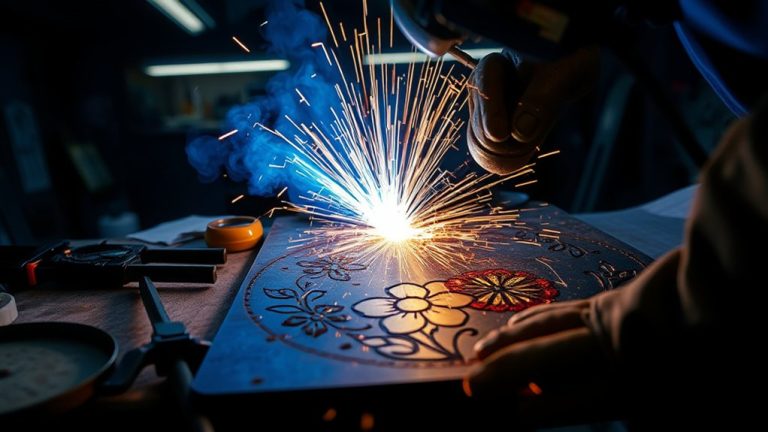
Setting up a plasma cutter in your garage starts with power and air: you’ll match output current to material thickness, check duty cycle, and decide if dual-voltage is worth it. A 120V unit at 20–40A handles light gauge; 240V up to ~65A pushes clean cuts on thicker stock. You’ll also need dry, regulated compressed air and a pilot arc for dirty steel. Get these right first—before you choose a machine that bottlenecks your projects.
Key Power Specs for DIY Metal Cutting
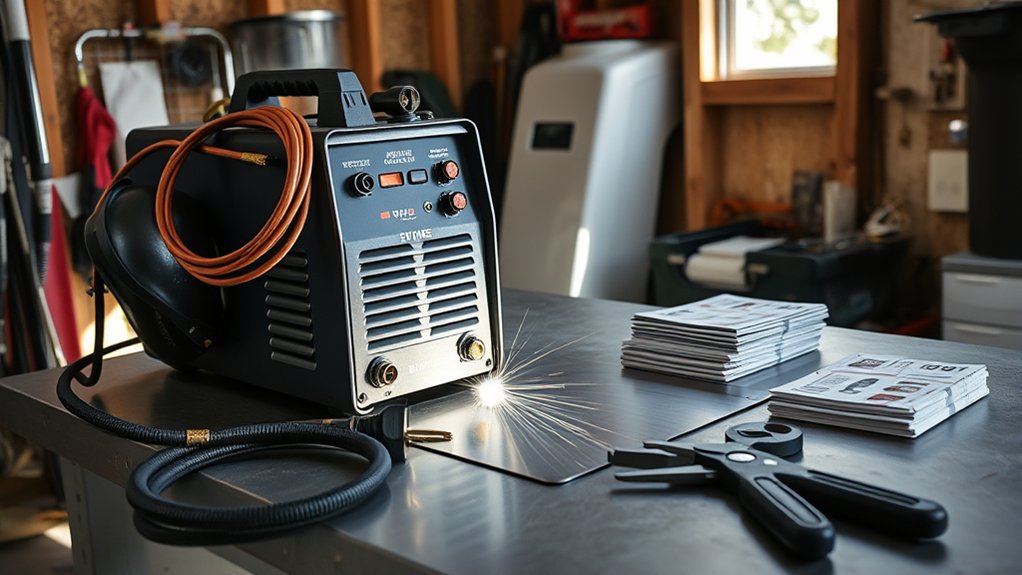
When you spec a plasma cutter for a home garage, start with output current, input voltage, duty cycle, and air supply. Match power requirements to your circuit: 120V for portability and light gauge work, 240V for thicker material and cleaner arc stability.
Look for dual-voltage units so you can plug into either outlet without rewiring. Set amperage settings to the material: 20–30A for sheet, 40–50A for 3/8–1/2 inch, and 55–65A when you need near 1 inch capability. Verify the machine’s rated output range aligns with your typical stock.
Choose dual-voltage. Match amps to thickness. Ensure rated output covers your typical stock.
Budget models that run on household electricity can be efficient and compact, but confirm real-world output under 120V won’t bottleneck your cut speed.
Air supply matters: most torches need clean, dry compressed air; plan for a shop compressor with adequate CFM and filtration. If space is tight, consider an integrated compressor unit to simplify setup and reduce hoses.
Understanding Duty Cycle and Cut Ratings
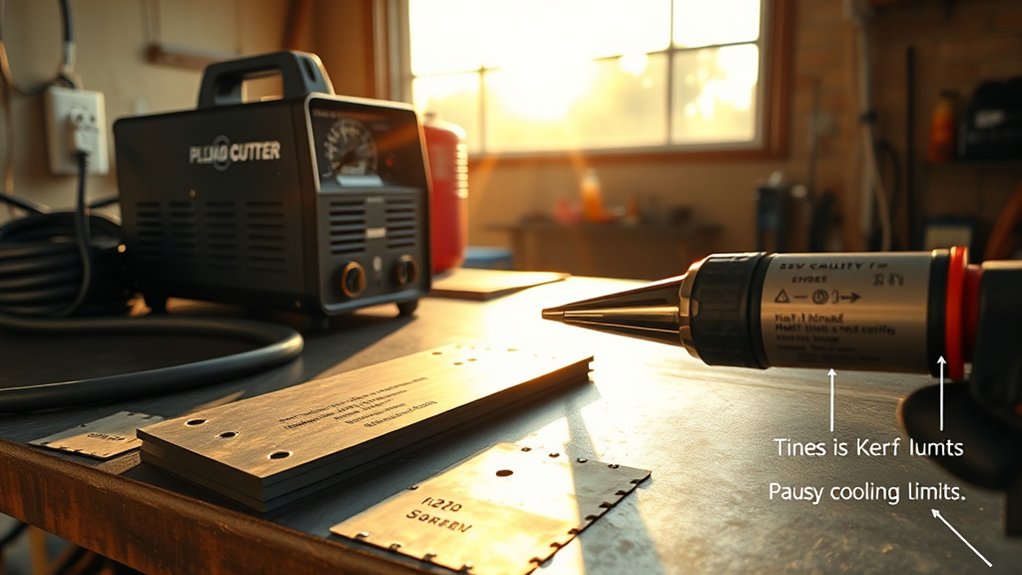
You’ve matched amperage and voltage to your garage power, so now quantify uptime and thickness limits. Duty cycle tells you how long the torch can stay lit in a 10‑minute window before thermal protection trips. A 60% duty cycle at 40 A means 6 minutes cutting, 4 minutes cooling—critical when you’re batching brackets or notching frames. Cut ratings define capability: recommended cut is clean and fast; sever is slower, rougher, and near the edge of the arc’s energy density. Higher amperage increases penetration, but only if the duty cycle supports your workflow frequency.
| Spec | Definition | Practical Check |
|---|---|---|
| Duty Cycle | % of 10 min at rated amps | Match to job duration bursts |
| Cut Ratings | Recommended vs. sever thickness | Verify with material list |
| Amperage | Current driving arc energy | Align to max thickness need |
Example: a unit like the Airforce 40i lists ~5/8 in recommended, 7/8 in sever. Choose by pairing duty cycle with cut ratings to fit real cut time and thickness.
120V Vs 240V: Which Fits Your Garage
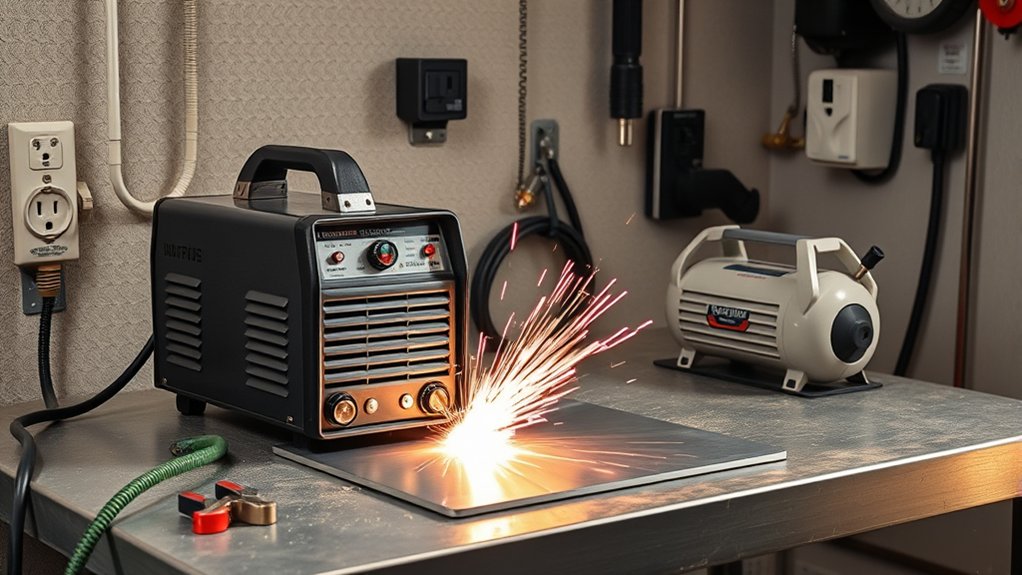
Before you pick a plasma cutter, audit your garage’s power: 120V on standard outlets vs a 240V dedicated circuit.
You’ll see clear cutting performance differences—120V handles light-gauge work, while 240V sustains higher amperage for thicker stock.
Match the circuit capacity and duty cycle to your workload, or choose dual-voltage to balance flexibility with throughput.
Power Availability Constraints
Although both 120V and 240V machines cut metal, your garage’s supply dictates realistic performance and duty cycle. Start by auditing your power source and outlet compatibility.
Most garages offer multiple 120V receptacles on 15–20A breakers—fine for light-duty cutters and short cycles. If you’ve got a 240V receptacle (or can add one), you gain access to higher duty cycles and sustained output without nuisance trips.
Verify breaker size, wire gauge, and circuit loading. High-draw units may require a dedicated 240V/50A circuit to avoid voltage sag and thermal trips.
Dual-voltage machines (e.g., Lotos CUT60D) give you flexibility: run 120V where that’s all you have, then step up to 240V when available. Match the cutter’s nameplate current to your panel capacity, and plan cord length and plug/NEMA configuration before purchase.
Cutting Performance Differences
While both voltages can sever steel, 240V gear changes the cut. On 120V, you’re usually limited to 20–40 amps, so cutting thickness stays in the light-gauge range with slower travel speeds.
Step up to 240V and you’ll see 50–65 amps, faster kerf progression, cleaner edges, and better arc stability—especially on plate approaching 1 inch.
Dual-voltage units like the Lotos Supreme CUT60D let you adapt to what’s on the wall while preserving performance when 240V is available. If your garage only has 120V outlets, expect compromises in speed and section capability.
- Compare 20–40A vs 50–65A output envelopes
- Assess real-world cutting thickness vs travel speed
- Evaluate arc stability and kerf quality on plate
- Leverage dual-voltage for site flexibility
- Match outlet availability to project scope
Circuit and Duty Cycle
Two specs decide if a plasma cutter plays nice with your garage: circuit and duty cycle.
Start with circuit compatibility. A 120V unit plugs into standard receptacles and handles light-gauge steel, but it pulls higher amperage near its limits and caps output. A 240V machine runs more efficiently, delivers higher arc current, and supports thicker cuts—provided your panel has a properly sized 240V breaker and receptacle.
Next, duty cycle considerations. A 60% duty cycle at rated amperage means six minutes on, four off in a 10‑minute window. Higher duty cycle reduces thermal trips and boosts throughput on longer cuts.
Dual‑voltage models (e.g., Lotos CUT60D) add flexibility: run 120V for quick jobs, switch to 240V for heavy work. Match voltage and duty cycle to your material thickness and workflow.
Air Supply: Built-In Compressors Vs External
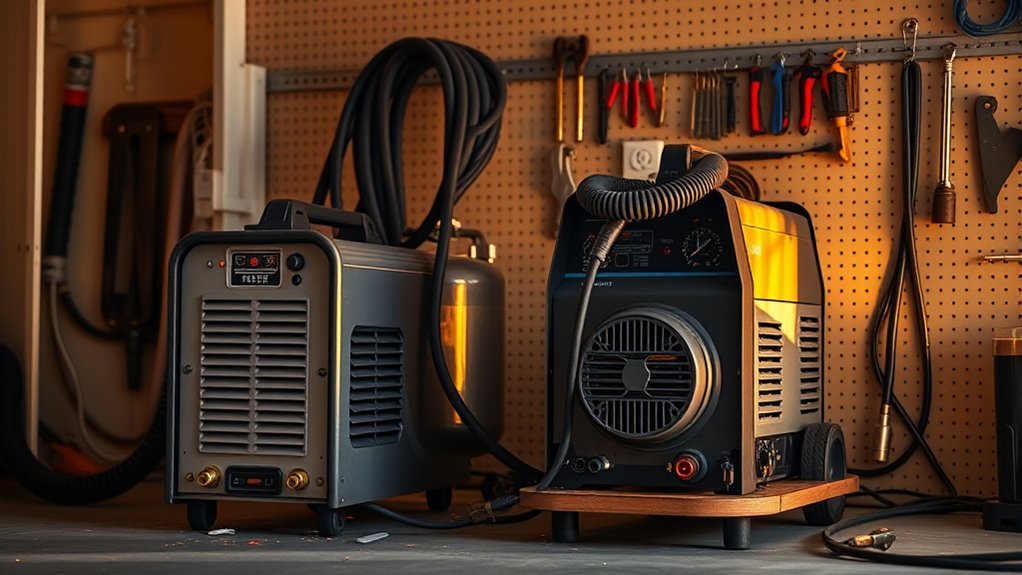
Before you pick a plasma cutter for your garage, decide how you’ll feed it air: an onboard compressor or an external supply.
Built-ins offer built in advantages—single box, fast setup, easy portability. You trade that for lower CFM, shorter sustained arcs, and limited pierce capacity.
External flexibility means pairing the cutter with a shop compressor that can deliver higher CFM at stable PSI, keeping arc quality consistent on thicker stock and longer cuts.
Verify CFM at your target pressure (typically 60–90 PSI) against the torch’s spec. Pre-installed regulators, like on the Lotos Supreme CUT60D, streamline hookup and moisture control.
Match air system to workload: light fab and mobile repairs favor integrated units; production-length cuts and heavy sections favor external air.
- Compare compressor CFM vs torch demand at operating PSI
- Check duty cycle impact from airflow stability
- Use quality filtration: water trap + regulator
- Size hose ID to reduce pressure drop
- Plan for power draw and noise management
Top Budget-Friendly 120V Plasma Cutters
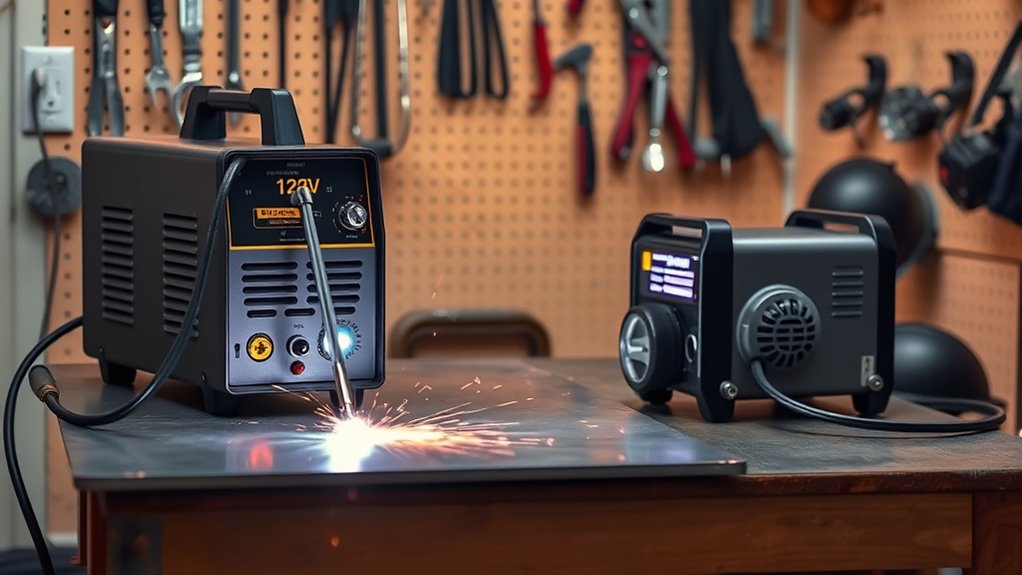
You want under-$500 standouts that actually cut clean on a 120V circuit, not just “dual-voltage” specs.
Prioritize true 120V performance: stable arc at 20–40A, clean 1/4–3/8 in cuts, reasonable duty cycle, and low inrush current for garage breakers.
Must-have features include pilot arc, HF or blowback start compatibility, digital display, drag-cap torch, and simple consumables.
Under-$500 Standouts
Five sub-$500 plasma cutters deliver real value for a 120V shop setup, combining dual-voltage inputs, stable pilot arcs, and usable duty cycles for clean cuts on mild steel.
If you’re doing plasma cutter comparisons across budget options, these standouts hit the sweet spot of amps, arc quality, and portability without wrecking your wallet.
- Lotos Supreme CUT60D: 20–60A range, auto 110/220V, flexible for thin sheet to thicker stock.
- ARCCAPTAIN 55A: non-touch pilot arc, dual-voltage, clean 1/2-inch cuts for DIY and fab tweaks.
- YESWELDER CUT-55DS PRO: 60% at 55A, sustained duty for batch cuts and fixture work.
- Hobart Airforce 40i: 31 lb inverter, rated to 5/8-inch, field-friendly mobility.
- Klutch PFC700: dual-voltage performance tuning, solid arc stability for shop or onsite.
True 120V Performance
Those under-$500 picks set the bar for value; now focus on machines that actually pull their weight on a 120V circuit.
You want steady arc starts, clean kerfs, and realistic duty cycles on household outlets. Dual-voltage units like the Lotos Supreme CUT60D let you run 20–60A, so you can fine-tune cutting techniques across metal types—steel, aluminum, copper—while staying practical on 120V for lighter gauges.
For portability with serious bite, the Hobart Airforce 40i (31 lb) can clean-cut 5/8 in steel and sever 7/8 in, yet still plugs into typical shop power when needed.
On a tight budget, the JEGS Cut 40 (~$200–$270) handles thin stock well at 120V. The PrimeWeld CUT50DP balances price and reliability for infrequent, accurate garage cuts.
Must-Have Features
Essentials first: prioritize dual-voltage capability so a 120V garage circuit handles light-gauge cuts while 240V releases full output when available.
Look for 50–60A class in budget units; models like ARCCAPTAIN 55A and PrimeWeld CUT60 sustain clean 1/2-inch cuts with stable arcs.
Pilot-arc ignition is non-negotiable for rusty, painted, or expanded metal—YESWELDER CUT-55DS PRO shows how it prevents tip sticking and preserves consumables.
Check duty cycle; 60% at 55A (CUT60) keeps production moving without thermal trips.
Favor compact frames (~30 lb) like Lotos Supreme CUT60D for easy bench-to-truck portability.
Don’t skip essential accessories and verify airflow/filtration.
Always cross-check user reviews for real-world reliability.
- Dual voltage (120/240V)
- 55A output, 1/2-inch capacity
- Pilot arc for dirty steel
- 60% duty cycle at 55A
- Lightweight, portable chassis
Midrange Picks for Intermittent Home Use
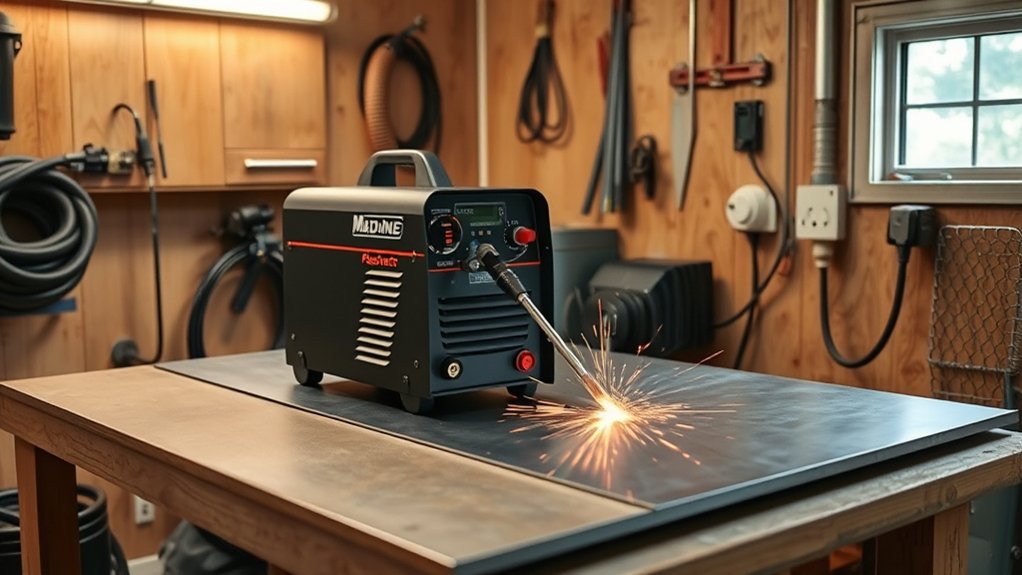
While you don’t need industrial output for weekend projects, midrange plasma cutters deliver the amperage, duty cycle, and portability that fit an intermittent home workflow. For home projects, user reviews consistently flag the Hobart Airforce 40i as a sweet spot: 40 A max, clean severance up to 5/8 in, and stable arc initiation for painted or rusty stock. The Lotos Supreme CUT60D adds value with automatic dual voltage (110/120V and 220/240V) and only 31 lb carry weight, plus a pre-installed air filter regulator for quick setup. If you want headroom, the Hypertherm Powermax 65 pushes 65 A and will slice 1 in steel, ideal when you don’t want to baby feed rates. Budget hawks can lean on the Yeswelder CUT-55DS PRO—dual voltage, high duty cycle, reliable for sporadic garage sessions.
| Use Case | Recommended Pick |
|---|---|
| General DIY up to 5/8 in | Hobart Airforce 40i |
| Portable, plug-flexible | Lotos Supreme CUT60D |
| Heavy occasional cuts | Hypertherm Powermax 65 |
Safety, Ventilation, and Electrical Setup
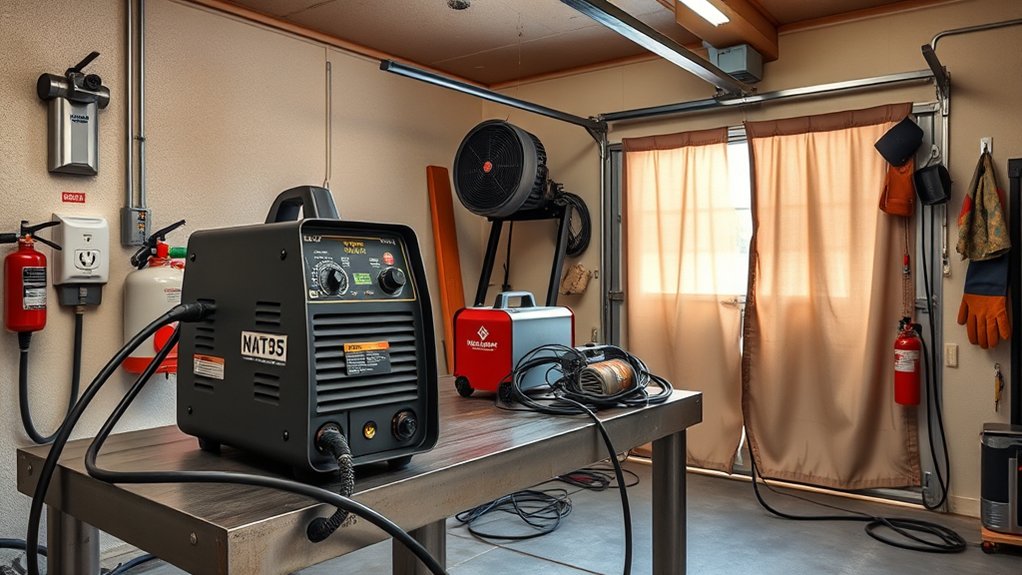
Before you pull the trigger on a cut, set up the space and power like a pro: move air, shield yourself, and size the circuit correctly. Treat safety precautions as non-negotiable.
Plasma cutting spits UV, IR, and fine metal oxide; meet ventilation requirements with crossflow—open opposing windows—or a dedicated exhaust fan pulling fumes away from your breathing zone. Wear a welding helmet with the correct shade, leather gloves, and flame-resistant clothing; no synthetics.
Run the machine on a dedicated circuit. Match the nameplate: most 120V units want a 20A breaker; higher-output or 240V machines often need 30–50A. Use correct wire gauge and a properly rated receptacle; avoid extension cords that cause voltage drop.
Keep your air system dry and clean—compressor, regulator, and filter/dryer—so the arc stays stable and consumables don’t scorch prematurely. Always follow the manufacturer’s operating envelope and duty cycle to prevent nuisance trips and thermal shutdowns.
- Local exhaust or open windows
- PPE: helmet, gloves, FR jacket
- Dedicated 20–50A circuit
- Correct wire gauge/receptacle
- Dry, filtered compressed air
Consumables, Maintenance, and Longevity
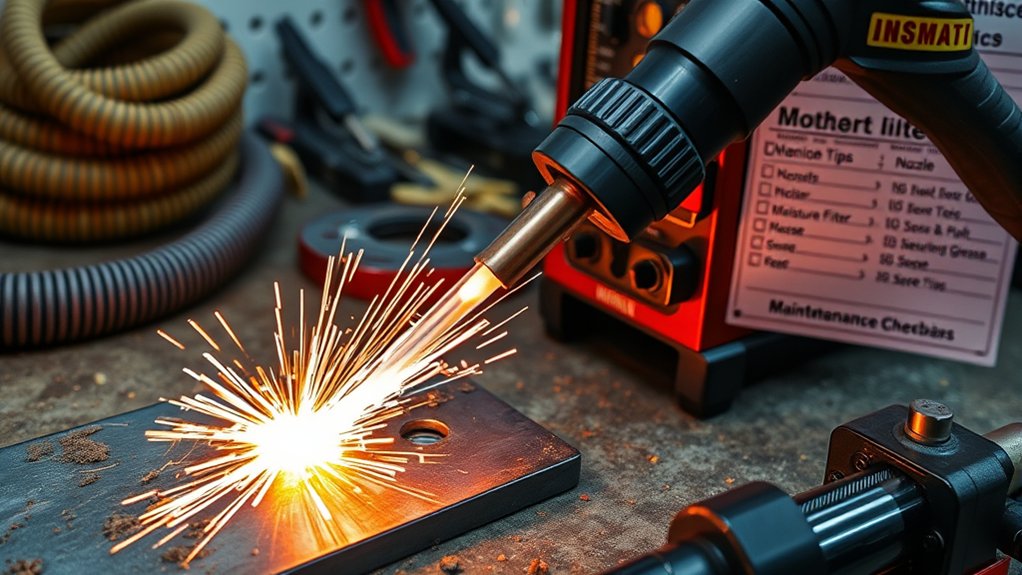
Even with perfect setup, consumables dictate arc stability and cut quality, so you’ll manage electrodes, nozzles, swirl rings, shields, and retaining caps as wear items. Prioritize consumable selection that matches torch model and amperage; cheap off-brand parts drift tolerances and cause double-arcing, bevel, and dross. Replace electrodes when hafnium pits reach spec depth, and swap nozzles once orifice grows or shows keyholing. Maintain rated air pressure and dry, filtered air—wet air erodes tips and destabilizes the plasma column.
Follow the manual’s intervals for torch teardown, O-ring lube, and filter service. Validate duty cycle; if you routinely bump the limit, step up machine class or reduce arc-on time to protect the inverter and torch leads. Use a leak-down test to verify fittings and hoses.
| Task | Maintenance tips |
|---|---|
| Air system | Drain tank, service filters, fix leaks |
| Torch | Inspect orifice, replace pitted parts |
| Operation | Respect duty cycle, verify pressure |
Stock affordable, OEM-compatible spares to sustain cut quality and machine longevity.
Frequently Asked Questions
Can a Plasma Cutter Run off a Portable Generator Safely?
Yes, if you match generator capacity to plasma cutter requirements. Use an inverter generator with clean sine, 120/240V as specified, sufficient surge watts, low THD (<5%), correct breakers, proper grounding, dry cords, and stable airflow.
How Loud Are 120V Plasma Cutters During Operation?
They’re loud: expect 85–100 dB at the torch. Like standing near a shop vac, you’ll shout. You mitigate noise levels with a quieter compressor, water table, and sound insulation; wear NRR 25–33 ear pro, maintain consumables.
Will Plasma Cutting Interfere With Home Wi‑Fi or Electronics?
Yes, you can see Wi‑Fi dropouts and EMI on sensitive devices. Main interference sources: HF start, unfiltered leads, poor grounding. Mitigate with electronic shielding, ferrites, bonded grounds, separated circuits, short torch leads, clean earth, and distance from routers.
What Extension Cord Gauge Is Safe for 120V Cutters?
Use 12‑gauge for runs under 50 ft; step to 10‑gauge beyond. A 50 ft 16‑gauge can drop ~8V at 20A—heat risk. Prioritize extension cord safety, voltage drop, duty cycle, and plasma cutter compatibility with NEMA 5‑15/5‑20.
Can I Cut Painted or Galvanized Steel Without Special Prep?
Yes, but you shouldn’t. You’ll get arc instability, toxic fumes, and dross. Do minimal metal preparation: grind/strip for paint removal at the cut line, wire-wheel galvanizing, ventilate, wear respirator, increase amperage slightly, slow travel, use fine-cut consumables.
Conclusion
You’ve got the specs, duty cycle math, and air requirements dialed. Worried a 120V unit won’t cut it? For thin stock and fab tasks, a 30–40A inverter with pilot arc and clean, dry air will slice consistently with minimal kerf and dross; step to 240V only when you need thicker sections or faster travel speeds. Choose reliable consumables, verify CFM at duty cycle, and wire safely. Do that, and your garage setup runs clean, repeatable, and cost-effective.