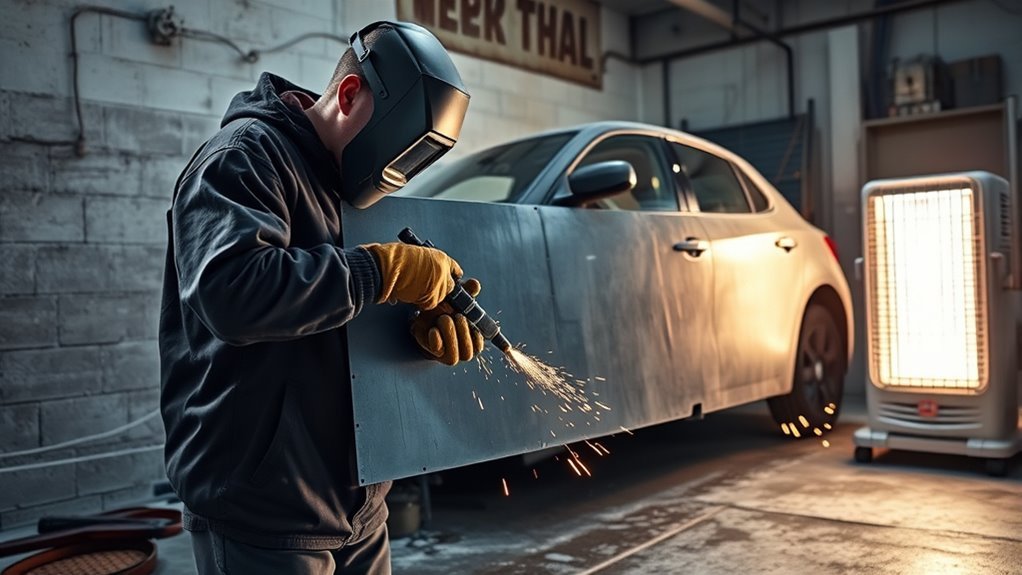
Cold weather can make auto body welding harder because thin vehicle panels lose heat quickly, collect condensation, and distort fast when the weld area is not controlled. You can still get clean results, but you need a dry work area, steady panel temperature, correct welding settings, good ventilation, and slow cooling after the weld.
Quick Answer
For cold-weather auto body welding, dry the panel, remove coatings near the weld, warm the repair area to a stable working temperature, block drafts, and use short, controlled welds. Keep consumables dry, avoid welding over moisture or frost, and let the repair cool slowly before grinding or coating.
Key Takeaways
- Cold panels cool the weld fast, which can increase poor fusion, hard weld edges, cracking risk, and distortion.
- Warm the whole repair zone evenly, not just the exact weld line, and verify the temperature with an infrared thermometer or temperature-indicating crayon.
- Keep panels, wire, rods, gas lines, and clamps dry because moisture raises porosity and hydrogen-related cracking risk.
- Use short stitch welds, skip around the panel, and let each tack cool enough to limit warping on thin sheet metal.
- Follow the vehicle maker’s repair procedure when welding modern high-strength steel, coated panels, structural parts, or safety-related areas.
At a Glance
| Time Required | 30 minutes to 2 hours, depending on panel prep, temperature control, and repair size |
| Difficulty | Intermediate; thin panels are easy to warp or burn through |
| Tools Needed | MIG, TIG, or approved welder; clamps; grinder; wire brush; infrared thermometer or temperature crayon; windbreak; PPE; fire extinguisher; ventilation |
| Cost | Usually low if you own the welder; expect extra cost for shielding gas, wire, abrasives, insulation, and corrosion protection |
Why Cold Weather Makes Auto Body Welding Harder
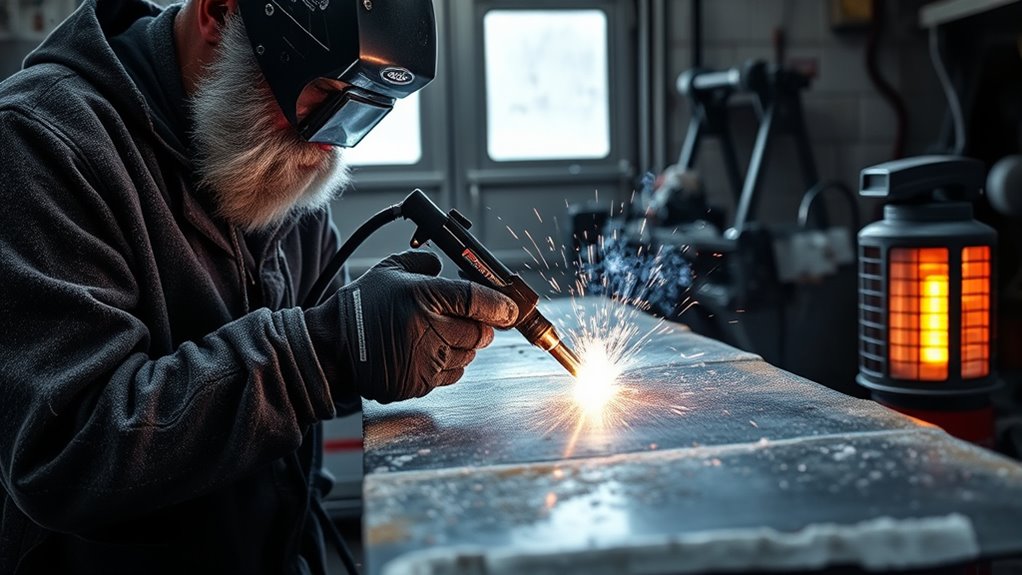
Cold weather makes auto body welding harder because it pulls heat out of the panel faster than warm shop air does. That fast heat loss can leave you with poor fusion, incomplete penetration, brittle weld edges, and a higher chance of cracks.
Cold panels cool the weld faster, so your main job is to control moisture, heat input, wind, and cooling speed.
Thin auto body panels are especially sensitive because they do not hold much heat. If the weld puddle cools before it ties into both edges, the bead can sit on top instead of bonding properly. If you add too much heat to fight the cold, the panel can shrink, oil-can, or warp.
Cold weather also creates moisture problems. A panel that moves from cold air into a warm shop can sweat. That condensation can cause porosity, contamination, and a weaker weld. Snow, frost, wet seam sealer, damp undercoating, and wet abrasives all make the problem worse.
When welding galvanized steel, zinc-coated panels, or areas near factory coatings, cold conditions do not remove the fume hazard. Zinc-bearing coatings still require safe preparation and ventilation. If you need background on coating removal, see this guide on zinc contamination issues.
You need consistent, controlled heat rather than guesswork. That means warming the panel, blocking drafts, using dry consumables, welding in short sections, and letting the repair cool in a controlled way.
Warning: Do not weld on wet, frosted, painted, undercoated, fuel-contaminated, or galvanized metal without proper cleaning, ventilation, PPE, and fire protection. Disconnect or protect nearby batteries, wiring, fuel lines, trim, airbags, insulation, and interior materials before hot work.
Safety Checks Before Cold-Weather Auto Body Welding
Before you think about settings, make the job safe. Cold weather often pushes welding into garages, tents, and tight workspaces, which can trap fumes and make fire risks easier to miss.
- Ventilate the area: Use local exhaust or strong cross ventilation so fumes move away from your breathing zone. Welding fumes can contain metals and gases that are harmful to breathe.
- Control fire hazards: Move paper, rags, solvents, upholstery, cardboard, fuel containers, and dust away from the weld area. Keep a fire extinguisher nearby and check the area after welding.
- Protect yourself: Wear a welding helmet, gloves, jacket, eye protection, hearing protection when grinding, and respiratory protection when the hazard calls for it.
- Dry the electrical setup: Keep the welder, extension cords, ground clamp, gloves, and floor dry. Moisture raises shock risk and can hurt arc stability.
- Follow OEM repair procedures: Modern vehicle structures may use high-strength steel, ultra-high-strength steel, aluminum, adhesives, and coated panels. Do not weld structural areas unless the vehicle maker allows that method.
Note: A windbreak or tarp can help hold heat, but it must not trap fumes, catch sparks, block your exit, or create a fire hazard.
Prep Auto Body Panels for Cold-Weather Welding
Before you strike an arc, bring the repair area to a stable working temperature. For light sheet metal, many welders use about 50°F as a practical baseline, but the correct temperature depends on the material, thickness, filler, process, and repair procedure. Structural parts and high-strength steels may need specific preheat limits or may not allow welding at all.
Warm the auto body panel evenly with a safe heat source such as a heat lamp, electric heating blanket, or carefully controlled torch. Do not overheat one small spot. Aim for a broad, even warm zone around the weld so the panel expands and cools more evenly.
Use an infrared thermometer or temperature-indicating crayon to verify the metal, not just the air. Cold exposure can drop panel temperature fast, so check again before each pass if you are working outdoors or near an open shop door.
Clean the weld area to bright metal where welding is allowed. Remove paint, primer, rust, seam sealer, undercoating, adhesive residue, oil, and dirt from both sides of the joint when possible. Proper metal preparation helps the arc stay stable and lowers the chance of porosity.
Products Worth Considering
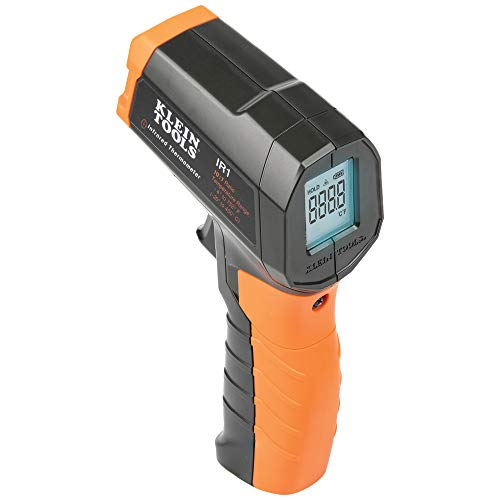
PRECISE TEMPERATURE MEASUREMENT: Optical resolution (distance-to-spot) of 10:1 ensures accurate temperature readings from a distance

【Highly Accurate & Adjusts to Any Surface】Designed with the latest thermopile sensor technology, the infrared laser thermometer gun is accurate to +/-1.5%; Improve this pizza oven thermometer gun measurements by adjusting the emissivity from 0.1–1.0 to match the surface material being measured

【Measures Up to 2732°F – Extreme Heat Ready】: This high-precision infrared thermometer gun measures surface temperatures from -58°F to 2732°F (-50°C to 1500°C), the widest range in its class, perfect for high-temperature applications such as pizza ovens, furnaces, kilns, welding, and forging industrial use. No more switching between multiple tools
Cold-Weather Setup Checklist
Use this checklist before welding a cold panel:
- Confirm the repair method is allowed by the vehicle maker or shop procedure.
- Move the vehicle into a dry, ventilated work area when possible.
- Let cold panels acclimate before welding so condensation can form and be wiped away.
- Remove coatings and contaminants from the weld zone and backside.
- Dry clamps, ground contact points, wire, rods, gloves, and cables.
- Block wind without blocking ventilation.
- Pre-fit the patch or joint tightly so you do not use weld metal to fill large gaps.
- Set up a fire watch if sparks can reach hidden materials.
- Keep insulating blankets ready for controlled cooling after welding.
Pro Tip: If a cold panel starts sweating after you warm the shop, wait until the condensation stops, wipe the metal dry, and recheck the joint before welding. Welding through invisible moisture is a common cause of pinholes and porosity.
Products Worth Considering

【Fiberglass Welding Blanket】 : Made of 24.7 oz/yd² fiberglass fabric, the welding blanket provides excellent thermal protection and withstands up to 1,022℉ (550℃) working temperatures. Effectively protecting welders and property from heat, embers, sparks and spatter. NOTE: There are fiberglass on the surface of the welding blanket, please wear gloves when you check it.

✅【Fire-Resistant Carbon Felt Construction】The Matace welding blanket is made from 5mm thick carbon felt and has been tested in accordance with ASTM D6413 standards. Its dense, heavy-duty structure is designed to help manage sparks, hot slag, and radiant heat during welding and high-temperature work.

🔥FIRE RETARDANT BLANKET: Made of heat resistant carbon fiber with a low thermal conductivity of 0.13 W/(m-K), the fireproof welding blanket can withstand temperatures up to 1800F (982C), provides maximum thermal protection for most welding jobs
Keep Panel Temperature Steady While You Weld
Once the panel is warm and dry, keep that heat from drifting too far during the weld. A hand torch, heat lamp, or electric heating blanket can help, but the goal is steady warmth, not a hot panel. Too much heat can soften coatings, damage nearby parts, or increase distortion.
Block drafts with a pop-up tent, welding screen, or windbreak, but keep enough airflow to control fumes. Check the weld zone often and verify the temperature with a temperature crayon or infrared thermometer.
| Control | Use | Result |
|---|---|---|
| Heat source | Heat lamp, blanket, or careful torch use | Steadier panel temperature |
| Shielding | Tent, welding screen, or windbreak | Less heat loss and better gas coverage |
| Monitoring | IR thermometer or temperature crayons | More consistent heating |
| Cooling control | Insulating blanket after welding | Lower thermal shock |
After you finish a weld section, cover the repair with an insulating blanket if the procedure allows it. Slow cooling helps reduce thermal shock and protects the weld from a sudden cold draft. You still need effective ventilation so fumes do not collect around you.
Use Cold-Weather Welding Settings That Hold Heat
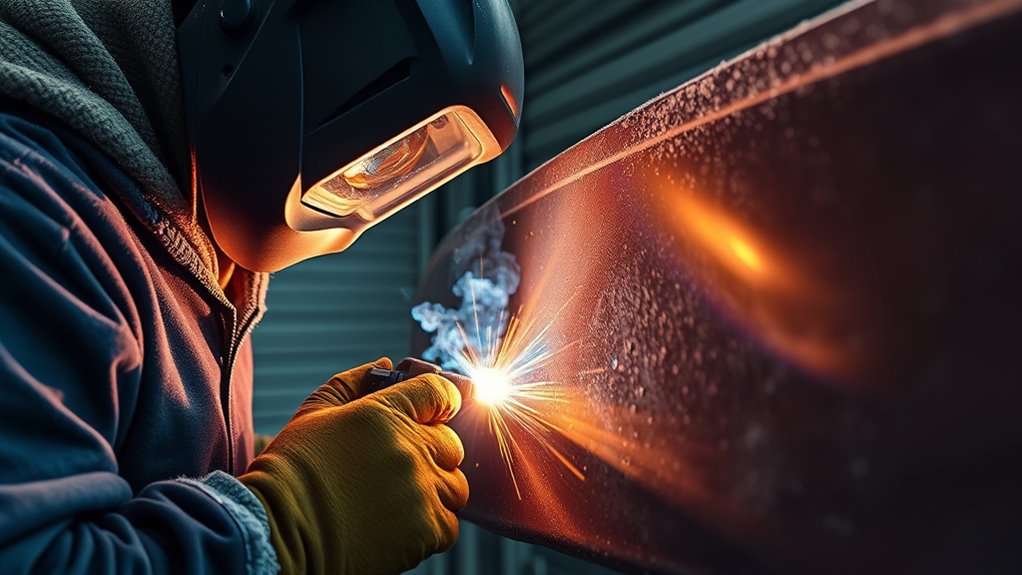
Set your welder for cold conditions by keeping the arc stable, the joint clean, and the travel speed steady. Do not simply crank up amperage to fight the weather. On thin sheet metal, too much heat burns holes and pulls panels out of shape.
- For MIG welding: Use clean solid wire with the correct shielding gas for the job, keep the nozzle clean, use short tack or stitch welds, and protect the gas stream from wind.
- For TIG welding: Keep the tungsten and filler rod clean and dry, use tight fit-up, and add heat carefully because TIG can overheat a thin panel if you dwell too long.
- For stick welding: Use low-hydrogen electrodes such as E7018 only when the material and procedure call for stick welding, and keep rods dry according to the electrode maker’s storage guidance.
- For plug welds: Clean both layers, clamp tightly, and verify penetration without overheating the outer sheet.
- For structural repairs: Follow OEM instructions for weld type, location, sectioning, corrosion protection, and testing.
Use stringer beads where appropriate, keep the arc short and consistent, and avoid wide weaving on thin panels. When you move too fast, the joint cools hard and fusion suffers. When you move too slowly, the panel overheats and warps.
Joint size still matters in cold weather. For fillets and thicker brackets, maximum fillet weld size should match the thinner member and the repair requirement rather than guesswork.
Prevent Warping, Cracking, and Moisture Issues
Cold-weather settings help you control heat, but thin body panels also need good welding sequence. Use short tacks, skip around the repair, and let heat spread out before you add the next weld. Do not run a long continuous bead on a thin exterior panel unless the repair procedure specifically calls for it.
Fit-up is just as important as temperature. Large gaps force you to add more filler metal, which increases heat and shrinkage. Tight, clean joints let you use less heat and produce a flatter repair.
To reduce cracking risk, keep moisture away from the weld zone and use dry consumables. Hydrogen-related cracking is more of a concern with harder steels, thicker parts, restrained joints, and high-strength materials, but moisture is still bad practice on any weld.
After welding, let the panel cool slowly under insulating blankets when practical. Do not blast the weld with compressed air, snow, water, or a cold fan. Sudden cooling can increase stress and make distortion harder to control.
Once the panel is cool, inspect both sides if you can. Look for pinholes, cracks, undercut, cold lap, poor tie-in, burn-through, and missed edges. Then grind only as much as needed and restore corrosion protection on bare metal. Mastering key welding parameters helps you balance heat, speed, voltage, amperage, and travel angle.
Troubleshooting Cold-Weather Weld Defects
| Problem | Likely Cause | Fix |
|---|---|---|
| Poor fusion | Cold panel, fast travel, dirty joint, low heat | Warm the repair zone, clean to bright metal, slow travel slightly, and verify settings on scrap first |
| Porosity | Condensation, wind, poor gas coverage, coating contamination | Dry the panel, block drafts, clean the nozzle, check gas flow, and remove coatings farther from the weld |
| Cracking | Hard cooling, moisture, restrained joint, wrong filler or process | Use the approved filler, keep consumables dry, warm the panel evenly, and slow the cooling rate |
| Burn-through | Too much heat, large gaps, long arc time | Tighten fit-up, lower heat, use shorter tacks, and allow cooling time between welds |
| Warping | Uneven heat, long beads, poor clamping | Clamp better, skip weld, stitch in short sections, and cool gradually |
Frequently Asked Questions
How cold is too cold for auto body welding?
There is no single temperature that applies to every repair. If the panel is wet, frosted, windy, or too cold to hold a stable weld temperature, stop and improve the work area first. For light sheet metal, warming the repair zone to at least about 50°F is a practical starting point, but structural repairs and high-strength steels must follow the OEM or welding procedure.
Is it better to TIG or MIG weld body panels in cold weather?
MIG is usually faster and more common for many steel patch-panel and plug-weld repairs, while TIG gives finer puddle control for careful custom work. In cold weather, either process can fail if the panel is damp, the gas stream is disturbed, or the heat is not controlled. Use the process approved for the repair.
How do you weld in cold weather without cracking?
Dry the panel, clean the joint, warm the repair area evenly, keep consumables dry, use the correct filler, and block drafts. Weld with short, controlled passes and let the area cool slowly. If you are welding high-strength steel or a structural part, follow the approved repair procedure instead of guessing.
Can you weld a car panel outside in winter?
You can weld outside only if the panel is dry, the wind is controlled, the work area is safe, and your shielding gas is protected. Outdoor winter welding becomes risky when snow, frost, wind, poor lighting, or trapped fumes make it hard to control the weld.
What is the most important rule for cold-weather welding?
Control the conditions before you weld. The panel should be dry, clean, warm enough for the procedure, protected from drafts, and safe from fire and fume hazards. A stable setup matters more than trying to fix a cold, wet panel with extra amperage.
Conclusion
Cold weather can make auto body welding feel like trying to strike a match in the wind, but you can still get clean, strong results when you control the work area. Dry the panel, warm the full repair zone, protect the weld from drafts, and use short, steady welds that limit distortion.
Do not treat cold-weather welding as a settings-only problem. Moisture, coatings, fumes, fire hazards, hidden vehicle materials, and OEM repair limits matter just as much as amperage and travel speed. Control the conditions, inspect the finished weld, restore corrosion protection, and your repair has a much better chance of staying solid.
Sources
- OSHA 1910.252 Welding, Cutting, and Brazing — supports ventilation, fire prevention, zinc-coated material, and hot-work safety guidance.
- CDC/NIOSH Welding Fumes and Manganese — supports welding fume exposure, confined-space exposure risk, and respiratory safety concerns.
- ANSI Z49.1 Safety in Welding, Cutting, and Allied Processes — supports general welding safety practices, PPE, fumes, and fire-prevention principles.
- Lincoln Electric: Hydrogen Cracking — supports low-hydrogen practice, moisture control, and preheat concepts for crack-sensitive steel welds.
- Miller: Techniques for Welding Sheet Metal — supports short welds, heat control, and distortion reduction on thin sheet metal.