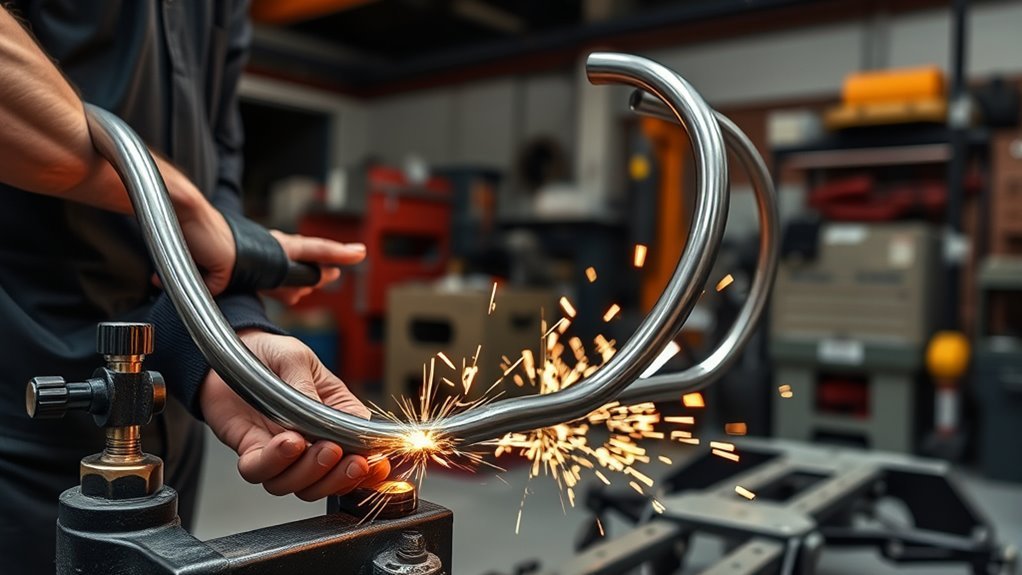
Bending tubing for a roll cage starts before you pull the bender handle. You need the correct rulebook, approved tube material, matched bender tooling, clean layout marks, and a way to check each bend after it comes out of the die. A good bend is smooth, round, repeatable, and placed exactly where the cage layout needs it.
Quick Answer
To bend roll cage tubing, first confirm the current rules for your class, vehicle, tube material, outside diameter, and wall thickness. Use a real tube bender with a die matched to the tube OD, mark tangent points carefully, make a scrap test bend for springback, then inspect every bend for flattening, wrinkles, cracks, and fit.
Key Takeaways
- Treat common tube sizes, such as 1.5-inch OD by .120-inch wall, as examples only until your sanctioning rules confirm them.
- Use a tube bender, not a pipe bender, because the die must match the tube’s actual outside diameter.
- Plan centerline radius, bend angle, bend start, rotation, and springback before cutting the tube to final length.
- Reject bends with kinks, cracks, sharp wrinkles, major flattening, or damage in a required structural member.
- Keep a bend log so the main hoop, harness bar, door bars, and braces can be repeated cleanly.
At a Glance
| Time Required | Several hours for measuring, test bends, and one main hoop; longer for a full cage. |
| Difficulty | Advanced fabrication. Measuring errors and poor bends can ruin expensive tubing. |
| Tools Needed | Rulebook, tube bender, matched die, angle finder, tape measure, marker, square, level, notcher, deburring tools, PPE, and scrap tube for test bends. |
| Cost | Varies by tube material, cage size, die set, notcher, and whether you already own a bender. |
Warning: A roll cage is safety equipment. Do not copy a tube size, bend layout, or mounting design from a generic article and assume it will pass tech or protect the driver. Always verify the current rulebook for your sanctioning body and have the design checked by a qualified cage builder or tech inspector when the build is for competition.
Check the Rules Before You Bend Any Tube
Before you buy tube, check the current rulebook for your exact series, class, vehicle weight, and cage type. The SCCA General Competition Rules are updated during the season, and the FIA Appendix J safety-equipment rules include safety-cage requirements for many international categories.
That rule check tells you what material, outside diameter, wall thickness, main hoop shape, brace layout, mounting plates, welding process, and inspection standard apply. You may see 1.5-inch OD with .120-inch wall used in some builds, but that does not make it legal for every car or every class.
Write the required tube spec on your build sheet before cutting. Include the material, OD, wall thickness, minimum bend radius if listed, and any rule about bends near mounting points or joints. This keeps the project tied to a real requirement instead of a shop guess.
Pick the Right Tube for a Roll Cage
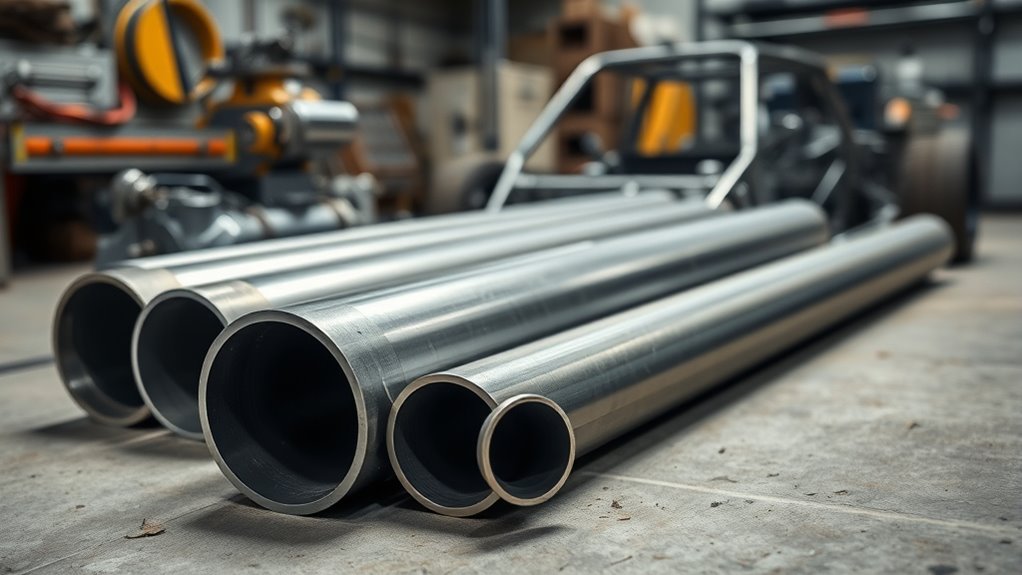
When you choose tubing for a roll cage, start with the material your rules allow. DOM mild steel is common because it bends predictably, welds well, and gives builders a forgiving fabrication window. Chromoly can reduce weight, but it usually demands tighter fit-up, cleaner preparation, and a welding process that matches the rulebook and material spec.
Do not mix “tube” and “pipe” language when choosing material or tooling. Roll cages are built from tubing sized by actual outside diameter and wall thickness. Pipe is often sized by nominal pipe size, so a pipe bender die may not support the tube correctly.
DOM steel is often the easier cage material to bend and fit, while chromoly can save weight but gives you less room for sloppy prep or poor weld control.
Choose tubing that follows the load path. The main hoop, front legs, door bars, harness bar, diagonal, and rear braces should land where the design needs strength, driver clearance, and clean welding access. If you are still comparing materials, review how different metals respond to heat and filler choice in this guide to welding processes for different metals.
Products Worth Considering

Allstar Round DOM Steel Tubing 1-3/4in x .120in x 4ft

Item Package Dimension: 48.19L x 1.19W x 1.19H inches
Allstar Round DOM Steel Tubing 1-3/4in x .120in x 7.5ft
Choose the Right Bender and Die CLR
Use a real tube bender with a die made for your tube’s outside diameter. The die should cradle the tube, support the wall, and bend around a known centerline radius, often shortened to CLR. A pipe bender or loose-fitting die can flatten the outside of the bend, wrinkle the inside, or kink the tube.
A 3x OD centerline radius is a common conservative planning point for many shop bends, but it is not a universal rule. Some rules or cage layouts may require a larger radius, and some tooling may not produce an acceptable bend on a given wall thickness. Check the die manufacturer’s limits and your sanctioning rules before locking in the layout.
For very tight bends, thin-wall tube, or high-appearance work, mandrel support may be needed to control ovality and wrinkling. Many roll cage bends are made without an internal mandrel when the tube, wall thickness, die radius, and rotary-draw bender are matched correctly.
Pro Tip: Make one test bend from the same tube batch before bending cage parts. Measure the actual springback, ovality, and bend location, then record the numbers on the tube or in a build log.
Products Worth Considering

Precision‑Ground Bend Geometry: Ensures accurate 5" radius bends for 1‑5/8" OD round tubing with minimal distortion. Precision‑ground surfaces maintain even pressure, preserving wall thickness and roundness for tubing from 0.090" to 0.134"

Form Bends In Up To 0.120” Wall Tubing

Fitment: for Die 1.50 in. Round Tubing 5 in. Radius Each; WFB2 and WFPB1000
Understand Bend Angles, Offset, and Springback
Accurate bend angles keep the roll cage aligned with the roof, pillars, floor, dash, and driver space. Set each bend carefully and verify it with an angle finder or bending gauge. A small error at the main hoop can become a large fit problem by the time you add door bars and braces.
Plan the bend around three things: the start of bend, the centerline radius, and the tangent point where the bend returns to straight tube. The bend does not begin and end at the same place as your outside marks unless you account for the die and radius.
Springback is the amount the tube relaxes after you release pressure from the bender. Overbending helps, but the exact amount depends on tube material, wall thickness, bend radius, bender style, and bend angle. Instead of assuming 5 to 10 percent every time, test a scrap piece, measure the result, and use that correction for the next bend.
Offset and rotation matter on multi-bend parts. Draw a reference line down the tube before bending so you can keep each bend in the correct plane. If the second bend is rotated even a few degrees off the first, the tube can twist away from the cage layout.
Mark and Measure Tube Bends Accurately
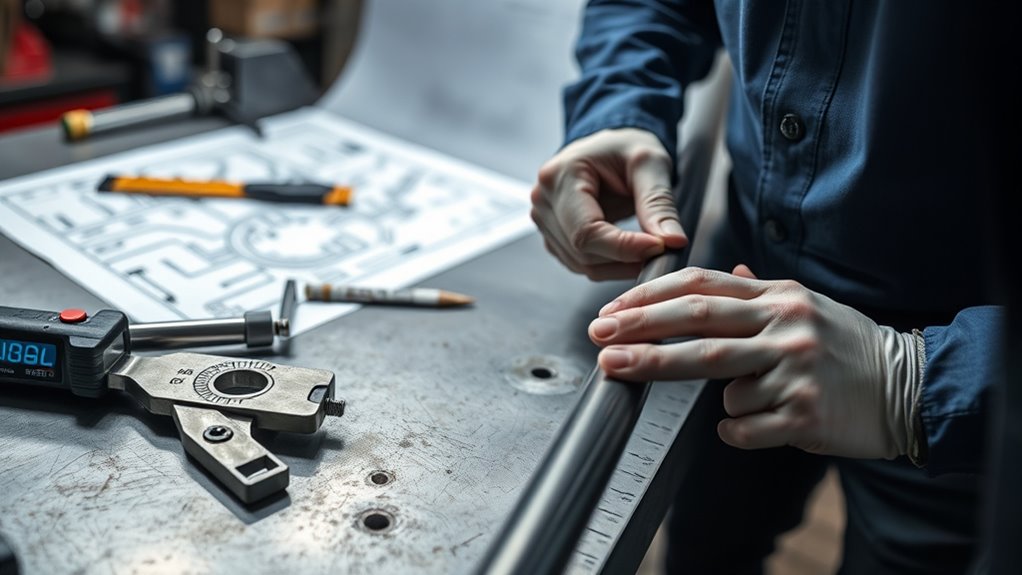
Start every bend by marking the tube’s bend point clearly and lining it up with the die’s reference mark. Use a permanent marker, soapstone, or layout dye that stays visible while you handle the tube. Mark the top reference line too, especially when the part has more than one bend.
- Confirm the tube spec. Check material, OD, wall thickness, and rulebook requirement.
- Cut long for the first bend. Leave extra length until you know how the tube fits in the car.
- Mark the reference line. Run a straight line along the tube to control bend rotation.
- Mark the bend start. Align it with the bender’s reference point, not a random spot on the die.
- Make a test bend. Measure actual springback and adjust your target angle.
- Bend slowly. Keep the tube seated in the die and watch for walking, flattening, or twist.
- Verify immediately. Check angle, plane, centerline, and fit before making the next bend.
Keep each measurement in a bend log. Note the tube length, bend angle, springback correction, die CLR, bender mark, and rotation. That record helps you repeat the main hoop, match left and right bars, and avoid wasting tubing.
If you plasma cut tabs, trim ends, or notch brackets during the same project, use correct cutting setup and air supply for that separate step. Good plasma-cutting air pressure helps cut quality, but it does not prevent tube deformation during bending.
Keep Bends Inside Your Cage Layout
As you lay out a roll cage, keep every bend inside the allowed structure and vehicle clearance. The main hoop should follow the body closely while leaving room for the driver, helmet, seat, belts, padding, and inspection access. The tighter the cabin, the more important your bend order becomes.
| Check | Action | Result |
|---|---|---|
| Bend point | Mark it from a fixed reference | Accurate bend start |
| Bend angle | Measure after springback | Correct final angle |
| Bend plane | Use a tube reference line | No twist between bends |
| Mock-up | Test on the vehicle or a flat layout | Clear fit and safe clearance |
| Documentation | Record each mark and correction | Repeatable cage parts |
Build a scrap-tube mock-up if the shape is complex. You can also bend a shorter sample to confirm bend gain and springback before committing to the full-length tube. Measure from fixed cage points, not flexible interior trim, because small errors compound fast.
After the tube is bent, trim and notch only after you know the bend is usable. If the bar will be welded into a joint, size and place the weld for the actual members being joined. This guide on weld size for the thinner member can help you think through joint fit-up, but your roll-cage rulebook still controls the final requirement.
Inspect Each Bend Before Welding
Do not weld a bent tube into the cage until you inspect it. A smooth-looking bend can still be out of plane, too flat, or damaged at the inner radius.
- Check for kinks. Any sharp crease in a structural cage tube is a reject sign.
- Look for wrinkles. Light surface ripples may appear on some bends, but deep folds or sharp wrinkles weaken the tube.
- Measure flattening. Compare the tube OD before and after the bend. Large ovality means the die, radius, or technique is wrong.
- Check for cracks. Inspect the outer radius, weld seam area, and any heat-affected or scratched spots.
- Verify the plane. Lay the tube on a flat surface or fixture so twist shows up before welding.
- Confirm fit-up. Notched joints should touch cleanly without forcing the tube into place.
Note: Heat should not be used as a shortcut to force a bad bend into shape unless the material, rulebook, and qualified welding procedure allow it. Heating can change material properties and may fail inspection.
Work Safely Around the Bender
A tube bender can create serious pinch and crush hazards. Anchor the bender according to its instructions, keep hands away from the die and follower, and never let a helper stand in the sweep path of the tube or handle.
Wear eye protection when cutting, grinding, deburring, or working around chips and flying particles. OSHA’s eye and face protection standard covers hazards such as flying particles, molten metal, and injurious light radiation. OSHA’s machine-guarding standard also addresses hazards at the point of operation, ingoing nip points, rotating parts, flying chips, and sparks.
Gloves can help with sharp tubing, but keep them clear of pinch points. Avoid loose sleeves, jewelry, hoodie strings, and long hair near the bender. Use hearing protection when cutting or grinding, and switch to welding PPE when the project moves from bending to assembly. If you have arc-start trouble before assembly, fix the process first rather than forcing poor tack welds; this guide on stick welder electrode issues explains common arc problems.
Troubleshoot Common Tube Bending Problems
| Problem | Likely Cause | Fix |
|---|---|---|
| Bend lands short or long | Wrong reference mark or no bend allowance | Make a test bend, record tangent points, and adjust the start mark. |
| Tube flattens | Wrong die, tight CLR, thin wall, or poor support | Use matched tooling, a larger CLR, or better support. |
| Inside wrinkles | Compression on inside radius is too high | Increase bend radius, check lubrication, or use mandrel support when appropriate. |
| Second bend twists | Rotation line was missing or misread | Mark a full-length reference line and verify the tube plane before bending. |
| Springback changes | Different material batch, wall thickness, or bend angle | Test the same tube batch and log correction by angle. |
If a bent structural tube looks questionable, do not hide it with grinding, filler, paint, or padding. Replace the tube. The cost of a new stick of tubing is small compared with a failed tech inspection or a cage that does not perform in a crash.
Welding is a separate step from bending, but it affects the finished cage just as much. Match the welding process to the tube material and rules. If you are using flux-core equipment for other fabrication tasks, review flux-core welding techniques, but do not assume that every roll-cage rule set allows every welding process.
Frequently Asked Questions
How do I prevent tube collapse during tight bends?
Use the correct die for the tube OD, avoid a bend radius that is too tight for the tube and wall thickness, keep the tube seated in the die, and make a scrap test bend first. For very tight or thin-wall bends, use a larger centerline radius or mandrel support if your tooling allows it.
What lubricant should I use for bending DOM tubing?
Use the lubricant recommended by your bender or die manufacturer. Many builders use a high-pressure, non-chlorinated bending lubricant or drawing compound on contact areas to reduce galling and die marks. Keep lubricant away from areas that will be welded until the tube is cleaned properly.
How often should I inspect bending dies for wear?
Inspect dies before each job and whenever bend quality changes. Look for grooves, burrs, rough spots, loose pins, worn followers, or damage that can mark or flatten the tube. Clean the die before bending and replace worn parts before they ruin cage tubing.
Can I reuse tube sections with minor bend imperfections?
You can reuse a section only if it passes a strict inspection and is not part of a required structural cage member. Do not reuse tubing with kinks, cracks, sharp wrinkles, deep die damage, or major flattening. When in doubt, cut a new piece.
What safety gear is essential when operating a tube bender?
Wear safety glasses, sturdy footwear, close-fitting clothing, and gloves when handling sharp tube ends. Use hearing protection when cutting or grinding. Keep hands out of pinch zones, anchor the bender securely, and keep helpers away from the handle and tube sweep path.
Can I use a pipe bender for roll cage tubing?
No, not for structural roll cage work. Pipe benders are made around nominal pipe sizes, while roll cage tubing is sized by actual outside diameter. A mismatched pipe die can kink, flatten, or damage the tube.
Should I heat roll cage tubing before bending it?
Do not heat roll cage tubing as a shortcut unless the material, rulebook, and qualified procedure allow it. Heat can change material properties and may make the part fail inspection. Use proper cold-bending tooling and reject bad bends instead of trying to rescue them with heat.
Conclusion
Bending tubing for a roll cage is about accuracy, rules, and discipline. Start with the current rulebook, choose approved tubing, use a tube bender with the correct die, and test for springback before bending the real part. Mark cleanly, check every bend, keep the tube inside the cage layout, and reject damaged sections. When the bend is right, the rest of the cage fits better, welds cleaner, and stands a better chance of passing inspection.
Sources
- Sports Car Club of America, Cars and Rules — current SCCA General Competition Rules and rulebook update context.
- Federation Internationale de l’Automobile, Regulations — FIA Appendix J safety-equipment and safety-cage regulation references.
- OSHA 1910.212, General Requirements for All Machines — machine guarding, point-of-operation hazards, nip points, flying chips, sparks, and anchoring fixed machinery.
- OSHA 1910.133, Eye and Face Protection — eye and face protection for flying particles, molten metal, and injurious light radiation.
- Schema.org HowTo — structured data type used for step-based how-to instructions.