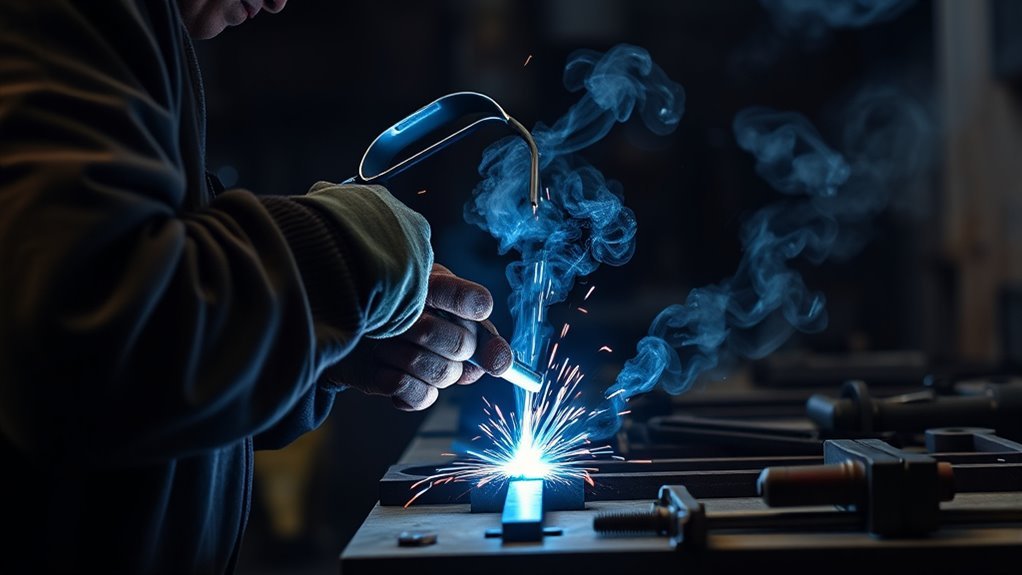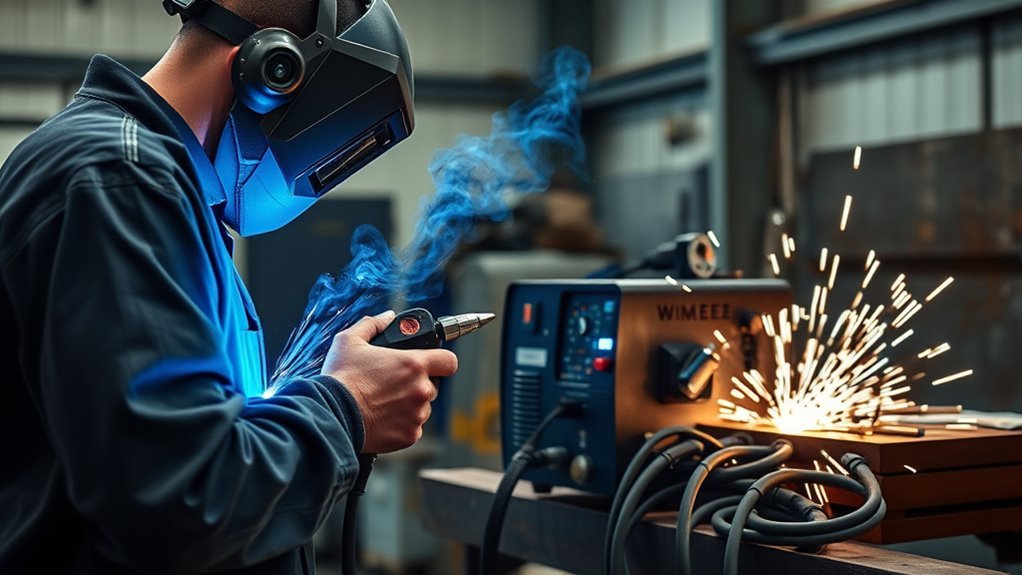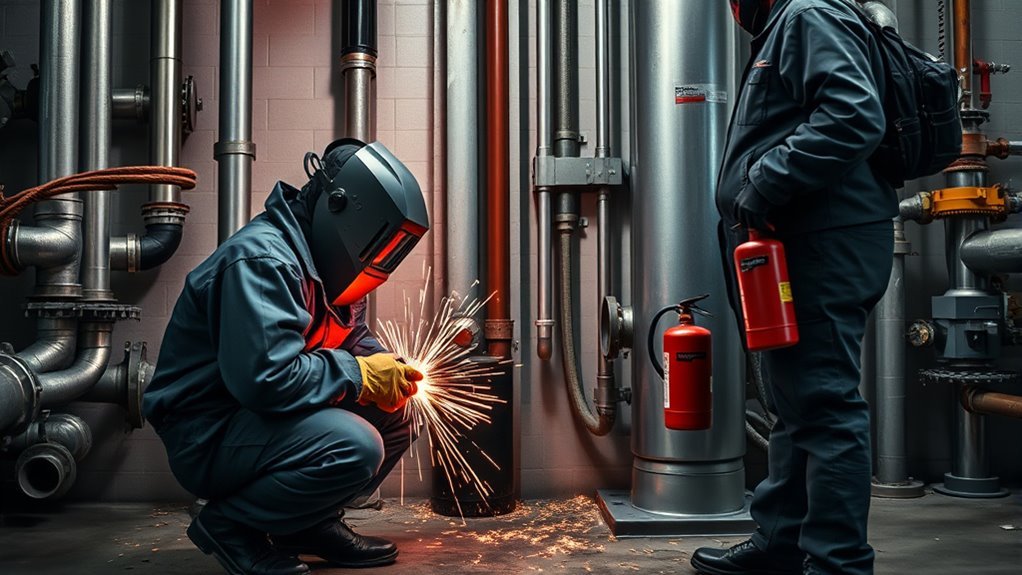
Welding near fuel lines is a high-risk hot-work job because gasoline vapor, diesel mist, plastic tanks, rubber hoses, wiring, undercoating, and old shop debris can all turn a small repair into a fire. Treat the fuel system as live until you have removed, drained, disconnected, ventilated, tested, shielded, and inspected it. If you cannot prove the area is safe, do not weld there.
Quick Answer
You should not weld near fuel lines unless the fuel system is depressurized, drained, disconnected, ventilated, checked for vapors, and shielded from heat and sparks. Draining the tank alone is not enough. When possible, remove the tank or move the weld area away from fuel parts.
Key Takeaways
- Do not trust an “empty” tank. Gasoline vapors can remain flammable even when liquid fuel is gone.
- Remove the fuel tank or relocate the work whenever practical. Shielding is the backup, not the first choice.
- Depressurize the fuel system, disconnect fuel lines, cap open ends, ventilate the area, and test for vapors before welding.
- Keep a Class B-rated extinguisher nearby and assign a fire watch for the full job and at least 30 minutes after welding.
- Stop immediately if you smell fuel, see wet fittings, find damaged plastic lines, or cannot keep sparks away from the fuel system.
At a Glance
| Time Required | 30 minutes to several hours, depending on tank access, line routing, cleaning, shielding, and post-weld inspection |
| Difficulty | Advanced; hire a qualified repair shop if the tank or lines cannot be removed or isolated |
| Tools Needed | Vehicle service manual, line disconnect tools, drain pan, caps or plugs, non-sparking cleanup tools, combustible gas meter, welding blankets, steel shields, PPE, and Class B-rated extinguisher |
| Cost | Low if you already own safety gear; much higher if tank removal, line replacement, vapor testing, or professional repair is needed |
Warning: Never weld on a fuel tank, fuel line, or sealed fuel container just because it has been drained. Used tanks and lines can hold flammable vapor. If hot work may heat the tank or line directly, the part must be removed or professionally cleaned, vented, gas-tested, and prepared.
Can You Weld Near a Fuel Tank Safely?
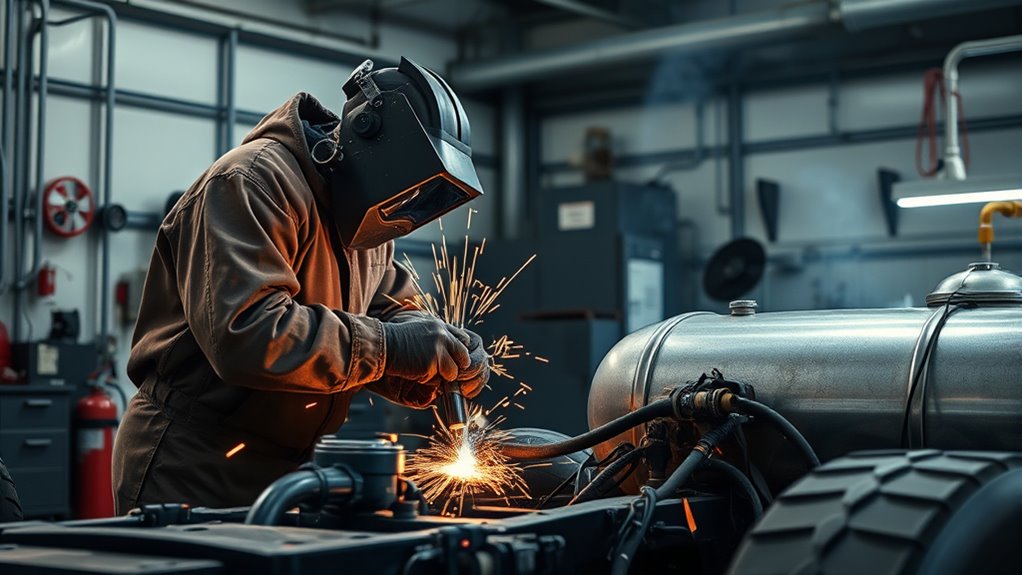
You can weld near a fuel tank only when the fuel hazard has been removed or controlled. The safest move is to remove the tank or move the work away from the tank. If that is not practical, the tank, fuel lines, vapor lines, wiring, plastic clips, undercoating, and nearby trim must be protected from heat, sparks, and slag.
Gasoline is especially dangerous because its vapor can ignite at very low temperatures. The NOAA CAMEO gasoline datasheet warns that gasoline vapors may travel to an ignition source and flash back. The NIOSH Pocket Guide for gasoline lists gasoline as a Class IB flammable liquid with a flash point below 73°F.
OSHA’s hot-work rule also gives a clear safety principle: move fire hazards away when you can, guard them when you cannot, and do not weld if those controls cannot be met. That is the standard to follow when welding near fuel lines, fuel tanks, or fuel vapors.
Keep a charged ABC or BC extinguisher rated for Class B flammable-liquid fires within reach. Do not count on a solid water stream for gasoline. For small gasoline fires, emergency guidance commonly points to dry chemical, CO2, water spray, or foam, and warns against aiming straight or solid water streams directly onto the fuel.
Always ensure proper ventilation in the work area, especially under a vehicle, in a small garage, or near a tank cavity where vapor can collect.
Move the Job or Remove the Fuel Tank First
Before you pick up the torch or stinger, decide whether the job can be moved away from the fuel system. If the repair is on a loose bracket, exhaust hanger, patch panel, or removable part, take it off the vehicle and weld it on a bench. That one choice removes most of the fire risk.
If the weld must happen on the vehicle, check whether the fuel tank, filler neck, vapor canister, plastic lines, rubber hoses, and nearby wiring can be removed or moved out of the heat zone. Do not assume a metal shield will protect everything. Radiant heat can soften plastic fuel tanks, damage nylon lines, melt clips, and cook seals even when sparks never touch them.
Note: Follow the vehicle service manual before disconnecting fuel parts. Modern fuel systems may include pressurized rails, EVAP lines, plastic quick-connect fittings, electrical connectors, and tank-mounted pumps that are easy to damage.
Do not weld if the fuel tank is plastic and close enough to soften, if fuel lines cannot be moved or shielded, or if you do not know where the lines run behind the panel. Hidden fuel routing is a stop sign, not a guessing game.
Drain, Depressurize, and Prep the Vehicle
Draining fuel is only one part of the prep. You also need to relieve pressure, disconnect the right lines, control vapors, and remove ignition sources. Start by shutting the vehicle down, letting hot parts cool, and disconnecting the battery according to the service manual. Then relieve fuel pressure before opening any fuel line.
Drain the tank only into an approved fuel container and only in a ventilated area away from sparks, heaters, pilot lights, grinders, and extension-cord arcs. Running the vehicle out of gas is not a safe substitute for proper draining and isolation. Fuel can remain in the pump module, filter, rail, vapor lines, hose bends, and low spots.
An empty-looking fuel system is not automatically safe. Treat every line, tank seam, and vapor hose as hazardous until it is drained, opened, ventilated, and checked.
Disconnect fuel lines at safe separation points, cap or plug open ends, and move the line ends away from the weld area. If the line cannot be moved, protect it with a rigid steel shield and a rated welding blanket. Do not aim heat toward capped fuel lines, plastic lines, fuel filters, or the tank flange.
- Read the service manual for fuel pressure relief and line-disconnect steps.
- Disconnect the battery and remove ignition sources from the area.
- Drain fuel into an approved container, then remove that container from the shop area.
- Disconnect, cap, or blank fuel lines so fuel and vapor cannot migrate toward the weld zone.
- Ventilate the area and use a combustible gas meter when vapor may be present.
- Clean fuel residue with safe, non-sparking methods and remove contaminated rags immediately.
Letting fuel “evaporate” is not a safety test. Odor can warn you of danger, but a lack of odor does not prove the area is safe. If there is any chance vapor is present, use a combustible gas meter or stop and have the work handled by a qualified shop.
Additionally, ensure that any zinc residues, coatings, seam sealers, and underbody contaminants are removed from the weld area before you strike an arc. Coatings can create toxic fumes and can also hide fuel seepage or old damage.
Products Worth Considering

Made of Flame Retardant Fiberglass

Fireproof felt is made of flame retardant fabric material, won't melt or burn up to 1800°F(1000℃), used on anywhere fire protection needed, Toss it on the ground, place it on a table or tack it to a wall and marvel at its metal-like resistance to flames, sparks and intense heat.

✅【Fire-Resistant Carbon Felt Construction】The Matace welding blanket is made from 5mm thick carbon felt and has been tested in accordance with ASTM D6413 standards. Its dense, heavy-duty structure is designed to help manage sparks, hot slag, and radiant heat during welding and high-temperature work.
Shield the Tank, Lines, and Heat Sources
Once the fuel system is disconnected, dry, ventilated, and checked, cover the tank, fuel lines, brake lines, wiring, rubber boots, plastic clips, and nearby heat-sensitive surfaces with rated welding blankets or steel heat shields. Shield farther than the immediate weld bead because sparks and slag bounce, roll, and fall into gaps.
When welding or cutting near fuel plumbing, you must shield every exposed line, rail fitting, bracket, pump connector, vapor hose, and filler-neck area that could absorb heat. Position the blankets tightly, leave no open path for sparks, and secure shields so vibration, torch movement, or body position cannot shift them.
Clear the area of rags, solvents, aerosol cans, plastic trim, sound deadener, seam sealer scraps, cardboard, paper towels, and any other flammable material. OSHA’s welding, cutting, and brazing rule uses a 35-foot hot-work zone for combustible material concerns, so inspect beyond the exact weld point.
Ensure proper ventilation to manage toxic fumes that may arise during the welding process. This matters even more when you are working under a vehicle, where fuel vapor and welding fumes can collect in low spaces.
Pro Tip: Use a rigid steel shield closest to the fuel component and a welding blanket outside it. The steel blocks direct sparks and radiant heat, while the blanket catches stray slag and protects surrounding parts.
Do not use old towels, moving blankets, cardboard, thin aluminum foil, or wet rags as your main protection. They can burn, steam, sag, or leave gaps. A shield that moves during the weld is not a shield.
Products Worth Considering

🔥FIRE RETARDANT BLANKET: Made of heat resistant carbon fiber with a low thermal conductivity of 0.13 W/(m-K), the fireproof welding blanket can withstand temperatures up to 1800F (982C), provides maximum thermal protection for most welding jobs

Extreme Heat Resistance (3000°F+) – Carbon Fiber Welding Blanket Made of high-density carbon felt welding blanket, our fireproof welding blanket certified to ASTM D6413 and UL94-V0, withstands extreme temperatures over 3000°F — Outperforms standard fiberglass welding blankets (1000°F limit)Much more effective at stopping spatter than fiberglass offerings, and doesn't shed glass fibers!

✅【Fire-Resistant Carbon Felt Construction】The Matace welding blanket is made from 5mm thick carbon felt and has been tested in accordance with ASTM D6413 standards. Its dense, heavy-duty structure is designed to help manage sparks, hot slag, and radiant heat during welding and high-temperature work.
Weld Safely and Keep a Fire Watch
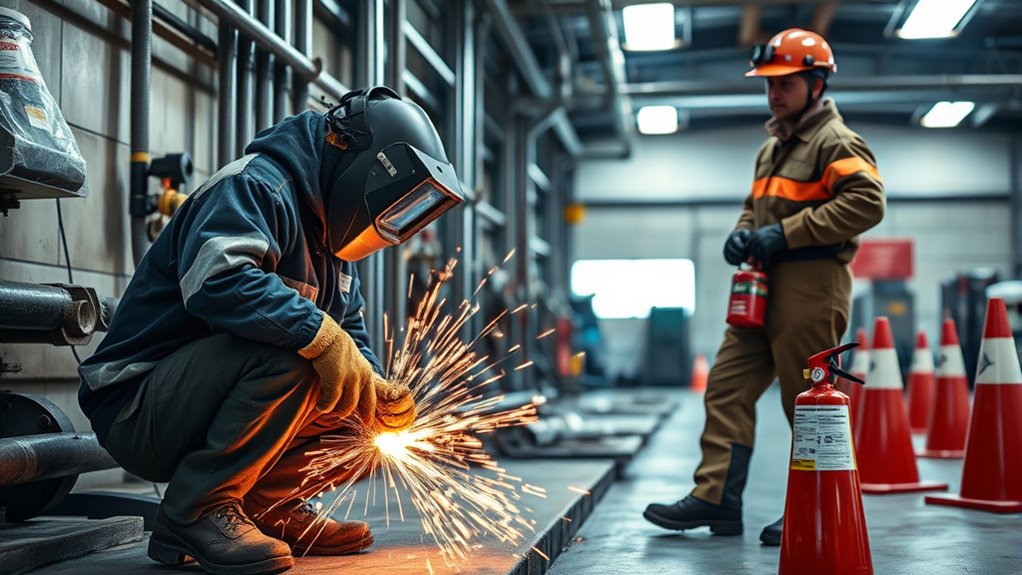
With the tank and lines isolated and shielded, weld only after you have cleared the hot-work zone and confirmed there is no fuel odor, wet fitting, vapor concern, loose debris, or exposed plastic line. Keep the arc, torch, grinder sparks, and hot slag pointed away from the fuel system whenever possible.
Assign a fire watch before you start. That person should have a clear view of the weld area, the floor, the opposite side of the panel, and the 35-foot zone where sparks could land. The fire watch must not be the person welding. Their job is to look for smoke, hidden ignition, dripping slag, and heat transfer.
Keep welding deliberate: shield exposed surfaces, and place a fire watch where they can monitor sparks, slag, heat transfer, and flare-ups.
Keep the extinguisher in reach, verify the nearest fire exit, and make sure the fire watch knows when to stop the job. It’s crucial to monitor for toxic fumes that may arise during the process.
- Monitor the weld area continuously while welding.
- Watch both sides of the panel when heat can transfer through metal.
- Pause often to check shields, blankets, fuel lines, wiring, and undercoating.
- Keep a Class B-rated extinguisher ready for flammable-liquid hazards.
- Continue the fire watch for at least 30 minutes after the final weld or cut.
Skip welding can help reduce heat input, but it does not make fuel hazards safe. Use short welds, allow cooling time, and keep checking nearby components with care. If any shield gets hot enough to smoke, melt, or transfer heat to a fuel part, stop and let the area cool.
Inspect for Leaks and Heat Damage
Run a full leak and heat-damage check before and after welding. Before welding, sniff around the tank and fuel lines for gas vapor, then inspect the entire fuel system for wear, corrosion, prior damage, damp fittings, soft hose, loose clamps, and rubbed-through sections.
You need to inspect for leaks with discipline because residual vapors can ignite fast. Work methodically along every hose, fitting, clamp, quick-connect, seam, vapor line, rail connection, filter, and pump area. Do not treat odor, staining, wetness, blistering, or soft plastic as minor.
After welding, let the area cool, then check again. Look for melted clips, heat-marked hoses, hardened rubber, softened nylon line, blistered undercoating, damaged wire loom, scorched tank straps, loose fittings, and new seepage. If anything looks overheated, replace it before the vehicle is refueled or started.
Use a welding blanket or heat shield to block sparks and radiant heat from the fuel system throughout the job. Additionally, ensure that your protective clothing includes flame-resistant clothing, as it provides essential protection against sparks, slag, and brief heat exposure during welding.
Safe Restart After Welding Near Fuel Lines
Do not refill the tank or cycle the key until the weld area has cooled and every fuel connection has been checked. Reconnect fuel lines according to the service manual, confirm clips are locked, and keep the work area ventilated. Then prime the system as directed by the vehicle manufacturer while watching for leaks.
If the vehicle uses an electric fuel pump, have one person cycle the key while another watches the repaired area, fuel rail, tank fittings, and disconnected-line points. Stop immediately if you smell fuel or see wetness. Wipe nothing while the pump is running; shut the system down first.
- Let the metal and shields cool fully.
- Remove blankets and inspect underneath them for smoldering or melted parts.
- Reconnect fuel lines and electrical connectors correctly.
- Add only enough fuel to test safely.
- Prime the system and inspect for leaks before starting the engine.
- Start the engine only after the fuel system stays dry under pressure.
Stop-Work Signs
Some conditions mean the job should stop immediately. Do not weld near fuel lines if you cannot keep sparks away from the fuel system, if you cannot confirm line routing, or if the tank is too close to the weld area to protect from radiant heat.
- You smell gasoline, diesel, solvent, or unknown vapor.
- A fuel fitting, hose, tank seam, filter, or rail connection is wet.
- The fuel tank cannot be removed and cannot be shielded safely.
- You do not have a working Class B-rated extinguisher nearby.
- No one is available to serve as a fire watch.
- You are working in a tight space without enough ventilation.
- You cannot test for vapors where vapor may be present.
- Plastic fuel lines, EVAP lines, or wiring are hidden behind the weld area.
If one of these signs appears, stop and change the plan. Move the part, remove the tank, replace the line, or send the job to a shop equipped for hot work around fuel systems.
Common Mistakes to Avoid
The biggest mistake is treating fuel as the only hazard. Fuel vapor, plastic tanks, rubber hoses, insulation, paint, seam sealer, wiring, and old undercoating can all ignite or fail from welding heat.
- Trusting an empty tank: Empty tanks can still hold flammable vapor.
- Skipping fuel pressure relief: Pressurized fuel can spray when a line is opened.
- Using rags as shields: Rags can ignite, especially if they have absorbed fuel or solvent.
- Forgetting the opposite side: Heat can travel through sheet metal and ignite hidden material.
- Leaving fuel containers nearby: Drained fuel should be moved far from the hot-work area.
- Stopping the fire watch too soon: Smoldering trim, insulation, or undercoating can show up after the weld looks finished.
Frequently Asked Questions
Can you weld near a fuel tank?
You should avoid welding near a fuel tank whenever possible. If the weld must be done on the vehicle, remove the tank or isolate it from the weld area, clear the hot-work zone, shield nearby parts, ventilate, check for vapor, stage a Class B-rated extinguisher, and keep a fire watch in place.
Is it safe to weld after draining the fuel tank?
Not by itself. Draining removes liquid fuel, but vapors can remain in the tank, lines, pump module, filler neck, and low spots. The system still needs pressure relief, disconnection, ventilation, vapor checking, shielding, and a fire watch. If the tank itself may be heated, remove it or have it professionally prepared.
What is the skip welding technique?
Skip welding means welding short, separated sections instead of running one long bead. It lets each area cool before the next pass, which helps control distortion and heat input. It can reduce heat near fuel lines, but it does not replace fuel removal, shielding, vapor checks, or a fire watch.
What are 5 welding safety precautions near fuel lines?
Five key precautions are: remove or relocate fuel parts when practical, depressurize and disconnect the fuel system, ventilate and test for vapors when needed, shield lines and the tank with steel shields or rated welding blankets, and keep a Class B-rated extinguisher plus a fire watch on duty.
What fire extinguisher should you use for fuel-line welding work?
Use a charged extinguisher rated for Class B flammable-liquid fires. A multipurpose ABC extinguisher is common in garages, while BC units are also used for flammable liquids and electrical hazards. Make sure the fire watch knows how to use it before welding starts.
What is the golden rule in welding near fuel systems?
The golden rule is to remove the fuel hazard before creating heat. If you cannot remove it, you must isolate, shield, ventilate, test, and monitor it. If you cannot do those steps with confidence, do not weld.
Conclusion
Welding near fuel lines is not the time to improvise. Move the job away from the vehicle when you can, remove the fuel tank when practical, depressurize and disconnect fuel lines, ventilate the area, shield every vulnerable part, and keep a trained fire watch in place until the risk is gone. Then inspect for leaks, heat damage, loose fittings, and hidden smoldering before you restart the vehicle. When fuel and flame are close together, caution is not optional; it is the job.
Sources
- OSHA 1910.252: Welding, Cutting, and Brazing General Requirements — backs hot-work fire prevention, 35-foot combustible-zone guidance, fire watch, container cleaning, and ventilation rules.
- NOAA CAMEO Chemicals: Gasoline — backs gasoline vapor flashback risk, flammability hazards, and emergency response guidance for gasoline fires.
- CDC/NIOSH Pocket Guide: Gasoline — backs gasoline flash point, explosive limits, exposure routes, and personal protection guidance.