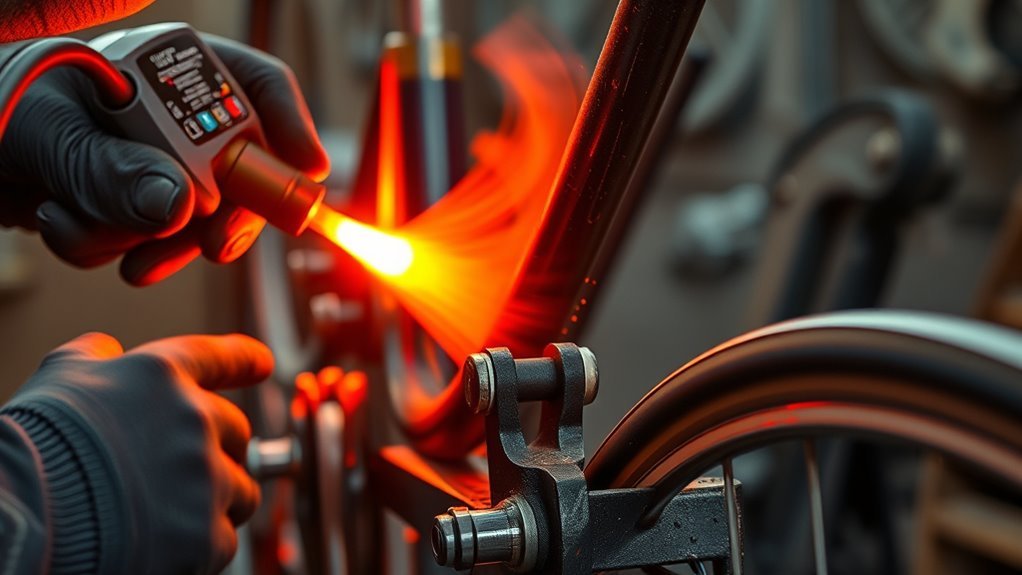
Heat straightening can help correct some bent vehicle frame rails and structural body parts, but it is not safe or permitted on every vehicle. The decision depends on the exact year, make, model, body style, material, damage location, and current OEM repair procedure. Applying heat without those checks can weaken the structure or change how it performs in another collision.
Quick Answer
Heat straightening is safe only when the current OEM body repair procedure permits it for the exact structural part and material. A qualified technician must control the heat, monitor temperature with an approved method, prevent heat transfer, measure the structure throughout the repair, and replace the part when the manufacturer requires it.
Key Takeaways
- Record the VIN, model year, body style, and powertrain before looking up the current OEM body repair procedure.
- Never choose a heat limit by metal color, shop habit, steel thickness, or a temperature used on another vehicle.
- Mild steel and some higher-strength steels may have limited repair options, but the OEM material matrix controls the decision.
- Kinks, tears, crush zones, safety-related mounts, intrusion beams, and restricted steels often require replacement.
- Infrared thermometers can misread shiny or bare metal, so use the temperature method required by the repair procedure.
- Restore corrosion protection and complete all required measurements, scans, calibrations, alignment checks, and documentation.
At a Glance
| Time Required | Varies by damage analysis, OEM research, measuring, setup, pulling, replacement work, corrosion protection, scanning, calibration, alignment, and final inspection. |
| Difficulty | Advanced professional collision repair. This is not a driveway or general fabrication procedure. |
| Tools Needed | Current OEM repair information, approved anchoring and measuring equipment, approved heating equipment, suitable temperature indicators, scan equipment, PPE, fire protection, and specified corrosion products. |
| Cost | Shop-dependent. Cost rises with structural damage, restricted materials, replacement parts, disassembly, refinishing, scans, calibrations, and suspension or wheel-alignment work. |
Warning: Do not heat a vehicle structure simply because the metal is bent. Stop if the OEM procedure cannot be found, the material cannot be identified, the part is replace-only, or the damage involves a kink, tear, crack, crush zone, safety-related mount, intrusion beam, bumper reinforcement, or prohibited heat area.
Note: This article explains professional repair planning. It does not replace the current vehicle-specific body repair manual, position statements, equipment instructions, technician training, or shop safety procedures.
What Is Heat Straightening on a Frame?
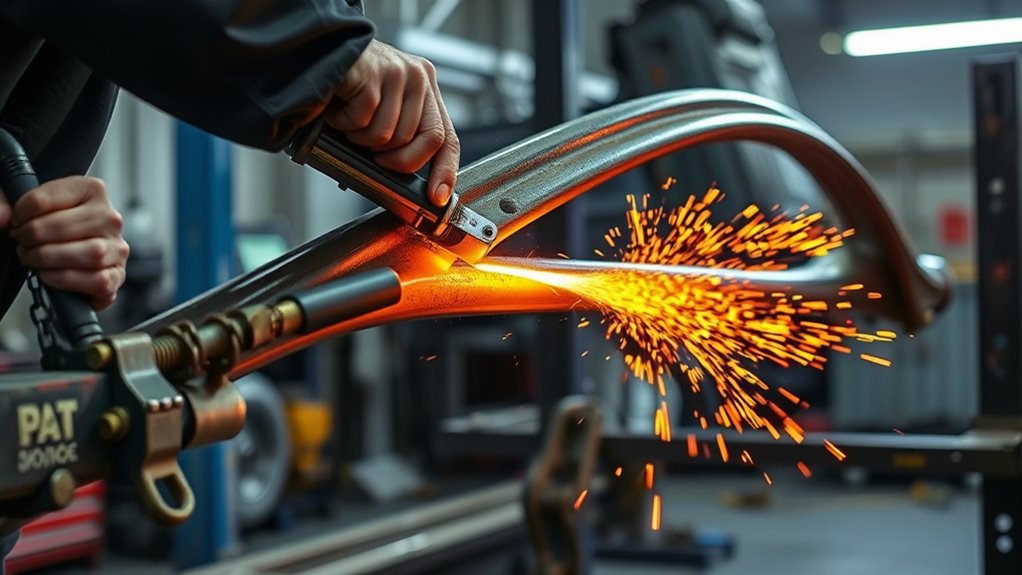
Heat straightening is a controlled structural repair method that may combine localized heat, measured pulling force, and repeated dimension checks. Heat is used only when the vehicle maker allows it for the exact part and material. It is not used to soften an entire rail or body structure.
The word frame is often used broadly in search queries. A body-on-frame truck or SUV has a separate frame under the body. Most passenger cars and many crossovers use unibody construction, where rails, pillars, rockers, aprons, floors, and reinforcements form the main structure. These parts may use different materials even when they are joined together.
The first rule is to use the current repair information for the exact vehicle. I-CAR explains that heat can permanently damage certain metals and that OEM heat restrictions must guide the repair.
Heat straightening is therefore not a universal frame-repair method. One maker may permit limited heat on a named steel, another may require replacement after heat-assisted pulling, and another may prohibit heat or structural pulling for the same general type of damage.
Identify the Vehicle Before Planning the Repair
Do not begin with the visible bend. Begin with the vehicle identity and the current repair documents.
- Record the VIN. Confirm the model year, make, model, body style, build variation, and relevant options.
- Confirm the powertrain. Hybrid and electric versions may have different batteries, high-voltage cables, cooling parts, reinforcements, and disable procedures.
- Identify the construction. Determine whether the vehicle is body-on-frame, unibody, or uses a mixed construction with steel, aluminum, castings, or composites.
- Retrieve current OEM information. Use the body repair manual, material matrix, position statements, measuring data, joining instructions, and required safety procedures.
- Match the exact component. A general material chart does not replace instructions for the rail, reinforcement, bracket, pillar, rocker, crossmember, or mounting area being repaired.
- Save the documents. Keep the procedure title, revision or access date, diagrams, and limits with the repair file.
If the procedure is missing, unclear, or conflicts with a general chart, stop and obtain clarification through the vehicle maker’s repair-information system or a recognized collision-repair technical resource.
When Can You Safely Use Heat?
Heat may be considered only when every required condition is satisfied:
- The current OEM procedure permits heat on the exact component.
- The material and tensile-strength category are confirmed through OEM information.
- The damage is classified as repairable.
- The procedure gives a permitted heating method and a maximum temperature.
- Any time limit, application limit, heat pattern, or replacement requirement is known.
- The shop has approved anchoring, pulling, and measuring equipment for that vehicle.
- Nearby systems and materials can be removed, disabled, shielded, or monitored as required.
- The technician can verify temperature and heat spread with an appropriate method.
- Corrosion protection and all disturbed materials can be restored.
OEM limits differ sharply. For example, Ford/Lincoln guidance cited by I-CAR gives an HSLA example of up to 1,200°F for as long as 90 seconds, with no more than two heat applications. I-CAR reports a similar GM limit for specified mild-steel and HSLA repairs. These examples apply only where the manufacturer’s current procedure allows them.
There is no universal safe temperature for heating a vehicle frame. The limit comes from the current OEM procedure for the exact part and material.
When Heat Is Not Allowed
Do not use heat when the manufacturer prohibits it, when the material cannot be identified, or when the required temperature and application limits are unavailable. Do not assume that a thicker part, an older vehicle, or a separate frame automatically permits heating.
GM’s Ultra High Strength Steel Repair Guide describes its UHSS category as normally greater than 700 MPa and does not recommend heat repair. The guide includes martensitic, press-hardened, and boron steels within that GM category and directs replacement at factory joints.
Mopar states that a structural high-strength, advanced high-strength, or ultra-high-strength component must be replaced if heat is used to straighten it. It also prohibits cold or heat-added repair near listed safety-related components, including restraint mounting areas, impact bars, intrusion beams, and roll-over protection.
Heat is also unsuitable when it cannot be kept inside the permitted zone. Conducted heat may reach an attached restricted steel, adhesive joint, foam, sealer, wiring harness, battery component, fuel line, brake line, or restraint-related part.
Note: Heat may be permitted only to assist a rough pull before a damaged part is removed. Permission to heat the part does not always mean the part may remain on the vehicle.
Bend, Kink, or Crush Zone: Can the Part Be Repaired?
Visual appearance alone does not establish repairability. A gradual bend may be a repair candidate, while a sharp kink, tear, crack, or collapsed section usually points toward replacement. However, even a smooth bend may require replacement when the OEM prohibits straightening or the part manages collision energy.
Replacement is usually the safer decision when damage involves:
- A kink, crack, tear, puncture, or split seam.
- Severe thinning, stretching, twisting, or cross-section collapse.
- A designed crush zone or highly formed energy-management area.
- A bumper reinforcement or door intrusion beam.
- A restraint, suspension, steering, body, cab, or powertrain mounting area that the OEM restricts.
- UHSS, press-hardened steel, boron steel, or another replace-only material.
- A part that cannot return to specification without exceeding an allowed temperature, time, or pulling limit.
- Damage that creates cracking or tearing during an attempted approved pull.
A service part being available is not, by itself, permission to section or replace it anywhere convenient. Use the factory seams or sectioning locations stated by the OEM.
How Heat Straightening Works
Approved heat can reduce resistance to movement within a limited zone while the structure is controlled by the specified anchoring, pulling, and measuring equipment. The technician does not rely on sight alone. Measurements, material restrictions, and the repair procedure control the work.
The following is a repair-planning sequence, not a universal physical procedure:
- Document the initial condition. Photograph the damage and record three-dimensional measurements, panel gaps, secondary damage, and diagnostic information.
- Identify every affected material. Check the damaged part and attached reinforcements, brackets, and panels.
- Make the repair-or-replace decision. Confirm whether straightening, heat-assisted pulling, cold straightening, full replacement, or partial replacement is permitted.
- Plan access and protection. Determine which trim, wiring, fuel-system parts, batteries, sealers, foams, adhesives, and coatings must be removed or protected.
- Set up approved equipment. Use the required bench, rack, fixtures, anchors, clamps, and measuring system.
- Follow the OEM pulling sequence. Do not assume that tension must always be applied before heat or that every pull uses the same direction.
- Apply only permitted heat. Use the specified equipment, location, pattern, temperature, duration, and number of applications.
- Measure throughout the work. Stop at planned checkpoints and compare the structure with OEM dimensions and tolerances.
- Use the specified cooling method. Do not quench or force-cool the part unless the procedure clearly authorizes it.
- Inspect before deciding the part can remain. Check for cracks, tears, thinning, distortion, excessive heat spread, coating loss, and damage to adjacent parts.
- Replace any part required by the procedure. A heat-assisted pull may be only a preparation step for removal and replacement.
- Restore and verify the repair. Complete corrosion protection, assembly, scanning, calibration, alignment, measurements, and final quality checks.
Pro Tip: Create a one-page repair-plan sheet before setup. Record the procedure source, material, permitted temperature, time limit, application limit, measuring points, replacement requirement, cooling instruction, safety steps, and corrosion products.
How Steel Type Affects the Repair
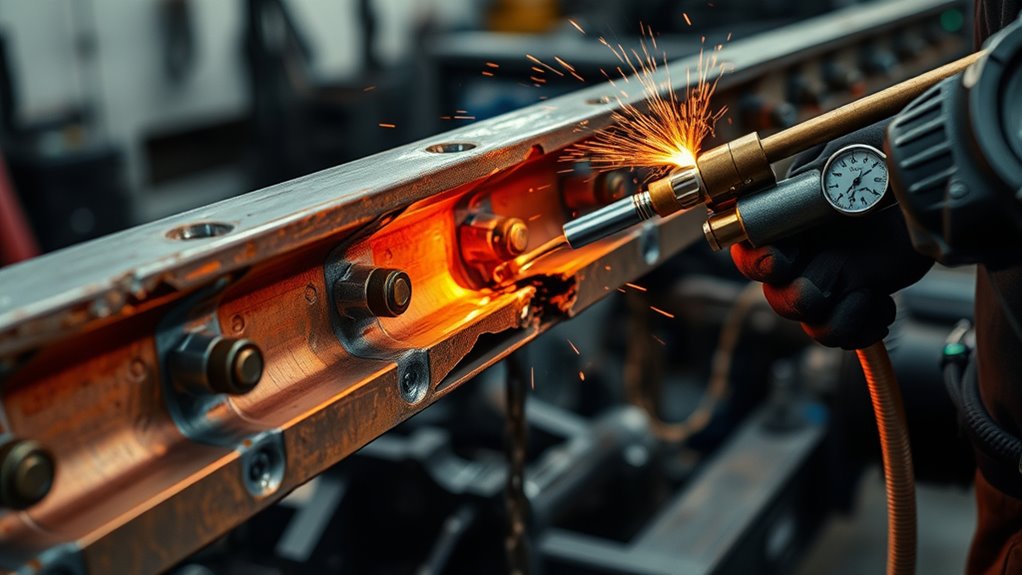
A modern vehicle structure may contain several steel grades, aluminum parts, castings, adhesives, composites, and mixed-material joints. The material cannot be identified reliably by color, thickness, magnetism, vehicle age, or appearance.
Terms such as HSS, HSLA, AHSS, UHSS, martensitic steel, boron steel, and press-hardened steel do not create one universal repair rule. Vehicle makers may classify tensile strengths differently and may give part-specific rules that are stricter than a general material chart.
| Material Description | Heat-Straightening Guidance |
| Mild or lower-strength steel | May be repairable on some components, but only within the vehicle maker’s stated limits. |
| HSLA or other named high-strength steel | May permit limited heat, cold straightening, heat-assisted pulling followed by replacement, or no straightening. Check the exact matrix and part procedure. |
| AHSS | Too broad for a generic decision. Repairability depends on the named steel, strength, location, damage, and OEM instruction. |
| UHSS, martensitic, boron, or press-hardened steel | Frequently replace-only and highly heat-sensitive. Do not straighten or heat unless a current, part-specific OEM procedure expressly permits it. |
| Aluminum, castings, or mixed-material structures | Require material-specific procedures, equipment, contamination controls, joining methods, and heat limits. Steel-frame rules do not apply. |
Genesis stated on January 30, 2025 that certain mild- and high-strength-steel structural parts may be heated up to 752°F. However, the heated damaged areas must then be replaced and may not be reused. The statement prohibits heat on UHSS structural components and heat repair on listed non-structural panels.
This example shows why a temperature number alone is not enough. The same document that gives a limit may also require replacement afterward.
Products Worth Considering

REACH TIGHT ACCESS AREAS: Specifically designed to grip vehicle panels, seams, and structural components where larger pulling clamps cannot fit

Multi-Purpose Tools - Our hydraulic ram kit is the perfect choice for auto-body repairs, construction sites, and frame repairs. Pull, bend, lift, push, straighten and spread metals with our industrial-quality hydraulic kit! The quality components & fittings make this unit perfect for those looking for quality & precision all day!

MULTIPLE PULLING ANGLES: The unique G-Clamp design allows technicians to pull from multiple directions, making it suitable for complex collision repairs and difficult pulling situations
Safe Temperature Control
Temperature control separates a documented repair from guesswork. Do not judge heat by the metal’s color. Shop lighting, coatings, surface finish, steel grade, viewing angle, and heat spread can make visual judgment unreliable.
Use the measuring method named by the repair procedure. Options may include temperature-indicating crayons, heat sticks, labels, thermal paint, a contact thermometer, or an infrared thermometer.
I-CAR warns that infrared readings can be inaccurate on shiny, reflective, bare-steel, and bare-aluminum surfaces because of low emissivity. In those conditions, a temperature crayon, label, thermal paint, or another approved contact method may give a more reliable indication.
Before heating, confirm:
- The instrument is suitable for the surface.
- The instrument or indicator covers the required temperature range.
- The measurement location matches the OEM instruction.
- Coatings or surface preparation will not create a false reading.
- Heat spread into nearby parts can be monitored.
- The technician can document each heat application and stop before the limit.
More heat does not mean a better pull. If the reading is uncertain, the permitted area cannot be controlled, or the limit is approached too quickly, stop the repair.
Products Worth Considering

Accurate, fast, low-cost method for measuring surface temperatures
Accurate, fast, low-cost method for measuring surface temperatures

Accurate results are +/- 1 percent of rated temperature; reliable always in calibration
Protect Nearby Systems Before Heating
Structural heat work requires more than eye protection and gloves. The repair plan must account for every system and material that heat, sparks, or pulling force may affect.
- High-voltage vehicles: Follow the exact OEM disable, verification, waiting-period, personal-protective-equipment, and reactivation procedure. Locate the battery and every nearby high-voltage cable before setup.
- Low-voltage and backup power: Follow the vehicle-specific battery and backup-power disconnect procedure where required.
- Restraint systems: Identify airbags, sensors, control modules, pretensioners, wiring, and mounting points. Do not heat or repair a restricted restraint-related area.
- Fuel and brake systems: Inspect both sides of the work area for fuel lines, tanks, vapor lines, brake lines, hoses, and fittings.
- Wiring and electronics: Remove, reroute, shield, or monitor harnesses, modules, grounds, connectors, cameras, radar units, and antennas as the procedure requires.
- Adhesives, foams, and sealers: Determine whether they must be removed and later replaced. Excess heat can damage a bonded joint outside the visible repair area.
- Interior and cargo-area materials: Remove or protect carpet, insulation, trim, sound deadener, and other flammable materials on both sides of the metal.
- Fire protection: Use the shop’s hot-work controls, suitable extinguishing equipment, ventilation, and fire-watch procedure.
- Adjacent materials: Monitor attached panels and reinforcements so heat does not transfer into a steel or joint where it is prohibited.
Warning: Never assume the visible side of a rail or panel is clear. Inspect the backside, enclosed cavity, attached reinforcement, and nearby electrical, fuel, brake, battery, restraint, adhesive, foam, and trim areas before applying heat.
Restore Corrosion Protection After Heating
Heat can burn primer, coatings, seam sealer, adhesive, cavity wax, undercoating, and sound-control materials. Every heated, exposed, stripped, or disturbed area must be restored according to the vehicle maker’s procedure.
- Inspect the heated area and both sides of the repair.
- Remove scale, oxidation, damaged coating, residue, and loose material as specified.
- Prepare the substrate with the approved cleaning and surface-preparation method.
- Apply the specified primer, coating, seam sealer, adhesive, undercoating, and cavity wax.
- Restore protection at edges, seams, weld flanges, fastener interfaces, enclosed sections, and access holes.
- Observe product thickness, overlap, temperature, and curing instructions.
- Inspect coverage before trim or adjacent parts hide the area.
- Record the products and application areas in the repair file.
Corrosion protection is structural maintenance, not a cosmetic extra. Rust in a seam, flange, or boxed rail can reduce durability and weaken the repaired area over time.
Post-Repair Checks Before the Vehicle Leaves
A structure can look straight while remaining outside the manufacturer’s dimensions. Complete the required checks before the vehicle is released.
- Three-dimensional measurements: Verify length, width, height, datum points, centerline relationships, and cross-measurements against OEM data.
- Repair tolerances: Confirm every measured point is within the specified tolerance rather than merely close to a nearby point.
- Panel fit: Test-fit adjoining panels and check gaps, flushness, openings, closures, lamps, glass, and weather seals.
- Material condition: Inspect for cracks, tearing, thinning, buckling, excessive tool marks, and heat beyond the approved area.
- Adjacent parts: Check reinforcements, brackets, welds, adhesives, fasteners, suspension mounts, steering mounts, and body mounts.
- Corrosion protection: Verify coatings, primer, seam sealer, adhesives, undercoating, and cavity wax before final closure.
- Fasteners and joints: Confirm replacement fasteners, torque values, welds, rivets, brazed joints, and bonded joints match the procedure.
- Mechanical condition: Inspect steering, suspension, subframes, hubs, wheels, tires, and alignment when the collision or repair affected those areas.
- Diagnostics: Complete required pre-repair and post-repair scans, clear repair-related faults only after correction, and document the results.
- ADAS and safety systems: Perform every required aiming, calibration, initialization, relearn, or functional test.
- Road and quality checks: Complete only the road test or static test permitted by the repair plan and vehicle condition.
- Repair file: Retain OEM procedures, measurements, photos, heat records, material notes, scan reports, calibration results, alignment results, and corrosion-product records.
When Replacement Is the Better Repair
Replacement is the correct repair when the OEM says the component is replace-only, the material cannot be straightened, the damage is kinked or torn, or the required correction would exceed an approved heat or pulling limit.
Replacement is also appropriate when:
- The part is a crush-zone component, intrusion beam, bumper reinforcement, or restricted safety structure.
- The part has lost its original cross-section or shows permanent thinning.
- A crack, tear, or micro-damage appears during an approved pull.
- Heat spread reaches a prohibited adjacent part or joint.
- The maximum temperature, time, or number of heat applications is exceeded.
- The structure cannot be returned to measurement and fit specifications.
- The heated part must be replaced under a manufacturer position statement.
The objective is not to preserve the original metal at any cost. It is to follow the repair standard set by the manufacturer and restore the vehicle’s structure, corrosion resistance, systems, fit, and documented function.
Frequently Asked Questions
What is the heat straightening procedure?
There is no universal heat-straightening procedure. A professional repair begins with vehicle identification, OEM research, material identification, damage measurement, and a repair-or-replace decision. When heat is permitted, the technician follows the exact anchoring, pulling, heating, temperature, cooling, measuring, replacement, corrosion-protection, and verification instructions supplied for that vehicle.
Does heat straighten metal?
Controlled heat can help some metals move during a measured pull or can create controlled expansion and contraction. Automotive structural steels do not all respond safely to heat, so the vehicle maker must permit the method for the exact component.
What temperature is used to straighten a vehicle frame?
There is no universal temperature. Some OEM procedures give a specific maximum for a named steel and part, while others prohibit heat. The technician must use the current vehicle-specific limit and approved measuring method rather than a temperature copied from another repair.
Can a unibody rail be heat straightened?
Only when the current OEM procedure permits heat and straightening on that exact rail, material, and damage location. Many unibody rails contain several steel grades or reinforcements, and some are replace-only even when the visible damage appears minor.
Can a heated structural part remain on the vehicle?
Sometimes, but not always. Some procedures permit limited heat and continued use when every requirement is met. Other manufacturers permit heat only to assist a pull and then require the damaged heated area to be replaced.
Can an infrared thermometer measure frame temperature?
It may be suitable when the procedure and surface allow it. Shiny, reflective, bare-steel, and bare-aluminum surfaces can produce inaccurate infrared readings because of low emissivity. The approved alternative may be a temperature crayon, heat stick, label, thermal paint, or contact instrument.
How do you straighten a shaft with heat?
Shaft heat straightening is a separate engineering process that depends on the alloy, heat treatment, diameter, service load, support method, and runout specification. Do not apply automotive frame temperatures or methods to a shaft unless its manufacturer or an approved engineering procedure authorizes them.
How do you straighten a steel plate with heat?
General steel-plate heat straightening may use engineered heating patterns, measured temperatures, restraint, and controlled cooling. Those methods do not authorize heating an automotive structural part. Vehicle work must follow the OEM body repair procedure.
Can you heat straighten a car frame at home?
No. Structural heat straightening requires current OEM information, professional training, approved anchoring and measuring equipment, temperature control, vehicle-system safety procedures, fire protection, corrosion materials, and post-repair verification.
What happens if a frame gets too hot during repair?
Excess heat can change material properties, damage coatings and bonded joints, spread into restricted parts, and affect crash performance. If a limit is exceeded or heat reaches a prohibited area, the OEM procedure may require replacement of the affected component or adjacent parts.
Conclusion
Heat straightening can be part of a safe structural repair, but only when the current OEM procedure permits it for the exact vehicle, component, material, and damage. Identify the vehicle, classify the damage, protect nearby systems, control and document the temperature, measure the structure throughout the repair, and stop when any limit or condition cannot be verified. When the part is restricted, kinked, torn, overheated, located in a safety area, or designated for replacement after heating, replacement is the correct repair. Finish by restoring corrosion protection and completing every required measurement, scan, calibration, alignment, and quality check.
Sources
- I-CAR: Straightening And Heat — supports the OEM-first decision rule and the warning that heat can damage structural metals.
- I-CAR: Straightening And Heat—Ford/Lincoln — supports the cited Ford/Lincoln HSLA temperature, time, and application example.
- I-CAR: Straightening And Heat—General Motors — supports the cited GM mild-steel and HSLA example.
- General Motors: Ultra High Strength Steel Repair Guide — supports GM’s UHSS description, heat restriction, and factory-joint replacement guidance.
- Mopar: Use of Heat While Repairing Damaged Structural and Non-Structural Components — supports replacement after heating specified structural steels and restrictions near safety components.
- Genesis: Use of Heat During Straightening — supports the 752°F example, required replacement after heating, and prohibition on heating UHSS.