Imagine a world without Plasma Arc Welding (PAW)—a world where precise metalwork is a distant dream. Luckily, that’s not the case, thanks to Robert M. Gage, who invented PAW in 1953. By 1957, Gage patented this groundbreaking technique that transformed industries. You’ll uncover how PAW revolutionized aerospace and manufacturing, setting new standards. Curious about its evolution and future innovations? There’s more to explore in this technological journey.
The Birth of Plasma Arc Welding
When Robert M. conceived Plasma Arc Welding (PAW) in 1953, its historical significance became immediately evident. PAW presented a revolutionary leap in welding technology, allowing unparalleled precision in cutting and welding both thin and thick metals.
By 1957, with the patent secured, the technological implications were profound. You see, PAW operates by generating an electric arc between a tungsten electrode and the workpiece, achieving temperatures up to 28,000°C. This high temperature capability enables it to perform tasks that other welding methods simply can’t match in precision and efficiency.
Achieving up to 28,000°C, PAW sets a new standard in precision and efficiency beyond other welding methods.
The unique process design of PAW employs a constricted arc setup and two inert gases, setting it apart from conventional methods. This innovation not only improved the quality of welds but also expanded the applicability of welding technology.
From aerospace to industrial manufacturing, PAW’s inception marked a pivotal moment in advancing welding techniques, transforming industries reliant on metal fabrication.
Key Inventor: Robert M. Gage

You’re about to examine how Robert M. Gage revolutionized welding technology with his invention of Plasma Arc Welding (PAW) in 1953.
By securing a patent in 1957, Gage’s process allowed for precise cutting and welding of both thin and thick metals, pushing the boundaries of traditional methods.
His innovation not only enabled new applications, such as spray coating turbine blades for the Saturn V rocket, but also set a precedent for advancements in sectors like aerospace and manufacturing.
Origin of Invention
Though the field of welding had seen various innovations, it was Robert M. Gage who harnessed the historical context and technological influences in 1953 to invent plasma arc welding (PAW). His creation marked a pivotal moment in welding technology, evolving from tungsten inert gas (TIG) welding.
By employing a constricted arc setup, Gage achieved higher temperatures, enabling precision in cutting and welding both thin and thick metals. His method allowed for the spray coating of hardening metals onto various materials, an essential technique for aerospace applications like turbine blades in the Saturn V rocket.
- Gage’s innovation offered enhanced control and efficiency.
- PAW revolutionized welding in manufacturing and aerospace.
- It facilitated precision in high-temperature applications.
- The development supported diverse material adaptability.
- Plasma arc technology set new industry standards.
Patent Achievement
In 1957, Robert M. Gage secured a patent for the plasma arc welding (PAW) process, highlighting its patent significance in the evolution of welding technology. This legal achievement guaranteed exclusive rights to his innovative method, which transformed metalworking capabilities.
The patent’s legal implications protected Gage’s design, particularly the separation of arc plasma from shielding gas via a fine-bore copper nozzle, which enhanced welding precision. By establishing a legal framework, Gage enabled industries like aerospace to utilize PAW for tasks such as coating turbine blades on the Saturn V rocket.
This patent not only safeguarded Gage’s intellectual property but also laid the groundwork for advancements in modern manufacturing, underscoring the pivotal role of patents in technological progress.
Early Developments in the 1950s
In the 1950s, you witness a pivotal shift in welding technology as Robert M. Gage pioneers Plasma Arc Welding (PAW), a method that revolutionizes precision work on metals.
By 1957, Gage’s patented process facilitates the welding and cutting of both thin and thick metals, leveraging a constricted arc setup to achieve exceptionally high temperatures.
Early applications, such as spray coating turbine blades for the Saturn V rocket, highlight PAW’s impact on advanced manufacturing and aerospace industries.
Robert M. Gage’s Innovation
Robert M. Gage’s vision in 1953 revolutionized welding technology by inventing plasma arc welding (PAW). His innovation prioritized welding precision, offering unmatched capabilities in metal fabrication and repair.
Traditional methods couldn’t achieve the high temperatures and efficiency inherent in PAW, as plasma jet temperatures reached approximately 28,000 ºC. Gage patented this groundbreaking process in 1957, facilitating precision cutting and welding for both thin and thick metals.
- High-Temperature Capability: Plasma jets reach around 28,000 ºC.
- Precision: Enables accurate cutting and welding.
- Versatility: Effective on various metal thicknesses.
- Innovation in Coating: Allows spray coating on metals like turbine blades.
- Revolutionary Impact: Transformed metal fabrication and repair.
Gage’s development laid the foundation for broader industrial applications, marking a pivotal moment in welding history.
Early Applications and Impact
With Robert M. Gage’s invention of Plasma Arc Welding (PAW) in 1953, you witnessed one of the most transformative early innovations in welding technology.
By 1957, PAW’s patent reflected its unparalleled precision for both thin and thick metals. The technique’s high temperatures, reaching up to 28,000°C, enabled efficient material bonding, essential for industrial applications.
Early on, its potential was realized in aerospace, where it played a pivotal role in spray coating hardening metals onto Saturn V rocket turbine blades. This not only showcased PAW’s capability but also set a new standard in weld quality.
PAW revolutionized welding practices in the 1950s, enhancing productivity and setting the stage for future advancements in the field.
Patent Milestone in 1957
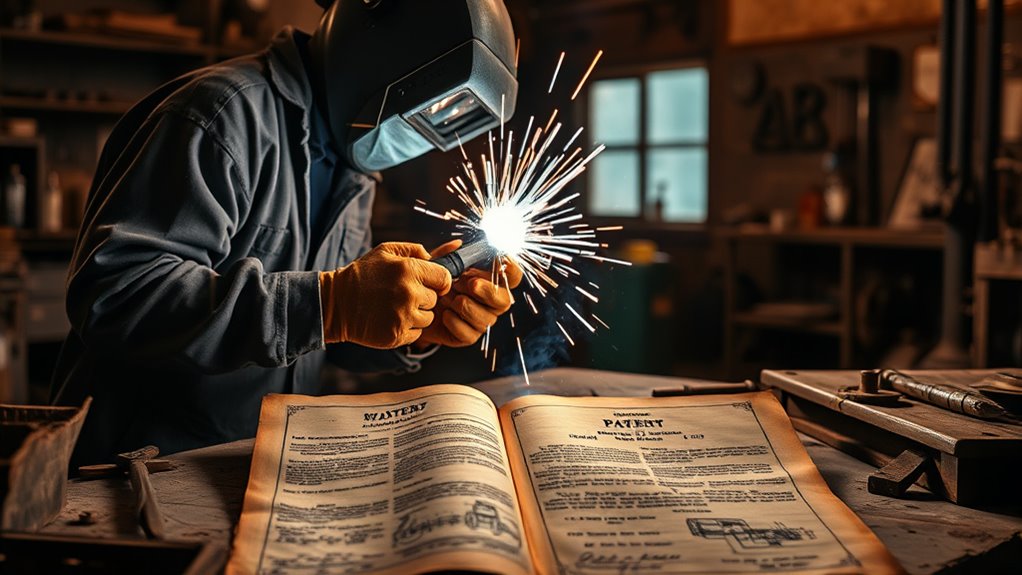
By 1957, the innovative plasma arc welding process, invented by Robert M. Gage, had reached a pivotal milestone with the granting of a patent. This event underscored the patent significance of plasma arc welding, highlighting its role as a groundbreaking advancement in welding technology.
The patent solidified the process’s industrial relevance, offering unmatched precision in welding both thin and thick metals. Plasma arc welding’s ability to perform precision cutting and innovative applications, such as spray coating hardening metals, marked significant welding advancements.
- The patent emphasized the unique capabilities of plasma arc welding in industrial contexts.
- It opened doors for precision applications, essential for cutting-edge technology.
- Plasma arc welding’s versatility positioned it as a cornerstone in manufacturing.
- The process allowed for enhanced durability of components, like turbine blades.
- This 1957 patent laid the groundwork for widespread industrial adoption, transforming various sectors including manufacturing.
Advancements in Aerospace Applications

Building on the foundation laid by the 1957 patent milestone, plasma arc welding (PAW) has greatly advanced the aerospace industry by offering unparalleled precision and reliability.
You’ll find PAW indispensable for achieving welding precision on various metal thicknesses, vital for components like turbine blades. This process reaches temperatures up to 28,000°C, ensuring strength and durability in materials exposed to extreme aerospace conditions.
PAW’s ability to spray coat hardening metals onto components markedly improves wear resistance, extending the lifespan of critical parts. Its low heat input minimizes distortion, essential for maintaining the integrity of delicate aerospace components.
You’ll appreciate that PAW meets stringent safety and performance standards, ensuring high-quality welds that are fundamental in aerospace applications.
Moreover, PAW has streamlined manufacturing processes, enhancing aerospace efficiency. By integrating PAW, you contribute to producing high-quality components for vehicles like the Saturn V rocket, optimizing both performance and reliability.
Evolution in Manufacturing Techniques

As you explore the evolution in manufacturing techniques, plasma arc welding (PAW) stands out as a transformative force. Invented by Robert M. Gage in 1953, PAW revolutionized welding by enhancing both manufacturing efficiency and welding precision. The patented process in 1957 opened new possibilities, allowing for effective welding of diverse metal thicknesses.
By incorporating a constricted arc, PAW achieves temperatures up to 28,000°C, greatly boosting weld speed and quality over traditional methods. The use of shielding gases like argon and helium further improves weld integrity, laying the groundwork for advancements in other techniques, such as Gas Tungsten Arc Welding (GTAW).
Achieving up to 28,000°C with a constricted arc, PAW enhances weld speed and quality with superior shielding gases.
Consider these notable features of PAW:
- Allows welding of both thin and thick metals with high precision.
- Achieves superior temperature control for maximum weld quality.
- Enhances overall manufacturing efficiency through faster processing.
- Utilizes shielding gases to prevent contamination and maintain integrity.
- Pioneers high-precision applications in aerospace and beyond.
Plasma Arc Welding in the Modern Era
Though plasma arc welding (PAW) has its roots in the mid-20th century, its impact on modern manufacturing is profound and continually evolving. PAW’s precision and versatility make it essential in today’s industrial landscape. Its plasma applications have expanded, with industries like aerospace and automotive relying on its ability to achieve high-quality welds with minimal distortion. The integration of PAW with robotic systems marks a significant leap in welding efficiency, facilitating automation and precision.
| Feature | Description | Impact on Modern Era |
|---|---|---|
| High Temperature | Up to 28,000°C | Effective for thin and thick metals |
| Quality Welds | Minimal Distortion | Preferred in aerospace, automotive |
| Robotic Integration | Automation | Enhanced efficiency and precision |
| Energy Efficiency | Ongoing Research | Expanding sector applications |
| Versatility | Broad Applications | Integral in modern manufacturing |
Continuous advancements guarantee that PAW remains at the forefront of welding technology. Current research focuses on improving energy efficiency, further solidifying its role in expanding plasma applications across sectors.
Comparisons With Other Welding Technologies
When comparing Plasma Arc Welding (PAW) to other welding technologies, it’s essential to evaluate its unique features and benefits.
PAW stands out due to its exceptional welding efficiency and advanced heat management capabilities. Unlike Shielded Metal Arc Welding (SMAW), PAW reaches temperatures up to 28,000°C, greatly enhancing its ability to penetrate tough materials. Its constricted arc setup increases heat concentration, reducing distortion compared to traditional methods.
- Higher temperature range: PAW achieves up to 28,000°C, surpassing SMAW’s 5,500°F (3,000°C).
- Enhanced heat management: Constricted arc setup minimizes heat input, reducing workpiece distortion.
- Dual gas flow system: Improves arc stability and weld quality, suitable for varying material thicknesses.
- Precision control: Ideal for both thin and thick materials, offering superior weld quality.
- Versatile applications: Effective for metals with refractory oxides, outperforming oxy-fuel cutting.
In essence, PAW’s technical superiority offers unmatched precision and reliability in demanding welding scenarios.
Future Prospects and Innovations
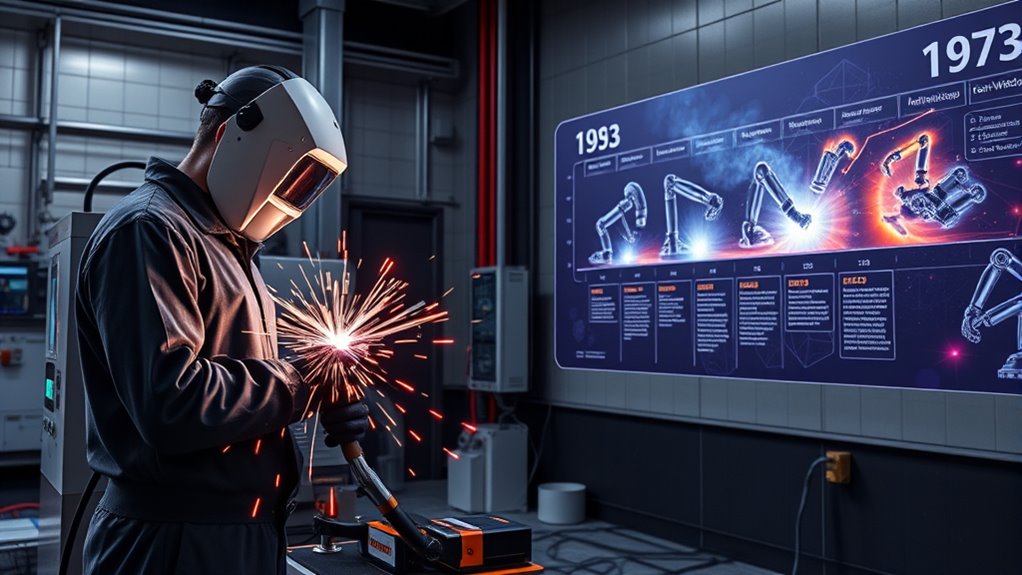
In exploring the future prospects and innovations of Plasma Arc Welding (PAW), researchers are actively integrating advanced automation and robotics into the process, aiming to boost both efficiency and precision.
Automation integration allows for precise control over welding parameters, minimizing human error and enhancing consistency. Innovations are also focusing on alternative gases and new torch designs to optimize heat control, reducing distortion in materials.
Hybrid techniques are gaining traction, combining PAW with other processes to expand application range and increase productivity. This approach allows for the strengths of various welding methods to be utilized simultaneously, optimizing the overall welding operation.
Moreover, real-time monitoring systems powered by artificial intelligence are being developed to further enhance quality control, offering adaptive parameter adjustments during welding.
The potential of PAW in additive manufacturing and 3D printing is also under investigation, promising revolutionary advancements in fabricating complex metal components with improved precision and efficiency.
Frequently Asked Questions
What Materials Are Suitable for Plasma Arc Welding?
You can effectively use plasma arc welding on aluminum alloys and stainless steel. This method allows precise control over heat input, ensuring minimal distortion and high-quality welds. It’s ideal for materials requiring tight tolerances and superior finish.
How Does Plasma Arc Welding Differ From TIG Welding?
Imagine a dance of sparks: Plasma arc welding uses a constricted arc with distinct plasma characteristics, enabling precise control and deeper penetration. It suits demanding welding applications, unlike TIG welding’s broader arc, offering less penetration but greater versatility.
What Are the Safety Precautions for Plasma Arc Welding?
Make certain you wear appropriate safety gear, including gloves, goggles, and protective clothing. Conduct a thorough risk assessment before starting. Maintain a well-ventilated workspace to prevent toxic fume exposure. Regularly inspect equipment to avoid malfunctions and hazards.
What Is the Cost Comparison With Other Welding Methods?
Imagine a toolbox where each tool has its price and purpose. Conduct a cost analysis, and you’ll find plasma arc welding may initially cost more, but its welding efficiency can lead to long-term savings over traditional methods.
How Does Plasma Arc Welding Impact Welding Speed?
Plasma arc welding increases welding speed by providing higher welding efficiency and focused heat input. You’ll notice it minimizes distortion, enhances penetration, and reduces overall weld time compared to conventional methods, improving productivity and quality.
Conclusion
You’ve journeyed through the fascinating evolution of Plasma Arc Welding, where precision, performance, and progress intersect. From Robert M. Gage‘s groundbreaking invention in the 1950s to its vital role in aerospace advancements, PAW has persistently pushed technological boundaries. As you compare it with other welding techniques, you’ll appreciate its unparalleled accuracy and adaptability. Looking forward, the future of PAW promises pioneering possibilities, particularly in new materials and automation, ensuring it remains a essential component in modern manufacturing marvels.