If you’re curious about who invented plasma arc welding, you’ll want to explore the pivotal role of Robert M. Gage. In 1953, his groundbreaking work on the plasma torch revolutionized welding, offering unmatched temperature control and precision. Supported by Linde Corporation, Gage’s innovations transformed industries from aerospace to automotive. But how exactly did his engineering genius set the stage for modern practices? Discover the intricate details and lasting impact of his contributions.
The Early Days of Welding Technology

In the early days of welding technology, various methods such as forge welding and gas welding laid the groundwork for modern advancements. As you explore manual welding, you’ll appreciate the historical techniques that shaped today’s practices.
Forge welding, an ancient yet essential technique, involved heating and hammering metals together, offering the first glimpse of metal joining. Its simplicity required skilled artisans to guarantee durability and strength.
Gas welding, introduced later, brought innovation by utilizing fuel gases and oxygen to melt and bond metals. This method allowed for more precise control over the welding process, greatly improving joint quality.
These manual welding techniques were pivotal, yet the real evolution emerged with electric arc welding in the early 20th century. This advancement provided stronger, more efficient joints, transforming the industry.
Understanding these historical techniques gives you an all-encompassing view of how foundational practices evolved into sophisticated methods.
The Birth of Plasma Arc Welding
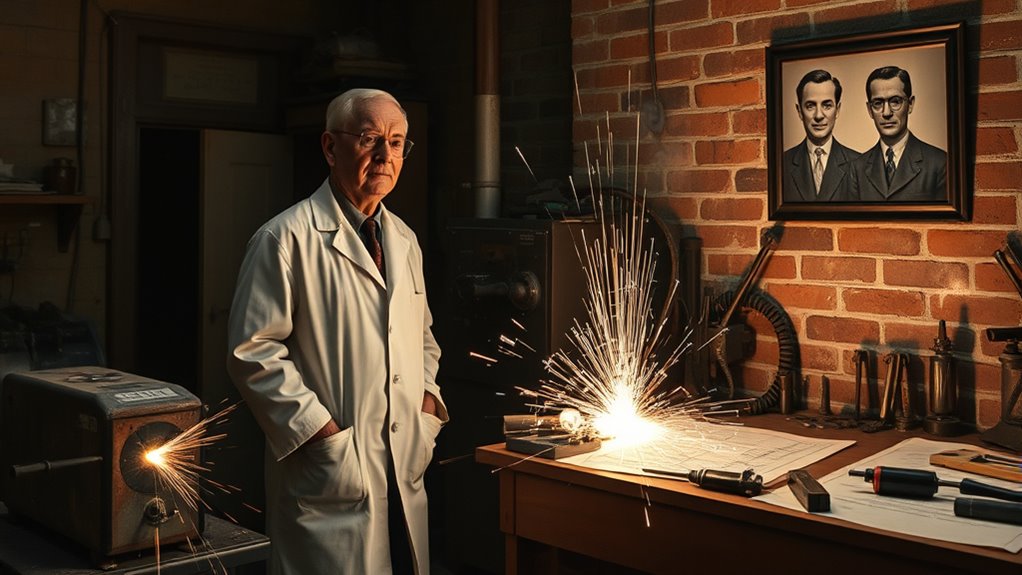
As you explore the birth of Plasma Arc Welding, consider Robert M. Gage‘s pivotal 1953 innovation, which revolutionized welding precision.
His development of the plasma torch marked a technological breakthrough, offering unmatched control over welding both thin and thick metals.
This advancement not only set new standards in metalworking but also laid the foundation for the highly versatile systems used in today’s industries.
Robert M. Gage’s Innovation
Plasma Arc Welding (PAW) owes its inception to the groundbreaking work of Robert M. Gage. His methodology, developed at Linde Corporation and patented in 1957, revolutionized welding applications.
Gage introduced a constricted arc setup using a tungsten electrode, producing a plasma arc reaching temperatures up to 28,000°C. This innovation allowed for precision welding and cutting of both thin and thick metals, greatly advancing welding processes.
The precision and control offered by Gage’s methodology expanded the scope of welding applications, enabling industries to achieve higher-quality welds and cuts. Additionally, Gage’s work led to the invention of Plasma Arc Cutting (PAC), further enhancing plasma technology’s role in manufacturing.
His contributions remain pivotal, continually influencing modern industrial welding methods.
1953 Technological Breakthrough
Although the concept of welding dates back to the Bronze Age, the birth of Plasma Arc Welding (PAW) in 1953 marked a technological leap that redefined the field.
Invented by Robert M. Gage, PAW introduced technological advancements that improved welding efficiency considerably. By utilizing a constricted arc setup, an electric arc forms between a tungsten electrode and the workpiece, achieving precise welding and cutting of metals, both thin and thick.
Operating at temperatures up to 28,000°C (50,000°F), PAW effectively melts and coalesces various materials. Additionally, the use of two inert gases—one for arc plasma, another for shielding—enhanced process control and efficiency.
This minimized distortion and improved the metallurgical structure and bond strength, setting PAW apart from traditional methods.
Welding Precision Revolution
The leap from the Bronze Age to modern welding methods saw another transformative stride in 1953 with Robert M. Gage’s invention of Plasma Arc Welding (PAW).
This innovation marked a new epoch in welding accuracy and fabrication efficiency. Utilizing a tungsten electrode, PAW generates a plasma arc reaching temperatures up to 28,000°C, effectively cutting and welding both thin and thick metals.
Unlike conventional methods, PAW offers unmatched precision with reduced heat input, minimizing distortion and allowing for intricate welds across various joint configurations, including square butt, J, and V joints.
R. M. Gage: A Pioneering Engineer
R. M. Gage’s background in engineering equipped him with the analytical skills necessary to tackle welding challenges of his time. At Linde Corporation, he meticulously examined the limitations of existing welding methods, recognizing the need for enhanced precision and efficiency.
In 1953, Gage invented plasma arc welding (PAW), innovating with a plasma torch that revolutionized the welding industry. By 1957, his groundbreaking technology secured a patent, marking a pivotal advancement in welding techniques.
Gage’s plasma torch laid the foundation for both plasma arc welding and cutting processes, offering a versatile solution for a wide variety of materials. His ability to transform theoretical concepts into practical applications underscored his expertise and technical prowess.
His contributions didn’t just improve welding precision; they redefined industry standards. The impact of his work continues to be felt today, with plasma arc processes widely adopted across diverse applications, showcasing Gage’s lasting legacy in the field.
The Role of Linde Corporation
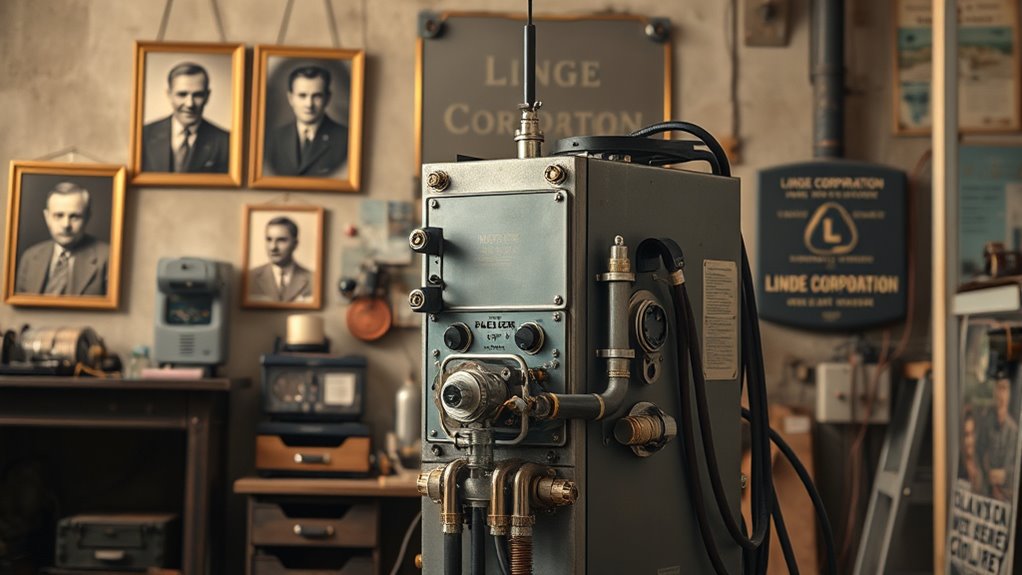
Gage’s pioneering work in plasma arc welding wouldn’t have reached its full potential without the support and resources of Linde Corporation. As Gage started on his innovative journey in the 1950s, Linde provided an environment ripe for technological advancement. Their commitment to Linde innovations and corporate collaboration was essential.
Linde Corporation’s support was crucial for Gage’s plasma arc welding innovation in the 1950s.
You’ll find that Linde’s expertise in industrial gases and welding technology laid the groundwork for transforming theoretical concepts into practical applications. The resources at Linde enabled Gage to develop the plasma torch, leading to the patented plasma arc welding process in 1957.
This collaboration guaranteed the seamless integration of cutting-edge research and industrial application, revolutionizing manufacturing processes. By leveraging their extensive knowledge base, Linde played a vital role in the successful commercialization of plasma arc welding, making it a cornerstone in modern welding technology.
Without Linde’s essential support, the trajectory of plasma arc welding might’ve been markedly different.
Innovations in Plasma Torch Design
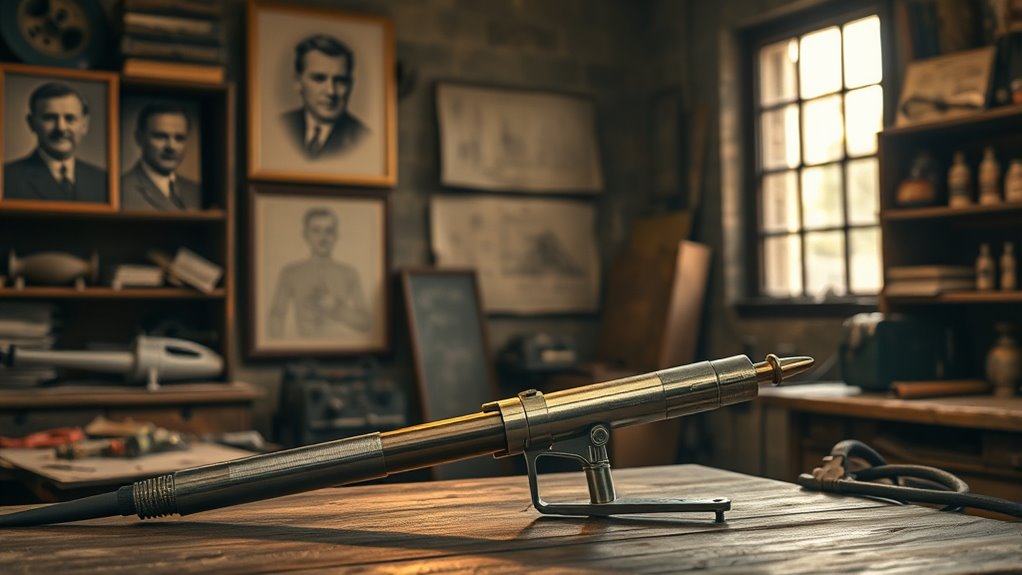
Since its inception in 1953, the plasma torch has undergone substantial innovations, transforming welding and cutting applications across industries. Originally invented by Robert M. Gage, the plasma torch design has evolved to enhance torch efficiency and arc stability.
Initially utilizing a tungsten electrode, modern designs have adapted to use both AC and DC currents, with DC torches favored for their lower noise levels and superior energy efficiency.
One of the key advancements in plasma torch design includes reducing turbulence in the plasma arc. This enhancement results in ultra-smooth cuts and improved cutting quality, minimizing bevel angles and ensuring precision.
Furthermore, continuous improvements in the design of consumables have considerably increased their lifespan, effectively reducing downtime and operational costs.
These innovations haven’t only bolstered the torch’s efficiency but also provided a more stable arc, cementing the plasma torch as an indispensable tool for precision welding and cutting tasks.
Industrial Adoption and Impact
As plasma arc welding (PAW) gained traction in the late 1950s, industries rapidly adopted it for its precision and reliability. Manufacturers favored PAW for its ability to join both thin and thick metals with minimal distortion, thanks to its low heat input. This made PAW indispensable in industries like aerospace and automotive, where delicate components are common. With a bond strength of about 65,000 psi, it became essential for creating robust turbine blades and valves.
| Industry | Application | Benefit |
|---|---|---|
| Aerospace | Turbine blades | High bond strength |
| Automotive | Delicate component welding | Minimal distortion |
| Petrochemical | Valve production | Precision and durability |
The technology’s versatility extended PAW’s industrial advancements into sectors such as marine, petrochemical, and glass. By producing smooth deposits close to final geometry, manufacturers reduced machining time, boosting efficiency and cutting costs. PAW’s welding applications solidified its role in modern manufacturing practices.
Recognition and Legacy in Welding
You can appreciate the profound impact Robert M. Gage’s innovations in plasma arc welding have had on industrial processes by examining both historical significance and current applications.
His 1957 patent laid the groundwork for advancements that revolutionized precision and efficiency in manufacturing, from aerospace to automotive sectors.
Gage’s Impact on Industry
Pioneering advancements in welding technology, Robert M. Gage’s invention of plasma arc welding revolutionized industrial efficiency and welding applications. By efficiently welding both thin and thick metals with minimal distortion, his technique became essential across various sectors.
Patented in 1957, the plasma arc torch enabled versatile processes that enhanced manufacturing capabilities. Recognized in industrial publications, like the 1963 Iron Age Magazine feature, Gage’s work underscored plasma arc technology’s critical role in modern practices.
You can see his influence in industries such as automotive, aerospace, and petrochemical, where precision and efficiency are paramount. Gage’s contributions laid the groundwork for future innovations, shaping how welding processes are designed today.
His legacy remains crucial in the ongoing evolution of welding technology.
Historical Significance of Innovations
Though often overlooked, the historical significance of Robert M. Gage’s invention of Plasma Arc Welding (PAW) in 1953 can’t be overstated. By enabling precise welding of both thin and thick metals, Gage revolutionized welding advancements, transforming industrial methods.
The historical applications of PAW in sectors like aerospace and automotive underscore its versatility and efficiency. Publications such as Iron Age Magazine in 1963 highlighted PAW’s impact on manufacturing processes, cementing its role in the welding industry.
Gage’s legacy lies in enhanced heat control and reduced distortion, setting new benchmarks for industrial applications. The development of the plasma torch initiated a wave of innovations, continuously improving welding equipment and techniques, thereby shaping future industrial practices and standards.
The Evolution of Plasma Arc Techniques
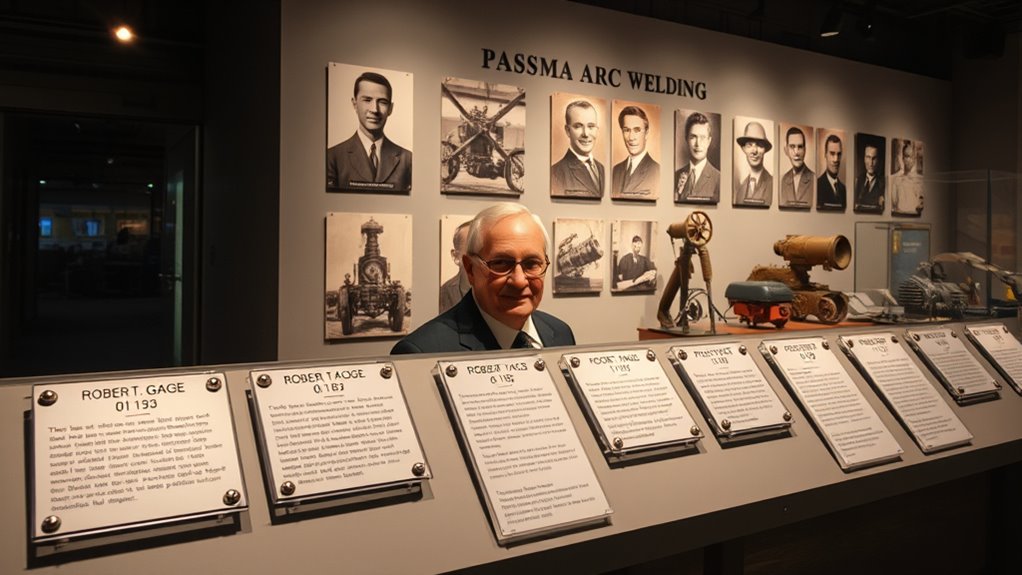
As plasma arc welding (PAW) evolved, its techniques transformed the landscape of industrial welding through significant technological advancements. Initially developed by Robert M. Gage, PAW harnessed plasma technology advancements, particularly through the innovative plasma torch. This torch’s design enabled high-temperature welding, reaching up to 28,000°C, and provided unmatched precision for both thin and thick metals. These enhancements directly contributed to welding efficiency improvements, making PAW a preferred method in various industrial settings.
The evolution of PAW didn’t stop there. The introduction of non-transferred arcs and shielding gases reduced oxidation, thereby enhancing weld quality. This refinement not only improved the quality but also increased the durability of welds.
Moreover, the adaptation of mechanized and automated systems in PAW streamlined the process, optimizing productivity and consistency. These innovations have made PAW a cornerstone in modern industrial applications, ensuring its relevance and continued evolution in the welding domain.
Frequently Asked Questions
What Are the Safety Measures for Plasma Arc Welding?
Guarantee welding safety by wearing protective gear, maintaining equipment, and using ventilation. Regularly inspect torches and hoses for leaks. Calibrate machines precisely. Never overlook ground connections. Follow protocols to prevent accidents and guarantee efficient plasma arc welding operations.
How Does Plasma Arc Welding Differ From TIG Welding?
Plasma arc welding differs from TIG welding by using a constricted arc and unique plasma properties, allowing greater precision in narrow, deep welding applications. You’ll achieve better control over heat input and weld penetration compared to TIG.
What Materials Can Be Welded Using Plasma Arc Welding?
Imagine welding a titanium bike frame; you’d use plasma arc welding for precision. Plasma applications extend to materials like stainless steel, aluminum, and copper. You achieve quality joints by leveraging plasma’s consistent heat and control capabilities.
What Are the Energy Requirements for Plasma Arc Welding?
You need to guarantee the energy consumption aligns with plasma arc welding’s requirements, typically ranging from 100 to 200 amperes. Plasma efficiency is critical; optimizing it minimizes energy waste and maximizes welding precision and effectiveness.
How Does Plasma Arc Welding Affect Weld Quality and Precision?
In plasma arc welding, precision control and weld integrity stand at opposite ends, yet they converge beautifully. You achieve exact welds with minimal distortion, ensuring high-quality results and maintaining structural integrity in even the most demanding applications.
Conclusion
As you’ve journeyed through the evolution of Plasma Arc Welding, it’s clear that Robert M. Gage didn’t just advance welding technology; he revolutionized it. With Linde Corporation‘s backing, his ingenious plasma torch design became the gold standard, transforming welding into an art of precision. The impact on industries like aerospace and automotive is nothing short of seismic, and Gage’s legacy continues to shape modern welding practices. His contributions remain etched in the annals of industrial history.