You want a plasma cutter that matches the metal you cut, the power in your shop, and the amount of equipment you are willing to carry. This 2026 guide compares five practical plasma cutters for thick plate, fabrication, longer shop runs, CNC-ready hobby work, and portable cutting with built-in air. You will see the important differences in output, voltage, air requirements, clean-cut versus maximum-cut claims, and everyday usability.
Affiliate disclosure: This article contains Amazon affiliate links. If you buy through a link, we may earn a commission at no extra cost to you. Product specifications, ratings, review counts, prices, and availability can change, so confirm the current listing and manual before buying.
Quick Verdict
Choose the LOTOS LTP8500 when thick-metal capacity is your priority and you already have 220/240V power plus shop air. Choose the LOTOS LTP8000 for a balanced fabrication workhorse. Choose the AmicoElectric APC-80HF for a fixed shop where longer runs matter. Choose the Bestarc BTC800XP when non-HF CNC integration is important. Choose the ANDELI CUT-50Y Pro XS when built-in air and mobility matter more than maximum output.
Most important check: compare clean or recommended cutting thickness, not only the largest severance number. Then confirm voltage, breaker size, compressor flow, torch consumables, and warranty.
Top Picks
| Best For | Product | Why It Stands Out |
|---|---|---|
| Thick Metal | LOTOS LTP8500 | Highest output in this group, pilot arc, and drag-cut support |
| Fabrication Work | LOTOS LTP8000 | Strong all-around capacity with a pre-installed air filter/regulator |
| Longer Shop Runs | Amico APC-80HF | 80A shop focus, built-in air controls, and manufacturer-promoted duty cycle |
| CNC and Hobby Use | Bestarc BTC800XP | Non-HF blow-back start, CNC ports, digital display, and dual voltage |
| Portable All-in-One Use | ANDELI CUT-50Y Pro XS | Built-in compressor with an optional external-air connection |
How We Picked These Plasma Cutters
We compared the published specifications, intended use, power requirements, air setup, pilot-arc type, CNC features, portability, consumable needs, and buyer risks for each model. We gave more weight to practical cutting guidance and setup fit than to the largest advertised severance number.
This is a specification-based buying guide. It does not claim that every machine was tested hands-on. Manufacturer claims can use different test conditions, so always compare the manual’s clean, recommended, and maximum cutting figures carefully.
Safety and Setup Note
Plasma cutters create intense light, sparks, heat, noise, fumes, and electrical risk. Follow the manual, use a properly rated helmet or face protection, flame-resistant clothing, gloves, hearing protection, and ventilation. Keep flammable material away, attach the work clamp to clean conductive metal, use dry air, and never run a high-output cutter on undersized wiring or an unsuitable generator.
Cutting painted, galvanized, plated, or coated metal can release hazardous fumes. Remove coatings when appropriate and use local fume extraction or professional ventilation.
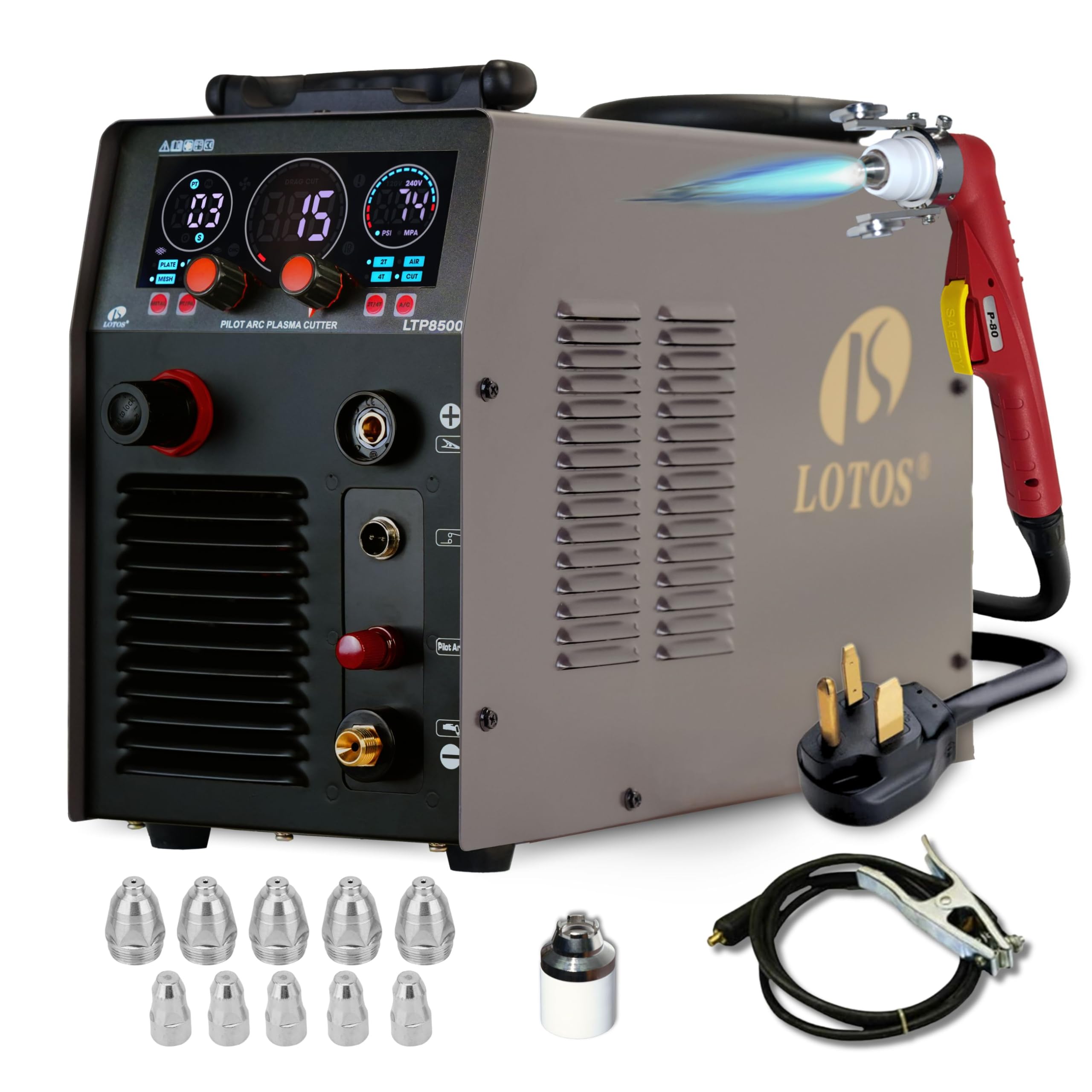
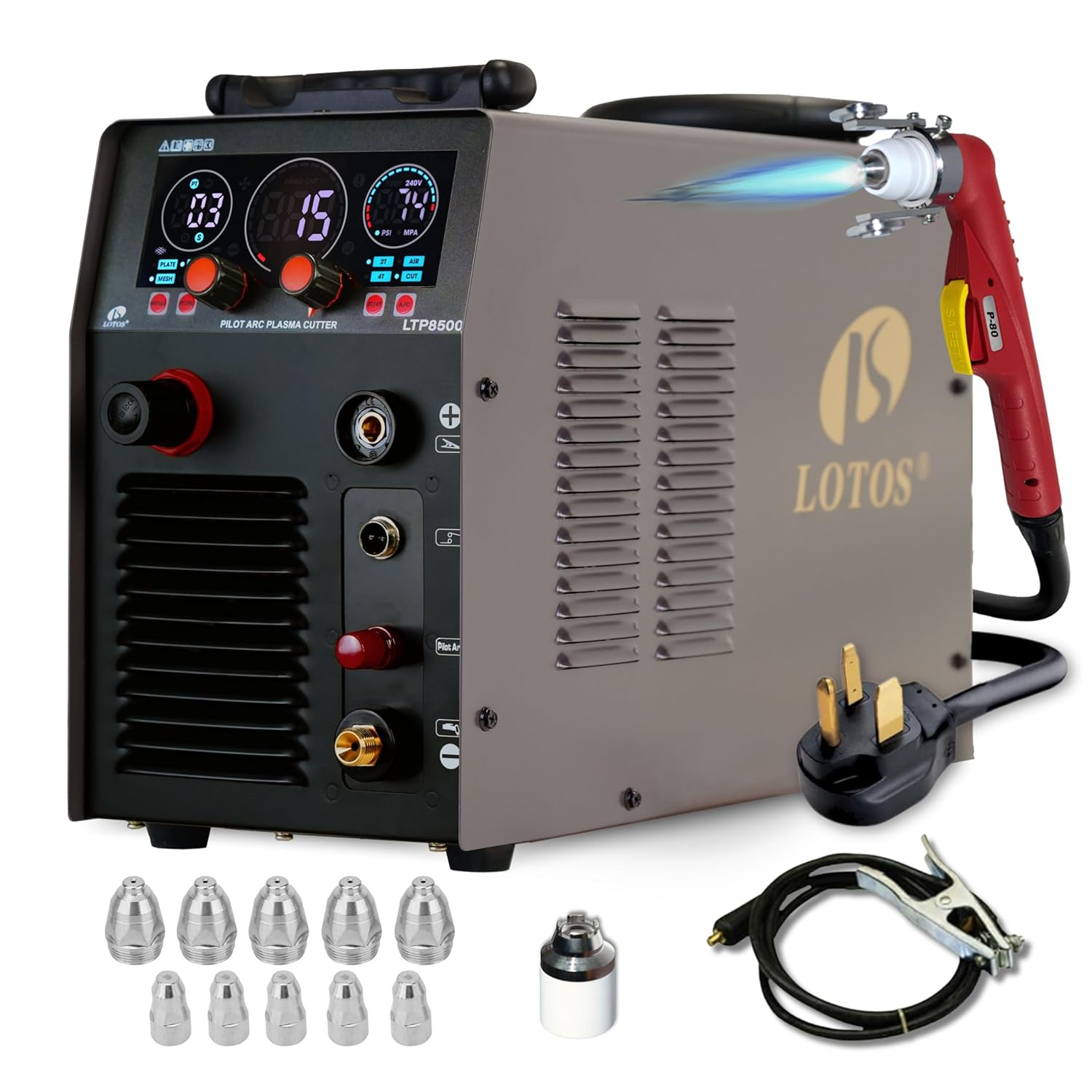
The LOTOS LTP8500 is the strongest cutting-focused option in this roundup. It makes sense when you regularly work on trailer frames, farm equipment, structural parts, or thicker plate and already have a suitable 220/240V circuit and compressor.
Its non-touch pilot arc can start on rusty, painted, or expanded metal, while drag-cut support helps when you follow a straightedge or template. The tradeoff is simple: this is a heavier shop machine, not the easiest cutter to carry between small jobs.
Why You’ll Like It
You get more output headroom than a basic 50A garage cutter, plus pilot-arc and drag-cut features that reduce prep work on imperfect metal.
Who Should Buy This
- Small shops that cut medium-to-thick steel often
- Fabricators who want pilot arc for rusty, painted, or expanded metal
- Users with a proper 220/240V circuit and enough clean, dry shop air
Who Should Avoid This
- You mainly cut thin sheet and do not need 85A output
- You do not have the required electrical circuit or compressor
- You need the lightest possible cutter for frequent carrying
Buyer Feedback Snapshot
Current buyer feedback can change. When you check the listing, focus on recent comments about arc starting, cut quality at the thickness you use, torch comfort, consumable supply, and support. Do not treat advertised maximum severance thickness as the same as a clean daily cut.

Long-Term Value
The value comes from faster cutting and less grinder cleanup on heavier jobs. You still need to budget for a suitable circuit, dry air, and replacement consumables.
Situational Benefits
| Situation | How It Helps |
|---|---|
| Trailer or farm repairs | High output and pilot arc help you remove damaged brackets and cut imperfect steel with less surface preparation. |
| Thicker plate projects | The manufacturer lists up to a 1-inch clean cut and 1.5-inch severance, although results depend on material, air, consumables, and travel speed. |
| Template and freehand work | Drag-cut support can make it easier to follow a guide or pattern. |
| Repeated shop use | A stable power supply, adequate airflow, and cooling time help maintain consistent performance. |
Ease of Use
| Feature | Ease Level |
|---|---|
| Electrical setup | Moderate to advanced |
| Air hookup | Moderate |
| Torch handling | Easy |
| Controls | Easy |
| Consumable replacement | Moderate |
Key Benefits
- 85A output for demanding shop work
- Manufacturer-listed 1-inch clean and 1.5-inch severance capacity
- Pilot arc for rusty, painted, and expanded metal
- Drag-cut support for guides and templates
- Front-mounted air controls and replaceable consumables
Before you order: Confirm the recommended breaker, plug, air pressure, airflow, included consumables, and current warranty in the manual and Amazon listing before ordering.
Check Product Details on Amazon

The LOTOS LTP8000 is a strong all-around choice for fabrication, repairs, and repeated shop work. It gives you serious output without moving all the way to the highest-amperage model in this guide.
The pilot arc helps on rusty or painted surfaces, and the pre-installed air filter/regulator reduces setup time. You still need a 210-250V supply, an appropriately sized breaker, and clean compressed air.
Why You’ll Like It
It balances high cutting capacity, useful pilot-arc performance, and a relatively simple external-air setup for a home or small fabrication shop.
Who Should Buy This
- Fabricators who want dependable pilot-arc cutting
- Repair users working on rusty, painted, or rough metal
- Buyers who need more capacity than a common 40A or 50A cutter
Who Should Avoid This
- You need a built-in compressor
- You only have light-duty household power
- Portability matters more than output
Buyer Feedback Snapshot
Read the newest reviews for cut quality, thermal shutdown behavior, air-regulator fittings, consumable life, and customer support. The published duty cycle applies under stated temperature and output conditions, so your real run time can change with heat and setup.

Long-Term Value
This cutter can save time on repeated fabrication jobs by reducing hacksaw, cutoff-wheel, and grinding work. Ongoing costs include dry-air equipment and torch consumables.
Situational Benefits
| Situation | How It Helps |
|---|---|
| Fabrication and repair | The 20-80A range gives you adjustment room for different conductive metals and thicknesses. |
| Painted or rusty steel | Non-touch pilot arc reduces the need to clean every cut path to bright metal. |
| Longer cuts | The manufacturer lists a 60% duty cycle at 80A and 100% at 50A at 40°C, so lower output can support longer runs. |
| Fast compressor hookup | The pre-installed filter/regulator and quick-connect fitting reduce setup steps. |
Ease of Use
| Feature | Ease Level |
|---|---|
| Electrical setup | Moderate to advanced |
| Air hookup | Easy to moderate |
| Torch handling | Easy |
| Controls | Easy |
| Consumable replacement | Moderate |
Key Benefits
- 80A adjustable output
- Manufacturer-listed 1-inch ideal and 1.5-inch maximum cut
- Non-touch pilot arc for imperfect surfaces
- Pre-installed air filter/regulator
- 2T/4T trigger modes for short or longer cuts
Before you order: Confirm the current plug, breaker recommendation, torch package, consumable part numbers, and warranty before buying.
Check Product Details on Amazon
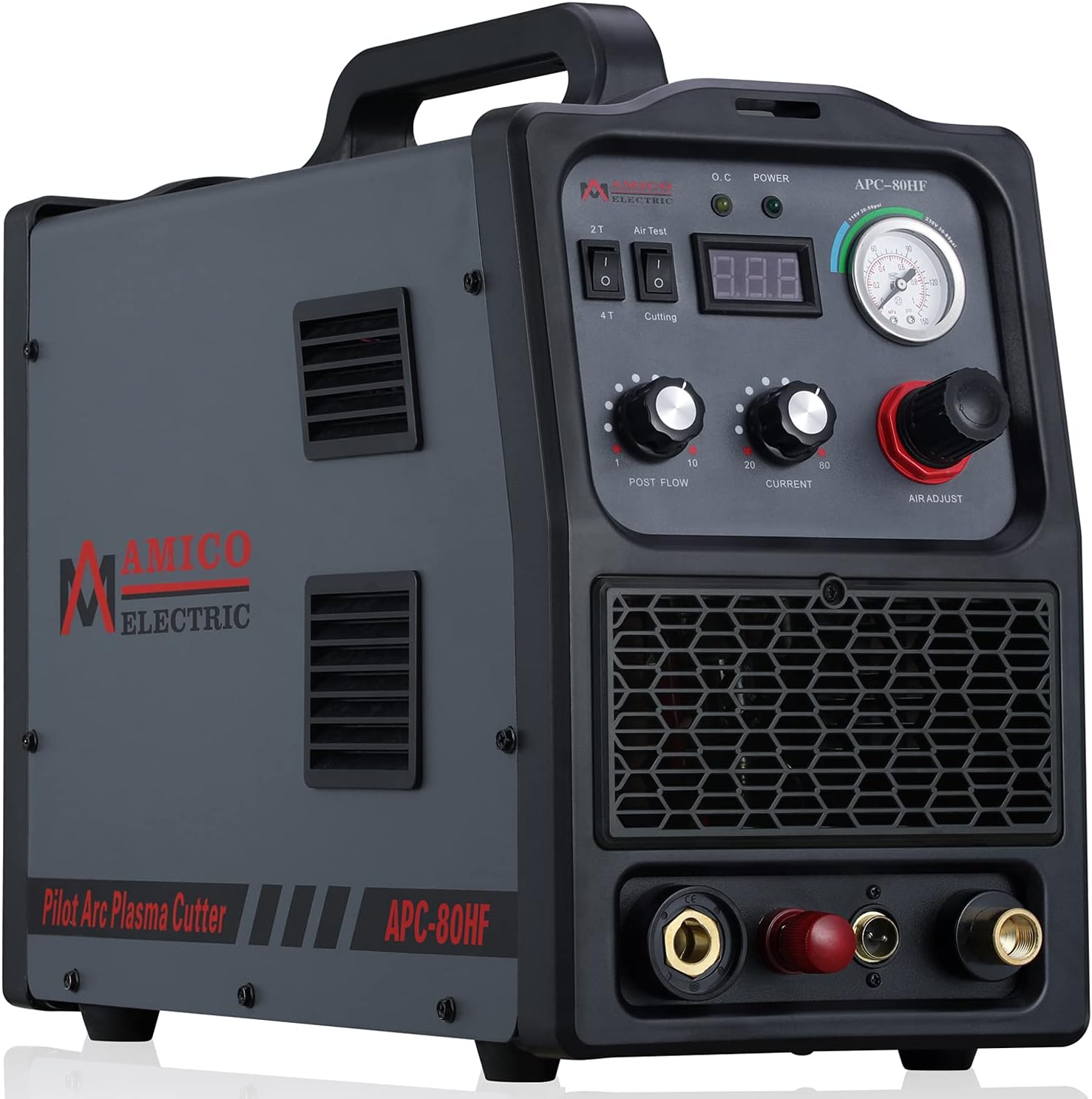
The AmicoElectric APC-80HF targets users who want high output and longer cutting sessions in a fixed shop. Its built-in air filter/regulator simplifies the connection, but the machine still needs an external compressor and a suitable 230V circuit.
The manufacturer promotes a high duty cycle and voltage-compensation features. Treat those as manufacturer claims and match your expectations to the current manual, ambient temperature, output setting, and power quality.
Why You’ll Like It
It combines 80A output, non-touch pilot arc, and integrated air controls in a shop-focused package.
Who Should Buy This
- Small shops that make repeated cuts in batches
- Users who value a built-in air filter and pressure gauge
- Repair work involving painted, rusty, or imperfect conductive metal
Who Should Avoid This
- You need 110V operation
- You want a built-in compressor
- You only make occasional cuts in thin sheet
Buyer Feedback Snapshot
Check current reviews for duty-cycle performance, torch and consumable availability, regulator quality, fan noise, and support response. Published cut-capacity figures are best-case or manufacturer-listed values, not a promise of production-quality edges at every thickness.

Long-Term Value
The APC-80HF can pay off when sustained output shortens batch work and reduces grinding. You still need a capable compressor, moisture control, and the correct 230V electrical setup.
Situational Benefits
| Situation | How It Helps |
|---|---|
| Batch fabrication | High output and the manufacturer-promoted duty cycle suit repeated shop cuts when cooling and airflow are adequate. |
| Rough or coated metal | Non-touch pilot arc helps start the arc without perfect surface preparation. |
| Remote shop areas | Voltage-compensation claims may help with reasonable supply variation, but you should still use correctly sized wiring and follow the manual. |
| Quick air connection | The built-in filter/regulator and pressure gauge reduce the number of separate air components at the machine. |
Ease of Use
| Feature | Ease Level |
|---|---|
| Electrical setup | Moderate to advanced |
| Air hookup | Easy to moderate |
| Torch handling | Easy |
| Controls | Easy |
| Consumable replacement | Moderate |
Key Benefits
- 80A shop-focused output
- Non-touch pilot arc
- Built-in air filter, regulator, and pressure gauge
- Manufacturer-advertised high duty cycle
- Thermal, current, and overload protection features
Before you order: Confirm the exact duty-cycle chart, circuit requirement, air flow, torch consumables, and warranty in the current documentation because retailer descriptions can differ.
Check Product Details on Amazon
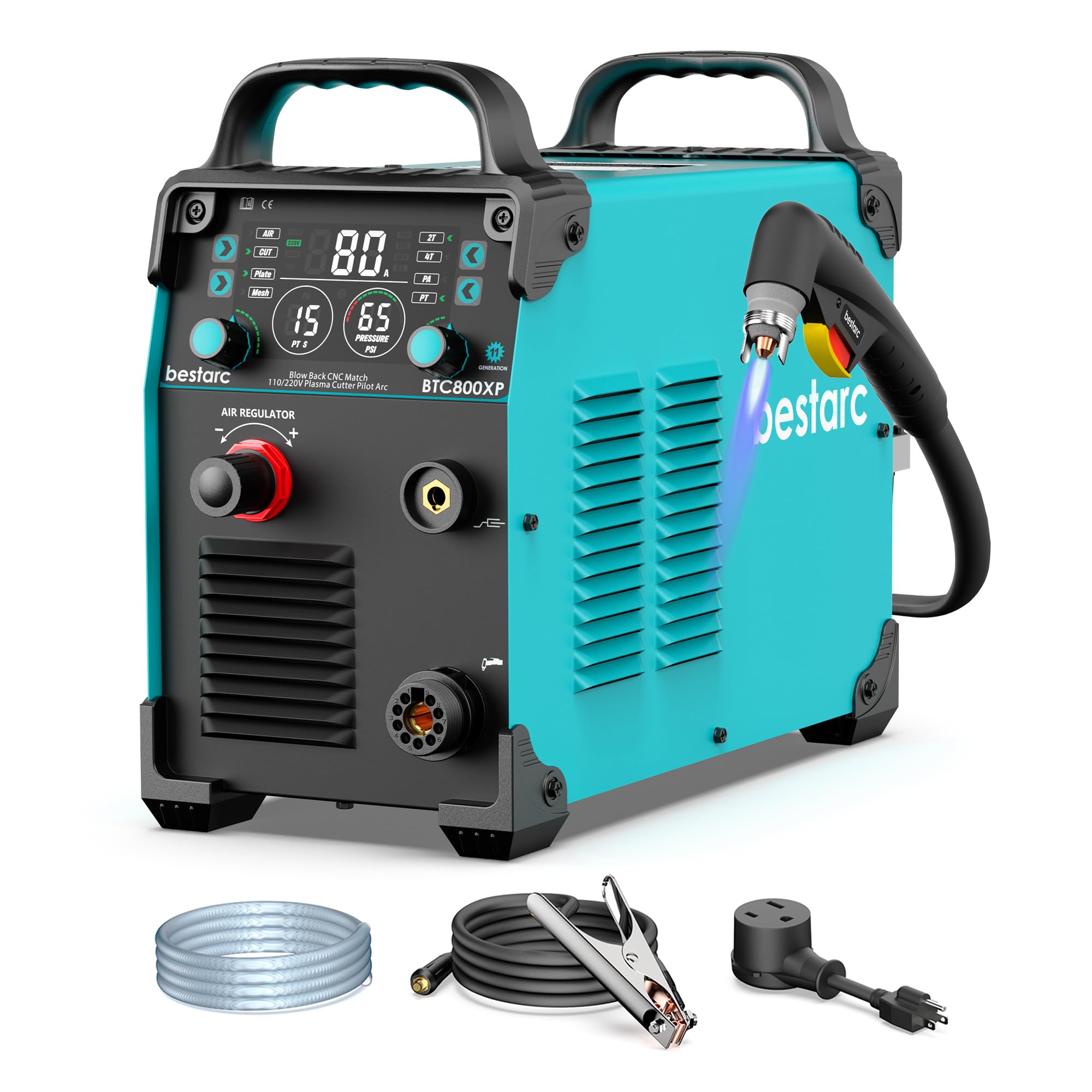
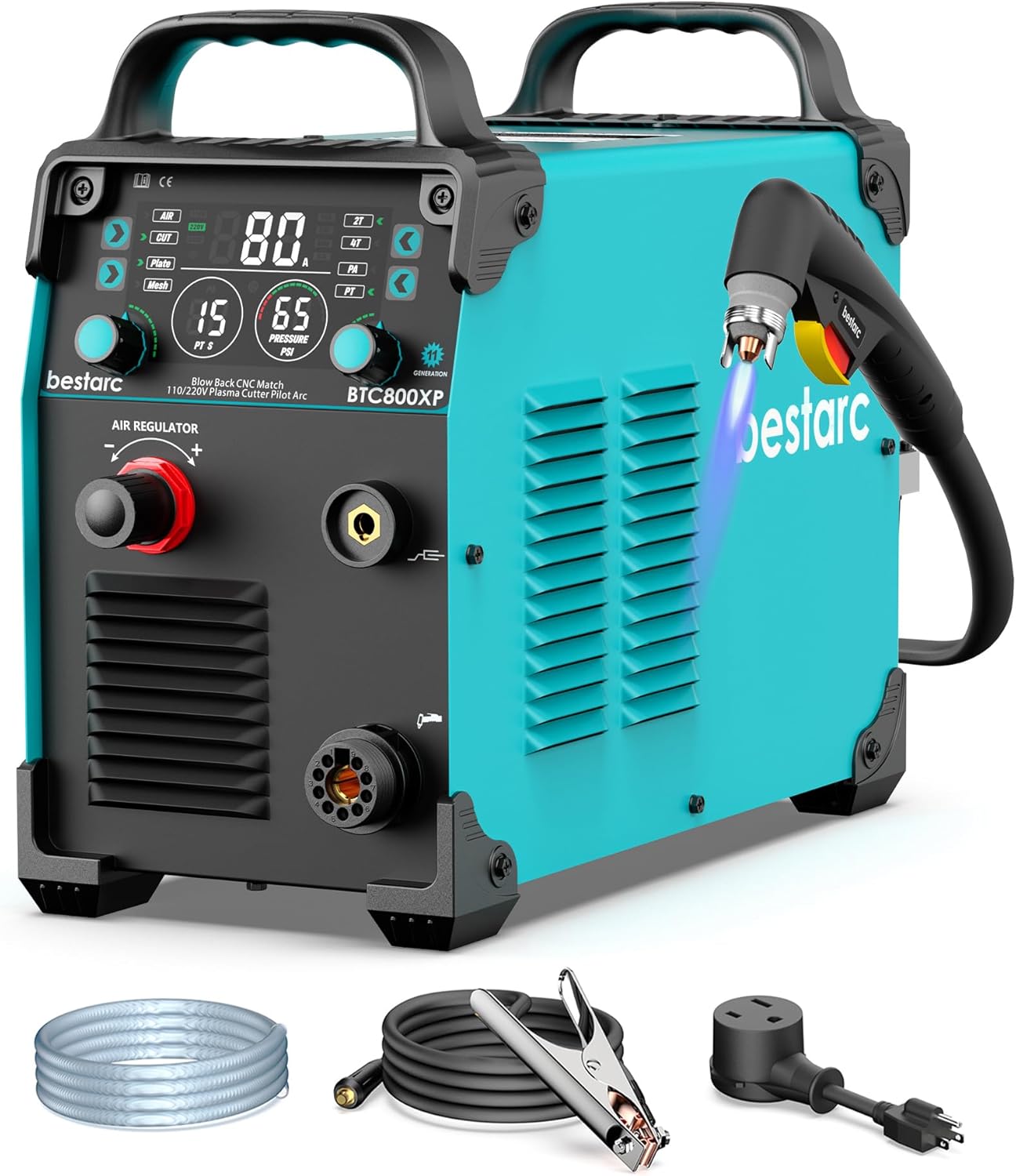
The Bestarc BTC800XP is the most CNC-focused option here. Its non-HF blow-back pilot arc reduces high-frequency interference, and the rear control ports make it easier to integrate with a compatible CNC table or torch-height-control setup.
It supports 110V and 220V input, but voltage changes its usable output and cutting guidance. The manufacturer recommends up to 14 mm at 40A on 110V and up to 25 mm at 80A on 220V. It includes an air sensor and filter/regulator, but you must supply dry compressed air.
Why You’ll Like It
You get dual-voltage flexibility, a readable display, non-HF pilot arc, and CNC-ready connections in one machine.
Who Should Buy This
- Hobbyists planning a future CNC table
- Users who want non-HF pilot arc near CNC electronics
- Garage fabricators who value a digital status display and dual-voltage input
Who Should Avoid This
- You need an all-in-one machine with a built-in compressor
- You want premium industrial support and fit-and-finish
- You cut maximum-thickness plate every day
Buyer Feedback Snapshot
Read recent feedback for torch compatibility, CNC voltage output, air leaks, error codes, consumable availability, and support. Confirm that the exact torch version and control-port configuration match your table before ordering.

Long-Term Value
Its main value is avoiding a second purchase when you move from handheld cutting to a hobby CNC table. Correct air quality and compatible control wiring matter more than advertised maximum severance numbers.
Situational Benefits
| Situation | How It Helps |
|---|---|
| CNC table integration | Non-HF blow-back starting and dedicated control ports make it more suitable around CNC electronics than an HF-start cutter. |
| Home workshop work | Dual-voltage input lets you use 110V for lighter cuts and 220V for the machine’s higher-output range. |
| Setup troubleshooting | The screen shows current, voltage, air information, and fault codes. |
| External-air shop use | The built-in filter/regulator simplifies the connection, but an adequate external compressor is still required. |
Ease of Use
| Feature | Ease Level |
|---|---|
| Electrical setup | Moderate |
| Air hookup | Moderate |
| Handheld controls | Easy |
| CNC integration | Moderate to advanced |
| Consumable replacement | Moderate |
Key Benefits
- Non-HF blow-back pilot arc
- CNC signal and arc-voltage ports
- 110/220V auto-detection
- 60% manufacturer-listed duty cycle
- Digital display, fault codes, air sensor, and filter/regulator
Before you order: Confirm the exact torch package, voltage-divider requirements, breaker size, compressor flow, and compatibility with your CNC controller before buying.
Check Product Details on Amazon

The ANDELI CUT-50Y Pro XS solves the biggest portability problem: it can cut without a separate compressor. That makes it useful in a small garage, service vehicle, or jobsite where carrying extra air equipment is inconvenient.
It supports 110V and 220V, but its listed maximum capacity is lower on 110V. The manual lists up to 22 mm at 220V and 15 mm at 110V. For thicker or longer cuts, the manual also allows an external compressor, which can provide stronger airflow than the onboard unit.
Why You’ll Like It
The built-in compressor reduces setup time and equipment count, while dual-voltage input gives you more location flexibility.
Who Should Buy This
- Mobile repair users who do not want to carry a separate compressor
- Home-garage users cutting thin-to-moderate material
- Buyers who want both onboard air and an external-air option
Who Should Avoid This
- You cut thick plate all day
- You need maximum output and the strongest long-run performance
- You already have excellent shop air and prefer a lighter cutter-only unit
Buyer Feedback Snapshot
Check the newest reviews for onboard-compressor strength, early failures, torch parts, external-air performance, and warranty support. A built-in compressor improves convenience, but it may cut more slowly on thicker metal than a strong shop-air setup.
Long-Term Value
You may save the cost and space of a separate compressor for light work. The value drops if you often need external air or if your jobs demand continuous high-output cutting.
Situational Benefits
| Situation | How It Helps |
|---|---|
| Mobile repairs | The built-in compressor removes one large piece of equipment from the setup. |
| Small garage projects | Dual-voltage input and onboard air suit brackets, sheet metal, and occasional fabrication. |
| Generator-powered work | It can work from a properly sized, clean-output generator that meets the manual’s electrical requirements. |
| Thicker cuts | The external-air option can improve airflow when the onboard compressor is not enough for the job. |
Ease of Use
| Feature | Ease Level |
|---|---|
| Electrical setup | Moderate |
| Built-in compressor use | Easy |
| External-air hookup | Moderate |
| Torch handling | Easy |
| Consumable replacement | Moderate |
Key Benefits
- Built-in air compressor
- Optional external-air connection
- 110/220V dual-voltage input
- 15-50A adjustable output
- Manual-listed maximum of 22 mm at 220V and 15 mm at 110V
Before you order: Confirm the plug, breaker requirement, generator compatibility, included consumables, current warranty, and whether the onboard compressor meets your normal thickness needs.
Check Product Details on Amazon
Before You Buy: Quick Plasma Cutter Checklist
- Normal material thickness: Buy for the thickest metal you cut often, not a one-time emergency cut.
- Clean, recommended, and severance cuts: These are not interchangeable. Clean or recommended capacity is the more useful daily number.
- Input voltage: Confirm whether full output needs 220V or 240V. Dual-voltage does not mean equal performance on both voltages.
- Breaker and wiring: Follow the manual and local electrical code. Do not choose a breaker from amperage alone.
- Air supply: Check required pressure and flow. A pressure reading does not prove the compressor can maintain enough airflow.
- Moisture control: Use a separator or dryer because water and oil shorten consumable life and hurt cut quality.
- Pilot arc: Helpful for rusty, painted, expanded, or imperfect metal.
- CNC plans: Look for non-HF starting, the correct control ports, a compatible torch, and the voltage output your controller expects.
- Consumables: Confirm nozzle, electrode, shield, and torch-part availability before choosing a less common model.
- Portability: Include the weight of the cutter, compressor, hoses, generator, and cables, not only the machine.
FAQ
How Do I Choose the Right Plasma Cutter for My Workshop?
Start with the material and thickness you cut most often. Then match that work to the machine’s clean or recommended capacity, input voltage, duty cycle, and airflow. A high-amperage model is not useful if your breaker, wiring, or compressor cannot support it.
Choose pilot arc when you often cut rusty, painted, mesh, or expanded metal. Choose a non-HF CNC-ready model when you plan to use a plasma table. Choose a built-in-compressor model when mobility matters more than maximum sustained output.
What Is the Difference Between Clean Cut and Severance Cut?
A clean or recommended cut is the thickness the machine can cut with a more usable edge at a suitable speed and setup. A severance or maximum cut is the thickest material it may separate under favorable conditions, often more slowly and with more dross or bevel. Use the clean or recommended number for everyday buying decisions.
Do I Need a Special Air Supply or Electrical Setup?
Usually, yes. Most plasma cutters need dry compressed air at a specified pressure and flow. Check both values because a small compressor may reach the required pressure but fail to maintain the required airflow during a long cut.
For power, follow the exact voltage, breaker, plug, wiring, and extension-cord guidance in the manual. High-output machines often need a dedicated 220V, 230V, or 240V circuit. Ask a qualified electrician when you are unsure.
What Maintenance Helps Produce Consistent Cuts?
Inspect the electrode, nozzle, shield, torch, work clamp, hoses, filter, and cables before use. Drain moisture separators, keep cooling vents clear, and replace worn consumables before they damage cut quality. Match amperage, travel speed, standoff, and air pressure to the material.
Is a Pilot-Arc Plasma Cutter Worth It?
It usually is when you cut painted, rusty, expanded, or dirty metal. Pilot arc reduces surface-prep time and helps the arc start across gaps. You still need a solid work-clamp connection and proper settings.
Should I Choose a Built-In Compressor or External Shop Air?
A built-in compressor is convenient for mobile repairs, small garages, and short light-to-moderate jobs. External shop air is usually better for sustained cutting, thicker material, and consistent airflow. Some machines, including the ANDELI in this guide, let you use either option.
Which Plasma Cutter Is Best for a CNC Table?
The Bestarc BTC800XP is the clearest CNC-oriented choice in this group because it uses non-HF blow-back starting and includes dedicated control connections. You must still confirm torch style, arc-voltage output, voltage-divider needs, trigger wiring, and compatibility with your controller and torch-height-control system.
What Buyers Usually Prioritize
Most buyers should rank their needs in this order: clean or recommended cutting capacity, available voltage, compressor flow, duty cycle, consumable supply, pilot-arc type, and portability. CNC users should move non-HF starting and control-port compatibility near the top of the list.
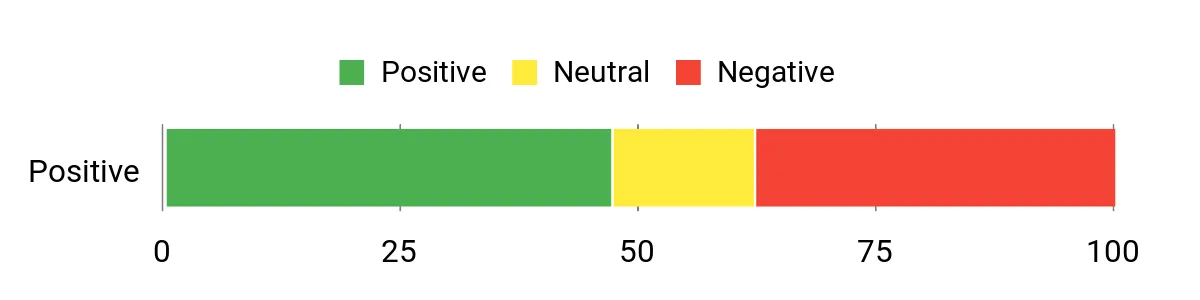
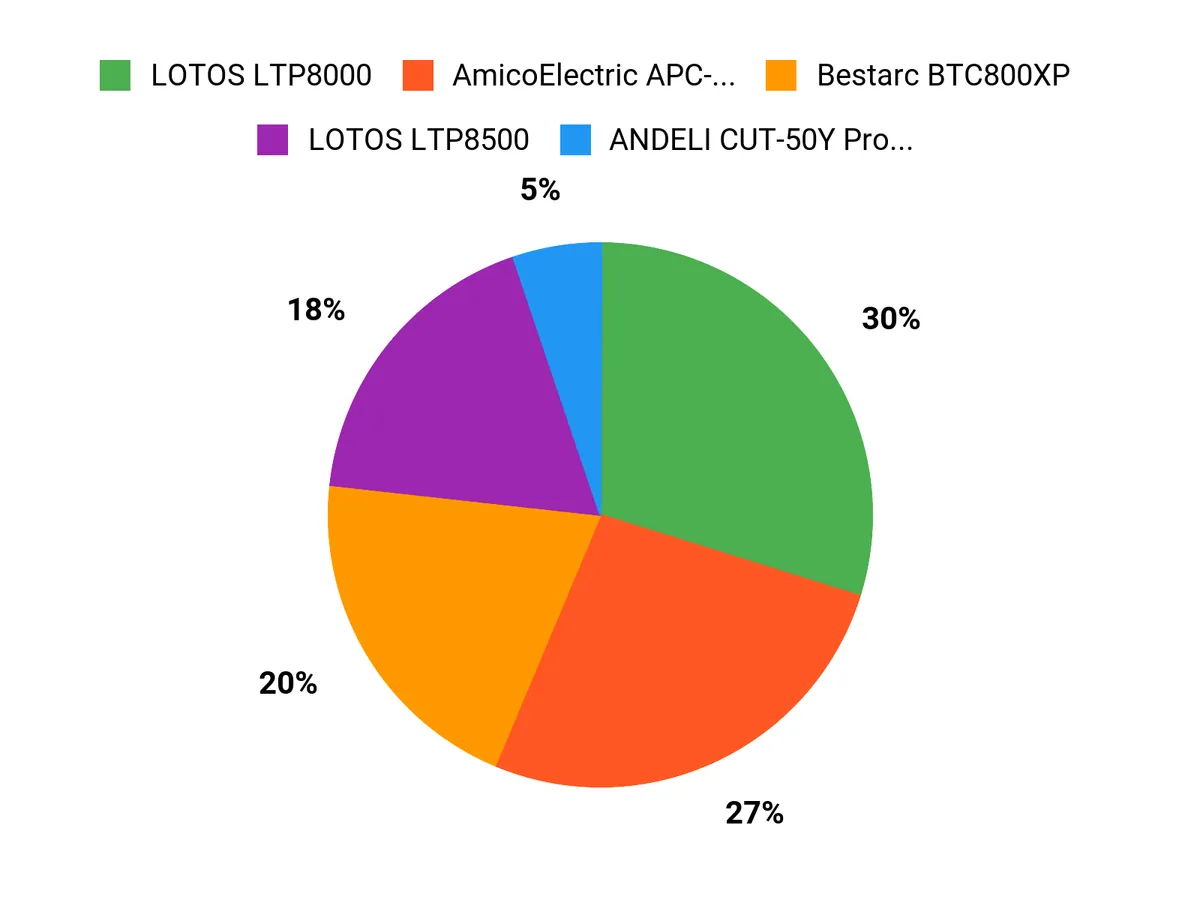
The visual below is an editorial summary from the original article, not live market data. Check current product listings and recent reviews before making a final decision.
Wrapping Up
The LOTOS LTP8500 is the best fit here when you need the most cutting headroom and already have the required shop infrastructure. The LOTOS LTP8000 is the better all-around fabrication choice for many small shops. The AmicoElectric APC-80HF suits a fixed shop focused on longer runs, while the Bestarc BTC800XP is the better path for non-HF CNC integration.
Choose the ANDELI CUT-50Y Pro XS when portability and built-in air matter more than maximum sustained output. Whichever model you choose, confirm the current manual, breaker, compressor flow, clean-cut guidance, consumables, and warranty before buying.
Final Recommendation
For thick metal, choose the LOTOS LTP8500. For a balanced fabrication machine, choose the LOTOS LTP8000. For longer fixed-shop runs, compare the current documentation for the AmicoElectric APC-80HF. For CNC-ready hobby work, choose the Bestarc BTC800XP. For mobile all-in-one cutting, choose the ANDELI CUT-50Y Pro XS.
Quick Specification Comparison
Important: The figures below use manufacturer-listed terms and are not directly equal. “Clean,” “ideal,” “recommended,” “standard,” and “maximum” cuts may use different test conditions.
| Product | Image | Output | Input Power | Manufacturer-Listed Cutting Guidance | Air Setup |
|---|---|---|---|---|---|
| LOTOS LTP8500 85AMP Plasma Cutter |
 |
85A | 220/240V class | Up to 1 inch clean and 1.5 inches severance | External dry compressed air |
| LOTOS LTP8000 80 A Plasma Cutter |
 |
20-80A | 210-250V | 1 inch ideal and 1.5 inches maximum | External dry compressed air; filter/regulator included |
| APC-80HF Plasma Cutter |
 |
80A | 230V | 1.2 inches standard and 1.5 inches maximum | External compressor; filter/regulator included |
| Bestarc BTC800XP Plasma Cutter |
 |
Up to 80A | 110/220V | Recommended up to 14 mm on 110V and 25 mm on 220V | External dry compressed air; filter/regulator included |
| ANDELI CUT-50Y Pro XS |
 |
15-50A | 110/220V | Maximum 15 mm on 110V and 22 mm on 220V | Built-in compressor or optional external air |
This roundup is reader-supported. When you click an Amazon affiliate link, we may earn a referral commission on qualifying purchases. Always confirm current specifications, included accessories, ratings, review counts, prices, and availability on the product page.