Pilot arc and non-pilot, or contact-start, plasma cutters can both make fast cuts in conductive metal. The main difference is how the arc starts. That changes how easily the cutter handles rust, paint, mesh, and repeated pierces, but it does not replace a solid work-clamp connection, clean dry air, correct settings, or safe surface preparation.
Quick Answer
Choose a pilot arc plasma cutter for rusty or coated steel, expanded metal, frequent piercing, or easier starts. Choose a non-pilot contact-start cutter for mostly clean stock and simple occasional work. In either case, check the machine’s separate pierce rating, compressor requirements, duty cycle, consumable cost, and start method before buying.
Key Takeaways
- Pilot arc starts inside the torch and transfers to the work without the tip touching the metal.
- Contact-start machines usually need the tip at the work and a clean starting area, so coatings and heavy rust can cause failed starts.
- Pilot arc is usually better for expanded metal, grating, repair work, and repeated pierces, but the machine must still stay within its published pierce capacity.
- Blowback pilot start creates much less electrical noise than high-frequency start, which often makes it easier to use near CNC controls.
- Dry air, adequate CFM under load, a clean work-clamp spot, correct torch height, and sound consumables affect cut quality on both types.
Last updated: July 20, 2026
How pilot arc and contact-start plasma cutters work
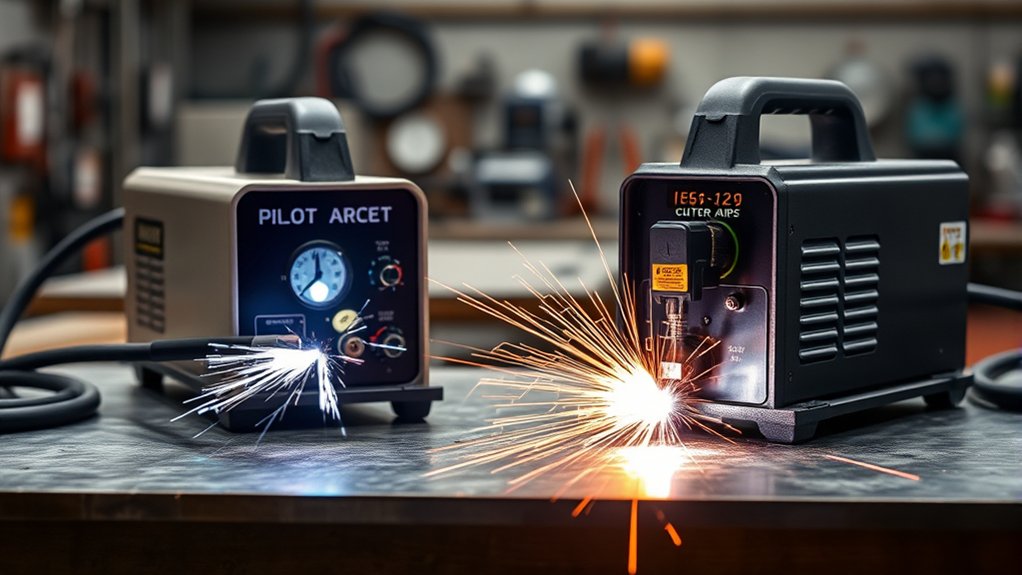
Most handheld air plasma cutters use electricity and compressed air to create a narrow jet of ionized gas. The jet melts conductive metal, and the fast-moving air blows the molten material out of the kerf. Both start types use the same basic cutting process after the main arc transfers to the workpiece.
- Pilot arc, or non-touch start: A low-energy arc forms between the electrode and nozzle inside the torch. It ionizes the air stream, then the main arc transfers to the grounded workpiece when the torch gets close. ESAB describes this as a conductive plasma path that lets the cutting arc transfer without the tip touching the work.
- Non-pilot, or contact-start: The torch tip must touch or nearly touch the work to initiate the cutting arc. A coating, heavy rust, or a poor electrical path can make the start less reliable.
A pilot arc does not remove the need for a work clamp. The main cutting current still needs a low-resistance return path through the workpiece. Attach the clamp to clean bare metal, place it reasonably close to the cut, and check the cable and connection if the pilot arc lights but will not transfer.
If you’re still shopping, see our roundup of the best plasma cutters for home garages and small shops.
What pilot arc plasma cutters do best
Pilot arc machines are more forgiving when the material has surface contamination because the torch can create its initial plasma stream before touching the work. They are commonly the better choice for:
- rusty, painted, or mill-scaled plate
- expanded metal, mesh, grating, and other interrupted cuts
- repair work where grinding every start point would waste time
- frequent internal cutouts that begin with a pierce
They are also easier to position because you do not have to tap or drag the bare nozzle against the work just to initiate the arc. That can reduce failed starts and physical damage to the nozzle. According to ESAB’s guide to pilot arc technology, pilot arc improves starting on coated and perforated material and can reduce repeated striking at the nozzle.
Warning: Easier arc starting does not make an unknown coating safe to cut. Paint, galvanizing, lead-bearing coatings, oil, and residues can create toxic fumes or fire hazards. Identify and remove hazardous coatings when required, use suitable ventilation, wear the PPE specified by the cutter manufacturer, and never cut a closed or previously used container unless it has been properly cleaned, vented, and made safe.
Related reading: how a pilot arc plasma cutter works.
What non-pilot contact-start plasma cutters do best
A non-pilot cutter can be a good fit when your workpieces are clean, your jobs are occasional, and you do not need to cross gaps in mesh or grating. Many compact entry-level machines use a contact-start torch, although price and portability vary by model rather than by start type alone.
The trade-off is surface sensitivity. Paint, mill scale, heavy rust, and grime can prevent the tip from making the electrical contact needed to start. When that happens, grind a small bare starting spot, check the work clamp, and confirm that the torch consumables are assembled correctly.
Contact-start does not automatically mean poor cut quality. Once the cutting arc is established, air quality, amperage, travel speed, torch angle, standoff, and consumable condition have a much larger effect on the finished edge.
Related reading: how contact-start plasma cutters work.
Pilot arc vs non-pilot plasma cutter comparison
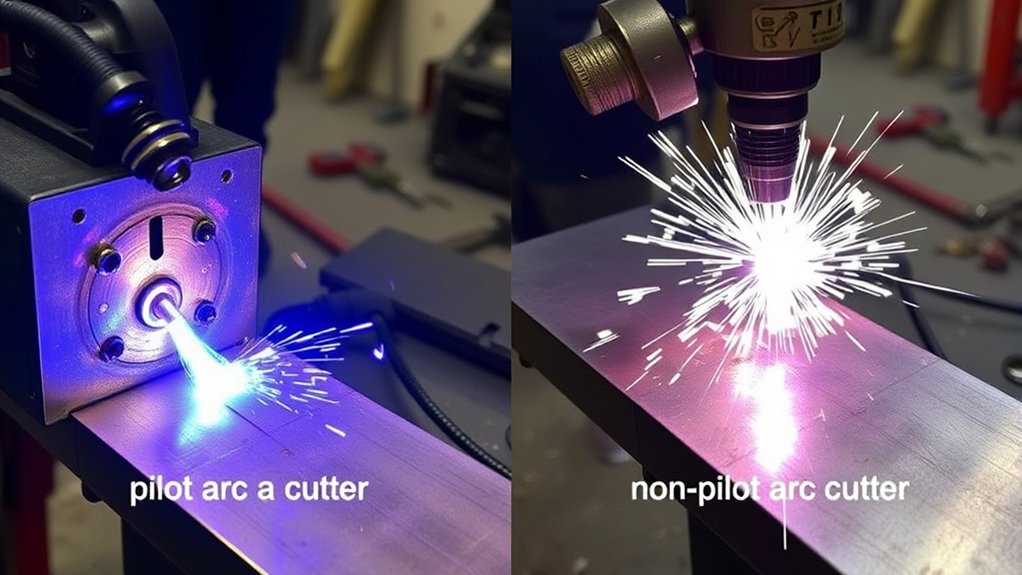
| Feature | Pilot arc | Non-pilot contact-start |
|---|---|---|
| Torch contact at start | Not required for pilot ignition or transfer | Usually required at the starting point |
| Rust, paint, and mill scale | More likely to start with limited prep, although hazardous coatings still require safe removal or fume controls | Usually needs a clean bare spot to initiate the arc |
| Expanded metal and grating | Usually better, especially when the machine can rapidly return to or re-strike the pilot arc across gaps | More likely to lose the arc at every opening |
| Piercing | Convenient for internal starts, but only within the machine’s published pierce capacity and procedure | Possible on some machines, but starting and tip protection can be less forgiving; follow the manual |
| CNC compatibility | Blowback pilot start is often preferred on entry-level CNC systems because it creates far less electrical noise than HF start | Physical contact start is generally less suitable for automated height control and repeated programmed starts |
| Consumables | Avoids repeated nozzle striking, but unnecessary pilot-arc time still consumes the electrode and nozzle | Has no separate pilot burn time, but sticking, tapping, or dragging the wrong tip can damage the nozzle |
| Typical best use | Repair, fabrication, coated stock, mesh, frequent cutouts, and CNC-friendly setups | Clean sheet or plate, occasional straight cuts, and simple low-prep jobs |
Do not confuse cut capacity with pierce capacity
A plasma cutter can have several different thickness ratings. They are not interchangeable:
- Recommended cut capacity: The thickness the machine can cut at a useful speed and acceptable quality.
- Pierce capacity: The maximum thickness where the torch can safely start in the middle of the plate using the specified height and delay.
- Maximum severance: The thickest material the machine can separate slowly, usually with a rougher edge.
Pierce capacity is commonly lower than recommended edge-cut capacity. For example, Hypertherm lists separate recommended, severance, and pierce values for its Powermax systems. That is why the original machine manual, not the words “pilot arc,” must decide whether a direct pierce is allowed.
When piercing is permitted, hold the torch at the specified pierce height or angle it so molten metal blows away from the nozzle, then move to the normal cut height after the arc penetrates. Piercing too low can throw molten metal into the shield and nozzle, damage consumables, and interrupt the arc.
Pro Tip: If the plate is thicker than the published pierce rating but still within the recommended edge-cut range, drill a starting hole or begin from an accessible edge instead of forcing a direct pierce.
Cost, portability, and operating value
Contact-start machines are often found at the lower end of the market because their starting systems can be simpler. A pilot arc model may cost more, but it can save grinding and restart time when you regularly cut rusty plate, coated stock, or interrupted shapes.
Portability depends on the full package. Check the power supply weight, torch and ground-lead length, input voltage, plug requirements, and the compressor you must carry or supply. A lightweight cutter is not truly portable if it needs more air volume than your jobsite compressor can deliver.
Also check the local availability and price of electrodes, nozzles, shields, retaining caps, and complete torch heads. A cheaper machine can cost more over time if consumables are hard to find or wear quickly.
Blowback start vs high-frequency start
Pilot arc describes the preliminary arc inside the torch. It does not tell you how that pilot arc is created. Two common ignition systems are blowback start and high-frequency start.
Blowback pilot start
In a blowback torch, air pressure moves an internal electrode or cartridge away from the nozzle to create the initial spark and ionize the gas. It does not need a high-frequency ignition pulse. Blowback systems still create normal electrical noise, but they create far less high-frequency interference than HF-start machines. That often makes them easier to integrate with entry-level CNC controllers and nearby computers.
High-frequency pilot start
HF start uses a high-voltage, high-frequency pulse to ionize the gas and establish the arc. It starts quickly and remains useful in industrial equipment, but the ignition pulse can interfere with unprotected electronics. CNC installations may need careful grounding, cable routing, shielding, and equipment specifically designed for HF environments.
Note: Sellers sometimes use “lift,” “low-frequency,” “blowback,” and “non-HF” loosely. Read the torch description and manual. For CNC use, confirm that the cutter has a true non-HF blowback start, a supported machine-torch option, a CNC interface or divided-voltage output if needed, and manufacturer approval for automated use.
Setup tips that improve cuts on either machine
- Match compressor flow, not only tank size: Confirm the required CFM at the specified PSI. Set and check pressure while air is flowing because static pressure can look correct and still collapse during a cut.
- Keep the air clean and dry: Moisture, oil, and particles destabilize the arc and shorten consumable life. Use a water separator, drain the compressor, and add coalescing or desiccant filtration when conditions demand it. ESAB’s air-pressure and air-quality guide explains why dynamic pressure and dry air matter.
- Clean the work-clamp spot: Even a pilot arc cutter needs the main arc to transfer through the workpiece. Clamp to bare metal and move the clamp closer if the arc starts but will not transfer.
- Use the correct amps and travel speed: Too fast can leave an incomplete cut or hard bottom dross. Too slow can widen the kerf, increase heat, and build low-speed dross.
- Use the correct tip method: Drag only when the torch and consumables are designed for drag cutting. Otherwise, hold the standoff specified in the manual.
- Inspect consumables as a set: Replace a pitted electrode, distorted nozzle orifice, cracked swirl ring, or damaged shield before it creates hard starts and angled cuts.
- Respect duty cycle: Long cuts at high output can overheat a compact machine. Follow the duty-cycle rating and allow the fan and thermal protection system to work.
Troubleshooting hard starts and arc dropouts
| Symptom | Likely causes | What to check |
|---|---|---|
| No arc or no air | Power, trigger interlock, loose consumables, low pressure, or open safety circuit | Input power, torch assembly, air supply, fault lights, and the manual’s start checklist |
| Pilot arc lights but will not transfer | Poor clamp contact, clamp too far away, nonconductive coating, or excessive standoff | Clean the clamp area to bare metal, move the clamp closer, and use the specified torch height |
| Arc sputters or repeatedly goes out | Wet air, pressure drop, worn consumables, poor electrical connection, or travel across gaps | Drain and filter air, verify flowing PSI and CFM, inspect parts, and confirm the machine supports interrupted cutting |
| Heavy bottom dross | Travel too slow, low current, low air flow, or worn nozzle | Use the manual’s cut chart, increase speed carefully, verify pressure under load, and inspect the nozzle |
| Short consumable life | Contaminated air, overpressure, piercing too low, unnecessary pilot firing, or incorrect parts | Improve filtration, use specified pressure and pierce height, and stop test-firing the pilot arc into open air |
What to check before you buy
- Start system: Pilot arc or contact start, plus blowback or HF ignition.
- Real capacity: Recommended cut, pierce, and severance ratings for the material you use.
- Air demand: Required CFM and PSI with the torch flowing.
- Input power: Voltage, amperage draw, plug type, breaker size, and generator compatibility.
- Duty cycle: Output and ambient temperature at which the rating applies.
- Torch options: Drag shield, standoff guide, machine torch, gouging parts, and lead length.
- CNC support: Non-HF ignition, CNC port, arc-ok signal, divided voltage, warranty terms, and machine-torch support.
- Consumables and service: Local stock, genuine part numbers, torch replacement cost, warranty, and technical support.
Products Worth Considering

【Non-Touch Pilot Arc Function】The ARCCAPTAIN 55A plasma cutter features a pilot arc function. It utilizes a high-frequency non-touch arc starting mode. The torch head does not need to touch the metal plate, reducing energy consumption during non-cutting work, minimizing electrode burning, and extending service life. NOTE: Do not switch voltages until the screen turns off and the fan stops.

【Non-Touch Pilot Arc Function】The plasma cutter features a high frequency non-touch arc starting mode. It allows for cutting steel surfaces with dirt, rust or coatings. The torch head does not need to touch the metal plate, reducing energy consumption, minimizing electrode burning, and extending service life. NOTE: DO NOT power on until the screen turns off and the fan stops working!
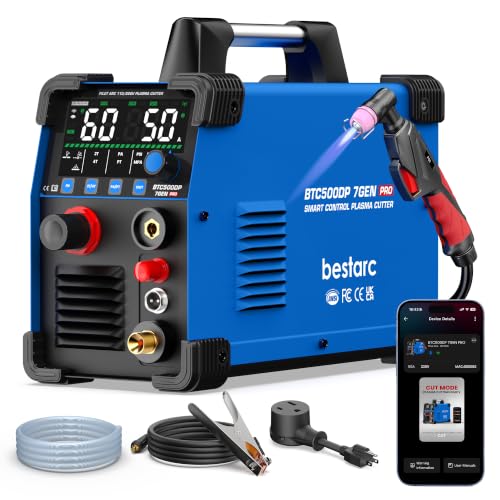
[Smart APP Remote Control Up to 98FT] Control your plasma cutter from up to 98 ft (30 m) away via Bluetooth APP. Adjust cutting current, switch cutting modes, save preferred settings, monitor operating status, and check error codes directly from your phone. Reduce trips back to the machine and work more efficiently—ideal for workshops, auto repair, farms, garages, and DIY projects.
Which plasma cutter start type should you choose?
- Choose a pilot arc cutter if you regularly cut rusty or painted stock, expanded metal, grating, repair parts, or internal shapes. It is also the safer starting point for future CNC use when the model uses non-HF blowback ignition and supports automation.
- Choose a non-pilot contact-start cutter if you mostly cut clean conductive metal, make occasional simple cuts, and do not mind cleaning a small start spot when needed.
Do not choose by start type alone. A well-supported contact-start machine with adequate air, honest capacity ratings, and available consumables can be more useful than a poorly supported pilot arc unit with weak duty cycle or inflated severance claims.
Products Worth Considering

[Powerful Cutting Ability] Dual voltage 110/220V good for home, workshop and hardware shop use. Professional performance 1/2" clean cuts on Iron, Steel aluminum and copper with Inverter IGBT Technology. Very powerful for DIY and heavy duty project. The Maximum cutting thickness is recommended to 1/2" @35A 110V 50PSI; 2/3" @50A 220V 65PSI. Dry and compressed air is required. Power breaker up to 60A@110V 35A; Up to 50A@220V 50A.

CUTTING THICKNESS UP TO 20MM: Featuring a brand-new MCU technology upgrade, the plasma cutter machine has a high degree of internal integration, combining full digitalization for more precise control of cutting parameters such as current and voltage. This results in better cutting effects and improved stability. Cutting thickness: Quality 12mm (1/2"), maximum 20mm (3/4").

Powerful Cutting: This VEVOR plasma cutter delivers a maximum output current of 65A for powerful cutting. It supports clean cuts up to 1/2" (12mm) at 110V and 9/16" (14mm) at 220V, with a maximum cutting thickness of 5/8" (16mm) at 110V and 3/4" (20mm) at 220V
Frequently Asked Questions
Do pilot arc plasma cutters need to touch the metal to start?
No. The pilot arc forms inside the torch, ionizes the air stream, and transfers to the grounded workpiece when the torch is close enough. The work clamp still needs a sound electrical connection.
Can a non-pilot plasma cutter cut rusty or painted steel?
It can cut after the main arc starts, but the coating or rust can prevent reliable contact ignition. Clean a small bare start spot and the clamp area. Also identify coatings and control hazardous fumes before cutting.
Do you need to drill a start hole for piercing?
Not when the material is within the machine’s published pierce capacity and you follow its pierce-height procedure. If the plate exceeds that rating, drill a start hole or begin from an edge rather than forcing a direct pierce.
Does pilot arc always mean high-frequency start?
No. Pilot arc describes the preliminary arc between the electrode and nozzle. A cutter may create that arc with blowback ignition or with a high-frequency ignition circuit.
Is blowback start the same as lift-arc start?
Some sellers use the terms as if they were interchangeable, but “blowback” is the clearer plasma-cutting term for an internal moving electrode or cartridge actuated by air pressure. “Lift-arc” is also widely used for TIG ignition, so verify the plasma cutter’s manual instead of relying on the label alone.
Does a pilot arc cutter still need a clean work-clamp connection?
Yes. The pilot can ignite inside the torch, but the main cutting arc cannot transfer and stay stable without a low-resistance return path through the workpiece.
How does humidity affect plasma cutter performance?
Moisture and oil in compressed air can cause sputtering, unstable starts, rough edges, and faster electrode and nozzle wear. Drain the compressor, use suitable filters, and verify pressure while the torch is flowing.
Which start type is better for a CNC plasma table?
A true non-HF blowback pilot start is usually easier to integrate with entry-level CNC electronics. You should still confirm machine-torch support, CNC interface signals, divided voltage, grounding requirements, and manufacturer approval.
Do pilot arc plasma cutters wear out consumables faster?
Unnecessary pilot-arc time wears the electrode and nozzle, so do not fire the torch into open air for testing. However, non-touch starting can reduce nozzle damage from repeated tapping, sticking, or improper dragging. Air quality and correct setup often matter more than the label.
Can you cut underwater with a standard pilot arc plasma cutter?
No. Underwater plasma cutting uses specialized equipment, procedures, electrical protection, and trained operators. Do not submerge or use a normal handheld air plasma cutter in wet conditions unless its manufacturer specifically designed and approved it for that application.
Bottom line
A pilot arc plasma cutter is the better all-around choice when you cut rusty or coated stock, expanded metal, repair parts, or frequent internal shapes. A non-pilot contact-start cutter can still work well on clean material when low complexity matters more than start convenience.
Whichever type you choose, compare the separate pierce and recommended-cut ratings, verify compressor CFM under load, clamp to clean metal, use dry filtered air, and follow the torch manual. Those details will affect reliability and edge quality more than the start label by itself.
Sources
- ESAB: Understanding Pilot Arc Technology — pilot-arc operation, contact-start comparison, expanded metal, coatings, grounding, and consumable guidance.
- ESAB: How Air Pressure Affects Plasma Cut Quality — dynamic pressure, CFM, moisture, filtration, dross, and consumable wear.
- Hypertherm: 10 Common Plasma Arc Cutting Mistakes — contaminated air, piercing height, travel speed, and consumable protection.
- Hypertherm Powermax85 Specifications — separate recommended cut, severance, and pierce capacities.
- LinuxCNC Plasma Cutting Primer — blowback and high-frequency ignition behavior and CNC interference considerations.
- OSHA 29 CFR 1910.252 — arc-cutting eye protection, ventilation, coated-metal fumes, used-container hazards, and general hot-work safety.