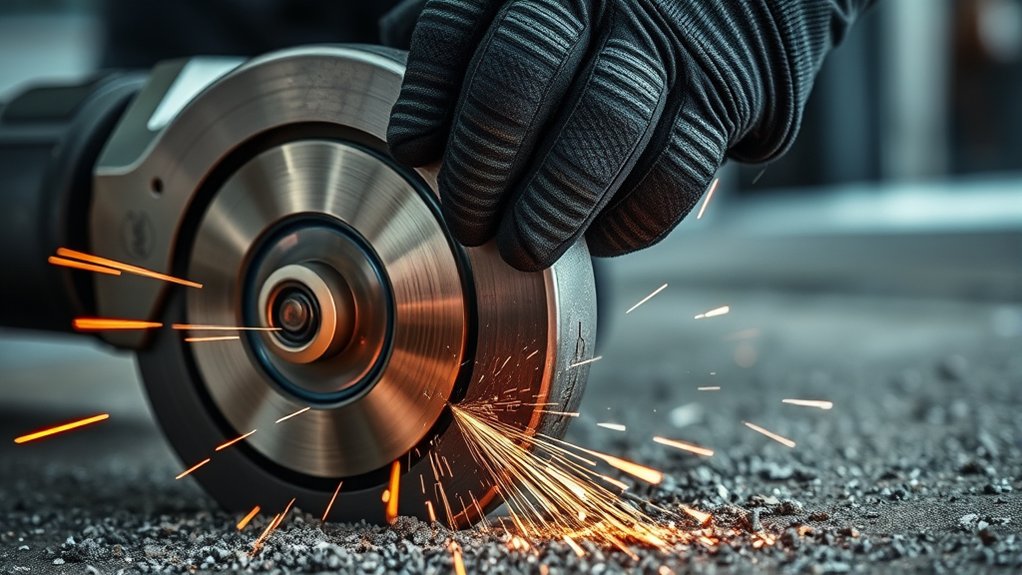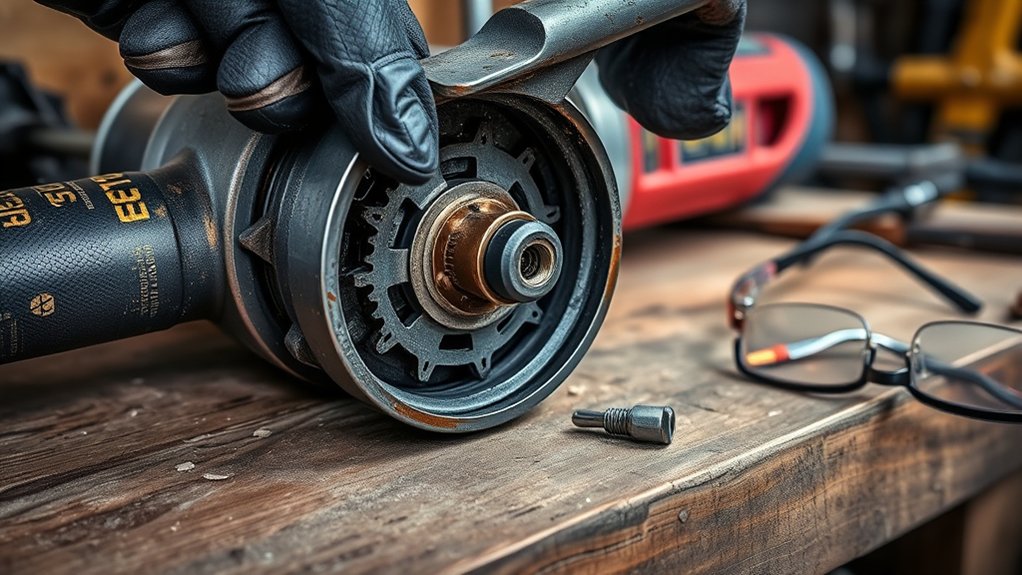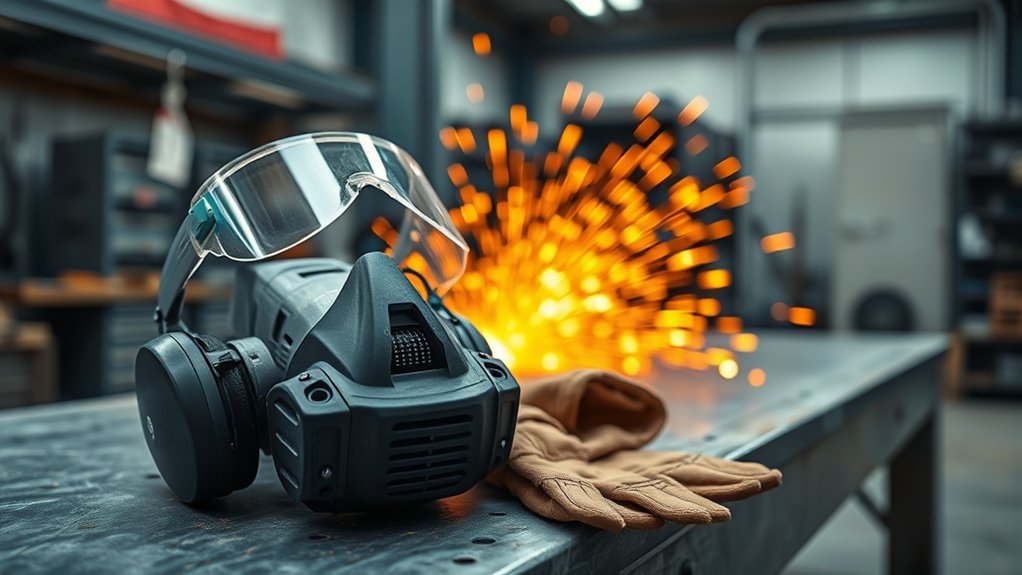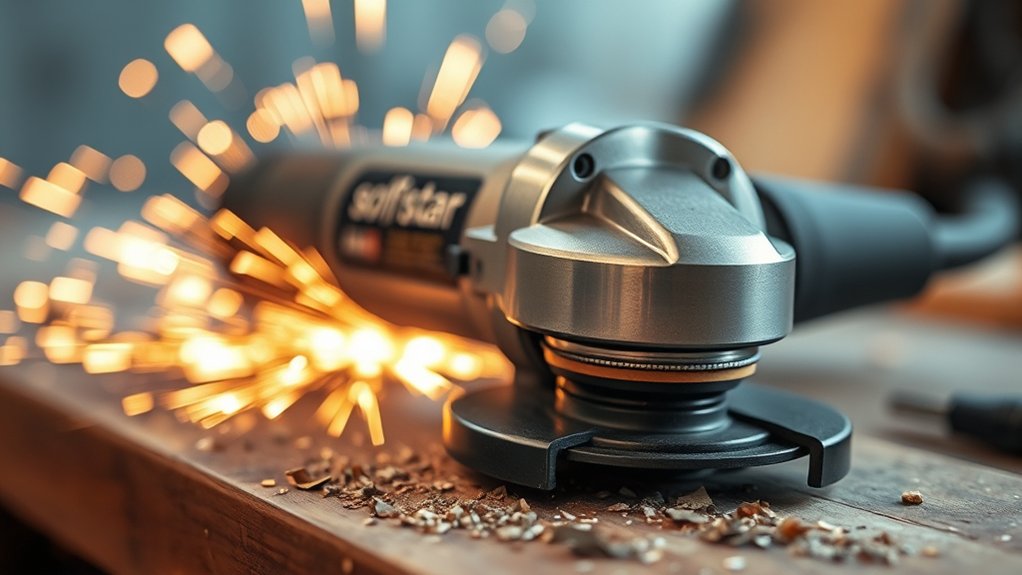
A soft start on an angle grinder controls how quickly the motor accelerates after you press the switch. Instead of delivering full startup force at once, the grinder builds speed over a brief period. This reduces the initial twist in your hands and makes it easier to position the tool. However, soft start does not prevent kickback from a trapped wheel or replace proper guarding and two-handed control.
Quick Answer
Soft start gradually brings an angle grinder up to operating speed instead of applying full startup torque at once. It reduces the initial twist or startup reaction, making the tool easier to hold and position. It does not prevent kickback from a pinched wheel, replace the guard, or make one-handed use safe.
Key Takeaways
- Soft start reduces the grinder’s initial startup reaction and makes the first seconds easier to control.
- It is not the same as variable speed, restart protection, electronic braking, or KickBack Control.
- The feature is often most noticeable on powerful grinders and tools fitted with heavier accessories.
- Safe use still requires the correct wheel, the correct guard, the side handle, eye and face protection, and two hands.
- Do not install a generic soft-start module unless the grinder manufacturer supports the modification and the work is performed by a qualified repair technician.
What Soft Start Does in an Angle Grinder
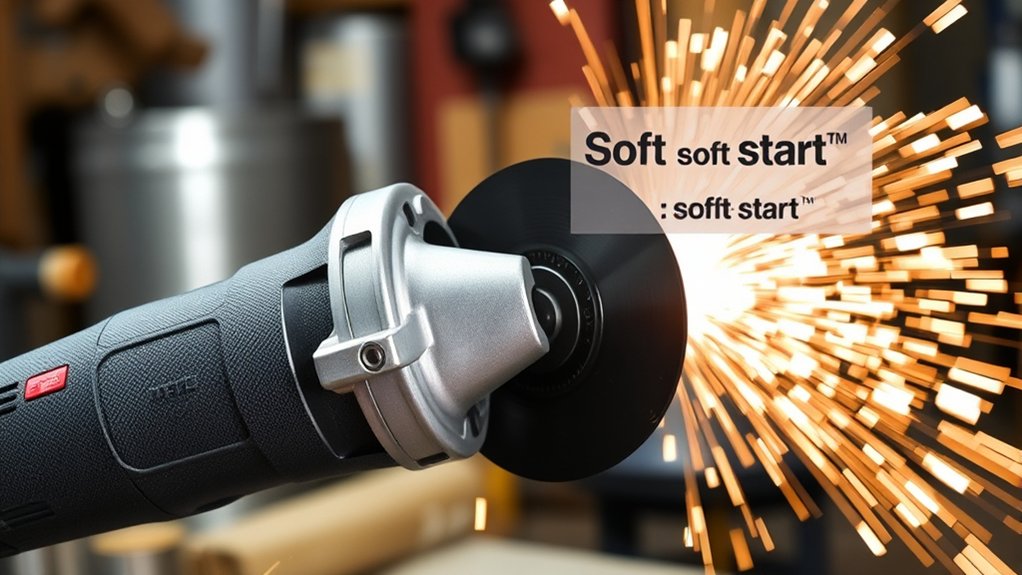
When you switch on a standard grinder, the motor may try to reach operating speed almost immediately. The reaction torque can make the grinder twist in the opposite direction of the wheel’s acceleration. A soft-start circuit controls that first burst of power so the motor reaches speed more gradually.
Manufacturers describe the feature in similar terms. Bosch identifies soft start as a startup-protection feature, while Makita states that soft start suppresses startup reaction on equipped models.
The result is a calmer switch-on rather than a slower working speed. After the brief ramp-up period, the grinder reaches its normal operating speed unless it also has a separate variable-speed control.
Note: Startup reaction and kickback are not the same. Startup reaction occurs as the motor and wheel accelerate. Kickback can occur later if the wheel is pinched, snagged, or forced out of the cut. Soft start reduces the first hazard but does not eliminate the second.
Benefits of Using a Soft Start Feature
The most useful benefit is predictable control during the first moments after switch-on. This can help when you are lining up a cut, working close to a finished edge, or using a grinder with enough power to produce a noticeable startup reaction.
- Less initial twisting: The grinder accelerates without applying its full startup reaction at once.
- Easier positioning: You can establish a secure two-handed grip before the wheel reaches full speed.
- Reduced mechanical shock: A controlled start can reduce the sudden load placed on gears, couplings, and other drive components.
- Lower current peaks on some designs: Soft-start electronics can limit the initial current peak, although the amount depends on the grinder’s motor and control circuit.
- More comfortable frequent starts: The feature is useful when a job requires repeated starting and stopping.
- Cleaner approach to detailed work: A calmer start makes it less likely that an uncontrolled initial movement will mark a nearby surface.
These benefits do not guarantee a longer tool life. Dust, overheating, excessive pressure, blocked vents, worn brushes, battery condition, and overall build quality still have a major effect on reliability. Soft start should be treated as one useful control feature rather than a cure for tool wear.
Soft start controls the first moments after switch-on. Wheel choice, guarding, workpiece support, and two-handed control determine safety during the rest of the job.
Soft Start Compared With Other Grinder Features
Several electronic features sound similar but solve different problems. Check the manufacturer’s feature list rather than assuming that one system performs every function.
| Feature | What It Controls | Main Benefit | What It Does Not Do |
|---|---|---|---|
| Soft start | Initial motor acceleration | Reduces startup reaction | Does not prevent wheel-binding kickback |
| Variable speed | Operating speed after startup | Matches speed to approved accessories and applications | Does not automatically maintain speed under load |
| Constant-speed electronics | Speed changes under load | Helps maintain a steadier working speed | Does not let every grinder run at any chosen speed |
| KickBack Control | Certain sudden wheel stalls or tool reactions | May shut down or limit the tool during a detected event | Cannot prevent every bind, snag, or loss of control |
| Restart protection | Unexpected restart after power returns | Requires the switch to be reset before restarting | Does not slow normal startup unless soft start is also fitted |
| Electronic brake | Wheel coast-down after switch-off | Stops the accessory sooner | Does not control the tool’s initial acceleration |
When Is Soft Start Worth Having?
Soft start is useful on almost any grinder, but its effect is often easier to notice in certain situations:
- High-power grinders: More powerful motors can create a stronger initial reaction.
- Large or heavy accessories: Greater rotating mass can make acceleration feel more forceful.
- Frequent start-and-stop work: Repeated startups are less tiring when each start is controlled.
- Detailed fabrication: A steady start helps when the wheel must be positioned near a marked line or finished edge.
- Restricted work areas: Reduced startup movement can help, although a confined space may create other hazards that require a different tool or work setup.
- Newer users: A gradual start can feel less abrupt, but training and supervision remain more important than the feature itself.
A compact, lower-power grinder can still be safe and useful without soft start. Consider it a valuable convenience and control feature rather than a basic requirement for every small grinder.
Products Worth Considering

【Smooth Start-Up】: Our soft start feature eliminates abrupt starts, allowing your machine to gradually reach full speed within a short time (approximately 1-2 seconds) after powering on. This gentle acceleration effectively protects bearings and gears, extending the lifespan of your tools.

【Smooth Start-Up】: The soft start technology ensures a gradual ramp-up to full speed (within 1-2 seconds), eliminating sudden jerks. This protects motor bearings, gears, and internal components, significantly extending your tool's lifespan.

HIGH TORQUE AND FLEXIBILITY 5 INCH GRINDER: This variable speed grinder features a powerful high torque motor with six variable speed settings, offering exceptional control for a variety of tasks, from polishing to rough grinding.
What to Look For in an Angle Grinder
Soft start should be considered alongside the grinder’s guard system, switch, handle, wheel capacity, and other safety controls.
- Correct guard options: Confirm that the grinder accepts the guard required for the wheel and operation. A grinding guard and a cutting guard may not provide the same coverage.
- Side-handle placement: The handle should fit securely and allow a stable two-handed grip.
- Wheel diameter and thickness: Accessories must remain within the grinder manufacturer’s stated capacity.
- Wheel speed rating: The accessory’s marked maximum RPM must equal or exceed the grinder’s maximum spindle speed. OSHA requires the spindle speed to be checked against the wheel’s marked operating speed.
- Switch type: Consider a paddle or dead-man-style switch when rapid shutoff is important.
- Restart protection: This helps prevent an unexpected restart after a power interruption.
- Kickback detection: Electronic KickBack Control can provide another layer of protection on equipped models.
- Electronic brake: A brake reduces the time the wheel continues spinning after switch-off.
- Variable speed: This is useful only when the manufacturer approves lower speeds for the selected accessory and application.
- Service support: Choose a model with available manuals, replacement guards, handles, flanges, batteries, and authorized repairs.
Pro Tip: Prioritize the correct guard, secure side handle, suitable switch, and compatible wheel before convenience features. Soft start improves startup control, but it cannot make an incorrect accessory or unsafe setup acceptable.
Products Worth Considering


Motor Startup Protection: Gradual current ramp-up prevents damaging power surges. Extends tool lifespan by reducing initial stress on motor components and electrical systems

POWERFUL PERFORMANCE––The digital brushless motor provides efficient, high-performance power for cutting through strong materials like steel, ceramic, and more.
How to Start an Angle Grinder Safely
Use the following checks every time you install an accessory or begin a new task. Always follow the instructions supplied with your exact grinder, guard, and wheel.
- Disconnect the power. Unplug a corded grinder or remove the battery before inspecting, fitting, or adjusting an accessory.
- Inspect the grinder and accessory. Do not use a cracked, chipped, bent, expired, or otherwise damaged wheel.
- Match the accessory to the tool. Check wheel type, diameter, thickness, arbor, mounting hardware, and maximum RPM.
- Fit the correct guard. Position it between your body and the exposed portion of the wheel so fragments and sparks are directed away from you as far as the task allows.
- Install the side handle. Bosch’s grinder-safety guidance calls for two-handed use with the side handle attached.
- Secure the workpiece. Clamp material that is not stable under its own weight, and support long sections near the cut to reduce wheel pinching.
- Clear the area. Remove combustible material, control dust, protect nearby people, and keep the cord away from the wheel and sparks.
- Hold the wheel clear of the material. Establish a firm stance and two-handed grip before pressing the switch.
- Let the wheel reach operating speed. Listen and feel for unusual vibration before bringing it carefully into contact with the workpiece.
Warning: Do not start a grinder with the wheel buried in a cut. A trapped wheel may bind, climb, or kick back as the tool accelerates. Remove the wheel from the cut, let it reach full speed, and then carefully re-enter along the existing path.
Can You Add a Soft Start Module to an Angle Grinder?
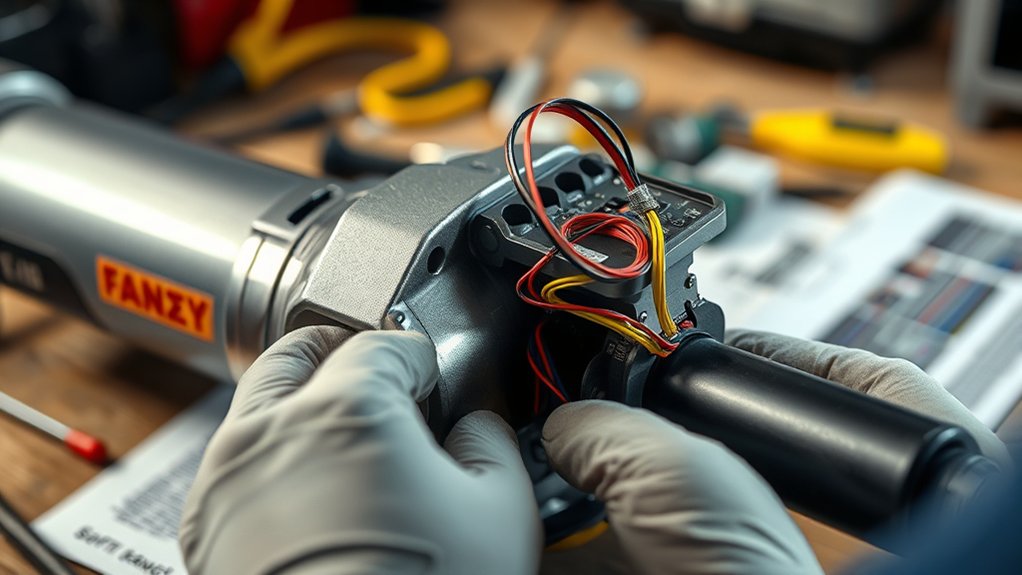
You should not assume that a generic soft-start module can be added to any angle grinder. Corded universal motors, brushless cordless motors, switches, electronic controllers, overload systems, and braking circuits are not interchangeable.
An unsuitable module may prevent the grinder from starting correctly, interfere with braking or restart protection, overheat inside the housing, damage the motor controller, defeat electrical insulation, or create a shock and fire risk. Opening the tool may also affect its warranty or safety certification.
For most users, the safest choice is an angle grinder that includes soft start from the manufacturer. When an existing grinder develops a soft-start fault, use the manufacturer’s parts and an authorized or otherwise qualified power-tool repair service.
Warning: Do not open, probe, or rewire a grinder while it is connected to mains power or a battery. Internal electrical work should be performed only by a qualified technician using the service information and parts specified for that exact model.
A qualified technician evaluating a repair or supported modification must verify all of the following conditions:
| Service Check | What Must Be Verified | Why It Matters |
|---|---|---|
| Power isolation | The plug or battery is removed and any stored electrical energy is handled safely. | Prevents accidental startup and electrical contact. |
| Motor and control design | The module is compatible with the motor, switch, controller, brake, overload protection, and restart system. | An incompatible control can cause poor operation or disable safety functions. |
| Electrical rating | Voltage, current, motor type, duty, and expected starting load match approved specifications. | An underrated component can overheat or fail. |
| Housing and insulation | Clearance, insulation, strain relief, dust protection, airflow, and heat dissipation remain suitable. | Loose or crowded components can create abrasion, heat, shock, and fire hazards. |
| Functional testing | Startup, switch release, braking, overload response, restart protection, insulation, and current draw meet service requirements. | A smooth startup alone does not prove that the grinder is electrically or mechanically safe. |
Capacitors, resistors, rectifiers, semiconductor controls, and other components may appear in soft-start circuits. Their presence does not provide a universal wiring plan. The correct circuit and test procedure depend on the exact grinder model.
Troubleshooting Common Soft Start Problems
Begin with checks that do not require opening the grinder. Unplug the tool or remove its battery before inspecting the wheel, guard, vents, cord, battery contacts, or other external parts.
| Symptom | User-Safe Checks | When to Stop and Seek Service |
|---|---|---|
| The grinder suddenly starts at full speed | Confirm that the model is supposed to have soft start and review its manual. | Stop using it if its normal gradual startup has changed abruptly. The soft-start control or switch may have failed. |
| Startup is unusually slow or weak | Check the supply, extension cord suitability, battery charge, battery seating, wheel size, and free wheel rotation with power disconnected. | Seek service if the motor struggles with no load or the startup behavior continues with a known-good power source. |
| The grinder starts and then stops | Allow the tool to cool, clean external vents, reduce pressure, and check for an overloaded or unsuitable accessory. | Stop if the problem returns under light or no load. The overload circuit, battery, switch, brushes, or motor may need testing. |
| The grinder will not start | Check the outlet, breaker, battery charge, battery contacts, cord condition, and switch position without opening the housing. | Arrange service if the power source is known to be good or the tool has been dropped, wet, or overheated. |
| Burning smell, smoke, body sparks, or unusual heat | Switch off immediately and disconnect the power once it is safe to do so. | Do not restart the grinder. Have it inspected before further use. |
Do not repeatedly cycle a grinder that sounds rough or smells hot. Repeated attempts can worsen damage to the switch, brushes, windings, controller, battery, or soft-start electronics.
Soft Start vs. Variable Speed: What Is the Difference?
Soft start controls acceleration only during startup. Once the grinder reaches normal speed, the soft-start phase is complete.
Variable speed controls operating speed. It lets you select a lower or higher speed within the range approved by the manufacturer. This can be useful for certain sanding, polishing, surface-conditioning, and heat-sensitive applications, but only with an accessory approved for the chosen speed.
A grinder may have soft start without variable speed, variable speed without a sophisticated kickback system, or several electronic features together. Check the exact model specifications instead of relying on terms such as “electronic grinder.”
Frequently Asked Questions
Is a soft start better than a hard start?
Soft start usually provides a more controlled and comfortable startup. It reduces the initial twisting reaction as the wheel accelerates. A basic grinder can still be used safely without it when the tool is suitable for the job and handled correctly.
What are the disadvantages of soft start?
Soft-start electronics add cost and complexity. A failure may require replacement of an electronic module rather than a basic mechanical switch. Poorly designed or incompatible electronics can also cause slow starting, heat, or unreliable operation.
How does an angle grinder soft start work?
The grinder’s control electronics limit the motor’s initial power and then increase it over a short ramp-up period. This reduces the sudden starting reaction before the motor reaches its normal operating speed.
Does soft start reduce starting current?
It can reduce or spread out the initial current peak, depending on the motor and electronic design. It does not guarantee that a weak circuit, undersized extension cord, overloaded battery, or existing electrical fault will stop causing problems.
Can you add soft start to any angle grinder?
No. Compatibility depends on the motor, voltage, current, switch, controller, brake, overload protection, available space, insulation, and heat management. Use only a manufacturer-supported repair or modification performed by a qualified technician.
Do small angle grinders need soft start?
Not necessarily. Many compact, lower-power grinders operate without soft start. The feature can still improve comfort, but the correct wheel, guard, handle, switch, and operating technique are more important.
Does soft start reduce the grinder’s full power?
A properly designed soft-start system limits power only during the brief acceleration period. The grinder should then reach its rated operating speed and power. Continued weak performance may indicate an overload, poor power supply, worn component, or electronic fault.
Does soft start prevent angle grinder kickback?
No. It reduces startup reaction but cannot prevent kickback caused by a pinched, snagged, damaged, incorrectly used, or unsuitable wheel. Proper workpiece support, correct cutting technique, guarding, two-handed control, and any separate KickBack Control feature remain important.
Conclusion
A soft start feature makes an angle grinder easier to control as the motor and wheel accelerate. It can reduce the initial twisting reaction, limit startup shock, and make repeated starts more comfortable. Its role ends once the grinder reaches operating speed.
Choose soft start as part of a complete safety and control package. The correct wheel, sufficient wheel-speed rating, proper guard, secure side handle, suitable switch, stable workpiece, and two-handed technique matter throughout the job. For internal faults or retrofit questions, use model-specific manufacturer guidance and qualified service rather than a generic wiring method.
Sources
- Bosch Professional GWS 1400 — supports the description of soft start as a startup-control and user-protection feature.
- Makita 9564CV Product Details — supports suppressed startup reaction and model-specific drivetrain benefits.
- OSHA 29 CFR 1910.243: Guarding of Portable Powered Tools — supports grinder guarding, wheel inspection, and maximum wheel-speed requirements.
- Bosch Professional Angle Grinder Safety Training — supports power isolation, guard selection, wheel inspection, side-handle use, workpiece support, and safe startup practices.
- Schneider Electric Altistart 01 — supports the general motor-control principles of gradual acceleration and limiting startup torque and current peaks.