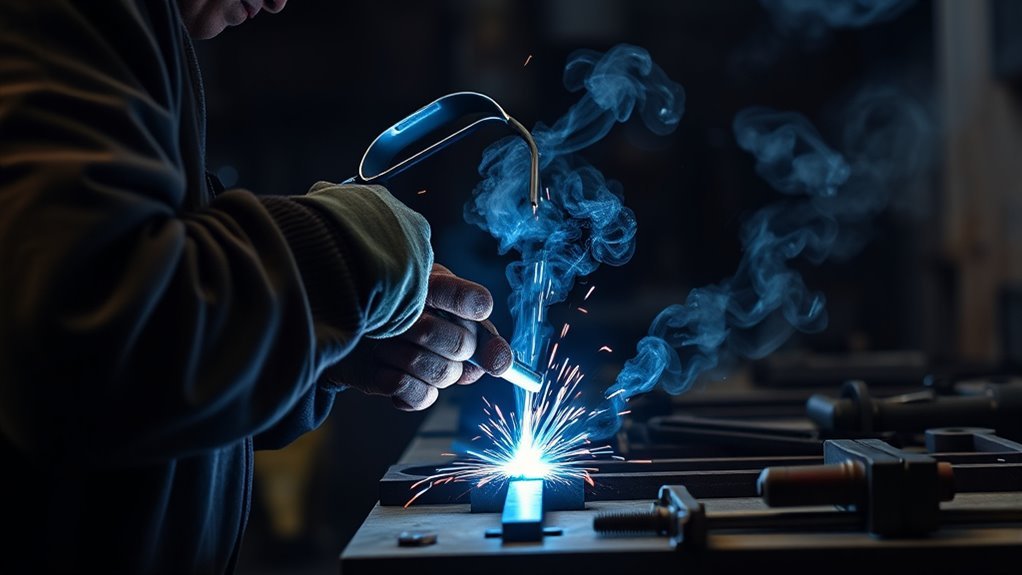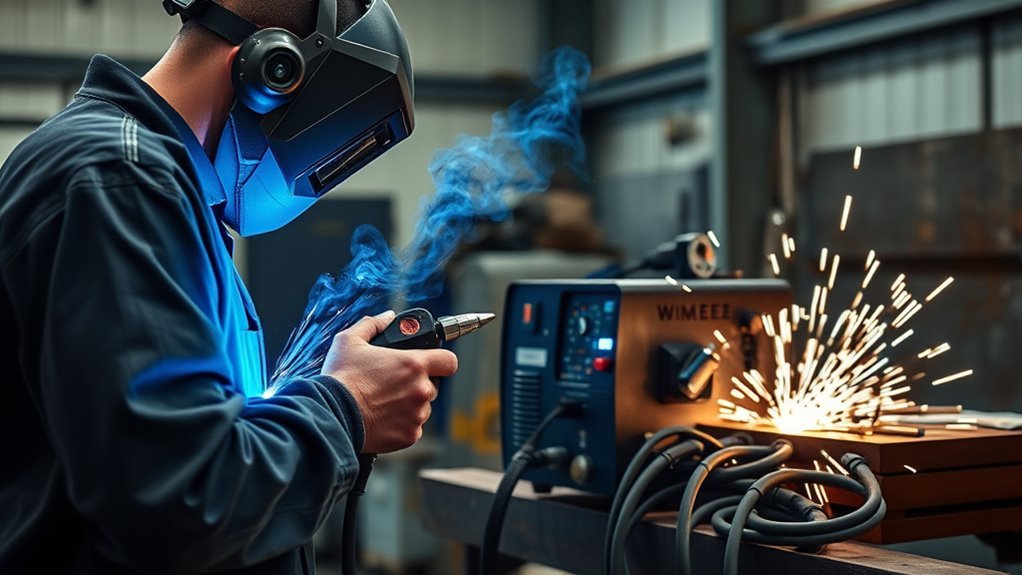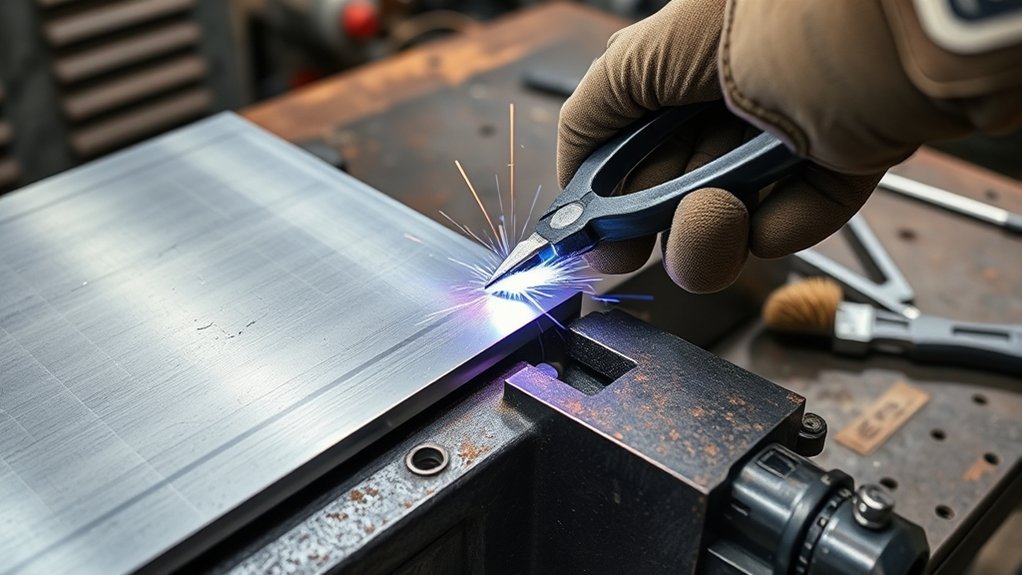
A MIG weld on automotive sheet metal can be strong enough for many body repairs, but only when the joint is clean, tight, and welded with controlled heat. On thin mild-steel panels, the goal is not a tall bead. The goal is full fusion, low distortion, and a weld that survives a bend, peel, or hammer test without cracking away from the base metal.
Quick Answer
A sound MIG weld on mild automotive sheet metal can be very strong, often strong enough for patch panels, seams, brackets, and OEM-approved plug welds. Strength depends on clean metal, tight fit-up, correct wire and gas, controlled heat, and testing. For structural areas, follow the vehicle maker’s repair procedure.
Key Takeaways
- A MIG weld is only as strong as its fusion, fit-up, base metal, and heat control.
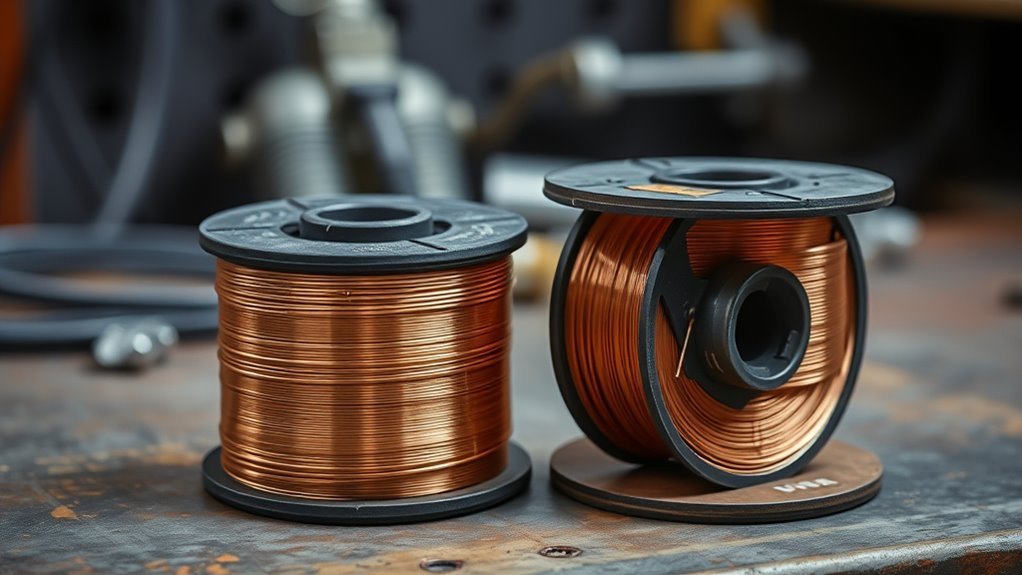
- For most mild-steel body panels, .023-inch or .024-inch solid wire with 75/25 argon-CO2 shielding gas is easier to control than flux-core wire.
- Wire-feed speed does not simply “reduce heat.” It affects amperage and deposition, so tune it with voltage on matching scrap metal.
- Stitch welding, skip welding, and cooling time help prevent burn-through and warping.
- Do not MIG weld structural, AHSS, UHSS, boron steel, or safety-critical areas unless the OEM repair procedure allows it.
At a Glance
| Time Required | 15-30 minutes for setup and test welds; longer for panel repair, grinding, and corrosion protection |
| Difficulty | Moderate; thin sheet metal requires practice before welding the vehicle |
| Tools Needed | MIG welder, .023/.024 solid wire, 75/25 gas, grinder, clamps, copper backing, PPE, fire extinguisher, and matching scrap metal |
| Cost | Low if you already own a welder; expect extra cost for wire, gas, abrasive discs, primer, seam sealer, and cavity wax |
Warning: Welding creates heat, sparks, ultraviolet light, fumes, and fire risk. Remove paint, undercoating, seam sealer, fuel residue, and zinc coating from the weld zone when the repair procedure allows it. Use ventilation, PPE, and a fire watch. Do not weld modern structural or high-strength vehicle parts unless the OEM repair procedure says the location and joining method are approved.
How Strong Is a MIG Weld on Sheet Metal?
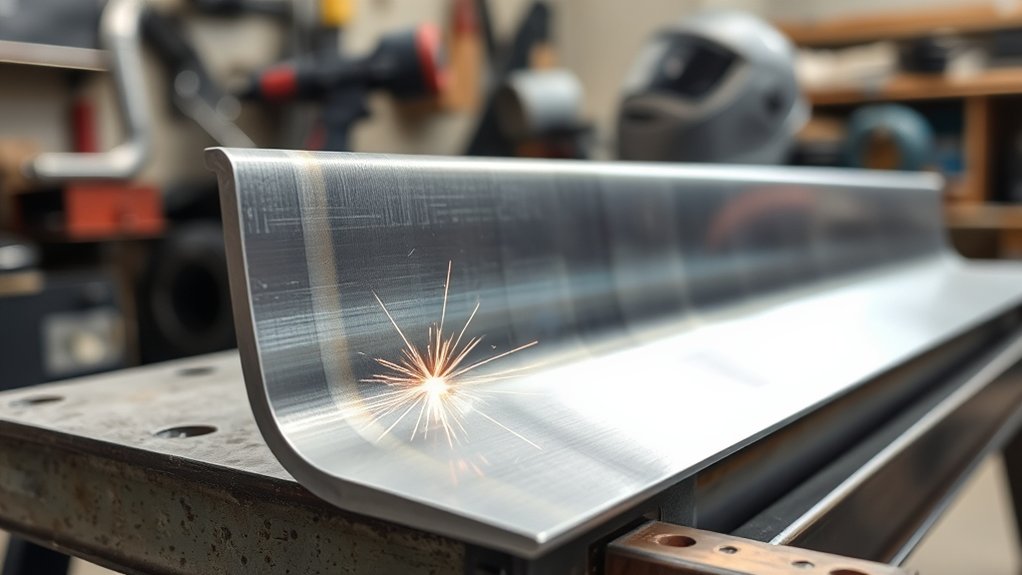
A properly made MIG weld on mild automotive sheet metal can be strong enough for many body repairs. In many good test coupons, the surrounding sheet metal tears before the weld bead separates. That is the practical sign you want: the weld has fused into the base metal instead of sitting on top like a cold bead.
Still, weld strength is not a single number. The filler wire may have a high tensile rating, but the finished joint also depends on the base metal, panel thickness, joint design, penetration, heat-affected zone, and corrosion protection after welding. A strong bead on rusty, painted, or poorly fitted metal is still a weak repair.
For mild-steel sheet metal, ER70S-6 solid wire is a common choice because it works well on clean steel and has deoxidizers that help with minor surface oxidation. If you are welding galvanized steel, remove zinc from the weld area where allowed and use strong ventilation, because welding fumes can contain harmful metals and gases. OSHA’s welding fume guidance explains that welding surfaces should be cleaned of coatings that may create toxic exposure, including paint and solvent residue. OSHA welding fume guidance
For structural sheet-steel work, standards such as American Welding Society standards provide code context. For vehicle repairs, however, the vehicle maker’s repair procedure is the controlling source. If the OEM says a part must be replaced, spot welded, MIG brazed, rivet bonded, or sectioned only at a specific location, do not substitute a regular MIG weld.
What Makes a MIG Weld Strong on Body Panels?
A MIG weld on body panels gets its strength from fusion, not bead size. You need the arc to melt both panel edges enough to join them, but not so much that the sheet overheats, blows through, or warps. Thin panels punish slow travel, wide gaps, dirty metal, and oversized wire.
The strongest sheet-metal MIG welds usually share these traits:
- Clean metal: Remove rust, paint, oil, seam sealer, undercoating, and coating residue from the weld zone.
- Tight fit-up: Keep edges close. Large gaps force you to fill holes instead of welding a joint.
- Correct wire: Use .023-inch or .024-inch solid wire for most thin mild-steel body panels.
- Correct gas: Use 75/25 argon-CO2 for common short-circuit MIG welding on mild steel.
- Short welds: Use tacks, stitches, and skip welding to keep the panel cool.
- Good ground: Clamp the ground to clean, bare metal on the workpiece.
- Test coupons: Weld matching scrap before touching the vehicle panel.
Pro Tip: For body panels, a slightly flatter, well-fused bead is usually better than a tall rope-like bead. A high bead can look strong while hiding poor side fusion underneath.
Why Wire Size and Gas Matter
Wire size and shielding gas control how manageable the puddle feels on thin sheet metal. Smaller solid wire needs less current to melt, so it gives you finer control when the panel is easy to overheat. That is why many auto body welders prefer .023-inch or .024-inch wire for thin mild steel.
A 75% argon and 25% CO2 shielding gas mix, often called C25, gives a stable short-circuit arc on mild steel with less spatter than straight CO2. It also helps the bead wet into the base metal cleanly. If shielding gas is blocked, blown away, or set too low, the weld can develop porosity and weak spots. This is why gas flow issues can ruin an otherwise good setup.
Set gas flow by the welder, nozzle, cup size, and work area. Many sheet-metal jobs are run around the low-to-mid 20 CFH range indoors, then adjusted after checking the bead. More gas is not always better. Too much flow can create turbulence and pull air into the shielding zone.
Note: Self-shielded flux-core wire can be useful outdoors, but it is usually harder to control on thin body panels. For most mild-steel automotive sheet metal, solid wire with shielding gas gives cleaner, cooler, easier-to-test welds.
How to Prep Sheet Metal for MIG Welding
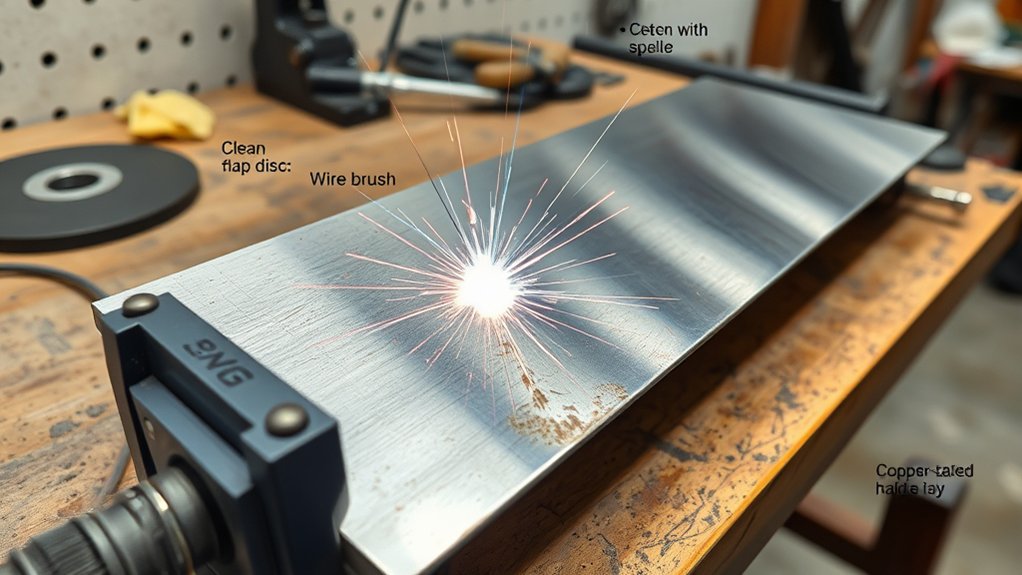
Before you strike the arc, clean the sheet metal until the weld area is bare and bright. Paint, rust, oil, zinc, body filler, seam sealer, and undercoating can cause porosity, weak fusion, and hazardous fumes. Clean both sides of the weld area when you can reach them, because heat can pull contamination from the back side into the puddle.
- Strip paint, rust, zinc coating, and scale from the weld zone where the repair procedure allows it.
- Remove nearby seam sealer, undercoating, sound deadener, and insulation that can ignite.
- Wipe oil or wax with a suitable cleaner, then let the metal dry fully before welding.
- Fit the panel tightly before tacking. Do not rely on weld metal to fill large gaps.
- Clamp the panel so it cannot lift, shift, or vibrate while you weld.
- Attach the ground clamp to clean bare metal, not paint, rust, or a loose bracket.
- Keep wind and fans from blowing across the shielding gas.
If the joint is a butt weld, use careful trimming and clamps to hold the panel flush. If the joint is a plug weld replacing a factory spot weld, drill or punch clean holes, remove burrs, and make sure the lower panel is bare where the plug weld will fuse.
Safety and OEM Repair Limits Before You Weld
Automotive welding is not only a bead-quality issue. It is also a safety and repair-procedure issue. Modern vehicles may use mild steel, high-strength steel, ultra-high-strength steel, boron steel, galvanized coatings, adhesives, and factory spot welds in the same body shell. Welding the wrong area can reduce crash performance.
Use this rule: cosmetic sheet metal can often be MIG repaired, but structural repair must follow OEM information. That includes pillars, rocker panels, rails, strut towers, bumper reinforcements, suspension mounts, roof rails, door intrusion beams, and any part tied to airbag or crash-load paths.
Before welding a vehicle, check for:
- OEM sectioning locations and approved joining methods
- Whether the part is mild steel, HSS, AHSS, UHSS, boron steel, aluminum, or coated steel
- Fuel lines, brake lines, wiring, airbags, modules, interior trim, and insulation near the weld
- Fire risk behind the panel, not just on the side you can see
- Required corrosion protection after welding
For fume control, OSHA recommends understanding the hazards of the materials being welded, cleaning coatings that may create toxic exposure, positioning yourself to avoid breathing fumes, and using ventilation or respiratory protection when needed. OSHA welding, cutting, and brazing resources
MIG Welding Settings for Automotive Sheet Metal
The best settings are the ones that pass a test on scrap metal of the same thickness as the repair panel. Use the chart inside your welder door as the starting point, then fine-tune voltage, wire-feed speed, travel speed, and stickout. Do not copy one voltage or wire-speed number and assume it fits every welder.
Products Worth Considering

[9-Inch Heavy Duty Construction] Full 9-inch length provides reach and leverage for welding, sheet metal, and fabrication work.

✅【ER70S-6 PROFESSIONAL PERFORMANCE】- Highest manganese-silicon deoxidizers eliminate pre-cleaning! Weld rusty/oily plates smoothly with 100% CO2 gas. Perfect for sheet metal - zero burn-through at high amps (AWS A5.18 Certified).
Voltage and Wire Speed
Voltage affects arc length and how the bead wets into the metal. Wire-feed speed affects amperage and how much wire is deposited. On a constant-voltage MIG welder, turning up wire speed usually increases current, so it can add heat rather than reduce it. The right setting sounds steady and produces a small puddle that ties into both edges without dropping through.
- Start with the welder’s chart for the wire size, metal thickness, and shielding gas.
- Use .023-inch or .024-inch wire for most thin mild-steel panels.
- Keep stickout short, often around 1/4 to 3/8 inch.
- Use short tacks or stitches instead of long continuous beads.
- Increase travel speed or reduce heat if the edge glows too wide or starts to sag.
- Retune if you change wire size, gas, polarity, panel thickness, or joint type.
Test Panel Calibration
A test panel gives you control before you risk the real part. Cut scrap from the same thickness and type of metal when possible. Clean it the same way you cleaned the vehicle panel. Then weld short beads or plug welds and break them apart.
- Set the welder from the machine chart.
- Run a few tacks or short stitches on matching scrap.
- Check the front for smooth tie-in and minimal spatter.
- Check the back for slight heat marks or penetration, not a large burn-through crater.
- Bend, peel, or hammer the coupon to see whether the weld holds.
- Adjust one setting at a time and test again.
If the bead sits on top, increase heat slightly or slow down. If the panel collapses, reduce heat, shorten the weld time, improve fit-up, or use copper backing. That test coupon is the difference between guessing and welding with a plan.
What Settings Prevent Burn-Through?
You prevent burn-through by combining low controlled heat, fast enough travel, good fit-up, and short weld duration. Settings matter, but technique matters just as much. A perfect setting can still burn through if you hold the arc in one spot too long.
| Problem | Likely Cause | Fix |
|---|---|---|
| Panel opens into a hole | Too much heat, too much dwell time, or a gap | Use shorter tacks, tighten fit-up, add copper backing, and retest settings |
| Tall cold bead | Too little heat or poor ground | Clean the ground, increase heat slightly, or slow travel on scrap |
| Porosity | Dirty metal, poor gas coverage, wind, or too much nozzle distance | Clean again, check gas flow, shorten stickout, and block drafts |
| Warped panel | Too many welds in one area | Skip around the panel and let each tack cool before adding another |
For more detail on thin-panel technique, review heat control and practice until you can make repeatable tacks without blowing holes in scrap.
How to Weld Patch Panels Without Warping
Welding patch panels without warping starts with controlling heat from the first tack. Set the patch so it sits flush, tack it at several points, and then build the weld slowly. Do not run one long bead around a body patch. That traps heat and pulls the panel out of shape.
- Clean both surfaces to bright metal.
- Fit the patch tightly with a small, consistent gap if a gap is needed for your method.
- Tack opposite sides first to lock alignment.
- Use short stitches or individual tacks.
- Move to another area after each weld.
- Let the panel cool naturally; do not quench hot sheet metal unless the repair procedure allows it.
- Hammer and dolly only when needed and only after the weld is stable.
You’ll get better fusion when the joint is clean and the arc stays steady. If you rush or linger, the panel can pull, shrink, or oil-can. A consistent travel speed helps, but the bigger habit is patience: tack, move, cool, inspect, and repeat.
Products Worth Considering

Value Pack: The package includes 24 packs of butt welding clamps, enough quantity to meet your daily needs and replacements. Each butt welding clamps is individually wrapped in a small bag, convenient to carry and use.

Clamp for holding items in place; ideal for pocket hole joinery, woodworking, welding, and other projects or repairs

16-Pack Welding Clamps Set: Includes 16 butt welding clamps designed for precise edge-to-edge welding, ideal for body repair, floor patching, door skins, and sheet metal alignment.
Best Joint Types for MIG Welding Car Sheet Metal
The joint type affects strength as much as machine settings. A clean butt weld may look best on an exterior patch, while a plug weld may be required when replacing a factory spot weld. Choose the joint based on the panel, access, corrosion risk, and OEM procedure.
| Joint Type | Best Use | Strength Notes |
|---|---|---|
| Butt weld | Visible patch panels and flush repairs | Can be strong and clean, but needs tight fit-up and careful heat control |
| Lap weld | Hidden flanges and non-cosmetic areas | Easy to weld, but trapped seams must be sealed to prevent corrosion |
| Plug weld | Replacing factory spot welds where OEM allows MIG plug welds | Needs fusion into the lower panel, not just a filled hole |
| Stitch weld | Long seams on thin sheet metal | Controls heat by breaking the weld into short sections |
How Do MIG Welds Compare to TIG on Sheet Metal?
When you’re welding sheet metal, MIG usually gives you faster, easier control for quick repairs and stitch work. TIG takes more skill, but it lets you control heat and filler more precisely. Neither process is automatically stronger in every repair. The stronger weld is the one that matches the metal, joint, procedure, and test requirement.
MIG Speed and Ease
MIG welding is usually faster on automotive sheet metal because the machine feeds wire continuously. It is practical for tacks, stitch welds, plug welds, brackets, and many mild-steel panel repairs. It is also easier for many beginners to learn than TIG because one hand controls the gun and filler at the same time.
- Fast setup and repair speed
- Good for tacks, stitches, and plug welds
- Works well on mild-steel body panels with solid wire and gas
- More spatter than TIG if settings are poor
- More heat spread if you weld too long in one place
TIG Precision and Control
TIG gives finer control over the puddle, filler rod, and heat input. That makes it useful for visible seams, thin custom fabrication, and places where appearance matters. TIG can produce a clean weld with less spatter, but it is slower and requires more coordination.
| Process | Sheet Metal Result |
|---|---|
| MIG with solid wire and 75/25 gas | Fast, practical, strong when tuned and tested |
| MIG with self-shielded flux core | Better outdoors, but usually smoky and harder on thin panels |
| TIG with argon | Slower, cleaner, more precise, and better for fine visible work |
Understanding flux core welding still helps your overall welding knowledge, but it does not replace the need to tune solid-wire MIG for thin automotive sheet metal.
What Causes Weak MIG Welds and Porosity?
Weak MIG welds usually come from poor surface prep, bad gas coverage, poor fit-up, or incorrect settings. If you leave rust, oil, paint, zinc, seam sealer, or moisture in the joint, the puddle can trap gas and form pinholes. If the wire speed and voltage are out of balance, the bead may sit on top without fusion or burn through before it bonds.
- Rust or paint: causes contamination and poor fusion.
- Oil, wax, or solvent: can create porosity and hazardous fumes.
- Wind or fan airflow: can push shielding gas away from the puddle.
- Long stickout: reduces control and weakens gas coverage.
- Wrong polarity: causes unstable arc performance.
- Oversized wire: makes thin panels harder to control.
- Poor ground: creates an erratic arc and inconsistent penetration.
Before blaming the welder, check the basics: clean metal, correct polarity, fresh contact tip, clean nozzle, good ground, proper gas flow, and matching scrap tests. If the welder still acts wrong, this guide to a MIG welder not working can help you isolate gas, wire-feed, and electrical problems.
How to Test a MIG Weld on Automotive Sheet Metal
Testing matters because a weld can look acceptable and still be weak. Always test on scrap before welding the vehicle, especially when you change metal thickness, wire size, shielding gas, or joint type.
Visual Weld Inspection
A quick visual inspection can tell you a lot. Look for a consistent bead that ties into both sides of the joint without undercut, pinholes, or cold overlap. On thin sheet, you want controlled heat marks on the back side, not a large melted crater.
- No porosity or pinholes
- No cracks or crater cracks
- No cold bead sitting on top of the panel
- No severe overheating discoloration
- No panel distortion around the weld
- No excessive spatter from poor settings or gas coverage
Bend Test Methods
After visual inspection, bend a test coupon. For a butt-weld sample, bend the metal back on itself and watch whether the weld cracks or separates. For a lap or plug weld, peel the top piece away from the bottom piece. A good plug weld should tear metal around the nugget instead of popping out cleanly like a button.
Shop tests do not replace code testing or OEM repair validation, but they help you find problems before the repair is on the car. If the weld breaks cleanly at the joint, improve prep, heat, or technique and test again.
Stress Test Results
Record what happens during each test. Note the wire size, gas, voltage setting, wire-feed setting, metal thickness, joint type, and failure point. This simple log helps you repeat a good setup later.
- Peel the joint along the weld line.
- Measure or note how much force it took to fail.
- Look for porosity, undercut, or lack of fusion.
- Check whether failure happened in the weld or the base metal.
- Retest after every major setting change.
A good sheet-metal MIG weld is proven on a test coupon before it is trusted on the vehicle.
When Is MIG Strong Enough for Repairs?
MIG is strong enough for many repair jobs when you match the process to the material and joint. It is commonly used for mild-steel patch panels, small brackets, seams, and OEM-approved plug welds. It is not automatically approved for structural parts, high-strength steels, or crash-load areas.
| Repair Factor | What You Should Do |
|---|---|
| Mild-steel body patch | Use solid wire, shielding gas, tight fit-up, and stitch welding |
| Plug weld replacement | Use the hole size, spacing, and procedure allowed by the OEM or repair standard |
| Structural or crash part | Follow OEM repair information; do not guess or substitute another weld type |
| Stainless steel part | Use filler and shielding gas that match the stainless alloy and procedure, such as ER308L only when appropriate for the base metal |
| Rusty load-bearing area | Cut back to sound metal or replace the part; do not weld over thin rust |
For critical repairs, choose the filler wire, gas, joint design, and weld location from the repair information, not from habit. If you keep penetration consistent, prevent burn-through, and protect the metal after welding, MIG gives durable, practical strength for many mild-steel sheet-metal jobs.
Post-Weld Finishing and Corrosion Protection
A strong weld can still fail early if corrosion starts behind it. After welding, grind only as much as needed. Do not thin the base metal while chasing a perfectly flat surface. Then restore corrosion protection on both sides of the repair.
- Dress the bead carefully without grinding into the panel.
- Clean grinding dust and residue from the repair area.
- Apply weld-through primer only where the repair system calls for it before welding.
- After welding, use epoxy primer or the coating system recommended for the repair.
- Seal lap joints and flanges with seam sealer.
- Apply cavity wax inside closed sections after refinishing where appropriate.
This step matters most on lap joints, rocker panels, wheel arches, and lower body areas where moisture can sit behind the repair.
Frequently Asked Questions
Can you MIG weld auto body panels?
Yes, you can MIG weld many mild-steel auto body panels. Use clean metal, tight fit-up, .023-inch or .024-inch solid wire, 75/25 shielding gas, short tacks, and test coupons. For structural panels, follow the OEM repair procedure before welding.
Is MIG welding as strong as stick welding?
MIG and stick can both make strong welds when used on the right material with the right procedure. Stick welding is better suited to thicker steel and outdoor work. MIG is usually better for thin automotive sheet metal because it is easier to control at lower heat.
Is MIG welding good for automotive work?
Yes, MIG welding is useful for many automotive mild-steel repairs, especially patch panels, brackets, seams, and approved plug welds. It is fast and practical, but it must be tuned carefully to avoid burn-through, porosity, and warping.
What wire size is best for automotive sheet metal?
For most thin mild-steel body panels, .023-inch or .024-inch solid MIG wire is the easiest to control. Thicker brackets or heavier sheet may work with .030-inch wire, but you should test on matching scrap before welding the vehicle.
Should I use flux-core wire on car body panels?
Usually no. Self-shielded flux-core wire is convenient outdoors, but it is often smoky, spattery, and harder to control on thin sheet metal. Solid wire with 75/25 shielding gas is usually the cleaner choice for mild-steel body panels.
What is the thickest metal you can weld with MIG?
That depends on the welder output, wire size, joint design, and number of passes. Some high-output MIG welders can weld steel around 1/2 inch thick with the right setup, but this article focuses on thin automotive sheet metal, where heat control matters more than maximum thickness.
Conclusion
When you MIG weld automotive sheet metal, strength comes from clean prep, tight fit-up, correct wire and gas, and controlled heat. A good weld should fuse both sides of the joint without burning through or warping the panel. The safest habit is simple: test on matching scrap, inspect the result, break a coupon when possible, and only then weld the vehicle. For structural repairs, let the OEM procedure decide whether MIG welding is allowed.
Sources
- OSHA — Controlling Hazardous Fume and Gases during Welding — welding fume hazards, coating cleanup, ventilation, and respiratory safety.
- OSHA — Welding, Cutting, and Brazing — official welding safety topic page and standards references.
- American Welding Society Standards — welding code and sheet-steel standards context.
- Miller — MIG Welding: The Basics for Mild Steel — MIG setup and mild-steel welding fundamentals.
- Lincoln Electric — Gas Metal Arc Welding Basics and Troubleshooting — GMAW process basics, settings, and troubleshooting principles.