A dirty MIG welder can turn a straightforward job into an erratic wire feed, unstable arc, overheated gun, or porous weld. Spatter, metallic dust, damaged cables, worn tips, and loose gas fittings all affect performance. The steps below show you how to clean the accessible parts safely, identify parts that need replacement, and know when the machine needs professional service.
Quick Answer
Turn off and unplug the MIG welder, close the shielding-gas cylinder, and let the gun cool. Clean the nozzle, contact tip, diffuser, feeder, and drive rolls with hand tools, a vacuum, or filtered dry air as the owner’s manual allows. Inspect the liner, cables, hose, fittings, and clamp; replace damaged or worn parts.
Key Takeaways
- Close the gas supply, shut down the machine as directed by its manual, unplug it, and let hot parts cool before cleaning.
- Clean the complete wire path: drive rolls, guide tubes, liner, contact tip, diffuser, and nozzle.
- Use a vacuum, hand brush, or filtered dry air only where the machine or gun manufacturer permits it.
- Replace elongated tips, cracked hoses, damaged cables, clogged liners, and heat-damaged consumables instead of trying to restore them.
- Do not open internal electrical compartments, lubricate parts, or use solvents unless the owner’s manual specifically authorizes the procedure.
At a Glance
| Time Required | 15–30 minutes for routine cleaning; longer if the liner or consumables need replacement |
| Difficulty | Easy to moderate for owner-authorized maintenance |
| Tools Needed | Safety glasses, gloves, MIG pliers or nozzle reamer, clean hand brush, vacuum, clean cloth, and approved leak-detection solution |
| Cost | About $0–$30 when you already own the tools; replacement liners, cables, guns, or regulators cost more |
What’s in This Article
- Before You Begin: Clean a MIG Welder Safely
- What You’ll Need to Clean a MIG Welder
- Clean the Case, Vents, and Wire Feeder
- Clean the Nozzle, Tip, and Diffuser
- Check the Liner, Cable, and Gas Hose
- Inspect Drive Rolls and Gun Connections
- Replace Worn MIG Consumables on Time
- Prevent Spatter Buildup on the Gun
- Follow a MIG Welder Maintenance Routine
- Troubleshoot the Welder After Cleaning
- Common MIG Welder Cleaning Mistakes
- When to Use a Qualified Service Technician
- Frequently Asked Questions
- Conclusion
- Sources
Warning: This guide covers routine maintenance on parts the owner’s manual allows you to access. Do not remove power-source covers or touch internal electrical components unless the manufacturer’s procedure specifically authorizes the work and you are qualified to perform it.
Before You Begin: Clean a MIG Welder Safely
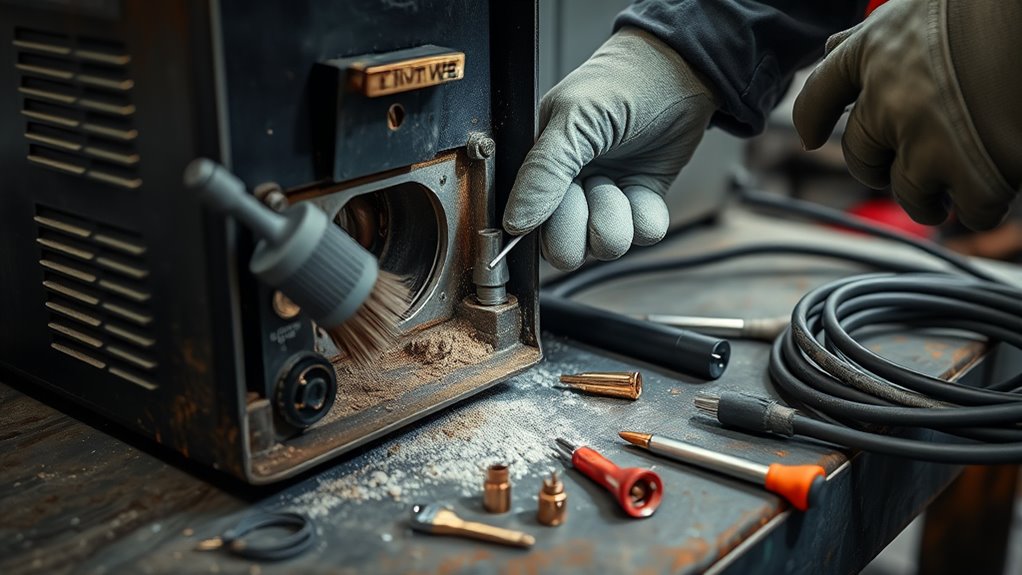
Read the maintenance section of the welder and MIG gun manuals before removing a part. The manual controls the shutdown order, approved cleaning method, air pressure, liner direction, replacement procedure, and tightening requirements for your model.
- Finish the weld and release the trigger. Keep the gun pointed away from people and conductive objects.
- Close the shielding-gas cylinder valve. Follow the owner’s manual to relieve downstream pressure. Do not press the gun trigger to vent gas unless the manual instructs you to do so.
- Turn the machine off and unplug it. In a workplace, also follow the employer’s energy-control or lockout procedure.
- Let the gun and consumables cool. A nozzle, diffuser, or contact tip may remain hot after the arc stops.
- Wear safety glasses and clean gloves. Glasses protect against wire fragments, spatter, and airborne dust. Clean gloves keep oil away from consumables and wire.
- Clear the work area. Remove flammable material and keep hoses and cables out of walkways.
Inspect the power cord, plug, gun cable, work lead, and visible insulation before cleaning. Cuts, exposed conductors, heat damage, loose plug blades, or crushed insulation require repair or replacement. The same basic warning signs discussed when you inspect a damaged power cord apply to portable welding equipment.
Lincoln Electric’s Handy MIG manual directs users to disconnect input power before internal work and to leave maintenance and troubleshooting that exceed routine service to qualified personnel.
Note: Turning the front-panel switch off does not replace unplugging or isolating the input supply. Do not assume an internal compartment is safe to enter simply because the machine has stopped running.
What You’ll Need to Clean a MIG Welder
Gather the tools and replacement parts before you start so the welder does not remain partly disassembled.
- Safety glasses and clean work gloves
- MIG pliers, nozzle reamer, or the gun maker’s approved nozzle tool
- Clean hand brush with bristles suitable for the part being cleaned
- Vacuum with a narrow nonconductive attachment when available
- Clean, dry cloths or shop towels
- Filtered, dry compressed air when the manual permits it
- Approved gas leak-detection solution
- Replacement contact tips, nozzles, diffusers, O-rings, or liners matched to the gun and wire
- Anti-spatter spray, gel, or nozzle dip approved for the gun and application
- The welder and gun owner’s manuals
A routine gun and feeder cleaning usually takes 15 to 30 minutes. Replacing a conventional liner or tracing a gas leak takes longer because the gun may need to be disconnected, laid straight, and reassembled to a specified liner stickout.
Warning: Never use gasoline, chlorinated brake cleaner, or another unidentified solvent on the welder, gun, wire, or nearby metal. Heated chlorinated-solvent residue or vapor can form highly toxic phosgene. Use only a cleaner specifically approved by the equipment manufacturer and its safety data sheet.
Clean the Case, Vents, and Wire Feeder
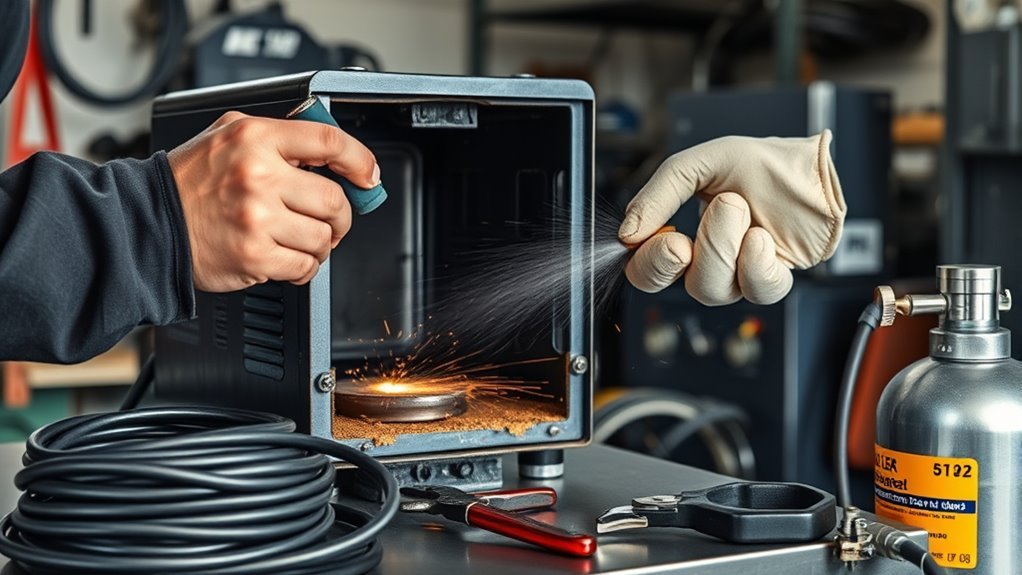
Start with the parts that collect shop dust and wire shavings. Keep the welder unplugged and leave fixed cabinet panels in place unless the owner’s manual provides an owner-maintenance procedure for removing them.
- Wipe the exterior. Use a clean, dry cloth. Do not spray liquid cleaner into switches, displays, vents, receptacles, or cable connections.
- Clear ventilation openings. Vacuum loose dust from intake and exhaust openings. Do not push debris farther into the machine.
- Open only the normal wire-feed or spool door. Vacuum loose metallic dust, wire fragments, and dirt from the accessible feeder compartment.
- Brush guide tubes and accessible surfaces. Use a clean hand brush rather than a powered wire wheel.
- Inspect the wire spool. Replace wire that is rusty, oily, kinked, or heavily contaminated. Feeding dirty wire through the gun can quickly foul the liner and tip.
- Check cooling airflow. Bent panels, blocked vents, and thick dust buildup can make the welder run hotter.
Miller’s maintenance checklist recommends vacuuming or using filtered compressed air to remove dirt from a welder and cleaning the drive rolls periodically. It also directs owners to use the machine’s manual for complete procedures.
Note: When compressed air is used for workplace cleaning, OSHA 29 CFR 1910.242 requires pressure below 30 psi at the cleaning nozzle, along with effective chip guarding and personal protective equipment. A gun manual may provide a separate procedure for blowing out a removed liner; follow both the applicable safety rules and the manufacturer’s limits.
Clean the Nozzle, Tip, and Diffuser
The nozzle directs shielding gas, the contact tip transfers welding current to the wire, and the diffuser carries current while distributing gas. Buildup or loose connections in this group can restrict gas coverage, increase resistance, overheat the gun, or destabilize the arc.
- Remove the nozzle as the gun manual directs. Thread-on and slip-on nozzles use different removal methods.
- Remove loose spatter. Use MIG pliers, a nozzle reamer, or a suitable hand brush. Do not gouge the bore or damage an internal insulator.
- Inspect the contact tip. Replace it when the hole is enlarged, elongated, rough, burned, or repeatedly catches the wire.
- Check the tip size. The stamped tip size must match the wire size and the gun manufacturer’s recommendation.
- Inspect the diffuser. Clear accessible gas holes without enlarging them. Replace a cracked, burned, stripped, or badly clogged diffuser.
- Reassemble the front end. Seat each component fully and tighten it only as the gun manual specifies. Do not overtighten small threads.
Bernard and Tregaskiss explain that the contact tip transfers weld power, the nozzle directs shielding gas, and the diffuser both distributes gas and carries electricity to the tip. Their condition and fit affect both arc performance and gas coverage.
Different processes may use different front-end parts. A self-shielded flux-core setup may use a gasless nozzle, while gas-shielded flux-core welding still relies on clear gas passages. Confirm the correct parts before applying general flux-core welding practices.
A clean nozzle alone cannot correct an obstructed liner or dirty drive system. Reliable feeding depends on the entire path from the spool to the contact tip.
Products Worth Considering

COMPATIBILITY: Designed for Lincoln Magnum 100L (K530 series) and Tweco Mini/#1 welding torches. This kit is also a direct fit for YESWELDER FLUX-135PRO Old Version/MIG-140DS PRO/YWM-160/MIG-165DS PRO/MIG-185DS PRO/MIG-205DS PRO/MIG-250PRO/MCT-520.

Superior Durability: Our copper nozzles in the Lincoln Magnum 100L & Tweco Mini/#1 MIG welding gun accessories kit are engineered to provide exceptional durability, offering longevity and resistance to spatter adhesion.

COMPATIBILITY: Designed for Lincoln Magnum 100L (K530 series) and Tweco Mini/#1 welding torches. This kit is also a direct fit for YESWELDER FLUX-135PRO Old Version/MIG-140DS PRO/YWM-160/MIG-165DS PRO/MIG-185DS PRO/MIG-205DS PRO/MIG-250PRO/MCT-520.
Check the Liner, Cable, and Gas Hose
The liner guides the wire through the gun cable. Dust, copper flakes, steel particles, rust, tight cable loops, or an incorrectly trimmed liner can increase drag and cause erratic feeding, burnback, or birdnesting.
- Remove the wire and disconnect the gun when the manual requires it. Do not pull a liner through a loaded or energized feeder.
- Lay the gun cable straight. Tight curves make cleaning less effective and can hide a damaged liner.
- Remove the nozzle and contact tip. Follow the gun manual for any additional front-end disassembly.
- Clean the liner using the approved method. Many manufacturers permit filtered dry air, but direction, pressure, and disassembly vary. Aim the discharge away from people and equipment.
- Replace rather than clean a damaged liner. Kinks, corrosion, collapsed sections, recurring drag, or incorrect trimming call for replacement.
- Inspect the cable jacket and hose. Look for cuts, flattening, burns, stiff sections, loose fittings, or evidence of leaking gas.
| Component | What to Inspect | Corrective Action |
|---|---|---|
| Liner | Debris, rust, kinks, drag, incorrect length | Clean by the approved method or replace |
| Gun cable | Cuts, crushed areas, burns, tight loops | Straighten for use or replace if damaged |
| Gas hose | Cracks, abrasion, loose fittings, bubbles during testing | Tighten as specified or remove from service |
| Power pin or gun connector | Dirt, looseness, heat discoloration, damaged seals | Clean, reseat, or replace according to the gun manual |
| Cable routing | Sharp bends, tight coils, pinch points, trip hazards | Support the cable in broad loops and clear the walkway |
To check a shielding-gas connection, secure the cylinder upright, open the valve according to the regulator instructions, and apply an approved leak-detection solution to the connection being tested. Bubbles indicate a leak. Close the cylinder before tightening or replacing a part, and never test for gas leaks with a flame.
Clean parts cannot compensate for incorrect voltage, wire speed, polarity, gas flow, or technique. Pair maintenance with appropriate MIG settings for the wire, joint, and material.
Inspect Drive Rolls and Gun Connections
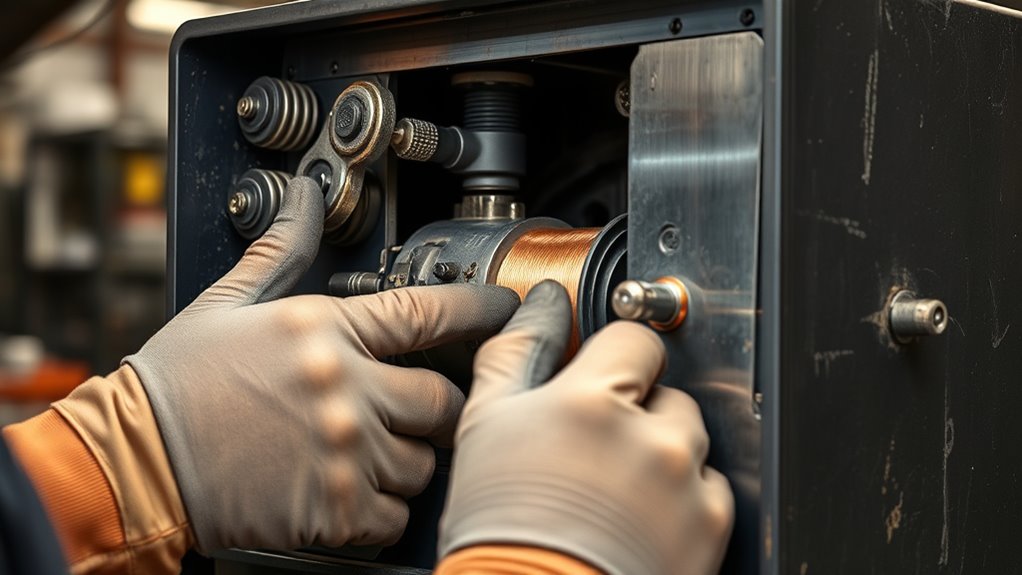
Drive rolls must grip the wire firmly enough to feed it without crushing, shaving, or deforming it. Metallic dust around the rolls or guide tubes is often a sign of excessive pressure, the wrong groove, contaminated wire, or misalignment.
- Release the drive-roll pressure and remove the wire as the manual directs.
- Vacuum loose shavings from the feeder compartment.
- Remove and brush the drive rolls when the manufacturer’s procedure permits it.
- Confirm that the groove and guide components match the wire size and type.
- Align the wire through the guide tubes and the center of the roll groove.
- Reset tension using the machine’s prescribed test. Do not increase pressure merely to overcome a clogged liner or worn tip.
Inspect the gun connector, power pin, trigger plug, neck, and trigger leads. Clean mating surfaces only with a manufacturer-approved method. Loose or heat-discolored connections can create electrical resistance and may require replacement rather than further tightening.
Check the work lead and clamp as well. Remove dirt, rust, or spatter from the clamp’s contact surfaces and confirm that the cable connection is tight. Poor work-clamp contact can mimic a machine or wire-feed fault.
Keep feeder parts free from process contamination. Surface coatings such as zinc require separate preparation and fume controls; review the correct method before attempting to remove zinc coating or perform MIG welding on galvanized steel.
Pro Tip: If drive-roll pressure must be increased repeatedly to keep the wire moving, stop and inspect the tip, liner, cable routing, spool brake, guide alignment, and wire condition. Extra pressure can hide the original restriction while creating wire shavings and deformation.
Replace Worn MIG Consumables on Time
Consumables should be replaced according to condition and the gun manufacturer’s instructions rather than an arbitrary calendar date. Heavy arc time, high amperage, short-circuit transfer, contaminated wire, and frequent burnback can shorten service life.
| Part | Replace It When | Common Symptoms |
|---|---|---|
| Contact tip | The bore is elongated, enlarged, rough, burned, or blocked by fused wire | Hunting arc, erratic current transfer, wire wandering, repeated burnback |
| Nozzle | It is cracked, distorted, heavily gouged, loose, or cannot be cleared safely | Poor gas coverage, spatter bridging, contact with the tip |
| Diffuser | Gas holes remain blocked or threads, insulation, or sealing surfaces are damaged | Uneven gas flow, excess heat, loose consumables |
| Liner | It is kinked, rusty, incorrectly trimmed, collapsed, or repeatedly obstructed | Erratic feed, wire shavings, birdnesting, excessive roll pressure |
| O-ring or seal | It is cut, flattened, missing, hardened, or leaking | Gas leakage or an improperly seated gun connection |
Do not lubricate a liner, wire, drive roll, spindle, bearing, or O-ring unless the welder or gun manufacturer specifically calls for a named lubricant. Oil in the wire path collects dirt and can contaminate the weld. Replace a damaged seal rather than coating it with an unapproved product.
When cleaning does not correct porosity, burnback, or an unstable arc, use a structured MIG welding problems and solutions checklist instead of replacing random parts.
Products Worth Considering

Welding tools Package List: Ceramic shunt, Snap on gas nozzles and gas diffusers M6 internal thread each 2pcs, 5pcs Red copper contact tips 0.032''(0.8mm), 3pcs welding tips 0.035''(0.9mm), 3pcs Copper welding tips 0.039''(1.0mm), 3pcs welding contact tips 0.047''(1.2mm). Totally 20pcs in this welder kit of 24KD MIG welding torch consumable parts set

High-valued Package: 15pcs x .030" Contact Tip, 2pcs x Gas Diffuser, 2pcs x Gas Nozzle
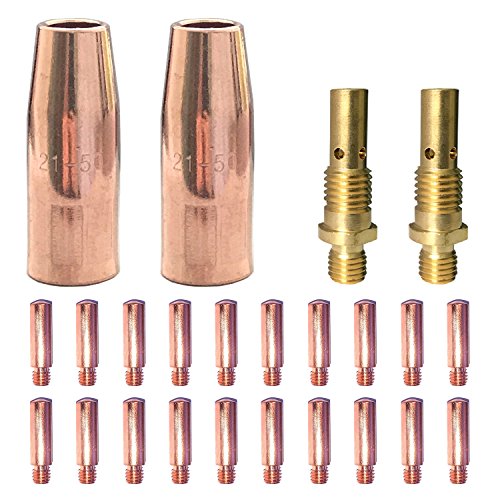
Mig Welding gun accessory 0.030" kit tip-nozzle-diffuser with contact tip,gas nozzle,gas diffuser for Lincoln Magnum 100L & Tweco Mini/#1.
Prevent Spatter Buildup on the Gun
Spatter is easier to remove before it bridges the nozzle and contact tip or blocks diffuser holes. Check the gun during long jobs and after any sudden increase in spatter.
Nozzle Spatter Control
- Let the nozzle cool enough to handle safely.
- Remove it according to the gun design.
- Use MIG pliers, a nozzle reamer, or a suitable hand brush to break away loose deposits.
- Inspect the insulator and seating surfaces while the nozzle is off.
- Replace a distorted or deeply gouged nozzle.
Do not hammer the nozzle against the workbench or use a powered grinding tool on it. Impact can distort the bore, loosen internal parts, or damage the gun neck.
Tip and Diffuser Care
Clear accessible diffuser openings without drilling them larger. Check that the contact tip seats fully against the diffuser and that both parts have sound threads. A loose tip-to-diffuser connection can increase electrical resistance and heat.
Cleaning cannot restore an enlarged tip bore, stripped thread, cracked diffuser, burned insulator, or deformed nozzle. Replace those parts.
Anti-Spatter Cleaning Habits
An approved anti-spatter spray, gel, or nozzle dip may reduce adhesion and make later cleaning easier. Follow the product label and gun manufacturer’s instructions.
- Apply only a light amount where the product is intended to be used.
- Keep excess product out of the contact-tip bore, diffuser gas holes, liner, wire, trigger, and electrical connections.
- Do not soak a hot gun unless the product specifically permits that use.
- Consider later painting, coating, or inspection requirements before spraying the workpiece.
- Store spare tips, nozzles, liners, and diffusers in clean packaging.
Pro Tip: Keep correctly sized spare contact tips and one compatible nozzle near the machine. A fast replacement is safer and more reliable than trying to reuse a keyholed tip or badly distorted nozzle.
Follow a MIG Welder Maintenance Routine
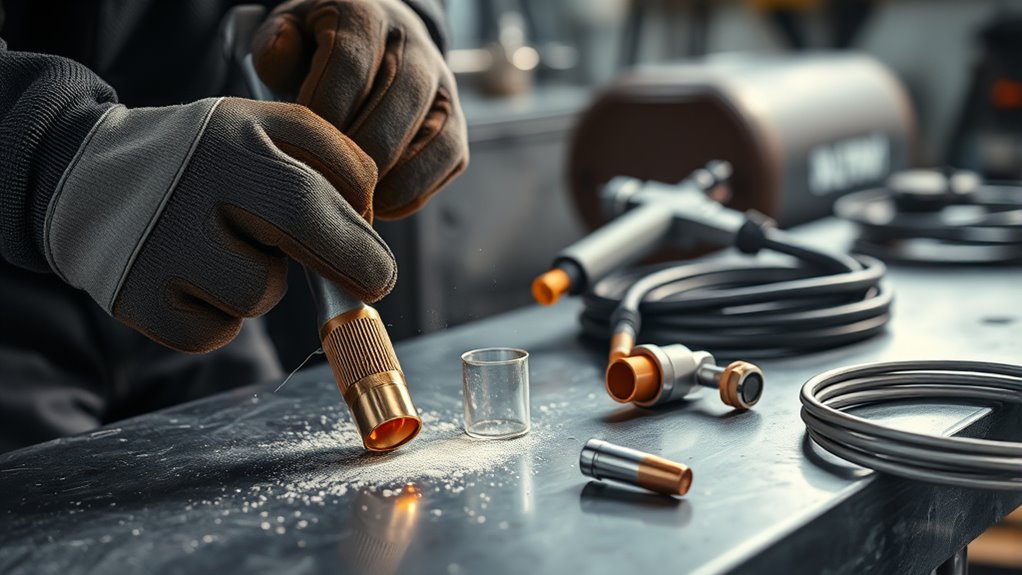
Maintenance frequency depends on arc time, wire type, shop dust, humidity, and the manufacturer’s schedule. A machine used daily in a grinding area needs attention sooner than a hobby welder stored in a clean, dry cabinet.
| Interval | Suggested Checks |
|---|---|
| Before each use | Inspect cords, cables, gun, clamp, hose, fittings, wire condition, and visible damage. |
| After each session | Close the gas supply, clean nozzle spatter, check the tip, wipe the exterior, and store the cable in broad loops. |
| Monthly | Check accessible gun and work-lead connections, clean the clamp, and inspect the feeder for shavings. |
| About every three months | Inspect hoses and cables closely, clean accessible terminals, and service the gun liner as the manual directs. |
| About every six months | Clean the accessible welder and feeder, remove and clean drive rolls when authorized, and inspect cooling airflow. |
| As needed | Replace worn consumables, damaged seals, cracked hoses, faulty clamps, contaminated wire, or a restricted liner. |
This schedule reflects general guidance in Miller’s welder-maintenance checklist. Follow shorter intervals when the machine sees heavy service or operates near grinding dust, moisture, corrosive material, or high humidity.
Daily Cleaning Checks
- Check the nozzle for spatter and the tip for burnback or bore wear.
- Inspect cables and hoses for fresh damage.
- Confirm that the cylinder is secure and the hose is not pinched.
- Clean the work clamp’s contact surfaces.
- Close the shielding-gas valve when the machine is not in use.
- Wrap the gun cable in broad, loose loops instead of tight coils.
Inspect Consumables Often
Inspect the nozzle, tip, diffuser, and liner before a new job and during long production runs. Look for heat discoloration, spatter bridges, elongated holes, rough edges, damaged threads, and blocked gas openings.
Use clean gloves when handling replacement parts. Do not drag a new liner across the floor or leave consumables loose in a dusty drawer.
Protect Cables and Gas
Route gun and work cables so vehicles, doors, sharp edges, and hot metal cannot crush or cut them. Keep the gas hose away from sparks and avoid hanging the gun by its cable.
Close the cylinder valve when work is finished. Follow the regulator and welder manuals before disconnecting a regulator or relieving pressure. OSHA’s cylinder-handling rules also require cylinders to be secured upright and the valve to be closed when work is finished.
Regular maintenance helps prevent the restrictions and connection faults commonly associated with MIG welder wire-feed problems.
Troubleshoot the Welder After Cleaning
Reassemble the gun, reinstall the correct wire, and verify that all doors and guards are in their normal operating position. Reconnect power and gas only after tools, loose wire, and cleaning materials have been removed.
Perform a test weld on clean scrap that matches the intended material and thickness. Do not test the machine on a structural or finished part.
| Symptom | Cleaning-Related Causes to Check | Other Checks |
|---|---|---|
| Erratic wire feed | Dirty or worn tip, restricted liner, wire shavings, misaligned guides, tight cable loops | Roll tension, spool brake, correct roll and tip size, damaged gun |
| Porosity | Blocked nozzle or diffuser, loose gun connection, leaking hose or fitting | Gas flow, wind, contaminated metal, wrong gas, excessive stickout |
| Repeated burnback | Worn tip, liner drag, dirty drive system | Wire speed, tip size, stickout, feeder timing, gun condition |
| Gun becomes unusually hot | Loose tip or diffuser, spatter bridge, dirty connection | Duty cycle, undersized gun, damaged cable, internal connection fault |
| Unstable arc | Elongated tip, poor work-clamp contact, dirty power connection | Polarity, voltage, wire speed, input power, contaminated wire |
Stop testing if the machine trips a breaker, smells burned, sparks inside the case, displays an electrical fault, leaks gas after a connection is tightened correctly, or continues to overheat.
Common MIG Welder Cleaning Mistakes
- Cleaning while connected to power: Turning off the switch is not a substitute for unplugging or isolating the supply.
- Leaving the gas cylinder open: Close the cylinder before cleaning or loosening gas-system parts.
- Blasting dust with uncontrolled air: High pressure can scatter metal particles, damage delicate parts, or pack debris into a liner.
- Directing compressed air at skin or clothing: Never use compressed air to clean yourself or another person.
- Opening the electrical cabinet: Internal cleaning and troubleshooting may require a qualified service technician.
- Reusing a worn contact tip: A keyholed or enlarged tip cannot be restored by brushing or reaming.
- Overtightening torch parts: Excess force can strip threads, crack an insulator, or collapse a liner.
- Using solvent on drive components: Solvent may wash lubricant from bearings or leave contamination in the feed path.
- Lubricating the liner or rolls: Oil collects dust and can contaminate the wire and weld.
- Using chlorinated brake cleaner: Chlorinated residues and vapors can form toxic decomposition products near an arc.
- Ignoring the work clamp: Poor contact can look like a power-source or wire-feed fault.
- Increasing roll tension to overcome a blockage: This may crush the wire and create more metallic debris.
- Storing consumables loose: Dirt, oil, moisture, and impact damage can shorten their life.
The CDC’s phosgene guidance notes that welding metal cleaned with chlorinated hydrocarbons can produce phosgene. Keep chlorinated degreasers away from welding equipment, workpieces, and welding areas.
When to Use a Qualified Service Technician
Routine cleaning should stop when the problem moves beyond accessible consumables, feeder parts, cables, hoses, or normal owner-service items. Arrange qualified service when you find any of the following:
- Exposed conductors, burned wiring, melted connectors, or damaged input plugs
- Repeated breaker trips or internal fuses that continue to open
- Burning odors, smoke, internal arcing, or unusual electrical noise
- A fan that does not operate as the manual describes
- Persistent overheating after vents and accessible dust are cleaned
- A gas solenoid, regulator, valve, or hose that continues to leak
- A cracked gun neck, damaged power pin, failed trigger, or severely overheated gun cable
- A feeder motor or gearbox that binds, slips, or makes abnormal noise
- A fault code that remains after the manual’s approved checks
- Any repair that requires cabinet removal, electrical measurement, capacitor discharge, or energized testing
Provide the technician with the machine model, serial number, gun model, wire type and size, gas type, fault code, and a clear description of when the problem occurs.
Frequently Asked Questions
How often should you clean a MIG welder?
Check the nozzle, contact tip, cables, hose, wire, and clamp before or after each welding session. Inspect the feeder regularly, service the liner when feeding becomes rough or at the manual’s interval, and clean accessible machine dust and drive rolls periodically. Heavy use and dusty conditions require more frequent maintenance.
What is the fastest way to clean MIG welder spatter?
After the welder is shut down and the gun has cooled, remove the nozzle and use MIG pliers, a nozzle reamer, or an approved hand tool. Replace rather than force-clean a distorted nozzle, blocked diffuser, or contact tip with an enlarged bore.
When should you replace a MIG contact tip?
Replace it when the wire hole is elongated, enlarged, rough, burned, blocked by fused wire, or no longer holds the wire steadily. A hunting arc, repeated burnback, excessive wire movement, or unusual heat can also point to a worn or loose tip.
Can a dirty liner cause MIG wire-feed problems?
Yes. Dust, rust, metal flakes, a kink, or an incorrectly trimmed liner can increase friction and contribute to uneven feeding, birdnesting, wire shavings, and burnback. Clean it only by the gun manufacturer’s procedure and replace it when damage or recurring drag remains.
Should you use compressed air inside a MIG welder?
Use a vacuum or filtered dry air only where the welder or gun manual permits it. Use low pressure around the machine, comply with workplace compressed-air rules, and do not remove fixed electrical covers unless the manufacturer authorizes owner access. Liner-cleaning pressure and direction are model-specific.
Can you use brake cleaner to clean a MIG welder?
Do not use chlorinated brake cleaner or an unidentified solvent on the welder, gun, wire, or nearby workpiece. Chlorinated residues and vapors can form highly toxic gases when exposed to welding heat or ultraviolet radiation. Use only a cleaner approved by the equipment manufacturer.
Should you lubricate a MIG gun liner or drive rolls?
Not unless the equipment manufacturer specifically instructs you to use a named product. Oil and general-purpose lubricant collect debris and may contaminate the wire and weld. Clean the parts by the approved method and replace damaged components.
How do you know whether cleaning fixed the problem?
Reassemble the machine correctly and make a test weld on clean scrap. Wire should feed smoothly, gas flow should remain steady, and the arc should not hunt or cut out. Stop and troubleshoot further if the gun overheats, the feed remains erratic, gas leaks, or an electrical fault appears.
Conclusion
Cleaning a MIG welder safely means maintaining the whole system rather than scraping only the nozzle. Shut down the gas and power correctly, clean the accessible case and feeder, service the nozzle, contact tip, diffuser, liner, drive rolls, guides, gun connections, hose, work lead, and clamp, and replace any part that is worn or damaged.
Use the owner’s manual as the controlling instruction for access, compressed-air pressure, liner cleaning, tightening, lubrication, and gas shutdown. A short condition-based routine prevents many feed and gas problems, while clear service limits keep routine cleaning from becoming unsafe electrical repair.
Sources
- Miller Electric — Welder Maintenance Checklists — daily, three-month, six-month, liner, cable, hose, and drive-roll maintenance guidance
- Lincoln Electric — Handy MIG Owner’s Manual — shutdown, electrical safety, nozzle and tip cleaning, liner cleaning, feeder cleaning, and consumable replacement
- Bernard and Tregaskiss — Welding Gun Consumables Guide — functions and selection of nozzles, contact tips, diffusers, liners, and power pins
- OSHA 29 CFR 1910.242 — compressed-air cleaning pressure, chip guarding, and PPE requirements
- OSHA 29 CFR 1926.350 — compressed-gas cylinder securing, shutdown, handling, and hose precautions
- CDC — Phosgene Medical Management Guidelines — danger of welding metal exposed to chlorinated hydrocarbons