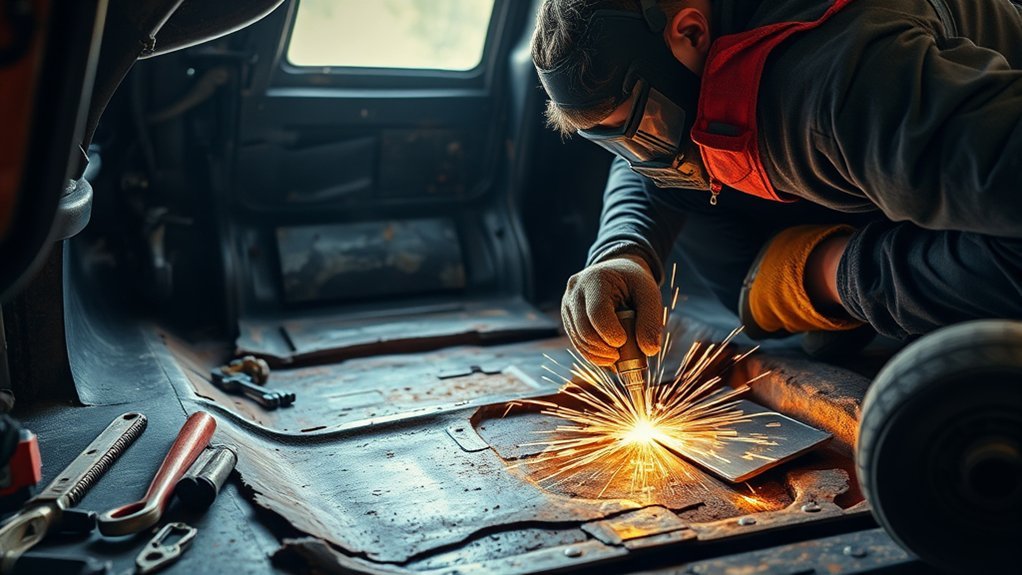
Rust in a car floor pan often extends farther than the hole you can see from inside the cabin. A durable repair requires you to find the source of the moisture, remove every section of weak steel, fit a matching patch, control welding heat, and restore the coatings on both sides. Before cutting, confirm that the damage does not involve a seat mount, seat-belt anchor, reinforcement, frame rail, high-voltage component, or another structural area.
Quick Answer
To patch-weld a car floor pan at home, first confirm the rust is limited to a nonstructural area. Remove nearby combustibles, cut back to solid steel, fit a same-thickness patch, tack and skip-weld it with controlled heat, then inspect, prime, seam-seal, paint, and protect both sides.
Key Takeaways
- Find and correct the leak or trapped-moisture source before repairing the metal.
- Consult the vehicle maker’s body-repair information before choosing a joint or weld pattern.
- Remove rust until the complete edge of the opening is clean, solid steel.
- Practice on same-thickness scrap and use separated tacks rather than one continuous bead.
- Inspect the back side for fusion, pinholes, heat damage, and hidden fire before applying coatings.
- Use professional repair if damage reaches a seat mount, restraint anchor, reinforcement, frame area, or hybrid/EV high-voltage component.
At a Glance
| Time Required | Several hours to a full day for a small nonstructural patch; extensive shaping, coating removal, or hidden rust adds time |
| Difficulty | Advanced DIY; requires safe vehicle lifting, sheet-metal fabrication, and thin-metal welding experience |
| Tools Needed | MIG welder, cutoff tool, grinder, sheet-metal tools, clamps, measuring tools, safe lifting equipment, ventilation, PPE, and fire extinguisher |
| Cost | Varies with patch size, replacement steel, welding consumables, coatings, safety equipment, and whether you already own the tools |
Most home floor-pan patch repairs take several hours to a full day. Heavy corrosion, difficult underside access, complex panel contours, or additional water-leak repairs can extend the job.
What’s in This Article
- Assessing Floor-Pan Rust Before Welding
- What Tools and Materials You’ll Need
- Preparing the Vehicle for Safe Welding
- Cleaning and Cutting the Damaged Floor Pan
- Fitting the Patch Panel
- Choosing a Floor-Pan Welding Technique
- Step-by-Step Patch-Welding Process
- Inspecting the Weld Before Sealing
- Sealing and Protecting the Repair
- Troubleshooting Common Welding Issues
- When to Get Professional Help
- Frequently Asked Questions
- Sources
- Conclusion
Warning: Do not weld a floor pan until you have inspected both sides for fuel lines, the fuel tank, brake lines, wiring, electronic modules, restraint-system components, insulation, undercoating, and other combustible or heat-sensitive materials. Stop if the repair is near a high-voltage battery or orange high-voltage cable.
Assessing Floor-Pan Rust Before Welding
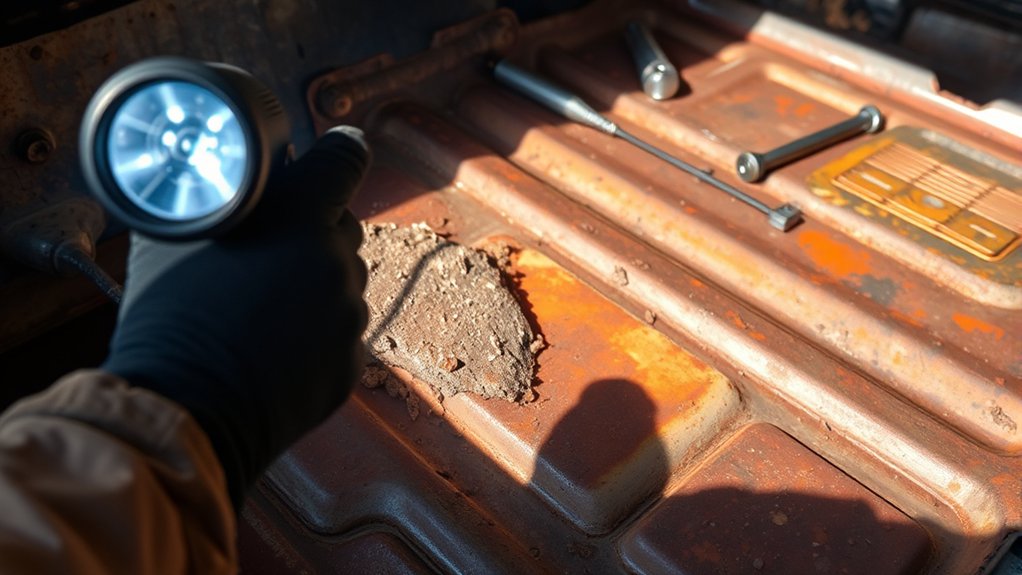
Remove the seats or trim required for safe access, then lift the carpet, padding, sound deadener, and loose insulation around the damaged area. Inspect the footwells, trunk floor, seat mounts, floor seams, drain plugs, rocker-panel edges, and the underside of the vehicle. Rust often travels beneath seam sealer or undercoating beyond the visible hole.
A magnet may help you locate thick body filler or a non-steel repair, but it cannot prove that the remaining steel is strong. Remove coatings carefully and probe questionable metal with a pick or screwdriver. Steel that flakes, tears, bends with light pressure, or develops new pinholes during cleaning must be removed.
Find the Source of the Water
Do not repair the floor until you know why it rusted. Check door and windshield seals, sunroof drains, heater or air-conditioning drains, body seams, missing floor plugs, damaged underbody coating, and water thrown from a wheel opening. A sound patch can rust again if moisture continues to enter or remains trapped beneath the carpet.
Addressing corrosion early can limit how far it spreads. This guide to repairing rusted metal with holes explains the basic process of removing weakened steel rather than covering it.
Decide Whether a Home Patch Is Appropriate
A small patch may be reasonable when the damage is confined to an accessible, nonstructural section of flat or lightly formed floor sheet. Before cutting, consult the vehicle maker’s collision or body-repair information to determine whether the area has a required replacement procedure, factory reinforcement, adhesive, weld pattern, or corrosion-protection process.
Choose professional repair when rust reaches any of these areas:
- Seat mounting points or seat tracks
- Seat-belt or child-restraint anchorages
- Rocker panels, frame rails, crossmembers, or boxed reinforcements
- Suspension, subframe, or body-mount locations
- A factory seam whose weld count or joint design affects crash performance
- High-voltage batteries, cables, or components on a hybrid or electric vehicle
- A large area where the remaining panel cannot hold its original shape
OSHA’s hot-work rule uses 35 feet as a key threshold for appreciable combustible material and requires a fire watch under specified fire-hazard conditions. Vehicle interiors and underbodies can hide combustible material much closer than that.
What Tools and Materials You’ll Need
Gather the cutting, shaping, welding, fire-control, and coating supplies before opening the floor. Leaving bare steel exposed while you search for missing materials increases the chance of contamination and flash rust.
Products Worth Considering

【Premium Material】This wire metal sheet thickness gauge set is made of high quality 2Cr13 stainless steel, which is firm and durable, well made, not easy to bend, easy to read, accurate measurement, simple to operate. (There will be a little oil on the wire metal sheet thickness gauge, which is used to prevent rust)

Automotive Bodywork and Rust Repair

Premium 20 Gauge Mild Steel Sheet Metal – Crafted from high-quality cold rolled steel, these sheets offer exceptional durability and a smooth, uniform surface. Ideal for precision-driven projects requiring reliable material performance without compromising on structural integrit
Essential Tools Checklist
- MIG welder capable of stable output on the vehicle’s sheet-metal thickness
- Correct contact tip, drive roll, polarity, wire, and shielding gas for the chosen process
- Cutoff wheel, air saw, or other controlled sheet-metal cutting tool
- Angle grinder, die grinder, stripping disc, and wire brush
- Body hammer, dolly, sheet-metal brake, or forming tools as required
- Clamps, panel-holding magnets, clecos, or temporary screws
- Cardboard for a template and a marker or scribe
- Spot-weld cutter or drill and hole punch when reproducing a factory flange joint
- Jack stands or a lift rated for the vehicle
- Work light for inspecting the back side of the seam
- Fire extinguisher, welding blanket, and a second person for fire watch when needed
A flanger and hole punch can help when the approved repair uses an overlap and plug welds. Do not choose a lap joint only because it is easier. Overlaps create a moisture trap unless the complete flange receives the correct approved protection.
Required Welding Materials
Match the patch material to the original floor as closely as practical. Avoid using noticeably thicker steel simply because it seems stronger; it can be harder to shape and may require more heat than the surrounding panel can tolerate.
| Material or Tool | Purpose and Qualification |
|---|---|
| MIG Welder | Joins the patch to the floor; verify that the machine can run steadily at the required low setting |
| Small-Diameter MIG Wire | A .023-inch solid wire is a common thin-sheet option when supported by the welder, contact tip, drive system, and procedure |
| Sheet-Metal Patch | Replaces the removed steel and should closely match the original panel thickness and contour |
| Approved Weld-Through Product | Protects specified hidden flange areas only when permitted by the OEM repair procedure and product instructions |
| Automotive Primer and Topcoat | Restores corrosion protection according to the coating manufacturer’s system |
| Automotive Seam Sealer | Seals an approved, prepared seam after welding and priming in the product-specified order |
| Underbody or Cavity Protection | Protects the underside and inaccessible areas after the repair system has cured |
Safety Gear Necessities
Wear a welding helmet with the correct shade, safety glasses beneath the helmet, leather welding gloves, hearing protection, flame-resistant clothing, and sturdy closed-toe boots. Protect your knees and body from electrical contact when working in a cramped metal cabin.
Grinding and welding can release dust, coating vapors, and metal fumes. Use effective mechanical ventilation or local fume extraction, keep your head out of the plume, and follow the coating and consumable safety data sheets. A simple dust mask is not a substitute for properly selected respiratory protection when hazardous fumes or vapors are present.
Review these flux-core welding safety and ventilation tips if you plan to use self-shielded wire. This overview of protective gear for spark-producing metalwork also covers clothing and eye protection.
Preparing the Vehicle for Safe Welding
Products Worth Considering

✅【Fire-Resistant Carbon Felt Construction】The Matace welding blanket is made from 5mm thick carbon felt and has been tested in accordance with ASTM D6413 standards. Its dense, heavy-duty structure is designed to help manage sparks, hot slag, and radiant heat during welding and high-temperature work.

Made of Flame Retardant Fiberglass

Well-woven Fiberglass Blanket: Constructed from 24.7 oz/yd² fiberglass material, this welding blanket serve as an excellent shield against heat and fire. Tight stitching and exquisite weaving. Our heat resistant mat shield is a nice addition to welding equipment. Standard size : 4x6 ft (122x183cm), thickness: 0.31” (8mm)
Support the Vehicle Safely
Work on a level, stable surface. If you need underside access, raise the vehicle only at approved lift points and support it with correctly rated jack stands or a lift. Never work beneath a vehicle held only by a hydraulic jack. Confirm that your supports will not obstruct or deform the section you plan to repair.
Follow OEM Electrical and High-Voltage Procedures
Turn the ignition off, remove the key or disable the starting system, and consult the exact vehicle’s service information before disconnecting power. Some vehicles require a waiting period, window initialization, memory procedures, module disconnection, or other steps.
For a conventional vehicle, disconnect the 12-volt system as directed by the manufacturer. For a hybrid or electric vehicle, follow the maker’s complete high-voltage disabling and verification procedure. I-CAR’s vehicle-welding guidance for an EV manufacturer shows why disconnecting only the 12-volt battery may be insufficient.
Warning: Do not attempt to disable or work near a hybrid or EV high-voltage system unless you have the required training, insulated equipment, service information, and verification tools. Have a qualified high-voltage technician perform the repair instead.
Clear and Protect the Hot-Work Area
Remove the carpet, padding, trim, sound deadener, seam sealer, loose undercoating, and adhesive far enough from the repair that heat and sparks cannot reach them. Inspect the opposite side and all enclosed spaces that sparks may enter.
Locate and protect or remove nearby:
- Fuel tank, fuel lines, vapor lines, and filler-neck components
- Brake lines and flexible hoses
- Wiring harnesses, connectors, grounds, and electronic modules
- Airbag, pretensioner, and seat-occupancy wiring
- Plastic clips, drain tubes, rubber plugs, and sound insulation
- Factory wax, cavity coating, seam sealer, and underbody material
If welding heat or sparks could reach a fuel component, sealed cavity, battery, module, or restraint part, stop and move the job to a qualified repair facility. Follow the fire-prevention requirements in OSHA’s hot-work standard. Keep suitable extinguishing equipment ready and use a fire watch whenever hidden or nearby combustibles create a risk.
Cleaning and Cutting the Damaged Floor Pan
Clean enough of the top and underside to reveal the true damage boundary. Do not draw the cut line around the visible hole alone. Continue removing coating and scale until the complete perimeter is solid steel.
Cleaning Techniques Explained
- Vacuum loose rust and debris rather than blowing it into the cabin.
- Remove grease with an appropriate automotive surface cleaner.
- Strip paint, seam sealer, undercoating, and corrosion from the planned weld zone.
- Inspect both sides under strong lighting.
- Mark the cut line in sound metal beyond every thin or pitted edge.
Do not leave oil, rust converter, paint, ordinary primer, or cleaning residue in the fusion area. Products used between overlapping flanges must be expressly allowed by the OEM repair information and the product technical data sheet.
If the floor contains zinc-coated steel, remove the coating from the immediate fusion zone as required by the repair procedure. This guide explains how to remove zinc coating from galvanized steel. Welding heated zinc can produce zinc oxide fume, so use effective ventilation and review the NIOSH zinc oxide guidance.
Accurate Cutting Methods
Cut conservatively at first. A cutoff wheel or air saw offers good control, but you must know what lies behind the panel before the blade enters it. Use shallow passes and protect lines, harnesses, and components on the other side.
After removing the damaged section, clean the new opening and inspect the edge again. If additional pinholes appear or the edge folds easily, enlarge the opening until every side is sound.
Note: There is no universal plug-weld hole diameter or one-inch spacing rule for every vehicle. Where the patch replaces a factory flange, follow the manufacturer’s weld number, location, and nugget-size requirements.
Fitting the Patch Panel
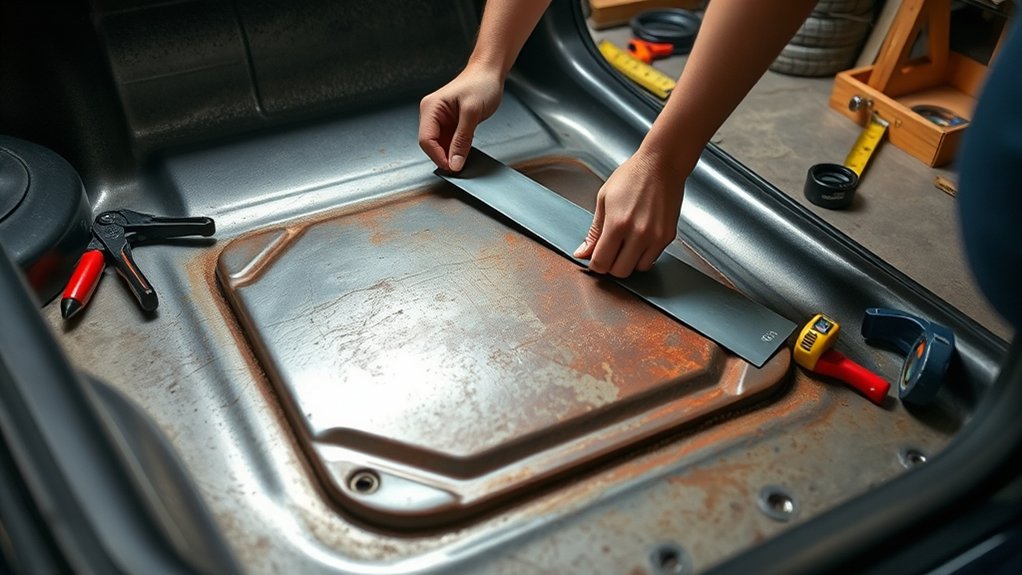
Make a cardboard template before cutting the replacement steel. Transfer ribs, bends, drain locations, and other contours that give the floor stiffness. Cut the patch slightly oversized, then trim it in small steps until it sits without forcing the surrounding floor out of shape.
- Test-fit the patch from the same side on which it will be welded.
- Shape ribs and bends before final trimming.
- Remove burrs and sharp corners.
- Hold the panel firmly with clamps, clecos, or temporary screws.
- Confirm that the patch does not interfere with wiring, plugs, trim, or components below.
- Check the joint from the top and underside before welding.
Butt Weld vs. Overlap Patch
A butt-welded patch can leave a flatter repair and avoids creating a wide moisture-trapping overlap. It also demands accurate trimming, stable machine settings, and careful heat control.
An overlap can be easier to hold, but the hidden flange must receive the exact corrosion protection, adhesive, primer, or weldable product specified for that procedure. Seal and protect the finished overlap completely. Do not use an overlap across a structural factory joint unless the vehicle maker permits it.
Plug welds are suitable where an approved flange joint replaces factory spot welds. Match the factory pattern or OEM procedure. I-CAR’s plug-weld guidance emphasizes following manufacturer requirements for weld-nugget size.
General weld-sizing principles can help you understand why adding excessive weld metal does not automatically improve a thin-panel repair.
Choosing a Floor-Pan Welding Technique
MIG welding usually gives a home fabricator the most manageable balance of speed, wire control, and thin-sheet capability. Flux-core wire can complete some repairs, but it generally creates more smoke and cleanup and may make heat control harder on very thin automotive steel.
This guide to controlling heat while welding thin metal with flux core explains the extra care the process requires.
Set Up the MIG Welder on Scrap
Use offcuts from the patch and, when available, a sound piece removed from the vehicle to create a test coupon that duplicates the planned joint. Set the machine from its chart or manual, then adjust it on the coupon rather than on the car.
Before welding the vehicle, verify:
- The wire type and diameter match the machine, contact tip, and base metal
- The machine polarity matches the wire process
- The shielding-gas cylinder, regulator, hose, and flow are working correctly when gas is required
- The work clamp contacts bright metal close to the repair
- The arc is stable without excessive popping, wire stubbing, or burn-back
- The test weld fuses both edges without repeatedly burning through
Control Heat With Tacks and Skip Welding
Do not run one continuous bead around a thin floor-pan patch. Place a tack, move to a distant part of the patch, and allow the first area to cool. Continue filling the spaces in stages while checking panel alignment and temperature.
Pro Tip: Keep several scrap coupons beside the vehicle. When you change voltage, wire speed, stickout, joint gap, or torch angle, confirm the result on scrap before touching the floor pan.
Step-by-Step Patch-Welding Process
- Confirm the repair is appropriate. Verify that the rust is limited to a nonstructural area and review the vehicle maker’s repair information.
- Correct the moisture source. Repair leaking seals, drains, seams, plugs, or underbody damage that caused the rust.
- Support the vehicle safely. Use approved lift points and correctly rated stands or a lift on stable ground.
- Follow the electrical shutdown procedure. Disable the 12-volt and, where applicable, high-voltage systems exactly as the manufacturer directs.
- Strip the work area. Remove carpet, padding, trim, wiring, coatings, and combustible material from both sides.
- Inspect for hidden hazards. Locate fuel, brake, restraint, electrical, and high-voltage components before cutting.
- Mark the damaged area. Place the cut line in solid metal beyond every weak edge.
- Cut out the rust. Use shallow, controlled cuts and avoid damaging anything behind the panel.
- Clean the opening. Remove burrs, scale, paint, zinc, sealer, and contamination from the required weld zone.
- Make and shape the patch. Match the original thickness and reproduce important ribs, bends, and contours.
- Choose the approved joint. Use a butt, lap, or factory-style flange only where appropriate for the vehicle and repair location.
- Protect hidden mating surfaces. Apply only the OEM- and product-approved weld-through material, adhesive, or coating to inaccessible flanges.
- Clamp and recheck the patch. Confirm flushness, contour, underside clearance, and access for coating after welding.
- Make test welds. Tune the welder on same-thickness scrap with the same joint and surface condition.
- Attach the work clamp. Place it on clean metal close to the repair so welding current does not travel unnecessarily through the vehicle.
- Tack the patch. Add small, separated tacks around the perimeter while maintaining alignment.
- Fill the seam gradually. Skip between distant areas and pause for cooling instead of running a continuous bead.
- Complete approved plug welds. Reproduce the required size, number, and locations when replacing a factory flange joint.
- Inspect for hidden fire. Check the cabin, underside, cavities, insulation, and nearby components repeatedly during the work.
- Dress the weld carefully. Grind only high spots and avoid thinning the patch or original floor.
- Inspect both sides. Repair pinholes or incomplete fusion before applying primer or seam sealer.
- Maintain a post-weld fire watch. Continue inspecting the vehicle and surrounding work area for heat, smoke, odor, or smoldering material after welding ends.
Inspecting the Weld Before Sealing
Do not judge the repair only by how smooth it looks from above. Clean the seam and inspect it under bright light from both sides. Where access allows, place a light behind the seam to reveal pinholes.
Check for:
- Fusion into both the patch and original floor
- Unfilled gaps or pinholes
- Cracks at tack starts and stops
- Porosity or contaminated weld metal
- Excessive grinding that has thinned the panel
- Heat damage to wiring, lines, coatings, and nearby components
- Distortion that affects seat, trim, plug, or component fit
- Remaining loose rust around or beneath the repair
For a factory-style plug weld, confirm that the weld filled the prepared opening and fused to the lower panel rather than forming a raised cap with no attachment underneath. If you cannot inspect or protect the rear side adequately, the repair may require greater disassembly or professional equipment.
Sealing and Protecting the Repair
Allow the metal to cool fully. Remove grinding dust, soot, oil, and residue with products approved for the coating system. Restore corrosion protection in the order specified by the vehicle maker and each product manufacturer.
A typical compatible system may include:
- Cleaning and preparing the bare steel
- Applying the specified automotive primer
- Applying seam sealer over the approved prepared surface
- Allowing the sealer to cure for the stated time
- Applying compatible paint or topcoat
- Restoring underbody coating on the underside
- Applying approved cavity protection inside enclosed areas where required
Do not assume every seam sealer goes directly onto bare metal. Some products allow it, while other repair systems require a compatible primer first. The 3M urethane seam-sealer technical data, for example, provides product-specific preparation, application, ventilation, and painting instructions.
- Seal the complete seam on every accessible side.
- Do not block factory drains or reinstall a damaged drain plug.
- Restore the underside coating beyond the repair edge.
- Protect enclosed overlaps that cannot be reached after assembly.
- Let every primer, sealer, paint, and underbody product cure as directed.
- Reinstall wiring, grommets, insulation, carpet, trim, and seats only after the repair is cool, dry, protected, and inspected.
Note: Seam sealer is not a substitute for a complete weld where a welded joint is required. Apply it only after the metal repair passes inspection and according to the approved coating system.
Troubleshooting Common Welding Issues
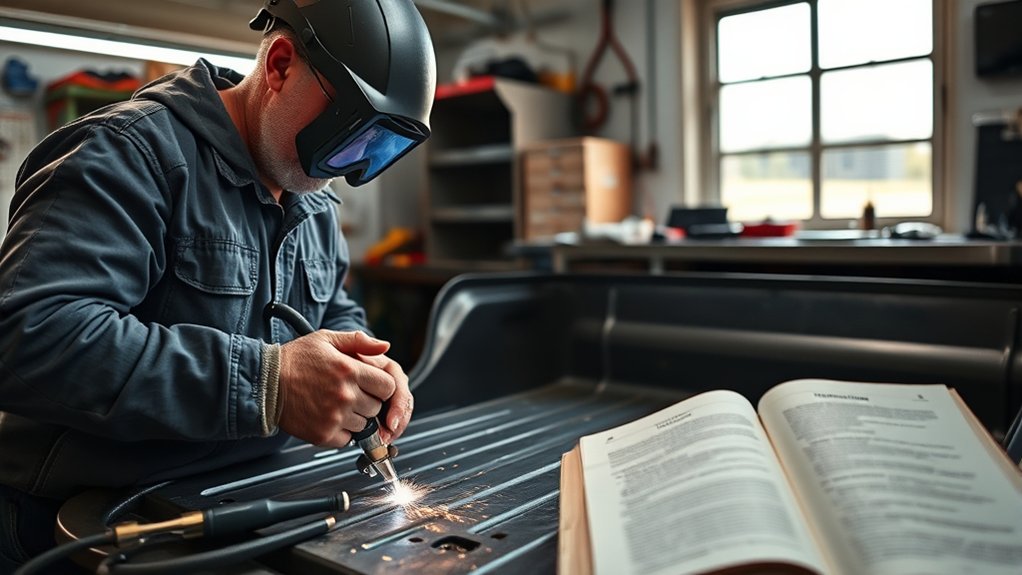
Repeated Burn-Through
Stop and let the panel cool. Recheck the metal thickness, joint gap, voltage, wire speed, stickout, and tack duration on scrap. Large gaps and remaining rust make burn-through much more likely. If the surrounding floor continues to disappear at low, stable settings, enlarge the patch until it reaches sound steel.
Poor Fusion or a Weld Sitting on Top
Clean the surfaces again, move the ground clamp closer, and confirm that the voltage and wire feed produce fusion on the test coupon. A plug weld that looks full from above may still lack attachment to the lower panel.
Porosity
Check for paint, sealer, rust, moisture, wind, gas leaks, a blocked nozzle, incorrect gas flow, and excessive gun distance. Do not cover porous welds with seam sealer. Remove the defective metal and reweld after correcting the cause.
Excessive Spatter or an Unstable Arc
Confirm polarity, wire compatibility, clean work-clamp contact, contact-tip condition, drive-roll tension, wire speed, and voltage. Keep anti-spatter products away from the actual fusion surfaces and follow their flammability and ventilation instructions. Consult the correct flux-core or MIG settings guidance for your process and machine.
Panel Warping
Stop welding and allow the area to cool naturally. Shorten each tack, increase the distance between consecutive welds, and check whether the patch is being forced into place. Do not quench a hot panel unless an approved repair procedure specifically calls for it, since rapid cooling can alter shape and create additional stress.
Pinholes After Grinding
Clean the seam and mark each hole under bright backlighting. Repair one pinhole at a time with a brief tack, then reinspect after cooling. Repeated pinholes across a wide area indicate thin or contaminated metal and may require a larger patch.
When to Get Professional Help
Stop and use a qualified collision or restoration repairer if rust affects a seat mount, seat-belt anchor, structural reinforcement, rocker, rail, crossmember, suspension point, or factory crash-management joint. These areas may require an OEM replacement panel, controlled weld locations, structural adhesive, squeeze-type resistance spot welding, measuring equipment, or post-repair inspection.
Professional help is also appropriate when:
- The vehicle is hybrid or electric and the repair is near a high-voltage component
- The fuel tank or fuel line cannot be safely separated from the hot-work area
- The back side cannot be inspected or protected
- Rust continues beyond the planned patch in several directions
- The floor has lost its shape or alignment
- You cannot produce repeatable welds on same-thickness scrap
- The repair affects roadworthiness, restraint performance, or local inspection requirements
Safety Disclaimer: This article provides general information and does not replace the vehicle maker’s repair procedures, product instructions, workplace-safety requirements, or an inspection by a qualified automotive repair technician.
Frequently Asked Questions
How do I know if floor-pan damage is too extensive to repair at home?
Look for widespread perforation, metal that flexes or tears easily, cracked factory seams, lost panel shape, and damage near seat mounts, belt anchors, rails, reinforcements, or suspension points. Those conditions require professional assessment and usually a larger replacement procedure.
Can I weld a floor-pan patch over rust?
No. Remove every weak, scaly, perforated, or deeply pitted section until the entire opening ends in solid steel. Welding over rust creates contamination, unstable edges, poor fusion, and an early path for corrosion to return.
Can I use a stick welder instead of a MIG welder?
Stick welding is difficult to control on thin automotive sheet and can add too much heat. MIG is generally more manageable for a small floor patch. Flux-core can work with suitable equipment and skill, but practice on matching scrap and confirm that the process is appropriate for the panel.
What thickness of steel should I use for the patch?
Use automotive sheet steel that closely matches the original floor thickness and material. Measure a clean edge or consult the vehicle’s repair information. A much thicker patch can be difficult to shape and may require more heat than the surrounding panel can handle.
What safety gear should I wear while welding?
Wear a suitable welding helmet, safety glasses, flame-resistant clothing, leather welding gloves, hearing protection, and sturdy boots. Use effective ventilation or fume extraction and properly selected respiratory protection when the coating, metal, consumable, or work environment requires it.
How long should I wait before sealing the welds?
Wait until the metal is fully cool, then clean and inspect the complete repair. Apply primer, seam sealer, paint, and underbody protection according to the exact products’ surface-preparation and cure-time instructions.
What should I do if the floor pan warps during welding?
Stop welding and let the panel cool naturally. Recheck patch fit, shorten the tacks, and move between distant sections. Do not continue adding weld metal to a hot, distorted panel because the extra heat can make the deformation worse.
Should I weld a floor pan from the top or underneath?
Many home repairs are easier from the top after the interior is removed, but the correct side depends on the joint, access, factory construction, and repair procedure. You still need to inspect, clean, and protect the underside after welding.
How can I keep the repaired floor pan from rusting again?
Correct the original leak, seal every accessible seam, restore primer and paint, replace damaged plugs, restore underbody protection, protect hidden cavities where required, keep drains open, and make sure the carpet and insulation are dry before reassembly.
Sources
- OSHA 29 CFR 1910.252, Welding, Cutting, and Brazing — hot-work fire prevention, combustible-material control, fire watch, ventilation, and welding safety
- CDC/NIOSH Pocket Guide: Zinc Oxide — zinc oxide fume hazards and exposure information
- I-CAR: Volvo Position Statement on Electric Vehicle Welding — 12-volt and high-voltage precautions before vehicle welding
- I-CAR: Steel Spot and Plug Weld Nugget Size — following OEM weld-size and repair requirements
- I-CAR: Weldable Seam Sealer — OEM-specific limits on weldable sealers and flange protection
- 3M Urethane Seam Sealer Technical Data — floor-pan applications, surface preparation, ventilation, and product-specific application instructions
Conclusion
A durable floor-pan patch depends on much more than closing the visible hole. Find the moisture source, verify that the area is suitable for a home repair, follow the vehicle maker’s procedures, remove all weak steel, practice the weld on matching scrap, and inspect both sides before applying coatings. When rust reaches a restraint mount, reinforcement, rail, factory structural joint, fuel-system area, or hybrid/EV high-voltage component, professional repair is the safer choice.