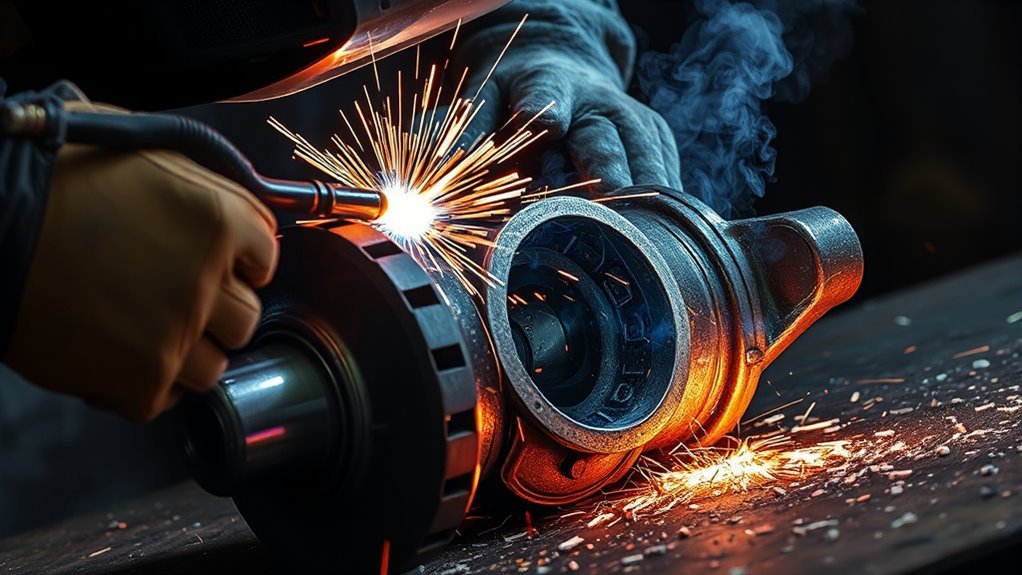
Welding a differential housing is a high-risk axle repair, not the same job as welding the internal spider gears to make a permanently locked differential. Before you strike an arc, identify the axle, the housing material, the damaged location, and the manufacturer-approved repair procedure. Some housings and weld locations can be repaired; others must be replaced.
Quick Answer
Weld a differential housing only when the axle or vehicle manufacturer permits that exact repair. Remove oil and heat-sensitive components, identify the base metal, use an approved welding procedure and filler, control preheat and distortion, place the ground close to the joint, then inspect the weld and housing alignment before reassembly.
Key Takeaways
- Do not assume the center section is nodular iron. Axle housings may use fabricated steel, cast steel, gray iron, ductile iron, or more than one material.
- The service manual controls the repair location, filler, preheat, weld sequence, inspection, and replacement limits.
- Never weld metal that is wet with cleaner, and never use a chlorinated solvent near arc welding.
- Remove or isolate bearings, seals, sensors, brake parts, wiring, and the differential carrier as the approved procedure requires.
- A sound-looking bead is not enough. Check for cracks, leaks, distortion, housing alignment, and correct gear setup before driving.
At a Glance
| Time Required | Allow a full workshop day for identification, disassembly, welding, controlled cooling, inspection, and reassembly. Complex repairs may take longer. |
| Difficulty | Advanced. This is a structural drivetrain repair that needs welding, mechanical, heat-control, and inspection skills. |
| Tools Needed | Approved welder and filler, rated supports or a housing fixture, grinder, temperature-indicating tools, local ventilation, fire extinguisher, torque tools, and the inspection equipment required by the service procedure. |
| Cost | Varies by axle, damage, disassembly, machining, alignment checks, and whether replacement is safer. Professional inspection and setup usually cost more than the welding consumables. |
What’s in This Article
- Identify the Job and Housing Material
- Before You Begin: Prepare the Differential Housing
- What You’ll Need to Weld a Differential Housing
- Step-by-Step Process for Welding a Differential Housing
- Choose the Correct Welding Process
- Essential Welding Techniques for Nodular Iron
- Heat Control, Grounding, and Distortion
- Post-Weld Care for Durability
- When to Replace the Housing Instead
- Driving With a Welded Differential
- Common Challenges and Solutions
- Welded Differentials vs. Limited-Slip Differentials
- How to Stay Safe While Welding
- Common Mistakes to Avoid
- Frequently Asked Questions
Warning: Do not use this article as a substitute for the axle manufacturer’s repair manual or a qualified welding procedure. Unapproved welding can weaken an axle beam, distort bearing alignment, damage internal components, and create a loss-of-control risk.
Identify the Job and Housing Material
Start by naming the job correctly. A differential housing repair joins or repairs the outer axle housing, center casting, cover seam, tube, bracket, spring seat, or reinforcement. A welded differential usually means the internal spider gears have been welded so both axle shafts stay locked together. The welding methods, risks, and driving effects are different.
Find the axle identification tag, casting number, vehicle service information, and any manufacturer bulletin before choosing a process. Manufacturer instructions may permit welding only at listed seams or brackets and require replacement when the crack enters the housing material, a bearing area, or another non-serviceable section.
Do not identify the metal by appearance alone. A housing may combine a fabricated steel shell or tubes with a cast center section. Cummins, for example, describes its P600 axle as having a fabricated steel housing, while other axle designs use cast sections.
| Possible Construction | What It Changes | Safe Next Step |
|---|---|---|
| Fabricated or stamped steel housing | Often uses a steel-filler procedure with controlled preheat and sequence. | Use the axle maker’s approved electrode or wire, temperature range, and weld profile. |
| Cast steel center or component | May accept a steel procedure, but alloy, carbon equivalent, and section thickness still matter. | Confirm the material grade or obtain a written procedure from the manufacturer or a welding engineer. |
| Gray iron or ductile/nodular iron | Rapid heating and cooling can create hard, crack-prone zones. Nickel or nickel-iron filler may be specified. | Use a cast-iron repair procedure that defines joint prep, filler, preheat, bead length, peening, interpass control, and cooling. |
| Unknown or mixed material | A guessed filler or temperature can cause cracking or poor fusion. | Stop and identify it through service data, manufacturer support, or a qualified welding shop. |
Before You Begin: Prepare the Differential Housing
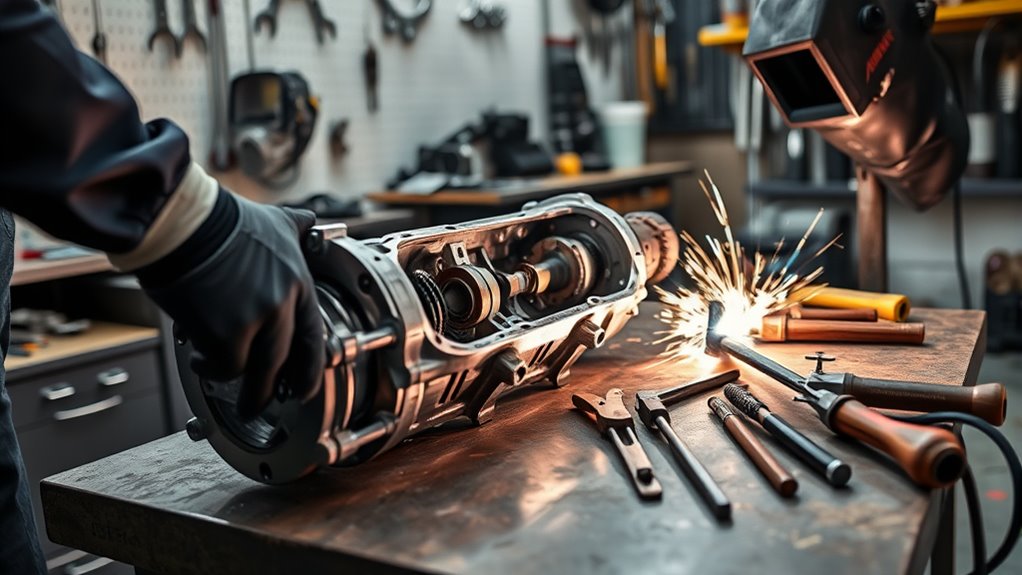
Inspect the damage before cleaning away all evidence. Look for impact marks, a bent tube, a loose bracket, a leaking cover seam, porosity, a crack beside an old weld, or a crack that enters the housing itself. Photograph the area and compare it with the service manual’s repair and replacement limits.
Drain the gear oil into a suitable container. If the approved procedure requires it, remove the axle assembly from the vehicle and remove the differential carrier, axle shafts, wheel-end parts, seals, bearings, ABS sensors, wiring, brake lines, vent hose, and nearby heat-sensitive components. Do not rely on masking tape to protect parts that should be removed.
Clean oil and grease with an SDS-checked, nonchlorinated product that is approved for hot-work preparation, or use an alkaline detergent method. Let the part dry completely. Never weld while cleaner remains in a seam, cavity, or porous casting. The CDC warns that welding metal cleaned with chlorinated hydrocarbons can produce phosgene, and OSHA restricts chlorinated-hydrocarbon degreasing near arc welding.
Remove paint, rust, scale, sealant, and contaminated metal from the weld zone using a grinder, wire wheel, or approved gouging method. Keep grinding shallow so you do not thin or notch the housing wall. This guide on removing mill scale can help with similar steel preparation, but the axle maker’s procedure takes priority.
Support the axle on rated stands or in a rigid housing fixture. Record baseline measurements for flange position, tube alignment, and other dimensions the service manual requires. A tight fit helps, but alignment and restraint matter just as much because heat can pull the housing out of shape.
The first repair decision is not which rod to use. It is whether the manufacturer allows welding at that exact location.
What You’ll Need to Weld a Differential Housing
Gather the equipment listed in the approved procedure before you heat the axle. Stopping halfway through a critical weld can upset temperature control and sequence.
- Service information: Axle identification, vehicle manual, manufacturer bulletin, repair limits, torque values, lubricant specification, and an approved welding procedure.
- Welder and filler: The exact process, polarity, electrode or wire classification, shielding gas, and size required for the identified material. A suitable MIG welder may fit some steel procedures, but MIG is not automatically correct for cast iron.
- Preparation tools: Grinder, approved discs, wire brushes reserved for the base metal, files, joint-prep tools, clean lint-free rags, and a safe nonchlorinated cleaner.
- Heat-control tools: Torch or approved heating system, temperature crayons or contact thermometer, and insulating material such as a welding blanket when the procedure calls for controlled cooling.
- Holding and measuring tools: Housing fixture or rated stands, clamps, straightedge, dial indicator or alignment bar as required, feeler gauges, and torque tools.
- Inspection tools: Bright light, magnification, and the liquid-penetrant or magnetic-particle equipment specified for the material and repair.
- Safety equipment: Welding helmet, safety glasses, gloves, flame-resistant clothing, hearing protection, local exhaust ventilation, suitable respiratory protection when required, fire extinguisher, and fire-watch equipment.
- Service supplies: New seals, gasket or approved sealant, fasteners that must not be reused, specified gear oil, and any required friction modifier.
Warning: Do not weld near fuel, pressurized components, trapped oil, cleaner residue, batteries, brake parts, wiring, or sealed cavities. Follow the vehicle maker’s hot-work and electrical-isolation procedure before connecting the welder.
Products Worth Considering

True Color Clear View: A 3.64" x 1.67" viewing area with 1/1/1/1 optical clarity delivers a true color view for improved visibility and reduced eye strain.

LARGE VIEW WITH TRUE COLOR CLARITY: See more of the weld puddle, joint edges, and work position through a wide 3.93" x 3.66" viewing area. The 1/1/1/1 true-color optical clarity provides a clearer, more natural view than traditional green-tinted lenses, helping support better visibility for detailed welding, fabrication, and garage projects.

CLEAR VIEWING AREA - Features a 3.86 x 1.62 in viewing area for a clear view of your work. The fixed shade lens requires no manual shade adjustment, making this welding helmet simple and convenient to use
Step-by-Step Process for Welding a Differential Housing
Use this sequence as a planning checklist. The manufacturer-approved procedure must supply the actual temperatures, filler classification, bead dimensions, joint geometry, inspection method, and acceptance limits.
- Identify the axle and repair location. Confirm the model, serial or build information, housing construction, crack path, and whether the repair is permitted.
- Choose repair or replacement. Replace the housing when the service information prohibits welding, the assembly is bent, or the damage exceeds the stated limits.
- Remove the axle or expose the repair. Secure the vehicle and axle with rated equipment. Remove anything that blocks access or could be damaged by heat, current, sparks, or grinding debris.
- Drain and disassemble. Drain the oil and remove the differential carrier and other components when the approved procedure requires it. Keep oil and flammable waste away from hot work.
- Clean and prepare the joint. Degrease safely, dry the part, remove coatings and corrosion, then grind or gouge only to the profile and depth allowed by the procedure.
- Inspect the exposed area. Use the specified crack-detection method after removing the failed weld or damaged material. A crack that continues into a non-repairable section changes the job to replacement.
- Fixture and measure the housing. Hold the assembly in alignment, confirm fit-up, and record the dimensions needed for a post-weld comparison.
- Preheat as specified. Heat the required area evenly and verify temperature with the approved measuring method. Do not guess by color or touch.
- Place the ground close to the joint. Clamp to clean metal on the housing so weld current does not pass through bearings, gears, suspension joints, or electrical components.
- Make the weld in the specified sequence. Use the approved filler, short arc, travel speed, bead size, interpass temperature, and balanced sequence. Do not add extra weld because it looks stronger.
- Peen only when the procedure calls for it. Some cast-iron filler instructions call for light peening between passes. Do not hammer the base metal, root pass, or finished weld unless the written procedure permits it.
- Cool according to the material procedure. Cast-iron repairs may need slow, insulated cooling. A steel-housing procedure may use different controls. Never quench the repair with water or compressed air.
- Inspect and measure again. Check the bead, adjacent base metal, crack ends, alignment, flange runout, sealing surfaces, and any dimensions listed by the manufacturer.
- Reassemble and service. Remove all slag and abrasive debris, install the specified gasket or sealant, torque fasteners correctly, refill with the correct oil, and confirm the breather is open.
- Test cautiously. Check for leaks and abnormal noise before loading the axle. Reinspect after the initial heat cycle or road test if the service procedure requires it.
Choose the Correct Welding Process
There is no universal “best welder” for every differential housing. The repair location and base metal control the choice. Understanding material thickness and process limits helps, but it does not replace the axle maker’s welding procedure.
| Repair Type | Possible Procedure Direction | Important Limitation |
|---|---|---|
| Approved steel seam or bracket repair | SMAW or GMAW with a specified low-hydrogen electrode or steel wire, controlled preheat, and a defined weld profile. | One Meritor manual lists E7018 or ER70S-3 for certain approved housing repairs, but that is not a universal axle specification. |
| Cast or ductile-iron repair | Often uses nickel or nickel-iron filler, prepared grooves, short beads, controlled preheat or low-heat technique, and slow cooling. | Filler selection changes with machinability, strength, dissimilar-metal joining, casting condition, and the written procedure. |
| Unknown center casting or steel-to-casting reinforcement | Material verification and a qualified welding procedure before work begins. | A trial bead on unrelated scrap does not prove compatibility with the axle casting. |
Flux-cored welding can be productive on suitable steel, and these flux core welding basics explain the process. However, do not use flux core, MIG, TIG, or stick on an axle housing merely because the machine can create a bead.
Note: E6010 can penetrate through some contamination on carbon steel, but it is not a substitute for clean metal and is not a default choice for cast or ductile-iron axle housings. Review the characteristics of E6010 welding rods, then follow the housing procedure.
Products Worth Considering

Comprehensive Welding Package: our package comes with 24 low temperature universal welding rods available to meet your welding requirements; Whether you are a novice or an experienced welder, this kit of welding rods ensures you have things you need for your welding projects; Material is relatively brittle, received with breakage is a normal phenomenon, does not affect the use

You will receive 60 plastic welding rods in various colours, such as green, blue, yellow, red, white, and black, with 10 rods of each colour; the ample quantity and variety can meet your diverse needs.

Material: The package includes ENiFe-CI 7pcs 12 * 3/32'' Welding Electrode Rods
Essential Welding Techniques for Nodular Iron
Nodular iron, also called ductile iron, contains graphite in a form that improves ductility compared with gray iron, but welding can still create a brittle heat-affected zone or cracking when the procedure is wrong. Confirm that the housing is actually ductile iron before using a cast-iron repair method.
Lincoln Electric’s cast-iron guidance stresses preparation, controlled preheat, and slow cooling. A Harris nickel-electrode data sheet lists its nickel-iron product for gray, alloyed, and ductile iron and calls for cleaning, beveling, short-arc technique, light peening between passes, and slow cooling. It also gives a 400°F to 500°F preheat range for heavy cast-iron sections, but that product sheet is not a blanket temperature rule for every axle.
Use short, controlled beads and keep the interpass temperature within the written procedure. Balance welds when possible so contraction does not pull the housing to one side. Avoid wide weaving unless the procedure requires it.
Nickel-iron filler is often selected when a stronger deposit or cast-iron-to-steel joint is needed, while high-nickel filler may offer better machinability. The correct choice depends on the casting, joint, load path, and whether the repaired area must be machined.
Pro Tip: Mark several temperature-check points around the repair. Watching the heat spread helps you avoid a hot weld line surrounded by a cold, highly restrained casting.
Heat Control, Grounding, and Distortion
Housing alignment is part of weld quality. A strong weld on a distorted axle can still cause seal wear, bearing heat, gear noise, poor contact patterns, and shortened component life.
- Preheat broadly: Bring the specified area up to temperature evenly instead of overheating the crack edge.
- Measure temperature: Use temperature-indicating crayons, a contact probe, or another method accepted by the procedure. Shiny or curved surfaces can mislead an infrared thermometer.
- Control sequence: Use short, balanced passes and allow the procedure’s required interval between them.
- Keep the return path short: Attach the ground close to the repair on clean housing metal. Do not place a bearing, gearset, U-joint, suspension joint, or electrical module in the current path.
- Do not straighten with uncontrolled heat: If the housing is bent or moves outside tolerance, stop and follow the manufacturer’s replacement or specialist-straightening policy.
A Ford axle weld-repair bulletin illustrates how vehicle-specific these jobs can be: it requires moving the ABS sensor, harness, vent hose, and brake-line hardware before welding, and it directs housing replacement when inspection damage exceeds the bulletin’s limits.
Post-Weld Care for Durability
After the final pass, maintain the specified postheat or cooling cycle. A welding blanket may help a cast-iron repair cool slowly, but do not wrap a steel housing by habit when its approved procedure calls for a different cycle.
Remove slag, spatter, grinding dust, and abrasive particles without thinning the housing. Inspect the weld toes, starts, stops, crack ends, and nearby base metal under good light. Use liquid-penetrant or magnetic-particle inspection when the procedure calls for it. Visual inspection alone cannot confirm that the housing is crack-free.
Recheck the measurements recorded before welding. Depending on the axle, this may include tube alignment, flange runout, carrier-bore alignment, bracket position, cover sealing surface, or gear-contact setup. Send the housing to a driveline or axle specialist when the required alignment equipment is not available.
Install a fresh cover gasket or the specified sealant only after the housing is clean. Replace seals, fasteners, and other one-time-use parts listed by the manual. Fill with the exact grade and amount of gear oil required for the axle, add friction modifier only when specified, and make sure the breather is clear.
Before normal driving, rotate the assembly, check for binding, and inspect for leaks. During the first controlled test, listen for gear noise, bearing rumble, clicking, or vibration. Stop if the housing leaks, the weld shows a crack, the axle runs hot, or handling changes.
Wear proper protective clothing during welding, grinding, and cleanup because hot metal and sharp slag remain hazardous after the arc stops.
When to Replace the Housing Instead
Replacement is often safer than welding when the damage affects a non-serviceable or alignment-critical part. Stop and seek manufacturer or specialist guidance when you find any of the following:
- A repair location that the axle or vehicle manufacturer does not authorize.
- A crack that enters a bearing bore, mounting face, tube-to-center interface, plug weld, suspension load path, or housing wall beyond the stated repair limit.
- A bent tube, twisted bracket, damaged flange, crushed housing, or alignment measurement outside specification.
- Multiple cracks, extensive corrosion thinning, impact damage, or an old repair with an unknown filler and heat history.
- A casting that cannot be identified or cleaned well enough to establish sound base metal.
- A repair that would require welding with the carrier, bearings, seals, or sensitive components left in place contrary to the manual.
Manufacturer limits are model-specific. Meritor’s housing manual, for example, permits repair welding only at listed locations and warns that unauthorized welding can reduce axle-beam fatigue life. It also requires replacement for certain cracks or gouges rather than continued weld repair.
Adapting to Daily Driving With a Welded Differential
This section applies only when the internal differential gears have been welded to create a permanent lock. Repairing an outer housing crack or seam does not make the differential locked and should not change normal cornering behavior by itself.
With the internal gears welded, both drive wheels are forced toward the same speed. During a turn, the outside tire must travel farther than the inside tire, so the drivetrain releases the difference through tire scrub, wheel hop, component windup, or loss of grip.
| Driving Condition | What to Expect | Risk-Control Step |
|---|---|---|
| Tight corners | Tire scrub, hopping, pushing, and driveline load | Use smooth steering and throttle; avoid crowded public-road testing |
| Wet, icy, or loose surfaces | More abrupt breakaway and reduced cornering margin | Reduce speed and avoid sudden throttle changes |
| Low-speed parking | Noise, vibration, scrub, and wheel hop | Expect a larger practical turning effort and increased tire wear |
| Higher-speed cornering | Less forgiving handling if traction changes | Use a closed course and professional setup rather than public-road experimentation |
Learn the behavior only in a controlled, legal environment. Check local vehicle regulations, inspection rules, insurer requirements, and track rules before using a permanently locked differential. Material-specific welding challenges also show why drivetrain modifications need more than a generic welding method.
Common Challenges and Solutions for Welded Differentials
The phrase “welded differential” can describe two separate problems in casual conversation, so diagnose the housing and the internal differential separately.
- Housing crack returns: Stop driving, remove the coating, inspect the crack path, and verify that the location was repairable and the original cause was corrected.
- Housing leaks after welding: Check weld porosity, crack ends, cover flatness, sealant use, breather blockage, and housing distortion.
- Bearing or gear noise: Check alignment, preload, backlash, contact pattern, debris control, lubricant level, and whether welding current passed through components.
- Poor filler choice: Identify the base metal and use the approved filler instead of choosing nickel or mild-steel filler by habit.
- Fast cooling cracks: Follow the cast-iron cooling procedure and verify that the interpass and postheat controls were maintained.
- Wheel hop or tire scrub: Confirm whether the internal gears were welded. Those symptoms do not normally come from a properly repaired outer housing alone.
- Unstable street handling: Stop public-road use until the vehicle is inspected and the modification is confirmed legal and suitable for the intended use.
Inspect the axle after the first controlled test and at later service intervals. Stop driving if you find a crack, oil leak, metal in the lubricant, abnormal heat, harsh noise, vibration, or unpredictable handling.
Welded Differentials vs. Limited-Slip Differentials
A permanently welded internal differential locks the axle shafts together at all times. It is inexpensive as a fabrication shortcut, but it removes the speed difference that normal cornering needs and can increase tire scrub, driveline stress, noise, and handling risk.
A limited-slip differential allows some wheel-speed difference while biasing torque when one tire loses grip. A selectable locker can remain open for normal turns and lock when additional traction is needed, depending on its design.
| Option | Best Fit | Main Drawback |
|---|---|---|
| Welded internal differential | Purpose-built drift, off-road, or competition use where rules and setup permit it | Permanent lock, harsh cornering, tire scrub, and possible legal or insurance problems |
| Limited-slip differential | Daily driving, performance street use, and mixed conditions | Higher purchase cost and design-specific maintenance |
| Selectable locker | Vehicles that need normal cornering plus occasional maximum traction | More parts, controls, installation work, and cost |
For a street-driven vehicle, an engineered limited-slip or selectable locker usually offers a better balance than welding the internal gears. That choice is separate from deciding whether an outer housing crack can be repaired.
How to Stay Safe While Welding
Welding an axle combines hot-work hazards with vehicle fluids, confined cavities, coatings, electrical systems, and heavy components. Plan the area before bringing in a torch or welder.
- Wear a welding helmet with the correct shade, safety glasses, gloves, flame-resistant clothing, hearing protection, and suitable footwear.
- Use local exhaust ventilation and keep your head out of the fume plume. A respirator must match the hazard and be used under a proper respiratory-protection program where required.
- Remove flammable material from the hot-work area, shield openings, keep an extinguisher ready, and assign a fire watch when conditions require one.
- Do not weld on a container or housing that can trap flammable vapor or pressure. Drain, open, clean, and verify the assembly according to the hot-work procedure.
- Read coating and cleaner safety data sheets. Never bring chlorinated solvent vapor or residue near the welding arc.
- Follow the vehicle maker’s steps for batteries, modules, sensors, wiring, fuel systems, brake systems, and other electrical or heat-sensitive parts.
- Inspect leads, electrode holder, torch, shielding-gas equipment, ground clamp, and machine before use.
- Inspect grinders and discs, use guards and side handles, and follow this guide on how to inspect grinder and disc before grinding or cutting.
OSHA’s general welding requirements cover fire prevention, hot-work restrictions, ventilation, and chlorinated-hydrocarbon hazards. Apply the rules that govern your workplace and location.
Common Mistakes to Avoid
- Confusing the housing with the differential gears: Housing repair does not create a locked differential.
- Assuming every center section is nodular iron: Identify the material and axle model before selecting filler.
- Using brake cleaner without checking the SDS: Use a nonchlorinated product approved for hot-work preparation and allow complete drying.
- Leaving the carrier, bearings, seals, or sensors in place: Follow the manufacturer’s disassembly and protection steps.
- Placing the ground far from the repair: Keep welding current out of bearings, gears, and electrical systems.
- Skipping crack inspection after grinding: The visible end of a crack may not be the true end.
- Adding long or oversized beads: Extra weld metal can add heat, restraint, and distortion without making the repair safer.
- Using one cooling rule for every housing: Slow cooling is common for cast iron, but the written procedure controls the cycle.
- Judging success only by appearance: Verify crack freedom, alignment, sealing, gear setup, and lubricant condition.
- Driving hard immediately: Complete a controlled test and reinspect before returning the axle to normal load.
Frequently Asked Questions
Can you weld a differential housing?
Sometimes. Weld it only when the axle or vehicle manufacturer allows repair at that location and provides, or approves, the welding procedure. Replace the housing when the crack, distortion, corrosion, or impact damage falls outside the service limits.
Is welding the housing the same as welding the differential?
No. Housing welding repairs or modifies the outer axle structure. Welding the differential usually means welding the internal spider gears so the axle shafts stay locked together. Only the internal gear modification causes permanent locked-differential driving behavior.
Can you MIG weld a differential housing?
MIG may be approved for some fabricated-steel housing seams or brackets, but it is not a universal choice. Cast steel, gray iron, ductile iron, mixed-material joints, and alignment-critical repairs may need another process, filler, or replacement.
Do you have to preheat a differential housing?
Use the preheat required by the approved procedure. Some steel-housing repairs use a moderate specified preheat, while heavy cast-iron repairs may need a higher controlled preheat and slow cooling. Do not apply one temperature to every axle.
What filler should you use on a differential housing?
Use the filler classification specified for the identified base metal and repair. Some approved steel repairs use low-hydrogen steel electrodes or matching wire. Cast or ductile-iron repairs may use nickel or nickel-iron filler. Guessing from appearance is unsafe.
What’s the hardest thing to weld on a differential housing?
The hardest repair is usually one with unknown material, oil-soaked porosity, high restraint, poor access, or damage near bearing and alignment features. Those conditions make replacement or specialist repair more sensible than a general shop weld.
What is the golden rule in welding an axle housing?
Confirm that the repair is permitted before choosing the welding method. Then follow the approved procedure for cleaning, fit-up, filler, preheat, sequence, grounding, cooling, inspection, alignment, and reassembly.
Is it illegal to have a welded differential?
Rules vary by country, state, province, inspection program, vehicle class, and intended use. A permanently locked differential may also affect insurance or track eligibility. Check the rules and your insurer before public-road use.
Can you daily drive a welded differential?
A vehicle may move with welded internal gears, but tight turns, wet roads, tire wear, noise, and abrupt traction changes make it a poor daily-driving choice. A limited-slip or selectable locker is generally more suitable for mixed street use.
Safety Disclaimer: This article is for general information and does not replace manufacturer service information, a welding procedure specification, engineering approval, or hands-on inspection by a qualified welder and axle technician. Do not return a repaired drivetrain or structural axle component to service until it passes the required inspections and measurements.
Conclusion
A safe differential housing weld begins with identification and an approved repair decision, not a generic preheat and nickel rod. Remove oil and vulnerable components, clean without chlorinated solvent, use the specified filler and heat cycle, control the current path and distortion, then inspect the repair and housing alignment before reassembly. When the damage exceeds the manual’s limits, replace the housing instead of trying to weld around the problem.
Sources
- Meritor Maintenance Manual 8: Drive Axle Housings — approved weld locations, carrier removal, grounding, preheat, filler examples, crack inspection, and replacement limits.
- Ford Safety Recall 21S31 Technical Instructions — a vehicle-specific axle weld repair showing required inspection, component protection, and replacement criteria.
- Lincoln Electric: Guidelines for Welding Cast Iron — cast-iron preparation, preheat, welding, and slow-cooling principles.
- Harris 65 Nickel Electrode Technical Information Sheet — nickel-iron filler applications, heavy-section preheat, peening, and slow cooling.
- OSHA 29 CFR 1910.252 — welding fire prevention, ventilation, hot-work controls, and chlorinated-hydrocarbon restrictions.
- CDC/ATSDR Phosgene Medical Management Guidelines — phosgene formation when welding metal cleaned with chlorinated hydrocarbons.