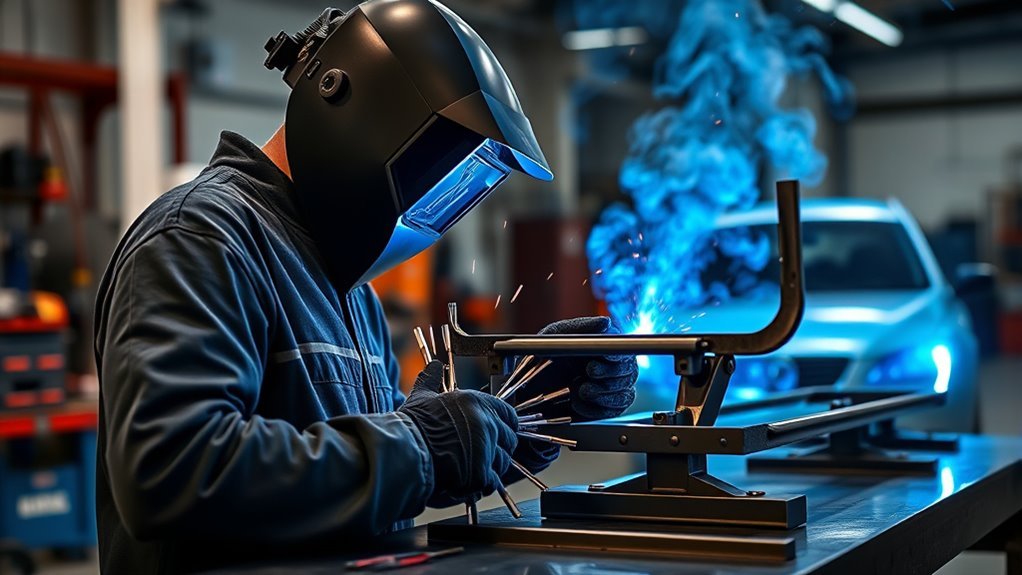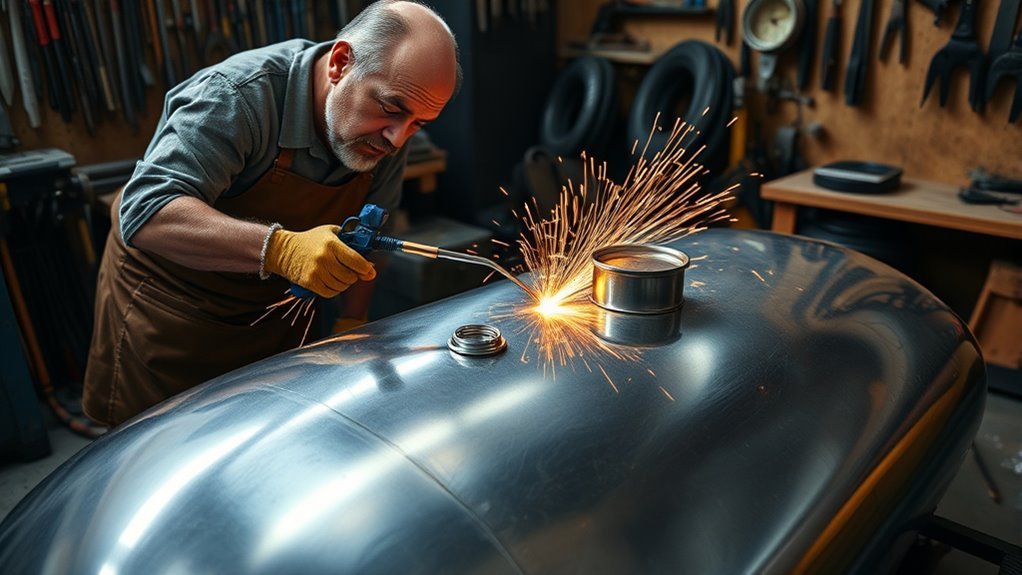
Welding a bung into a custom fuel tank is a precision job, not a routine patch. The fitting must match the tank and fuel-system hardware, the hole must fit closely, and the weld must stay leak-free through vibration and temperature changes. Most importantly, hot work must never begin while fuel, vapor, or unknown residue may remain inside the tank.
Quick Answer
Only weld a bung into a new, never-fueled tank or a used tank that a qualified professional has cleaned, isolated, vented, purged, and declared safe for hot work. Match the bung to the tank material, fit it tightly, tack it square, weld with controlled heat, inspect both sides, and follow an approved leak-test procedure before adding fuel.
Key Takeaways
- Do not perform hot work on a tank that may contain fuel, vapor, or unknown residue.
- Use a bung that matches the tank material, thread or sealing style, and fuel-system layout.
- Measure the bung itself or use its drawing; do not assume a universal hole size or amperage setting.
- Keep the fit-up tight, tack in opposing positions, and control heat to prevent warping and burn-through.
- Inspect the root when accessible and remove every chip, abrasive particle, and contaminant from the tank.
- Use only the tank maker’s or a qualified fabricator’s leak-test procedure; never improvise with unregulated compressed air.
At a Glance
| Time Required | Several hours for a new, clean tank, plus cooling, inspection, leak testing, drying, and finishing time |
| Difficulty | Advanced; thin-sheet welding and fuel-system fabrication experience are strongly recommended |
| Tools Needed | Suitable TIG or MIG welder, correct filler, drill or hole saw, deburring tools, clamps, PPE, fire extinguisher, and approved leak-test equipment |
| Cost | Variable; professional cleaning, gas-free certification, fabrication, or testing can cost more than the bung and consumables |
What’s in This Article
- Before You Start: New Versus Used Tanks
- Understanding the Purpose of a Bung
- Preparing Your Workspace and Tools
- Choose the Right Bung for Your Tank
- Prep Your Tank for Welding
- Drilling Holes for Bung Installation
- Executing the Weld After Drilling
- Check Your Weld to Ensure It’s Solid
- Finalizing the Bung Installation and Testing
- Troubleshooting Common Bung-Weld Problems
- Frequently Asked Questions
- Conclusion
Before You Start: New Versus Used Tanks
The steps in this guide apply to a new, never-fueled tank, an open tank shell that has never held a flammable product, or a previously used tank that a qualified professional has prepared and released for hot work. This guide does not teach tank gas-freeing, because rinsing, draining, airing out, or relying on smell does not prove that a tank is safe.
Warning: OSHA prohibits welding or cutting on used tanks until they have been thoroughly cleaned so no flammable or toxic material remains. Connections must be disconnected or blanked, hollow spaces must be vented, and purging may be required. Never use oxygen for ventilation. If a tank has held fuel, stop and use a qualified tank-cleaning or welding professional.
Remove the tank from the vehicle before welding whenever practical. Remove the pump, sender, filters, hoses, seals, foam, rubber mounts, and other heat-sensitive parts. Disconnect the vehicle battery and keep the tank away from wiring, upholstery, fuel containers, and other combustibles.
Keep suitable fire-extinguishing equipment ready. In a workplace, follow the required hot-work permit and fire-watch procedure. OSHA uses a 35-foot combustible-clearance benchmark in many hot-work situations and requires a fire watch to continue for at least 30 minutes after welding when fire-watch conditions apply. Review the current OSHA welding, cutting, and brazing requirements before starting.
Note: A professional “gas-free” release is a controlled safety decision based on the tank’s history, cleaning method, isolation, ventilation, and atmospheric testing. It is not the same as an empty-looking tank.
Understanding the Purpose of a Bung
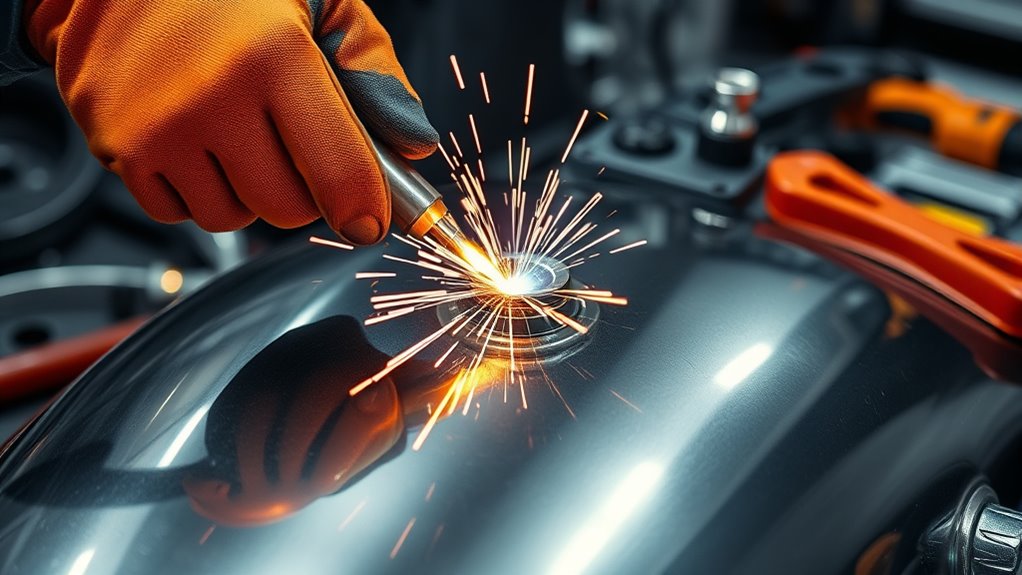
On a custom fuel tank, a bung creates a fixed connection for a fuel pickup, return, vent, drain, filler neck, sending unit, cap, or sensor. The bung must support the connected part without cracking the tank wall, and its sealing method must remain compatible with the fuel, vibration, and service temperature.
Many bungs have threaded openings, but the threads do not all seal in the same way. Tapered pipe threads seal at the threads with a compatible sealant. Flare fittings seal at the flare. O-ring boss fittings seal at the specified O-ring. Identify the exact fitting standard before buying or drilling.
Match the bung material to the tank whenever possible. Mild steel to mild steel, stainless to the same stainless family, and a known aluminum alloy to compatible aluminum are the simplest combinations. Mixed-metal joints need a qualified filler and welding procedure.
The bung is only as reliable as its location, fit-up, weld root, and sealing interface. A good-looking bead cannot compensate for trapped contamination, a loose hole, or the wrong fitting standard.
Plan the Bung Location Before You Drill
Choose a location that gives the fitting enough room inside and outside the tank. Check for baffles, seams, mounting straps, skid plates, exhaust heat, suspension travel, driveshaft clearance, and service access. A pickup or drain may need a low point, while a vent normally needs a high point that will not be submerged during normal vehicle movement.
Do not place a large or heavily loaded bung close to a sharp corner, existing weld, mounting tab, or highly flexed panel unless the tank design supports it. A filler neck, pump module, or large hose connection may need a formed flange, reinforcement ring, or doubler plate to spread the load.
When you weld a bung into a fuel tank, the joint must protect the tank’s structural integrity. A closely fitted hole and clean bare metal help reduce distortion and leak risk. The same basic preparation principles used for cleaner metal edges also apply here, but fuel-tank work requires stricter contamination control.
Preparing Your Workspace and Tools
Set up a clean, well-ventilated welding area with a noncombustible work surface. Remove fuel cans, oily rags, paint, solvents, batteries, upholstery, and other flammable items. Protect people nearby from arc flash and sparks, and keep the work stable so the tank cannot roll or shift.
Warning: Never weld on a tank that contains fuel, fuel vapor, unknown residue, a sealed cavity, or a connected fuel line. Do not drill, grind, or strike an arc until the tank’s hot-work status is known.
Gather the tools and supplies before you start:
- TIG or MIG welder suited to the tank material and thickness
- Filler rod or wire selected for the exact base metals
- Drill, step bit, chassis punch, or hole saw sized from the bung drawing
- Center punch, deburring tool, files, and a die grinder or sanding disc
- Clean clamps or fixtures that hold the bung square without contaminating it
- Dedicated stainless-steel brush and abrasives for aluminum, if applicable
- Non-chlorinated cleaner approved for welding preparation
- Thread plug, heat-resistant masking, or another method to protect the bung threads from spatter
- Welding helmet, safety glasses, gloves, hearing protection, flame-resistant clothing, and suitable footwear
- Suitable fire extinguisher and the equipment required by the approved leak-test procedure
Clean and arrange the tools so dirt, carbon-steel particles, oil, or old abrasive residue cannot transfer to stainless steel or aluminum. Wear flame-resistant welding clothing that covers exposed skin.
Pro Tip: Make a practice coupon from the same alloy and thickness as the tank. Drill a similar hole, fit a spare ring or scrap bung, and tune the process there before touching the tank.
Products Worth Considering
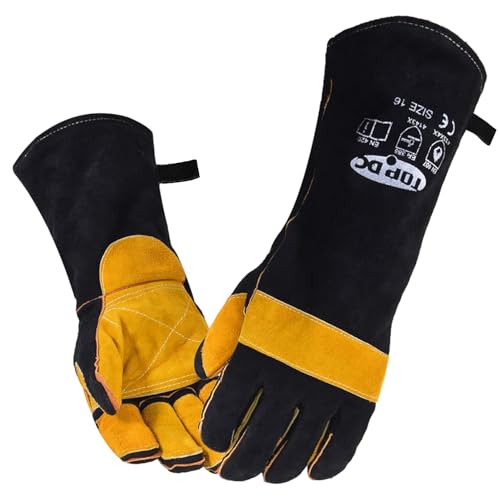
EXTREME HEAT RESISTANT PROTECTION: Reinforced Kevlar stitching, double leather reinforcement and high-strength sewing on the fingers, palms, elbows and backs. An aluminum foil layer in the palm adds insulation. A fully lined interior helps protect against heat, flames, spatter and sparks during welding tasks. Heat resistant up to 932°F (500°C)

✅Arc & Flame Resistant for Life - This 7 oz material is a soft, breathable cotton. They will remain arc and flame retardant regardless of the washes and wear cycles. These cotton fr balaclavas are NFPA 70E Compliant, HRC / CAT 2, EBT = 12 cal/cm² and meet ASTM F1506.

FR MATERIALS:7oz mid-weight 100% cotton flame resistant knit,all the materials from our FR crew/henley shirts and classified by UL.
Choose the Right Bung for Your Tank
Choose the right bung by checking four details: its purpose, sealing style, material, and flange shape. Confirm the mating part’s exact thread designation and sealing surface. Do not substitute a bolt thread for a pipe, flare, or O-ring connection simply because the diameters look close.
The bung’s pilot or neck should fit the drilled opening with a small, even clearance. Its flange must remain larger than the hole and sit flat against the tank. A tophat-style bung is often easier to locate because its pilot centers the fitting while the flange supports it on the tank surface.
| Tank Material | Preferred Bung and Filler Approach |
| Mild steel | Use a weldable mild-steel bung and an ER70S-family filler selected for the procedure and surface condition. |
| 304 or 304L stainless | Use a compatible stainless bung; ER308L is a common matching filler for 304L. Keep stainless tools separate from carbon-steel tools. |
| 316 or 316L stainless | Use a compatible 316-family bung; ER316L is a common matching filler. Confirm the tank grade before welding. |
| Aluminum | Use a known, compatible aluminum alloy. Select 4043, 4943, 5356, or another filler from an alloy-selection chart rather than guessing. |
| Dissimilar metals | Use only a qualified procedure and compatible filler. For example, 309L is commonly used for some stainless-to-mild-steel joints, but it is not a universal answer. |
Filler selection depends on the exact alloy and service requirements. Hobart’s guidance matches 308 or 308L filler to 304L stainless and 316L filler to 316 stainless, while Miller recommends choosing aluminum filler from the base-alloy and service requirements rather than using one universal wire. See the Hobart stainless filler-metal guide and Miller aluminum welding guide.
Avoid unknown castings, zinc-plated bungs, and galvanized parts. Zinc coating creates fumes and contaminates the joint. If coated steel is unavoidable elsewhere in a project, understand the separate preparation and ventilation requirements before reviewing welding consumables for galvanized steel; a fuel-tank bung itself should be clean, known, and weldable.
Products Worth Considering

Size: 1/2" NPT female thread, pack of 2

Wide Applications:The Female Weld on Bung Fitting suit for fuel tank, intercooler piping, intake manifold, overflow tank, ect

【 material】Filler Neck Cap,Crafted from premium-grade aluminum alloy, this fuel tank cap is exquisitely constructed to withstand and offer unparalleled durability.
Prep Your Tank for Welding
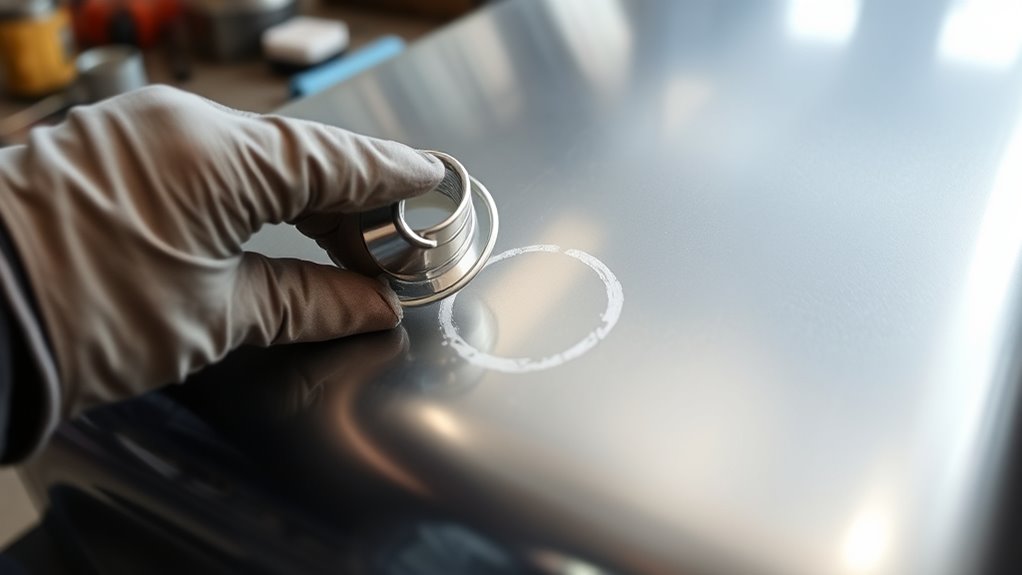
Good preparation creates a strong, leak-resistant bond. Clean both sides of the planned joint when accessible. Remove paint, powder coat, undercoating, rust, scale, oil, adhesive, plating, and oxidation from an area wider than the bung flange and expected heat-affected zone.
Use clean abrasives that match the tank material. For aluminum, use a stainless-steel brush dedicated only to aluminum and clean the oxide shortly before welding. For stainless steel, avoid carbon-steel brushes and grinding dust that can embed iron and cause later rust staining.
You can apply Dykem layout fluid to improve mark visibility, but remove it fully from the weld zone before fitting the bung. Mark the center based on the tank layout, internal clearance, and the bung manufacturer’s drawing.
Warning: Do not use chlorinated brake cleaner or allow chlorinated solvent vapor near an arc. OSHA requires chlorinated-hydrocarbon degreasing operations to be kept away from gas-shielded welding atmospheres. Use a non-chlorinated cleaner approved for weld preparation and let it evaporate completely.
If the tank or bung has zinc coating, remove it from the complete heat-affected area and provide suitable ventilation. Review the separate hazards involved in removing zinc coating before welding.
Use welding blankets or heat shields to protect surfaces that are well away from the joint. Do not place leather washers, sealant, tape, paint, or any other combustible material between the bung flange and the tank. The flange must contact clean bare metal.
Drilling Holes for Bung Installation
Mark the center and use a center punch so the pilot bit does not wander. Support the panel from behind when possible, especially on thin sheet, so drilling pressure does not dish the tank wall.
Drill a pilot hole, then enlarge it with a step bit, hole saw, chassis punch, or other suitable tool. Use the bung manufacturer’s cutout dimension or measure the bung’s pilot carefully. There is no universal 3/4-inch bung hole.
Stop before the hole becomes loose. The pilot should enter without force while leaving only a small, even gap. A wide or uneven gap makes burn-through, distortion, and incomplete fusion more likely.
Deburr the hole on both sides. Remove every chip, burr, abrasive grain, and piece of masking from the tank. If the tank is closed and you cannot retrieve the drilling debris or inspect the back of the joint, redesign the work or use a qualified fabricator.
A plasma cutter can leave a wider heat-affected zone and a less precise edge on thin tank sheet. A drilled or punched hole is usually easier to fit. If you use thermal cutting in another fabrication context, match the process to material thickness using a reliable plasma-cutter amperage and thickness reference, then machine the final bung seat accurately.
Test-fit the bung and confirm that its flange sits flat with no rocking. Protect the threads from spatter with a clean, removable thread plug or suitable heat-resistant protection that stays outside the weld joint.
Executing the Weld After Drilling
Place the tank on a stable fixture, recheck that it is safe for hot work, and clamp the welding return lead to clean bare metal close to the joint. Do not route welding current through vehicle bearings, wiring, modules, fuel-system hardware, or a loosely connected tank mount.
Clean the bung and hole one final time. Seat the flange firmly, verify the bung angle, and make small opposing tack welds. Recheck alignment after every tack before completing the seal weld.
Good fit-up matters as much as machine settings. The metal-preparation basics in these welding preparation tips are useful, but a fuel-tank seal weld normally benefits from the cleanliness and puddle visibility of TIG or gas-shielded MIG rather than a slag-producing process.
Preparing the Area
Remove grease, layout fluid, grinding dust, fingerprints, and oxide from both the bung and the tank. Check the inside edge for burrs and confirm that no coating, seam sealer, foam, or residue remains where heat can reach it.
For a tophat-style bung, the pilot should center the fitting and the flange should sit flat. Correct a distorted panel before welding. Do not pull a large gap closed with the weld bead.
Avoid anti-seize, thread sealant, gasket cement, and epoxy before welding. These products can contaminate the puddle and produce fumes. Add the correct fuel-compatible seal only after the weld passes inspection and leak testing.
Place at least four small tacks in opposing positions, such as 12, 6, 3, and 9 o’clock. Let each tack cool briefly, then confirm that the bung remains square and the flange stays seated.
Selecting Welding Equipment
Choose welding equipment that matches the material, thickness, joint, and your skill. TIG offers precise control over arc length, filler addition, and heat input. Short-circuit MIG can also work on thin mild steel when the machine, wire, gas, and technique are suitable. Pulsed TIG or pulsed MIG may help manage average heat on compatible equipment.
Miller notes that TIG, short-circuit MIG, and pulsed TIG provide useful heat control on thin sheet where warping and burn-through are major concerns. Review its guide to welding sheet metal with MIG and TIG.
Use the correct filler rod or wire for both base metals. ER70S-2 can be suitable for clean mild-steel TIG work, but it is not a universal choice for every tank. Match stainless filler to the stainless grade, and select aluminum filler from an alloy chart.
There is no safe universal amperage range for a fuel-tank bung. The correct setting depends on metal thickness, alloy, process, polarity, wire or tungsten size, joint gap, torch angle, travel speed, pulse settings, and machine behavior. Start with the welder manufacturer’s chart, then test and section a coupon made from matching material.
Do not copy a stick-welding amperage chart for TIG or MIG tank work. Each process uses different electrodes, arc characteristics, and heat-control methods.
Ensuring Proper Technique
Keep the arc short, the puddle small, and the travel controlled. On thin sheet, complete the circumference in short, alternating sections rather than heating one side continuously. Let the joint cool between sections while keeping the final weld continuous and fully sealed.
Overlap starts and stops enough to eliminate craters and pinholes without building a large, overheated bead. Aim for fusion into both the bung flange and tank wall. If the tank edge melts away or the panel begins to sag, stop and correct the fit-up or settings on a practice coupon.
For stainless steel, use the shielding and back-side protection required by the procedure to prevent heavy root oxidation. For aluminum, remove oxide immediately before welding, use the correct polarity and shielding gas, and fill the end crater to reduce cracking.
Allow the joint to cool naturally. Do not quench it with water or compressed air. Rapid, uneven cooling can distort the panel and conceal heat-control problems.
Pro Tip: Mark the tank at four or eight equal positions before welding. Alternating between opposite marks makes it easier to distribute heat and track which sections still need a continuous seal.
Check Your Weld to Ensure It’s Solid
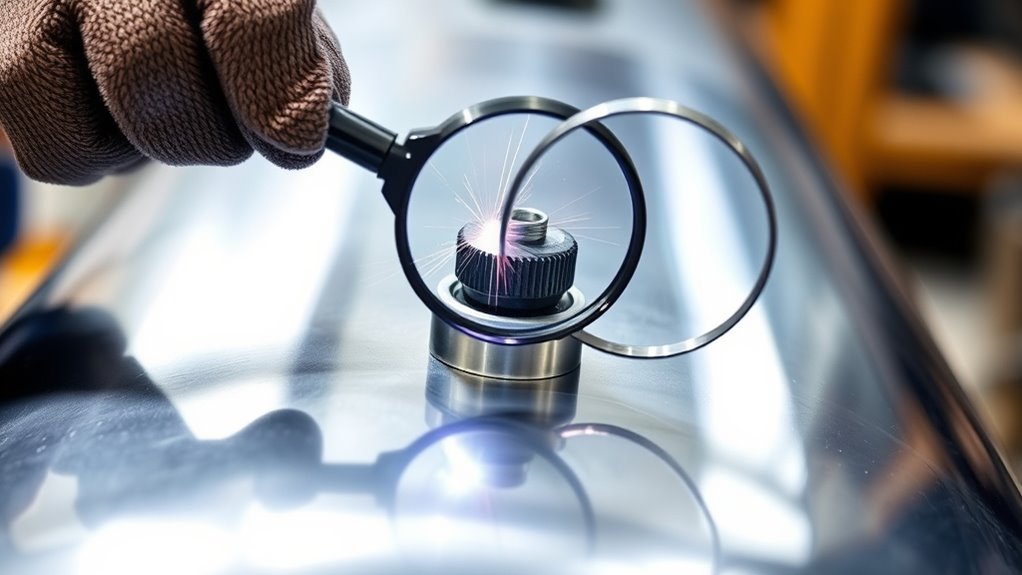
Inspect the weld before coating, sealing, or installing the tank. Clean the bead gently so soot cannot hide defects, but do not grind away evidence of undercut, lack of fusion, or porosity.
A smooth bead still needs a controlled leak test. Tiny pores, start-stop craters, and incomplete root fusion can remain invisible from the outside.
Use these checks before moving forward:
- Outside visual inspection: Look for a continuous bead, even tie-in, no cracks, no pinholes, no undercut, and no missed section.
- Inside or root inspection: When accessible, inspect the back of the joint for complete fusion, excessive penetration, oxide, slag, spatter, and loose debris.
- Distortion check: Confirm that the panel did not dish, the bung remains square, and the fitting still clears internal and external parts.
- Thread and sealing-surface check: Make sure spatter or heat did not damage the threads, flare seat, O-ring counterbore, or gasket face.
- Approved leak test: Follow the tank manufacturer’s, vehicle builder’s, or qualified fabricator’s written procedure.
Warning: Do not pressurize a thin fuel tank with unregulated shop air. Compressed gas stores energy, and a failed tank or plug can become a dangerous projectile. Never use oxygen, fuel, a flame, or an ignition source to find a leak.
Some approved procedures use regulated pneumatic testing with a calibrated low-range gauge, pressure relief, secure closures, an exclusion zone, and leak-detection solution. Others use a liquid test when the tank material and finishing process allow it. The test pressure and method must come from the tank design or qualified fabricator, not from a generic internet value.
If a leak appears, fully depressurize and drain the test medium before touching the joint. Mark the defect, remove contamination, repair the weld correctly, and repeat the complete inspection and test. Do not hide a pinhole with paint, sealant, solder, or epoxy.
Finalizing the Bung Installation and Testing
Finalize the bung installation only after the weld passes visual inspection and the approved leak test. Remove test residue and dry the tank completely. Confirm that no chips, water, abrasive dust, backing material, or loose spatter remains inside.
Apply sealant or a gasket only where the fitting design requires it:
- Tapered pipe threads: Use a sealant specifically approved for the fuel and fitting material, and keep excess sealant out of the tank.
- AN or other flare fittings: The flare is the sealing surface; do not use thread tape to compensate for a damaged flare.
- O-ring boss fittings: Use the specified O-ring material and size, lubricated and tightened as the fitting maker directs.
- Flat-gasket flanges: Use the specified fuel-compatible gasket and tightening pattern.
Do not use sealant to hide a poor weld. A defective weld must be repaired and retested.
Check the alignment of the bung with the hose, pickup, vent, cap, or sensor. The connected part should not preload the tank wall or place side force on the bung. Add proper hose support so vibration is not carried by the weld.
After testing, clean and coat the exterior as required for corrosion protection. Do not coat the weld before inspection. If rust remains elsewhere, prepare it correctly rather than relying on paint alone; see this guide to whether you can apply Rust-Oleum over rust.
Reinstall the tank only after all mounts, straps, isolators, vents, rollover valves, hoses, wiring, and shields are in safe condition. Add fuel in a controlled area, inspect for seepage, and recheck the fitting after the first heat and vibration cycle.
Troubleshooting Common Bung-Weld Problems
| Problem | Likely Cause | Corrective Action |
| Burn-through | Loose fit, excessive heat, long dwell, or unsupported thin sheet | Stop, let the panel cool, restore the opening with a qualified repair, improve fit-up, and retune on matching scrap. |
| Warped tank wall | Too much continuous heat or an uneven tack sequence | Use opposing tacks and short alternating weld sections. Repair severe distortion before testing. |
| Pinholes or porosity | Oil, paint, oxide, moisture, poor shielding, or contaminated filler | Remove the defect to sound metal, correct shielding and cleanliness, reweld, and repeat the leak test. |
| Lack of fusion | Arc aimed at one side, cold lap, excessive travel speed, or oxide | Remove the faulty section and reweld with the arc directed into both the bung and tank wall. |
| Bung moved out of square | Weak fixture, oversized hole, or tacks placed on one side first | Correct alignment before the full weld. Replace the bung or repair the hole if the fit cannot be restored safely. |
| Leak at the installed fitting, not the weld | Wrong thread, damaged flare, incorrect O-ring, or improper sealant | Identify the sealing standard and replace the damaged or mismatched component. Do not overtighten it. |
Frequently Asked Questions
How do I add a bung to a fuel tank?
Start with a new, never-fueled tank or a used tank professionally released for hot work. Choose a compatible bung, plan its location, clean both sides to bare metal, drill a close-fitting hole, tack the bung square, weld with controlled heat, inspect the root, and follow an approved leak-test procedure.
What J-B Weld works with gasoline?
J-B Weld markets TankWeld as a repair kit for metal and fuel-storage containers. Follow the current product label, surface-preparation limits, cure instructions, and vehicle or tank-maker guidance. Epoxy is not a substitute for a structural weld-in bung or a repair that requires certified welding.
Can you weld your own fuel tank?
You can fabricate a new, never-fueled tank only when you have the welding skill, design knowledge, equipment, and test procedure to do it safely. Do not weld a tank that has held fuel unless a qualified professional has cleaned, isolated, vented, purged, tested, and released it for hot work.
What is a fuel tank bung?
A fuel tank bung is a welded or formed fitting that creates a secure connection point for a fuel line, vent, drain, filler, cap, sender, or sensor. Its material, thread or sealing style, flange, and location must match the tank and connected hardware.
Should you use TIG or MIG to weld a fuel tank bung?
TIG usually gives the most direct control on thin steel, stainless, and aluminum. Short-circuit MIG can work on suitable mild-steel tanks, and pulsed processes can help manage heat. The best choice depends on the alloy, thickness, access, machine, joint fit, and welder’s proven procedure.
Can I weld a bung into a used gas tank after rinsing it?
No. Rinsing does not prove that flammable vapor or residue is gone. Used tanks require professional cleaning, isolation, ventilation or purging, atmospheric testing, and a documented hot-work decision that follows applicable safety rules.
How should I leak-test a welded fuel tank bung?
Use the written procedure supplied by the tank maker, vehicle builder, or qualified fabricator. Do not improvise a pressure or use unregulated shop air. A professional procedure controls the test medium, pressure, gauge range, relief, closures, exclusion zone, inspection method, and drying requirements.
Do fuel-line fitting threads need sealant?
It depends on the fitting. Tapered pipe threads normally use a compatible sealant. AN or other flare fittings seal at the flare, and O-ring boss fittings seal at the O-ring. Identify the fitting standard and follow its manufacturer’s instructions instead of adding tape or sealant to every thread.
Safety Disclaimer: This article is for informational purposes only and does not replace a hot-work permit, professional tank cleaning, atmospheric testing, an engineered fuel-system design, or qualified welding advice. Fuel tanks can retain explosive vapors even when they look empty. Consult a qualified welder or fuel-system professional before welding, repairing, testing, or modifying any tank that has held fuel.
Conclusion
A safe bung installation starts with the right decision about the tank itself. Work only on a new tank or one professionally released for hot work. Then choose a compatible bung, plan the location, prepare both sides to clean metal, make a close-fitting hole, control heat during welding, inspect the root, and use an approved leak test. Do not add fuel until the weld, sealing interface, mounting, venting, and connected hardware have all passed inspection.
Sources
- OSHA 29 CFR 1910.252, General Requirements for Welding, Cutting, and Brazing — used-container cleaning, venting and purging, fire prevention, PPE, ventilation, and solvent precautions
- NFPA 326, 2025 Edition — safeguarding tanks and containers for entry, cleaning, and repair
- Miller: Successfully Welding Sheet Metal With MIG and TIG — thin-sheet heat control, warping, and burn-through prevention
- Hobart Brothers: Selecting Filler Metals for Austenitic Stainless Steel — matching 308L and 316L filler to common stainless grades
- Miller: Guide to Industrial Aluminum Welding — aluminum preparation, process control, and filler selection
- J-B Weld TankWeld Product Information — manufacturer-stated scope for its metal and fuel-tank repair kit