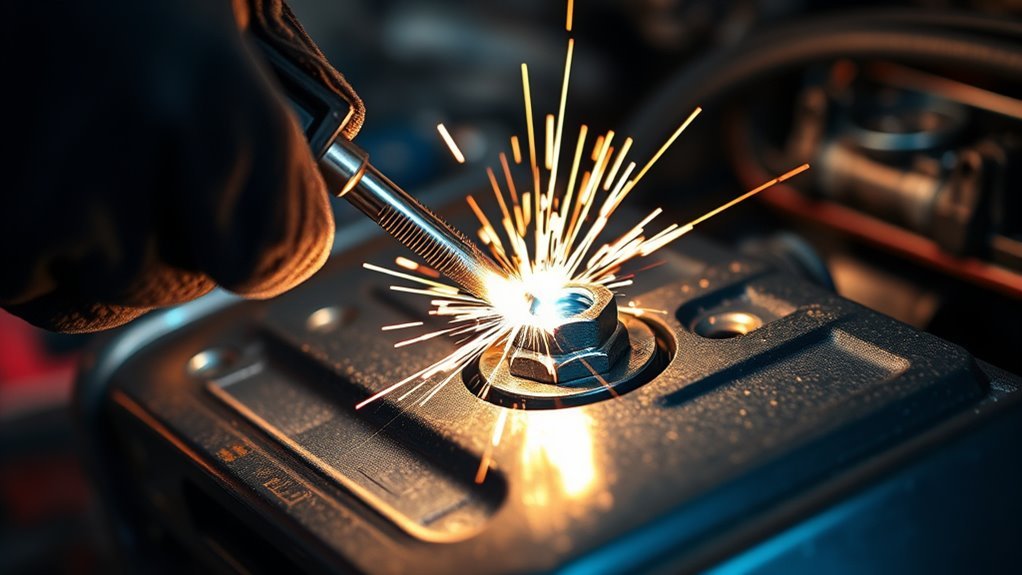
A rounded or stripped bolt can stop an otherwise simple car repair, but welding on a vehicle adds electrical, fire, fume, and heat risks that ordinary bolt-removal guides often miss. Before you strike an arc, identify what has failed, review the vehicle-maker’s service procedure, protect nearby components, and confirm that the fastener can be heated safely.
Quick Answer
To weld a nut over a stripped car bolt, expose clean steel, place a close-fitting plain steel nut over the damaged head or stud, attach the work clamp nearby, and weld from the bolt outward into the nut. Let the weld solidify, then use a six-point socket and steady pressure to remove the bolt.
Key Takeaways
- Check the vehicle-maker’s welding, battery, restraint-system, and high-voltage procedures before you disconnect anything.
- Do not weld near fuel vapor, batteries, pressurized lines, hidden wiring, airbags, undercoating, or other materials you cannot safely remove or shield.
- Clean the bolt to bare metal and place the work clamp on clean metal as close to the weld as practical.
- Use the welder’s setup chart and a practice piece instead of relying on one universal voltage or wire-speed setting.
- Inspect the threads and install the correct replacement fastener after removal.
At a Glance
| Time Required | About 20 to 45 minutes for an accessible bolt, plus extra time for vehicle isolation, cooling, fire inspection, or thread repair |
| Difficulty | Intermediate to advanced; not suitable as a first welding project on a vehicle |
| Tools Needed | MIG or suitable flux-core welder, plain steel nuts, wire brush or grinder, work clamp, welding PPE, fire extinguisher, heat shields, six-point socket, and thread-cleaning tools |
| Cost | Usually limited to a nut and welding consumables if you already own the equipment; professional extraction is safer when access or vehicle systems create added risk |
What’s in This Article
- Identify What Is Actually Stripped
- How Welding a Nut Fixes Stripped Bolts
- Essential Safety Precautions Before Welding
- Tools You Need for Successful Welding
- Tips for Strong Welds
- Step-by-Step Guide
- Common Mistakes to Avoid
- What to Do If the Weld Fails
- Alternative Bolt-Removal Methods
- What to Do After Removal
- Prevent Future Bolt Damage
- Frequently Asked Questions
Warning: Do not attempt this repair if you are not confident with the welder, cannot identify what lies behind the fastener, or are working near a fuel system, battery, airbag component, brake line, steering part, high-voltage cable, or other safety-critical system. Use a qualified technician instead.
Identify What Is Actually Stripped
People often use “stripped bolt” to describe several different failures. Check the fastener before choosing a removal method:
- Rounded bolt head: The socket flats are damaged, but the bolt and threads may still be intact. A bolt-extractor socket may work before welding becomes necessary.
- Broken bolt or stud: The head has snapped off, leaving part of the shank above, flush with, or below the surface. A welded nut can work well when you can reach the remaining steel.
- Stripped male threads: The bolt turns but does not tighten or pull out. Welding a nut to the head does not repair the damaged threads.
- Stripped female threads: The threaded hole is damaged. After removing the bolt, you may need to tap the hole oversize, install a thread insert, or replace the component.
- Cross-threaded or seized bolt: The fastener may require considerably more torque and can damage the parent material during removal.
Try the least destructive method that fits the problem. Welding is most useful when the head is too rounded to grip or a broken steel stud leaves enough material for a weld.
How Welding a Nut Fixes Stripped Bolts
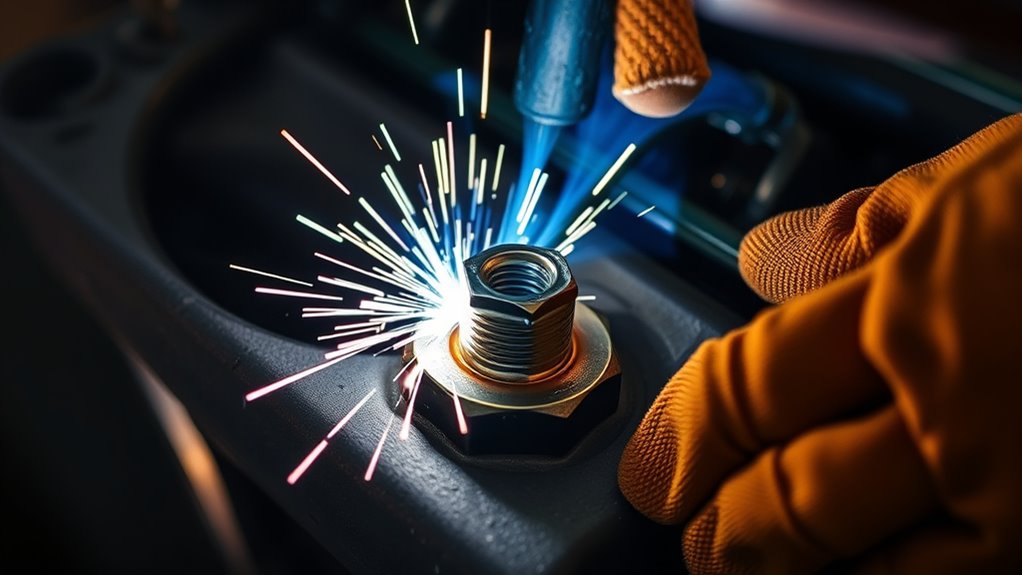
Welding a nut onto a stripped bolt creates a new hex-shaped gripping surface for a socket or wrench. The weld joins the center of the nut to the damaged bolt head or exposed stud.
The heating and cooling cycle may also help disturb rust between the bolt and threaded hole. This effect can make some seized fasteners easier to move, but it does not guarantee removal.
The best nut is not simply the largest one available. Choose a plain steel nut that:
- Leaves clear access to the exposed bolt in the center.
- Sits flat without rocking.
- Provides enough wall thickness to accept the weld.
- Leaves room for a six-point socket or box-end wrench.
- Does not touch delicate surrounding material.
A nut that is too small can block access to the bolt. A nut that is excessively large creates a gap that is harder to bridge and can spread more heat into the surrounding area.
Clean metal preparation remains essential. Review these flux-core welding fundamentals before using a wire-fed welder for the first time.
Essential Safety Precautions Before Welding
Welding on a vehicle is not the same as welding loose steel on a bench. Current, heat, sparks, ultraviolet radiation, fumes, and spatter can affect parts you cannot see from the working side.
Products Worth Considering

✅【Fire-Resistant Carbon Felt Construction】The Matace welding blanket is made from 5mm thick carbon felt and has been tested in accordance with ASTM D6413 standards. Its dense, heavy-duty structure is designed to help manage sparks, hot slag, and radiant heat during welding and high-temperature work.

MESS FREE- Unlike chemical fire extinguishers, the fire blanket does not leave a chalky mess after use

Skin friendly: Orange silicone-coated surface significantly reduces skin contact with glass fibers. You can grab and deploy it bare-handed without hesitation — no need to search for gloves in an emergency
Follow the Vehicle-Maker Procedure
Find the service information for the exact year, make, model, and powertrain. Battery disconnection can erase settings, trigger relearn procedures, or require special steps for electronic parking brakes, air suspension, restraint systems, security systems, and other modules.
I-CAR’s vehicle-welding guidance calls for a short welding-current path, isolation of both battery cables with the negative cable removed first, high-voltage battery disconnection where applicable, careful cable routing, and protection or removal of nearby electronic parts. The vehicle maker’s instructions take priority because procedures vary.
Note: Disconnecting the battery does not make every vehicle safe to weld. Hybrid and electric vehicles may retain dangerous high voltage after the 12-volt system is disconnected. Do not work on a high-voltage vehicle unless you are trained, equipped, and following its official disabling procedure.
Inspect the Entire Hot-Work Area
Check the front, back, inside, and opposite side of the repair area. Remove or shield:
- Fuel lines, tanks, hoses, and fuel vapor sources.
- Brake lines and flexible brake hoses.
- Air-conditioning lines and other pressurized systems.
- Wiring harnesses, control modules, sensors, and connectors.
- Airbags, seat-belt pretensioners, and restraint-system wiring.
- Batteries, including small backup batteries.
- Plastic clips, rubber bushings, seals, carpet, insulation, and trim.
- Oil, grease, penetrating fluid, seam sealer, undercoating, paint, and sound-deadening material.
OSHA’s hot-work requirements call for movable fire hazards to be removed, immovable hazards to be shielded, and welding to stop when those controls cannot be provided.
Do not remove an oil-pan drain plug to “relieve pressure.” That is not a welding-safety step. Repair leaks, clean contaminated surfaces, and protect the oil pan from spatter instead.
Support the Vehicle Safely
Park on a firm, level surface, apply the parking brake when appropriate, chock the wheels, and support the vehicle at approved lifting points. Never crawl under a vehicle held only by a hydraulic jack. Keep welding leads and hoses away from sharp edges, hot exhaust parts, and moving components.
Control Fumes and Cleaning Chemicals
Remove paint, rust, oil, and coatings from the immediate weld zone. Zinc, lead, cadmium, unknown plating, paint, and other coatings can produce hazardous fumes when heated. Use effective ventilation that carries fumes away from your breathing zone.
OSHA’s welding-fume fact sheet explains that fume exposure depends on the process, base metal, filler metal, coatings, location, ventilation, and work practices.
Follow the cleaner manufacturer’s label. Do not weld where vapors from chlorinated degreasers or cleaners can reach the arc. OSHA specifically requires chlorinated-hydrocarbon cleaning operations and vapors to be kept away from welding atmospheres.
Place the Work Clamp Correctly
The clamp commonly called the “ground clamp” is the welder’s work clamp. Attach it to clean bare metal on the same component or panel as the weld when practical, and place it as close to the weld as the repair allows. Do not create a current path through bearings, hinges, electronic modules, wiring, steering components, or other assemblies.
Route the torch and work cables away from computers, sensors, harnesses, and restraint components. I-CAR advises shortening the current path and protecting nearby electronic parts.
Wear the Right PPE
Use a welding helmet with a suitable filter shade, safety glasses under the helmet, flame-resistant gloves, long sleeves, closed footwear, and flame-resistant clothing. Shield other people from arc radiation and sparks.
| Precaution | Why It Matters | Required Action |
|---|---|---|
| OEM electrical procedure | Protects modules, restraint systems, and high-voltage components | Follow the exact service-information sequence |
| Work clamp placement | Shortens the welding-current path | Clamp to clean metal close to the weld |
| Fire control | Sparks can enter hidden cavities or ignite material on the opposite side | Remove or shield combustibles and keep an extinguisher ready |
| Ventilation | Reduces exposure to welding and coating fumes | Move fumes away from your breathing zone |
Warning: Do not weld in the presence of fuel vapor or on a component that has contained a flammable substance unless it has been professionally cleaned, purged, and declared safe for hot work.
In workplaces where a fire watch is required, OSHA calls for monitoring for at least 30 minutes after welding ends. A home garage should also be checked carefully for hidden heat, smoke, or smoldering material before the area is left unattended.
Tools You Need for Successful Welding
Gather everything before isolating the vehicle so you do not have to stop midway through the repair.
Products Worth Considering
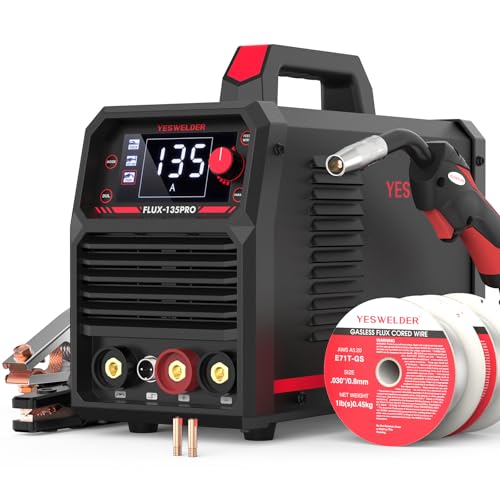
READY OUT OF THE BOX: Start welding immediately! It masterfully handles Gasless Flux Core MIG, Stick, and Lift TIG (Extra Lift TIG torch required). This budget-friendly 3-in-1 machine includes extra E71T-GS .030''&.035'' flux core wires, known for its smooth arc and high feedability. Say goodbye to heavy shielding gas cylinders—perfect for outdoor, windy, or all-position welding.

FIVE PROCESSES, ONE MACHINE FOR EVERY JOB - Pulse MIG, SPOT, Flux Core, Lift TIG and Stick in a single 140A welder. Pulse mode smooths the arc for less spatter, and SPOT mode pulses on a timer so thin auto body panels weld without burn-through or warping. Synergic control matches current to wire speed automatically, with no guesswork. The clear digital display shows your settings while you work. One machine replaces three
Essential Welding Equipment
| Tool | Purpose | Selection Tip |
|---|---|---|
| MIG or suitable flux-core welder | Fuses the nut to the bolt | Use a machine you understand and set it from its chart |
| Plain steel nuts | Creates a new gripping surface | Bring several sizes and avoid unknown or heavily coated material |
| Plain steel washer | Can help protect the parent surface around a flush-broken stud | Use only when it can be placed without welding it to the surrounding part |
| Wire brush or small grinder | Exposes clean steel | Keep abrasive debris out of openings, bearings, and seals |
| Fire-resistant shields | Blocks sparks and radiant heat | Protect both the visible side and hidden opposite side |
| Six-point socket and ratchet or breaker bar | Applies removal torque | Confirm clearance before welding the nut |
| Thread chaser, tap, and pitch gauge | Checks and restores usable threads | Do not cut away sound material unless thread repair is necessary |
Gas-shielded MIG often gives cleaner access with less slag than self-shielded flux core. Flux core can still work, but it usually produces more fume, spatter, and slag. Protect the vehicle accordingly.
Safety Gear Requirements
Wear a welding helmet, safety glasses, flame-resistant gloves, a welding jacket or sleeves, long trousers, and closed leather footwear. Keep a suitable fire extinguisher within reach, and make sure you know how to use it.
Good ventilation does not mean placing a fan so it blows shielding gas away from a MIG weld. Position airflow or local extraction so it removes fumes without disrupting the arc’s shielding.
Tips for Strong Welds
Choose and Prepare the Nut
Use a clean plain steel nut when possible. Remove oil, paint, rust, plating, and coatings from the surfaces that will be welded. A nut with heavy zinc coating can contaminate the weld and add zinc-containing fume.
Test-fit the socket before welding. The nut should sit flat and leave enough room for the torch, socket, surrounding casting, and nearby vehicle parts.
Pro Tip: Practice the same center-out weld on a scrap bolt and nut of similar size. Confirm that your wire reaches the base metal and that the nut can withstand removal torque before working on the vehicle.
Prepare the Bolt and Parent Material
Expose bright metal on the bolt head or stud. If a bolt is broken flush in an aluminum or cast-iron component, avoid grinding into the parent material. Damage around the hole can make thread repair harder.
Plug or cover openings that could collect abrasive dust or weld spatter, but do not use combustible material near the arc.
Set the Welder
Use the machine manufacturer’s chart as the starting point for wire type, wire diameter, polarity, voltage, and wire speed. The nut and bolt are usually thicker than nearby vehicle sheet metal, but the surrounding assembly may still be heat-sensitive.
Do not copy one amperage value from an unrelated chart. A MIG or FCAW setting depends on the machine, process, polarity, wire, extension, shielding gas, material condition, and joint geometry. Review the main welding parameters before adjusting the machine.
Control the Arc
Aim the first part of the weld at the exposed bolt, not only at the nut. Build the puddle from the bolt outward until it fuses with the inner wall of the nut. The weld must grip both pieces.
Use controlled trigger time, but do not treat “a few seconds” as a universal limit. A tiny tack that never melts the bolt will twist off. An excessively long arc can overheat the surrounding component. Watch the puddle and stop once you have achieved fusion without spreading unnecessary heat.
Step-by-Step Guide to Welding a Nut Over the Stripped Bolt
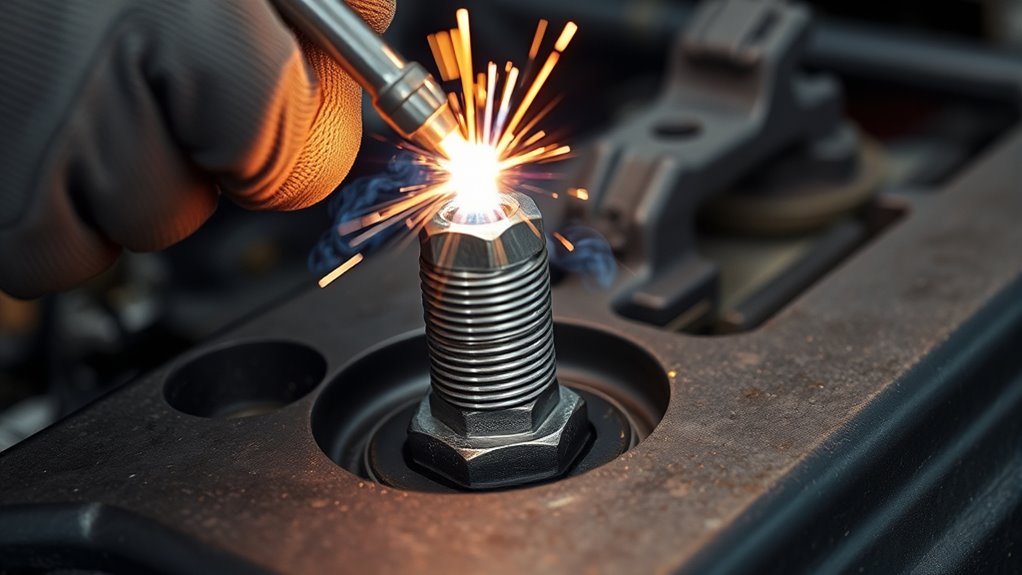
- Confirm that welding is appropriate. Identify the failed fastener and make sure a less destructive extractor, locking pliers, or correctly sized removal socket will not solve the problem first.
- Read the service information. Check the vehicle-maker procedure for welding, battery isolation, restraint systems, high-voltage systems, lifting, and component removal.
- Support the vehicle. Chock the wheels and use approved lifting points and rated stands if you must work underneath.
- Remove or shield hazards. Inspect both sides of the work area for fuel, wiring, batteries, modules, hoses, oil, seam sealer, undercoating, rubber, plastic, and other combustibles.
- Isolate the specified electrical systems. Follow the OEM sequence. Do not assume removing one terminal is enough.
- Clean the bolt and nut. Expose clean steel while protecting the surrounding surface. Remove coating from the weld area when it can be done safely.
- Test-fit the nut and socket. Center the nut over the bolt or stud. Make sure the socket will fit after welding.
- Attach the work clamp. Clamp to clean metal close to the repair and route both welding cables away from electronics and wiring.
- Set and test the welder. Start with the machine chart and confirm the setup on comparable scrap metal.
- Weld from the center outward. Establish the puddle on the bolt, then carry it into the inside wall of the nut. Keep the torch centered so you do not fuse the nut to the surrounding component.
- Let the weld solidify. Do not apply torque while the weld is molten, glowing, or mechanically soft. Keep flammable penetrating fluids away until the area is cool enough for the product’s instructions.
- Remove the bolt carefully. Fit a six-point socket and apply smooth force in the loosening direction. If it begins to move, work it back and forth in small increments instead of forcing it through rusty threads.
- Stop if the parent material moves or cracks. Excessive force can break a casting, distort a bracket, or pull threads from aluminum.
- Inspect the area after removal. Check the threaded hole, nearby wiring, seals, coatings, and both sides of the panel for heat damage or fire.
Note: A flush-broken stud sometimes allows a plain steel washer to be welded to the stud first, followed by a nut welded to the washer. This method requires precise arc control so the washer does not become welded to the surrounding component.
Avoid Common Mistakes When Welding a Nut Over a Stripped Bolt
Proper Preparation Steps
- Do not weld through grease, rust, paint, threadlocker, zinc coating, or old failed weld metal.
- Do not clean with an unidentified solvent and immediately strike an arc.
- Do not assume the visible side is the only side exposed to heat and sparks.
- Do not place the work clamp on a distant body panel when you can clamp closer to the repair.
- Do not use a nut before checking socket clearance.
If the area contains galvanized or zinc-coated metal, review the hazards and preparation steps in this guide to removing zinc coating before welding.
Effective Welding Techniques
- Start the puddle on the bolt so the weld does not attach only to the nut.
- Hold the wire where you can see it contact exposed base metal.
- Maintain the correct contact-tip-to-work distance for your process.
- Keep the arc centered and prevent contact with the parent casting or sheet metal.
- Allow slag to cool and remove it before judging a flux-core weld.
Essential Safety Precautions
- Keep a suitable fire extinguisher ready.
- Use fire-resistant blankets or shields without trapping heat against wiring or plastic.
- Protect nearby people from arc flash.
- Keep your head out of the fume plume.
- Inspect concealed areas during and after welding.
- Reconnect electrical systems only in the order specified by the vehicle maker.
Warning: Never spray penetrating oil, brake cleaner, degreaser, or another flammable cleaner onto hot metal. Wait until the surface is within the product’s permitted application temperature and all ignition sources are controlled.
What to Do If Your Weld Fails to Hold?
If the nut twists off, inspect the failed surface before trying again. The location of the break usually points to the cause.
| Failure Sign | Likely Cause | Correction |
|---|---|---|
| Weld remains inside the nut | The arc never fused with the bolt | Expose more base metal and start the puddle directly on the bolt |
| Porous or dirty weld | Oil, rust, coating, poor gas coverage, or excessive stickout | Remove contamination and correct the setup |
| Nut breaks away at one side | Off-center nut or incomplete fusion around the inner wall | Recenter the nut and build an even center-out weld |
| Weld looks sound but still twists off | The fastener needs more torque than the weld can carry | Stop repeated heating and move to a controlled drilling or machining method |
| Arc is unstable | Poor work connection, wrong polarity, contaminated metal, or incorrect settings | Clean the clamp point and verify the machine setup |
A larger nut can provide more weld area only when it still allows good access to the bolt. It will not correct poor cleaning, poor fusion, wrong polarity, or a current path that passes through the wrong part of the vehicle.
Review these MIG welding problems and solutions if the weld shows porosity, lack of fusion, unstable feeding, or poor shielding.
Do not continue adding heat after several failed attempts. Repeated cycles can damage threads, seals, coatings, castings, and nearby components.
What If Welding Doesn’t Work? Alternative Bolt Removal Methods
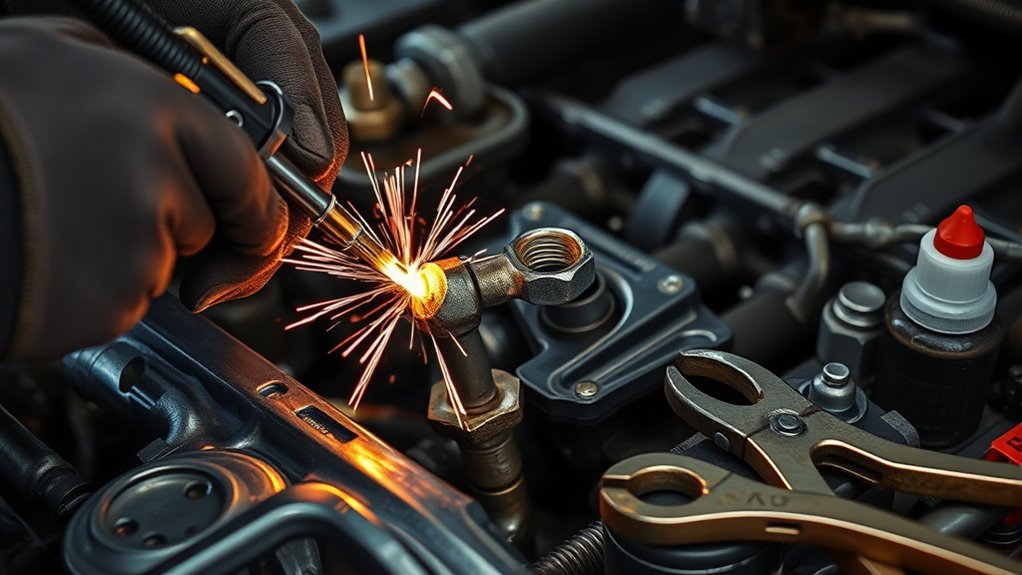
Choose the least destructive method that can still provide enough grip or controlled cutting.
- Correct six-point socket: A slightly smaller metric or SAE socket may grip a mildly rounded head, but do not hammer a socket where it could damage the surrounding component.
- Rounded-bolt extractor socket: Spiral-fluted extractor sockets often work before welding becomes necessary.
- Locking pliers: Use them when enough of the head or stud protrudes and there is room for a solid bite.
- File or grind two flats: This can create wrench surfaces on an exposed head without cutting it off.
- Manual impact driver: A controlled impact may help with suitable screw or bolt heads, but it is not appropriate for every casting or delicate assembly.
- Left-hand drill bit: Center-punch the fastener and drill straight. The reverse-cutting bit may turn the fastener out while drilling.
- Screw extractor: Use the specified pilot size and avoid excessive force. A hardened extractor broken inside the bolt is difficult to drill.
- Drill to the thread root: Skilled drilling can remove most of the bolt while preserving the female threads, but alignment is critical.
- Re-tap or install a thread insert: Use this when the original female threads are no longer serviceable.
- Professional machining or EDM: A machine shop may remove a hardened fastener or broken extractor with less risk to an expensive component.
Do not apply a torch simply because welding failed. Added heat is only appropriate when the vehicle-maker procedure and a complete fire-hazard inspection confirm that the location can be heated safely.
What to Do After the Bolt Comes Out
Inspect and Clean the Threads
Remove loose rust, weld spatter, old threadlocker, and debris. Use a thread-pitch gauge or a known correct replacement fastener to confirm the thread size.
A thread chaser cleans existing threads with less cutting than a standard tap. Use a tap when damaged material must be removed, but keep it square to the hole and use the correct cutting method for the material.
Replace or professionally repair the component if the hole is cracked, badly enlarged, off-center, or part of a safety-critical steering, suspension, brake, seat, restraint, or structural joint.
Select the Correct Replacement Bolt
Match the vehicle-maker specification for:
- Thread diameter and pitch.
- Fastener length and shoulder length.
- Metric property class or SAE grade.
- Head style and flange design.
- Coating or corrosion protection.
- Single-use or torque-to-yield requirements.
Do not replace a high-strength automotive bolt with an unmarked hardware-store fastener.
Torque the Fastener Correctly
Use the manufacturer’s torque value and tightening sequence. Apply oil, anti-seize, threadlocker, or another compound only when the service information calls for it.
Anti-seize products are designed to reduce seizing, galling, and corrosion, but that does not mean they belong on every automotive fastener. Wheel, brake, suspension, oxygen-sensor, exhaust, and coated fasteners can have application-specific instructions.
Restore Protection and Check the Vehicle
After the repair area has cooled:
- Restore approved primer, paint, seam sealer, undercoating, or corrosion protection removed during preparation.
- Inspect wiring, hoses, seals, and plastic parts for heat damage.
- Check both sides of the area for smoldering material.
- Reconnect electrical systems in the specified order.
- Perform required relearn, calibration, or initialization procedures.
- Scan the vehicle for fault codes when the service information calls for it.
Maintain Your Bolts to Prevent Future Stripping
Use clean, correctly sized six-point sockets and keep them square to the bolt head. Stop when a socket begins to slip instead of repeatedly rounding the corners.
Clean male and female threads before reassembly. Replace bolts with damaged heads, stretched shanks, necked threads, heavy corrosion, or missing grade markings.
Use a calibrated torque wrench when the manufacturer provides a torque specification. Over-tightening can stretch the fastener, damage the threaded hole, or round the head during future removal. Under-tightening can allow movement and joint failure.
Apply anti-seize only where the vehicle maker or product application specifically allows it. Use the correct threadlocker where required and replace single-use fasteners instead of reinstalling them.
Record major fastener and thread repairs in your maintenance notes, especially when you install an insert or replace a safety-critical component.
Frequently Asked Questions
What should you do if a bolt is stripped on a car?
Identify whether the head, bolt threads, or threaded hole is damaged. Start with the least destructive suitable method, such as a six-point socket, extractor socket, or locking pliers. Weld a nut only when the location can be isolated and protected from electrical, heat, fire, and fume hazards.
Does J-B Weld work on stripped threads?
Some metal-filled epoxies can be drilled and tapped after curing, but they are not a universal substitute for sound automotive threads. Do not rely on epoxy for a loaded, heated, structural, steering, suspension, brake, wheel, seat, or restraint fastener. Use an approved thread insert, replacement component, or professional repair.
Can you weld bolts and nuts?
Yes, compatible steel bolts and nuts can be welded for extraction when the surfaces are clean and the surrounding area can tolerate the heat. Do not assume every fastener material, coating, heat treatment, or vehicle location is suitable for welding.
Can you weld a nut to a bolt broken flush with the surface?
Sometimes. Skilled welders may build weld metal on the exposed center or weld a washer to the stud before adding a nut. The method becomes much harder when the stud is below the surface or the parent material is easy to damage. Professional machining may be safer.
Should you remove the bolt while the weld is warm or completely cold?
The weld must first solidify and become strong enough to carry torque. Do not turn the nut while the weld is molten, glowing, or mechanically soft. Some seized bolts release while the assembly remains warm, while others need more cooling. Protect yourself from burns and keep flammable fluids away from hot metal.
Can you use this method on a hybrid or electric vehicle?
Only after following the exact high-voltage disabling and welding procedure for that vehicle. Disconnecting the 12-volt battery does not remove every high-voltage hazard. Anyone without hybrid or EV training and proper protective equipment should send the repair to a qualified technician.
What metal is hardest to weld?
There is no single answer because weldability depends on composition, thickness, heat treatment, contamination, joint design, and process. Tungsten is difficult because of its extremely high melting temperature, while reactive metals, high-carbon steels, coated fasteners, and some cast alloys present different challenges.
Conclusion
Welding a nut onto a stripped or broken bolt can create a strong new grip and may help release corrosion, but the weld itself is only one part of the repair. Vehicle isolation, fire control, work-clamp placement, surface preparation, ventilation, and correct extraction technique determine whether the job is safe and successful.
Stop when you cannot identify nearby hazards, repeated welds keep failing, or the fastener belongs to a safety-critical system. A machine shop or qualified automotive technician can often remove the bolt without sacrificing an expensive casting or damaging vehicle electronics.
After removal, inspect the threads, install the exact replacement fastener, use the specified torque and compounds, restore corrosion protection, and check the vehicle for heat or electrical damage.
Sources
- OSHA 29 CFR 1910.252: Welding, Cutting, and Brazing — fire prevention, PPE, ventilation, coatings, and cleaning-compound precautions
- OSHA Fact Sheet: Controlling Hazardous Fume and Gases During Welding — welding-fume sources and exposure controls
- I-CAR: Battery Disconnection Before Vehicle Welding — battery, restraint-system, module, and high-voltage precautions
- I-CAR: Protecting Electronic Parts During GMA Welding — work-clamp placement, cable routing, and electronic-component protection
- Permatex Technical FAQs — purpose and limitations of anti-seize and thread compounds