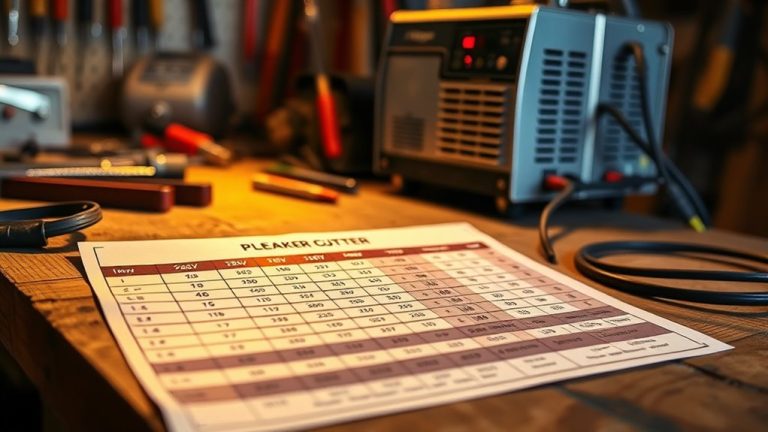
Think of the power supply for a plasma cutter as the lifeblood of its precise operation. Your understanding of amps, voltage, and phase is essential for achieving ideal cuts. Most plasma cutters require either a 120V or 240V supply, but industrial models might demand three-phase power for efficiency. Amperage directly affects cutting speed and thickness, so verifying circuit breaker compatibility is crucial. Are you ready to guarantee your plasma cutter’s peak performance?
Understanding Plasma Cutter Power Supply Basics
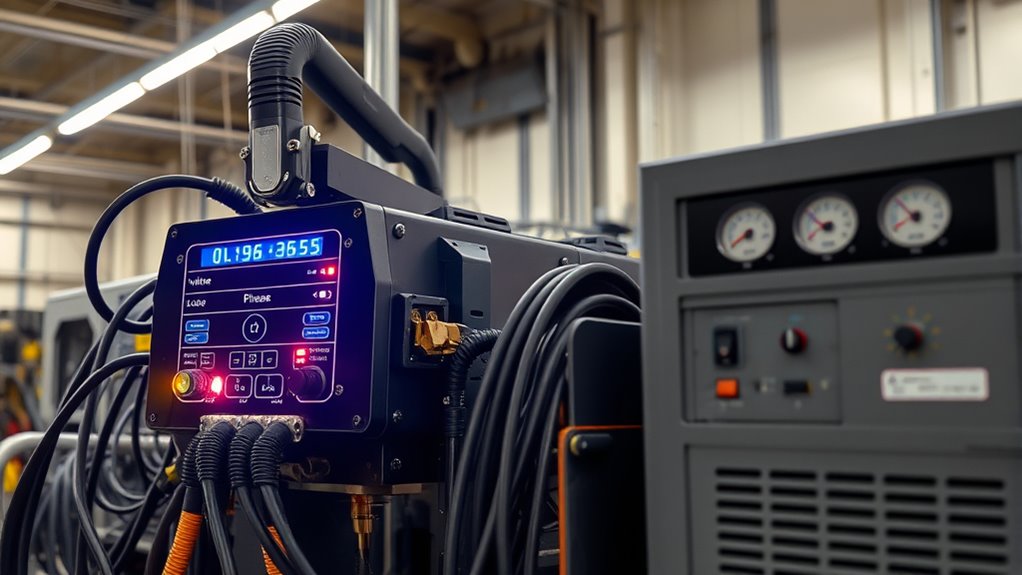
When you’re delving into the world of plasma cutters, it’s vital to grasp the power supply basics to guarantee peak performance and safety. Plasma cutter efficiency hinges on power supply optimization. A well-matched power source secures the equipment operates without hiccups.
Generally, plasma cutters demand either a 120V or 240V supply, with larger units often requiring a three-phase supply. Your choice affects the machine’s cutting prowess, particularly with thicker materials.
Consider the amperage carefully. Small, portable models might only need 20A, while industrial behemoths can demand 50A or more. For instance, the Hypertherm Powermax 45xp works best on a 50A circuit, minimizing breaker trips and ensuring reliability.
The circuit’s amperage affects the duty cycle—higher amperage permits longer, uninterrupted cuts without overheating. Comprehending these power dynamics is vital for optimizing your plasma cutter’s performance, enhancing its longevity, and guaranteeing a safe operational environment.
Voltage Requirements for Plasma Cutters
Grasping the power supply basics lays the groundwork for understanding voltage requirements in plasma cutters. Confirming voltage compatibility is vital for peak performance.
Smaller plasma cutters generally operate on a single-phase 120V system, making them suitable for light-duty tasks. In contrast, larger industrial units demand more robust power, often requiring a 3-phase supply with 480V or 600V connections. This higher voltage capacity enables increased cutting thickness and speed, fundamental for demanding industrial applications.
Smaller plasma cutters use 120V for light tasks, while industrial units need 3-phase, 480V or 600V for heavy-duty cutting.
To maintain power stability, verify that your electrical supply aligns with the cutter’s voltage needs. Mismatched voltages can lead to reduced performance or even equipment damage.
Some advanced systems incorporate Auto-Line technology, which automatically adjusts to varying voltage inputs, offering flexibility across different environments. By focusing on these voltage parameters, you guarantee effective operation and longevity of your plasma cutter, tailoring its performance to your specific cutting demands.
Amperage Considerations in Plasma Cutting
Amperage plays a pivotal role in plasma cutting, directly affecting your cutter’s speed and material compatibility. Making precise amperage adjustments is vital for maximizing cutting efficiency.
For instance, cutting 1/2-inch mild steel typically demands 40 to 50 amps, while 1/4-inch steel might only require about 30 amps. Adjusting amperage correctly allows you to achieve desired results, whether you’re slicing through thicker materials or executing intricate cuts on thinner sheets.
Using systems like the Powermax 45xp, which draws up to 39 amps under low voltage, necessitates a 50 amp circuit, ensuring both optimal performance and safety.
Operating on a 30-amp breaker restricts the capabilities of high-output plasma cutters, jeopardizing cutting efficiency and risking breaker trips. As material thickness increases, so does amperage draw; cutting 5/8-inch steel may require 29 to 31 amps.
Consequently, understanding and adjusting amperage is paramount to match power supply specifications with cutting demands.
Single-Phase vs. Three-Phase Power Supplies
Why does the choice between single-phase and three-phase power supplies matter in plasma cutting? It hinges on your equipment’s power needs and operational context.
Single-phase power supplies, typically operating at 120 or 240 volts, offer single phase advantages for smaller, portable plasma cutters. They’re ideal in residential settings due to their widespread availability. These systems often require a 30-amp breaker, suitable for light-duty tasks.
Conversely, three-phase power supplies, operating at 208-600 volts, deliver three phase benefits important for industrial-grade machines. They demand higher amperage, often needing a 40-amp breaker or more, supporting the increased power requirements for cutting thicker materials.
Three-phase systems provide balanced load distribution, ensuring smoother operation, especially essential for continuous usage on robust metals.
Understanding these distinctions is significant. Machines designed for three-phase operation can’t efficiently run on single-phase circuits without proper adaptation, impacting efficiency and performance.
Choose wisely based on your cutting demands.
Circuit Breaker Compatibility and Safety
When selecting a circuit breaker for your plasma cutter, it’s important to take into account the specific amperage requirements of your equipment to guarantee both safety and peak performance.
The Hypertherm Powermax 45xp, for instance, operates effectively with a 50A breaker due to its potential to draw up to 39A under low voltage conditions. A 30A breaker may limit its capabilities, risking tripping during operation.
Here are vital considerations:
- Circuit Breaker Ratings: Verify your breaker can handle the maximum amperage draw, especially under low voltage scenarios.
- Electrical Safety: Monitor the amperage settings as longer arcs increase draw, potentially causing electrical hazards.
- System Upgrades: Consider upgrading to a 50A circuit for safe operation during heavy usage.
- Load Management: Avoid exceeding the breaker’s limit when running multiple devices on the same circuit to prevent tripping.
These steps guarantee your plasma cutter remains efficient and safe.
Impact of Material Thickness on Power Needs
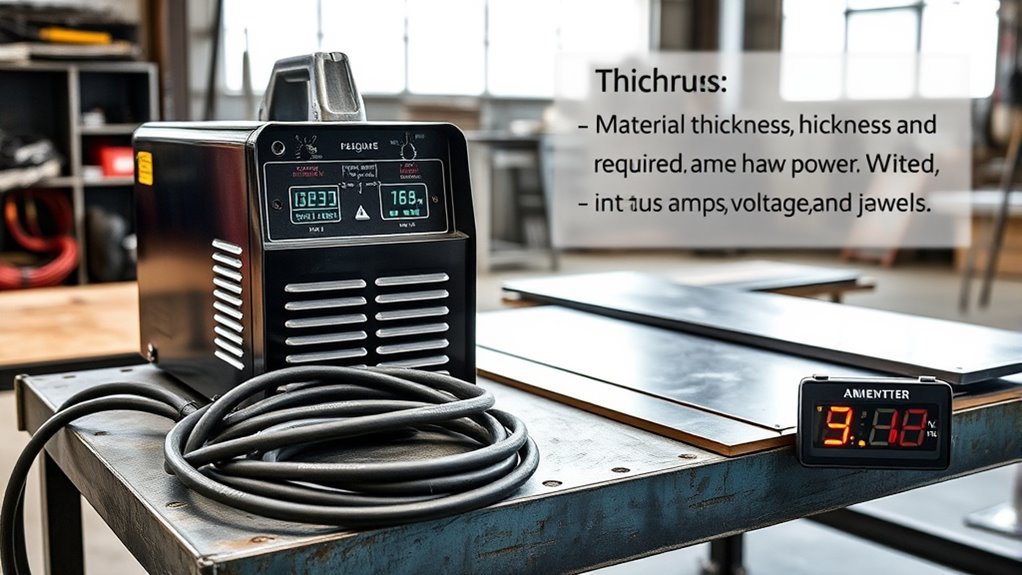
Understanding the relationship between material thickness and power needs is essential for optimizing plasma cutter performance. When you’re cutting, material thickness considerably impacts power requirements. For instance, cutting efficiency for 1/4″ steel demands around 25 to 30 amps, while 1/2″ steel requires 35 to 40 amps.
As thickness increases, amperage needs rise, causing a voltage drop that affects your cutter’s power consumption. For example, cutting 16 gauge steel at 45 amps results in approximately 3510 watts.
Thicker materials like 5/8″ steel can draw between 29 to 31 amps, underscoring the necessity for a robust power supply. To prevent breaker trips and optimize performance, verify your circuit specifications meet the breaker capacity.
A 50 amp circuit is recommended for materials over 1/2″ thickness. This precaution helps maintain consistent cutting performance and prevents interruptions, ensuring your plasma cutter operates efficiently and effectively across varying material thicknesses.
Adapting to Dual Voltage Plasma Cutters
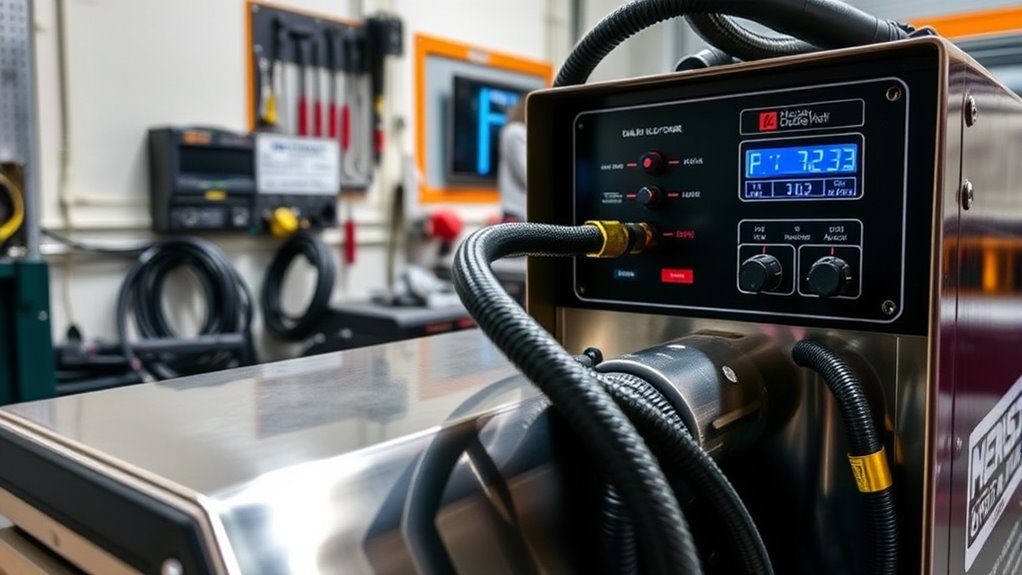
As you adapt to dual voltage plasma cutters, versatility becomes a significant advantage, allowing you to work across different power environments. The dual voltage benefits offer plasma cutter flexibility, enabling operation on both 120V and 240V systems.
For example, with a model like the Hypertherm Powermax 30XP, you can seamlessly switch between voltages based on your needs. To maximize efficiency and prevent electrical issues, consider the following:
- Amperage Breaker Compatibility: Confirm a 20A breaker for 120V and a 30A or higher for 240V to match the system’s requirements.
- Understanding Electrical Supply: Analyze your supply to prevent tripping breakers or overloading circuits, vital for smooth operations.
- Automatic Switching Features: Utilize models with automatic voltage adjustment to simplify setup and enhance operational ease.
- Adaptability Analysis: Assess your worksite’s power conditions to leverage dual voltage capabilities effectively.
Embrace these strategies to optimize your plasma cutter’s performance across varied power settings.
Importance of Duty Cycle in Power Supply
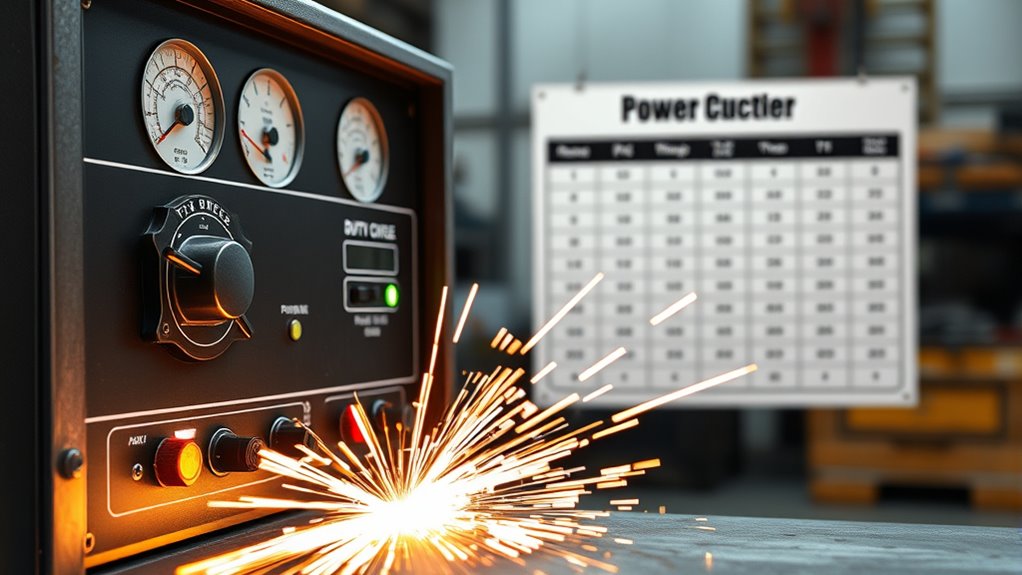
When considering the duty cycle of a plasma cutter, you need to calculate the operational time limits to prevent overheating and guarantee efficiency.
For instance, a machine with a 60% duty cycle allows you 6 minutes of cutting in a 10-minute span, demanding proper intervals to cool down.
If you push the machine beyond its duty cycle, you risk thermal overload, which compromises both performance and equipment longevity.
Operational Time Limits
Although often overlooked, the duty cycle of a plasma cutter plays a pivotal role in its operational efficiency and longevity. Understanding this metric guarantees cutting efficiency and effective cooling strategies. Here’s why:
- Duty Cycle Definition: It indicates the percentage of time a plasma cutter can operate in a given period. For example, a 60% duty cycle allows 6 minutes of work in a 10-minute cycle.
- Amperage Impact: Higher amperage reduces the duty cycle, necessitating more frequent cooling pauses.
- Material Consideration: Thicker materials require a longer operational time, demanding a higher duty cycle for effective cutting.
- Longevity Assurance: Exceeding the rated duty cycle risks overheating, potentially damaging the unit.
Plan operations with these factors to maximize efficiency and lifespan.
Preventing Overheating Risks
Understanding the duty cycle is essential for preventing overheating risks in plasma cutters. The duty cycle indicates the percentage of operational time within a 10-minute interval. For instance, a 60% duty cycle allows 6 minutes of cutting followed by 4 minutes of rest to avoid overheating.
Higher amperage settings reduce the duty cycle, so cutting thicker materials demands frequent pauses. Proper thermal management involves knowing the machine’s duty cycle limits to prevent thermal damage, optimizing lifespan.
Plasma cutters with a 100% duty cycle can operate continuously without overheating, ideal for high-demand scenarios. Implement effective cooling mechanisms and monitor operational time closely to maintain equipment performance and reliability, ensuring the plasma cutter runs efficiently under varying workloads.
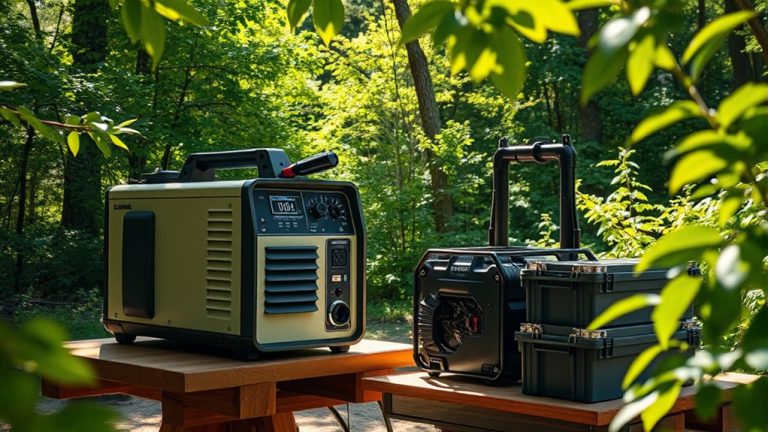
Generator Use for Plasma Cutters
To guarantee ideal performance of your plasma cutter, it’s vital to select a generator with a minimum output of 5000 watts, especially for models that demand higher amperage. Proper generator sizing guarantees power efficiency, preventing voltage drops that could compromise cutting quality.
Consider these significant factors:
- Power Stability: Choose a generator that supplies clean, stable power. Voltage fluctuations can disrupt the plasma arc, affecting precision and efficiency.
- Voltage Compatibility: Verify the generator matches the cutter’s voltage needs, typically 120V or 240V. Incorrect voltage alignment can lead to inefficient operation or potential damage.
- Amperage Rating: Confirm the generator supports 30-50 amps to avoid tripping breakers during high-demand tasks. This capacity is vital for uninterrupted performance.
- Duty Cycle: A generator with a robust duty cycle prevents overheating during prolonged use, maintaining operational integrity and preventing shutdowns.
Upgrading Electrical Systems for Optimal Performance
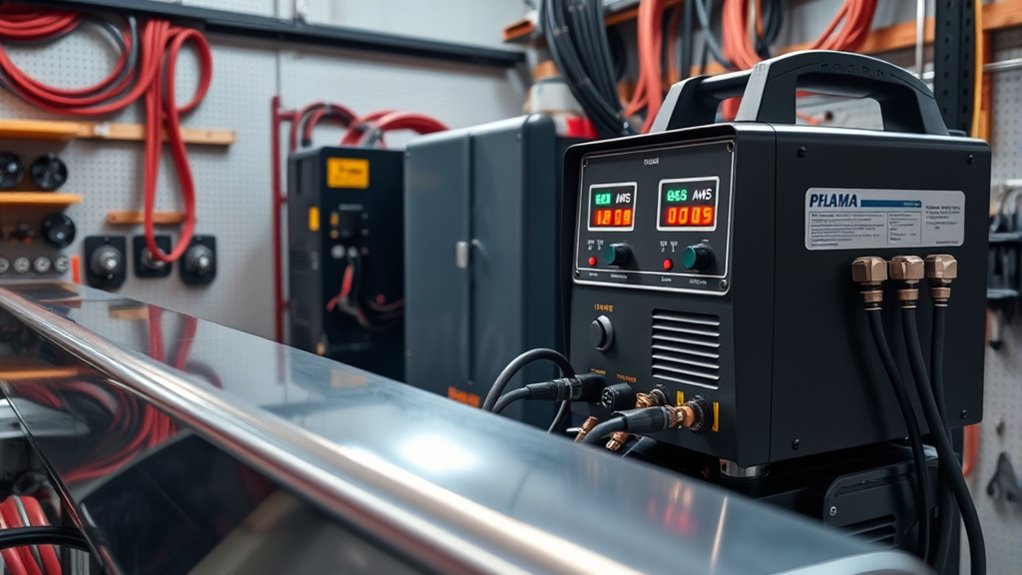
When using a generator for your plasma cutter, understanding the intricacies of your electrical system becomes vital for best performance. Start by considering electrical upgrades like installing a 50 amp breaker, especially if you’re operating a Hypertherm Powermax 45xp. This upgrade is key to prevent tripping breakers during intense operations, such as cutting thicker materials.
Installing a 50 amp breaker is essential for optimal performance when using a generator with your plasma cutter.
A single-phase 240V supply is typically required for larger plasma cutters, enhancing both efficiency and cutting capability. Ensure a dedicated circuit installation, ideally a 50 amp circuit, to handle materials beyond 1/2″ thickness without interruptions.
Avoid using multiple devices on the same circuit, as this may lead to insufficient power supply, performance issues, or potential overloads. Continuous use on lower amperage circuits risks overheating and damaging your equipment.
As a result, upgrading your electrical system is essential for accommodating the power needs of your plasma cutter, ensuring consistent and best performance.
Frequently Asked Questions
Can Plasma Cutters Operate on Renewable Energy Sources?
Yes, you can power plasma cutters using renewable energy sources like solar power and wind energy. Make certain your system provides sufficient wattage, typically around 8-12 kW, and includes an inverter to convert DC to AC electricity efficiently.
How Does Altitude Affect Plasma Cutter Power Requirements?
Altitude can throw a wrench in your plasma cutter’s power efficiency. As altitude increases, air density decreases, requiring altitude adjustments to maintain ideal performance. You might need to tweak settings for precise calculations and efficient operation.
Are There Portable Power Solutions for Plasma Cutters?
Yes, there are portable power solutions for plasma cutters. You can use battery options with high-capacity lithium-ion cells or inverter solutions that provide stable AC power, ensuring efficient cutting while maintaining precise control over voltage and amperage.
Do Plasma Cutters Have Built-In Power Surge Protection?
Imagine a knight’s shield against lightning; in advanced plasma cutters, built-in surge protection offers you power stability, like a fortress against sudden voltage spikes. This technology guarantees precision, safeguarding delicate components and maintaining consistent performance during demanding tasks.
What Is the Lifespan of a Plasma Cutter’s Power Components?
Your plasma cutter’s power component longevity typically ranges from 3,000 to 5,000 hours. Effective plasma cutter maintenance, like regular inspection and cleaning, can greatly extend this lifespan, ensuring ideal performance and reducing the risk of unexpected failures.
Conclusion
In the world of plasma cutting, think of your power supply as the heart of the operation. Just as a marathon runner needs a well-tuned heart to maintain pace, your plasma cutter requires the right voltage, amperage, and phase to perform at its best. Imagine trying to run with a weak heart; your cutter, without proper power, faces the same struggle. Ensuring correct power supply isn’t just about performance—it’s crucial for safety and longevity, much like maintaining a healthy heart.