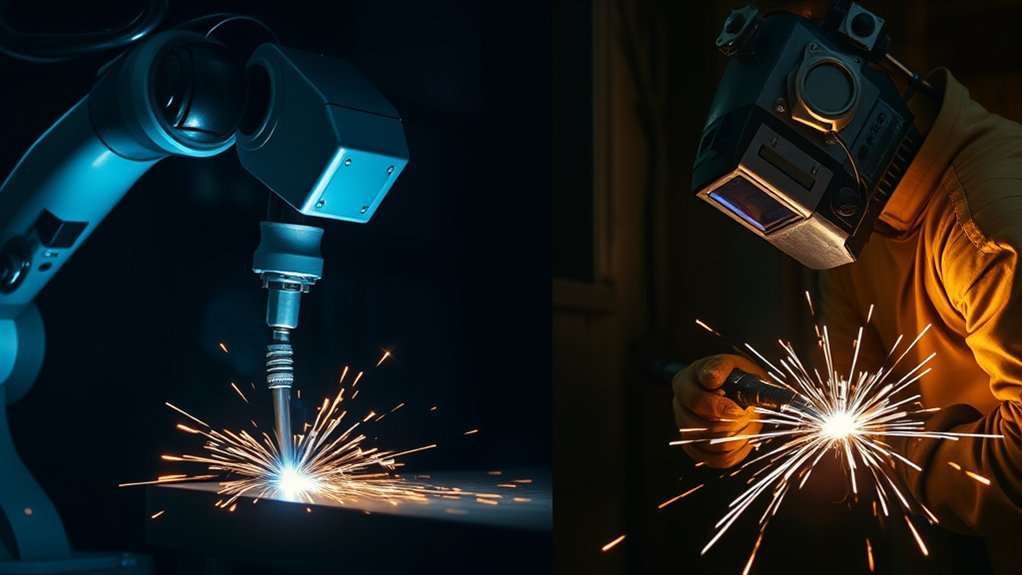
When you compare robotic welding with manual welding, the quality difference is not as simple as “robot good, human bad.” Robotic welding usually wins on repeatability in high-volume production, while manual welding can still win on repairs, one-off fabrication, poor fit-up, and tight access. The best choice depends on the joint, material, tolerance, inspection standard, production volume, and how well the process is controlled.
Quick Answer
Robotic welding usually produces more consistent weld quality when the parts, fixtures, program, wire, gas, and inspection plan are repeatable. Manual welding is often better for custom work, repairs, variable gaps, and complex access where a skilled welder can adjust in real time.
Key Takeaways
- Robotic welding quality is most reliable in repeat production with good fixtures, clean parts, stable parameters, and trained operators.
- Manual welding quality depends heavily on skill, but a good welder can adapt to poor fit-up, tight spaces, unusual joints, and repair work.
- Robot repeatability is not the same as weld quality. A robot may return to the same path accurately, but weld size, penetration, porosity, distortion, and acceptance still need inspection.
- The best quality system uses procedure control and inspection, whether the weld is made by a robot or by hand.
Robotic Welding vs Manual Welding Quality Overview
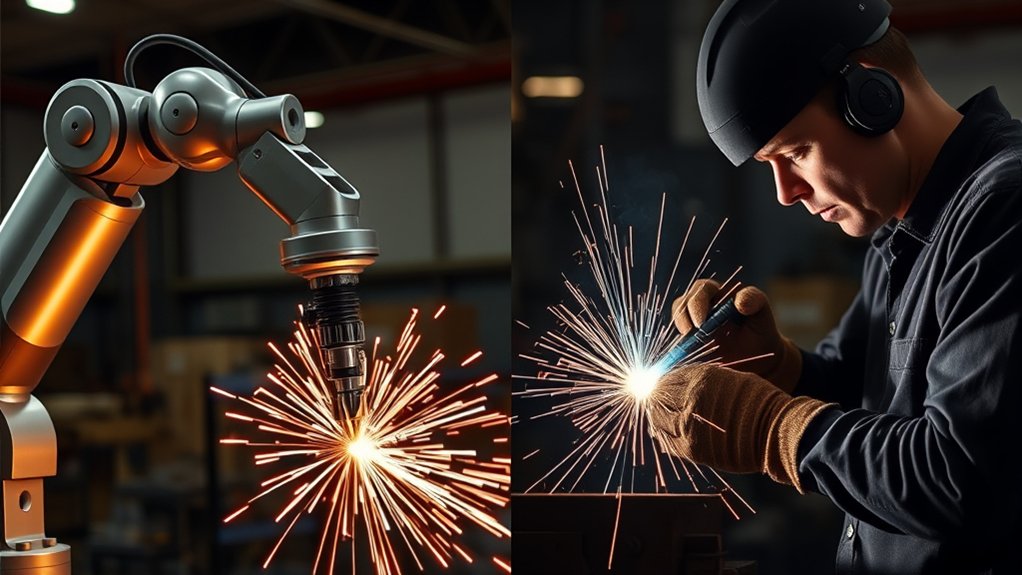
Robotic welding is strongest when the same joint repeats hundreds or thousands of times. The robot follows the programmed torch angle, travel speed, contact-tip-to-work distance, weave pattern, and arc start point the same way each cycle. That consistency can improve bead appearance, penetration uniformity, spatter control, and downstream fit.
Manual welding is strongest when the work is less predictable. A skilled welder can see a changing gap, hear an unstable arc, adjust torch angle, slow down on a cold edge, add filler where needed, or pause when the puddle is not wetting in. That judgment is hard to replace on repair, field, prototype, and low-volume work.
The most accurate answer is this: robotic welding improves repeatability; manual welding improves adaptability. Weld quality comes from matching the method to the job and then controlling the process.
Robotic vs Manual Welding Quality Comparison
| Quality Factor | Robotic Welding | Manual Welding |
| Consistency | Very strong on repeat parts with stable fixtures and programs. | Depends on welder skill, fatigue, position, access, and shift-to-shift habits. |
| Adaptability | Limited unless the system has sensing, seam tracking, good programming, or operator intervention. | Excellent for irregular gaps, field repairs, unusual joints, and custom fabrication. |
| Defect Control | Strong when joint prep, wire, gas, torch condition, and TCP calibration are controlled. | Strong when the welder is qualified and uses the correct procedure, but more variable over long runs. |
| Best Use | Automotive, production fixtures, repeat assemblies, long runs, and controlled shop cells. | Repair, maintenance, prototypes, field welding, low-volume work, and complex access. |
Welding Quality Metrics Explained
Weld quality should be measured by more than how smooth the bead looks. A clean-looking bead can still have lack of fusion, poor penetration, undercut, porosity, or too much distortion. A complete quality check looks at the weld and the finished part.
The main welding quality metrics include:
- Weld size: fillet leg size, throat size, groove fill, reinforcement, and whether the weld meets the drawing or procedure.
- Penetration and fusion: whether the weld properly bonds to the base metal and reaches the required depth.
- Bead profile: shape, tie-in, undercut, overlap, convexity, concavity, and spatter.
- Discontinuities: porosity, cracks, slag inclusions, lack of fusion, burn-through, and crater defects.
- Distortion: warping, shrinkage, angular pull, and fit problems after cooling.
- Repeatability: how closely welds match from part to part, shift to shift, and batch to batch.
- Rework and scrap: how often welds need grinding, rewelding, straightening, or rejection.
- Inspection results: visual inspection, gauges, macro etch, bend tests, ultrasonic testing, radiography, liquid penetrant testing, or magnetic particle testing when required.
For a deeper look at weld sizing, proper fillet weld sizing matters because oversize and undersize welds can both create problems. An oversized weld can add heat, cost, and distortion. An undersized weld may not meet strength requirements.
Repeatability vs Accuracy vs Finished Weld Quality
A common mistake is treating robot repeatability as a direct promise of weld quality. These are related, but they are not the same.
- Repeatability means the robot can return to the same taught path over and over.
- Path accuracy means the torch follows the intended path in the real work cell.
- Weld quality means the final weld meets the required size, appearance, strength, penetration, and inspection standard.
For example, KUKA lists a KR CYBERTECH repeatability of ±0.03 mm. That is a useful robot performance value, but it does not guarantee that every weld will have perfect penetration or zero distortion. The final weld still depends on the fixture, material thickness, joint gap, wire feed, shielding gas, torch condition, heat input, and inspection criteria.
Note: A robot can repeat a bad weld just as consistently as a good one. Robotic welding quality improves only when the program, fixture, parts, consumables, and inspection plan are also controlled.
How Robotic Welding Improves Consistency
Robotic welding improves consistency by removing much of the variation that comes from hand position, fatigue, changing travel speed, and inconsistent torch angle. Once the job is programmed and proven, the robot repeats the same motion each cycle.
Robotic welding can improve quality through:
- Stable travel speed: The robot can maintain a consistent pace along the joint, which helps control bead width and heat input.
- Repeatable torch angle: A stable push or drag angle improves tie-in and bead profile.
- Controlled arc starts and stops: Proper start, crater-fill, and burnback settings reduce start defects and crater cracks.
- Consistent contact-tip-to-work distance: This helps stabilize amperage, wire feed behavior, and penetration.
- Data logging: Many automated systems can track current, voltage, wire feed speed, cycle time, and fault history.
- Less fatigue variation: The robot does not get tired during a long production run.
This is why robotic welding is common in repeat manufacturing, including automotive, equipment frames, brackets, production fixtures, and other high-volume assemblies. ABB describes the IRB 1600 as a robot built for speed, accuracy, quality, and demanding duty cycles, which is the type of environment where automation can make sense.
Robotic welding does not automatically create better welds. It creates more repeatable welds, and repeatability becomes better quality only when the weld procedure is already correct.
What Can Still Go Wrong in Robotic Welding?
Robotic welding can produce poor welds if the cell is not set up and maintained correctly. Because the robot repeats the program exactly, a small setup error can repeat across a full batch before anyone catches it.
Common robotic welding quality problems include:
- Poor part fit-up: A gap that changes from part to part can cause undercut, burn-through, or lack of fusion.
- Weak fixtures: Loose or worn fixtures allow the joint to move away from the programmed path.
- Bad TCP calibration: If the tool center point is off, the torch may be shifted from the joint even though the program looks correct.
- Worn contact tips: A worn tip can create arc instability, wandering wire, and inconsistent bead shape.
- Gas coverage problems: Drafts, leaks, wrong flow, or clogged nozzles can cause porosity.
- Wire feed issues: Liner drag, poor drive-roll tension, or rusty wire can cause stubbing, burnback, or spatter.
- Dirty material: Oil, paint, rust, mill scale, or plating can create porosity and poor fusion.
- Heat buildup: Fast repeat cycles can overheat parts, fixtures, or torch components if cooling and sequence are not planned.
That is why robotic welding cells need more than a good robot. They need qualified procedures, trained operators, planned maintenance, fixture checks, torch cleaning, and first-part inspection.
The Role of Human Skill in Manual Welding Quality
Manual welding quality depends on the welder’s ability to control the puddle, arc length, heat input, travel speed, angle, and filler placement. A skilled welder can make real-time decisions that a basic robot program cannot make without sensors or operator input.
Importance of Experience
Experience matters because welders learn how the puddle should look, sound, and behave. They can notice when a joint is opening up, when the arc is too cold, when the edge is not washing in, or when contamination is causing porosity.
Experienced welders improve quality by:
- Adapting to joint fit-up: They can bridge a gap, change travel speed, or adjust electrode angle.
- Managing heat: They can reduce distortion by skipping around, using shorter welds, or allowing cooling time.
- Reading the puddle: They can see whether fusion is happening at both toes of the weld.
- Handling difficult positions: They can adjust for vertical, overhead, cramped, or out-of-position welds.
Technique and Precision
Manual welding can be highly precise, but the precision comes from the person, not from a programmed motion path. The welder must control hand steadiness, body position, electrode angle, travel speed, and arc length during the full weld. That is why fatigue and access can affect manual weld quality during long runs.
This is especially true in processes such as stick welding, TIG welding, and flux-core welding, where puddle control, slag control, electrode manipulation, and heat management all affect the finished weld.
Problem-Solving Ability
The biggest advantage of manual welding is problem solving. When a part is slightly bent, a joint is tight on one end and wide on the other, or access blocks the ideal torch angle, a skilled welder can adjust immediately. A robot may need reprogramming, seam tracking, a better fixture, or a positioner to handle the same change.
Manual welding often performs better for:
- Repairs and maintenance welding
- Field work where fixtures are limited
- Prototype fabrication
- Small batches with frequent design changes
- Large structures where access changes from joint to joint
- Parts with inconsistent gaps, distortion, or surface condition
Key Factors Influencing Welding Quality: Robotic vs Manual
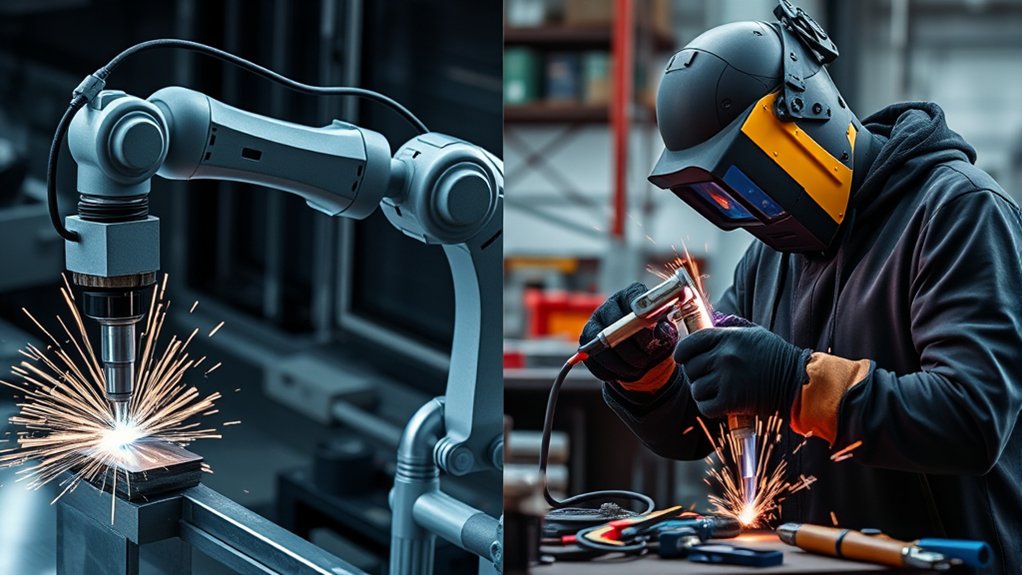
Several factors decide whether robotic or manual welding will produce better quality. The process itself is only one part of the answer.
Joint Preparation
Clean, consistent joint preparation improves both robotic and manual welding. Robots are less forgiving when gaps, bevels, or tack locations change. Manual welders can compensate, but poor prep still increases the risk of defects.
Welding Procedure Control
A welding procedure controls essential variables such as process, filler metal, base material, amperage, voltage, travel speed, preheat, interpass temperature, shielding gas, and weld size. Whether the weld is robotic or manual, the procedure should match the material, joint, and acceptance standard.
For more detail on welding variables, see this guide to the main welding parameters.
Fixture and Part Repeatability
Robotic welding needs repeatable part location. If the joint moves even slightly outside the expected path, the robot may miss the seam, undercut one side, or lose penetration. Manual welding is more forgiving because the welder can follow the joint visually.
Inspection and Feedback
Quality improves when inspection feedback reaches the operator or programmer quickly. A robotic cell should include first-piece inspection, periodic checks, and a response plan for defects. Manual welding should include the same checks, especially on structural or safety-critical work.
Inspection and Quality Assurance for Better Welds
You should not judge robotic or manual welding by appearance alone. A sound quality system uses inspection before, during, and after welding.
Products Worth Considering
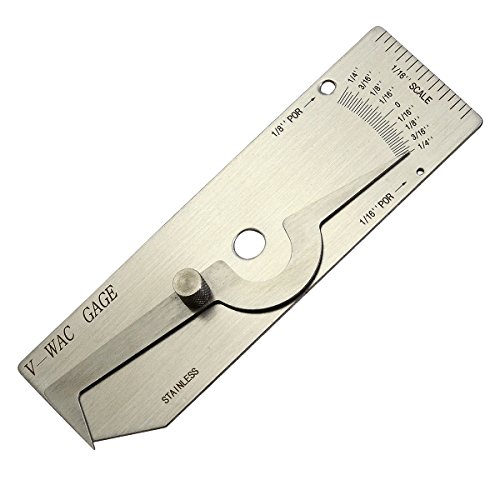
V-WAC Single Weld Gage

Standard Reading: The item of Undercut Gauge can be read in Standard. It can measure depth of undercut or pit and the height of misalignment and weld seam (Range: 0-1/4'', Increment: 1/64''). It can check the size in 1/16'', 1/8'', 1/4'' of porosity and per inch amount

Angle of Preparation, 0° to 60° and Excess Weld Metal (capping size)
Before Welding
- Confirm the correct drawing, weld symbol, and acceptance criteria.
- Check base metal, filler metal, shielding gas, and consumables.
- Clean the joint of oil, rust, paint, coatings, and moisture.
- Verify fit-up, gap, bevel, root opening, and tack welds.
- For robotic welding, confirm fixture condition and TCP calibration.
During Welding
- Monitor arc stability, travel speed, heat input, and gas coverage.
- Watch for porosity, undercut, burn-through, excessive spatter, or poor tie-in.
- Track parameter alarms and stoppages in robotic cells.
- Control interpass temperature on multi-pass welds.
After Welding
- Use visual inspection and weld gauges to check size and profile.
- Use destructive tests such as macro etch or bend tests when qualifying procedures or sampling production.
- Use nondestructive testing when required, such as liquid penetrant, magnetic particle, ultrasonic, or radiographic testing.
- Record defects, rework, and trends so the process can be corrected instead of patched repeatedly.
The American Society for Nondestructive Testing explains that nondestructive testing evaluates materials and components without damaging them. That matters for weld quality because many defects are not visible from the outside.
Safety and Compliance Considerations
Quality and safety are connected. A weld process that exposes workers to fumes, arc radiation, pinch points, poor guarding, or uncontrolled hot work is not a well-controlled process.
Warning: Welding can expose workers to hazardous fumes, gases, heat, ultraviolet radiation, electrical hazards, and fire risks. Robotic welding cells also add robot motion, pinch-point, guarding, interlock, and lockout hazards. Follow applicable workplace rules, equipment manuals, and safety standards.
OSHA’s welding, cutting, and brazing resources cover applicable standards, hazards, and solutions. OSHA’s welding fume guidance also notes that welding fumes may contain harmful metal fumes and gases, and that ventilation or respiratory protection may be required when exposure is not controlled.
For robot cells, ISO 10218-1:2025 covers safety requirements for industrial robots. Robotic welding applications should also be designed with proper guarding, emergency stops, safe teaching procedures, risk assessment, lockout/tagout, and trained operators.
How to Choose Between Robotic and Manual Welding for Optimal Quality
Choose the welding method based on the work, not just the technology. A robot is not automatically better, and a skilled welder is not automatically more economical. Use the quality requirements and production conditions as your guide.
Choose Robotic Welding When
- The part repeats with consistent fit-up.
- The production volume is high enough to justify programming, fixtures, and maintenance.
- The welds are accessible to the torch and positioner.
- The joint design is stable and unlikely to change often.
- You need consistent bead appearance and cycle time.
- You can inspect and validate the process before full production.
Choose Manual Welding When
- The job is a repair, prototype, or small batch.
- The parts vary too much for a fixed robot path.
- Access is tight or changes from joint to joint.
- The weld requires constant judgment and adjustment.
- The project cannot justify robotic fixtures, programming, and support.
- A qualified welder can meet the acceptance criteria more efficiently.
Use a Hybrid Approach When
Many shops get the best quality by using both. A robot can handle repeat welds, while manual welders handle tacks, repairs, touch-ups, odd joints, and inspection-driven corrections. This approach gives you consistency where the work repeats and flexibility where the work changes.
Pro Tip: Before buying a welding robot, run a real part trial. Measure fit-up variation, tack repeatability, cycle time, defect rate, and inspection results. A robot trial with your actual parts is more useful than a generic productivity estimate.
Frequently Asked Questions
Does robotic welding always produce better weld quality?
No. Robotic welding usually produces more repeatable welds in controlled production, but it can repeat defects if the program, fixture, consumables, or joint fit-up are wrong. Manual welding can produce better results on repairs, custom work, and joints that need real-time adjustment.
What types of materials are best suited for robotic welding?
Robotic welding works well on carbon steel, stainless steel, and aluminum when the material, joint design, fixture, filler metal, shielding gas, and process settings are consistent. Thin material and aluminum need especially careful heat control, clean surfaces, and stable gas coverage.
Can robotic welding handle complex geometries effectively?
Yes, but only with the right setup. Complex parts may need positioners, custom fixtures, offline programming, seam tracking, vision sensing, or multiple robot angles. If access changes often or the joint fit-up is unpredictable, manual welding may be more practical.
How does maintenance affect robotic welding quality?
Maintenance has a direct effect on quality. Worn contact tips, dirty nozzles, damaged liners, loose fixtures, bad gas hoses, and poor TCP calibration can cause porosity, missed seams, spatter, burnback, and inconsistent bead shape.
Are there limitations to robotic welding technology?
Yes. Robotic welding has higher setup cost, needs programming skill, depends on repeatable parts, and may struggle with inconsistent gaps or unusual access unless extra sensing or fixturing is added. Safety guarding and operator training are also required.
What is the cost comparison between robotic and manual welding?
Robotic welding usually has higher upfront costs for the robot, fixture, programming, guarding, and maintenance. It can lower cost per weld in repeat production by improving consistency and cycle time. Manual welding has lower setup cost and better flexibility for short-run or repair work.
What is the best way to compare weld quality in my shop?
Use the same part, drawing, acceptance criteria, filler metal, shielding gas, and inspection method for both processes. Track weld size, visual defects, NDT results if required, cycle time, rework, scrap, distortion, and operator intervention. Compare actual inspection data, not just bead appearance.
Conclusion
Robotic welding and manual welding can both produce high-quality welds, but they do it in different ways. Robotic welding is best for repeatability, speed, and consistent production once the process is proven. Manual welding is best for adaptability, repair work, variable fit-up, and jobs where human judgment matters.
If your parts repeat, your fixtures are strong, and your quality checks are clear, robotic welding can be the better quality choice. If every joint is different, access is difficult, or the job needs constant adjustment, a qualified manual welder may produce better results. The safest decision is to judge both methods by procedure control, inspection results, and real shop data.
Sources
- OSHA Welding, Cutting, and Brazing — welding safety standards, hazards, and solutions.
- OSHA Fact Sheet: Controlling Hazardous Fume and Gases during Welding — welding fume, gases, ventilation, and respiratory protection guidance.
- ISO 10218-1:2025 Robotics Safety Requirements — industrial robot safety and risk reduction requirements.
- ASNT: What Is Nondestructive Testing? — NDT methods used to evaluate materials and components without damage.
- KUKA KR CYBERTECH — example of industrial robot repeatability and technical performance specifications.
- ABB IRB 1600 — manufacturer example of production robot performance and quality-oriented automation.