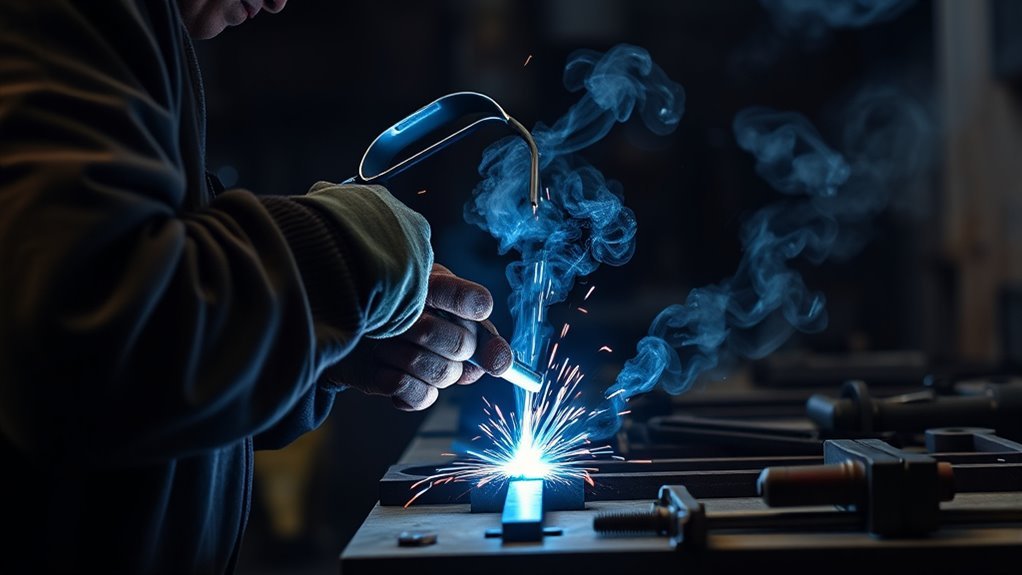
For custom car fabrication, your weld quality depends on three choices: the base metal, the welding process, and the filler metal. Use MIG welding when you need fast, repeatable welds on mild steel panels, brackets, and many chassis jobs. Use TIG welding when heat control, thin metal, aluminum, stainless steel, chromoly, or bead appearance matters more than speed. Clean every joint to bare metal, test-fit the parts, tack them in alignment, manage heat, and inspect the finished weld before the part goes back on the car.
Quick Answer
For custom car fabrication, use MIG for faster steel work and TIG for thin, aluminum, stainless, chromoly, or high-visibility parts. Match the filler metal to the base metal, clean the joint to bare metal, tack the part in alignment, weld in a controlled sequence, and inspect for cracks, porosity, and distortion.
Key Takeaways
- MIG is usually the better choice for fast mild-steel fabrication, patch panels, brackets, and many non-cosmetic structural jobs.
- TIG gives better puddle control on thin sheet metal, aluminum, stainless, chromoly, exhaust parts, and visible welds.
- Filler metal must match the base material and service load; never guess on aluminum, chromoly, suspension, or roll cage parts.
- Fit-up, tack order, and heat control prevent warping, weak penetration, and alignment problems.
- Safety is part of the build: manage fire risk, fumes, eye protection, gloves, clothing, and post-weld inspection before assembly.
At a Glance
| Time Required | 30 minutes for a small bracket or patch; several hours or more for chassis, cage, suspension, or exhaust work |
| Difficulty | Moderate to advanced, depending on material, thickness, access, and whether the part is structural |
| Tools Needed | MIG or TIG welder, correct filler, shielding gas, clamps, grinder, wire brush, measuring tools, PPE, fire extinguisher, and ventilation |
| Cost | Project-dependent; filler, gas, abrasives, and inspection supplies are small costs, while a quality welder and safety gear are the main investment |
Warning: Chassis, roll cage, steering, suspension, brake, and seat-belt mounting welds are safety-critical. Follow the vehicle maker’s repair data, your racing rulebook, or a qualified welding procedure. Do not weld near fuel vapors, sealed tanks, flammable trim, undercoating, or unknown coatings without proper cleaning, ventilation, and fire control. OSHA’s hot-work rules require fire hazards to be moved or guarded and may require a fire watch after welding.
Choose the Right Welder
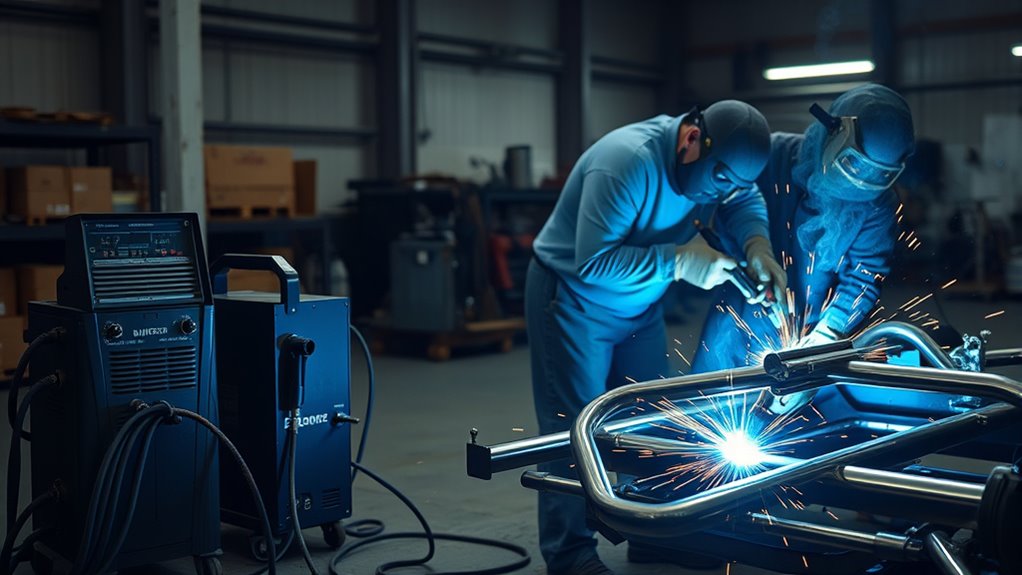
Choosing the right welder starts with the metal you will use most often. Mild steel, stainless steel, aluminum, and 4130 chromoly all need different settings, filler metals, cleaning steps, and heat control.
For many automotive applications, MIG welding gives fast and consistent results on mild steel. It works well for body patches, brackets, exhaust hangers, tabs, and many shop-made parts. TIG welding gives finer control on thin sections, aluminum, stainless, and chromoly, but it takes more hand control and more time.
Check input power before you buy a machine. A 120V welder can handle light-gauge work, but 240V gives you more duty cycle and amperage for thicker brackets, frame work, and larger fabrication jobs. Match the machine’s amperage range to the thickest metal you plan to weld, not just the thinnest panel.
If you work with aluminum, choose a machine with AC TIG capability or a MIG setup that supports aluminum wire with the right gun system. If you build many different parts, a multiprocess welder can help you switch between MIG, TIG, and stick work. For cutting before welding, a plasma cutter with pilot arc technology can help start cuts on rough or painted material, but the weld area still needs to be cleaned to bare metal before welding.
Prioritize safety features such as thermal overload protection, stable voltage control, clear settings, and a duty cycle that fits your work pace. A welder that runs at the edge of its capacity will make heat control harder and can lead to inconsistent welds.
Products Worth Considering
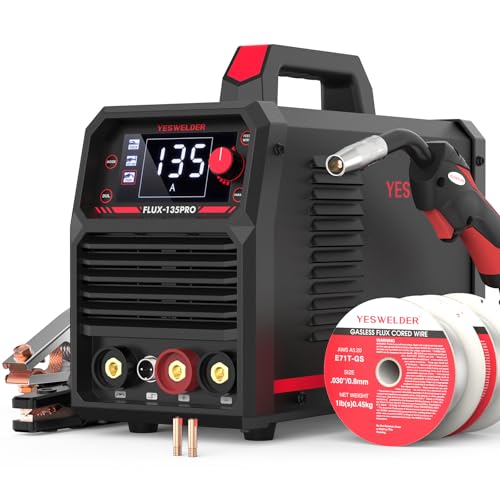
READY OUT OF THE BOX: Start welding immediately! It masterfully handles Gasless Flux Core MIG, Stick, and Lift TIG (Extra Lift TIG torch required). This budget-friendly 3-in-1 machine includes extra E71T-GS .030''&.035'' flux core wires, known for its smooth arc and high feedability. Say goodbye to heavy shielding gas cylinders—perfect for outdoor, windy, or all-position welding.

4-in-1 MIG Welder: This 200Amp 4-in-1 mig welder supports multiple welding functions - lift TIG, gasless MIG, gas MIG, and MMA welding. Versatile and efficient, it easily handles various materials and welding scenarios, providing a convenient and high-performance solution for your welding tasks. (Note: Lift TlG Torch is not included)

3-in-1 Multi Process Welder: Designed to handle Gasless MIG welder, MMA, and Lift TIG perfectly, this 110V welding machine is a garage essential for home DIY and fast farm repairs.(Lift TIG Torch NOT included)
MIG vs. TIG for Custom Car Fabrication
Once you match the welder to your material and shop power, decide whether MIG or TIG fits the job. The best process is not the one that looks more advanced; it is the one that gives the right penetration, control, speed, and repeatability for the part.
- MIG welding is faster and easier to set up, making it useful for mild-steel patch panels, tabs, brackets, and many thicker steel repairs.
- TIG welding gives more control over heat and filler, which helps on thin sheet metal, aluminum, stainless steel, chromoly tubing, and visible welds.
- MIG uses a continuously fed wire electrode and shielding gas. TIG uses a tungsten electrode and separate filler rod, so you can control the puddle and filler more precisely.
- If you want less distortion on thin or critical parts, TIG often helps. If you need faster fabrication on compatible mild steel, MIG is often the practical choice.
- Always consider the maximum fillet weld size based on material thickness and joint design so the weld is strong without adding unnecessary heat.
Products Worth Considering
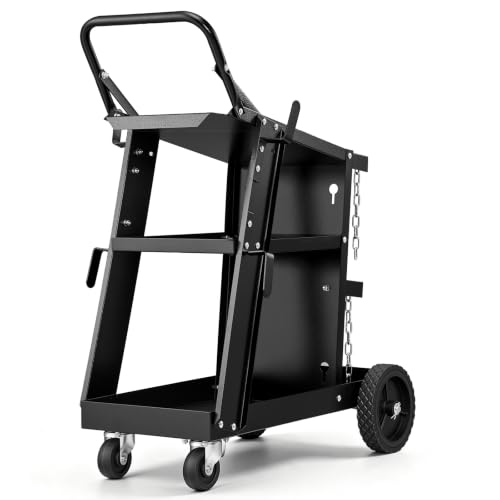
Strong Weight Capacity: VEVOR 3-tier welding cart can effortless handle various heavy loads, with 400LBS maximum static weight capacity and 370LBS maximum dynamic weight capacity. Heavy-duty welder cart is suitable for a variety of welding tasks such as manual welding, gas shielded welding, and argon arc welding.


True Color Clear View: A 3.64" x 1.67" viewing area with 1/1/1/1 optical clarity delivers a true color view for improved visibility and reduced eye strain.
Match Material, Process, and Filler Metal
Filler choice matters as much as machine choice. A weld can look clean and still fail if the filler metal does not match the base metal, load, heat exposure, or corrosion needs. Use the table below as a starting point, then confirm the exact alloy, part use, and any required welding procedure before final welding.
| Material or Part | Common Process | Common Filler Starting Point | Shop Note |
|---|---|---|---|
| Mild-steel body patches | MIG or TIG | ER70S-6 for MIG; ER70S-2 for TIG | Use short welds and cooling pauses to prevent panel warp. |
| Mild-steel brackets and tabs | MIG or TIG | ER70S-6 or ER70S-2 | Bevel thicker joints only when needed for penetration. |
| 4130 chromoly tubing | Usually TIG | ER70S-2 or ER80S-D2, depending on the procedure | Follow the rulebook or qualified procedure for cage and chassis work. |
| 6061 aluminum | AC TIG or aluminum-capable MIG | 4043, 4943, or 5356 depending on strength, finish, and service needs | Clean oxide with a stainless brush used only on aluminum. |
| 5052 aluminum | AC TIG | Often 5356; verify the exact application | Do not treat all aluminum alloys the same. |
| 304 stainless exhaust | DC TIG | 308L for matching stainless; 309L for some dissimilar joints | Back purging improves stainless tube weld quality. |
Note: A filler chart is only a starting point. For structural parts, pressure parts, racing cages, suspension links, and parts exposed to high heat, confirm the exact alloy and follow a written welding procedure when one is required.
Welding Engines, Cooling, and Exhaust Parts
When you move from body and chassis work to engine, cooling, and exhaust parts, the weld has to match both the base metal and the heat it will see in service. Automotive parts may be cast aluminum, 3003 aluminum, 5052 aluminum, 6061 aluminum, mild steel, stainless steel, or nickel alloy. Clean identification matters.
For aluminum intake manifolds, tanks, and some cylinder-head repairs, AC TIG is common because it gives cleaning action and heat control. Cast aluminum may need extra cleaning, slow preheat, and filler such as 4043, 4047, or 4943 depending on the casting and crack risk. For 6061 parts, 4043, 4943, or 5356 may be used depending on strength, appearance, and service needs. For 5052 tanks, 5356 is often a better starting point than 4043.
For cooling parts like radiators, tanks, and overflow reservoirs, keep heat low and steady. Thin aluminum can burn through fast, so proper joint fit-up is critical before you add filler. Clean both sides of the joint when possible, remove oxide, and pressure-test tanks after the weld cools.
For exhaust systems and headers, switch to DC TIG when precision matters. Use ER70S-2 for mild steel, 308L for many 304 stainless parts, 309L when joining some stainless-to-mild-steel combinations, and specialty filler such as 347 or 625 only when the base alloy and heat service justify it.
| Part | Process | Filler Starting Point |
|---|---|---|
| Intake manifold | AC TIG | 4043/4047/4943, based on cast alloy |
| Radiator or tank | AC TIG | 4043/4943/5356, based on alloy |
| Header or exhaust | DC TIG | ER70S-2, 308L, 309L, 347, or 625 as needed |
For oil pans, match the process to the material: DC TIG or MIG for steel and AC TIG for aluminum. After welding, check for pinholes, clean the inside surface, and leak-test before final installation.
Build Chassis and Roll Cage Welds That Hold
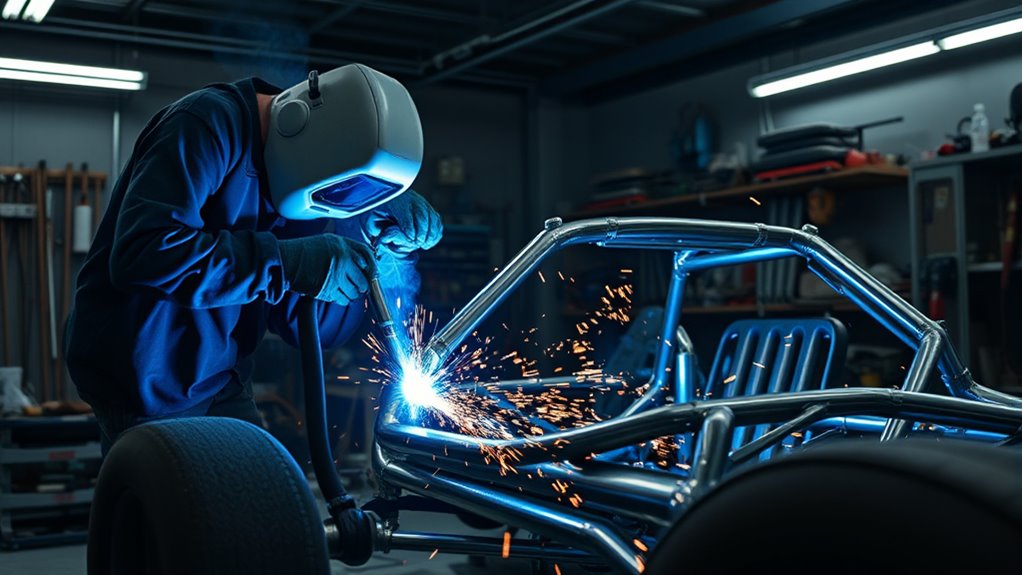
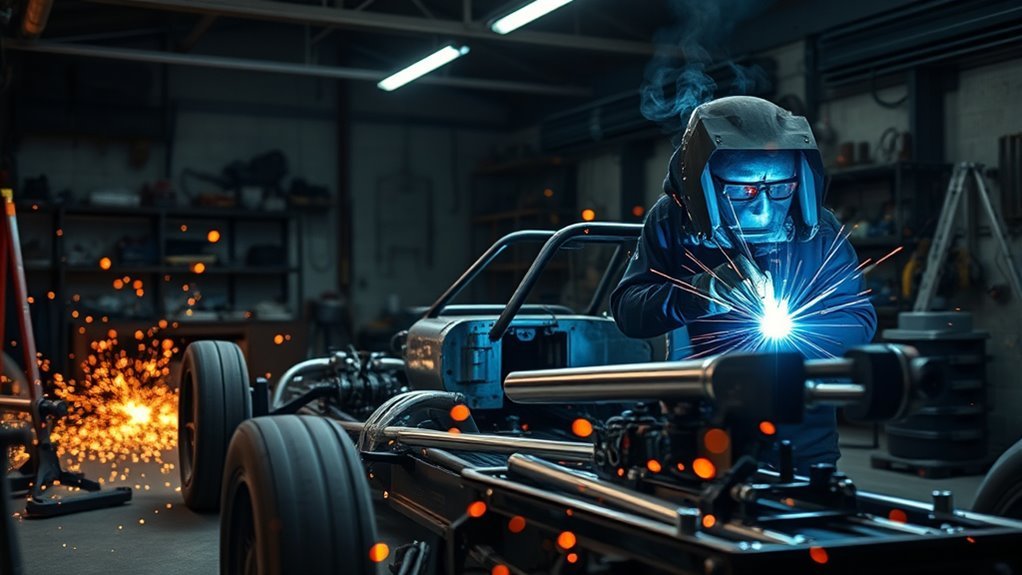
You should choose mild steel or 4130 chromoly for chassis and roll cage fabrication based on the build’s purpose, rulebook, weight target, and inspection requirements. Mild steel is easier to source and more forgiving. 4130 chromoly can save weight, but it demands better fit-up, better heat control, and stricter procedure control.
You’ll need to compare MIG and TIG based on joint access, material thickness, and heat input. Weld quality depends on clean metal, consistent settings, steady travel speed, and full tie-in at the joint edges. Proper amperage settings are essential for achieving strong welds.
Prepare every joint by cleaning the surfaces, fitting tubes tightly, checking tube size, and verifying cage geometry before welding. A cage that looks strong but does not meet the rulebook may fail tech inspection and may not protect the driver correctly.
Material and Filler Choice
For chassis and roll cage fabrication, choose mild steel or 4130 chromoly based on the build’s goals. Mild steel keeps cost down and is easier to work with. Chromoly offers high strength for its weight, but it is less forgiving when heat input, fit-up, or filler selection is wrong.
In custom car fabrication, match your filler metal to the base alloy to protect weld integrity.
- For MIG welding on mild steel, use .030-.035 ER70S-6 wire as a common starting point.
- For TIG welding on mild steel, ER70S-2 is a common choice.
- For 4130 chromoly, ER70S-2 or ER80S-D2 may be used depending on the rulebook, design, and welding procedure.
- Use visual inspection on every bead, and use dye penetrant testing on critical or suspect welds when the material and inspection plan call for it.
For thin-walled tubes, TIG welding often gives tighter control, but the final decision should follow the alloy, load path, joint access, and inspection requirements.
MIG vs TIG Process
With your base metal and filler matched, the next choice is the welding process. That decision shapes weld speed, control, distortion, and appearance.
MIG welding gives you speed and ease, so it works well for thicker mild steel and fast custom chassis fabrication when the procedure allows it. Use ER70S-6 where filler compatibility fits the joint.
TIG welding gives you finer heat input control, cleaner beads, and better control on thin tubing and complex joints. In high-stress areas, TIG welding often wins because it helps limit warping and gives the welder a clear view of puddle shape and tie-in.
Choose by application: MIG for fast mild-steel fabrication, TIG for precise roll cage welds, chromoly tubes, thin joints, and visible beads that need clean control.
Weld Prep and Safety
Clean metal and tight fit-up are the foundation of chassis and roll cage welds that hold. Your weld prep starts by removing rust, paint, grease, mill scale, undercoating, and other contaminants so the joint can fuse cleanly.
Keep gaps tight. Good fit-up helps the welding process deliver uniform penetration and structural integrity. Large gaps make the weld harder to control and can increase heat input, burn-through, and distortion.
- Clean every joint to bare metal on all sides you can reach.
- Cope tubing so the joint fits tightly before tacking.
- Match filler metals to the base material and procedure.
- Wear safety gear: helmet, gloves, flame-resistant clothing, eye protection, and hearing protection when grinding.
- Inspect every bead after cooling for cracks, porosity, undercut, lack of fusion, or inconsistent tie-in.
When you control prep and safety, you build stronger tubes and safer structures.
Weld Suspension Parts for Strength and Alignment
You need to choose the right process and base material before welding suspension parts, because these parts carry load and affect steering, braking, tire wear, and handling. Suspension work demands controlled heat input, tight weld quality, and accurate alignment.
Set alignment before you make the final welds. Even small distortion can change caster, camber, toe, wheelbase, or bushing position. That can cause uneven tire wear or unsafe handling.
For filler selection, use ER70S-2 for many TIG-welded mild steel parts and ER80S-D2 for some chromoly work when the procedure calls for it. Understanding electrode selection is crucial to achieving weld quality and strength in suspension components.
Material and Process Choice
Choosing the right material and welding process for suspension parts is critical to strength, alignment, and long-term durability. Use mild steel or chromoly only when you know the part design, wall thickness, load path, and inspection method.
- Inspect each component first for cracks, corrosion, bends, and previous repairs.
- Use MIG welding for faster fabrication on compatible mild steel parts when the design allows it.
- Use TIG welding with ER70S-2 for many mild steel joints and ER80S-D2 for chromoly when the procedure calls for it.
- Manage heat carefully to avoid warping and preserve alignment.
These welding techniques let you reinforce suspension parts without excess distortion. Choose filler metals precisely, control heat management, and verify the final geometry after the part cools.
Alignment Before Final Welding
Once you’ve selected the right material and welding process, lock in the suspension geometry before striking the final weld. You need exact alignment of control arms, brackets, tabs, shock mounts, and pickup points to keep handling predictable.
Start with pre-weld checks, then use precision measuring tools such as a tape measure, angle finder, straightedge, square, tram gauge, dial indicator, or laser alignment tool. Confirm that control arms, spindles, and mounts sit within the design or manufacturer’s specifications.
Make adjustments before welding. Once the arc starts, heat can pull a part out of square. Tack opposite sides, remeasure, and weld in a balanced sequence.
After welding, perform post-weld inspections and verify alignment again to confirm the welding process has not introduced distortion.
Filler Metals for Strength
For suspension welding, the filler metal you select needs to match the base material, part design, and load. You protect alignment and structural integrity by choosing the right alloy for each joint.
- Use ER70S-2 for many TIG-welded mild steel suspension parts.
- Use ER80S-D2 for chromoly only when it matches the procedure and service needs.
- In high-stress areas, choose filler based on the full design, not only the tube’s listed strength.
- Apply preheat only when the material, thickness, and procedure call for it.
Your welding technique should keep heat controlled and penetration consistent. After welding, inspect every bead because weak filler choices, poor fit-up, or missed cracks can reduce fatigue resistance and safety.
Control Heat, Fit-Up, and Tack Sequence
Most custom car welding problems start before the final bead. Poor fit-up, weak tacks, dirty metal, and random weld order can create warping, gaps, and weak joints.
- Mock up the part first. Bolt or clamp the part in its real position before final welding.
- Clean the weld zone. Remove paint, rust, oil, plating, seam sealer, undercoating, and mill scale.
- Fit the joint tightly. Do not use weld metal to fill large gaps unless the design and procedure allow it.
- Tack opposite sides. Place tacks so the part cannot pull out of position.
- Remeasure before final welding. Check square, length, angle, clearance, and bolt-hole location.
- Weld in a balanced sequence. Move around the part instead of dumping all heat into one area.
- Let the part cool naturally. Forced cooling can increase stress or distortion on some materials.
Pro Tip: Before final welding, mark reference lines across the joint with a paint marker or scribe. If the lines move after tacking, the part has shifted and should be corrected before the final bead.
Final Prep, Safety Gear, and Weld Cleanup
Before you strike an arc, clean and degrease every joint so the metal surface is ready for a strong, consistent weld. Your final prep should remove oil, rust, paint, dust, coatings, and trapped debris because contamination weakens fusion and can cause porosity.
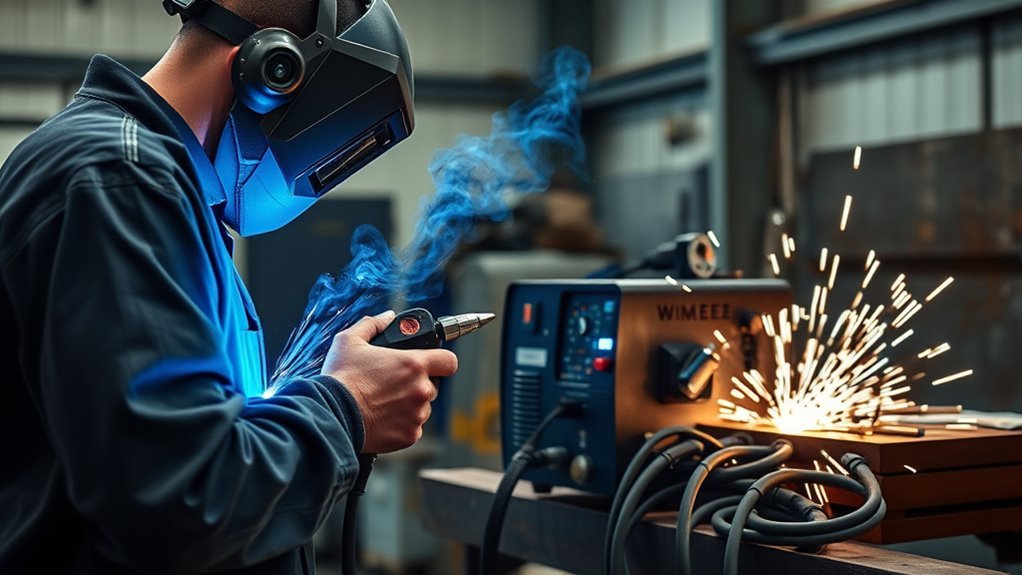
Put on safety gear before you start. Use a welding helmet or hand shield for arc welding, safety glasses under the helmet, welding gloves, flame-resistant clothing, and closed-toe leather footwear. Wearing flame-resistant clothing helps protect against burns from spatter. OSHA also gives guidance for eye protection and filter shade selection for welding and cutting.
Control fire hazards before welding. Move flammable items away from the work area, shield anything that cannot be moved, keep a fire extinguisher nearby, and inspect the area after welding. Never weld on a used fuel tank, closed container, or unknown sealed part unless it has been properly cleaned, vented, and prepared by someone qualified for that work.
Ventilation matters too. Welding fumes can be hazardous, especially on coated, galvanized, stainless, painted, or contaminated metal. Use local exhaust, open airflow, or a respirator selected for the hazard when needed. Never use oxygen as ventilation.
After welding, perform weld cleanup by removing slag, spatter, and trapped impurities from the bead and surrounding metal. This cleanup improves both strength and finish, and it gives you a clear view for inspecting welds for uniformity, penetration, and integrity.
If you find defects, mark them before assembly continues. Do not grind a bad structural weld smooth just to make it look better. Repair the weld correctly, then inspect it again.
Keep maintaining workspace order by storing tools, leads, clamps, and consumables in defined locations. A clean, organized area cuts hazards and speeds fabrication.
Common Welding Mistakes in Custom Car Builds
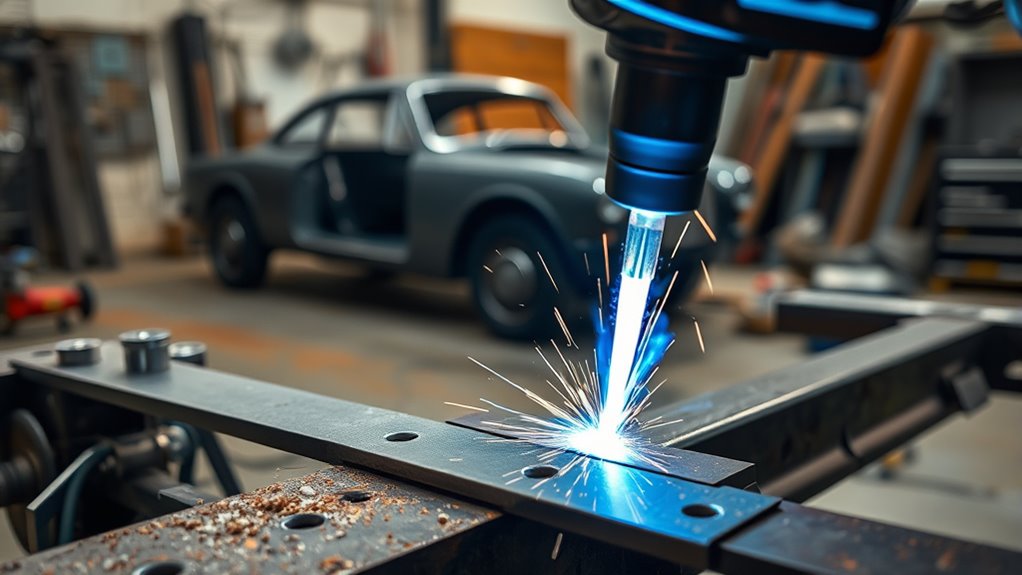
Even careful custom fabrication can go wrong if you skip the fundamentals. Small mistakes can become structural problems, especially on suspension, chassis, steering, brake, and seat mounting parts.
In custom builds, the most common welding mistakes usually start before the arc: poor planning, wrong process choice, and rushed prep. Use these welding tips to keep control:
- Verify fitment and mock-ups before you strike an arc.
- Match filler and process to the base metal; improper material selection hurts MIG welding and TIG welding results.
- Remove rust, oil, paint, mill scale, undercoating, plating, and seam sealer from the weld zone.
- Manage heat control to prevent warping, especially on thin panels.
- Practice on the same material thickness before welding the actual part.
- Inspect the backside of the joint when possible so you can confirm penetration and avoid hidden defects.
Additionally, make sure you clean metal thoroughly to improve weld quality and avoid issues such as cracks and porosity.
Troubleshooting Weld Defects
Use the table below when a weld does not look or act right. Stop and correct the cause before adding more weld over a bad joint.
| Problem | Likely Cause | Fix |
|---|---|---|
| Porosity | Dirty metal, poor gas coverage, wind, moisture, or wrong gas flow | Clean the joint, check gas flow, block drafts, and keep filler dry and clean. |
| Burn-through | Too much heat, wide gaps, slow travel, or thin metal | Reduce heat, tighten fit-up, use stitch welds, and practice on scrap of the same thickness. |
| Lack of fusion | Low heat, poor angle, fast travel, dirty joint, or poor access | Clean again, adjust angle, increase heat as needed, and make sure the weld ties into both sides. |
| Warping | Too much heat in one area or poor tack sequence | Use shorter welds, skip around, clamp the part, and allow controlled cooling. |
| Cracking | Wrong filler, high stress, poor alloy match, fast cooling, or contaminated metal | Stop welding, identify the alloy, remove the crack fully, and use the correct procedure. |
Frequently Asked Questions
What is the best welding for car fabrication?
MIG welding is usually best for fast mild-steel car fabrication because it is quick, repeatable, and easier to learn. TIG welding is better for thin panels, aluminum, stainless, chromoly, exhaust work, and visible welds where heat control and bead quality matter most.
Can you make $100,000 as a welder?
Yes, it is possible, but it is not the typical base wage for most welders. The U.S. Bureau of Labor Statistics lists the May 2024 median annual wage for welders, cutters, solderers, and brazers at $51,000, with the highest 10 percent earning more than $75,850. Six-figure income usually requires specialization, overtime, travel work, pipeline or industrial work, business ownership, or high-demand certifications.
What is a fabricator welder’s salary?
Pay depends on location, industry, skill level, certifications, overtime, and whether the job is shop-based or field-based. A general automotive fabricator may earn less than a certified pipe, aerospace, industrial, or travel welder. Use current BLS wage data and local job listings to estimate pay in your area.
What is the welding process in automotive manufacturing?
Automotive manufacturing uses several welding processes, including resistance spot welding, MIG welding, TIG welding, laser welding, and robotic welding. The process depends on the metal, part design, production speed, joint access, strength requirement, and inspection method.
Is MIG or TIG better for roll cages?
It depends on the material and rulebook. Many mild-steel cages can be MIG or TIG welded when the rules allow it and the welder is qualified. Chromoly cages are commonly TIG welded. Always follow the sanctioning body’s tubing, filler, joint, and inspection requirements.
Do you need to preheat car parts before welding?
Sometimes. Thin mild steel usually does not need preheat, but thicker sections, some castings, chromoly parts, and repair welds may require controlled preheat. Use the base material, thickness, and welding procedure to decide. Do not guess on structural parts.
Conclusion
When you weld custom car parts, your process directly affects strength, alignment, and safety. MIG is usually faster for mild-steel fabrication, while TIG is usually slower but gives finer control on thin, aluminum, stainless, chromoly, and visible joints. Match the welder to the material, choose the right filler, clean every surface, tack the part in alignment, manage heat, and inspect each bead before moving on. If you skip prep, cleanup, or fitment checks, you can compromise the build and the vehicle’s long-term reliability.
Sources
- OSHA 1910.252, Welding, Cutting, and Brazing General Requirements — hot-work fire prevention, ventilation, eye protection, and welding safety requirements
- OSHA 1910.133, Eye and Face Protection — eye and face protection requirements relevant to welding and cutting
- U.S. Bureau of Labor Statistics: Welders, Cutters, Solderers, and Brazers — wage, job outlook, training, and safety context
- The Aluminum Association: Industry Standards — aluminum alloy designation and standards background