Welding gear heat ratings tell you how a glove, sleeve, jacket, or blanket performed in a specific heat test. They do not mean you can safely grab any hot part for any length of time. To choose the right gear, you need to match the rating to the real hazard: flame, contact heat, radiant heat, convective heat, or molten metal splash.
Quick Answer
Welding gear heat ratings show how the gear performed under a named standard, such as EN407 or ANSI/ISEA 105, for a specific heat hazard. The safest choice is not the highest advertised temperature. It is the gear whose tested rating matches your welding process, exposure time, splash risk, and PPE plan.
Key Takeaways
- EN407 is a common glove standard for thermal risks, and it rates separate hazards such as flame spread, contact heat, convective heat, radiant heat, and molten metal splash.
- A “1500°F” marketing claim is not the same as a certified contact-heat rating. Always check the standard, test method, and exposure time.
- TIG work often needs dexterity, while stick welding, flux-core welding, plasma cutting, and heavy fabrication usually need more cuff length, leather thickness, and spatter protection.
- Heat-rated gloves do not replace a welding helmet, flame-resistant clothing, ventilation, respirator selection, or a workplace PPE hazard assessment.
Warning: Do not use heat-rated gloves as permission to hold red-hot metal, freshly cut parts, or molten-splash areas by hand. Ratings are based on controlled lab tests. Real weldments can have sharp edges, trapped heat, slag, oil, solvents, and uneven hot spots that can burn through gear faster than expected.
What Welding Gear Heat Ratings Actually Mean
A heat rating is a test result, not a simple “good” or “bad” label. One glove may resist brief contact with a hot plate, while another may handle radiant heat better but perform poorly when molten metal hits the seams. That is why the standard and the hazard type matter as much as the number.
For welding gloves, you will often see EN407 thermal-risk testing, ANSI/ISEA hand-protection classifications, or a manufacturer’s own maximum-temperature claim. These are not interchangeable. EN407 uses separate thermal tests. ANSI/ISEA 105 is a North American hand-protection classification system. A product page that only says “rated to 1472°F” or “rated to 1500°F” may be describing a material limit, not safe hand-contact time.
| Marking or Claim | What It Tells You | Main Limit |
|---|---|---|
| EN407 code | Performance in separate flame, contact heat, convective heat, radiant heat, and molten metal tests. | You must read each position in the code, not just one number. |
| ANSI/ISEA 105 | North American glove classification for several hand hazards, with current 2024 marking changes for easier identification of key protection levels. | It is not the same as an EN407 code or a welding-specific pass/fail guarantee. |
| Maximum temperature claim | Often a marketing shorthand for brief exposure or material resistance. | May not state the test standard, contact pressure, exposure time, or failure point. |
Understanding the EN407 Standard for Thermal Protection
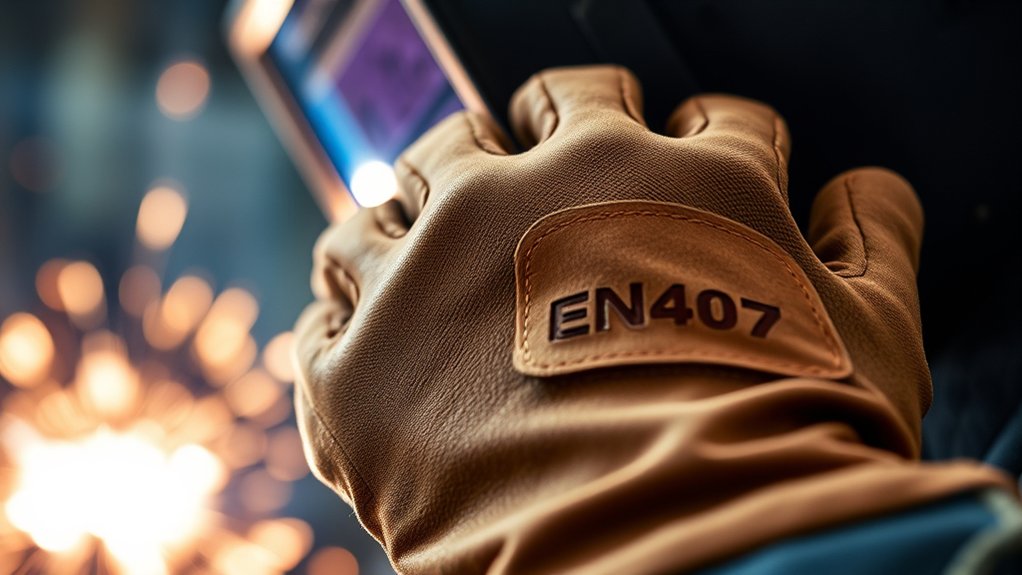
The EN407 standard is used to evaluate protective gloves against thermal risks. It does not give one single “welding heat rating.” Instead, it checks several types of heat exposure, including burning behavior, contact heat, convective heat, radiant heat, small splashes of molten metal, and large splashes of molten metal.
That matters because welders face more than one heat hazard. You may brush a hot plate, work near a flame, feel radiant heat from a large weldment, or get spatter on your glove cuff. A glove that performs well in one test may not be the best choice for another. Materials such as split cowhide, grain leather, aramid thread, Kevlar blends, aluminized layers, and carbon-fiber reinforcements can all improve protection, but only the test code tells you how the finished glove performed. For example, heavy 100% split cowhide leather may give strong spatter resistance, while thinner TIG gloves may trade some heat buffer for better finger control.
Note: If an EN407 position shows “X,” that hazard was not tested or the result was not claimed. If it shows “0,” the glove was tested but did not reach the first performance level for that hazard.
The Six Thermal Hazard Tests Explained
EN407 is useful because it separates heat hazards that feel similar on the job but behave differently in testing. The table below gives a practical reading of each hazard for welding work.
| EN407 Test | What It Measures | Why Welders Care |
|---|---|---|
| Limited flame spread | How the glove behaves after flame exposure. | Important around open flame, sparks, and hot work where the glove might ignite or keep glowing. |
| Contact heat | How long heat takes to pass through when the glove touches a hot surface. | Useful when handling warm workpieces, clamps, fixtures, and recently cut parts. |
| Convective heat | Heat transfer from hot gases or flame. | Useful for flame work, preheating, and jobs where hot air surrounds the hand. |
| Radiant heat | Heat reaching the glove from a hot source without direct contact. | Important near large weldments, heavy plate, furnaces, and long high-amperage passes. |
| Small molten metal splashes | Resistance to small drops of molten metal. | Relevant to MIG, stick, flux-core, grinding sparks, and general spatter. |
| Large molten metal splashes | Resistance to heavier molten-metal exposure. | Most important in foundry-like work, heavy cutting, and severe splash environments. |
Understanding these tests helps you make informed choices about gloves and protective clothing. A high contact-heat score alone does not mean the glove is ideal for heavy spatter, and a thick spatter glove may still be clumsy for low-amperage TIG work.
Limited Flame Spread: How Is It Tested?
The limited flame spread test checks how a glove behaves after direct flame exposure. Testers look at whether the material keeps burning, keeps glowing, opens at the seams, melts, drips, or forms holes. For welders, the practical question is simple: if sparks or flame hit the glove, does the glove stop the hazard or become part of it?
This is one reason you should be careful with unknown leather, synthetic liners, or bargain gloves that do not list a standard. Some gloves are comfortable for shop handling but are not flame-resistant enough for high-spatter work. When a glove is not flame retardant, as noted in some product-specific reviews such as Wells Lamont blue-lined leather welding gloves, use it only within its stated limits and avoid extreme heat exposure.
Pro Tip: Check the seams as closely as the palm. Heat-rated leather can fail early if the stitching is cotton, damaged, exposed, or not protected from spatter.
Understanding Contact Heat Resistance
Contact heat resistance measures how well a glove slows heat transfer when it touches a hot surface. This matters when you move tack-welded parts, adjust clamps, handle a warm coupon, or brush against a hot fixture. It does not mean you should grip freshly welded metal longer than needed.
In EN407-style contact heat testing, higher levels are tied to hotter test plates and a minimum threshold time before the inside temperature rises too much. A common way to read the contact heat level is shown below.
| EN407 Contact Heat Level | Typical Test Temperature | Practical Meaning |
|---|---|---|
| Level 1 | 100°C / 212°F | Light hot-surface contact, not enough for serious welding heat. |
| Level 2 | 250°C / 482°F | Useful for brief contact with moderately hot workpieces. |
| Level 3 | 350°C / 662°F | Better for heavier fabrication and hotter fixtures. |
| Level 4 | 500°C / 932°F | High contact-heat resistance, but still only for controlled, brief exposure. |
Contact heat is where many buyers get misled. A glove may say “932°F” because it reached EN407 contact heat Level 4, but that does not mean your hand will feel comfortable holding a 900°F part. Pain can arrive before a lab-defined injury threshold, and real workpieces may have edges, slag, and pressure points that speed heat transfer.
Quality leather gloves with a strong liner, such as the type discussed in a robust heat resistance glove review, may help with brief contact. Still, use pliers, tongs, clamps, or a work rest when the part is hot enough to cause injury.
The Importance of Convective Heat Resistance in Welding
Convective heat resistance deals with heat carried by hot gases or flame. This is different from touching hot metal. You may need convective protection when welding near preheated parts, using oxy-fuel equipment, working close to a flame, or reaching into a hot pocket where air movement carries heat around the glove.
- Look at the process: Oxy-fuel and flame heating create more convective heat than small TIG tack welds.
- Check cuff coverage: A short cuff can leave your wrist exposed even if the palm material is heat rated.
- Watch the liner: A liner can improve insulation, but loose liners reduce dexterity and can trap sweat.
- Use full PPE: Gloves should pair with flame-resistant sleeves, jackets, and other 100% cowhide leather or FR gear when the job creates heavy heat and spatter.
Evaluating Radiant Heat Resistance for Gear Selection
Radiant heat comes from a hot source even when you do not touch it. You feel it when standing near a large weldment, heavy plate, preheated casting, furnace opening, or long high-amperage weld. A radiant heat rating is especially useful when your hand stays near the heat source for repeated passes.
Key Testing Methods
Radiant heat tests measure how quickly heat passes through the glove material when it is exposed to a defined heat source. Longer protection times generally indicate better insulation against radiant heat. Materials such as aluminized backs, aramid fabrics, Kevlar stitching, and layered leather can improve performance, but they may reduce flexibility.
Radiant heat should also change how you think about full-body PPE. A glove rating cannot protect your face, neck, arms, or lungs. For plasma cutting and related hot work, proper personal protective equipment needs to cover eye, face, skin, fire, and fume hazards together.
Performance Ratings Overview
A higher radiant heat rating is useful when the heat source is close and exposure is repeated. For example, heavy stick welding on thick steel may call for a longer, heavier glove than low-amperage TIG on clean sheet metal. But high insulation can reduce grip and puddle control, so do not buy by the highest number alone.
The best welding glove is the one that matches the heat path: contact heat, flame, radiant heat, hot gas, or molten splash. A single temperature claim cannot tell you all of that.
Molten Metal Resistance: Protecting Against Splashes
Molten metal splashes are one of the biggest hand hazards in welding and cutting. Small spatter can damage stitching, burn through thin leather, or lodge in folds. Larger molten-metal exposure can overwhelm gloves that are fine for ordinary shop handling.
- Small splashes: Common with MIG, stick, flux-core, cutting, and grinding. Look for strong leather, protected seams, and good cuff coverage.
- Large splashes: More relevant to foundry work, heavy cutting, or severe molten-metal exposure. Standard welding gloves may not be enough.
- Seam and cuff design: Spatter often enters at the cuff or damages stitching before it burns through the palm.
- Surface condition: Oil, solvent, paint, and coatings can change the hazard and should be controlled before hot work.
When spatter risk is high, combine gloves with sleeves, jackets, aprons, blankets, screens, and fire-safe work practices. Flame-retardant materials, such as those discussed in a welding blanket safety review, can reduce ignition risk around the work area, but they must still be used within their listed rating.
Products Worth Considering

GREAT HEAT RESISTANCE ▶ Provide extreme high heat protection up to 932°F(500℃).Made of a high grade leather and soft cotton liner which is designed to withstand and protect against high temperatures

Kevlar Gloves with Sleeves: With the high performance cut resistant material, Achieve a good level of protection while ensuring the heat insulation, high resistance to traction, good tear resistance, anti-cut, excellent elbow guard arm performance

PREMIUM MATERIALS. Durability with high grade of US split leather available on the market. Got the CE EN388 and EN407 Certificates. Full cow split leather back till the cuff. Unlike other stiff welding gloves, these gloves are softer. Heat and flame resistant for all types of welding.
How to Choose Welding Gear Based on Heat Ratings
Start with the job, not the number on the glove. OSHA’s PPE rules require workplace hazards to be assessed and PPE to be selected for those hazards. For welding, that means looking at heat, flame, spatter, arc radiation, fumes, sharp edges, electrical risk, and fit before you choose gear.
| Welding or Cutting Task | What to Prioritize | Good Gear Direction |
|---|---|---|
| Low-amperage TIG | Dexterity, fingertip feel, moderate contact heat. | Goat, deer, or thin grain leather TIG gloves with heat-safe stitching. |
| MIG welding | Spatter resistance, contact heat, cuff coverage. | Medium to heavy leather gloves with lined backs and reinforced seams. |
| Stick or flux-core welding | Heavy spatter, radiant heat, slag, long cuffs. | Heavy split leather welding gloves with long cuffs and strong stitching. |
| Plasma cutting | Sparks, hot edges, radiant heat, eye and face protection. | Cutting gloves plus proper eye, face, clothing, and ventilation controls. See broader plasma cutting safety gear guidance. |
| Heavy fabrication or foundry-like work | Radiant heat, molten metal splash, full-arm coverage. | High-rated gloves, sleeves, aprons, spats, face protection, and process-specific PPE. |
Products Worth Considering

HEAVY DUTY - Premium split cowhide leather with split cowhide cuff

【EXCELLENT MATERIAL AND DESIGN】-This heavy duty gloves is made of 100% split cowhide leather and soft lining with cotton fibers, which makes it have High abrasion, puncture resistant, high temperature resistant, cut resistance, high flexibility and comfort. The reinforced palm provides extra protection. The adjustable wrist can prevent dirty small things from entering the gloves. When your hands sweat, you don't have to worry about it dyeing your hands. I think you can imagine all this
【EXCELLENT MATERIAL AND DESIGN】-This heavy duty gloves is made of 100% split cowhide leather and soft lining with cotton fibers, which makes it have High abrasion, puncture resistant, high temperature resistant, cut resistance, high flexibility and comfort. The reinforced palm provides extra protection. The adjustable wrist can prevent dirty small things from entering the gloves. When your hands sweat, you don't have to worry about it dyeing your hands. I think you can imagine all this
How to Inspect Heat-Rated Welding Gloves Before Use
Even a good heat rating does not help if the glove is worn out. Before welding, inspect the gloves the same way you would inspect a helmet lens, ground clamp, or regulator.
- Look for holes and thin spots: Pay close attention to the fingertips, thumb web, palm heel, and cuff edge.
- Check the seams: Broken, cotton, or exposed stitching can fail quickly under spatter.
- Flex the leather: Stiff, cracked, oil-soaked, or hardened leather may not protect like new leather.
- Check the liner: A torn liner can bunch up, reduce grip, and create hot spots.
- Replace after burn-through: Do not keep using gloves with charred holes, melted areas, or spatter pits that reach the liner.
Note: Gloves protect your hands, but welding also creates fume and gas hazards. OSHA notes that welding smoke can contain harmful metal fume and gas by-products, so ventilation and respiratory protection may be needed when work practices and exhaust controls are not enough.
Frequently Asked Questions
What is an ANSI Level 5 heat rating?
An ANSI heat rating is part of a North American glove classification system, not an EN407 code. Do not read “Level 5” as a promise that a welding glove can safely handle 1500°F metal. Check the manufacturer’s data sheet for the exact ANSI/ISEA 105 test, exposure time, and hazard type.
What is the heat number in welding?
A weld “heat number” usually refers to metal batch traceability, not glove protection. It helps identify the batch or melt of the base metal or filler material. It is separate from welding gear heat ratings such as EN407 or ANSI/ISEA glove classifications.
What is ANSI heat rating 2?
ANSI heat rating 2 is a lower contact-heat classification compared with higher ANSI levels. It may be acceptable for lighter hot-surface handling, but it is not enough by itself to choose gloves for heavy welding, stick welding, flux-core spatter, or molten metal splash. Always match the rating to the process and exposure.
What is an EN407 rating?
An EN407 rating reports how a glove performs against thermal risks such as limited flame spread, contact heat, convective heat, radiant heat, and molten metal splashes. The code must be read by position. A high score in one hazard does not automatically mean high protection in every welding heat hazard.
Are thicker welding gloves always safer?
No. Thicker gloves often improve heat buffer and spatter protection, but they can reduce grip and torch control. TIG work may need thinner gloves for precision, while stick welding and heavy fabrication usually need thicker leather, longer cuffs, and better spatter resistance.
When should welding gloves be replaced?
Replace welding gloves when you see holes, cracked leather, burned seams, stiff or oil-soaked areas, exposed liner, melted material, or spatter damage that reaches through the outer layer. Also replace them if you start feeling heat sooner than you did when they were new.
Conclusion
Understanding welding gear heat ratings helps you choose gloves and protective gear that match the hazard instead of trusting a single temperature claim. Use EN407 to compare flame, contact heat, radiant heat, convective heat, and molten metal splash performance. Use ANSI/ISEA information as a separate hand-protection reference. Most important, choose gear through a real hazard assessment, inspect it before use, and replace damaged gloves before heat reaches your skin.
Sources
- SATRA — EN407 protective gloves against thermal risks — supports the EN407 thermal hazard test overview.
- OSHA 1910.132 General Requirements — supports PPE hazard assessment, selection, fit, training, and damaged-equipment guidance.
- OSHA Welding, Cutting, and Brazing — supports welding hazard and regulatory context.
- OSHA Fact Sheet: Controlling Hazardous Fume and Gases during Welding — supports the note that welding fumes and gases require controls beyond gloves.
- PIP Global — ANSI/ISEA 105 2024 update — supports current ANSI/ISEA hand-protection classification context and marking update.