MIG welding in auto body repair is a fast, clean way for you to join thin steel, stainless, or aluminum panels using a continuous wire feed and shielding gas. It works well on 24-gauge to 1/4-inch metal, so you can patch rust, replace panels, and repair brackets with good control. You’ll use low heat, short tacks, and proper settings to avoid warping and burn-through. Keep going, and you’ll see how to set it up right.
What Is MIG Welding for Auto Body Repair
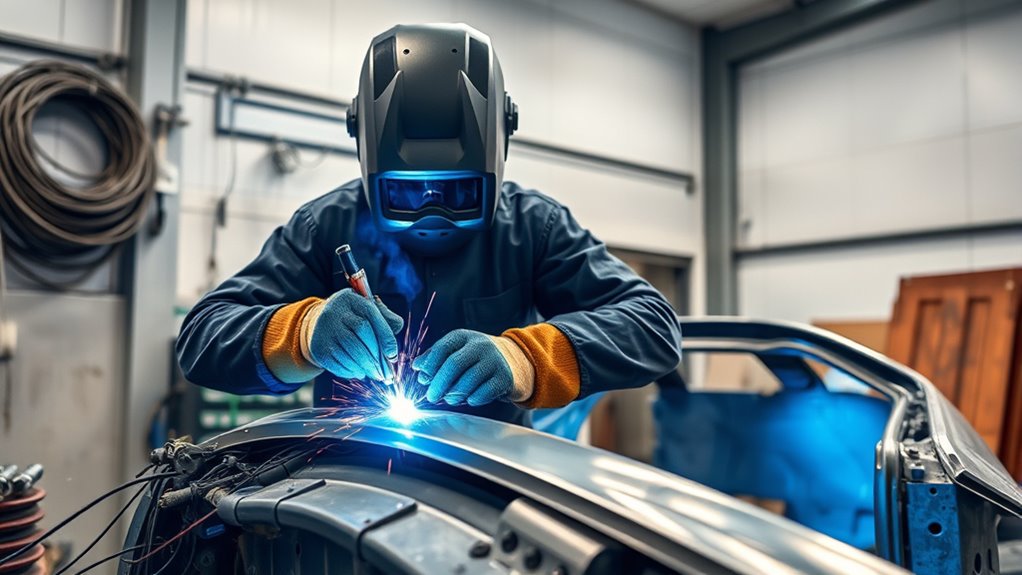
MIG welding, or Metal Inert Gas welding, is a practical choice for auto body repair because it lets you join carbon steel, stainless steel, and aluminum quickly and cleanly.
You get strong welding advantages: a continuous wire feed helps you move fast, and shielding gas protects the puddle from contamination. That control matters when you work on thin automotive panels from 24-gauge up to 1/4-inch.
You can use it for patching, seam repair, and panel replacement without fighting the process. Its material compatibility gives you flexibility across common body metals, so you’re not trapped by one repair path.
You also don’t need a complicated setup, which keeps the method accessible and efficient. When you set voltage and wire feed speed to match thickness, you improve weld quality and reduce distortion. This ensures you maintain optimal weld quality, allowing for precise repairs that stand the test of time.
This lets you work with precision, save time, and keep control over the repair.
Essential MIG Welding Gear for Auto Body Repair
For a solid auto body setup, you need five essentials: a MIG welder, quality wire, shielding gas, proper PPE, and a dependable ground clamp.
Choose a 120V or 240V machine based on metal thickness; Millermatic units are common, but any stable welder that suits your panel work will do. Load 0.030-inch or 0.035-inch ER70S-6 solid wire for mild steel, then use a 75% argon and 25% CO2 mix for clean, strong welds. The 140A 3 in 1 MIG Welder offers versatile capabilities, making it an excellent choice for various projects.
Choose a 120V or 240V welder, pair it with ER70S-6 wire, and run 75/25 shielding gas for clean panels.
Your welding safety starts with an auto-darkening helmet, leather gloves, and flame-resistant clothing. Keep equipment maintenance simple: inspect the gun, liner, and drive rolls, and replace worn parts before they fail.
- Set the welder to match the panel gauge.
- Feed wire smoothly and avoid birdnesting.
- Keep gas flow consistent.
- Clamp to clean, bare metal.
- Store PPE dry and ready.
How MIG Welding Works on Auto Panels
At its core, MIG welding on auto panels feeds a continuous wire electrode into an electric arc, which melts the wire and the panel edges so they fuse together. You guide the arc across the repair zone, and the heat forms a controlled puddle that delivers weld penetration without overpowering thin sheet metal.
Shielding gas, usually 75% argon and 25% CO2, surrounds the puddle and blocks contamination, so you get cleaner joints and fewer defects. On panels from 24-gauge to 1/4-inch thick, this process lets you work fast while keeping distortion in check. Proper wire selection is essential for achieving optimal results, ensuring compatibility with the materials being welded.
Your technique matters: steady travel, short wire stickout, and a smooth push angle help maintain arc stability and produce a flatter bead. Because MIG welding is efficient, you can restore panels quickly, spend less time grinding, and keep your workflow focused on the repair, not the struggle.
MIG Welding Settings for Thin Metal
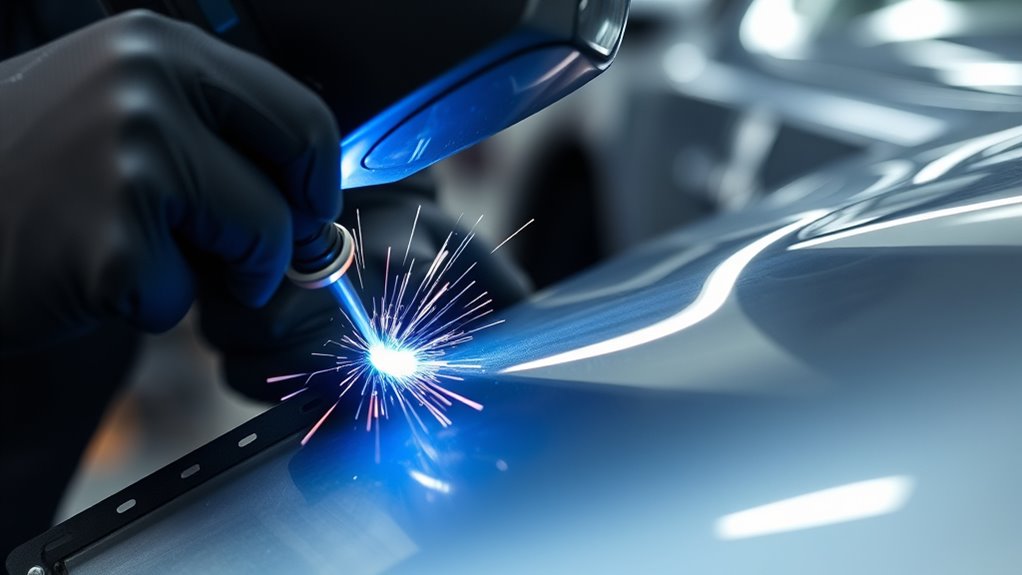
For thin panels, you’ll want to set the voltage low and keep the wire speed tight so you don’t overheat or burn through the metal. Start around 30A or lower, then fine-tune the feed rate until the arc stays stable with a 1/4 to 3/8 inch stickout. Use clean base metal and short tacks instead of long beads to control heat and reduce warping. Additionally, ensure correct polarity with DCEN for flux core welding to achieve optimal results.
Wire Speed Control
You should start near 100 to 200 inches per minute, then trim it for the panel and joint. On 1 mm steel, begin slower, around 30A-equivalent feed, and watch the puddle closely.
Keep stickout at 1/4 to 3/8 inch so the arc stays stable and your welds stay consistent.
- Test on scrap first
- Tune for wire speed, not guesswork
- Watch bead appearance for sharp changes
- Raise voltage only with feed changes
- Recheck settings as sheet thickness shifts
Voltage for Thin Panels
Keep MIG voltage on thin automotive panels in the 15 to 18 volt range so you don’t overheat the metal or blow through it. Match welding voltage to panel thickness, then fine-tune by test beads on scrap.
Start low on amperage, around 30 amps or less, and raise it only as the puddle stabilizes. Hold 1/4 to 3/8 inch stickout to keep the arc tight and heat input controlled. Use a push technique so you can spread heat, reduce distortion, and leave a cleaner bead.
After each short weld, let the panel cool before you continue. That pause protects the sheet, preserves shape, and gives you more control over every pass.
MIG Welding Techniques to Prevent Warping
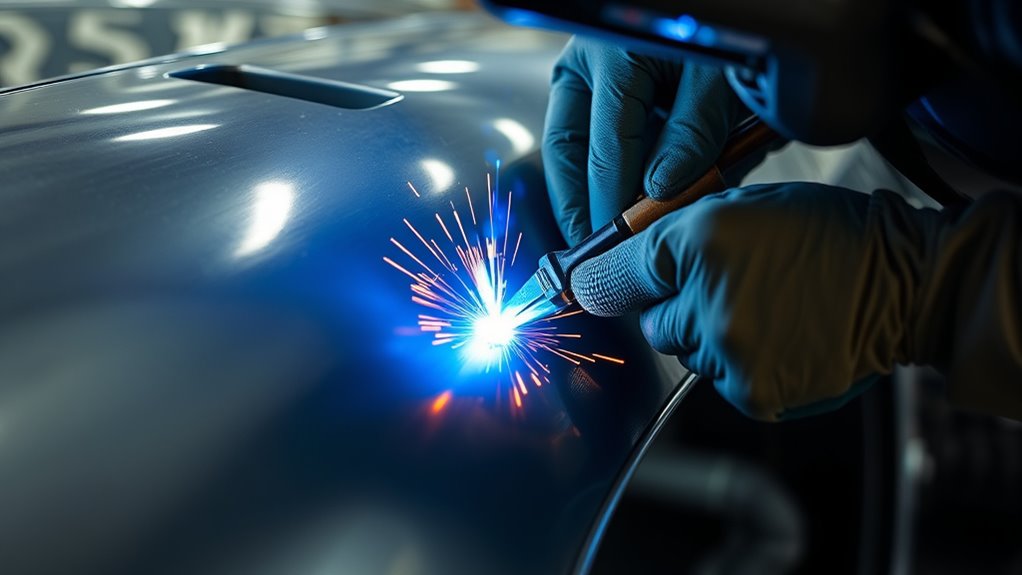
To prevent warping, you need tight heat control, starting with low amperage and a consistent torch distance so you don’t overload the metal. Use stitch welding instead of a continuous bead, placing short tacks with slight overlaps and letting the work cool between passes. Clean the base metal first so heat transfers evenly and you reduce distortion. Additionally, ensure proper surface preparation by grinding off zinc around the weld area to enhance weld strength and prevent porosity.
Heat Control
Heat control is critical in MIG welding because too much concentrated heat can warp the metal and distort the joint. You keep heat distribution even by holding a steady travel speed and adjusting amperage to match panel thickness. That helps you control thermal expansion and keep the sheet from moving on you.
- Use a staggered weld sequence.
- Place tack welds before full passes.
- Let each weld cool naturally.
- Lower amperage on thin panels.
- Move faster to limit heat buildup.
These habits cut distortion and protect fit-up. You’re not just joining metal; you’re preserving control, accuracy, and the freedom to repair panels without forcing the shape.
Stitch Welding
Stitch welding lets you join thin automotive panels without dumping heat into one spot, which helps prevent warping. You make short welds, usually 1 to 2 inches long, then leave 2 to 4 inches between stitches so the metal can cool. That pause cuts thermal distortion and keeps fitment tight.
Use lower amperage to control heat input, especially on 24-gauge to 1/8-inch sheet metal. The stitch advantages are clear: you keep panel shape, preserve alignment, and reduce grinding work later.
For stitch applications, work across seams, patches, and repair edges where full beads would overheat the panel. Move deliberately, watch puddle size, and let each section reset before you continue. This technique gives you cleaner, freer repairs.
Best Uses for MIG Welding in Auto Repair
MIG welding is a strong fit for auto repair because it handles everything from thin 24-gauge body panels to 1/4-inch structural sections with the right settings. You can use it for common repairs on fenders, quarter panels, floors, and frame edges without slowing the job.
Its continuous wire feed keeps your work moving, cuts downtime, and lays consistent beads. It also adapts to metal types you meet every day, including carbon steel, stainless steel, and aluminum.
- Patch rusted body panels fast
- Join replacement panels with clean fit-up
- Repair brackets and mounts with solid strength
- Restore frame sections with controlled heat
- Finish visible seams with low spatter
When you use shielding gas, you get a cleaner weld and better appearance, which matters on visible surfaces. Additionally, proper welding techniques help ensure structural integrity and prevent corrosion over time.
Adjust voltage and wire speed to match the material, and you’ll keep control while building durable, liberation-minded repairs.
Frequently Asked Questions
Why Is MIG Welding Used on Car Bodywork?
You use MIG welding on car bodywork because it offers strong metal compatibility, fast repairs, and clean welds on thin panels. It’s one of the most practical welding techniques for keeping your work efficient and precise.
What Is the Best Type of Welder for Auto Body Repair?
You’ll usually choose a MIG welder for auto body repair; for example, a beginner fixing 1/16-inch door skin can use a Millermatic 142. TIG Welding suits precision work, while Spot Welding handles factory-style seams.
What Is the Disadvantage of the MIG Welding Process for Repair Work?
You can run into messy cleanup, wire-feed jams, and limited material compatibility, especially beyond mild steel. That means you’ve got to manage welding safety carefully and adjust settings, or your repair quality suffers.
Conclusion
When you use MIG welding in auto body repair, you can join thin sheet metal quickly and with control. You set the right voltage, wire speed, and shielding gas, then make short tack welds to limit heat. For example, if you’re replacing a rusted quarter panel, you can stitch the seam, skip around the panel, and avoid warping. With proper gear and technique, you’ll get strong, clean repairs that hold up well.