While traditional welding methods struggle with precision, Plasma Arc Welding (PAW) thrives in environments demanding accuracy and quality. It’s particularly suited for aerospace, medical devices, and electronics industries, where welding exotic materials like titanium and nickel-based alloys is essential. PAW’s capability for minimal distortion makes it ideal for thin materials and high-strength components. Curious about how PAW achieves clean, strong welds and its impact on these industries? There’s much more to explore.
Understanding Plasma Arc Welding

Although it’s a highly specialized process, understanding Plasma Arc Welding (PAW) can be straightforward with the right knowledge. PAW leverages unique plasma characteristics to produce precise and consistent welds.
This process uses a focused plasma arc, achieving narrow, deep welds with minimal heat distortion. You’ll find it particularly effective for welding applications that demand high precision, such as aerospace and medical device manufacturing. Its ability to handle tough materials like titanium and nickel-based alloys guarantees deep penetration without the need for multiple passes.
For micro-welding and thin materials, PAW minimizes warping, preserving the integrity of delicate components. Industries like aerospace, electronics, and nuclear power frequently utilize PAW, given its capacity to meet strict quality standards.
Additionally, the technology’s consistency and repeatability make it ideal for automation in manufacturing, seamlessly integrating with robotic systems to enhance efficiency and quality in various welding applications.
Core Components of Plasma Arc Welding
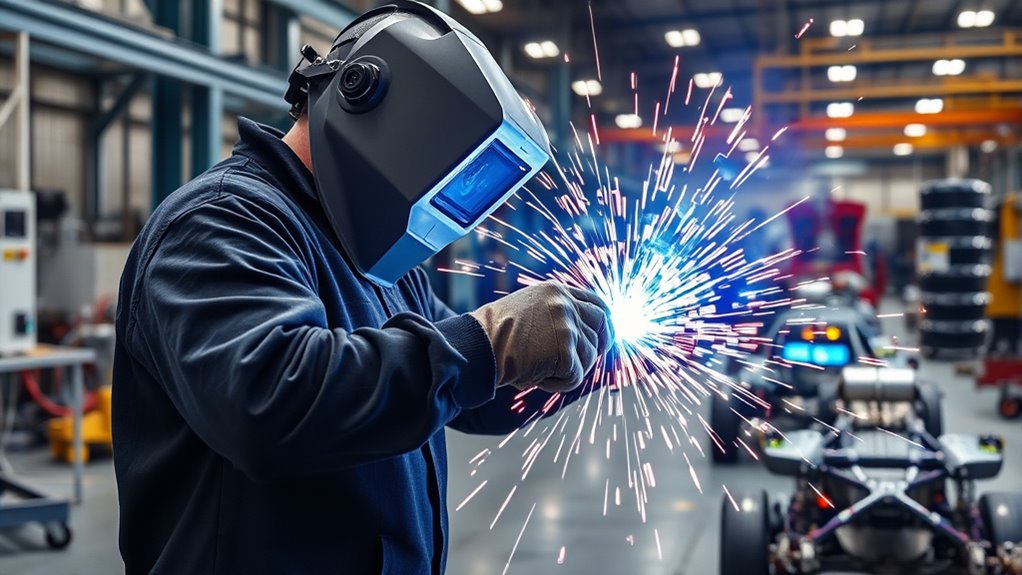
When setting up Plasma Arc Welding (PAW), you’ll need to focus on its core components, starting with the essential equipment like the plasma torch equipped with a tungsten electrode.
This torch features a constriction nozzle for precise plasma stream control, essential for welding a variety of materials.
Additionally, a dual gas strategy is important, as the plasma gas generates the arc and the shielding gas protects the weld pool, ensuring a clean and effective welding process.
Essential Plasma Welding Equipment
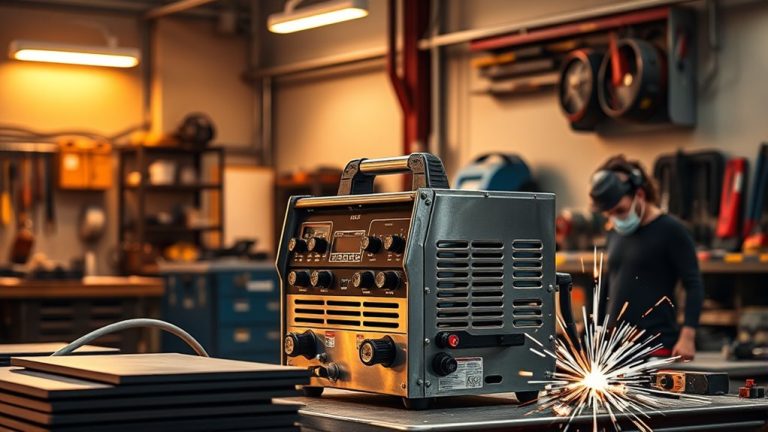
A plasma arc welding system relies on several essential components to achieve precise and efficient welding. The core of the system is the plasma torch, equipped with a tungsten electrode and constriction nozzle. This setup creates a focused plasma stream for precision work.
For welding safety, ensuring proper handling and maintenance of the plasma torch is significant. A constant current power supply is essential, delivering high-frequency starts and arc stability.
Utilizing both plasma and shielding gas protects the weld from contamination. A water cooling system is indispensable to prevent overheating during high-amperage operations, enhancing both efficiency and equipment longevity.
Finally, a control console allows you to adjust welding parameters, offering precise control and enabling automation in industrial settings.
Key Plasma Torch Features
To master plasma arc welding, understanding the key features of the plasma torch is essential.
At its core, the tungsten electrode generates a concentrated plasma stream, achieving temperatures near 30,000 degrees Fahrenheit. This intense heat is precisely controlled by the nozzle design, which utilizes a constriction nozzle to narrow the plasma stream for accurate heat delivery to the workpiece.
For peak torch performance, a constant current power supply initiates the arc with high frequency and maintains its stability.
The double-gas strategy involves shielding gas to prevent contamination and plasma gas to form the arc.
To guarantee reliability, a water cooling system is integrated, preventing overheating during high-amperage welding and extending the lifespan of the torch components.
The Plasma Welding Process Explained
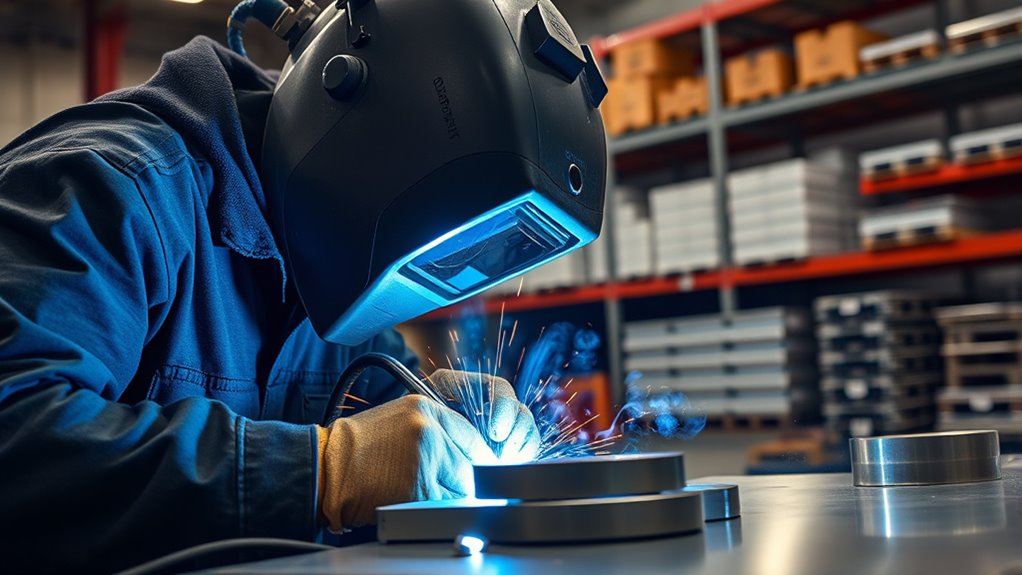
Although complex, the plasma welding process offers precision and efficiency unmatched by traditional methods. It begins with pilot arc initiation, which stabilizes a low-current gas arc before the full welding arc takes over.
You’ll appreciate the double gas strategy, using plasma gas to form the arc and shielding gas to protect against contamination. This guarantees a clean, strong weld every time.
Heat delivery is through a tightly constricted nozzle, giving you precise control over the weld area and minimizing heat spread. This precision is critical for maintaining the integrity of your materials.
- Precision: CNC or robotic arms guide operations, guaranteeing exact results.
- Versatility: Three modes—Microplasma, Medium current, and Keyhole plasma—adapt to material thickness.
- Efficiency: Ideal for high-volume production, reducing labor and time.
- Quality: Consistent, clean welds that meet high industry standards.
Plasma welding’s advanced technology makes it essential for high-stakes applications.
Key Advantages of Plasma Arc Welding
You’re likely aware that Plasma Arc Welding offers unmatched precision and control, which is essential for industries where detail can’t be compromised.
Its deep penetration capability at lower amperages guarantees robust joints with minimal heat distortion, making it ideal for thin or exotic materials.
This combination of features not only enhances weld quality but also optimizes efficiency in both automated and high-volume production settings.
Precision and Control
Plasma Arc Welding (PAW) stands out for its exceptional precision and control, making it a preferred choice for applications demanding high-quality results.
In precision applications, PAW’s control techniques deliver narrow welds with minimal heat-affected zones, ensuring both aesthetic and functional integrity. You’ll appreciate its capability to handle hard-to-weld materials like titanium and nickel alloys, maintaining material integrity under demanding conditions.
- Stable and controllable arcs: Achieve consistent results in automated and robotic tasks.
- Reduced distortion: Lower currents mean less risk of distortion and warping.
- Higher tolerance levels: Better arc control accommodates variations in torch standoff distance.
- Repeatability and efficiency: Enhance your production process with reliable weld quality.
PAW is your go-to solution for precision and control in welding.
Deep Penetration Capability
A standout feature of Plasma Arc Welding (PAW) is its deep penetration capability, which is a significant advantage in achieving robust welds in thick materials.
PAW excels in welding thickness, matching laser and electron beam methods with fewer passes. Utilizing the keyhole plasma mode at currents over 100A, PAW achieves deep penetration in thicker materials without excessive heat input, minimizing distortion.
Its narrow arc and concentrated heat allow deeper welds at lower amperages, reducing the heat-affected zone compared to traditional methods.
PAW is particularly effective with challenging materials like titanium and nickel alloys, where maintaining structural integrity is essential.
This precision control and heat management make PAW ideal for aerospace and medical industries, where deep penetration and weld quality are critical.
Limitations to Consider in Plasma Welding
Although plasma arc welding (PAW) offers numerous benefits, it’s crucial to take into account its limitations to guarantee it aligns with your operational needs. The high startup costs and equipment complexity can be intimidating, especially for smaller operations.
High startup costs and equipment complexity can be daunting, particularly for smaller operations considering plasma arc welding.
You’ll need to invest in operator training to secure proficiency, which can be challenging if skilled welders are scarce.
Consider these limitations:
- Operator Training: Specialized skills are required, which can be a hurdle if training resources are limited.
- Maintenance Costs: Continuous upkeep is necessary, leading to higher ongoing expenses that might strain your budget.
- Setup Time: The process requires meticulous setup and calibration, potentially delaying production timelines.
- Surface Contamination: Precision is key; surface contamination can negatively affect weld quality, demanding thorough preparation.
Weigh these factors carefully against your specific requirements to decide if PAW is the best fit for your industry and application.
Ideal Materials for Plasma Welding
When it comes to welding exotic metals, plasma arc welding (PAW) stands out as a superior choice. It excels with best alloys like titanium and nickel-based metals, often challenging to weld with other methods.
If you’re dealing with thin materials, PAW allows welding sheets as thin as 0.1 mm while minimizing distortion and warping. This precision makes it ideal for high-strength welding applications in fields where quality is non-negotiable.
For those requiring deep penetration welds without multiple passes, PAW can achieve welds in thick materials up to 15 mm. This capability is essential for demanding applications requiring strength and durability.
Consider PAW if you’re working with stainless steel and copper, as these materials benefit from clean, high-quality welds necessary for both aesthetic and functional integrity.
Industries Benefiting From Plasma Welding
You’ll find that Plasma Arc Welding (PAW) greatly enhances aerospace manufacturing, where precision and robust welds are essential for fabricating turbine blades and fuel nozzles.
In the medical device sector, PAW excels in welding stainless steel and titanium with minimal distortion, ensuring the reliability of intricate surgical instruments and implants.
Additionally, electronics production benefits from PAW’s micro-welding capabilities, allowing precise connections on sensitive components without material damage.
Aerospace Manufacturing Excellence
In aerospace manufacturing, Plasma Arc Welding (PAW) stands out for its unparalleled precision and efficiency in producing critical components like airframes and engine parts.
Dealing with aerospace innovations and manufacturing challenges, PAW excels by delivering precise, deep welds on titanium and nickel-based alloys. Its ability to minimize heat-affected zones guarantees the structural integrity of lightweight components, important for aerospace applications.
- Precision: Achieve flawless welds, meeting stringent aerospace standards.
- Efficiency: Integrate with robotic systems for consistent, high-volume production.
- Integrity: Maintain structural strength, reducing warping risks.
- Safety: Enhance safety and performance with superior weld control.
As the plasma welding market grows, adopting PAW becomes crucial for maintaining safety and quality in aerospace component production.
Medical Device Precision
Although often overshadowed by other welding techniques, Plasma Arc Welding (PAW) is a powerhouse in the medical device industry due to its precision and cleanliness.
You’ll find PAW essential for crafting intricate components like surgical instruments and implants. It guarantees sterility assurance and surgical precision by producing clean, precise welds on hard-to-join materials like titanium and nickel-based alloys.
These materials are favored for their biocompatibility and strength, vital in medical applications. PAW’s ability to minimize heat input and distortion is perfect for thin-walled devices, which demand tight tolerances.
The process supports high-volume automated manufacturing, enhancing efficiency while meeting stringent healthcare quality standards.
With technological advancements, expect PAW’s role in fabricating high-precision surgical and diagnostic tools to expand.
Electronics Production Efficiency
Having established its importance in the medical field, Plasma Arc Welding (PAW) also plays a pivotal role in electronics production, where the precision and efficiency it offers are indispensable.
You’ll find PAW excelling in micro-welding applications, essential for assembling intricate electronic components like circuit boards and semiconductors. This method minimizes thermal distortion, perfect for thin materials used in electronic housings.
With PAW, you can achieve narrow, deep welds, allowing high-density component packing, vital for modern electronics. Industries leveraging PAW report notable improvements:
- Enhanced production efficiency with reduced defects.
- Superior quality in electronic component assembly.
- Space-saving designs through precise welding.
- Integration with automation for consistent, speedy manufacturing.
PAW’s impact on electronics is undeniable, driving forward innovation and effectiveness.
Comparing Plasma Welding With Other Methods
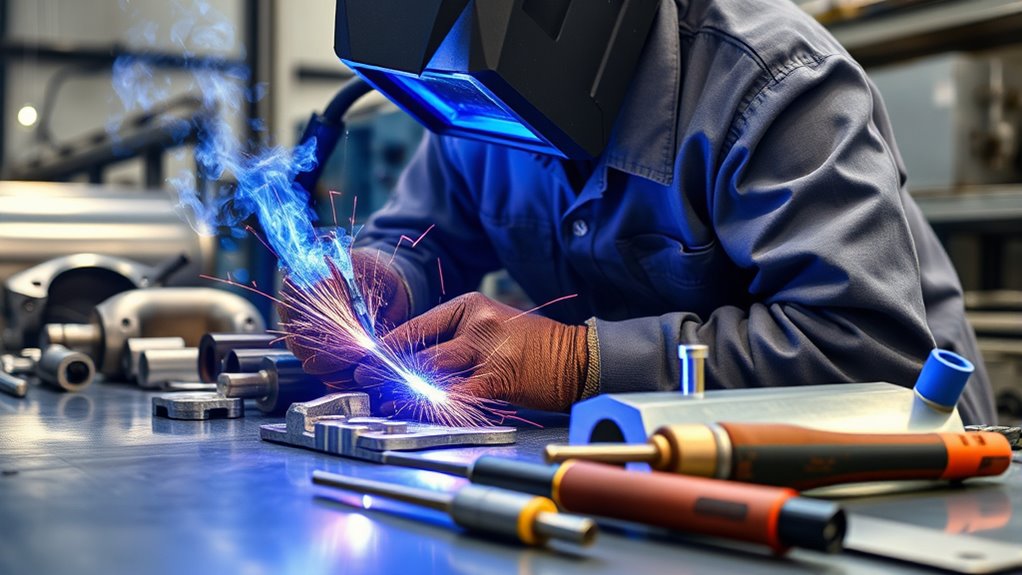
When evaluating welding methods, Plasma Arc Welding (PAW) stands out for its precision and deep penetration capabilities, especially with high-strength materials like titanium and Inconel. Plasma welding advantages include a narrower heat-affected zone and deeper penetration at lower currents compared to TIG welding, leading to less distortion and cleaner welds on thin materials. In plasma welding applications, this method is ideal for intricate and high-stakes projects where precision is critical.
| Method | Advantages Over PAW |
|---|---|
| TIG Welding | Broader heat-affected zone |
| MIG Welding | Faster for thicker metals |
| Laser Welding | Higher cost and limited on reflective materials |
Unlike MIG welding, which excels in efficiency for thicker metals, PAW provides the control needed for fine detailing. Laser welding offers precision but at a higher cost and struggles with reflective materials, making PAW a more versatile choice. With its automation compatibility, PAW guarantees consistent quality, further enhancing its appeal over traditional methods.
Automation in Plasma Welding Applications
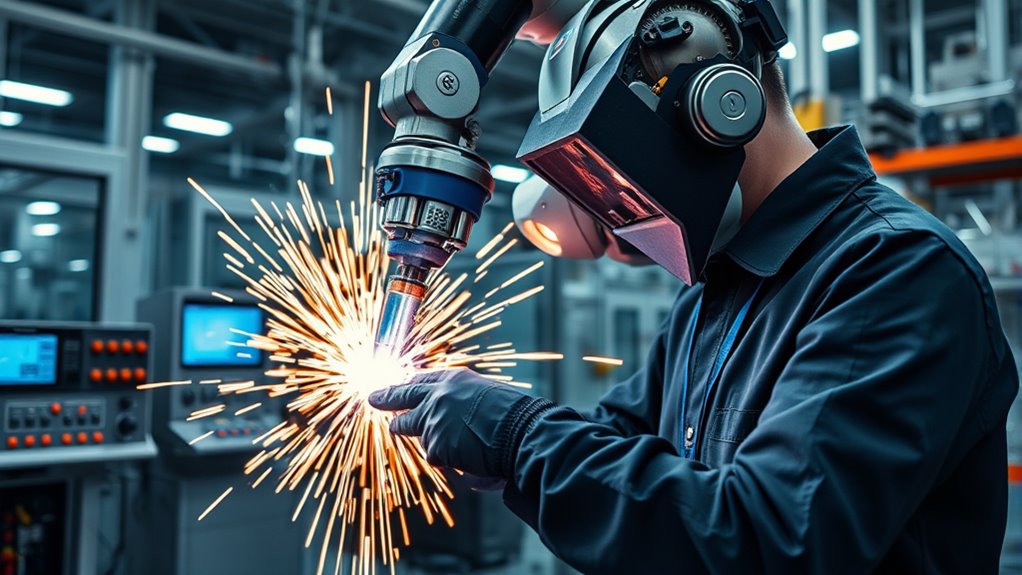
Plasma arc welding (PAW) excels in automation, offering precision and consistency that are vital for high-volume production environments like aerospace and medical device manufacturing.
The automation benefits of PAW are evident with its minimal defect rates and enhanced efficiency. Robotic integration, using systems such as the Fanuc ARC Mate 120i and Motoman EA1400, guarantees high-quality welds by performing tasks effectively and consistently.
Consider how automated plasma welding impacts operations:
- Increased Efficiency: Robotic systems work tirelessly, boosting productivity without compromising quality.
- Enhanced Safety: Collaborative robots (cobots) create safer workspaces by allowing real-time adjustments.
- Reduced Costs: CNC technology minimizes setup times and heat control, cutting operational expenses.
- Consistent Quality: Automation guarantees uniform welds, vital for sectors demanding high precision.
Future Trends in Plasma Arc Welding

As the plasma arc welding industry evolves, emerging trends are reshaping its landscape with cutting-edge advancements. Sustainability practices are at the forefront, driven by the integration of smarter systems using AI, enhancing process optimization and quality control. Emerging technologies like hybrid setups combine plasma welding with other methods, increasing versatility and efficiency in manufacturing. As collaborative robots (cobots) become more prevalent, they improve safety and efficiency in shared workspaces. The plasma welding market’s projected growth to $2.1 billion by 2032 underscores its expanding role across industries.
| Trend | Impact | Industry Application |
|---|---|---|
| AI Integration | Process optimization, quality control | Automotive, Aerospace |
| Hybrid Welding Setups | Versatility, efficiency | Manufacturing, Electronics |
| Collaborative Robots | Safety, efficiency | General Manufacturing |
| Advances in Plasma Tech | Exotic materials capability | High-Precision Industries |
| Sustainable Practices | Environmental impact | All Industries |
These trends guarantee plasma arc welding remains pivotal in high-precision and high-volume industries.
Frequently Asked Questions
What Safety Precautions Are Necessary for Plasma Arc Welding?
Wear proper protective gear to guarantee plasma safety, including a welding helmet, gloves, and fire-resistant clothing. Be aware of welding hazards like UV radiation and fumes. Guarantee adequate ventilation and follow strict operational protocols to prevent accidents.
How Does Plasma Arc Welding Affect Material Microstructure?
Plasma arc welding’s thermal effects can cause microstructure changes, influencing grain size and phase distribution. You should monitor heat input carefully to minimize undesirable transformations, ensuring that the final properties meet your specific material and application requirements.
Can Plasma Arc Welding Be Used Underwater?
Sure, just toss your high-voltage equipment into the ocean and see what sparks fly! In reality, plasma arc welding isn’t ideal for underwater applications. Specialized welding techniques like underwater shielded metal arc welding are better suited for such environments.
What Is the Typical Lifespan of Plasma Welding Equipment?
You can expect plasma welding equipment to last between 5-10 years. Longevity depends on plasma equipment maintenance and operating conditions. Regular servicing and proper usage greatly influence overall lifespan, ensuring ideal performance and reducing unexpected breakdowns.
How Does Plasma Arc Welding Differ From Laser Welding in Detail?
Plasma arc welding offers 25% deeper penetration than laser welding, enhancing your precision with thicker materials. It excels in plasma applications due to its flexibility, offering welding advantages like lower distortion and better control over heat input.
Conclusion
In the world of welding, Plasma Arc Welding (PAW) stands as a beacon of precision and strength. You’ll find it weaving its magic in industries like aerospace and medical device manufacturing, where exactitude is paramount. PAW dances gracefully with materials like titanium and nickel alloys, ensuring minimal distortion and robust bonds. As automation and innovation continue to advance, PAW’s role will only grow, etching its significance deeper into the fabric of modern manufacturing.