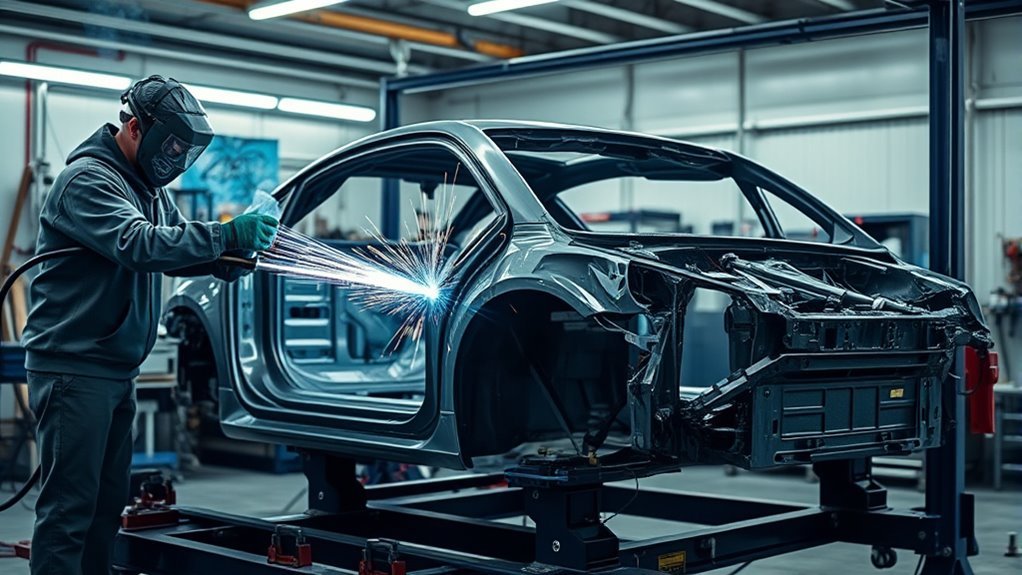
Structural welding in automotive repair joins load-bearing parts of a vehicle body or frame so the repaired structure can handle road loads and collision forces as designed. This work can involve frame rails, rocker panels, pillars, floor crossmembers, apron assemblies, brackets, and reinforced body panels. Because these parts affect crash protection, the repair must follow the vehicle maker’s procedure, use the approved joining method, and be checked before the vehicle returns to service.
Quick Answer
Structural welding in automotive repair is the controlled joining of load-bearing vehicle parts to restore strength, alignment, and crash performance. It is not the same as cosmetic panel repair. A proper repair follows OEM procedures, uses the specified welding or joining method, and includes inspection, corrosion protection, and documentation.
Key Takeaways
- Structural welding affects crash safety, alignment, and how impact loads move through the vehicle body.
- The OEM repair procedure controls the weld location, sectioning point, filler material, heat limits, and corrosion protection steps.
- Modern auto repair may use resistance spot welding, MIG plug welds, MIG brazing, TIG welding, adhesives, rivets, or a specified combination.
- High-strength steel, ultra-high-strength steel, aluminum, and mixed-material bodies need different repair methods.
- A qualified shop should provide measurements, weld-test proof, repair photos, scan reports, and written documentation.
Warning: Structural welding is not a casual DIY repair. It can affect airbag timing, crash-energy management, wheel alignment, corrosion resistance, and insurance approval. Use a trained collision repair technician with the correct OEM repair information, welding equipment, PPE, ventilation, and fire-prevention controls.
What Is Structural Welding in Automotive Repair?
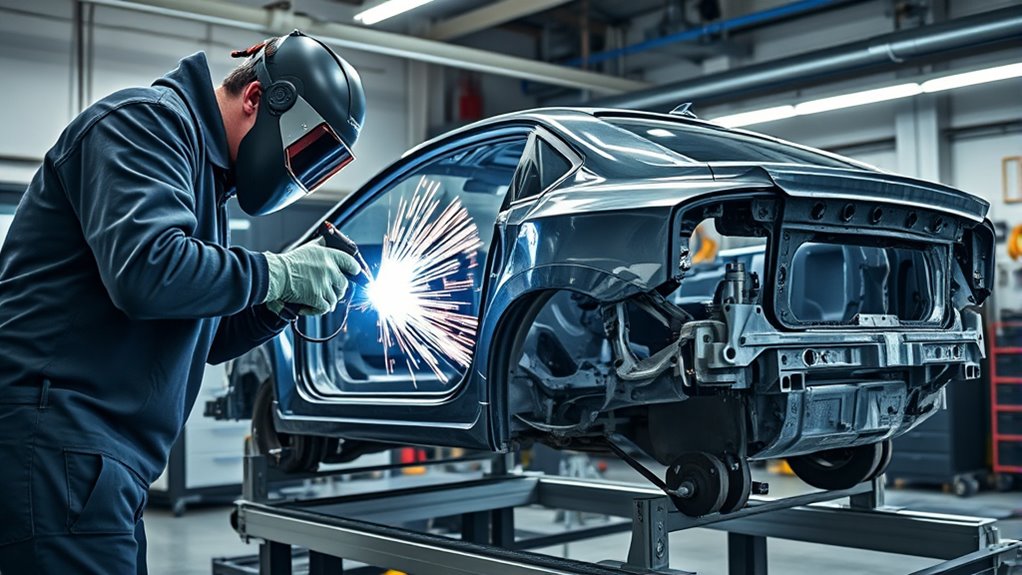
Structural welding in automotive repair is the process of joining metal parts that carry load, control alignment, or protect occupants in a crash. These parts may include frame rails, pillars, rocker panels, quarter panel reinforcements, suspension mounting brackets, roof rails, floor supports, and apron assemblies.
You use it after collision damage, corrosion, poor previous repairs, or structural section replacement. The goal is not only to make the panel look right. The goal is to restore the way the vehicle shell absorbs impact, supports suspension loads, and keeps doors, glass, restraints, and panels aligned.
That is why OEM repair procedures matter. The automaker defines where a part can be sectioned, which welds or fasteners are allowed, what filler material to use, how much heat is acceptable, and which corrosion-protection steps are required. Understanding flux core welding can help with general metalworking knowledge, but it does not replace the vehicle-specific procedure.
A structural weld is successful only when the joint, heat input, material, location, and protection steps match the repair procedure.
After welding, the shop should inspect weld shape, penetration, fit-up, and panel alignment. It should also restore seam sealer, cavity wax, primer, coatings, and other corrosion barriers that were disturbed during the repair.
Why Structural Welding Matters for Vehicle Safety
Structural welding matters because modern vehicle bodies are engineered to control crash energy. A rocker panel, rail, pillar, or crossmember may look like a simple piece of metal, but it can be part of a larger load path that helps protect the passenger compartment.
If a structural weld is placed in the wrong location, overheats high-strength steel, lacks penetration, or skips corrosion protection, the repaired area may fail sooner than expected. That failure can show up as poor alignment, water leaks, tire wear, suspension movement, rust, noise, or reduced crash performance.
- Use the exact OEM weld locations, spacing, sectioning points, and joining methods.
- Identify the base metal before welding, especially high-strength steel, ultra-high-strength steel, aluminum, or coated steel.
- Make test welds on matching scrap or coupons when the procedure requires it.
- Inspect welds for cracks, porosity, undercut, burn-through, incomplete fusion, and poor fit-up.
- Restore seam sealer, primer, cavity wax, and coatings after the structural work is complete.
Good welding does more than hold two pieces together. It helps the repaired structure behave predictably under vibration, suspension loads, and impact forces.
How Structural Welding Differs From Non-Structural Repairs
Structural welding repairs parts that affect strength, alignment, and occupant protection. Non-structural repairs usually involve cosmetic panels, trim, small dents, or outer skins that do not carry the same loads.
The difference matters because structural repairs leave less room for improvisation. You must control heat input, weld size, weld spacing, panel fit, measuring data, and corrosion protection. Non-structural work still needs skill, but it usually does not affect crash load paths in the same way.
| Repair Type | Common Examples | Why It Matters |
| Structural welding | Rails, pillars, rockers, floor supports, aprons, brackets, crossmembers | Affects crash performance, suspension geometry, alignment, and occupant protection |
| Non-structural repair | Minor dents, outer skins, trim, cosmetic patching, small surface repairs | Mainly affects appearance, corrosion control, and panel fit rather than primary crash load paths |
In structural work, the repair should be measured before and after the job. A shop may use a frame bench, electronic measuring system, tram gauge, fixture system, or OEM dimension data to confirm that the structure is back within specification.
Which Welding Methods Are Used in Auto Repair?
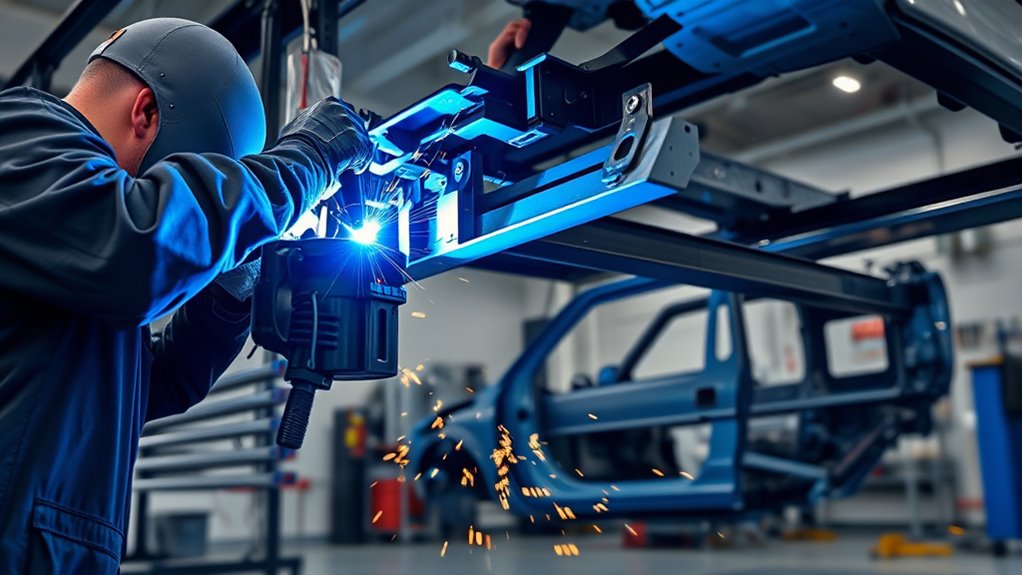
Auto repair shops use different joining methods based on the vehicle material, repair location, equipment access, and OEM procedure. The most common structural methods include resistance spot welding, MIG or GMAW welding, MIG plug welds, silicon bronze MIG brazing, and TIG welding. Some repairs also combine welding with adhesives, rivets, or mechanical fasteners.
Products Worth Considering

Professional Dent Removal: VEVOR Stud Welder Dent Puller offers a fast and efficient solution for removing dents from steel car body panels, all while providing precise dent pulling and controlled force for a professional-grade dent repair every time.

Highly Durable Design: The shell of stud welder kit is made of high-quality ABS body, has good stability under high temperature conditions, withstand temperature of 93-118℃, and the movement is pure copper electrode. This welder stud kit is wear-resistant, strong and sturdy.

Professional Dent Removal: VEVOR Stud Welder Dent Puller offers a fast and efficient solution for removing dents from car body, all while providing precise dent pulling and controlled force for a professional-grade dent repair every time.
Resistance Spot Welding and STRSW
Resistance spot welding joins overlapping sheet metal by clamping the panels between electrodes and passing current through the joint. In collision repair, a squeeze-type resistance spot welder, often called STRSW, is commonly used when the OEM procedure calls for spot welds and the tool can reach the repair area.
This method is valuable because it can reproduce many factory-style spot welds without adding filler metal. It also helps limit heat spread when the machine is set correctly. The shop still needs proper access, electrode arms, pressure, current, time settings, and test welds before welding the vehicle.
MIG/GMAW and Plug Welds
MIG welding, also called GMAW, is common in collision repair because it is fast, controlled, and suitable for many steel panel repairs. A continuous wire electrode feeds through the gun while shielding gas protects the weld pool from contamination.
For structural repair, MIG is often used for plug welds, stitch welds, or seam welds when the OEM procedure allows it. Plug welds can replace inaccessible factory spot welds in some repairs, but the hole size, spacing, weld size, and penetration must match the repair manual.
For thin panels, correct wire size, voltage, travel speed, and heat control matter. Too much heat can warp panels or weaken heat-sensitive steel. Too little heat can cause poor fusion and weak joints.
MIG Brazing for Coated and High-Strength Steel
MIG brazing uses a lower-melting filler, often silicon bronze, to join certain coated steels without melting as much of the base metal. This can help protect zinc coatings and reduce heat damage when the OEM procedure calls for it.
Do not treat MIG brazing as a stronger version of MIG welding. It is a different joining process with different joint design, heat input, and filler behavior. It must be used only where the vehicle maker approves it. If the repair involves galvanized or coated steel, review the procedure and the safety requirements before welding. This is also where knowledge of welding challenges such as fumes, porosity, and coating burn-off becomes important.
TIG for Precision Work
TIG welding gives the technician fine control over heat and filler metal. It can be useful on aluminum parts, stainless components, custom fabrication, thin brackets, and areas where clean bead control matters.
TIG is slower than MIG and requires a highly skilled operator. For structural collision repair, it should be used only when the OEM procedure allows it or when the work is an engineered fabrication repair outside normal collision-repair procedure.
Stick Welding Is Rare in Modern Unibody Repair
Stick welding, or SMAW, can be useful for heavy steel fabrication, trailers, older frame sections, agricultural equipment, and some field repairs. It is not the normal choice for modern unibody structural collision repair because it adds more heat, is harder to control on thin automotive sheet metal, and may not match OEM requirements.
If a repair involves heavy steel outside a standard collision repair path, the technician still needs a written procedure, proper electrode selection, fit-up control, and inspection. Learning stick welding stainless steel can build general process knowledge, but it should not be used as a substitute for a vehicle-specific structural repair method.
Flux-Core Welding in Auto Repair
Flux-core welding can help in outdoor fabrication or repair situations where shielding gas is difficult to protect. In structural collision repair, however, it is not a default replacement for MIG, resistance spot welding, or MIG brazing. Use flux core welding only when the repair procedure, material, and quality requirements support it.
Note: The best welding method is not the one a shop prefers. It is the one specified for that exact vehicle, part, material, and repair location.
Which Materials Change the Structural Repair Plan?
Modern vehicles use many metals in one body structure. A repair that works on mild steel may be unsafe on ultra-high-strength steel or aluminum. Before welding, the shop should identify the material and confirm whether it can be welded, brazed, sectioned, bonded, riveted, or must be replaced as an assembly.
Mild Steel
Mild steel is generally the most forgiving automotive repair material. It can often be MIG welded or spot welded when the OEM procedure allows it. Even then, weld location, fit-up, and corrosion protection still matter.
High-Strength and Ultra-High-Strength Steel
High-strength steel and ultra-high-strength steel help vehicles stay lighter while improving crash performance. These steels can be sensitive to heat. Welding in the wrong place or using too much heat can reduce strength and change how the part performs in a crash.
Some UHSS parts are not sectioned or welded except at factory-approved locations. Others may require spot welding, MIG brazing, adhesive bonding, or complete replacement. Always follow the OEM repair path.
Aluminum
Aluminum needs different preparation, filler selection, equipment, and contamination control than steel. A shop that repairs aluminum structures should have aluminum-dedicated tools, clean work practices, and technicians trained for aluminum welding or bonding.
Galvanized, Coated, and Mixed-Material Structures
Coated steel may release hazardous fumes when heated, and burning away protective coatings can create corrosion problems later. Mixed-material bodies may combine steel, aluminum, adhesives, rivets, and fasteners. That means the repair may require joining methods beyond welding alone.
Before work begins, the shop should review the material map, repair manual, and corrosion-protection steps. It should also protect nearby modules, wiring, trim, glass, fuel lines, batteries, and interior materials from heat and sparks.
What OEM Standards Apply to Structural Welding?
You need to follow each OEM structural repair rule before you weld, because the manufacturer’s procedure defines the approved process, joint design, sectioning location, filler material, corrosion protection, and inspection requirements.
No single welding code replaces the OEM repair manual for collision repair. AWS, ASE, I-CAR, or equivalent qualifications can help prove technician skill, but the vehicle maker’s procedure still controls the repair when it gives a specific instruction.
For general welding safety, OSHA requires safe arc-welding equipment selection, safe installation, and proper instruction or qualification for workers who operate arc-welding equipment. OSHA also covers fire prevention, eye protection, and ventilation requirements for welding, cutting, and brazing. Following welding procedures and equipment setup guidance is important, but structural work still needs the OEM repair procedure.
OEM Structural Repair Rules
- Confirm the exact year, make, model, body style, and production notes before looking up the repair procedure.
- Identify whether the part is mild steel, HSS, UHSS, aluminum, coated steel, or a mixed-material assembly.
- Use the specified welding, brazing, bonding, riveting, or replacement method.
- Follow approved weld locations, weld spacing, sectioning points, and heat limits.
- Perform test welds and destructive tests when required before welding the vehicle.
- Restore corrosion protection, seam sealer, cavity wax, foam, coatings, and refinishing systems.
- Document the repair with photos, procedures, measurements, invoices, scan reports, and calibration records.
When you respect these rules, you keep the repair aligned with factory intent and reduce the risk of hidden weakness.
Certification and Inspection Standards
Certification shows that a technician or shop has been tested or trained in a specific skill area. For structural welding, look for training that matches the vehicle and process being used. This may include OEM training, I-CAR welding qualification, ASE collision credentials, AWS welding credentials, or equivalent documented training.
The shop should also prove that its welding equipment is maintained and set up correctly. A qualified technician should be able to show test welds, explain the weld type, and document why that method was used.
Inspection starts with visual checks for weld size, bead shape, cracks, porosity, undercut, burn-through, distortion, and incomplete fusion. Depending on the repair, a shop may also use destructive coupon tests, peel tests, bend tests, ultrasonic inspection, dye penetrant, or other non-destructive testing methods.
What Does a Proper Structural Repair Workflow Look Like?
A professional structural repair should follow a controlled workflow instead of jumping straight to welding. The order matters because welding a misaligned structure can lock the damage into the vehicle.
- Initial inspection: Identify visible damage, hidden damage, corrosion, prior repairs, and affected safety systems.
- Pre-repair scan: Check electronic fault codes when required, especially after a collision.
- Measure the structure: Use OEM dimensions, a frame bench, electronic measuring system, or other approved measuring method.
- Research the OEM procedure: Confirm sectioning points, joining methods, corrosion steps, and parts replacement rules.
- Prepare the joint: Remove coatings only where needed, clean the metal, fit panels tightly, and protect nearby components.
- Set up and test equipment: Match wire, gas, electrodes, current, and settings to the procedure. Make test welds when required.
- Perform the repair: Clamp panels, control heat, and complete welds in the approved sequence.
- Inspect the welds: Check weld size, penetration, fit-up, distortion, and defects before closing panels.
- Restore corrosion protection: Apply primer, seam sealer, cavity wax, coatings, and refinishing materials as required.
- Post-repair checks: Re-measure, scan, align, and calibrate driver-assistance systems when required.
Pro Tip: Ask the shop for repair photos before the panels are closed. Good documentation should show the damaged area, OEM procedure reference, test welds, weld locations, corrosion protection, and final measurements.
What Are Signs of a Good or Bad Structural Weld?
A good structural weld should match the approved repair procedure and show clean fit-up, correct weld size, controlled heat, and complete fusion. It should not be judged only by appearance, but visual inspection can reveal many problems.
Warning signs of a bad weld include:
- Cracks in or beside the weld
- Porosity, pinholes, or gas pockets
- Undercut along the weld edge
- Burn-through on thin panels
- Uneven bead shape or poor plug-weld fill
- Incomplete fusion or lack of penetration
- Panel gaps, distortion, or pulled alignment
- Missing primer, seam sealer, cavity wax, or corrosion protection
- Ground-down welds with no proof of proper penetration
Some weld defects are visible, while others require destructive testing or non-destructive testing. That is why test coupons, repair documentation, and qualified inspection matter.
How to Choose a Structural Welding Shop
Choosing a structural welding shop starts with proof. A good shop should be able to show training, equipment, OEM repair information, measuring capability, and documentation habits before it starts cutting or welding.
Ask whether the shop has current access to OEM repair procedures for your exact vehicle. Ask what welding or joining methods the procedure requires and whether the shop has the tools to perform them. For many modern vehicles, that may include MIG welding, squeeze-type resistance spot welding, MIG brazing, aluminum repair tools, rivet tools, adhesive systems, and electronic measuring equipment.
- Verify technician training and relevant collision repair credentials.
- Ask whether the shop follows OEM repair procedures, not generic shortcuts.
- Confirm it has the correct welding, measuring, and corrosion-protection equipment.
- Ask for weld-test documentation and repair photos.
- Confirm the estimate includes scans, alignment, ADAS calibration, refinishing, and corrosion protection when needed.
- Review warranty terms and ask how the repair will be documented for insurance.
You deserve a shop that explains the repair path clearly. If a facility cannot show its procedure, equipment, and inspection process, choose another shop. Verifying that welders are trained and credentialed, such as through AWS Certified Welders or other recognized programs, can help you separate real competence from guesswork.
Products Worth Considering


【Even Pulling Force】 This universal auto body pull and weld clamp set helps spread pulling force across steel panels for more consistent dent and frame correction work.

Frequently Asked Questions
How long does a structural weld repair usually take?
A small weld-only operation may take a few hours, but a full structural collision repair can take several days. The total time depends on teardown, measuring, parts availability, OEM research, welding, corrosion protection, paint work, scans, alignment, and ADAS calibration.
Can all vehicle metals be structurally welded?
No. Mild steel, high-strength steel, ultra-high-strength steel, aluminum, and mixed-material assemblies all have different repair rules. Some parts may be welded, some may need MIG brazing or spot welding, and some may need bonding, riveting, or complete replacement.
Does structural welding affect insurance claims?
It can. Insurers often want repairs to follow approved procedures and may ask for documentation. Keep the estimate, OEM procedure reference, repair photos, weld-test proof, measurements, invoices, scan reports, and calibration records.
What signs show a bad structural weld?
Common signs include cracks, porosity, undercut, burn-through, poor plug-weld fill, uneven bead shape, panel distortion, missing corrosion protection, and gaps that do not match OEM fit. A weld can also be weak even if it looks smooth, so test welds and inspection matter.
Is structural welding more expensive than part replacement?
Sometimes. Structural welding can save a part when the OEM allows sectioning, but replacement may be safer or required when damage reaches certain areas or materials. The better option depends on the repair manual, damage location, labor time, parts cost, corrosion protection, and inspection requirements.
Can I do structural welding on my own car?
You should not attempt structural welding unless you have the correct training, OEM repair procedure, measuring tools, welding equipment, PPE, ventilation, fire controls, and inspection process. A poor structural repair can reduce crash protection and create hidden safety problems.
What should I ask a shop before approving structural welding?
Ask which OEM procedure applies, what joining method will be used, whether test welds are required, how the structure will be measured, how corrosion protection will be restored, and what photos or records you will receive after the repair.
Conclusion
Structural welding helps restore the strength and alignment of a vehicle after collision damage, corrosion, or structural part replacement. It differs from cosmetic repair because it affects crash performance, load paths, and occupant protection. The safest repair is the one that follows the OEM procedure, uses the correct joining method, controls heat, verifies weld quality, and restores corrosion protection. Before choosing a shop, ask for proof of training, equipment, measurements, test welds, and documentation. Your vehicle’s structure should be repaired by procedure, not by guesswork.
Sources
- OSHA 1910.252 — General requirements for welding, cutting, and brazing — supports hot-work fire prevention, PPE, ventilation, and hazard-control guidance.
- OSHA 1910.254 — Arc welding and cutting — supports safe equipment selection, installation, grounding, and operator instruction.
- Functional clustering methods for resistance spot welding process data in the automotive industry — supports resistance spot welding quality-control context in automotive production.
- Improved Training Strategies for Physics-Informed Neural Networks using Real Experimental Data in Aluminum Spot Welding — supports the importance of spot-weld nugget quality metrics in automotive body-in-white applications.