Choosing the wrong welding electrode can lead to an unstable arc, poor fusion, excess spatter, porosity, or cracking. The right choice controls more than filler metal: it also affects shielding, slag, penetration, deposition rate, and the current your machine must supply. This guide explains the main electrode types, AWS stick-rod codes, TIG tungsten colors, and a practical way to match an electrode to the metal and job.
Quick Answer
A welding electrode carries current to the arc. Consumable electrodes, including stick rods and welding wire, melt into the joint as filler metal. TIG tungsten is non-consumable and mainly carries the arc. Choose an electrode by base-metal grade, required strength, weld position, polarity, joint design, diameter, and the manufacturer’s storage rules.
Key Takeaways
- Match the electrode or filler alloy to the identified base metal and required service conditions.
- Confirm the weld position and machine output before buying a stick electrode; not every rod runs on every polarity.
- Treat AWS classifications as a screening tool, then read the manufacturer’s data sheet for exact amperage, polarity, and storage limits.
- Modern 2% lanthanated tungsten is a common all-purpose TIG choice, while color codes can vary by standard, region, manufacturer, and legacy stock.
- Keep low-hydrogen electrodes dry, but do not bake cellulosic rods such as E6010 or E6011 unless the manufacturer specifically permits it.
At a Glance
| Time Required | About 5–10 minutes to identify the metal and check the electrode data sheet |
| Difficulty | Beginner for general mild-steel work; advanced for unknown alloys, code work, or critical repairs |
| Tools Needed | Base-metal identification, thickness measurement, welder output information, joint requirements, and the electrode data sheet or approved WPS |
| Cost | Selection costs nothing; electrode price varies by alloy, diameter, package, and certification |
What’s in This Article
- What Is a Welding Electrode?
- Consumable vs. Non-Consumable Electrodes
- How Do Welding Electrode Types Work?
- Why Base Metal Matters for Electrode Choice
- How to Read Welding Electrode Codes
- What Are the Most Common Stick Welding Rods?
- What Do TIG Tungsten Color Codes Mean?
- How to Choose the Right Welding Electrode
- Common Welding Electrode Selection Mistakes
- How to Store Welding Electrodes Properly
- Frequently Asked Questions
- Conclusion
Warning: Electrode selection does not replace welding safety controls or an approved welding procedure. Use the correct helmet shade, dry insulating gloves, flame-resistant clothing, ventilation or local exhaust, and fire protection. For structural, pressure, vehicle-safety, lifting, or other critical work, follow the applicable code and a qualified welding procedure specification.
What Is a Welding Electrode?
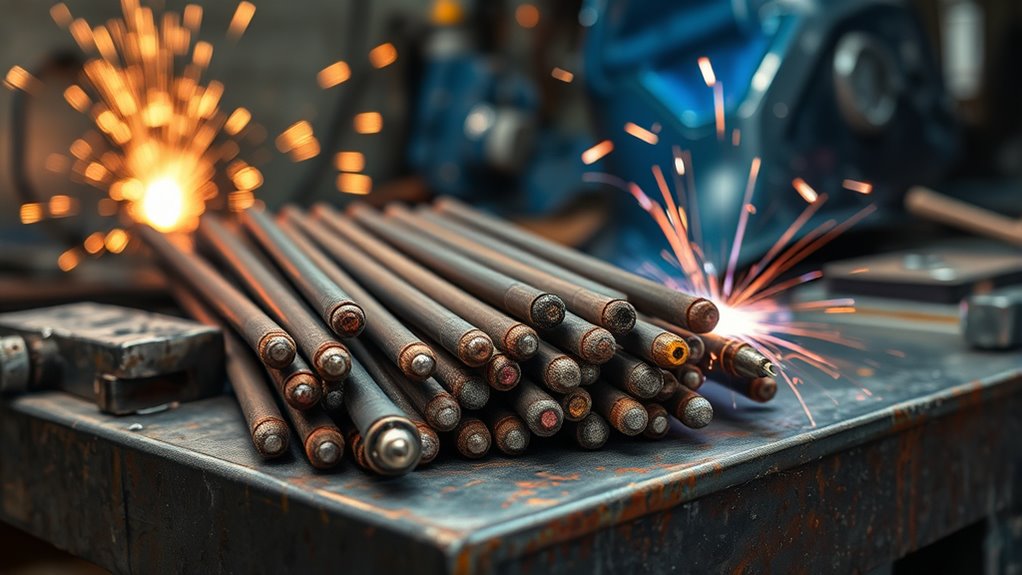
A welding electrode is a conductor that carries welding current to the arc. In many arc-welding processes, the electrode also melts and becomes filler metal in the completed joint.
The electrode’s core material, coating or flux, diameter, and classification affect arc starting, stability, penetration, shielding, slag, bead shape, deposition rate, and usable current range.
In shielded metal arc welding (SMAW), the flux-covered stick rod supplies filler metal and shielding. In gas metal arc welding (GMAW or MIG), a continuous solid or metal-cored wire feeds through the gun. In flux-cored arc welding (FCAW), a tubular wire contains flux and may be self-shielded or used with external gas. In gas tungsten arc welding (GTAW or TIG), a tungsten electrode carries the arc while filler metal is added separately when needed.
Electrode vs. Filler Rod vs. Welding Wire
These terms are related but are not interchangeable:
- Electrode: Carries current to the arc. It may be consumable or non-consumable.
- Filler rod: Adds metal but does not carry welding current, as in manual TIG welding.
- Welding wire: A continuous consumable electrode used in MIG, flux-cored, metal-cored, and submerged arc welding.
- Stick rod: A common shop term for a covered SMAW electrode.
| Process | Electrode | Consumable? | Shielding |
|---|---|---|---|
| SMAW / stick | Flux-covered rod | Yes | Flux creates gas and slag |
| GMAW / MIG | Continuous solid or metal-cored wire | Yes | External shielding gas |
| FCAW | Tubular flux-cored wire | Yes | Self-shielding flux or flux plus external gas |
| GTAW / TIG | Tungsten | No during normal use | External inert gas |
| SAW | Continuous wire | Yes | Granular flux covers the arc |
Consumable vs. Non-Consumable Electrodes
The main difference between welding electrode types is whether the electrode melts into the joint.
Consumable electrodes include SMAW rods, MIG wire, metal-cored wire, flux-cored wire, and submerged arc wire. They carry current and deposit metal. This supports fast deposition and high productivity, but the wire or rod chemistry must be compatible with the base metal.
Non-consumable electrodes are mainly tungsten electrodes used for TIG and plasma arc welding. They carry the arc but should not become part of the weld. A separate filler rod can be fed independently when the joint requires added metal.
This separation gives TIG welding close control over heat and filler addition, which is useful on thin metal, stainless steel, aluminum, and other non-ferrous alloys. Consumable wire processes are usually faster for production work. For more detail on tubular wire, see this guide to flux-cored welding wire types and uses.
How Do Welding Electrode Types Work?
Each electrode controls the electrical arc and weld pool differently. The choice changes penetration, puddle fluidity, freezing rate, bead profile, cleanup, and how easily the joint can be welded out of position.
Consumable Electrode Action
In a consumable process, arc heat melts the electrode and the edges of the joint. Molten electrode metal crosses the arc and becomes deposited weld metal. Current, voltage or arc length, travel speed, work angle, electrode angle, and wire-feed speed control the result.
In stick welding, the covering breaks down to form shielding gas and protective slag. The coating can also contain arc stabilizers, deoxidizers, alloying elements, and iron powder. That is why two rods with similar tensile-strength numbers can run very differently.
Non-Consumable Electrode Role
In TIG welding, the tungsten electrode carries current and holds a concentrated arc. It does not normally supply filler metal. A separate filler rod is added only when the joint requires it.
Tungsten type, diameter, tip shape, polarity, and current affect arc starting and stability. If the tungsten touches the puddle or filler rod, it can become contaminated and cause an erratic arc. Stop, remove the contaminated section, and regrind the electrode correctly before continuing.
Note: MIG wire and flux-cored wire are electrodes because they carry current. A manual TIG filler rod supplies metal, but it is not the electrode.
Why Base Metal Matters for Electrode Choice
The base metal sets the first limits on electrode choice. The filler must provide suitable chemistry, strength, ductility, corrosion resistance, and service performance after it mixes with the parent metal.
Before selecting a rod or wire, identify the alloy, thickness, surface coating, joint design, loading, operating temperature, and whether a code or approved procedure applies. Unknown, hardened, or heat-treated steel can crack even when the finished bead looks acceptable.
Matching Filler to Metal
| Base metal | Common filler approach | Important check |
|---|---|---|
| Mild carbon steel | E60- or E70-series stick rods, ER70S-series solid wire, or a suitable carbon-steel flux-cored wire | Strength, position, polarity, penetration, and code requirements |
| High-strength or low-alloy steel | A matching low-alloy filler selected from the procedure or engineering specification | Hydrogen control, preheat, heat input, toughness, and service temperature |
| 304-series stainless | 308L-type filler is common when permitted | Exact stainless grade, corrosion service, shielding, and heat input |
| 316-series stainless | 316L-type filler is commonly used | Molybdenum content and corrosion environment |
| Stainless to carbon steel | 309L-type filler is a common starting point | Dilution, cracking risk, service temperature, and procedure approval |
| Aluminum | Select aluminum filler by the exact alloy and required properties | Base-alloy series, crack sensitivity, strength, color match, and anodizing |
| Cast iron | Nickel, nickel-iron, or another repair filler chosen for the casting and repair method | Cast-iron type, contamination, restraint, preheat strategy, and cooling rate |
A filler that is stronger on paper is not automatically better. Excessive strength overmatching can reduce ductility or create an unsuitable hardness profile. The goal is compatibility with the design and service conditions, not the largest tensile-strength number.
Material Properties and Strength
Check carbon content, alloy content, thickness, surface condition, joint restraint, and expected load. Thick, highly restrained, hardenable, or high-strength steels may need low-hydrogen filler, preheat, controlled interpass temperature, and a written procedure.
For general carbon-steel work, E6010 and E6011 provide a digging arc and fast-freezing puddle. E7018 provides a smoother low-hydrogen deposit with a minimum tensile strength of 70,000 psi under its classification. That does not make E7018 correct for every steel, root pass, or repair.
For stainless steel, match the filler to the grade and service environment. For example, 308L is commonly used for 304-series stainless, 316L for 316-series stainless, and 309L for many approved stainless-to-carbon-steel joints. Confirm the selection with the welding procedure or a current filler-metal chart.
Warning: Galvanized coatings produce zinc-containing fume when heated. Remove the coating from the weld area when the procedure allows, use effective local exhaust or ventilation, and keep your head out of the plume. Respiratory protection may be required when engineering and work-practice controls cannot adequately control exposure. Never weld in a confined space without the required ventilation, monitoring, rescue, and respiratory controls.
For job-specific considerations, review this guide to welding rods for galvanized steel together with the consumable manufacturer’s safety data sheet and your workplace procedure.
How to Read Welding Electrode Codes
The American Welding Society classification system provides a compact summary of electrode performance. The current carbon-steel covered-electrode specification is AWS A5.1/A5.1M:2025. Other metals and welding processes use different AWS specifications and code patterns.
For a common carbon-steel stick classification such as E7018:
| Part | Meaning | E7018 example |
|---|---|---|
| E | Electrode | A covered SMAW electrode |
| 70 | Minimum tensile strength of deposited weld metal in thousands of psi | 70,000 psi minimum |
| 1 | Welding-position designation | All-position classification; follow product and procedure limits |
| 8 | Covering and current-characteristic family | Low-hydrogen, iron-powder family; exact current compatibility comes from the product data sheet |
A position digit of 1 generally indicates all-position use. A 2 generally limits the electrode to flat groove welds and flat or horizontal fillet welds. Do not assume “all position” means every direction is equally suitable. E7018 is normally run vertical-up for out-of-position structural work, and many product data sheets do not permit vertical-down use.
Common suffixes add useful information:
- H4 or H8: A diffusible-hydrogen designator. The number identifies the maximum milliliters of diffusible hydrogen per 100 grams of deposited weld metal under the classification test.
- R: A moisture-resistant covering designation under the applicable AWS test.
- -1: Identifies additional impact-toughness requirements for certain classifications. Confirm the exact requirement in the current standard and product data sheet.
Note: An AWS number does not provide a complete welding procedure. It does not replace the manufacturer’s amperage range, polarity guidance, storage instructions, or an approved WPS.
What Are the Most Common Stick Welding Rods?
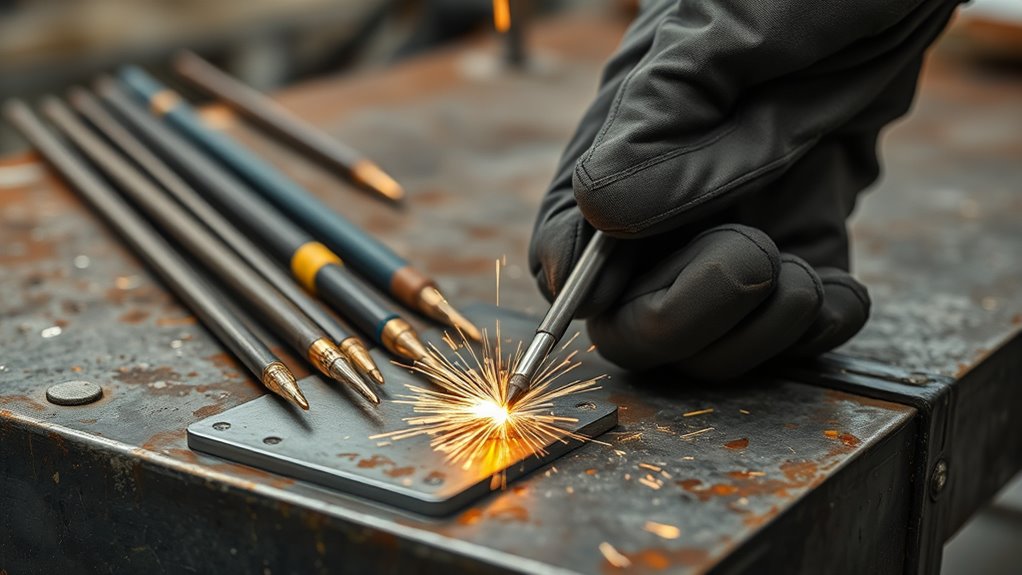
Common mild-steel stick rods include E6010, E6011, E6012, E6013, E7014, E7018, and E7024. Each has a different arc, penetration profile, puddle behavior, current requirement, and storage need.
| Rod | Arc and penetration | Typical current | Position | Common uses and limits |
|---|---|---|---|---|
| E6010 | Forceful digging arc, deep penetration, and a fast-freezing puddle | DCEP for standard E6010 products | All positions | Pipe roots, open roots, and repair work; harder for beginners and not accepted by every inverter |
| E6011 | Digging arc, deep penetration, and a fast-freezing puddle | AC or DC depending on the product | All positions | Repairs and machines limited to AC; still requires proper surface preparation |
| E6012 | Mild arc, shallow penetration, and good gap bridging | AC or DC depending on the product | All-position classification; often easiest flat or horizontal | Fillets, sheet, and poor fit-up where deep penetration is not required |
| E6013 | Soft, smooth arc with light-to-moderate penetration | AC or DC depending on the product | All positions | Clean thin steel, light fabrication, and beginner practice; poor joint preparation can cause lack of fusion |
| E7014 | Smooth iron-powder arc with moderate penetration and higher deposition | AC or DC depending on the product | All positions, with product and diameter limits | General fabrication and larger fillets where added deposition is useful |
| E7018 | Smooth low-hydrogen arc with moderate penetration | DCEP or AC depending on the exact product | All positions; vertical-up is typical | Structural and restrained joints when specified; requires moisture control and proper technique |
| E7024 | Smooth arc, shallow penetration, and very high deposition | AC or DC depending on the product | Flat and horizontal | Large fillets and production welding; not for vertical or overhead work |
Products Worth Considering

【 AWS-COMPLIANT E7018 LOW-HYDROGEN ELECTRODES 】: Metal Marlin H4R provides premium quality, low-hydrogen, arc welding carbon steel stick electrodes that ensure strong, reliable welds for all projects, ensuring strong and reliable welds with low hydrogen content, conforming to AWS A5.1 E7018 and ASME SFA-5.1 E7018 requirements.

MODEL: E7018 is a low-hydrogen iron powder type electrode that produces high quality x-ray welds. It can be used in all positions on AC or DC reverse polarity welding current.

MODEL: E7018 is a low-hydrogen iron powder type electrode that produces high quality x-ray welds. It can be used in all positions on AC or DC reverse polarity welding current.
E6010 to E7018: A Practical Choice
- Choose E6010 for a forceful DC arc, open roots, and deep penetration when the machine can run it.
- Choose E6011 when similar digging action is needed from an AC-capable rod.
- Choose E6012 for gap bridging and fillets where deep penetration is not the goal.
- Choose E6013 for clean, thin steel and a smooth, easier-to-control arc.
- Choose E7014 for higher deposition in general fabrication when its puddle suits the position.
- Choose E7018 when the procedure calls for a low-hydrogen, 70-ksi-class deposit.
- Choose E7024 for fast flat or horizontal deposition on suitable joints.
Uses, Strengths, and Limits
E6010 and E6011 tolerate mill scale and light surface contamination better than many smooth-running rods, but they do not make cleaning optional. Remove oil, paint, plating, moisture, and heavy rust whenever possible, especially for code or critical work.
E7018 is common in structural fabrication because of its low-hydrogen characteristics and mechanical properties. It is not a universal repair rod. Unknown steels, castings, high-carbon parts, and hard-facing jobs may require a different filler and heat-control plan.
E7024 deposits metal quickly, but its large fluid puddle and position limits make it a poor choice for vertical or overhead welding.
For manufacturer-backed descriptions of common rods, see Miller’s guide to stick-welding electrodes.
What Do TIG Tungsten Color Codes Mean?
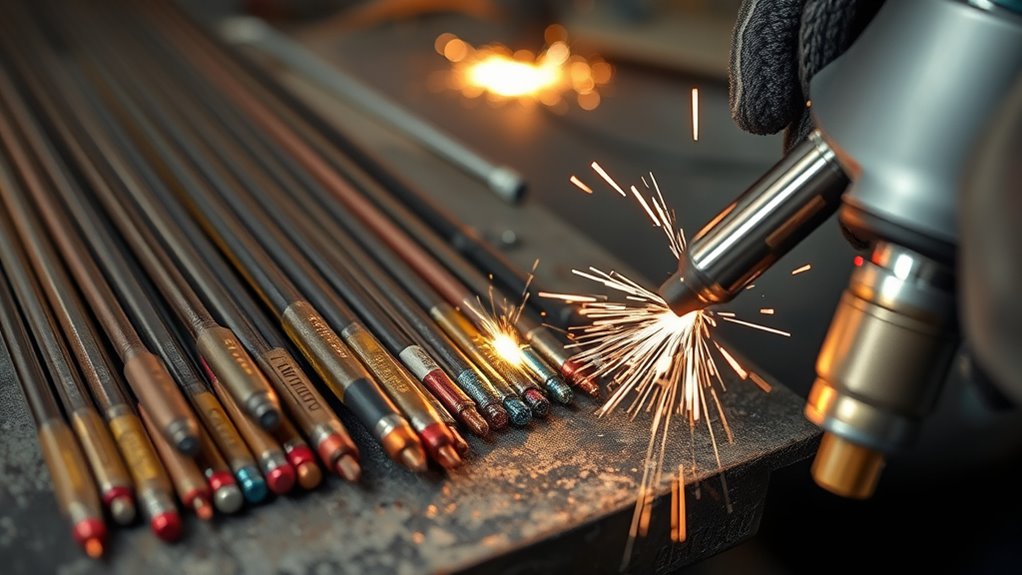
TIG tungsten color bands identify the electrode’s composition. The alloy affects arc starting, current capacity, tip life, burn-off, and AC or DC performance.
Color systems have changed over time and can differ by region, manufacturer, or standard. Read the package, etched marking, or manufacturer data sheet instead of relying on color alone.
| Common color | Typical composition | Typical use | Key point |
|---|---|---|---|
| Green | Pure tungsten | Legacy transformer AC on aluminum or magnesium | Modern inverter machines often perform better with alloyed tungsten |
| Red | About 2% thoriated | Traditionally DC TIG on steel, stainless, and nickel alloys | Contains radioactive thorium; non-radioactive alternatives are widely available |
| Blue | 2% lanthanated in a common current North American system | General AC and DC TIG | A common all-purpose choice for modern equipment |
| Gold | Often 1.5% lanthanated | AC and DC TIG | Provides strong starts and stable performance across a broad range |
| Gray | Often 2% ceriated in current North American markings | Low- and medium-current AC or DC work | Some legacy or regional systems use orange for ceriated tungsten |
| White | Zirconiated in a common current North American system | AC welding of aluminum and magnesium | Other systems may mark zirconium-bearing tungsten brown |
| Other or legacy colors | May identify rare-earth blends, 1% lanthanated, or another zirconium or cerium level | Application dependent | Brown, black, orange, chartreuse, purple, and other bands are unsafe to decode without the package or data sheet |
For many modern TIG machines, 2% lanthanated tungsten is a practical starting point for both AC and DC work—but the machine manual and tungsten manufacturer remain the final authority.
Warning: Thoriated tungsten contains radioactive material. Avoid creating or spreading grinding dust, use dedicated dust-controlled preparation equipment and local exhaust, and follow the manufacturer’s handling and disposal guidance. Consider a non-thoriated tungsten when it meets the application.
For current selection information, see Miller’s TIG tungsten types and selection guide.
How to Choose the Right Welding Electrode
Use the following order. It prevents a smooth-running rod from distracting you from a poor material or procedure match.
- Identify the base metal. Confirm the grade when possible. Do not guess on safety-critical, hardened, heat-treated, or unknown parts.
- Check the governing requirement. Read the drawing, repair manual, code, approved WPS, or engineering instruction before selecting filler.
- Match chemistry and strength. Choose filler that provides the required compatibility, toughness, ductility, and corrosion resistance after dilution.
- Match the welding position. Confirm flat, horizontal, vertical-up, vertical-down, and overhead limits on the data sheet.
- Match the power source and polarity. Check AC, DCEP, or DCEN requirements and make sure the welder has enough open-circuit voltage for the rod.
- Match penetration to the joint. Open roots and tight joints may need a digging arc; thin sheet and wide root openings may need a softer, lower-heat approach.
- Choose diameter and amperage. Smaller electrodes suit lower current, thinner material, and out-of-position control. Larger electrodes need more current and increase deposition.
- Confirm storage and exposure limits. Low-hydrogen rods, flux-cored wire, aluminum wire, and specialty consumables have different moisture and cleanliness requirements.
Products Worth Considering

BLUE-2% LANTHANATED: Lanthanated electrodes are popular due to the relative ease of striking an arc and lower amperage required. They perform exceptionally well in both AC and DC applications.

RED TIP: The red band tungsten electrode is a traditional outstanding welding electrode, whose arc is continuous, stable, without spreading and dispersing. As it is not easy to get a round top with thermostability, it performs well in a lifetime.

RED TIP: The red band tungsten electrode is a traditional outstanding welding electrode, whose arc is continuous, stable, without spreading and dispersing. As it is not easy to get a round top with thermostability, it performs well in a lifetime.
Choose Electrode Diameter and Amperage
Electrode diameter does not map to one universal amperage. The usable range changes with classification, brand, position, polarity, and joint design. Start with the package or manufacturer’s data sheet, then make small adjustments while watching the arc and bead.
A smaller stick electrode is normally easier to control on thin metal and in vertical or overhead positions. A larger rod raises deposition but also demands more current, greater heat input, and sufficient joint access. Some inverter welders cannot maintain the arc characteristics required by certain E6010 products even when their maximum amperage appears adequate.
| What you observe | Possible cause | Safe next check |
|---|---|---|
| Rod sticks, the arc repeatedly goes out, or the bead sits high | Low current, incorrect arc length, wrong polarity, damp rod, low OCV, or poor work connection | Verify polarity and the listed current range; inspect the leads, work clamp, machine capability, and rod condition |
| Excess spatter, undercut, an overheated electrode, or a very wide flat bead | High current, long arc, wrong polarity, or slow travel | Return to the manufacturer’s range, shorten the arc, and correct travel speed |
| Burn-through on thin steel | Excess heat, oversized electrode, slow travel, or poor fit-up | Use a smaller electrode or lower-heat process and improve fit-up |
| Slag trapped at the toes or between passes | Wrong angle, low heat, poor bead placement, oversized electrode, or incomplete cleaning | Remove all slag, correct technique, and verify that the rod suits the joint and position |
| Porosity or worm tracks | Moisture, contamination, damaged coating, excessive arc length, or shielding problems | Stop and identify the source; do not simply weld over the defect |
For mild-steel stick work, this stick-welding amperage guide for metal thickness can help establish a starting point, but the electrode manufacturer’s range should control.
Pro Tip: Keep the electrode package or a clear photo of its label near the machine. It provides the classification, diameter, lot information, polarity, amperage range, and storage instructions without relying on memory.
Common Welding Electrode Selection Mistakes
- Choosing by rod number alone: The classification narrows the options, but the manufacturer’s data sheet and WPS establish the working limits.
- Ignoring the exact base-metal grade: Carbon steel, high-strength steel, stainless, aluminum, and cast iron require different filler strategies.
- Using stainless filler as a universal repair rod: Dissimilar filler can be correct in a qualified procedure, but casual substitution can harm strength, ductility, or corrosion performance.
- Ignoring polarity: E6010 usually needs DCEP, while E6011 is commonly selected when AC capability is required.
- Ignoring position limits: E7024 is a flat and horizontal electrode even though it deposits metal quickly.
- Assuming a rod that tolerates rust can weld through anything: Oil, paint, plating, moisture, and heavy corrosion still create fume and weld-quality risks.
- Using damp low-hydrogen rods: Moisture can raise porosity and hydrogen-cracking risk in susceptible steels.
- Baking every damp rod: Cellulosic electrodes and low-hydrogen electrodes do not use the same storage or redrying procedure.
- Trusting bead appearance alone: A smooth bead can still contain incomplete fusion, slag, porosity, or cracking.
Understanding basic electrode numbering and welding technique helps, but a qualified procedure and inspection requirements take priority on critical work.
How to Store Welding Electrodes Properly
Proper storage begins with classification-specific moisture control. Water in a damaged or moisture-sensitive covering can cause unstable operation, porosity, excess hydrogen, or cracking in susceptible steel.
| Electrode group | General storage approach | Important caution |
|---|---|---|
| E6010 and E6011 cellulosic rods | Keep dry at normal protected storage conditions in the original package | Do not store or bake them like E7018 unless the manufacturer specifically permits it |
| E6012, E6013, E7014, and E7024 | Protect from humidity, condensation, damaged packaging, oil, and dirt | Redrying instructions vary; follow the product data sheet |
| E7018 and other low-hydrogen electrodes | Keep unopened packages sealed; after opening, use approved heated holding when required by the product, WPS, or code | Exposure limits and holding temperatures are product- and job-specific |
| Stainless, nickel, cast-iron, and specialty rods | Use the manufacturer’s storage method and keep alloys separated and identified | Do not assume carbon-steel rod-oven rules apply |
Store electrodes off the floor in a clean, dry area. Keep packages labeled by classification, diameter, manufacturer, and lot when traceability matters. Inspect rods for rust, oil, water staining, broken flux, or mixed identification before use.
Only redry electrodes when the manufacturer permits it and supplies a time-and-temperature schedule. Repeated or excessive heating can damage the coating. A household oven is not suitable because its temperature control, contamination, and safety characteristics are not designed for welding consumables.
Warning: Do not guess whether an exposed low-hydrogen electrode can be restored. For code or critical work, follow the approved WPS, consumable control procedure, and manufacturer’s exposure and redrying limits. Discard material whose identity or exposure history cannot be verified when the job requires controlled consumables.
Pro Tip: Mark opened containers with the classification, diameter, opening time, and return-to-oven time. This prevents mixed rods and makes exposure tracking easier.
See Lincoln Electric’s electrode storage and redrying guidance and this overview of which welding rods need controlled oven storage.
Frequently Asked Questions
What are the six main types of welding electrodes?
The two broad groups are consumable and non-consumable electrodes. Six practical groups commonly discussed in shops are covered stick electrodes, solid MIG wire, metal-cored wire, flux-cored wire, submerged arc wire, and TIG tungsten. These groups describe processes and product forms, so they are not six mutually exclusive scientific classifications.
What is the best welding electrode for beginners?
E6013 is often manageable for beginners practicing on clean, thin mild steel because it has a smooth arc and relatively easy slag removal. E7018 is also useful to learn, but it requires tighter arc control, correct polarity, and proper low-hydrogen storage. The best choice still depends on the machine, joint, and base metal.
Can you use the same electrode for every metal?
No. Carbon steel, high-strength steel, stainless steel, aluminum, nickel alloys, and cast iron require compatible filler chemistry and procedures. Even two stainless grades may need different filler. Identify the material and service requirements before selecting an electrode.
What happens if welding rods get wet?
Moisture can cause unstable operation, porosity, damaged flux, and excess hydrogen in the weld. Low-hydrogen rods need especially careful exposure control. Do not automatically bake wet rods; use only the manufacturer’s approved storage or redrying instructions.
How do you know which current and polarity an electrode needs?
Check the full AWS classification, package label, and manufacturer data sheet. The final classification digits identify a covering and current family, but the product sheet gives the usable AC, DCEP, or DCEN options and the amperage range for each diameter.
What is the difference between E6011 and E6013?
E6011 has a forceful digging arc, deep penetration, and a fast-freezing puddle. E6013 has a softer arc, lighter penetration, and a smoother bead on clean thin steel. E6011 is usually better for roots and repair conditions, while E6013 is often easier for light fabrication.
Can E7018 weld in every position?
E7018 has an all-position classification, but that does not make every technique acceptable. Vertical-up is normally used for out-of-position structural welding, and many E7018 products are not intended for vertical-down welding. Check the data sheet and approved procedure.
Why does a TIG tungsten electrode become unstable or contaminated?
Common causes include touching the tungsten to the puddle or filler rod, excessive current for its diameter, incorrect tip preparation, poor shielding gas coverage, or using the wrong tungsten type. Remove the contaminated section, prepare a clean tip, and correct the underlying cause before welding again.
Conclusion
The right welding electrode begins with the identified base metal and the requirements of the joint—not with whichever rod happens to strike the easiest arc. Match the filler chemistry and strength first, then confirm position, polarity, penetration, diameter, machine capability, and storage limits.
Use AWS classifications to narrow the choices, but rely on the current manufacturer data sheet and approved WPS for exact operating limits. Keep electrodes clean and correctly stored, verify TIG tungsten markings instead of trusting color alone, and use proper fume, electrical, fire, and personal-protection controls. Those checks reduce rework and help produce safer, more reliable welds.
Sources
- AWS A5.1/A5.1M:2025 — current classification specification for carbon-steel covered SMAW electrodes
- Miller: Common Stick Welding Electrodes — rod classifications, applications, polarity, and storage considerations
- Miller: TIG Tungsten Types, Selection, and Use — tungsten composition, color markings, preparation, and modern inverter guidance
- OSHA 29 CFR 1910.252 — welding, cutting, brazing, ventilation, and confined-space safety requirements
- Hobart Brothers: Dissimilar Metal Welding Guidelines — stainless filler selection for dissimilar-metal joints
- Lincoln Electric: Storing and Redrying Electrodes — classification-specific moisture control and redrying guidance