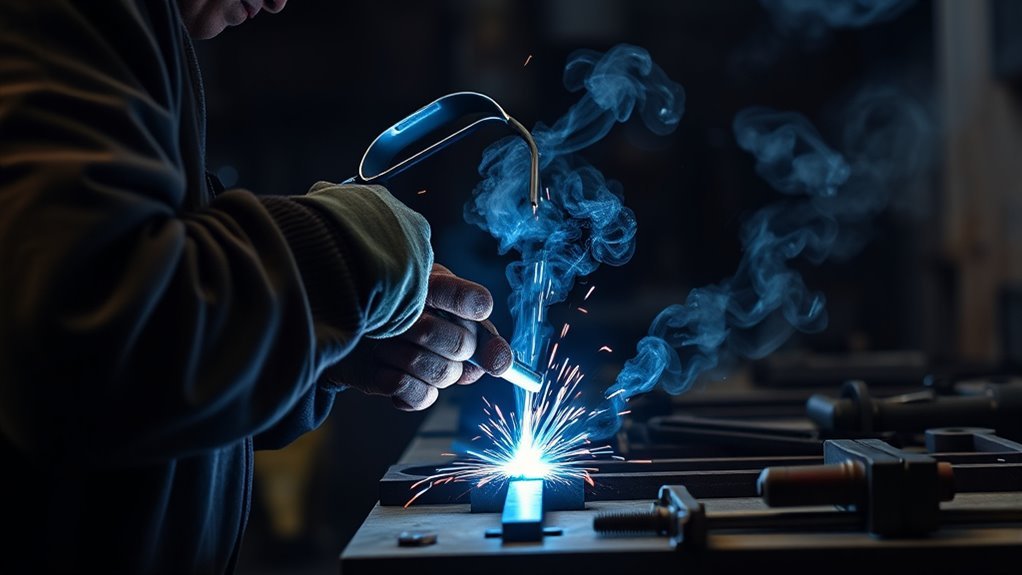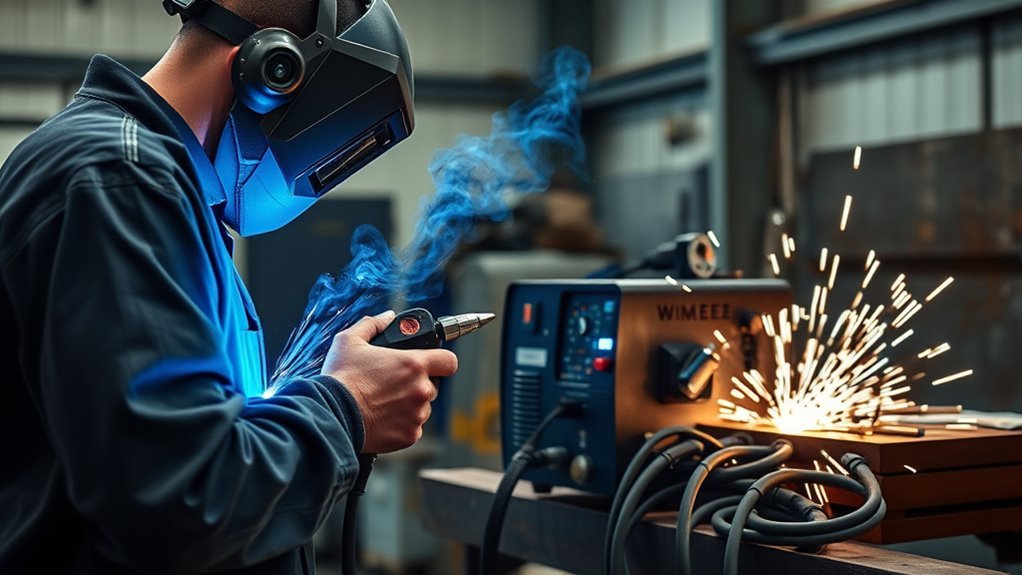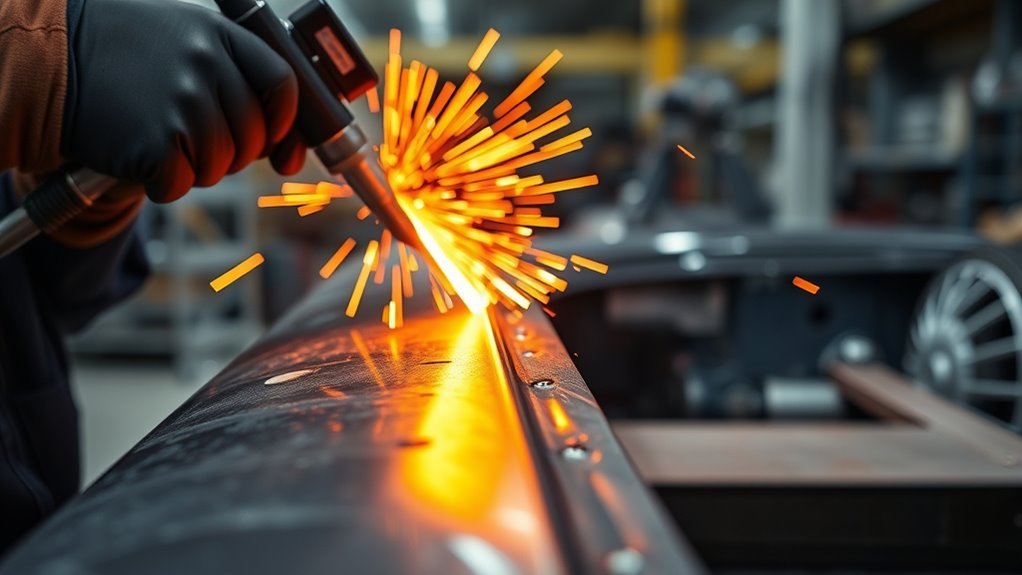
Seam welding in cars means joining metal along a line rather than at a few isolated points. In factory production, the term most often refers to resistance seam welding or laser welding. In race-car fabrication, “seam welding the chassis” usually means adding controlled MIG or TIG welds along selected body seams. These processes are related by purpose, but they are not interchangeable.
Quick Answer
Seam welding joins automotive metal along a continuous or closely overlapping line. Resistance seam welding uses powered wheel electrodes and electrical current, while laser or arc processes form the seam with a focused beam or welding arc. Car makers use seam welds where strength, repeatability, or a gas- or liquid-tight joint is required.
Key Takeaways
- Resistance seam welding is a form of resistance welding that uses rotating wheel electrodes on overlapping sheet metal.
- A sealed seam can be gas- or liquid-tight, but tightness depends on joint design, weld settings, cleanliness, and inspection.
- “Seam welding a chassis” in motorsports usually describes MIG or TIG stitch or continuous welding, not factory resistance seam welding.
- Welding does not replace seam sealer, primer, cavity wax, or other OEM-specified corrosion protection.
- Collision repairs must follow the vehicle maker’s body repair manual because the approved joining method changes by model, material, and repair location.
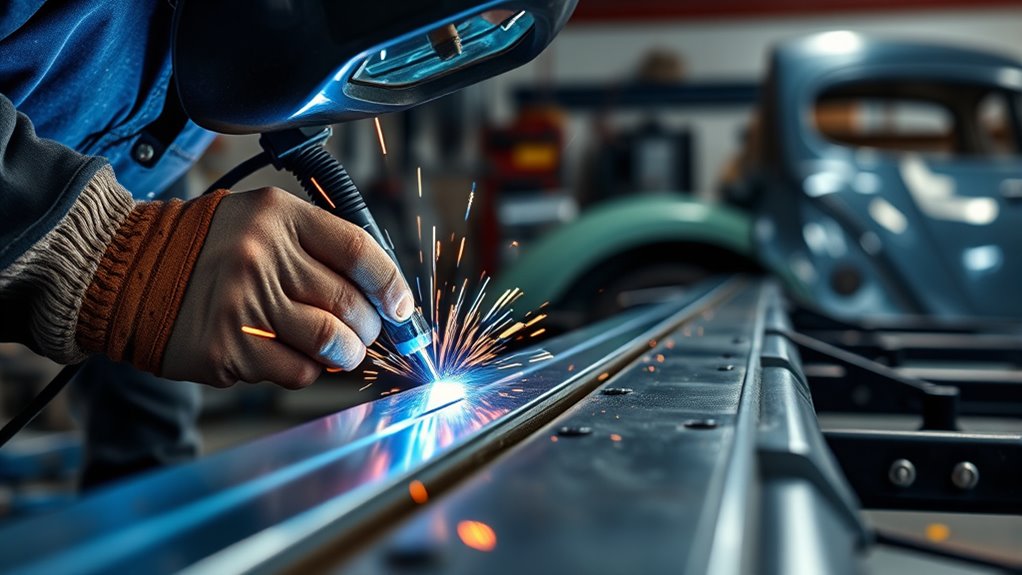
What Seam Welding Means in Cars
Seam welding is a broad term for joining workpieces along a seam. In automotive work, it can describe several different processes:
- Resistance seam welding: Powered copper wheel electrodes squeeze overlapping sheets while electrical current creates a row of overlapping weld nuggets. With the right spacing and settings, the joint can be gas- or liquid-tight.
- Laser seam welding: A focused laser produces a narrow, fast weld with low overall heat input. It is used in body manufacturing, tailored blanks, battery parts, and other automated assemblies.
- Arc seam or stitch welding: MIG/GMAW or TIG/GTAW adds a bead or a series of short welds along a fabricated joint. This is the meaning commonly intended when builders discuss seam welding a race-car body shell.
- Friction stir welding: A rotating tool softens and stirs metal together without melting it. It is mainly used on suitable aluminum components where tool access and joint geometry allow it.
These methods do not use the same equipment, joint design, heat cycle, or quality standard. The American Welding Society maintains separate automotive specifications for resistance, arc, laser, and friction-stir processes through its AWS D8 Committee on Automotive Welding.
In automotive work, “seam welding” describes the shape and continuity of the joint; the actual process may be resistance, laser, arc, or friction-stir welding.
How Resistance Seam Welding Works
Resistance seam welding is closely related to resistance spot welding. Instead of stationary electrode tips, the machine uses motor-driven wheel electrodes. The wheels clamp a lap joint, conduct current through the sheets, and move along the seam.
- The sheets are prepared and overlapped. Rust, scale, paint, dirt, and insulating contamination can make weld quality inconsistent. However, a coating or surface treatment specified by the material supplier or vehicle maker should not be removed without checking the approved procedure.
- The wheel electrodes apply force. Stable clamping keeps the sheets in contact and helps control the electrical resistance at the interface.
- Current creates localized heat. Electrical resistance is highest at the sheet-to-sheet contact area, so the metal heats and forms weld nuggets there.
- The wheels advance along the joint. Current may be continuous or pulsed. Closely spaced, overlapping nuggets form a sealed seam; wider spacing creates a roll-spot seam that may not be leak-tight.
- The weld is cooled and checked. Production systems control current, force, travel speed, pulse timing, and electrode condition. Leak-critical parts also require suitable inspection or leak testing.
The machine normally uses a high-current welding transformer or inverter power supply. No filler wire is required for standard resistance seam welding, which supports fast, repeatable automation.
Note: A seam made by overlapping resistance weld nuggets can look continuous from the outside, but leak-tight performance depends on nugget overlap, joint fit, surface condition, electrode force, current, and travel speed.
How Seam Welding Reinforces Car Panels
A properly designed seam can spread load along more of the joint than a few widely spaced attachment points. That can improve stiffness, fatigue performance, and local panel stability. The result still depends on the base metal, weld spacing, heat input, joint geometry, and the loads the vehicle was designed to carry.
Continuous Panel Strength
Closely spaced welds connect a longer section of the flange, so force can move through the joint with fewer unsupported gaps. This is useful where the design calls for a sealed lap joint or a consistent load path. It does not mean that every body seam should be welded solid. Vehicle structures are engineered as a system, and changing one joint can shift stress into another area.
On a race shell, controlled stitch welding may reduce movement at selected factory seams. Builders often use short, alternating welds rather than one long bead to manage heat. Arc-welded joints also require suitable edge preparation, penetration, and fillet weld sizing when a fillet joint is specified.
Reduced Flex and Distortion
A completed seam may reduce flex in the finished assembly, but the welding operation itself can cause distortion. Resistance and laser processes limit the heated area compared with many manual arc-welding methods, while careful clamping and programmed weld schedules improve repeatability. With MIG or TIG, short welds, alternating locations, and cooling time help control warping on thin automotive sheet.
More weld is not automatically better. Excessive heat can soften some high-strength steels, burn coatings, create residual stress, or pull panels out of alignment. The approved process and weld pattern matter more than simply making the longest possible bead.
Common Seam Welding Methods in Auto Fabrication
| Method | How It Works | Typical Automotive Uses | Main Limits |
|---|---|---|---|
| Resistance seam welding | Wheel electrodes apply force and current to overlapping sheet. | Metal tanks, radiators, muffler shells, reservoirs, and selected sheet-metal seams. | Requires wheel access, a suitable lap joint, controlled surfaces, and production-grade equipment. |
| Laser seam welding | A focused beam creates a narrow fusion weld, usually with automation. | Body panels, tailored blanks, roof seams, battery cells, and battery enclosures. | High equipment cost, precise fit-up, shielding and safety controls, and strict process monitoring. |
| GMAW/GTAW arc seam or stitch welding | An electric arc melts the base metal and usually adds filler metal. | Fabricated brackets, exhaust parts, collision-repair joints where approved, race shells, and roll cages. | Greater heat input and distortion risk; weld quality depends heavily on access, technique, and the correct procedure. |
| Friction stir welding | A rotating tool plasticizes and stirs material together below its melting point. | Selected aluminum suspension, wheel, crash-box, seat, and battery-tray components. | Needs rigid backing, tool access, suitable path geometry, and specialized machinery. |
For a broader comparison of arc processes, review the differences between FCAW and GMAW. They are separate from resistance seam welding and should not be treated as substitutes without an engineering or OEM-approved procedure.
Products Worth Considering

FR welding Cap:Updated New Functin on Surface(Water Repellent and Oil Resistant) we use the 10oz heavy weight flame resistant cotton duck(canvas) outside and inner material Flame Resistant cotton. More heat and arc resistant ATPV 14 Calories/cm2+8.2 Calories/cm2

FR Shirts Fabric: This flame-resistant shirt is crafted using flat-seam stitching and is knitted from 6 ounces of 100% flame-resistant cotton. This lightweight, high-visibility flame-resistant shirt is breathable, comfortable, and stand wear and tear.
FR welding Cap:Updated New Functin on Surface(Water Repellent and Oil Resistant) we use the 10oz heavy weight flame resistant cotton duck(canvas) outside and inner material Flame Resistant cotton. More heat and arc resistant ATPV 14 Calories/cm2+8.2 Calories/cm2
Which Metals Can You Seam Weld?
The weldable material depends on the process and the joint design.
- Low-carbon and coated steels: Common in automotive sheet structures. Coatings change contact resistance and electrode wear, so production settings must account for them.
- High-strength automotive steels: Weldable only with material-specific procedures. Unapproved heat can change local strength or crash behavior.
- Stainless steel and nickel alloys: Suitable for resistance seam welding in many tank, exhaust, and corrosion-resistant applications.
- Aluminum alloys: Weldable with resistance, laser, arc, or friction-stir processes when the alloy and joint are suitable. Aluminum’s high electrical and thermal conductivity means resistance welding generally needs much higher current than comparable steel, and its oxide layer makes surface control important.
- Magnesium and mixed-material joints: Possible in specialized production, but compatibility, coatings, intermetallic formation, and corrosion risk require a validated process.
The TWI guidance on resistance welding aluminum explains why current, weld time, surface condition, and electrode maintenance differ from steel. Stainless arc work also needs process-specific filler and heat-input control.
Where Seam Welds Matter Most on a Car
Seam welds are most useful where the design needs a sealed joint, a repeatable structural connection, or both.
- Metal fuel tanks and fluid containers: Resistance seam welding can create liquid-tight lap joints when the weld nuggets overlap correctly. Never weld a used fuel tank unless it has been professionally cleaned, purged, tested, and declared safe for hot work.
- Radiators, heat exchangers, and reservoirs: Leak control and consistent production quality are central requirements.
- Exhaust and muffler components: Resistance, laser, or arc seams may be used depending on the material and component shape.
- Body structures and panels: Resistance spot, roll-spot, laser, arc, adhesive bonding, brazing, and mechanical fasteners may all appear in one vehicle. The body repair manual identifies the approved replacement method.
- EV battery enclosures and trays: Automated laser and hybrid seams can provide the long, controlled, leak-resistant joints required by battery housings. TRUMPF describes laser-welded leak-tight battery trays as one current e-mobility application.
- Race-car body shells: Selected factory flanges may receive MIG or TIG stitch welds to reduce local movement. The weld plan should come from an experienced fabricator or vehicle engineer.
- Roll cages: Cage tubes and mounting plates are normally arc welded to a specified motorsport rule set. Calling those joints “seam welds” does not make them resistance seam welds.
Warning: Do not add welds to crush zones, high-strength steel, airbag areas, seat-belt anchor structures, fuel systems, or an EV battery enclosure without the vehicle-specific OEM procedure. Extra heat or stiffness can change crash performance, damage coatings, ignite trapped materials, or expose you to high voltage.
Pro Tip: Make test welds on matching scrap and verify them before touching the vehicle. For resistance welding, cleanliness, electrode condition, force, current, and travel speed all affect the result. Do not remove a supplier-applied or OEM-specified surface treatment unless the approved procedure says to do so.
Seam Welding vs. Spot Welding
Resistance spot welding joins sheets at separate locations with stationary electrodes. Resistance seam welding uses rotating electrodes to create a line of welds. Both processes rely on electrical resistance and clamping force, but they serve different joint requirements.
| Feature | Resistance Seam Welding | Resistance Spot Welding |
|---|---|---|
| Electrodes | Powered wheels | Stationary tips |
| Joint pattern | Continuous or overlapping row of nuggets | Separate weld nuggets |
| Leak-tight potential | Yes, with the correct overlap and process controls | Normally no; gaps remain between spots |
| Typical use | Tanks, shells, reservoirs, and selected long seams | Body flanges and high-volume panel assembly |
| Access | Both sides plus a path for the wheels | Both sides at each weld location |
Joint selection comes before welding. Cutting and edge preparation also matter, but a separate choice such as whether a plasma cutter uses nitrogen does not determine whether resistance seam welding is suitable. The material, flange design, access, and approved repair specification do.
Products Worth Considering

PREMIUM FLAME RETARDANT (FR) FABRIC – This coat is made from ASTM D6413 compliant 9 oz. FR black cotton which prevents and extinguishes fire / flames. The fabric also has an anti-static coating for added longevity and protection.

【MATERIAL】- Made of high-quality fiber and copper material, corrosion-resistant, not easy to deform, owning a long service life.

7.5 oz cotton twill FR treatment, FR reflective tape, FR zipper. Double seam 2-inch silver reflective tape ANSI/ISEA 107-20 Grade 1 O-Type 1. The bottom, side pockets, and back pocket are covered with double loop tape in the reflective area. More FR info On Neck Tag About UL Certification.We Attached A Small Sample Inside Package For Cunstomers Simple FR Try
Pros and Cons of Seam Welding for Cars
Advantages
- Sealed joints: Correctly designed seams can hold gas or liquid.
- Repeatability: Automated resistance and laser systems can control force, current or beam power, speed, and timing.
- Fast production: The process can join long seams without stopping for individual fasteners.
- No filler in resistance welding: Standard resistance seam welding joins the base sheets directly.
- Controlled heat zone: Resistance and laser methods can limit the heated area compared with a long manual arc bead.
- Consistent load path: A well-designed seam spreads force along more of the joint.
Limitations
- Equipment and access: Resistance wheel electrodes need access to both sides of the lap joint and cannot reach many internal corners or obstructed seams.
- Geometry: Conventional wheel systems work best on straight or gently curved paths. Complex shapes require different tooling or another process.
- Material thickness: Conventional resistance seam welding is mainly a sheet-metal process and is commonly limited to combined thicknesses around the thin-sheet range; the often-cited 3 mm limit should not be applied to laser, arc, or friction-stir seam welding.
- Surface sensitivity: Paint, rust, scale, oxide, sealers, and coatings can change current flow and weld quality.
- Electrode wear: Coated steel and aluminum can shorten electrode life and require frequent dressing or replacement.
- Heat effects: Manual arc seams can warp thin panels, burn corrosion protection, and change properties in heat-sensitive automotive steels.
- Inspection needs: A smooth-looking seam is not proof of penetration, nugget size, strength, or leak-tightness.
When Seam Welding Is Worth It
Seam welding is worth using when the joint design calls for a long, repeatable bond or a gas- or liquid-tight seal. In production, the high equipment cost can be justified by speed, automation, and consistent quality. In a fabrication shop, arc seam or stitch welding may be practical for brackets, exhaust parts, tanks built under an approved procedure, and competition shells designed for reinforcement.
It is not worth improvising on a road car when the vehicle maker specifies spot welds, MIG brazing, weld bonding, rivets, adhesives, or a particular sectioning joint. A stronger-looking weld can create a weaker repair if it overheats the metal or changes the intended load path.
There is no dependable universal price per linear foot. Cost varies with the process, material, seam length, access, tooling, fixturing, inspection, leak testing, production quantity, and whether the job is manufacturing, collision repair, or custom fabrication. Obtain a written quote based on drawings or the vehicle-specific procedure.
How Seam-Weld Quality Is Checked
Inspection depends on the process and the consequence of failure. A production plan may include:
- Visual checks for expulsion, cracks, undercut, burn-through, missed sections, and distortion.
- Peel, chisel, coupon, or destructive tests to confirm resistance-weld nugget formation.
- Process monitoring for current, force, pulse time, electrode condition, beam power, travel speed, and weld position.
- Dimensional inspection to confirm that the assembly stayed aligned.
- Pressure, vacuum, dye, helium, or other leak testing for sealed parts.
- Non-destructive examination when the design or applicable standard requires it.
The current AWS automotive standards list separate acceptance criteria for different processes and materials, including AWS D8.1M:2021 for resistance spot welding of steel and AWS D8.2M:2026 for resistance spot welding of aluminum.
Automotive Seam-Welding Safety
Automotive welding combines electrical, mechanical, fire, fume, coating, and stored-energy hazards. The OSHA welding standard requires suitable eye and face protection, and OSHA’s resistance-welding rules address guarding, grounding, sparks, machine controls, and operator training.
- Disconnect or isolate vehicle power as required by the service procedure. Hybrid and EV high-voltage systems require trained personnel and model-specific shutdown and verification steps.
- Remove or protect fuel, brake, refrigerant, airbag, seat-belt pretensioner, wiring, battery, and interior components in the heat zone as directed by the repair manual.
- Provide ventilation for fumes from coatings, oil, galvanized steel, paint, seam sealer, and contaminated metal. Proper galvanized-steel preparation is essential.
- Use suitable eye, face, hand, body, and hearing protection. A half-mask respirator may be part of the control plan, but it must be selected for the hazard, medically approved where required, and properly fit-tested.
- Keep combustibles away, use fire-resistant shielding, and maintain a fire watch when hidden insulation, seam sealer, undercoating, or trim may ignite.
- Do not weld a closed container, used fuel tank, refrigerant component, pressurized part, or battery enclosure unless a qualified procedure has made it safe.
Corrosion Protection After Welding
A weld does not prevent rust by itself. Welding often burns away zinc coating, primer, seam sealer, adhesive, undercoating, or cavity protection. Bare steel and trapped moisture can then corrode faster unless the protection system is restored.
After the weld passes inspection, follow the OEM procedure for cleaning, metal conditioner or primer, seam sealer, paint, undercoating, foam, and cavity wax. Some manufacturers permit a conductive weldable seam sealer with squeeze-type resistance spot welding, while others specify a different system. I-CAR’s weldable seam sealer guidance stresses checking both the vehicle maker’s repair information and the product technical data sheet.
Frequently Asked Questions
What are the disadvantages of seam welding?
The limits depend on the process. Resistance seam welding needs access for wheel electrodes, works best on suitable lap joints and simple paths, and is mainly used on thin sheet. Arc seam welding can distort panels and damage coatings. Laser and friction-stir systems need costly, specialized equipment and tight process control.
How much does automotive seam welding cost?
There is no reliable universal price per foot. Cost depends on the welding process, material, access, joint preparation, fixtures, inspection, leak testing, production quantity, and whether the job involves manufacturing, collision repair, or custom race fabrication. A shop needs the exact part or repair procedure to quote it accurately.
Can you seam weld aluminum car panels?
Yes, when the alloy, joint, equipment, and procedure are suitable. Resistance-welded aluminum generally needs higher current and careful oxide and electrode control. Laser, MIG, TIG, and friction-stir processes are also used for selected aluminum automotive components. Collision repair must follow the model-specific body repair manual.
How does seam welding affect rust?
A sealed joint can reduce paths for water to enter, but welding also removes or burns corrosion-protection layers. Rust prevention depends on restoring the OEM-specified primer, seam sealer, coating, underbody protection, and cavity wax after the weld is inspected.
Is chassis seam welding the same as resistance seam welding?
Usually not. In motorsports, chassis seam welding commonly means adding MIG or TIG stitch welds or short beads along selected factory body seams. Resistance seam welding uses powered wheel electrodes and is primarily a production sheet-metal process.
Does a continuous seam always make a car stronger?
No. A correctly engineered seam can improve local stiffness or distribute load, but extra welding can overheat high-strength steel, cause distortion, move stress into another area, or alter crash behavior. Use only a validated fabrication plan or the vehicle maker’s repair procedure.
Conclusion
Seam welding can create strong, repeatable, and leak-resistant automotive joints, but the name covers several different processes. Resistance wheel welding suits thin overlapping sheet, laser welding serves precise automated seams, and MIG or TIG is common in custom fabrication and race-shell reinforcement. Match the process to the material, joint, access, and required inspection. On a road vehicle, the OEM body repair manual—not a generic rule—must decide where and how a structural seam is repaired.
Sources
- TWI: What Is Seam Welding? — resistance seam-welding principles, advantages, limitations, materials, and applications.
- American Welding Society: D8 Committee on Automotive Welding — current automotive welding standards by process and material.
- TWI: Resistance Spot Welding Aluminum Alloys — aluminum current, oxide, surface, and electrode considerations.
- OSHA 29 CFR 1910.252 and OSHA 29 CFR 1910.255 — welding PPE, resistance-welding guarding, grounding, sparks, training, and ventilation requirements.
- I-CAR: Weldable Seam Sealer — restoring corrosion protection and following OEM and product instructions.
- TRUMPF: Automated E-Mobility Production — laser-welded leak-tight battery trays and enclosure seams.