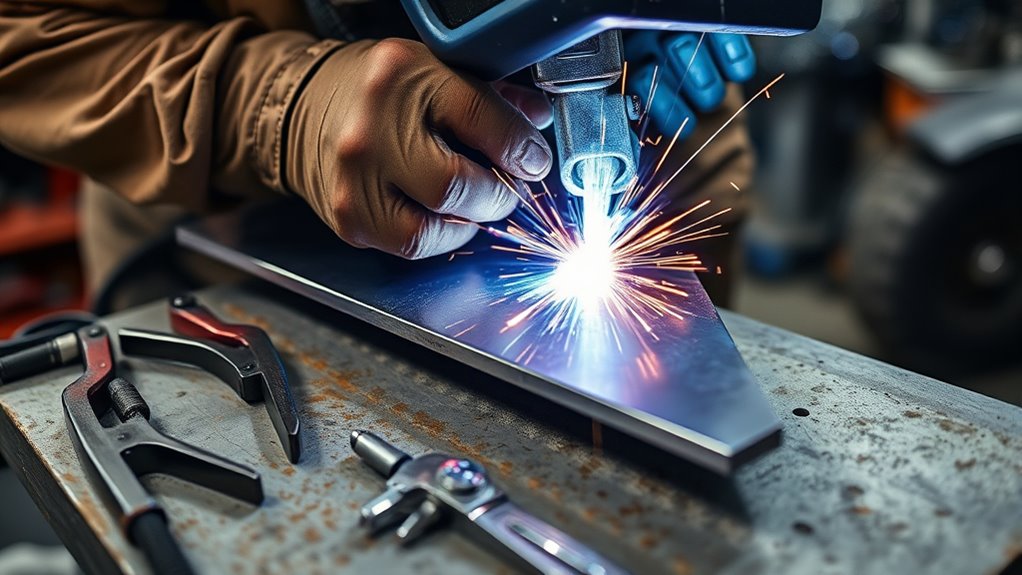
A lap weld is useful in auto body repair because the overlap helps hold thin panels in position while you join them. The joint can work well on approved floor-pan, patch-panel, flange, and outer-panel repairs, but it is not a universal shortcut. Before cutting or welding, identify the metal and follow the vehicle-specific repair procedure for the joint type, weld method, and weld locations.
Quick Answer
A lap weld joins overlapping metal panels. In auto body repair, the overlap may be joined with an edge seam, plug welds, or factory-style spot welds. Use it only where the vehicle maker permits it, control heat on thin steel, and restore primer, seam sealer, and cavity protection so the overlap does not trap moisture.
Key Takeaways
- A lap joint describes overlapping panel geometry; the approved attachment may be a seam weld, plug weld, resistance spot weld, rivet, adhesive, or a combination.
- Do not choose a lap joint for a structural or safety-related area without checking the vehicle maker’s repair information.
- Clean, tight fit-up and a test weld on matching scrap help prevent porosity, burn-through, and incomplete fusion.
- Use short, distributed welds on thin nonstructural sheet when the approved procedure allows them, rather than one long hot bead.
- Restore corrosion protection on both sides of the repair with the primer, seam sealer, topcoat, and cavity treatment required by the repair system.
At a Glance
| Time Required | Varies by panel size, access, weld count, and coating cure time |
| Difficulty | Intermediate for a small nonstructural patch; professional or OEM-controlled for structural repairs |
| Tools Needed | Approved welder and consumables, clamps, cleaning tools, matching scrap, PPE, fire protection, primer, seam sealer, and cavity coating |
| Cost | Varies with equipment, panel damage, approved materials, and refinishing needs |
What Is a Lap Weld?
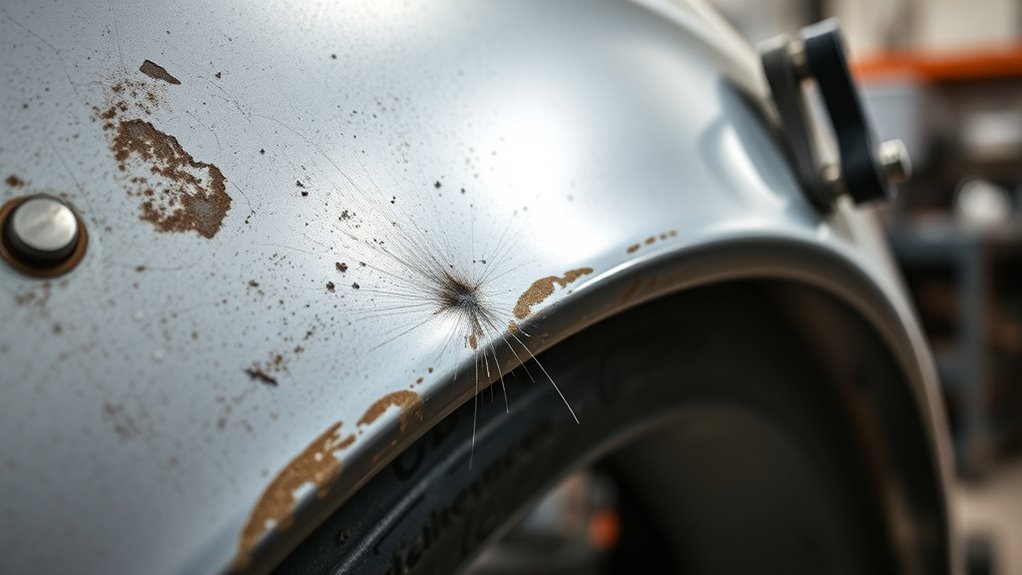
A lap joint forms when one piece of metal overlaps another. The term describes the joint layout, not one single welding process. In auto body work, the overlap may be joined along an exposed edge, through plug-weld holes, with resistance spot welds, or with another attachment method specified by the vehicle maker.
The overlap can make alignment easier because the lower panel supports the upper panel. It also creates a hidden interface that can hold contaminants or moisture if the mating surfaces and finished seam are not protected.
Lap joints are common in vehicle manufacturing, but repair methods are not interchangeable. Modern vehicles may combine mild steel, high-strength steel, ultra-high-strength steel, aluminum, adhesives, rivets, and several weld types. Use the vehicle-specific OEM repair information to identify the approved joint and attachment method before you begin.
Note: A lap joint is not automatically stronger or safer than a butt joint. Strength depends on the material, weld size, weld length, loading direction, fit-up, and the approved repair procedure.
Before You Choose a Lap Weld
Start by deciding whether the repair is cosmetic, nonstructural, or structural. A small patch in an approved outer panel is different from a repair near a rail, rocker reinforcement, pillar, roof rail, seat-belt mounting point, suspension mounting area, or airbag-related structure.
I-CAR guidance repeatedly stresses that the vehicle-specific body repair manual controls the required welding and sectioning joint. Do not invent a lap, butt, or sleeved joint in a structural area simply because it is easier to fit.
- Confirm the component: Identify whether it is an outer panel, reinforcement, structural member, or attached bracket.
- Identify the material: Check the OEM repair information for steel grade, aluminum, coatings, and heat restrictions.
- Confirm the attachment method: The procedure may call for spot welds, MIG plug welds, seam welds, MIG brazing, rivets, adhesive, or a combination.
- Check access: Make sure you can clean, clamp, weld, inspect, prime, seal, and protect the back side.
- Protect safety systems: Follow OEM steps for batteries, high-voltage systems, airbags, sensors, modules, wiring, fuel components, and interior trim.
Warning: Do not weld near fuel, wiring, batteries, high-voltage parts, airbags, sound deadener, carpet, foam, or hidden trim until the area has been made safe under the OEM procedure. Inspect and protect the opposite side of the panel, provide ventilation, keep suitable fire protection ready, and maintain a fire watch after welding.
Common Lap-Joint Methods in Auto Body Repair
Several welds can be used on overlapping panels. The correct choice depends on the original construction and the repair procedure.
| Method | How it joins the overlap | Typical repair use |
|---|---|---|
| Edge or fillet seam weld | Fuses the exposed edge of the upper panel to the lower panel | Approved nonstructural seams, patches, or fabricated brackets |
| MIG plug weld | Fills a prepared hole in the upper panel and fuses it to the lower panel | Replacing factory spot welds when the OEM procedure permits it |
| Resistance spot weld | Clamps the sheets and creates a weld nugget through electrical resistance | Factory-style flange replacement when equipment access and OEM requirements allow |
| Weld-bonded or mixed attachment | Combines approved adhesive, welds, rivets, or other fasteners | Vehicle-specific replacement procedures |
When to Use a Lap Weld in Auto Body
A lap joint may be practical when the OEM repair procedure specifies an overlap, when you are reproducing a factory flange, or when an approved nonstructural patch needs stable fit-up and back-side access. It can also work on fabricated tabs or brackets that are not part of a crash structure.
Do not use “mixed-gauge metal” or “limited access” alone as reasons to create a lap joint. Different thicknesses, coatings, and steel grades can require specific heat control and attachment methods. Limited access can also prevent proper cleaning, fusion, inspection, and corrosion protection.
| Condition | Lap joint may fit when | Avoid or stop when |
|---|---|---|
| Outer-panel patch | The repair is approved, the overlap can be sealed, and the finish can tolerate the joint | The overlap will telegraph through the finish or trap moisture without access |
| Floor pan or flange | You are reproducing an approved flange and can restore both sides | Fuel, wiring, insulation, or structure cannot be safely exposed and protected |
| Structural area | Only when the vehicle-specific procedure specifies the joint and attachment | No documented procedure permits the sectioning location or joint design |
Lap Weld vs. Butt Weld for Panels
A lap joint overlaps the panels, which can simplify alignment and provide a flange for plug or spot welds. A butt joint joins panel edges in the same plane, which can create a flatter exterior repair with no hidden overlap.
Neither joint is always stronger. A lap joint can carry load effectively when its welds and geometry are designed for that load, but it also creates an offset and a crevice. A butt joint can restore a flush surface, but it requires accurate fit-up and careful heat control on thin sheet.
| Factor | Lap joint | Butt joint |
|---|---|---|
| Fit-up | Overlap supports alignment | Edges need accurate trimming and gap control |
| Finished profile | May leave a step or visible seam | Can finish flatter |
| Corrosion control | Hidden interface must be protected and sealed | No overlap crevice, but both sides still need coating |
| Best choice | Where the approved procedure calls for an overlap or flange | Where the approved procedure calls for a flush sectioning joint |
What You Need Before Making a Lap Weld
Your exact setup depends on the panel material, thickness, weld process, and vehicle procedure. Gather the required equipment before exposing the vehicle to sparks or heat.
- Vehicle-specific body repair information and material identification
- Welder, wire, shielding gas, electrodes, or spot-welding equipment approved for the repair
- Matching scrap or a practice coupon that reproduces the panel stack and coatings
- Clamps, panel-holding tools, or temporary fasteners that keep the overlap tight
- Grinder, abrasive disc, wire brush, scraper, and approved cleaners
- Hole punch or drill if the procedure calls for MIG plug welds
- Weld-through primer only when required by the OEM and compatible with the repair system
- Epoxy or urethane primer, seam sealer, topcoat, underbody coating, and cavity wax as required
- Welding helmet, safety glasses, gloves, flame-resistant clothing, hearing protection, ventilation, and fire protection
Ordinary paint, body filler, seam sealer, rust, oil, and undercoating do not belong in the weld zone. Remove only what the repair procedure and product instructions require, then restore the corrosion-protection layers after welding.
Products Worth Considering

Value Pack: The package includes 24 packs of butt welding clamps, enough quantity to meet your daily needs and replacements. Each butt welding clamps is individually wrapped in a small bag, convenient to carry and use.

Highly Durable Design: The shell of stud welder kit is made of high-quality ABS body, has good stability under high temperature conditions, withstand temperature of 93-118℃, and the movement is pure copper electrode. This welder stud kit is wear-resistant, strong and sturdy.

Professional Dent Removal: VEVOR Stud Welder Dent Puller offers a fast and efficient solution for removing dents from car body, all while providing precise dent pulling and controlled force for a professional-grade dent repair every time.
How to Make a Strong Lap Weld
Products Worth Considering

【Unlock Precise Repairs】 This heavy-duty right-angle pull clamp is perfect for auto body repairs, working seamlessly with frame machines for accurate results.

COPPER ALLOY PAD - Copper alloy pad prevents burn through, allows higher welding temperature and better penetration

【Designed For Automotive Repair Work】Spot weld panel chisel Designed for automotive body repair work, precisely removes auto body spot welds and easily separates metal panels. It is suitable for a wide range of bodywork, include accident repairs, vehicle dismantling, door and fender replacement, and the separation of welds on frames and chassis, ensuring efficient performance to meet your needs.
1. Confirm the Approved Repair
Read the vehicle-specific procedure before cutting. Mark the permitted sectioning location, joint design, attachment method, weld count, weld spacing, and coating steps. If the information does not allow a lap joint, use the specified repair or refer the job to a qualified collision-repair professional.
2. Make the Vehicle Safe
Follow the OEM depowering and protection steps. Remove or shield nearby trim, carpet, foam, sound deadener, wiring, hoses, fuel components, glass, electronics, and heat-sensitive parts. Check the back side and every cavity that sparks or heat could reach. OSHA requires ventilation and fire precautions for welding, including protection on the opposite side of a surface when heat or sparks can create a hazard.
3. Fit the Overlap
Trim and shape the panels to the flange width or overlap shown in the repair procedure. There is no universal one-inch rule for auto body lap joints. The correct dimension depends on the panel, joint, weld method, and OEM instructions.
Clamp the panels firmly so the mating surfaces contact each other. A loose overlap can promote burn-through, poor plug-weld fusion, distortion, and corrosion gaps.
4. Clean and Prepare the Weld Zone
Remove paint, rust, adhesive, sealer, oil, and contamination from the weld area. Prepare plug-weld holes to the diameter and spacing required by the repair procedure. Deburr the holes and test the panel fit again.
Apply weld-through primer to mating flanges only when the OEM procedure and coating manufacturer call for it. Do not assume every repair or every primer uses the same sequence.
5. Test the Settings
Build a test coupon with the same material, thickness, panel stack, hole size, coating, and access as the repair. Adjust the machine until the practice weld shows acceptable fusion without excessive burn-through or distortion. Destructively test sample plug welds when the collision-repair procedure or shop quality process requires it.
Pro Tip: A flat scrap coupon is not enough when the repair uses two overlapping layers. Reproduce the actual panel stack so you can check fusion into the lower sheet before touching the vehicle.
6. Weld in the Required Sequence
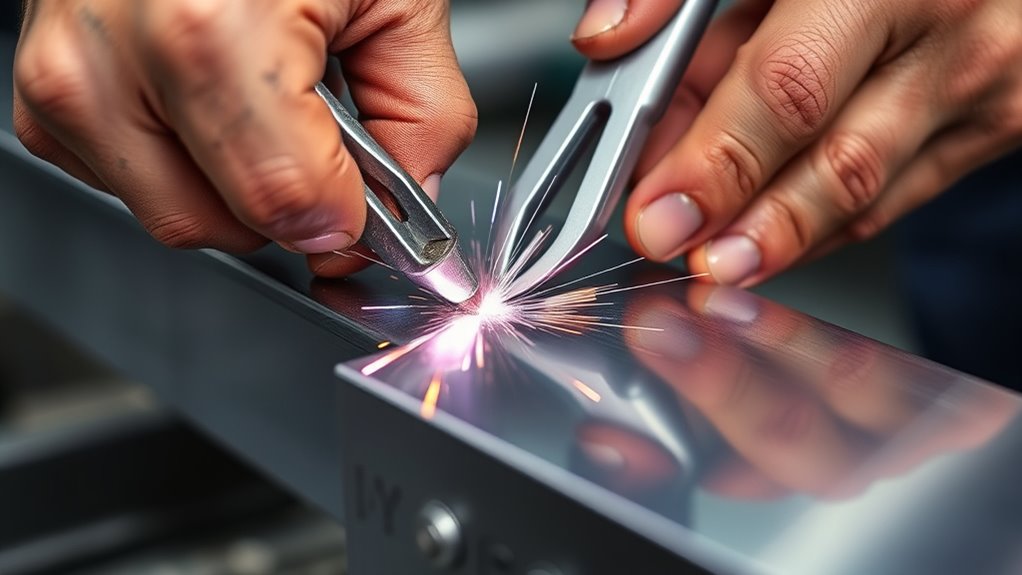
Follow the specified weld type and sequence. For an approved thin-sheet seam, use short, separated welds and move around the panel so heat does not build in one area. Miller recommends intermittent bead sequences rather than one constant bead to help reduce distortion on sheet metal.
For MIG plug welds, start the arc on the lower panel, establish fusion, and fill the hole according to your training and the approved procedure. For resistance spot welding, use the required equipment settings, electrode access, squeeze force, and quality checks.
7. Inspect Before Grinding
Look for complete tie-in, correct plug-weld fill, cracks, pinholes, porosity, undercut, excessive spatter, and distortion. Check the back side when accessible. Correct defective welds under the approved repair process before covering them.
8. Dress the Weld Minimally
Grind only what the repair and refinishing process require. Heavy grinding can thin the surrounding sheet or remove useful weld metal. Do not grind structural welds flush unless the OEM procedure specifically allows it.
9. Restore Corrosion Protection
Clean the repair, apply the approved primer system, seal the seam, refinish the exposed surface, and protect the back side or cavity. Follow each product’s recoat window and compatibility instructions.
The weld is only one part of a durable auto body repair. Fit-up, heat control, inspection, and restored corrosion protection matter just as much.
How to Inspect and Troubleshoot a Lap Weld
| Problem | Likely cause | Correction |
|---|---|---|
| Burn-through | Too much heat, slow travel, a gap, or poor backing support | Stop, let the panel cool, correct the fit-up, and retest settings on matching scrap |
| Incomplete fusion or cold lap | Low heat, poor gun angle, contamination, or failure to fuse the lower panel | Remove the defective weld as permitted, clean the area, improve access, and retest |
| Porosity or pinholes | Oil, paint, rust, moisture, poor gas coverage, or drafts | Clean to the required condition, check gas delivery, shield the area, and make a new test weld |
| Panel warping | Long beads, concentrated heat, weak clamping, or excessive grinding | Use the approved intermittent sequence, distribute heat, improve clamping, and allow cooling |
| Early rust at the seam | Unprotected mating surfaces, open seam edges, coating damage, or blocked drainage | Remove corrosion, restore the approved coating system, reseal the joint, and protect the cavity |
Common Lap Weld Mistakes to Avoid
- Choosing the joint without checking the OEM body repair manual
- Using a lap joint in a structural or restraint-related area without documented approval
- Assuming all vehicle sheet metal is mild steel or can tolerate the same heat
- Welding over paint, rust, undercoating, ordinary primer, oil, or wet seam sealer
- Leaving a gap between overlapping panels
- Using one long weld bead on thin sheet when an intermittent sequence is required
- Failing to confirm fusion into the lower panel on a plug weld
- Grinding the weld or surrounding sheet too thin
- Sealing over dirty metal or applying products in the wrong order
- Skipping back-side primer, cavity wax, drainage checks, or post-weld fire inspection
How to Protect Lap Welds From Rust
Corrosion protection starts before welding and continues after refinishing. The overlap creates a crevice, so both the mating surfaces and the exposed seam need a compatible repair system.
- Prepare the mating flanges: Clean and treat them as the OEM repair procedure and product instructions require. Use weld-through primer only where specified.
- Clean the completed repair: Remove welding residue, spatter, grinding dust, and contamination without thinning the panel.
- Prime the metal: Apply the approved epoxy, urethane, or direct-to-metal primer. 3M advises applying seam sealer over a high-quality two-component epoxy or urethane primer or OEM e-coat when the system allows it.
- Seal the seam: Apply the correct seam sealer to the prepared surface, reproduce the factory seam where practical, and close water-entry paths without blocking designed drains.
- Refinish exposed areas: Apply the required topcoat, underbody coating, chip protection, or sound-control layer.
- Protect hidden cavities: Apply approved cavity wax or corrosion-protection material after welding and painting, using access points that reach the back side of the overlap.
- Inspect the repair: Check for coating damage, lifted seam sealer, blocked drains, pinholes, or rust during later service.
3M’s collision-repair corrosion-protection guidance and seam-sealer guidance provide system-level steps, but the vehicle maker and coating manufacturer remain the final authority for your repair.
Frequently Asked Questions
What is lap welding used for?
Lap welding joins overlapping metal. In auto body repair, lap joints may appear at factory flanges, approved floor-pan or outer-panel repairs, plug-welded seams, spot-welded seams, and nonstructural tabs. The vehicle-specific repair procedure must approve the joint and attachment method.
What are the disadvantages of lap welding?
The overlap can leave a visible step, create an offset load path, hide incomplete corrosion protection, and form a crevice that traps moisture. It may also be difficult to inspect, coat, or repair the back side after assembly.
Is a lap weld stronger than a butt weld?
Not automatically. Joint strength depends on material grade, thickness, weld type, weld size, weld length, loading direction, heat effects, and workmanship. In collision repair, the correct joint is the one specified by the vehicle maker.
How much should sheet metal overlap for a lap weld?
Use the overlap or flange width shown in the vehicle-specific repair procedure or approved patch design. There is no reliable universal dimension for every panel, steel grade, and weld method.
Do you need to seal a lap weld?
Yes, when the repair system calls for seam sealing. Clean and prime the repair in the correct sequence, then apply compatible seam sealer, refinish the exposed side, and protect hidden cavities. Do not block factory drains.
Can you lap weld a structural car panel?
Only when the vehicle-specific OEM repair procedure permits that joint, location, and attachment method. Improvised sectioning or excess heat in rails, pillars, rockers, reinforcements, or restraint mounting areas can change crash performance.
Is a plug weld the same as a lap weld?
A plug weld is one method used to join a lap joint. The panels overlap, a hole is prepared in the upper panel, and weld metal fuses through that hole into the lower panel. A lap joint can also be joined by spot welds, an edge seam, or other approved methods.
Safety Disclaimer: This article provides general information, not a vehicle-specific repair procedure or welding qualification. Structural, restraint-related, high-voltage, fuel-adjacent, and crash-safety repairs should be completed by trained professionals using current OEM information, approved equipment, and documented quality checks.
Conclusion
A lap weld can give you stable fit-up and a practical attachment flange, but the overlap also creates heat-control, inspection, and corrosion-protection demands. Confirm the OEM procedure first, reproduce the approved joint, test your settings, inspect fusion before grinding, and restore every coating layer. When the joint is not documented or the area affects crash safety, do not improvise the repair.
Sources
- I-CAR OEM Technical Information Matrix — vehicle-specific sectioning, attachment, welding, and weld-through-primer requirements
- OSHA 29 CFR 1910.252 — welding ventilation, fire prevention, coatings, and hot-work precautions
- Miller: MIG Welding Sheet Metal — intermittent weld sequences and distortion control
- 3M Collision Repair Corrosion Protection — corrosion protection for seams, flanges, and repaired panels
- 3M Seam Sealer and Coating Resources — surface preparation, primer, and seam-sealer application guidance