Imagine you’re tasked with welding a stainless steel bicycle frame. You might wonder whether TIG or plasma welding is more suitable. TIG welding offers precision and control with its non-consumable tungsten electrode, ideal for intricate welds. In contrast, plasma welding’s high-temperature arc and dual gas setup allow for deeper penetration, great for thicker sections. Knowing the differences in equipment, technique, and application can greatly impact your project outcomes.
Evolution of Welding Technologies
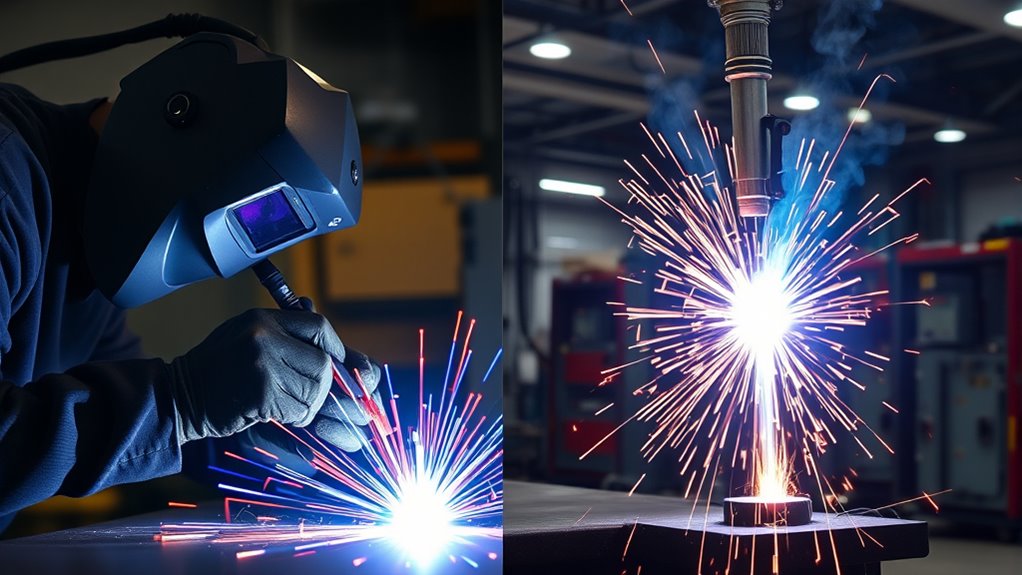
As welding technologies have evolved, they’ve shifted from basic heat-based methods to sophisticated techniques like electric arc welding, which includes TIG and plasma welding.
From basic heat-based methods to advanced electric arc techniques, welding has significantly evolved over time.
The welding history shows a remarkable journey from rudimentary processes to advanced methods driven by technological advancements. Initially reliant on open flames, welding has seen transformative changes with the introduction of electric arc welding. This leap forward paved the way for precise techniques like TIG, which excels in handling thin metals such as aluminum and stainless steel, essential for aerospace and manufacturing sectors.
Plasma welding further revolutionized the industry by offering deeper penetration and faster processing through its constricted arc. This innovation is particularly beneficial in high-volume production environments.
The continuous integration of automation and intelligent technologies has also enhanced efficiency and consistency across various industries. As welding technologies advance, choosing the right method is fundamental for meeting specific project requirements.
Core Principles of TIG Welding

In TIG welding, you use a non-consumable tungsten electrode to generate an electric arc, which melts the base metal, creating a weld pool.
This process requires an inert gas, typically argon or helium, to shield the electrode and weld pool from atmospheric contamination, ensuring high-quality and clean welds.
With its precise control over heat input, TIG welding is ideal for producing high-precision welds, especially in thin materials like aluminum and stainless steel.
Non-Consumable Tungsten Electrode
TIG welding relies on a non-consumable tungsten electrode to establish a stable electric arc, vital for melting and fusing metals. The electrode, available in various tungsten grades, doesn’t melt during welding.
Pure tungsten suits AC applications, while thoriated tungsten excels in DC, offering enhanced performance. With a melting point of about 3,422°C (6,192°F), tungsten maintains its shape, providing consistent arc stability and control.
Electrode maintenance is important; properly grinding it to a pointed tip guarantees peak arc characteristics. This preparation enhances weld quality by minimizing impurities.
While the inert gas shields the electrode, your focus should remain on maintaining the electrode’s integrity, as this directly influences the precision and quality of your welds.
Inert Gas Shielding
While maintaining a non-consumable tungsten electrode is essential for TIG welding, the role of inert gas shielding cannot be understated. Inert gas types, typically argon or helium, are key for shielding the weld pool and tungsten electrode from atmospheric contamination. This shielding gas importance lies in preventing oxidation and defects by guaranteeing a stable arc and protecting molten metal from oxygen and nitrogen. A consistent gas flow rate and high purity are crucial to maintain weld integrity and minimize impurities. This allows TIG welding to perform effectively on metals like aluminum and stainless steel, where contamination impacts performance.
| Inert Gas Types | Function | Importance |
|---|---|---|
| Argon | Shields weld | Prevents oxidation, impurities |
| Helium | Stabilizes arc | Guarantees weld quality |
| Mixed Gases | Customizes flow | Adapts to specific materials |
High-Precision Welds
When pursuing high-precision welds, TIG welding stands out due to its unparalleled control and finesse. You’ll use a non-consumable tungsten electrode to generate an electric arc, enabling meticulous control over welding accuracy. This is essential for thin metals and materials like stainless steel and aluminum.
The process uses inert gases, typically argon or helium, to shield the weld pool, ensuring a high-quality bead with minimal spatter or distortion. By producing a smaller heat-affected zone, TIG welding reduces the risk of warping, a critical factor in high precision techniques.
Its slower speed is ideal for intricate work, where your skill and detailed craftsmanship are paramount, making it a preferred choice in fields like aerospace and medical device manufacturing.
Understanding Plasma Welding

Plasma welding stands out as a precise technique, utilizing a high-temperature plasma arc generated through a tungsten electrode. This method produces concentrated heat, allowing you to weld metals with exceptional precision, especially thin materials. The constricted arc enhances penetration, making it suitable for various metals, including stainless steel and aluminum.
In plasma welding, you can choose between different operating modes like microplasma and keyhole mode. These modes let you tailor applications, from welding delicate electronics to thick steel plates in a single pass. The process requires two inert gases: one for the plasma arc and another for shielding, resulting in higher temperatures and faster welding.
| Feature | Benefit | Metals Applicable |
|---|---|---|
| Constricted Arc | Enhanced penetration | Stainless steel, aluminum |
| Operating Modes | Tailored applications | Electronics to steel plates |
| Dual Gas Requirement | Higher temperatures, speed | Various |
While plasma welding offers speed and depth of penetration, remember it also comes with higher equipment costs and requires skilled operators.
Key Differences in Equipment Setup

In setting up TIG and plasma welding equipment, you’ll first notice differences in electrode and nozzle design; TIG uses a broader arc, while plasma welding requires a narrow nozzle to focus the arc.
Effective gas supply management is essential, with TIG relying on a single shielding gas like argon, whereas plasma welding uses two gases to sustain and shield the arc.
Additionally, plasma welding demands precise current control due to its higher operating voltage, contrasting with TIG’s simpler, lower-voltage setup.
Electrode and Nozzle Design
Understanding the key differences in electrode and nozzle design between TIG and plasma welding is essential for selecting the right process for your welding needs.
In TIG welding, you use a non-consumable tungsten electrode that, along with a simple nozzle shape, facilitates the creation of a broad heat source. This setup combines the arc and inert gas shielding directly around the electrode materials, typically using argon.
Conversely, plasma welding features a tungsten electrode encased in a constricted nozzle design, producing a focused plasma jet. This configuration allows for deeper penetration and more precise welds.
The separation of the arc from the shielding gas creates a concentrated heat source, necessitating water-cooled torches for managing the higher temperatures effectively.
Gas Supply Management
When managing gas supply systems for TIG and plasma welding, you’ll notice several key differences that impact equipment setup and operation.
TIG welding uses a single inert gas, like argon, for gas flow to guarantee shielding effectiveness, protecting the weld pool from contamination. This setup is relatively simple, involving a gas cylinder and flow meter, adjusted based on material thickness and position.
In contrast, plasma welding requires dual gas supplies—one for the plasma arc and another for shielding. Controlling the plasma gas flow rate is critical to achieving a concentrated arc and deep penetration.
With higher flow rates and complex dual-gas arrangements, plasma welding systems demand precise management to maintain high temperatures and effective shielding, facilitated by specialized nozzle designs accommodating increased gas velocities.
Current Control Precision
Managing gas supply systems highlights distinct characteristics, yet current control precision further distinguishes TIG and plasma welding.
In TIG welding, you’ll utilize a non-consumable tungsten electrode, enabling precise current control techniques and stable arc formation, essential for precision welding methods on thin materials. The setup requires meticulous adjustment of current and gas flow rates to maintain the desired heat input.
Conversely, plasma welding employs a constricted arc, enhancing arc stability and allowing for deeper penetration across various material thicknesses.
Efficient current management in plasma welding involves optimizing plasma gas flow and arc constriction. Plasma welding typically operates at higher amperage levels—often exceeding 200A—necessitating robust equipment specifications.
The voltage characteristics also differ greatly, reflecting their distinct current control needs and precision capabilities.
Comparing Welding Process Parameters
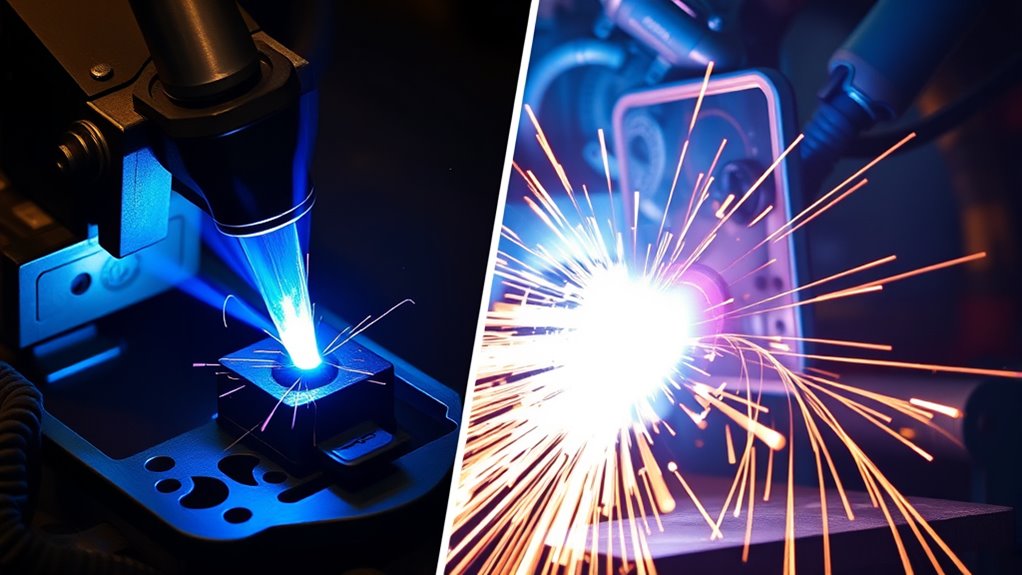
While both TIG and plasma welding are effective methods for joining metals, their process parameters differ markedly, affecting their suitability for various applications. Understanding these differences is key to optimizing welding efficiency and managing heat distribution.
- Current Range: TIG welding operates between 10 to 300 amps, offering fine control over thin materials. Plasma welding, however, can exceed 200 amps, making it ideal for thicker materials.
- Open Circuit Voltage (OCV): TIG welding requires a lower OCV of 60-80V. In contrast, plasma welding needs a higher OCV of 250-300V to sustain the arc in air, resulting in deeper penetration and higher temperatures.
- Arc Stability and Heat Distribution: Plasma welding’s constricted arc leads to superior arc stability, creating a narrower heat-affected zone and reducing distortion.
TIG welding, with its broader heat distribution, requires precise parameter adjustments like gas flow rate and arc travel speed to maintain quality.
These parameters make each technique uniquely suited for different welding tasks.
Material Compatibility and Applications
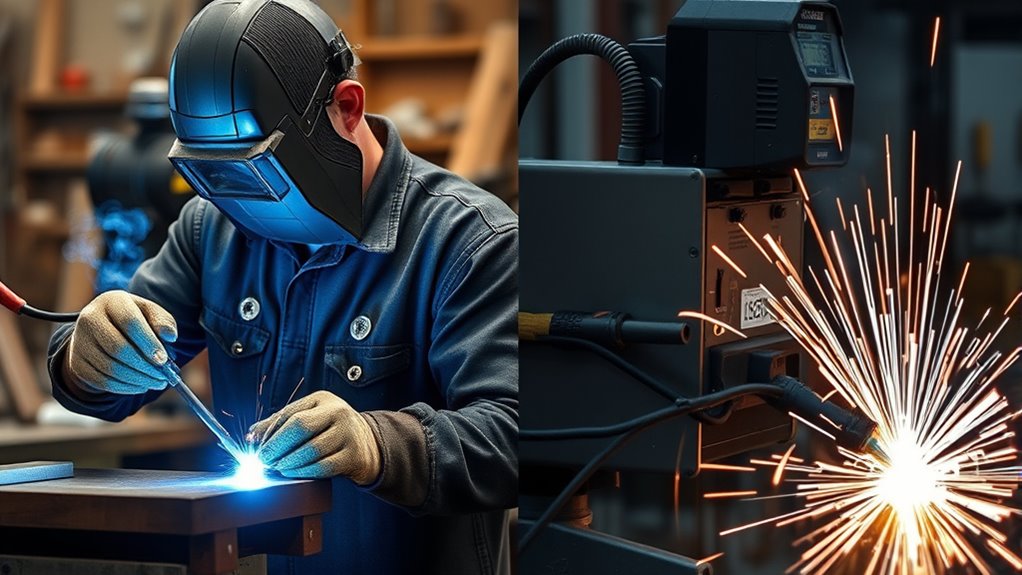
Though both TIG and plasma welding offer distinct advantages based on material compatibility, their applications differ considerably in industry settings.
TIG welding is highly compatible with metals like aluminum, stainless steel, and copper. Its precision makes it perfect for thin sections and intricate designs, commonly used in aerospace and automotive sectors. You’ll appreciate how TIG welding delivers clean, low-distortion welds, enhancing aluminum compatibility and guaranteeing aesthetic appeal without compromising on quality.
On the other hand, plasma welding excels at handling thicker materials and high melting point alloys. Its ability to produce deep, narrow welds allows it to achieve strong structural integrity, making it ideal for manufacturing applications.
You’ll find plasma welding invaluable in high-volume production environments where rapid welding of thicker components is necessary. This efficiency guarantees quick turnaround times, meeting the demands of industries requiring robust construction and durability, reinforcing its status in industrial manufacturing.
Assessing Weld Quality and Precision

Understanding the material compatibility and applications of TIG and plasma welding sets the stage for evaluating the quality and precision of the welds they produce. When examining weld quality, both techniques demand rigorous weld inspection and quality assurance protocols.
1. Process Control: Mastery over process parameters—such as current, arc travel speed, and gas flow rates—ensures consistent weld quality. TIG excels in creating clean, aesthetically pleasing welds, particularly for thin metals like aluminum and stainless steel.
Conversely, plasma welding achieves deeper penetration, enhancing weld integrity in thicker materials.
2. Quality Control Measures: Regular quality control, including visual inspections and advanced testing (e.g., X-ray analysis), helps detect defects, ensuring weld integrity.
These methods are essential for upholding high standards in both TIG and plasma welding.
3. Material and Project Considerations: The choice between TIG and plasma should hinge on material requirements, project scale, and desired weld characteristics to achieve ideal precision and quality outcomes.
Operator Skill and Training Requirements

Mastering TIG and plasma welding demands a high level of skill, precision, and understanding of the intricate nuances involved in each process. As an operator, proficiency in these techniques is essential.
TIG welding requires precise control over the arc and heat input, necessitating extensive training programs to develop your skill set. You’ll need to focus on perfecting your technique to produce high-quality, aesthetically pleasing welds, given its steeper learning curve.
In plasma welding, while the skill level is similarly high, you’ll encounter additional training challenges due to the complexity of settings and the plasma arc’s behavior. Proficiency in adjusting current, gas flow rates, and travel speeds is important to optimize weld quality and prevent defects.
Certification programs often combine hands-on practice with theoretical knowledge, ensuring you can effectively manage both the equipment and the processes. This extensive training is crucial for achieving excellence in either welding method.
Industrial Applications and Use Cases

Having developed the necessary skills and training, you’ll find that both TIG and plasma welding offer distinct advantages across various industries due to their unique capabilities.
TIG welding is renowned in the aerospace sector, addressing industrial trends that demand precision for thin aluminum and titanium, essential for aircraft components. Conversely, plasma welding excels in the automotive industry, overcoming application challenges with its rapid joining of thicker materials like chassis and bodywork.
Here are some key industrial applications:
- Aerospace: TIG welding guarantees clean, precise welds on lightweight metals, critical for achieving optimal aircraft performance.
- Automotive: Plasma welding’s efficiency reduces cycle times, significant for fast-paced automotive production lines and structural integrity.
- Medical Devices and Electronics: TIG welding supports the production of safe, high-quality medical instruments, while plasma welding minimizes distortion in delicate electronic circuits, preserving component functionality.
These techniques cater to specific industrial needs, reflecting evolving trends and addressing challenges in various applications.
Frequently Asked Questions
What Safety Precautions Are Specific to TIG and Plasma Welding?
When welding, wear gloves and a helmet to protect against TIG hazards like burns and UV radiation. For plasma risks, guarantee proper ventilation to avoid inhaling fumes, and use eye protection against bright arcs and hot metal splatter.
How Do TIG and Plasma Welding Affect the Environment?
When welding, you’re walking a tightrope between TIG’s lower emissions and plasma’s higher energy use. TIG typically has a smaller environmental impact due to fewer emissions, whereas plasma welding often contributes to greater emissions, affecting environmental sustainability.
Are There Specific Certifications Required for Each Welding Type?
Yes, you’ll need specific certifications for both TIG and Plasma welding. TIG certifications focus on precision welding techniques, while Plasma certifications emphasize high-speed cutting proficiency. Verify you meet industry standards and acquire hands-on training for each process.
Can TIG and Plasma Welding Be Used on Similar Material Thicknesses?
Yes, you can use TIG and plasma welding on similar material thicknesses. Both methods offer material compatibility across a broad thickness range, but plasma welding is often more effective for thicker materials due to its concentrated heat.
How Do Maintenance Requirements Differ for TIG and Plasma Welding Equipment?
You’ll find plasma welding equipment demands more frequent maintenance due to its complexity, but it coincidentally results in longer equipment longevity. TIG requires simpler maintenance schedules, making it easier, though slightly less robust, to manage.
Conclusion
In the domain of welding, choosing between TIG and plasma welding is like selecting the right tool from a craftsman’s kit. TIG welding, with its precision akin to a surgeon’s scalpel, is your go-to for detailed, aesthetic work on thin materials. On the other hand, plasma welding, resembling a sledgehammer, excels in high-volume production and robust applications, efficiently tackling thicker materials. Your decision will hinge on the specific demands of your project and desired outcomes.