Last updated: July 23, 2026
For most frequent cordless work, a brushless angle grinder is the better choice because it has no carbon brushes to replace and can use battery energy more efficiently. For occasional DIY work or long corded sessions near an outlet, a quality brushed grinder can offer better value and simpler brush service. Do not choose by motor type alone: wheel size, actual output, guard design, switch type, braking, anti-kickback control, battery cost, and service support can matter more.
This guide compares how brushed and brushless angle grinder motors work, where each design performs best, what maintenance each requires, and how to choose without assuming every brushless grinder is automatically stronger, safer, or longer-lasting.
Quick Answer
Choose a brushed angle grinder for occasional DIY work, a lower purchase price, and simpler brush servicing. Choose brushless for frequent use, often better cordless runtime, and no carbon-brush replacement. Compare wheel size, power, safety features, battery platform, warranty, and price because a brushless motor does not automatically make every grinder stronger or safer.
How this comparison was evaluated: The guidance below uses motor-design principles, current manufacturer documentation, and OSHA grinder requirements. It does not claim a universal runtime, power, or lifespan percentage because those results change with the exact grinder, battery, wheel, material, load, and test method.
Key Takeaways
- Brushed motors use carbon brushes and a commutator; those contact parts wear and eventually need service.
- Brushless motors use electronic commutation, so there are no motor brushes to replace.
- Brushless designs are especially useful in cordless grinders because better motor efficiency can extend useful work per battery charge.
- Motor type alone does not determine cutting speed, torque, safety, durability, or value.
- For any grinder, prioritize the correct guard and wheel, speed compatibility, anti-kickback protection, braking, overload protection, and a comfortable switch.
How Do Brushed and Brushless Angle Grinder Motors Work?
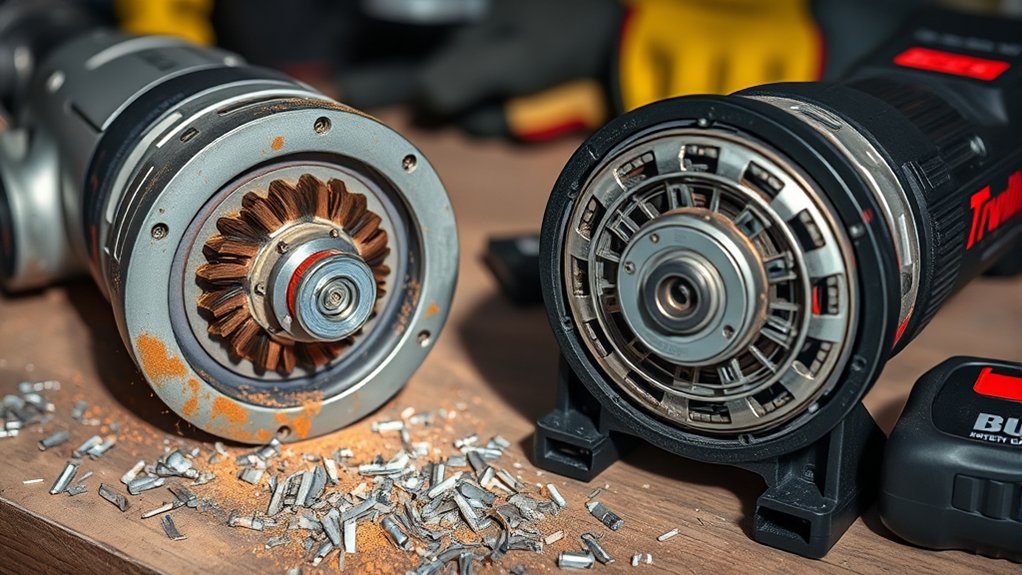
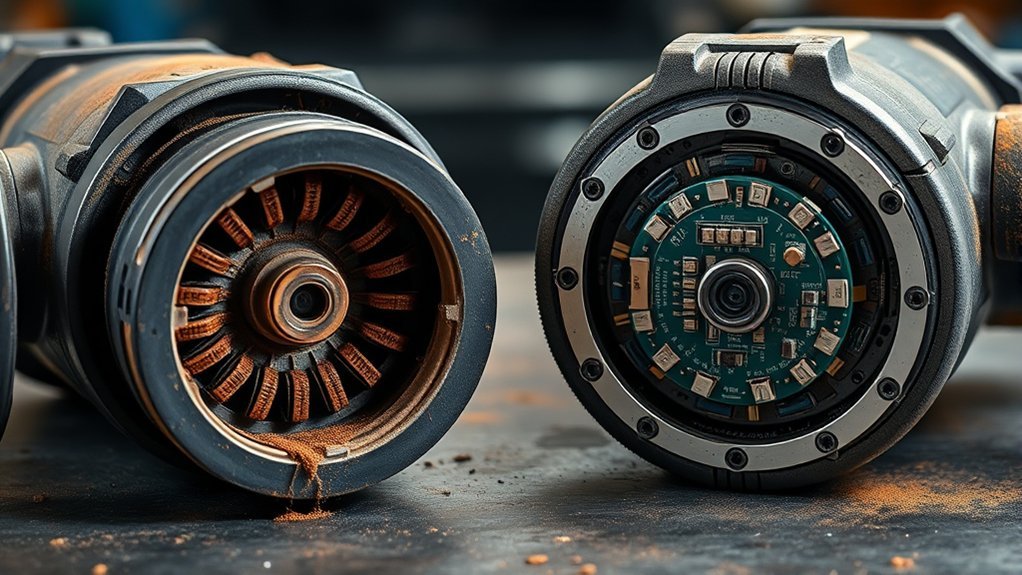
A brushed motor uses carbon brushes that press against a rotating commutator. In a cordless grinder, this is commonly a brushed DC motor. Many corded hand tools instead use a brushed universal motor, which can run on alternating current and still relies on brushes and a commutator. The University of Louisville’s motor lesson identifies universal motors as common in handheld electric tools. Because the brushes make physical contact, they wear and can create heat, dust, electrical noise, and internal arcing.
A brushless grinder replaces mechanical commutation with an electronic controller. In typical power-tool designs, the controller switches current through stationary windings while permanent magnets rotate. This removes carbon-brush wear and gives the electronics more control over motor response, but controller, sensor, or power-module faults can be more involved to diagnose than worn brushes.
| Comparison | Brushed Motor | Brushless Motor |
|---|---|---|
| Commutation | Carbon brushes and a mechanical commutator | Electronic controller |
| Typical purchase price | Usually lower within a comparable product line | Usually higher because of the motor and control electronics |
| Motor maintenance | Brush inspection or replacement may be required | No carbon-brush replacement |
| Cordless runtime | Often shorter when compared with an otherwise similar tool | Often better, but battery size, voltage, load, and electronics also matter |
| Speed under load | Depends on motor output and whether the grinder has constant-speed electronics | Often managed electronically, but performance still varies by model |
| Repair profile | Brush service can be simple on models with external brush caps | Controller or sensor faults may require professional diagnosis |
| Best fit | Occasional use, tight budgets, or users who value basic serviceability | Frequent work, cordless use, and users who want less motor maintenance |
Note: “Brushless” describes the motor, while “corded” or “cordless” describes the power source. Both corded and cordless brushless grinders are available. Brushed grinders are also available in both formats, although availability varies by brand and product line.
Pros and Cons of Brushed Angle Grinder Motors
Brushed angle grinders remain useful because they are mature, widely available, and often inexpensive. Some models have external brush caps or service indicators, which can make routine brush replacement straightforward. For example, Bosch lists carbon brushes, Service Minder brushes, constant electronics, direct-motor cooling, restart protection, and recoil mitigation on the GWS13-50PD. That model-specific example shows why motor type should not replace a full feature comparison.
Advantages of Brushed Grinders
- Lower entry price: Brushed models are often the least expensive way to buy a capable grinder.
- Simple brush service: On models with accessible brush caps, replacing matched carbon brushes may be easier and cheaper than repairing a failed electronic controller.
- Many proven corded choices: A quality corded brushed grinder can deliver strong sustained output without battery cost or charging downtime.
- Good value for short jobs: Occasional bolt cutting, mower-blade sharpening, rust removal, and small repairs may not justify a premium brushless model.
Disadvantages of Brushed Grinders
- Wear parts: Carbon brushes wear during normal operation and may need inspection or replacement according to the manufacturer’s manual.
- Internal brush dust: Worn brush material can collect inside the housing and around cooling paths.
- Contact losses: Brush-to-commutator contact adds friction and electrical losses.
- Possible service interruption: A grinder may stop or run poorly when its brushes reach their service limit.
Pro Tip: Before buying a brushed grinder, check whether the manufacturer sells replacement brushes and whether the tool has external brush caps. Brush access differs by model, and opening the housing may affect warranty coverage.
Key Advantages and Limits of Brushless Angle Grinders
Brushless angle grinders remove carbon brushes from the motor. Makita states that the XAG25Z brushless motor eliminates carbon brushes, while DEWALT lists constant speed under load for the DCG408B. Treat these as model-specific features, not proof that every brushless grinder has the same cooling, runtime, speed control, brake, or kickback response.
Advantages of Brushless Grinders
- No carbon-brush replacement: There are no motor brushes to inspect or replace.
- Efficient cordless operation: Lower commutation losses can help the tool get more useful work from a battery, although real runtime depends on the complete system.
- Electronic load response: Many brushless grinders use controls that manage speed, overload, braking, and kickback response.
- Less brush-related heat and debris: Removing brush contact eliminates that specific source of friction and dust.
Limits of Brushless Grinders
- Higher price: Brushless models and their battery kits often cost more upfront.
- More complex electronics: A failed controller, sensor, or power module may be harder to diagnose than worn carbon brushes.
- Not automatically more powerful: Wheel speed, wattage or motor output, battery voltage, gearing, electronics, and thermal limits all affect performance.
- Not maintenance-free: Bearings, gears, switches, vents, guards, cords, batteries, and dust screens still need inspection or care.
The motor label is only one part of the tool. A well-built brushed grinder can outperform a weak brushless model, while a strong brushless grinder can provide excellent runtime and load control.
Which Performs Better: A Brushless or Brushed Angle Grinder?
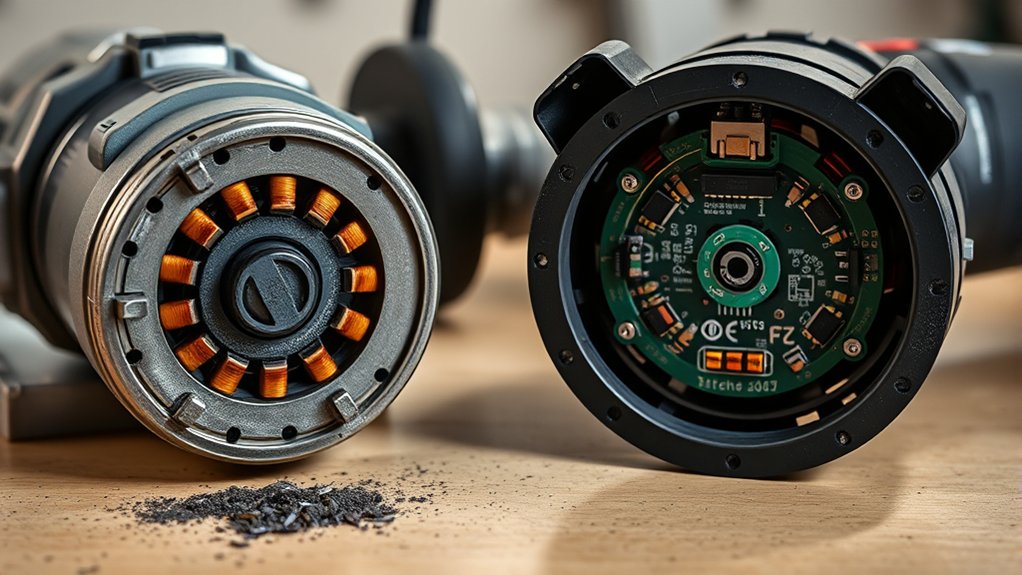
Brushless grinders often have an advantage in demanding cordless work because the motor and controller can use battery energy efficiently and respond to changing load. That can help the tool maintain useful speed when the wheel meets resistance. However, you should compare actual model specifications and independent test conditions rather than assume every brushless grinder will cut faster.
For a fair comparison, match wheel diameter, battery voltage and capacity, wheel type, material, charge level, and feed pressure. A 6-inch high-output brushless grinder should not be compared directly with a compact 4-1/2-inch budget brushed grinder and treated as proof that motor type alone caused the difference.
- Cutting and grinding speed: Motor output, wheel choice, gearing, speed regulation, and thermal protection all matter.
- Runtime: Brushless usually has the clearest advantage in cordless tools, but amp-hour rating, battery condition, temperature, and workload strongly affect results.
- Heat management: Brushless motors eliminate brush friction, yet the tool can still overheat from overload, blocked vents, dull accessories, heavy pressure, or hot batteries.
- Stall and kickback response: Some modern brushless grinders include electronic clutches, anti-kickback systems, brakes, and overload protection. These are model features, not guaranteed by the word “brushless.”
Wheel selection can change cutting speed and control as much as the motor label. Match the accessory to the material, guard, diameter, arbor, and rated speed. See the angle grinder wheel guide and wheel bore-size guide before comparing two tools with different accessories.
Products Worth Considering

Brushless motor of the angle grinder requires no brush changes. DEWALT grinder's brake stops wheel in 2 seconds or less on average Kickback Brake engages when a pinch, stall,...
Is Corded or Cordless Better for Your Work?
Motor type and power source answer different questions. A cordless brushless grinder offers mobility and usually makes efficient use of its battery. A corded grinder offers continuous power as long as an outlet and suitable extension setup are available. Many corded brushed grinders remain practical because battery runtime is not part of the decision.
- Choose cordless for field work, climbing, remote repairs, quick setup, and jobs where a cord creates a snag risk.
- Choose corded for long shop sessions, continuous material removal, and predictable power without charging.
- Choose your battery platform carefully: A tool-only brushless grinder may be poor value if you must also buy batteries and a charger.
- Check output, not voltage alone: Two tools with the same nominal voltage can have very different power and thermal limits.
For a deeper power-source comparison, see the corded vs. cordless angle grinder guide.
How Long Do Brushed and Brushless Grinders Last?
Brushless motors remove one common wear item, but no angle grinder is maintenance-free. Bearings, gears, switches, cooling fans, cords, battery contacts, guards, and spindle parts can wear or become damaged. Abrasive dust, heavy side loading, repeated stalls, blocked vents, and oversized or incorrect accessories can shorten the life of either motor type.
Brushed Grinder Maintenance
- Follow the manual’s inspection interval and replace both brushes as a matched pair when required.
- Use only the brush part specified for the exact model.
- Keep vents clear and stop using the grinder if it sparks excessively inside the housing, loses power, smells burned, or runs unevenly.
- Have a qualified service center inspect a damaged commutator, armature, switch, cord, or bearing.
Brushless Grinder Maintenance
- Keep vents and removable dust screens clean without forcing debris deeper into the housing.
- Inspect the battery, contacts, switch, guard, brake, and anti-kickback functions as directed by the manual.
- Let an overheated tool or battery cool naturally before reuse.
- Use an authorized service provider for controller, sensor, winding, or power-electronics faults.
Warning: Motor type does not make an angle grinder safe by itself. Use the correct guard and side handle, wear eye and face protection, inspect the wheel before mounting, and confirm that the wheel’s maximum operating speed meets or exceeds the grinder’s speed. OSHA requires portable abrasive wheels to be guarded and says a right-angle grinder’s guard should be positioned between the operator and wheel. OSHA also identifies cutting, frictional heat, and electrical or mechanical sparks as ignition sources. Keep sparks away from flammable vapors, liquids, and combustible materials.
Which Angle Grinder Motor Should You Buy?
Start with the work you actually do. A brushed grinder can offer excellent value for occasional cutting, sharpening, rust removal, and short repairs. A brushless grinder becomes easier to justify when you work frequently, depend on cordless runtime, or want to avoid carbon-brush service.
| Your Use | Better Starting Point | Why |
|---|---|---|
| A few short home projects each year | Brushed | Lower price may matter more than runtime or reduced motor maintenance |
| Frequent cordless cutting and grinding | Brushless | Efficiency and electronic load control are more valuable during repeated battery use |
| Long shop sessions near an outlet | Compare corded models of either type | Sustained output, ergonomics, safety features, and service support may matter more than motor type |
| Professional mobile fabrication | Brushless cordless | Mobility, reduced brush service, braking, and anti-kickback features can reduce downtime |
Three-Question Decision Rule
- Will most work be cordless and frequent? Start with brushless, then compare battery cost, brake, kickback control, and weight.
- Will most work be long sessions near an outlet? Compare corded models of either motor type by amperage, sustained speed, cooling, switch, and service support.
- Will the grinder be used only a few times each year? A quality brushed model may be the better value if replacement brushes and service are available.
Motor type is only one buying filter. The angle grinder amperage guide explains corded power ratings, while the switch-type guide compares paddle, slide, and trigger controls.
Products Worth Considering

【Brushless Motor】Electric angle grinder is equipped with a brushless motor. It has longer product life span, stronger power, faster heat dissipation and less energy...
Quick Buying Checklist
- Wheel size: Match 4-1/2-inch, 5-inch, 6-inch, 7-inch, or 9-inch capacity to the work and accessories you use.
- Rated speed: Every wheel and accessory must be rated for at least the grinder’s maximum speed.
- Power or output: Compare amperage and wattage for corded tools or manufacturer output claims for cordless tools.
- Switch style: Choose paddle, slide, trigger, lock-on, or no-lock based on control, local rules, and the task.
- Safety systems: Look for a suitable guard, side handle, electric brake, anti-kickback control, restart protection, and overload protection.
- Ergonomics: Check grip size, weight with battery, vibration control, balance, and guard adjustment.
- Battery ecosystem: Include the cost and availability of batteries and chargers.
- Service support: Check warranty terms, parts availability, repair centers, and replacement brush access when applicable.
Common Myths About Brushless Grinders
Brushless Always Means More Power
Not necessarily. Brushless technology can improve efficiency and control, but actual output depends on the complete motor, controller, battery or power supply, gearing, cooling, and software. Compare published specifications for the exact models.
Brushless Means Spark-Free
No. A brushless motor does not produce brush-to-commutator arcing, but the grinding wheel can throw a large stream of hot sparks. Switches and electronics may also be unsuitable for a hazardous atmosphere. Never treat an ordinary brushless grinder as explosion-proof or intrinsically safe. The angle grinder sparks guide explains the difference between motor arcing and workpiece sparks.
Brushless Means No Maintenance
No. Brushless means no carbon-brush maintenance. The grinder still needs correct accessories, clean ventilation, inspection, and service when bearings, gears, switches, cords, batteries, guards, or electronics wear or fail.
Frequently Asked Questions
Which is better: a brushless or brushed angle grinder?
Brushless is usually the better starting point for frequent cordless work because it eliminates carbon-brush replacement and can improve battery use. Brushed is often better value for occasional jobs or when a lower purchase price and simple brush service matter more.
What are the downsides of a brushless motor?
The tool usually costs more, and electronic controller or sensor faults can be more complex to diagnose. Brushless also does not guarantee more power, lower weight, better safety features, or longer life than every brushed model.
Which is better, a brushed or brushless motor in general?
A brushless motor is usually better when efficiency, electronic control, reduced motor maintenance, and long duty cycles matter. A brushed motor can be better when low cost, basic construction, and easy brush replacement are the priorities. The better choice always depends on the complete product and workload.
Do brushless motors last longer than brushed motors?
They can because they do not have carbon brushes that wear against a commutator. Actual tool life still depends on build quality, bearings, gears, cooling, dust exposure, workload, accessory choice, overloads, battery heat, and maintenance.
Is a brushless angle grinder worth it for home use?
It can be worth it when you use the grinder regularly, want cordless convenience, or already own compatible batteries. For a few short repairs each year, a quality brushed corded grinder may provide better value.
Can I replace the carbon brushes in a brushed grinder myself?
Some grinders have external brush caps and manufacturer instructions for replacement. Others require housing disassembly or professional service. Disconnect the cord or remove the battery, use the exact specified brush pair, and follow the manual so you do not damage the commutator or void coverage.
Are brushless angle grinders safer?
Not automatically. Some brushless models include brakes, anti-kickback control, overload protection, and restart protection, but those features must be confirmed on the exact tool. Safe use still depends on the guard, wheel, side handle, PPE, setup, and technique.
Can brushed and brushless grinders use the same wheels?
Motor type does not determine wheel fit. The wheel must match the grinder’s diameter capacity, arbor or mounting system, application, guard type, and maximum speed. Follow both the grinder manual and accessory instructions.
Is brushless better for a corded angle grinder?
It can reduce brush maintenance and support advanced electronic control, but cordless runtime is no longer a benefit when the tool is plugged in. Compare sustained output, cooling, ergonomics, safety systems, price, warranty, and service support.
Conclusion
Choose a brushed angle grinder when purchase price, occasional use, corded runtime, and straightforward brush service matter most. Choose a brushless grinder when you work frequently, depend on cordless runtime, or want to eliminate carbon-brush replacement.
Before buying, compare two exact models with the same wheel capacity and intended workload. Check output, speed regulation, brake, anti-kickback control, guard, switch, weight with battery, warranty, parts support, and total battery cost. The better grinder is the complete tool that safely handles your work, not the one with the more fashionable motor label.
Sources
- University of Louisville — ECE252 Lesson 19 — explains universal motors and their common use in handheld electric tools.
- Makita XAG25Z product details — supports manufacturer claims about eliminating carbon brushes and cooler, more efficient operation.
- DEWALT DCG408B product details — supports the model-specific constant-speed-under-load claim.
- Bosch GWS13-50PD product details — documents carbon brushes, service indicators, cooling, and constant electronics on a brushed grinder.
- OSHA 29 CFR 1910.243 — covers portable grinder guards, wheel inspection, mounting, and speed compatibility.
- OSHA 29 CFR 1910.106 — identifies frictional, electrical, and mechanical sparks as ignition sources around flammable liquids.