To perform a destructive weld test at home, make a practice weld on scrap coupons, let it cool to room temperature, then bend, break, or pull the sample until it fails. The goal is not to certify the weld. The goal is to see where it breaks, what the fracture surface looks like, and which welding settings need adjustment.
Quick Answer
For a simple home destructive weld test, weld two clean scrap coupons, inspect the bead, clamp the sample securely, and bend or break it with controlled force. A good practice weld should tear through the base metal or bend deeply before cracking, while poor fusion, porosity, or a brittle break points to settings or technique problems.
Key Takeaways
- Use scrap coupons made from the same type and thickness of metal you want to practice on.
- Clean the metal first because rust, paint, oil, zinc coating, and moisture can cause porosity, weak fusion, and unsafe fumes.
- Choose a bend test, fillet-break test, or lap-shear pull test based on the joint you welded.
- Document the process, settings, photos, failure location, and fracture surface so you can improve the next weld.
- Do not use a home destructive test to approve structural, vehicle, pressure-vessel, roll-cage, lifting, or code-required welds.
At a Glance
| Time Required | 45 to 90 minutes, including setup, welding, cooling, testing, photos, and cleanup |
| Difficulty | Moderate; safe clamping and controlled force matter as much as the weld itself |
| Tools Needed | Welder, scrap coupons, clamps or vise, wire brush or grinder, PPE, marker, tape measure or calipers, camera, and a controlled force tool such as a vise, press, jack, long wrench, or hammer and chisel |
| Cost | Usually $0 to $40 if you already own welding PPE and can use scrap metal |
Warning: Welding and destructive testing can expose you to fumes, UV radiation, burns, electrical shock, fire, sharp edges, and flying metal fragments. Follow the safety guidance in OSHA 1910.252, wear proper PPE, and never use a home break test as approval for safety-critical welds.
Gather Your Materials for a Successful Test
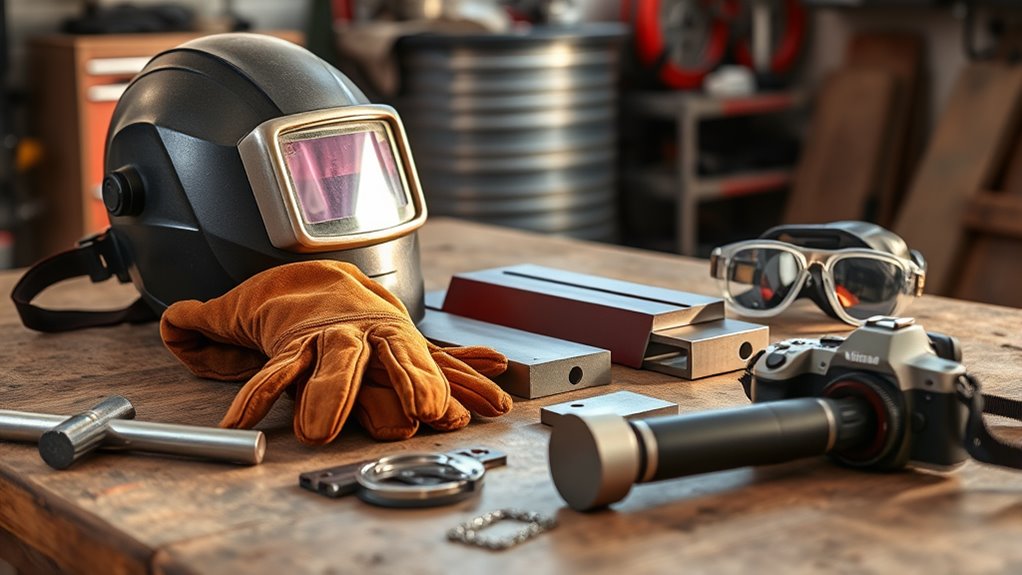
Start with scrap metal that matches your practice goal. If you want to improve welds on 1/8-inch mild steel, use 1/8-inch mild steel coupons. If you want to practice aluminum, use aluminum coupons and a welding process that is suitable for aluminum. Mixing random metals makes the test harder to read.
For a basic home test, gather these materials:
- Metal coupons: Two or more clean pieces of the same material and thickness.
- Compatible welding machine: MIG, flux-core, TIG, or stick setup matched to the metal and joint.
- Filler metal or electrode: Use filler designed for the base metal.
- Cleaning tools: Grinder, wire brush, flap disc, acetone, or another suitable cleaner for bare metal preparation.
- Measuring tools: Tape measure, calipers, square, marker, and a notebook.
- Holding tools: Clamps, vise, fixture, or welding magnets.
- Testing tools: Bench vise, press, hydraulic jack, long wrench, hammer and chisel, or another controlled way to apply force.
- Protective gear: Welding helmet, safety glasses, gloves, hearing protection, fire-resistant clothing, and closed-toe leather boots.
If you use shielding gas, check the hose, regulator, fittings, and cylinder connection before welding. Use an approved leak-detection solution where needed, not an open flame. Gas leaks are especially dangerous in garages, sheds, and other enclosed work areas.
Note: For galvanized, painted, plated, oily, or unknown scrap, remove the coating completely or choose different metal. Welding fumes vary by material and coating, and CCOHS lists welding fumes, gases, UV radiation, burns, eye injury, electrical shock, fires, and explosions among welding hazards.
Products Worth Considering

Material: low carbon steel; Finish: Plain

COMPLETE PRACTICE SET: Includes 6 welding practice coupons, each 2" x 4" and 3 mm thick; compact mild steel plates form a convenient welding starter kit

Includes 2 pre-cut steel sheets that detach into 24 parts—weld them to build 2 hollow cubes and 2 dice.
Set Up a Safe Welding Environment
A safe setup protects you while you weld and while you break the test piece. Work outdoors or in a well-ventilated space with clean airflow. Do not weld in a confined space, near solvent vapors, near fuel containers, or around unknown chemical residue.
Clear the work zone before you strike an arc. Move paper, sawdust, rags, fuel, cardboard, aerosol cans, and other combustibles away from the welding area. OSHA hot-work guidance uses a 35-foot radius for combustible material concerns, so treat that as a practical target when your workspace allows it.
Use fire-resistant welding blankets or metal shields when something cannot be moved. Keep suitable extinguishing equipment nearby. For most home garage welding, that may include an ABC extinguisher for ordinary combustibles, flammable liquids, and energized electrical equipment. A Class D dry-powder extinguisher is for combustible metal fires, such as magnesium or titanium dust, and is not a general replacement for other extinguisher types.
After welding, stay in the area and check for smoldering material. If sparks could have reached cracks, wall gaps, sawdust, insulation, or hidden spaces, keep a fire watch for at least 30 minutes after the hot work.
Choose the Right Welding Technique for Your Test
Choose the welding process based on the metal, thickness, joint, position, and equipment you actually use. The test should match your real practice conditions. If you normally weld a lap joint with flux-core wire, test a lap joint with flux-core wire instead of making a TIG butt joint that does not match your goal.
Products Worth Considering

COMPLETE PRACTICE SET: Includes 24 welding practice coupons, each 2" x 4" and 3 mm thick; compact mild steel plates form a convenient welding starter kit

Premium welding training steel

Premium Craftsmanship: Engineered for precision, Our steel plates are all laser-cut, providing edge and overall flatness that is unmatched by other stamped and sheared components.
Common Welding Techniques Overview
MIG welding is fast and beginner-friendly for clean mild steel and many shop projects. It can also work on aluminum when the machine, wire, liner, spool gun, and shielding gas are set up correctly.
Flux-cored arc welding is practical for outdoor mild steel work because many self-shielded wires do not need external shielding gas. It also leaves slag, so cleaning between passes and before inspection matters.
TIG welding gives strong control over heat and filler addition. It is useful for thin material, stainless steel, aluminum, and precise practice welds, but it demands clean material and steady technique.
Stick welding is useful outdoors and on thicker steel, but it takes practice to control arc length, slag, travel speed, and bead shape. It is less friendly on very thin sheet metal.
Technique Suitability for Materials
Match the test to the material. Mild steel practice coupons are the easiest place to start because the material is affordable and forgiving. Stainless steel and aluminum need more control over cleanliness, heat input, filler choice, and shielding.
For thin metal, test heat control and burn-through risk. For thicker metal, test penetration, joint prep, and fusion at the root. For fillet welds, test whether the weld fused into both legs of the joint, not just whether the bead looks smooth on top.
Safety Measures During Welding
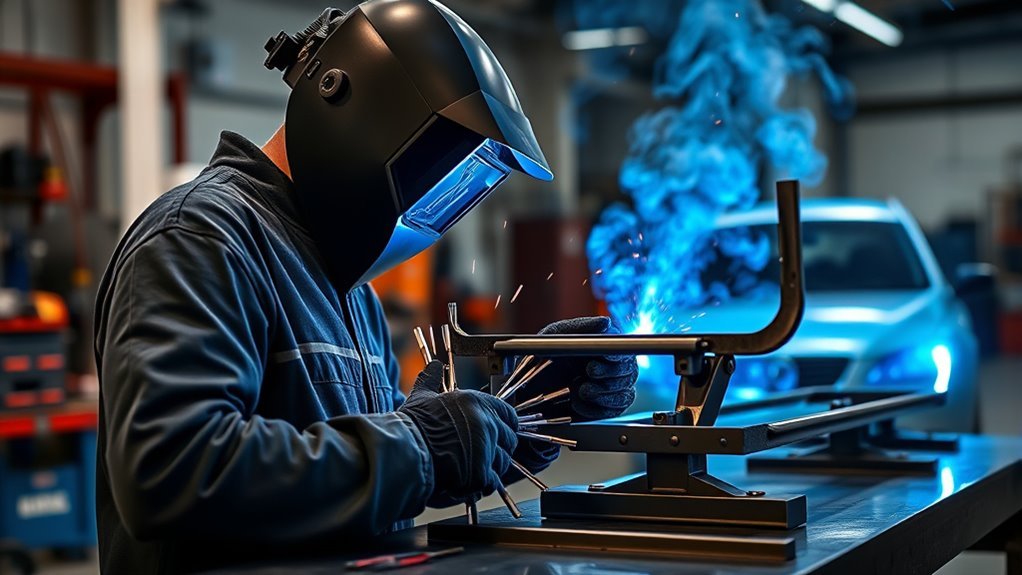
Wear your welding helmet during arc welding and keep safety glasses on when brushing, grinding, bending, chiseling, or breaking the sample. A weld coupon can snap suddenly and throw sharp fragments.
Keep welding cables out of walkways and off sharp edges. Do not weld while standing in water or on a wet floor. If you use a grinder, wear a face shield over safety glasses and keep sparks away from gas cylinders, vehicles, and stored chemicals.
Pro Tip: Make at least three identical coupons. One broken sample can mislead you. Three samples help show whether a result came from your welding settings, your test setup, or a one-time mistake.
Prepare Your Weld Coupons Before Testing
Good destructive testing starts before the weld is made. Cut coupons to consistent sizes so each test can be compared fairly. Remove mill scale, rust, oil, paint, and moisture from the joint area. If you are testing a butt weld, keep the gap and bevel consistent. If you are testing a fillet weld, keep the same leg length target on each coupon.
Label every coupon with a marker or metal stamp. Include the process, material, thickness, filler, and sample number. For example: “MIG, 1/8 mild steel, ER70S-6, Sample 1.” This small step prevents confusion later when several broken pieces are on the bench.
Before welding, write down your settings:
- Voltage or amperage
- Wire feed speed, if using MIG or flux-core
- Electrode or filler type and diameter
- Shielding gas type and flow rate, if used
- Joint type and coupon thickness
- Travel direction and position
- Number of passes
Create a Test Weld on Metal Samples
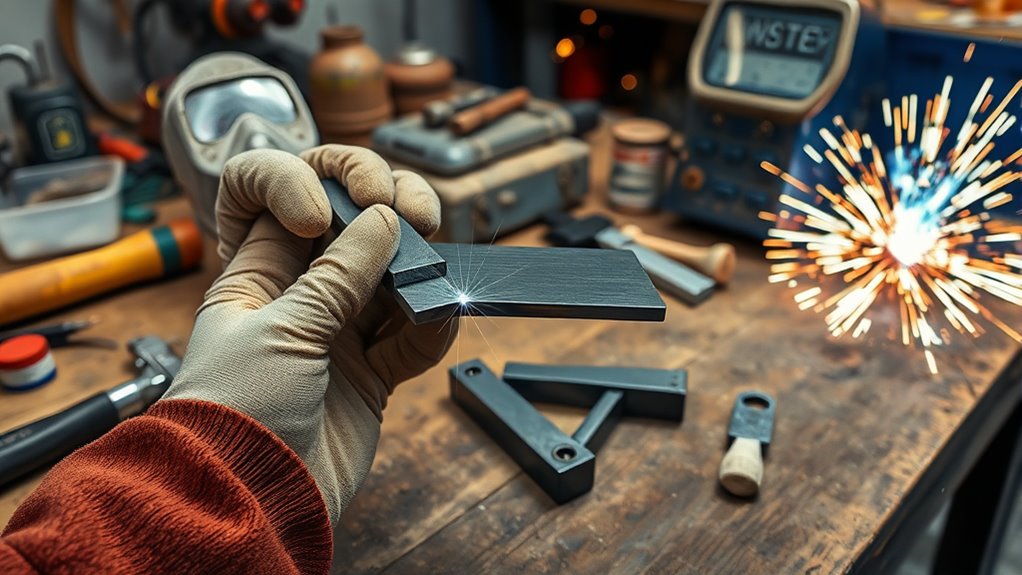
Clamp the metal so it cannot shift while you weld. Make the test weld with the same technique you want to evaluate. Watch your stickout, arc length, torch angle, travel speed, and puddle shape. A destructive test is more useful when you know exactly how the weld was made.
After welding, do not rush into breaking the sample. Let it cool naturally to room temperature. Avoid water quenching because rapid cooling can change the metal’s behavior and may create stress or cracking that does not reflect your normal weld quality.
Once the coupon is cool, clean slag, soot, and loose spatter from the weld. Do not grind the weld face smooth unless the test you are practicing specifically calls for it. The bead shape, toe condition, and surface defects are part of what you need to inspect.
Inspect the Weld Before You Break It
Look closely before applying force. A visual inspection will not reveal everything, but it can explain many failures before the test starts.
- Cracks: Any visible crack is a serious warning sign.
- Undercut: A groove along the weld toe can become the starting point for failure.
- Porosity: Pinholes or wormholes may point to contamination, poor shielding, moisture, or wrong settings.
- Lack of fusion: A bead sitting on top of the metal without tying into the base metal will usually fail early.
- Burn-through: Holes or excessive melt-through show too much heat for the joint.
- Cold lap: Rounded edges with poor wet-in can mean low heat, slow wire, bad angle, or fast travel.
- Excessive convexity: A tall, rope-like bead may hide poor toe fusion.
Take a photo before testing. Then take photos after testing from the side, top, and fracture face. These images are often more useful than memory when you compare samples later.
Choose a Home Destructive Weld Test Method
The best home test depends on the joint shape. A bend test works well for butt weld coupons. A fillet-break test works well for T-joints. A lap-shear pull test can compare plug welds, tack welds, or lap joints. None of these replaces a calibrated lab test, but each one can show useful practice-level feedback.
Simple Bend Test for Butt Welds
A bend test checks whether the weld and heat-affected zone can bend without cracking open. Clamp one end of the coupon in a heavy vise with the weld near the bend area. Use a long adjustable wrench, press, or controlled lever to bend the coupon gradually.
Watch the outside of the bend. Small surface marks may appear, but a deep crack through the weld, root, or toe usually points to poor fusion, contamination, brittle weld metal, or incorrect heat input.
Fillet Break Test for T-Joints
For a fillet weld, make a T-joint coupon with a consistent weld size. Clamp one plate securely. Use a hammer and chisel, press, or controlled lever to force the upright plate away from the base plate until the weld breaks or the base metal tears.
After the break, inspect the root of the fillet. A strong fillet weld often tears base metal or shows fusion into both plates. A weak one may peel off one side, leaving a smooth unfused surface.
Lap-Shear or Pull Test for Overlap Joints
For a lap joint, clamp one piece and pull or press the other piece in the direction that tries to slide the plates apart. If you have a hanging scale, load cell, or press gauge, record the highest reading before failure. If you do not have a gauge, keep the test comparative: use the same coupon size and same loading method each time.
Compare where the failure happens. If the weld nugget or bead tears out base metal, the weld is usually stronger than the surrounding sheet for that test. If the weld pops loose from the interface with little tearing, suspect poor fusion, contamination, or low heat.
Apply Force to Assess Weld Strength
Apply force slowly and consistently. Sudden impact can be useful for some break tests, but it can also hide what happened. A controlled bend or steady pull gives cleaner information.
Secure the specimen before loading it. Keep your hands out of the pinch zone. Stand to the side, not directly in line with the expected break path. Wear safety glasses or a face shield because the sample may snap without warning.
Types of Forces Applied
- Tensile force: Pulls the sample apart and shows how the joint handles direct tension.
- Shear force: Slides one piece across another and is useful for lap joints and plug weld practice.
- Bending force: Stretches one side of the weld and compresses the other, revealing ductility, root fusion, and toe cracking.
- Impact force: Strikes or shocks the joint, useful for some fillet-break practice but less controlled than a slow bend.
Measuring Weld Failure Point
If you have a press gauge, load cell, or hanging scale, record the maximum load just before failure. If you do not have measuring equipment, record the method instead: vise bend to 45 degrees, 90 degrees, or 180 degrees; hammer blows; lever length; or press position.
Keep the setup the same for each coupon. A test does not need lab-grade numbers to help you learn, but it does need consistency. If one coupon is twice as wide as another, or one is clamped closer to the weld, the results will not compare well.
What to Look for When Documenting Failure Points
After the weld breaks or bends, document the failure before cleaning the piece. The fracture surface tells you what the weld was doing under stress.
- Failure location: Did it break through the weld metal, the weld toe, the root, the heat-affected zone, or the base metal?
- Surface texture: Dull and torn surfaces often suggest ductile tearing. Shiny, flat, or crystalline-looking surfaces can point to brittle failure.
- Porosity: Round holes inside the break may indicate gas trapped in the weld.
- Slag inclusions: Dark lines or pockets may show poor cleaning between passes.
- Lack of fusion: Smooth areas where the weld separated from the base metal show the bead did not properly tie in.
- Incomplete penetration: A visible unfused root area means the weld did not reach through the joint as intended.
Use a repeatable documentation format. Record the coupon number, welding settings, test method, bend angle or load, failure location, visible defects, and what you will change next.
Analyze Weaknesses to Improve Future Welds

A failed coupon is not wasted metal. It is feedback. Compare what you see in the break with the settings and technique you wrote down.
| What You See | Likely Cause | What to Try Next |
| Weld peels off one plate | Poor fusion, wrong angle, low heat, or travel too fast | Increase heat slightly, slow travel, and aim into both sides of the joint |
| Many round holes in the break | Porosity from contamination, moisture, wind, or shielding problem | Clean better, check gas coverage, block wind, and dry consumables |
| Crack starts at weld toe | Undercut, sharp bead profile, or excessive heat | Adjust travel speed, angle, and bead size; avoid washing out the edge |
| Coupon bends deeply before tearing | Better ductility and fusion for that practice sample | Repeat the same settings on more coupons to confirm consistency |
Only change one variable at a time. If you change voltage, wire speed, travel speed, and angle all at once, you will not know what improved the weld. Make one adjustment, weld a new coupon, and repeat the same test.
Proven Techniques for Enhancing Your Welding Skills
Destructive testing works best when it becomes part of a practice routine. Set aside short sessions for one skill at a time: flat fillets, vertical-up welds, lap joints, butt joints, thin sheet, or thicker plate.
- Practice on consistent coupons: Same size, same thickness, same joint, same cleaning process.
- Track settings: Write down the settings before you forget them.
- Use visual inspection first: Learn to predict failure before breaking the sample.
- Break more than one weld: One test is a clue; repeated tests show a pattern.
- Compare good and bad samples: Save a few broken coupons so you can see progress over time.
- Get trained for critical work: For structural, vehicle, pressure, or code work, use qualified procedures and certified inspection.
When you understand why a weld failed, you can adjust with purpose. That is the real value of a destructive weld test at home.
Frequently Asked Questions
How do you perform a destructive test on a weld?
Make a test weld on scrap coupons, let it cool naturally, inspect the bead, clamp the sample securely, then bend, pull, shear, or break it until it fails. Record the test method, settings, failure location, and fracture appearance.
How do you test welds at home?
The simplest home methods are a bend test for butt welds, a fillet-break test for T-joints, and a lap-shear pull test for overlapping coupons. These tests help you compare practice welds, but they do not certify a weld for structural or safety-critical use.
What does God say about welding?
The Bible does not mention modern welding directly. Many welders connect the trade with broader values such as honest work, skill, patience, safety, and craftsmanship. In practical terms, that means working carefully, protecting others, and not pretending a weak weld is safe.
What are three basic types of destructive testing in welding?
Three common destructive weld tests are tensile testing, bend testing, and impact testing. For home practice, simpler versions include a bend test, a fillet-break test, and a lap-shear pull test on scrap coupons.
Does a broken weld always mean the weld was bad?
No. Destructive tests are designed to break the sample. The important question is where and how it failed. Base-metal tearing after heavy bending is usually a better sign than a weld bead peeling off a smooth, unfused surface.
Can I use a home destructive weld test for car frames or structural welds?
No. Use home destructive testing only for practice coupons and learning. Vehicle frames, suspension parts, roll cages, lifting points, pressure vessels, trailers, and structural welds need qualified procedures, proper inspection, and the standards required for that job.
Conclusion
A destructive weld test at home is one of the fastest ways to learn what your welds are really doing. Make consistent scrap coupons, weld them with documented settings, break or bend them safely, and study the failure surface. If the weld peels away, cracks early, or shows porosity, adjust one variable and test again. If the base metal tears or the coupon bends deeply before failure, you are moving in the right direction. Keep it as a practice tool, not a substitute for certified weld testing.
Sources
- OSHA 1910.252 — Welding, Cutting, and Brazing General Requirements — fire prevention, PPE, ventilation, fire watch, and hot-work safety guidance.
- Canadian Centre for Occupational Health and Safety: Welding Overview of Types and Hazards — welding processes, fume hazards, UV radiation, electrical shock, burns, fires, and explosions.
- OSHA Welding, Cutting, and Brazing Safety and Health Topics — workplace safety context for welding hazards and controls.
- ASTM E8/E8M: Tension Testing of Metallic Materials — reference point for calibrated tensile testing concepts and why home pull tests are only comparative.
- ISO 5173: Destructive Tests on Welds in Metallic Materials — Bend Tests — reference point for formal bend-test methods.