Start your garage welding setup by treating the space like a small hot-work area, not just an open corner of the garage. You need clear floor space, safe power, controlled airflow, secured gas cylinders, full PPE, and a fire plan before you strike an arc. A compact table, a rolling welding cart, and assigned storage can keep the area usable without turning the whole garage into a hazard zone.
Quick Answer
To set up a garage for welding, clear combustibles from the work area, place a metal welding table near safe power, separate grinding from welding, ventilate fumes away from your breathing zone, secure gas cylinders upright, wear welding PPE, and keep fire protection ready before, during, and after welding.
Key Takeaways
- Check local rules, lease terms, HOA limits, and insurance requirements before welding in a home garage.
- Use the welder nameplate and manual to size the circuit; many larger 240 V welders need a dedicated circuit installed by a qualified electrician.
- Keep sparks away from combustibles, protect nearby surfaces with welding blankets or screens, and check for smoldering material after welding.
- Do not rely on an open garage door alone for fume control; use crossflow, local exhaust, and proper positioning to keep fumes out of your breathing zone.
- Never weld on fuel tanks, sealed containers, drums, or unknown containers unless they have been professionally cleaned, vented, and declared safe for hot work.
At a Glance
| Time Required | 2 to 6 hours for layout, cleaning, tool placement, and basic safety setup; longer if electrical work or ventilation upgrades are needed |
| Difficulty | Moderate; electrical upgrades, gas piping, and structural or vehicle safety repairs require qualified help |
| Tools Needed | Welder, metal table, welding cart, clamps, vise, fire blankets, screens, extinguisher, fume extractor or exhaust fan, PPE, cable hooks, and storage bins |
| Cost | About $250 to $1,500+ for basic tables, storage, PPE, fire protection, and ventilation accessories; electrical upgrades can add more |
Choose a Garage Welding Setup That Fits Your Space
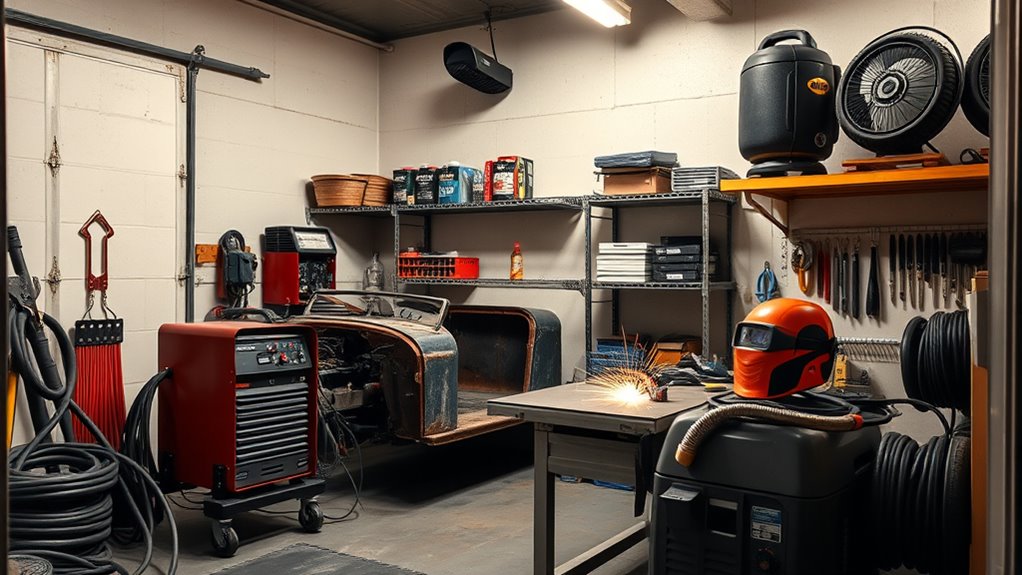
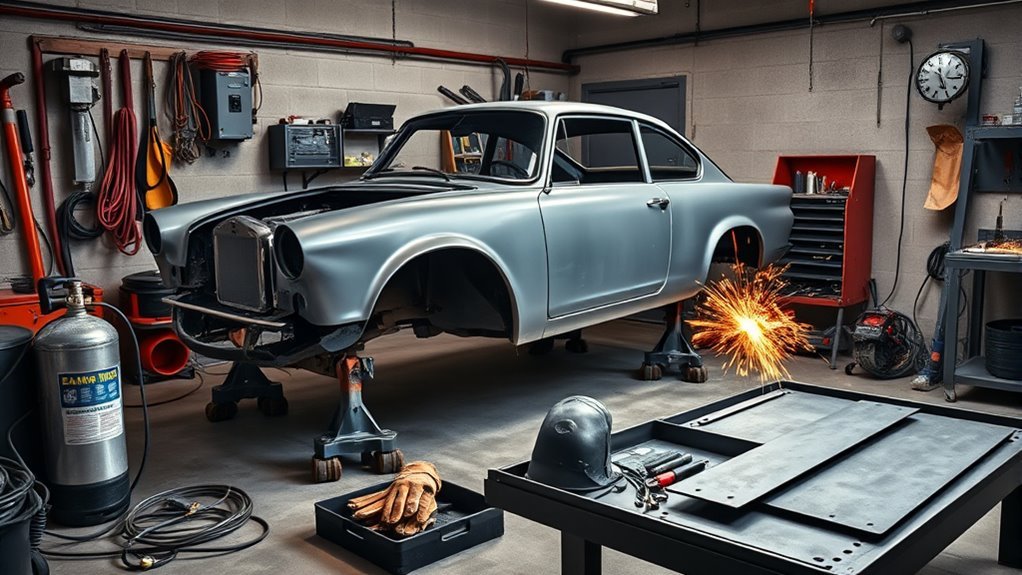
Before you set up any equipment, assess your garage size, door swing, ceiling height, storage, vehicle space, and exit path. A single-car garage can work for light welding if you keep the layout compact, but it leaves less margin for sparks, fumes, and material handling.
In a tight garage, choose a portable welding cart so you can roll the welder aside when you are done. Keep the cart close enough to the table to avoid long cable runs, but not so close that sparks hit regulators, hoses, plastic bins, or extension cords.
Place your welding table on a level surface with room to stand on at least two sides. Keep one clear path from the welding area to the garage door so you can step away quickly if a fire, gas leak, or electrical problem starts.
If you also use a plasma cutter, confirm you have a reliable compressed air source and enough space to manage the torch lead and air hose without crossing your welding leads.
Note: If your garage is attached to your home, treat fume control more seriously. Keep fumes from moving into living areas, laundry rooms, basements, or HVAC returns.
Check Rules, Permits, and Household Risks First
Before you weld in a home garage, check local fire code rules, building rules, HOA restrictions, lease terms, and insurance requirements. Some areas allow hobby welding but restrict stored gas cylinders, high-amperage circuits, noise, open flames, or business use from a residence.
Also check the garage itself. Do not weld near gasoline cans, lawn equipment, paint, solvents, aerosol cans, cardboard, sawdust, propane cylinders, or charging batteries. Sparks can travel farther than you expect, and grinding dust can collect under benches and along walls.
OSHA welding, cutting, and brazing guidance is written for workplaces, but its core safety ideas still help at home: identify hazards, control fumes, keep combustibles away, protect your eyes and skin, and make sure fire protection is ready before hot work begins.
Warning: Do not weld in a garage that smells like gasoline, solvent, propane, natural gas, or paint thinner. Stop, ventilate the area, remove the source, and do not restart until the hazard is gone.
Clear Space for Welding and Grinding Zones
You should separate your welding and grinding areas by a few feet so sparks, abrasive dust, and metal chips do not contaminate clean fit-up work. Keep the welding zone clear of flammable materials, and place a sturdy metal table near the power source to reduce cable length and trip hazards.
Maintain open pathways and store tools in assigned spots so you can move safely and work efficiently. Keep appropriate PPE close to both zones, because grinding can injure your eyes and hands even before welding starts.
Separate Work Areas
Set up separate zones for welding and grinding so each task stays controlled. Put the grinder where its spark stream points toward a safe, noncombustible surface, not toward cardboard, rags, stored cylinders, a vehicle, or the garage door weather seal.
Use welding blankets or curtains to block sparks and reduce contamination. In the welding zone, use a sturdy, non-flammable table that can support heavy parts without rocking.
Keep the grinding zone free of loose metal shavings and dust. Sweep or vacuum with equipment suitable for metal debris, and do not mix hot grinding debris with sawdust, oily rags, or paper trash.
Keep Pathways Clear
Keep walkways open between the table, welder, grinder, cylinder storage, and exit. Remove tools, loose cable, scrap, and dust to reduce trip hazards.
Coil welding leads neatly, hang them off the floor when possible, and route power cords along walls or overhead so they do not snag your boots, gloves, or material. OSHA says welding cable and other equipment should be placed clear of passageways, ladders, and stairs in covered workplaces, and the same habit makes a garage safer.
Store grinders, clamps, filler metal, and cutoff wheels inside their assigned zones. Before every session, inspect the floor and remove flammable debris, rags, and offcuts.
Set Up a Welding Table, Cart, and Clamps
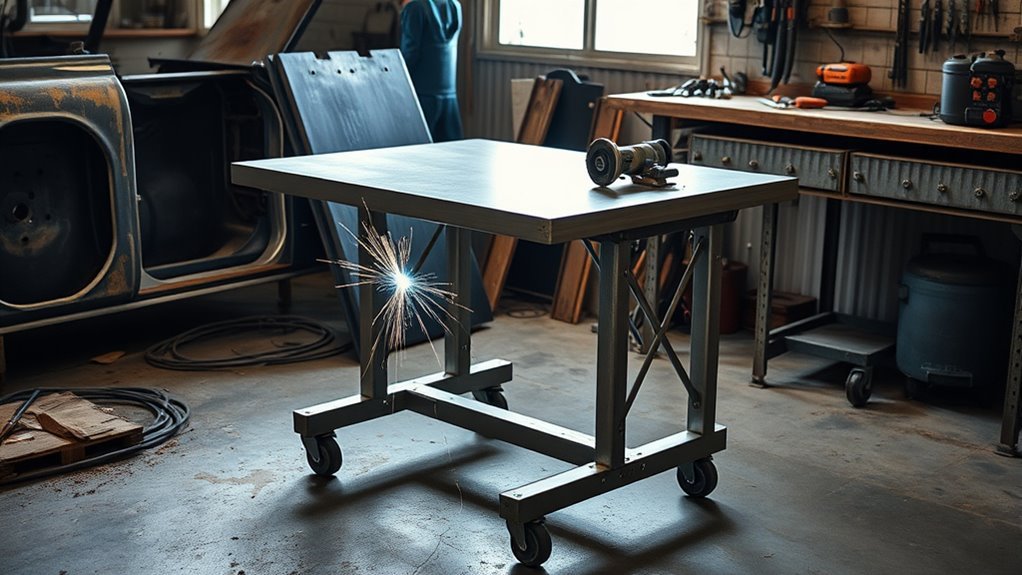
Place a sturdy welding table with a thick metal top in a clean, level area. A steel table gives you a stable surface for tack welding, clamping, and checking alignment. Avoid welding on wood benches, plastic folding tables, or painted furniture.
Keep the table free of oil, paint flakes, cardboard, paper, solvents, and shop towels. If you use a small table, add a metal tray or noncombustible shelf for hot parts so you do not set them on the floor or a plastic bin.
Position your welding cart beside the table, then mount the welder so you can roll it where you need it without dragging leads across the floor. Store contact tips, nozzles, electrodes, tungsten, wire brushes, anti-spatter, and spare lenses in closed drawers or bins.
Use C-clamps, locking pliers, magnets, and fixture blocks to hold panels, brackets, and tubing in alignment before you strike an arc. Tight clamping stops movement, improves joint fit-up, and protects dimensional accuracy.
Add a bench vise to one edge of the table for grinding, cutting, bending, and part shaping. Keep the vise far enough from the arc area that the handle does not block your stance or snag your lead.
Pro Tip: Put a small metal “hot parts” tray beside the table. It keeps freshly welded pieces off the floor, away from cords, and away from anything that can melt or burn.
Products Worth Considering

Insert into ∅5/8 for fast hold-down clamping.

DESIGNED FOR 5/8" FIXTURE HOLES: Compatible with 5/8-inch (16mm) fixture holes found on most welding tables, providing fast, secure, and reliable clamping for welding and fabrication setups
Plan Safe Power for Your Garage Welder
Check your welder’s outlet type, input voltage, rated input current, and plug before you buy cords or install a receptacle. Smaller welders may run on a standard 120 V household receptacle, while larger machines often need a dedicated 240 V circuit.
Do not assume every garage welder needs the same circuit. Some 240 V machines need 30 amps, some need 50 amps, and some dual-voltage welders can run on either 120 V or 240 V with different output limits. Use the welder nameplate and manual, then have a qualified electrician verify the breaker, conductor size, receptacle, grounding, and panel capacity.
Keep cords as short as practical and route them safely to reduce voltage drop, cable wear, and electrical hazards. If you are adding a new circuit, confirm breaker and wiring ratings match the equipment rather than guessing.
Outlet Type Needs
Power matters when you set up a garage welder. Match the welder plug to the correct receptacle, and do not force adapters into outlets that are not rated for the machine.
Many small inverter welders can run on a standard receptacle for light work. Larger MIG, TIG, and stick welders usually need a dedicated 240 V receptacle for better output and duty cycle. Do not share that circuit with compressors, heaters, dryers, or other high-draw tools.
If you need a new outlet, hire a qualified electrician. A proper installation protects the welder, reduces breaker trips, and lowers shock and fire risk.
Circuit Capacity Check
Once you have matched the plug and outlet, make sure the circuit can carry the welder’s load. Open your panel only if you are qualified to do so safely. Otherwise, ask an electrician to evaluate the panel, breaker, wiring, grounding, and any needed upgrade.
During setup, inspect the power cord, work lead, electrode holder, gun lead, and ground clamp. Replace cracked insulation, overheated plugs, loose connectors, or damaged clamps before welding.
Keep the work clamp attached to clean metal close to the weld joint. A poor return path can cause erratic arc behavior, overheating, and stray current problems.
Safe Cord Routing
Route your welder’s cords along walls or overhead so they stay out of walkways and reduce trip hazards. In garage welding, safe cord routing lets you move freely and keeps electrical hazards in check.
Use the shortest practical welding leads for better conductivity and less voltage drop. Match every extension cord to the welder’s amperage and manufacturer instructions; undersized cords can overheat. Avoid doorways, pinch points, puddles, and sharp metal edges that can damage insulation.
| Check | Action |
|---|---|
| Cord path | Run along walls, overhead, or outside walkways |
| Cord size | Use cords rated for the welder and length of run |
| Condition | Inspect before each use and replace damaged cables |
| Floor | Keep dry and clear of metal scrap, slag, and puddles |
Store Gas Cylinders and Flammables Safely
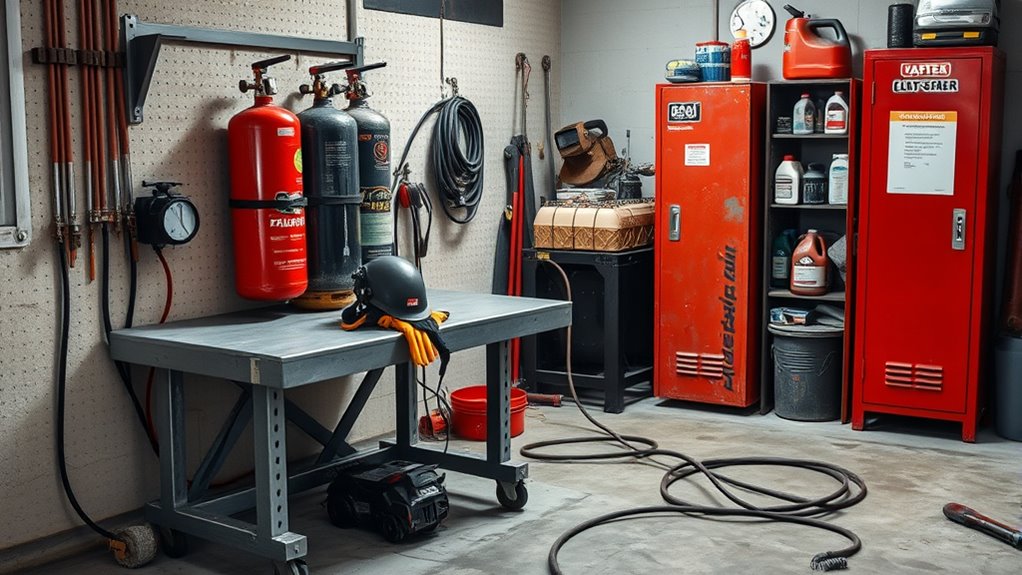
Store gas cylinders upright and secure them with chains, straps, or brackets so they cannot tip over and damage the valve. Keep cylinders in a dedicated area where tools, vehicles, doors, and falling material cannot hit them.
When a cylinder is not connected for use, keep the valve closed and use the protective cap if the cylinder is designed for one. Keep oxygen cylinders, fuel gas cylinders, and shielding gas cylinders clearly labeled so you do not mix them up.
Separate flammable materials such as gasoline, oil, solvents, cardboard, and oily rags from the welding area. Store flammable liquids in approved containers or metal cabinets, and keep lids closed.
Inspect cylinders, regulators, and hoses regularly for leaks, rust, corrosion, cuts, and loose fittings. If you smell gas, hear a leak, or see damage, stop work and correct the hazard before welding. Keep the storage area ventilated and review proper ventilation and cylinder handling practices before storing oxygen or fuel gas.
Create a 35-Foot Fire-Safe Zone
For welding and cutting, the safest plan is to move combustibles away from the work. OSHA’s hot-work fire prevention rules use a 35-foot radius as an important reference point for combustible material and fire watch conditions. At home, that means you should look beyond the table and check shelves, walls, floor cracks, door openings, and the other side of thin partitions.
Clear the area of cardboard, paper, sawdust, fuel cans, oily rags, plastic bins, upholstery, and aerosol cans. If something cannot be moved, shield it with a flame-resistant welding blanket, metal guard, or welding curtain.
Keep a properly charged ABC fire extinguisher near the exit side of the work area for ordinary combustibles, flammable liquids, and energized electrical equipment. Add a Class D dry powder extinguisher only if you work with combustible metals or metal dust, such as magnesium, titanium, or reactive metal shavings.
After welding, stay in the area long enough to check for smoke, glowing debris, hot slag, and smoldering material. For higher-risk work, keep a fire watch for at least 30 minutes after the final weld or cut.
Ventilate the Garage Before You Weld
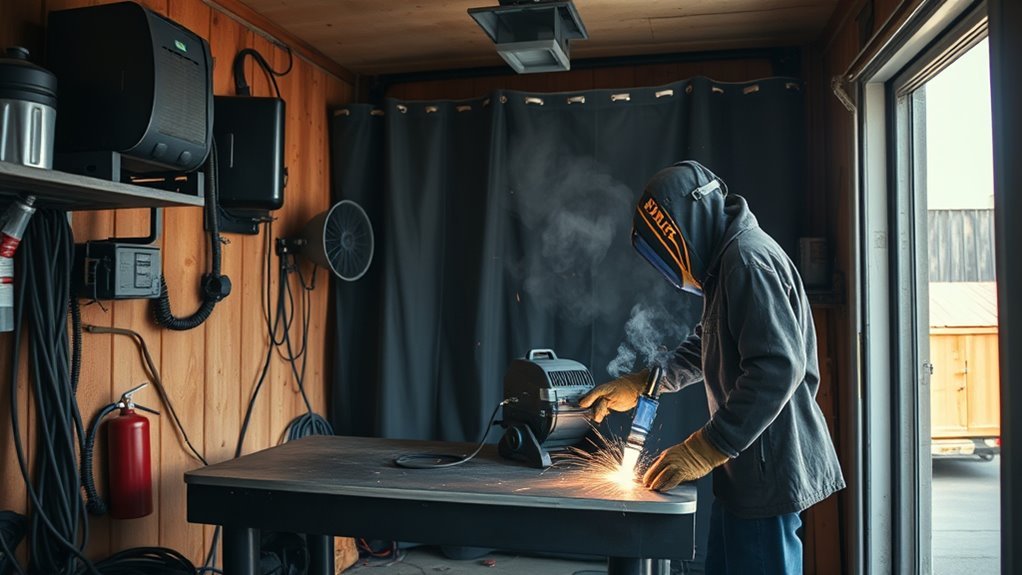
Open the garage door fully before you strike an arc so fresh air can move through the workspace. If your garage has windows, open them to create crossflow. Then add exhaust fans, a fume extractor, or local exhaust ventilation to pull fumes away from your breathing zone.
Do not aim a fan so it blows shielding gas away from the weld puddle. Place airflow so it moves fumes away from your face without ruining the weld. When possible, keep your head out of the plume and position the work so fumes move sideways or away from you.
Welding can produce harmful metal fumes and gases. Depending on the base metal, filler, coating, and process, fumes can involve manganese, chromium compounds, zinc oxide, nickel, cadmium, lead, or other metals, while gases can include ozone, nitrogen oxides, carbon monoxide, carbon dioxide, argon, and helium.
You can also use air blowers to clear lingering smoke from dead zones, but do not recirculate fumes back toward you or toward other people. Stop work if you feel eye, nose, or throat irritation, dizziness, nausea, chest tightness, or shortness of breath.
When ventilation and positioning are not enough, respiratory protection may be needed. A dust mask is not a welding fume plan. Use the correct respirator and filters for the materials involved, and follow the manufacturer’s instructions. For plasma cutting, wear suitable PPE for plasma cutting and control the extra smoke and sparks from cutting.
Wear Welding PPE for Garage Work
Before you strike an arc, gear up in flame-resistant clothing, including long sleeves and full-length pants, to shield your skin from sparks, spatter, heat, and ultraviolet radiation. Avoid polyester, nylon, and other synthetic fabrics that can melt into skin.
Good PPE does not make welding risk-free, but it gives you time to react when sparks, slag, heat, or UV light reach you.
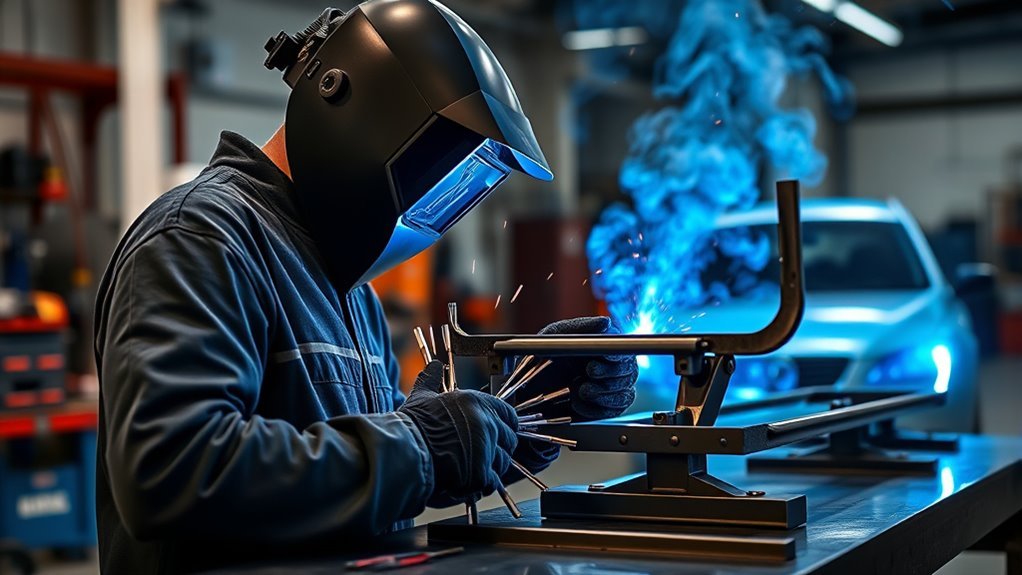
Wear a welding helmet with the correct shade for the process and amperage, and inspect the lens before each session. Wear safety glasses under the hood so your eyes stay protected when you lift the helmet to chip slag, wire-brush, or grind.
Fit leather welding gloves snugly enough to control the torch or stinger without exposing your wrist. Use steel-toed leather boots to protect your feet from dropped tools, hot metal, and slag. Add hearing protection when grinding, cutting, hammering, or using loud ventilation equipment.
Reliable PPE also includes safe clothing habits. Keep cuffs closed, remove lighters from pockets, avoid frayed sleeves, and do not wear fuel-soaked, solvent-soaked, or oily clothing. Review protective clothing needs for arc work before choosing jackets, sleeves, aprons, gloves, and helmets that protect against toxic fumes and UV radiation.
Products Worth Considering
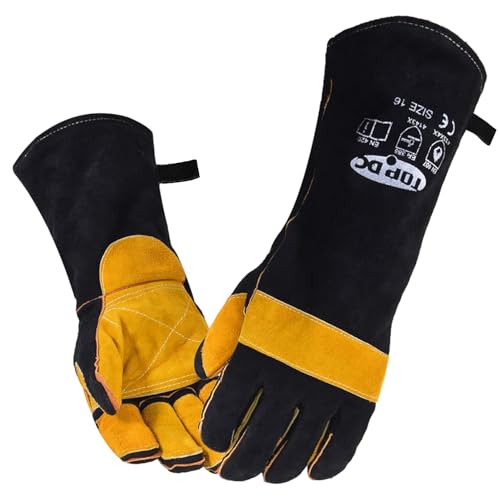
EXTREME HEAT RESISTANT PROTECTION: Reinforced Kevlar & Double leather stitching and high strength sewing on both fingers, palms, elbow and back. A fully lined interior to withstand daily exposure to heat, flames, spatter or sparks. These gloves are guaranteed to withstand extreme temperatures up to 932°F(500℃)

Excellent Heat Protection:Made of from 1.2mm thick and 100% natural cowhide leather, these gloves provide reliable heat resistance up to 662°F , protecting your hands from hot steam, with enhanced heat insulation that resists burns even in extended use.

Extreme Heat Protection: Three-layer build with 2.4 mm cowhide leather outer layer, insulating aluminum foil middle layer, and flame-retardant cotton inner layer withstands up to 1000°F, keeping hands shielded from sparks and heat during MIG and stick welding; These leather welding gloves double as fire gloves for forge work, metal fabrication, and soldering stations
Use Screens, Blankets, and Fire Protection
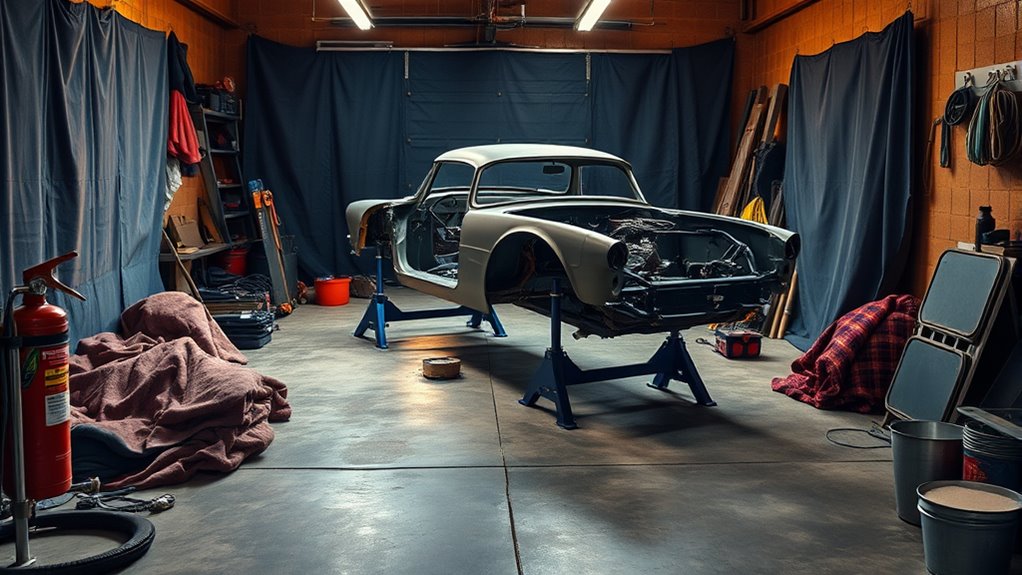
Set up welding screens or curtains around your work area to shield bystanders from sparks and UV radiation while still allowing airflow and visibility. Screens also help define the welding zone so kids, pets, neighbors, and visitors do not walk into arc flash.
Drape flame-resistant blankets over nearby items that cannot be moved, such as heavy equipment, wall surfaces, hoses, or fixed cabinets. Do not use ordinary blankets, tarps, towels, or cardboard as spark protection.
Before you strike an arc, clear the floor and benches of combustibles, then recheck the area after each pass. Sparks can roll under cabinets, into floor cracks, and behind stored items.
Keep a fire extinguisher within easy reach, fully charged, and visible from the welding position. Make sure you know how to use it before you need it. Your welding area should also include essential safety gear for sparks, heat, and flying debris.
Know What Not to Weld in a Garage
Some welding jobs do not belong in a home garage. Do not weld on fuel tanks, drums, barrels, sealed tubing, pressure vessels, closed containers, or unknown containers. Heating trapped vapor, residue, or pressure can cause an explosion.
Do not weld on galvanized, painted, plated, oily, or solvent-contaminated metal until you understand the coating and can remove or control it safely. Zinc, lead paint, cadmium plating, chlorinated solvent residue, and stainless steel chromium fumes can create serious exposure hazards.
Do not weld near vehicle batteries, fuel lines, brake lines, upholstery, airbags, sound deadening, foam, carpet, or plastic trim unless the area has been stripped, shielded, and made safe. Automotive welding also needs proper battery disconnection and manufacturer repair information when structural or electronic systems are involved.
Warning: Never weld on a closed or used container because it “looks empty.” Empty fuel and solvent containers can still hold explosive vapor.
Shut Down and Inspect After Welding
A safe garage welding setup includes a shutdown routine. When the weld is done, turn off the machine, close cylinder valves, secure the torch or electrode holder, and place hot metal on a noncombustible surface.
Inspect the table, floor, walls, nearby shelves, curtains, blankets, cylinder area, and trash bins for sparks or smoldering debris. Look under the table and behind objects, not just at the weld.
Coil leads after they cool, store filler metal and consumables, sweep metal debris, and return PPE to a clean dry spot. If you used fans or local exhaust, keep airflow running long enough to clear remaining fumes before closing the garage.
Frequently Asked Questions
Can you weld in a home garage?
Yes, you can weld in a home garage if local rules allow it and you control fire, fumes, electrical hazards, gas cylinders, and bystander exposure. You need a clean work area, safe power, ventilation, PPE, fire protection, and enough space to move without tripping over cords or hot metal.
How do you ventilate a garage for welding?
Open the garage door and windows for crossflow, then use a fume extractor or exhaust fan to move fumes away from your breathing zone. Keep your head out of the plume, avoid blowing away shielding gas, and stop if fumes build up or you feel irritation, dizziness, or nausea.
Do you need a 220 V or 240 V outlet for garage welding?
It depends on the welder. Many small hobby welders run on 120 V, while larger machines often need a dedicated 240 V circuit. Check the welder nameplate and manual, then have a qualified electrician verify the breaker, wire size, receptacle, and grounding.
What fire extinguisher should you keep near a garage welder?
Keep a properly charged ABC extinguisher near the exit side of the welding area for common garage fire risks. If you work with combustible metal dust or reactive metals such as magnesium or titanium, add the correct Class D dry powder extinguisher for that metal.
Is it illegal to weld in your garage?
It is usually not automatically illegal, but your city, county, HOA, landlord, or insurer may restrict welding, gas cylinders, electrical upgrades, noise, fumes, or business use. Check local rules before setting up the garage, especially if the garage is attached to your home.
Can you make $100,000 a year welding?
Yes, some welders can earn $100,000 or more, but it usually comes from specialized skills, certifications, travel work, industrial shutdowns, pipeline work, underwater welding, union work, inspection, or business ownership. A home garage setup is useful for practice and small projects, but income depends on training, code work, demand, and safety standards.
Conclusion
A safer garage welding setup starts with planning, not sparks. Clear the work area, separate welding and grinding, size the power correctly, secure cylinders upright, control fumes, and wear the right PPE every time. Then add screens, blankets, fire extinguishers, and a shutdown check so one quick repair does not turn into a garage fire.
When you build the space with safety in mind, your garage becomes more than a storage room with a welder in it. It becomes a controlled work area where you can cut, fit, tack, and weld with better focus and fewer preventable risks.
Sources
- OSHA 29 CFR 1910.252, Welding, Cutting, and Brazing General Requirements — fire prevention, fire watch, eye protection, cable placement, and container warnings.
- OSHA Welding, Cutting, and Brazing Topic Page — standards, hazards, and official welding safety resources.
- OSHA Fact Sheet: Controlling Hazardous Fume and Gases during Welding — fume hazards, ventilation, local exhaust, and respiratory protection guidance.
- CDC/NIOSH Welding Fumes and Manganese — welding fume health effects and manganese exposure concerns.
- NIOSH Engineering Controls Database: Welding Operations — local exhaust ventilation and welding fume control.